

You are currently viewing a new version of our website. To view the old version click .

Pharmaceutics, Volume 17, Issue 9

September 2025 - 149 articles

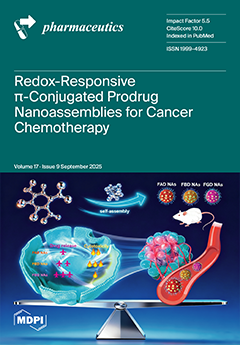
Cover Story: This study explores a disulfide bond-bridging strategy for tumor-responsive prodrug nanoparticles, emphasizing the role of π–π stacking in self-assembly and delivery. Three doxorubicin prodrugs (FAD, FBD, FGD) with α-, β-, and γ-disulfide linkages were synthesized to form nanoassemblies. They showed stable structures with release rates in the order of FAD > FBD > FGD, with β-linked FBD displaying superior cytotoxicity. Pharmacokinetics confirmed that FBD achieved the highest exposure, the longest half-life, and tumor selectivity. In 4T1 models, FBD outperformed free DOX and liposomes, delivering potent efficacy with minimal toxicity. These findings establish a framework for rational nanomedicine design. View this paper
  • Issues are regarded as officially published after their release is announced to the table of contents alert mailing list .
  • You may sign up for email alerts to receive table of contents of newly released issues.
  • PDF is the official format for papers published in both, html and pdf forms. To view the papers in pdf format, click on the "PDF Full-text" link, and use the free Adobe Reader to open them.

Articles (149)

  • Article
  • Open Access
847 Views
21 Pages

TDMQ20 as A Drug Candidate for Wilson’s Disease: Comparison with D-Penicillamine, Trientine, and Tetrathiomolybdate In Vitro and In Mice

  • Yingshan Zhu,
  • Weiling Peng,
  • Guangwei Liu,
  • Longxin Li,
  • Zikang Zhou,
  • Michel Nguyen,
  • Anne Robert,
  • Yan Liu and
  • Bernard Meunier

Background/Objectives: The lifelong treatment of Wilson’s disease (WD) currently relies on copper chelators with relatively poor metal specificity, which frequently exhibit serious adverse effects. There is a real medical need for a specific co...

  • Article
  • Open Access
1 Citations
606 Views
25 Pages

Daunomycin Nanocarriers with High Therapeutic Payload for the Treatment of Childhood Leukemia

  • Rosa M. Giráldez-Pérez,
  • Elia M. Grueso,
  • Antonio J. Montero-Hidalgo,
  • Cristina Muriana-Fernández,
  • Edyta Kuliszewska,
  • Raúl M. Luque and
  • Rafael Prado-Gotor

Background/Objectives: Malignant neoplasms in children include leukemias. The main types are B-cell acute lymphoblastic leukemia (B-ALL) and acute myeloid leukemia (AML). Treatments are expensive, which is a particular problem in low-income countries...

  • Article
  • Open Access
1,001 Views
30 Pages

Background/Objectives: Fixed-dose combination (FDC) antihypertensive medications containing olmesartan medoxomil, amlodipine besylate, and hydrochlorothiazide are widely used for the treatment of essential hypertension. Although effective, the use of...

  • Article
  • Open Access
1 Citations
969 Views
22 Pages

Laponite®-Based Smart Hydrogels for Sustained Topical Delivery of Silver Sulfadiazine: A Strategy for the Treatment of Contaminated or Biofilm-Forming Wounds

  • Jonas Lira do Nascimento,
  • Michely Conceição Viana da Costa,
  • Leticia Farias de Macêdo,
  • Luiz Henrique Chaves de Macêdo,
  • Ricardo Olímpio de Moura,
  • Tomás Jeferson Alves de Mélo,
  • Wilma Raianny Vieira da Rocha,
  • Ana Cristina Figueiredo de Melo Costa,
  • José Lamartine Soares-Sobrinho and
  • Dayanne Tomaz Casimiro da Silva

Background/Objectives: Silver sulfadiazine (AgSD) is widely used in the topical treatment of burns and infected wounds, but its conventional formulations present drawbacks such as poor water solubility, the need for multiple daily applications, and p...

  • Article
  • Open Access
1,116 Views
15 Pages

Predictive Modeling of Drug Product Stability in Pharmaceutical Blister Packs

  • Jan Pech,
  • Christoph Kaminski,
  • Matthias Markus,
  • Werner Hoheisel,
  • Roman Heumann,
  • Judith Winck and
  • Markus Thommes

Background/Objectives: The principal function of pharmaceutical blister packaging is to provide protection for the drug product. Moisture is regarded as a critical factor in the physical and chemical aging of drug products. The present work proposes...

  • Review
  • Open Access
1,087 Views
19 Pages

This brief review is a non-comprehensive look at some of the important aspects of lipidic nucleic acid delivery systems with a focus on RNA. In the context of this review on lipid-based formulation, nucleic acids are one of the key cargoes. Here, a b...

  • Article
  • Open Access
696 Views
18 Pages

Optimisation of Medicine Compounding Using Quality by Design Approach: Case Studies of Two Aqueous Cream Formulations

  • Okhee Yoo,
  • Wenting Li,
  • Siyu Ruan,
  • Elizabeth Syme,
  • Alisha Rodrigo,
  • Connelia Locher,
  • Sharmin Sultana and
  • Lee Yong Lim

Background/Objectives: Quality-by-Design (QbD) is a proactive, risk-based, regulatory-endorsed approach to the development and manufacture of medicinal products but is rarely applied to medicines compounded by pharmacists. This study aims to apply th...

  • Article
  • Open Access
784 Views
23 Pages

Background: Onychomycosis responds poorly to topical therapy, and efinaconazole (EFN) has low aqueous solubility. Methods: This study aimed to develop a 10% w/w EFN self-nanoemulsifying system (SNEDDS) with improved solubility, permeation, antifungal...

  • Article
  • Open Access
868 Views
24 Pages

Antiviral Activity of Liposomes Containing Natural Compounds Against CHIKV

  • Marília Freitas Calmon,
  • Luiza Araújo Gusmão,
  • Thalles Fernando Rocha Ruiz,
  • Guilherme Rodrigues Fernandes Campos,
  • Gabriela Miranda Ayusso,
  • Tamara Carvalho,
  • Isabella do Vale Francisco Bortolato,
  • Pâmela Joyce Previdelli Conceição,
  • Sebastião Roberto Taboga and
  • Ana Carolina Gomes Jardim
  • + 3 authors

Background/Objectives: Chikungunya virus (CHIKV), a mosquito-borne single-stranded RNA virus belonging to the genus Alphavirus (family Togaviridae), causes large-scale outbreaks. However, no specific treatment for CHIKV infections is currently availa...

  • Article
  • Open Access
663 Views
17 Pages

Indirect Modeling of Post-Prandial Intestinal Lymphatic Uptake of Halofantrine Using PBPK Approaches: Limitations and Implications

  • Malaz Yousef,
  • Farag E. S. Mosa,
  • Khaled H. Barakat,
  • Neal M. Davies and
  • Raimar Löbenberg

Background/Objectives: Despite the recognized importance and distinctive characteristics of the intestinal lymphatic pathway in drug absorption, its pharmacokinetic modeling remains largely unexplored. This study aimed to address this gap by developi...

of 15

Get Alerted

Add your email address to receive forthcoming issues of this journal.

XFacebookLinkedIn
Pharmaceutics - ISSN 1999-4923