



Next Issue
Volume 17, June
Previous Issue
Volume 17, April


Forests, Volume 17, Issue 5 (May 2026) – 114 articles
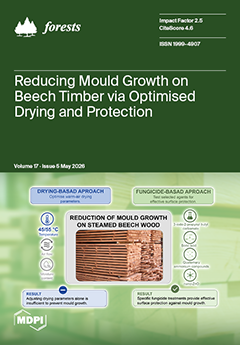
Cover Story (view full-size image): Mould growth on steamed beech wood remains a persistent challenge during drying and storage, often degrading surface quality and limiting its practical use. This study examines two control approaches: drying temperature modification (45–55 °C) and selected antifungal agents. Mould development was assessed macroscopically using a standardised intensity scale. Results show that temperature increase alone did not significantly reduce mould growth. In contrast, chemical protection was highly effective, especially 3-iodo-2-propynyl butyl carbamate (1%) and boric acid (3%), which completely inhibited surface contamination. Quaternary ammonium compounds and nano-zinc oxide provided only short-term protection. Overall, chemical treatment is essential for reliable mould resistance of steamed beech wood. View this paper
  • Issues are regarded as officially published after their release is announced to the table of contents alert mailing list.
  • You may sign up for e-mail alerts to receive table of contents of newly released issues.
  • PDF is the official format for papers published in both, html and pdf forms. To view the papers in pdf format, click on the "PDF Full-text" link, and use the free Adobe Reader to open them.
Order results
Result details
Section
Select all
Export citation of selected articles as:
15 pages, 16195 KB  
Article
Integrative Structural, Physiological, and Transcriptomic Analyses Reveal Key Determinants of Anthracnose Resistance in Rubber Tree (Hevea brasiliensis)
by Ling Xia, Peichun Li, Wenxiu Li, Meng Wang, Xiaoyu Liang and Yu Zhang
Forests 2026, 17(5), 629; https://doi.org/10.3390/f17050629 - 21 May 2026
Cited by 1 | Viewed by 432
Abstract
Anthracnose, caused by Colletotrichum spp., is a major foliar disease limiting rubber tree (Hevea brasiliensis) productivity. To uncover resistance mechanisms, we compared resistant and susceptible germplasm using an integrated framework combining leaf structural analysis, physiological defense profiling, and transcriptome sequencing. Resistant [...] Read more.
Anthracnose, caused by Colletotrichum spp., is a major foliar disease limiting rubber tree (Hevea brasiliensis) productivity. To uncover resistance mechanisms, we compared resistant and susceptible germplasm using an integrated framework combining leaf structural analysis, physiological defense profiling, and transcriptome sequencing. Resistant germplasm exhibited lower stomatal density and more compact mesophyll, likely restricting pathogen entry and within-leaf spread. Following inoculation, resistant accessions showed stronger antioxidant responses, with higher activities of superoxide dismutase (SOD) and peroxidase (POD), and elevated phenylpropanoid-related enzymes, including polyphenol oxidase (PPO) and phenylalanine ammonia-lyase (PAL), peaking at 24–48 h post inoculation. These responses were accompanied by enhanced reactive oxygen species (ROS) accumulation (H2O2) but reduced lipid peroxidation (malondialdehyde), indicating efficient oxidative stress regulation. Microscopic observation revealed delayed infection progression and postponed differentiation of infection structures in resistant germplasm. Transcriptomic analysis further demonstrated that differentially expressed genes were mainly enriched in pathways related to signal transduction and secondary metabolism, particularly phenylpropanoid metabolism and related secondary metabolic pathways. Together, these results suggest that anthracnose resistance is mediated by coordinated structural barriers, redox homeostasis, and transcriptional regulation of defense networks. This study provides a mechanistic framework for resistance-oriented breeding and the utilization of resistant germplasm in rubber tree. Full article
Show Figures

Figure 1

16 pages, 8200 KB  
Article
Potential of RNAi Targeting Juvenile Hormone Acid Methyltransferase (JHAMT) for Controlling Dendroctonus valens LeConte (Coleoptera: Scolytidae)
by Qin Cao, Yue Sun, Dejun Kong, Jinbin Han, Jianrong Wei and Jigang Li
Forests 2026, 17(5), 628; https://doi.org/10.3390/f17050628 - 21 May 2026
Cited by 2 | Viewed by 397
Abstract
Dendroctonus valens LeConte represents a major invasive pest species in China. Both larvae and adults primarily feed on the phloem of the tree trunk base and roots, disrupting nutrient transport and leading to host tree mortality, which poses a severe threat to forest [...] Read more.
Dendroctonus valens LeConte represents a major invasive pest species in China. Both larvae and adults primarily feed on the phloem of the tree trunk base and roots, disrupting nutrient transport and leading to host tree mortality, which poses a severe threat to forest ecosystems and the forestry economy. Juvenile hormone acid methyltransferase (JHAMT) is a key enzyme in insect juvenile hormone (JH) biosynthesis. In this study, we identified a JHAMT-encoding gene, DvJHAMT, in D. valens via bioinformatic analysis. RT-qPCR analysis revealed that DvJHAMT is predominantly expressed during the egg and larval stages. In the fourth-instar larvae, the highest expression levels were observed in the head and epidermis, suggesting a central regulatory role during this critical developmental period. To investigate its function via RNA interference (RNAi), a nanomaterial, star polycation (SPc), was employed for the transdermal delivery of dsRNA into the fourth-instar larvae. The results demonstrated that DvJHAMT knockdown significantly downregulated mRNA levels, resulting in marked decreases in larval survival, pupation, and eclosion rates. Notably, treatment with 0.7 µg dsDvJHAMT-SPc resulted in a 96.67% mortality rate and a reduced pupation rate of 41.67% at 34 days post-treatment. Furthermore, RNAi led to developmental deformities and significant weight loss in larvae. ELISA assays confirmed that DvJHAMT silencing led to reduced JHAMT enzyme activity and JH III titers in a dose-dependent manner. In conclusion, our findings demonstrate that DvJHAMT plays a vital role in JH biosynthesis and that its suppression exhibits potent lethal effects, suggesting that DvJHAMT is a promising candidate for RNAi-based management of D. valens. Full article
(This article belongs to the Special Issue Advances in Wood Borer Control and Management)
Show Figures

Figure 1

16 pages, 22645 KB  
Article
Investigations into the Efflorescence of the Treated Wood of the Iulia Felix Roman Wreck and Effects of Environmental Conditions on Its State
by Elisa Pecoraro, Nicola Macchioni, Giorgia Musina, Emma Cantisani, Sveva Longo, Marta Novello and Benedetto Pizzo
Forests 2026, 17(5), 627; https://doi.org/10.3390/f17050627 - 21 May 2026
Viewed by 366
Abstract
The Iulia Felix is a 2nd-century AD Roman shipwreck that was discovered off the coast of Grado in 1986. Following its recovery, the hull was dismantled and treated with high concentrations of PEG 4000 at elevated temperatures. This process was completed in 2003. [...] Read more.
The Iulia Felix is a 2nd-century AD Roman shipwreck that was discovered off the coast of Grado in 1986. Following its recovery, the hull was dismantled and treated with high concentrations of PEG 4000 at elevated temperatures. This process was completed in 2003. The elements were then stored for over 20 years. During this prolonged storage period, salt efflorescence developed on some surfaces, raising concerns about ongoing degradation and prompting an investigation into the composition of the wood and how environmental conditions influence it. The efflorescence was analysed using scanning electron microscopy with energy dispersive spectroscopy (SEM-EDS), X-ray powder diffraction (XRPD) and Fourier transform infrared spectroscopy (FTIR). To evaluate the impact of environmental factors, samples were exposed to controlled humidity levels of 35% and 85% until equilibrium was achieved. The analyses identified iron- and sulphur-based compounds, including hydrated ferrous sulphates, calcium sulphate and hydrated iron oxides. These findings suggest a corrosion-related degradation process that originates in a marine burial environment and progresses in humid, oxygen-rich conditions after recovery. The presence of PEG within the efflorescence indicates that environmental conditions after treatment promoted its gradual migration to the surface. Climate testing revealed that PEG 4000 significantly reduced hygroscopic exchange with the environment. Under dry conditions, dimensional changes were minimal, with less than 1% variation in mass and surface area. In contrast, prolonged exposure to high humidity resulted in a 11% increase in mass due to moisture uptake, as well as a roughly 5% increase in surface area. This was accompanied by minor cracking and, in some cases, structural failure. This study highlights the long-term conservation challenges posed by waterlogged archaeological wood treated with high-molecular-weight PEG. It emphasises the importance of continuous environmental monitoring to mitigate degradation processes and preserve structural integrity, providing valuable insights for future museum conservation strategies. Full article
(This article belongs to the Section Wood Science and Forest Products)
Show Figures

Figure 1

20 pages, 3165 KB  
Article
Prediction of Potential Forest Risk Areas for Phytopythium helicoides in China Under Climate Change Based on Maximum Entropy Modeling
by Yuzhe Kong, Binbin Jiao, Size Dai, Chun Yang, Qing Chen and Tingting Dai
Forests 2026, 17(5), 626; https://doi.org/10.3390/f17050626 - 21 May 2026
Viewed by 579
Abstract
Despite the growing threat of Pythium helicoides to forest plantations in China, a nationwide assessment of climatic suitability remains unavailable, limiting the development of preventive strategies. This study applied the Maximum Entropy model combined with geographic information system analysis to predict the potential [...] Read more.
Despite the growing threat of Pythium helicoides to forest plantations in China, a nationwide assessment of climatic suitability remains unavailable, limiting the development of preventive strategies. This study applied the Maximum Entropy model combined with geographic information system analysis to predict the potential distribution and suitable habitats of the pathogen across China. The model was constructed using occurrence records from the Global Biodiversity Information Facility and published literature, together with bioclimatic, topographic, and soil variables. Simulations were performed under current and future climate conditions throughout the twenty-first century across low, medium, and high emission scenarios. The model performed reliably, with Area Under the Curve values indicating favorable predictive accuracy across all periods. Habitat suitability was governed primarily by precipitation of the driest month, temperature annual range, and elevation. Under current conditions, highly suitable areas are concentrated in tropical and subtropical monsoon regions, particularly eastern Hainan and Taiwan. Under future scenarios, suitable habitats are projected to shift toward warm temperate regions while contracting overall, with plains, basin floors, and valleys retaining high suitability due to favorable moisture retention. Windward mountain slopes are generally unsuitable, although scattered medium-suitable habitats may form in lower-lying depressions with gentler slopes. Full article
(This article belongs to the Special Issue Pathogenic Fungi in Forests: 2nd Edition)
Show Figures

Graphical abstract

19 pages, 6700 KB  
Article
Biochemical Analysis of the Effect of Light on the In Vitro Antagonistic Ability of Clonostachys rosea Against Phytophthora cinnamomi and Phytophthora × cambivora
by Niccolò Conti, Gianni Della Rocca, Sara Barberini, Cecilia Brunetti, Roberto Danti, Giovanni Emiliani, Arcangela Frascella and Valentina Lazazzara
Forests 2026, 17(5), 625; https://doi.org/10.3390/f17050625 - 21 May 2026
Viewed by 440
Abstract
Clonostachys rosea is a promising biological control agent (BCA) against several plant pathogens, but its sensitivity to solar radiation limits its field efficacy. The biochemical changes occurring in C. rosea under light are still unknown, and no studies have assessed its antagonistic potential [...] Read more.
Clonostachys rosea is a promising biological control agent (BCA) against several plant pathogens, but its sensitivity to solar radiation limits its field efficacy. The biochemical changes occurring in C. rosea under light are still unknown, and no studies have assessed its antagonistic potential against Phytophthora cinnamomi and Phytophthora × cambivora, the main causal agents of ink disease in sweet chestnut. In this study, C. rosea was isolated from asymptomatic sweet chestnut plants in a forestry area affected by ink disease. We evaluated its in vitro antagonistic capacity against both oomycetes under dark and light conditions and investigated the metabolomic and volatilomic changes through HPLC-QToF-MS and GC-MS analyses. Under dark conditions, C. rosea exhibited remarkable inhibitory activity against both oomycetes in a dual-culture assay and through secreted secondary metabolites, including sorbicillinol and vertinolide, derivatives known for their biological activities. Light exposure significantly reduced antagonistic efficacy and secondary metabolite diversity. Volatilomic analyses revealed moderated differences between conditions, with volatile compounds whose biological roles remain uncharacterized and warrant further investigation. These findings indicate that light conditions critically affect the antagonistic potential of C. rosea, highlighting the importance of environmental factors in optimizing its use for the biological control of ink disease in chestnut. Full article
Show Figures

Figure 1

20 pages, 15572 KB  
Article
Preliminary Study on the Biocontrol Efficacy and Antimicrobial Mechanism of Pseudomonas eucalypticola NP-1 Against Gray Mold in Eucalyptus Seedlings
by Ying Lu, Menglan Shang, Zhe Li, Yongfeng Lu, Yu Long, Wangdong Xu and Qinghua Zhang
Forests 2026, 17(5), 624; https://doi.org/10.3390/f17050624 - 21 May 2026
Viewed by 330
Abstract
Botrytis cinerea is a globally distributed phytopathogenic fungus that causes gray mold in eucalyptus seedlings, posing a severe threat to eucalyptus nursery production. Pseudomonas eucalypticola Liu et al. NP-1 is an endophytic bacterium isolated from eucalyptus with broad-spectrum antifungal activity. In this study, [...] Read more.
Botrytis cinerea is a globally distributed phytopathogenic fungus that causes gray mold in eucalyptus seedlings, posing a severe threat to eucalyptus nursery production. Pseudomonas eucalypticola Liu et al. NP-1 is an endophytic bacterium isolated from eucalyptus with broad-spectrum antifungal activity. In this study, the fermentation broth extract of strain NP-1 was prepared using the organic solvent extraction method. The inhibitory effects, antifungal mechanisms, and biocontrol efficacy of the extract against B. cinerea were investigated. The results suggested that the NP-1 extract effectively inhibited mycelial growth, conidial germination, and germ tube development of B. cinerea. The EC50 and EC90 values for mycelial inhibition were 110 μg/mL and 332 μg/mL, respectively, while those for conidial germination inhibition were 126 μg/mL and 310 μg/mL. Microscopic and ultramicroscopic observations indicated that while the mycelial structures in the control and EC50 groups remained intact, the EC90 treatment significantly was associated with protoplasmic aggregation, leakage, and cavitation, suggesting potential structural damage to the fungal cells. In vitro and in vivo biocontrol assays showed that the control efficacy against gray mold reached 90.0% on detached eucalyptus leaves and 93.3% on eucalyptus seedlings. These findings elucidate the biocontrol potential of NP-1 and lay a foundation for the development of bio-based pesticides. Full article
(This article belongs to the Section Forest Health)
Show Figures

Figure 1

28 pages, 2925 KB  
Article
Transfer-Function Modeling and Modal Characterization of Wooden Beam Specimens Based on Frequency Response Functions
by Hongru Qiu, Liangping Zhang, Yunqi Cui, Tao Ding and Nanfeng Zhu
Forests 2026, 17(5), 623; https://doi.org/10.3390/f17050623 - 21 May 2026
Cited by 1 | Viewed by 368
Abstract
This study utilized three controlled Sitika spruce beam specimens and established a parameterized transfer-function model based on force–acceleration frequency response functions (FRFs) to characterize and reconstruct the frequency-domain modal response of beam specimens. The specimens were tested using non-contact magnetic swept-sine excitation, laser [...] Read more.
This study utilized three controlled Sitika spruce beam specimens and established a parameterized transfer-function model based on force–acceleration frequency response functions (FRFs) to characterize and reconstruct the frequency-domain modal response of beam specimens. The specimens were tested using non-contact magnetic swept-sine excitation, laser Doppler vibration measurement, and synchronous FFT analysis methods under free–free boundary conditions. In the experiment, one specimen was used for modeling and the other two specimens were used for consistency verification. Based on the measured complex FRF, a 1st–5th order modal transfer-function model was established in the frequency range of 0–1000 Hz. The experiment identified five resonance frequencies of the specimen, which were 65.0, 198.5, 370.5, 620.0, and 930.0 Hz, respectively. The model can reconstruct the measured magnitude and phase responses, with magnitude residuals within ±5 dB, resonance-peak magnitude errors of 0.03–0.73 dB, and wrapped-phase deviation around the poles of 0.20–5.08°. The Nyquist trajectory was continuous and smooth, with all poles located in the left half-plane, indicating that the model has stable pole behavior. The research results support the specimen vibration response as an approximate linear time-invariant system under small-magnitude and controlled testing conditions. The model can provide a physically interpretable and reconstructable modal-parameter expression for evaluating frequency-domain vibration responses of controlled wooden beam specimens. Full article
(This article belongs to the Section Wood Science and Forest Products)
Show Figures

Figure 1

22 pages, 4090 KB  
Article
Nitrogen Addition-Induced Variations in Stoichiometric Ratio of Organic Acids from Litter Decomposition in a Temperate Forest
by Qiangqiang Lu, Xinping Cai, Xiaomin Zeng, Ji Chen, Fan Chang, Guanghua Jing, Jiaqi Guo, Sha Zhou, Zhikun Chen, Lili Jia, Jun Liu and Tianjiao Liu
Forests 2026, 17(5), 622; https://doi.org/10.3390/f17050622 - 21 May 2026
Viewed by 427
Abstract
Litter decomposition is a key regulator of soil carbon formation and nutrient cycling in the plant–soil continuum. However, the utility of structural chemical indicators for capturing the relationship between litter decomposition and environmental factors under nitrogen (N) enrichment remains unclear. We conducted a [...] Read more.
Litter decomposition is a key regulator of soil carbon formation and nutrient cycling in the plant–soil continuum. However, the utility of structural chemical indicators for capturing the relationship between litter decomposition and environmental factors under nitrogen (N) enrichment remains unclear. We conducted a two-year in situ decomposition experiment with different N addition treatments in a pure Quercus variabilis forest on the Qinling Mountains, China. During the active six-month growing season, we investigated the stoichiometric ratios of typical organic acids in litter and soil layers and their responses to soil environments. The total relative content of the four organic acids showed the most pronounced nonlinear shift along the N addition gradient, peaking at N75 (7.5 g N m−2) then declining. The stoichiometric ratios of some typical organic acids varied analogously to soil physicochemical properties, microbial diversity and abundance. This inter-annual response was particularly pronounced in the warmer and wetter year of 2023. Structural chemical analysis revealed that steric hindrance and molecular symmetry are key factors regulating the decomposition efficiency of typical organic acids in litter. Notably, phenolic acid and butyric acid isomer ratios exhibited significant subgroup-specific responses to soil physicochemical factors, enzyme activities, and microbial abundances. Collectively, these ratios may indicate N addition impacts on litter decomposition, hold potential for predicting climatic variability responses, and provide conceptual support for an integrated framework linking N enrichment, litter chemistry, and soil carbon dynamics in temperate forests. Full article
Show Figures

Graphical abstract

15 pages, 679 KB  
Article
Impact of Afforestation, Energy Productivity, Renewable and Nuclear Electricity Generation on CO2 Emissions: Empirical Findings from the BRICS Countries
by Seda Sönmez, Halil Özekicioğlu, Marina Danilina and Yılmaz Bayar
Forests 2026, 17(5), 621; https://doi.org/10.3390/f17050621 - 21 May 2026
Viewed by 447
Abstract
Global warming and climate change have considerably enhanced worldwide environmental concerns since the 1970s. Therefore, researchers have extensively researched the nexus between renewable energy utilization and CO2 emissions in the literature. However, the influence of afforestation and energy productivity along with renewable [...] Read more.
Global warming and climate change have considerably enhanced worldwide environmental concerns since the 1970s. Therefore, researchers have extensively researched the nexus between renewable energy utilization and CO2 emissions in the literature. However, the influence of afforestation and energy productivity along with renewable and nuclear electricity generation on CO2 emissions has not been explored sufficiently in the associated literature regarding the multiple effects of these actors on the decarbonization process. Thus, this article analyzes the short- and long-term effects of afforestation, energy productivity, renewable and nuclear electricity production on CO2 emissions in the BRICS states over the 1993–2021 term via robust bootstrap cointegration and causality tests. The findings confirm a cointegration interplay among CO2 emissions, afforestation, energy productivity, renewable and nuclear electricity generation. Further, the cointegration coefficients demonstrate a negative influence of afforestation, energy productivity, renewable electricity generation on CO2 emissions in most of the BRICS states in the long term, but a negative effect of nuclear electricity production only in China and the Russian Federation. The findings of causality examination also uncover that afforestation, energy productivity, and generation of renewable and nuclear electricity are effective tools in reducing CO2 emissions, but their long-term effects are found to be relatively higher than short-term effects. These findings indicate that promotion of afforestation, along with energy productivity and electricity from renewables and nuclear sources is highly useful for curbing CO2 emissions in the short and long term. Full article
(This article belongs to the Special Issue Sustainable Urban Forests and Green Environments in a Changing World)
14 pages, 1166 KB  
Review
Integrating Habitat Suitability in Urban Forest Ecosystem Service Assessments: Reflections from i-Tree Wildlife
by Susannah B. Lerman, Corinne G. Bassett, Daniel E. Crane, David J. Nowak, Alexis Ellis and Jason Henning
Forests 2026, 17(5), 620; https://doi.org/10.3390/f17050620 - 20 May 2026
Viewed by 845
Abstract
Urban forests support wildlife populations across North America and the world. Yet, challenges remain for research and practice to integrate wildlife habitat as a core component of the myriad objectives that urban foresters manage. Ecosystem services have been adopted as a dominant paradigm [...] Read more.
Urban forests support wildlife populations across North America and the world. Yet, challenges remain for research and practice to integrate wildlife habitat as a core component of the myriad objectives that urban foresters manage. Ecosystem services have been adopted as a dominant paradigm in urban forestry for both advocacy and management, yet accounting for contributions to wildlife habitat does not fit squarely within typical ecosystem service frameworks. The i-Tree program, a suite of urban forest ecosystem service models and tools developed by the US Forest Service, presented an opportunity to link widely used urban forest assessment field protocols with indicators of suitable habitat. In this reflection piece, we demonstrate how the i-Tree Wildlife project assessed whether urban forest structural assessment methods could be applied to assess wildlife habitat provision, operationalizing the fundamental question “How do urban forests support wildlife?” We describe the development process for integrating bird habitat suitability models for 12 species present in the northeastern US, ten native and two non-native birds, into the flagship i-Tree Eco tool. We offer reflections, challenges, and opportunities from this process. Ultimately, the improvement of ecosystem assessment tools like i-Tree can assist practitioners who aim to manage healthy and productive urban forests that benefit people and wildlife. Full article
(This article belongs to the Special Issue Urban Forests and Ecosystem Services)
Show Figures

Figure 1

19 pages, 10992 KB  
Article
Production Trends and Portfolio Diversity of Non-Timber Forest Resources Under State-Controlled Forest Governance
by Hasan Tezcan Yıldırım, Pınar Topçu, Özlem Yavuz, Nilay Tulukcu Yıldızbaş, Dalia Perkumienė, Mindaugas Škėma, Marius Aleinikovas and Benas Šilinskas
Forests 2026, 17(5), 619; https://doi.org/10.3390/f17050619 - 20 May 2026
Viewed by 821
Abstract
Non-timber forest products (NTFPs) constitute an important component of forest-based production systems and biomass supply chains in Türkiye. Despite their growing economic and ecological significance, the long-term structural dynamics of NTFP production remain insufficiently understood. This study examines temporal and structural changes in [...] Read more.
Non-timber forest products (NTFPs) constitute an important component of forest-based production systems and biomass supply chains in Türkiye. Despite their growing economic and ecological significance, the long-term structural dynamics of NTFP production remain insufficiently understood. This study examines temporal and structural changes in NTFP production in Türkiye during the period 1988–2024 using official production statistics and production support data. The analysis applies a quantitative framework that combines linear trend analysis, Shannon diversity and Herfindahl–Hirschman concentration indices, volatility measures based on the coefficient of variation, and regression models to evaluate production trends, structural transformations, stabilization patterns, and the effectiveness of production support mechanisms. The findings reveal a non-linear and multi-phase development pattern characterized by diversification and production growth after 2000, followed by increasing concentration and greater production volatility after 2018. Although total production volume increased substantially, portfolio diversity declined over time, and dependence on a limited number of high-volume products intensified, indicating growing structural vulnerability within the system. In addition, production support mechanisms showed a weak and heterogeneous relationship with production outcomes. A limited contextual comparison with Lithuania’s multifunctional NTFP system is also included to position the findings within a broader European context. Overall, the results suggest that increasing production alone is insufficient to ensure long-term system stability. Instead, diversification-oriented and risk-sensitive resource management strategies that account for production risks, regional disparities, and product heterogeneity are essential for developing sustainable and resilient NTFP production systems. Full article
(This article belongs to the Section Forest Economics, Policy, and Social Science)
Show Figures

Figure 1

22 pages, 3004 KB  
Article
Prediction on Moisture Content of Living Trees Using a Multi-Scale One-Dimensional Convolutional Neural Network with Attention Mechanism Based on Data Augmentation
by Jiaxing Guo, Julie Cool, Chaoguang Luo, Yan Zhong, Fengfeng Ji, Kuanjie Yu, Ruixia Qin, Huadong Xu and Yanbo Hu
Forests 2026, 17(5), 618; https://doi.org/10.3390/f17050618 - 20 May 2026
Viewed by 478
Abstract
A nondestructive, rapid, and portable detection method for moisture content (MC) in living tree trunks remains unavailable. Tree radar, developed based on ground-penetrating radar (GPR) technology, represents a promising approach for tree trunk MC detection owing to its high penetration depth and low [...] Read more.
A nondestructive, rapid, and portable detection method for moisture content (MC) in living tree trunks remains unavailable. Tree radar, developed based on ground-penetrating radar (GPR) technology, represents a promising approach for tree trunk MC detection owing to its high penetration depth and low susceptibility to environmental interference. However, its application to living tree MC detection is constrained by curvature-induced wave propagation complexity, interspecific structural heterogeneity and the limited availability of labeled MC samples obtained through destructive coring, collectively resulting in poor model performance. The study proposed a novel GPR-based MC detection method employing a multi-scale one-dimensional convolutional neural network integrated with an attention mechanism and mixed data augmentation (mixed-MS1DCNNAM). GPR amplitude data extracted from the first 6.5 ns of B-scan signals were used to capture MC-related features via a custom program developed in MATGPR. A mixed model for four tree species with 15–30 cm diameters at breast height (DBH) achieved an R2 of 0.7908 and an RMSE value of 0.1059, outperforming traditional models, with test metrics calculated at the tree level by averaging predictions from five directional GPR scans per tree. Furthermore, three DBH-specific sub-models (15–20 cm, 20–25 cm, and 25–30 cm) and four single-species sub-models were developed, yielding improved performance (R2 ≥ 0.7246, RMSE ≤ 0.1033; RMSE ≤ 0.0959, MAE ≤ 0.0626, except for European white birch). These results highlighted the effectiveness of stratification by DBH class and tree species. Overall, this study effectively addresses aforementioned challenges and establishes a generalizable nondestructive approach for living trees under field conditions, facilitating sustainable forest management in tree growth monitoring, forest disaster monitoring, harvested timber storage and wood quality assessment. Full article
(This article belongs to the Section Forest Inventory, Modeling and Remote Sensing)
Show Figures

Figure 1

29 pages, 4244 KB  
Article
Advancing Ecosystem Recovery with Diverse Species Plantings in Tropical Forest Restoration
by Debra A. Hamilton, Victorino Molina Rojas and Therese M. Donovan
Forests 2026, 17(5), 617; https://doi.org/10.3390/f17050617 - 20 May 2026
Viewed by 748
Abstract
Tropical forest restoration has increased in the past decades, with possible advancements given the UN declaration of the “Decade of Ecosystem Restoration”. However, robust assessments to compare ecosystem functions among restored forest stages are essential. We evaluated 13 actively restored forest stands ranging [...] Read more.
Tropical forest restoration has increased in the past decades, with possible advancements given the UN declaration of the “Decade of Ecosystem Restoration”. However, robust assessments to compare ecosystem functions among restored forest stages are essential. We evaluated 13 actively restored forest stands ranging from 3 to 21 years of age and compared measures of forest biodiversity, structure, and ecosystem function to four 70+ year old “reference” stands that serve as restoration “targets” in the study region of the Premontane wet forest of Costa Rica. The restored stands were planted with an average of 13 tree species on abandoned pastures that were fallow for at least two years. Sixteen tree-stand attributes and six ecosystem function estimates were assessed, including: annual biomass (C) accumulation, N-fixation potential, threatened species conservation, and the provision of avian frugivore forage, insect habitat, and insect pollination. Using Principal Component Analysis, linear modeling, and Mahalanobis distance analyses, we learned that planting a diversity of tree species sets the stage for forest recovery at early restoration ages, with an inflection point at 15 years towards older reference forest characteristics and functions. Given that all restoration ages provided tree diversity and some level of ecosystem functions, the value of all restored stands in the landscape is notable. The assessment methods are easily employed, thereby providing an accessible tool to restoration practitioners. Full article
(This article belongs to the Section Forest Ecology and Management)
Show Figures

Figure 1

28 pages, 5902 KB  
Article
Effects of Exogenous Hormone Treatments on Seed Germination and Transcriptome Analysis in Zelkova schneideriana
by Xin Zhao, Jianan Li, Xiaohui Rao, Dong Li, Xueyu Liu, Rongrong Zhang, Jianbing Liu and Jindong Yan
Forests 2026, 17(5), 616; https://doi.org/10.3390/f17050616 - 19 May 2026
Viewed by 478
Abstract
Poor seed germination severely limits the propagation and conservation of Zelkova schneideriana (Chinese zelkova). However, the comparative effects of different exogenous phytohormones on seed germination of this species and the associated molecular responses remain insufficiently understood. To evaluate the effects of exogenous phytohormones [...] Read more.
Poor seed germination severely limits the propagation and conservation of Zelkova schneideriana (Chinese zelkova). However, the comparative effects of different exogenous phytohormones on seed germination of this species and the associated molecular responses remain insufficiently understood. To evaluate the effects of exogenous phytohormones on seed germination and to explore the underlying molecular basis, a germination experiment was conducted from January to March 2024 at Central South University of Forestry and Technology, Changsha, Hunan, China, in which seeds were treated with different concentrations of 6-benzylaminopurine (6-BA; 20, 40, and 80 mg/L), gibberellic acid (GA3; 125, 250, and 500 mg/L), indole-3-acetic acid (IAA; 100, 200, and 300 mg/L), brassinolide (BR; 10, 20, and 30 mg/L), and abscisic acid (ABA; 50, 100, and 150 mg/L). Germination traits were assessed, and transcriptome sequencing was performed for the BR treatment showing the strongest promotive effect. The results demonstrate that exogenous hormones exerted distinct regulatory effects on seed germination, among which BR at 10 mg/L showed the strongest promotive effect, increasing the final germination rate at 40 d from 50% in the control to 68%, whereas higher concentrations caused inhibitory effects. Transcriptome analysis identified 169 differentially expressed genes between BR-treated seeds and the control, mainly associated with reactive oxygen species (ROS) metabolism, redox regulation, energy and carbohydrate metabolism, and plant hormone- and MAPK-related signaling pathways. Antioxidant enzyme assays showed that BR10 increased POD activity but decreased SOD, CAT, APX, and GR activities. Endogenous hormone-related analysis further revealed marked BL accumulation and significant decreases in ACC, GA3, GA4, IAA, JA, and SA. Overall, exogenous BR promotes seed germination of Z. schneideriana through coordinated physiological and molecular regulation, providing a useful basis for seed pretreatment and seedling propagation. Full article
Show Figures

Figure 1

21 pages, 3604 KB  
Article
Multi-Timescale Soil Respiration Dynamics and Its Driving Factors in Two Broadleaf–Conifer Mixed Forest Stands in Northeast China
by Yuqing Zeng, Jiawei Lin and Quanzhi Zhang
Forests 2026, 17(5), 615; https://doi.org/10.3390/f17050615 - 19 May 2026
Cited by 1 | Viewed by 324
Abstract
Forest soils serve as critical terrestrial carbon sinks. While broad hydrothermal controls on soil respiration (Rs) are established, uncertainties persist regarding high-frequency temporal dynamics and moisture-dependent variations in temperature sensitivity (Q10). Specifically, conventional reliance on discrete, clear-day sampling obscures [...] Read more.
Forest soils serve as critical terrestrial carbon sinks. While broad hydrothermal controls on soil respiration (Rs) are established, uncertainties persist regarding high-frequency temporal dynamics and moisture-dependent variations in temperature sensitivity (Q10). Specifically, conventional reliance on discrete, clear-day sampling obscures how precipitation disrupts diurnal patterns. To address this, we continuously monitored Rs and environmental factors in two Northeast Chinese mixed forests (Korean pine, Pinus koraiensis (KP), and Dahurian larch, Larix gmelinii (DL)) to quantify weather-driven daily dynamics and carbon fluxes. Precipitation primarily drove daily variability, but more importantly, it reshaped day–night asymmetry. Under clear-day conditions, Rs exhibited a consistent daytime-dominant pattern, with daytime fluxes being significantly higher than nighttime fluxes (p < 0.05). However, precipitation events fundamentally neutralized this asymmetry, resulting in no significant day–night differences across most phenological stages. Annual Rs effluxes (759 and 965 g C m−2 yr−1 for KP and DL, respectively) lacked significant inter-stand or temporal variations. Seasonal emissions peaked unimodally in July, with the non-growing season contributing merely 5%–8%. Notably, spring freeze–thaw Rs in the KP stand surged interannually by 143%. While Rs correlated positively with temperature (p < 0.001), Q10 was co-regulated by forest stand and moisture. Under moderate moisture, the KP stand’s Q10 (2.72) was significantly lower than the DL stand’s (3.81); however, this divergence neutralized under low moisture. Consequently, soil moisture acts as both a direct Rs driver and a fundamental regulator of its temperature sensitivity. These empirical findings provide critical data to calibrate forest carbon models, improving predictions of soil carbon feedbacks under future climate scenarios. Full article
(This article belongs to the Section Forest Soil)
Show Figures

Figure 1

18 pages, 3797 KB  
Article
Dimensional Stability and Mechanical Performance of Exterior-Grade Particleboard and MDF After Accelerated Aging
by Tiam Mahmoudian, Rosilei Garcia, Aziz Laghdir and Alain Cloutier
Forests 2026, 17(5), 614; https://doi.org/10.3390/f17050614 - 19 May 2026
Viewed by 1307
Abstract
Wood-based panels are increasingly used in exterior applications; however, comprehensive evaluations of their durability under standardized aging conditions remain limited. This study evaluates the dimensional stability and mechanical performance of three industrial panels designed for exterior use: a three-layer particleboard (PB1) and a [...] Read more.
Wood-based panels are increasingly used in exterior applications; however, comprehensive evaluations of their durability under standardized aging conditions remain limited. This study evaluates the dimensional stability and mechanical performance of three industrial panels designed for exterior use: a three-layer particleboard (PB1) and a single-layer particleboard (PB2), both bonded with phenol–formaldehyde adhesive, and a medium-density fibreboard (MDF), bonded with polymeric methylene diphenyl diisocyanate through accelerated aging. The panels were subjected to six accelerated aging cycles according to the ASTM D1037-12 (2020) standard. Equilibrium moisture content, residual thickness swelling (Residual-TS), bending modulus of rupture (MOR), modulus of elasticity (MOE) in both parallel and perpendicular directions, and internal bond (IB) strength were measured under aged and non-aged conditions. PB2 demonstrated superior dimensional stability (Residual-TS: 0.49%) and strong mechanical retention (MOR: 67%, MOE: 56%–64%, IB: 75%). PB1 showed intermediate dimensional stability and mechanical retention (Residual-TS: 1.58%; MOR: 66%–74%, MOE: 56%–58%, IB: 71%), while MDF exhibited higher sensitivity to aging, with excessive Residual-TS (5.43%) and lower IB strength retention (30%). Specimen orientation did not affect dimensional stability but did influence the bending properties of the particleboard after aging, specifically MOR in PB2 and MOE in PB1. The results demonstrate that PB2 offers superior performance for demanding exterior applications, while PB1 and MDF are suitable for semi-protected uses. All panels were tested in an unfinished state, although surface coatings in actual applications may further enhance the resistance to aging. Full article
(This article belongs to the Special Issue Development and Properties of Wood Fiber-Based Products)
Show Figures

Graphical abstract

16 pages, 2833 KB  
Article
Roots Dynamics Assessed by Minirhizotron Is Affected by Phosphorus Fertilization and Correlates with Growth and Phosphorus Nutrition of Handroanthus heptaphyllus
by Álvaro Luís Pasquetti Berghetti, Matheus Severo de Souza Kulmann, Juliana Hoepers Marchioro Tedesco, Maristela Machado Araujo, Lincon Oliveira Stefanello, Jair Augusto Zanon, Marcos Vinícius Miranda Aguilar, Lucas Soares Miguez, Marcos Gervasio Pereira, Moreno Toselli, Elena Baldi, Renato Marques and Gustavo Brunetto
Forests 2026, 17(5), 613; https://doi.org/10.3390/f17050613 - 19 May 2026
Viewed by 536
Abstract
Understanding how P availability affects root turnover and P redistribution within plants is essential for optimizing fertilization strategies and sustaining forest growth under low-P soils. This study evaluated the effects of P fertilization on root system dynamics, plant growth, and P nutrition of [...] Read more.
Understanding how P availability affects root turnover and P redistribution within plants is essential for optimizing fertilization strategies and sustaining forest growth under low-P soils. This study evaluated the effects of P fertilization on root system dynamics, plant growth, and P nutrition of Handroanthus heptaphyllus, a flowering landscape tree, cultivated in a subtropical climate. Plants were grown under two soil P levels (low and high). Plant height, stem diameter, leaf P concentration, soil P availability, total numbers of living and dead fine roots, total fine root surface area, and fine root production rate were measured at 18, 24, 30, and 36 months after planting. Phosphate fertilization increased soil P availability during the first 24 months and resulted in significant gains in plant height, stem diameter, fine root production, total surface area, and the ratio between living and dead fine roots, indicating a higher proportion of living roots relative to dead ones. Under high P availability, the greatest fine root production and surface area of living fine roots occurred in the 0–20 cm soil layer, reflecting localized P application near the plants. High P availability enhanced root system development, promoted greater soil exploration, and improved P uptake. These results indicate that under P supplementation, plants strategically invest in root growth, improving nutrient acquisition efficiency and reducing dependence on external inputs. Increased phosphorus availability enhances root growth and increases fine root production and turnover. Minirhizotron monitoring effectively captured shifts in root system dynamics driven by P availability, including enhanced root growth, increased fine root production and turnover, and improved nutrient uptake under high P, as well as limited root activity under low P conditions, indicating a more conservative strategy with reduced investment in root production. Full article
(This article belongs to the Section Forest Soil)
Show Figures

Figure 1

14 pages, 1949 KB  
Article
Comparative Cradle-to-Gate Carbon Footprint of Bamboo-Based Activated Carbon Across Product Pathways
by Chuyun Wu, Jingwen Bi and Yawen Shen
Forests 2026, 17(5), 612; https://doi.org/10.3390/f17050612 - 18 May 2026
Viewed by 532
Abstract
To investigate the carbon footprint of bamboo-based activated carbon from different manufacturing pathways, this research evaluated cradle-to-gate manufacturing emissions under a unified system boundary and allocation baseline based on primary data from a 10,000 t/year continuous industrial production line. An LCA model was [...] Read more.
To investigate the carbon footprint of bamboo-based activated carbon from different manufacturing pathways, this research evaluated cradle-to-gate manufacturing emissions under a unified system boundary and allocation baseline based on primary data from a 10,000 t/year continuous industrial production line. An LCA model was constructed and verified using an allocation ratio interval scanning method. Results showed that carbon footprints of granular, powdered, and extruded activated carbons were 184.76 kg CO2 e/t kg CO2 e/t, 236.75 kg CO2 e/t, and 293.36 kg CO2 e/t. Although these products shared identical carbonization and steam activation units, the carbon footprints from milling, molding, and binder inputs accounted for 25.01%, 41.48%, and 52.77% of the total emissions. Internal thermal energy recovery via by-product gas recycling decreased emissions by 81.7%, 77.7%, and 73.8%, respectively. Compared with traditional coal-based alternatives, bamboo-based products achieved a reduction in emissions of about 95%. This study provides scientific guidance for the low-carbon production process of bamboo-based activated carbon and demonstrates the potential of biomass substitution for climate change mitigation. Full article
Show Figures

Figure 1

21 pages, 2232 KB  
Article
Administrative Fragmentation Distorts Ecological Networks: Mechanisms, Scale Effects, and Optimization Paths
by Xuan Zhang, Yingxin Teng, Wenjing Fu, Junfeng Lou, Abdul Basir and Shengbin Chen
Forests 2026, 17(5), 611; https://doi.org/10.3390/f17050611 - 18 May 2026
Viewed by 715
Abstract
Administrative fragmentation, whereby political boundaries are used as analytical extents, can disrupt ecological flows and weaken ecological network planning by creating a mismatch between governance units and ecological processes. However, the pathways through which such fragmentation alters network structure and function remain insufficiently [...] Read more.
Administrative fragmentation, whereby political boundaries are used as analytical extents, can disrupt ecological flows and weaken ecological network planning by creating a mismatch between governance units and ecological processes. However, the pathways through which such fragmentation alters network structure and function remain insufficiently quantified. This study quantifies these effects and identifies the landscape conditions that shape the effectiveness of cross-boundary integration. Using a multi-scale buffer experiment (1–32 km) across 30 representative counties in China, we constructed ecological networks based on Morphological Spatial Pattern Analysis and on the minimum cumulative resistance model. Results show that relaxing administrative boundaries reduced structural distortions and lowered total ecological flow cost, indicating that fragmentation increases connectivity costs. Mechanistically, reducing redundant internal links and forced detours improved network efficiency mainly by shortening corridors and lowering flow costs, whereas mean corridor resistance changed little. This suggests that functional degradation is driven primarily by topological disruption rather than by declines in corridor quality. The benefits of cross-boundary integration were greater in counties with regular shapes, high grassland cover, humid climates, and rugged terrain, but weaker under strong human pressure and warmer temperatures. Improvements leveled off beyond 32 km, suggesting a 32 km buffer (study-specific) for integration and supporting context-specific strategies for ecological network planning. Full article
(This article belongs to the Section Forest Ecology and Management)
Show Figures

Figure 1

14 pages, 1376 KB  
Article
Leaf Silicon and Phytolith Dynamics of Castanopsis fargesii Along an Elevational Gradient in Subtropical Forests
by Shaofei Jin, Haifeng Huang, Junjie Liao, Yan Huang, Xiaoli Liao, Gaolong Zhu, Xiangzhe Shangguan and Dexiang Zheng
Forests 2026, 17(5), 610; https://doi.org/10.3390/f17050610 - 18 May 2026
Cited by 2 | Viewed by 441
Abstract
Silicon (Si) plays a crucial role in forest ecosystem functioning by influencing plant nutrient cycling, stress resistance, and biogeochemical processes; however, how Si and phytolith characteristics respond to environmental gradients in subtropical forests remains poorly understood. This study investigated the variations in silicon [...] Read more.
Silicon (Si) plays a crucial role in forest ecosystem functioning by influencing plant nutrient cycling, stress resistance, and biogeochemical processes; however, how Si and phytolith characteristics respond to environmental gradients in subtropical forests remains poorly understood. This study investigated the variations in silicon and phytolith characteristics in the leaves of Castanopsis fargesii across different elevations in the Guoyan Mountain Nature Reserve (Nanping City, China). It aimed to identify the dominant phytolith morphologies and their proportions, and to examine the effects of elevation, leaf nutrient elements, and soil physicochemical properties on these parameters. Plots were established at 100 m elevation intervals within the natural distribution range of Castanopsis fargesii forests in the Guoyan Mountain Nature Reserve, covering elevations from 600 to 900 m. Fresh leaves, leaf litter, and soil samples (0–20 cm depth) were collected to analyze fresh leaf silicon content and phytolith contents, leaf nutrient elements, and soil physicochemical properties. From 600 to 900 m elevation, silicon content in fresh leaves, leaf litter, SCDI, and phytolith content all exhibited consistent patterns, with significantly higher values at 900 m than at 600 m. The dominant phytolith morphologies in leaves were elongate, flabellate, acute, trapeziform psilate, and blocky. At higher elevations (900 m), the proportions of elongate, acute, and trapeziform psilate phytoliths were relatively higher, while flabellate and blocky forms were more abundant at lower elevations (600 m). However, elevation had minimal influence on the overall proportions of dominant phytolith morphologies. Leaf calcium (Ca) and soil properties—including available calcium, organic matter, and available silicon—were identified as major factors affecting fresh leaf silicon content and phytoliths. Elevation, leaf nutrient elements, and soil physicochemical properties significantly influenced silicon and phytoliths in Castanopsis fargesii leaves. Certain phytolith morphologies in the leaves may be indicative of environmental changes. Full article
(This article belongs to the Special Issue Elemental Cycling in Forest Soils)
Show Figures

Figure 1

17 pages, 21006 KB  
Article
Identification and Transcriptional Expression of the WRKY Transcription Factor Family in Robinia pseudoacacia and Its Association with Heartwood Formation
by Boling Liu, Qianying Wei, Lin Zhang, Xuejie Guo, Ping Zhou, Tao Tao and Ruoke Ma
Forests 2026, 17(5), 609; https://doi.org/10.3390/f17050609 - 18 May 2026
Viewed by 415
Abstract
Background: As a transcription factor superfamily unique to plants, WRKY plays broad roles in both secondary development and secondary metabolic processes. Robinia pseudoacacia is renowned for its durable and naturally durable heartwood, which holds significant commercial value. However, their potential association with heartwood [...] Read more.
Background: As a transcription factor superfamily unique to plants, WRKY plays broad roles in both secondary development and secondary metabolic processes. Robinia pseudoacacia is renowned for its durable and naturally durable heartwood, which holds significant commercial value. However, their potential association with heartwood formation remains largely unexplored. Results: Leveraging published genomic data from Robinia pseudoacacia, we conducted a comprehensive bioinformatics analysis that identified 85 WRKY transcription factors. An uneven distribution across 11 chromosomes was observed for the RpWRKY genes, which were systematically named RpWRKY1 to RpWRKY85 according to their genomic locations, as determined by chromosomal localization. By conducting a phylogenetic comparison between RpWRKY and AtWRKY (from Arabidopsis thaliana), the RpWRKY family was categorized into three primary clades (I, II, and III), wherein group II was additionally partitioned into subgroups designated IIa through IIe. Conserved structural features and motif patterns were observed among members of each subgroup. Purifying selection was suggested by collinearity analysis as the primary evolutionary driver of RpWRKY, leading to structural and functional diversification. Finally, four candidate genes (RpWRKY78, RpWRKY45, RpWRKY50, RpWRKY80) potentially involved in heartwood formation regulation were identified through analysis of xylem tissue-specific expression patterns. Conclusions: For this economically important tree species, the present study not only provides the first systematic characterization of RpWRKY but also identifies potential regulators of heartwood development. Thus, the present study lays the groundwork for subsequent research aimed at uncovering the molecular processes that regulate heartwood development. Full article
(This article belongs to the Special Issue Forest Tree Breeding: Genomics and Molecular Biology)
Show Figures

Figure 1

19 pages, 10659 KB  
Article
Oblique UAV RGB Imagery Improves Rapid Detection of Wilt-Affected Pine Crowns with YOLO11
by Yujie Liu, Jinde Ji, Kaihong Xie, Zhongyi Zhan, Lihua Tao, Tingwu Li and Qi Jiang
Forests 2026, 17(5), 608; https://doi.org/10.3390/f17050608 - 17 May 2026
Viewed by 526
Abstract
Rapid detection of wilt-affected pine crowns in mountainous forests is hindered by occlusion, self-shadowing, and heterogeneous backgrounds in conventional nadir products. We evaluated whether oblique UAV RGB imagery improves crown-level detection relative to nadir imagery under matched site, season, sensor, and workflow conditions. [...] Read more.
Rapid detection of wilt-affected pine crowns in mountainous forests is hindered by occlusion, self-shadowing, and heterogeneous backgrounds in conventional nadir products. We evaluated whether oblique UAV RGB imagery improves crown-level detection relative to nadir imagery under matched site, season, sensor, and workflow conditions. The workflow was designed for rapid post-flight screening of geotagged UAV photographs. Paired nadir orthophotos and 45–70° oblique photographs were acquired over pine stands in Wenshan Prefecture, Yunnan, China, and organized into D1 (nadir), D2 (oblique), and D3 (simple mixed-view concatenation). Three YOLO11 detectors were trained for crown shoot damage ratio (SDR)-derived operational classes: early-stage (SDR < 50%), severely damaged (SDR ≥ 50%), and withered (needle-free dead crowns). A paired crown-level RGB subset (n = 20 crowns observed in both views) was analyzed as supporting evidence for view-dependent appearance differences. The oblique-image model (D2) achieved the highest validation performance, with precision of 0.994, recall of 0.991, F1-score of 0.989, mAP@0.5 of 0.995, and mAP@0.5:0.95 of 0.880. The paired subset showed a significant multivariate RGB profile difference between views (Hotelling’s T2 = 58.91, F = 3.10, p = 0.044), driven mainly by reduced Excess Green and greater dispersion of blue-related traits under oblique viewing. These results indicate that oblique UAV photographs retain additional crown-edge, lateral-structure, and chromatic context for detecting wilt-affected pine crowns. Oblique RGB imagery therefore provides a practical, low-cost input for rapid forest health surveillance and targeted field verification in rugged pine landscapes. Full article
(This article belongs to the Section Forest Inventory, Modeling and Remote Sensing)
Show Figures

Figure 1

12 pages, 2906 KB  
Article
Diel Activity Patterns of the Forest Dormouse (Dryomys nitedula, Pallas, 1779) in a Lowland Forest Mosaic in Northern Greece
by Artemis Papafoti, Dimitrios Tsioutsiourigas, Marialena Argyraki, Christos Astaras, Nikolaos Markos and Dionisios Youlatos
Forests 2026, 17(5), 607; https://doi.org/10.3390/f17050607 - 17 May 2026
Viewed by 577
Abstract
The forest dormouse (Dryomys nitedula) is a small, nocturnal, arboreal rodent widely distributed across Central and Eastern Europe. Yet, it remains one of the least studied European glirid species, with information on its ecology in southern populations being scarce. This study [...] Read more.
The forest dormouse (Dryomys nitedula) is a small, nocturnal, arboreal rodent widely distributed across Central and Eastern Europe. Yet, it remains one of the least studied European glirid species, with information on its ecology in southern populations being scarce. This study presents the first systematic investigation of the diel (24 h) activity patterns of D. nitedula in Greece. From March to December 2024, camera traps were deployed on trees facing branches or artificial nest boxes at 26 locations within a 30 ha forest–meadow mosaic in Northern Greece. Based on 958 independent detections at 22 sites, activity was highest at nest boxes and exhibited two nocturnal peaks that were consistent across seasons: a major one around midnight and a secondary one before sunrise. Temporal activity overlap between nest-box cameras and branch-facing cameras was high across all seasons. Activity, measured as the number of independent detections per night, was highest during short, humid nights with low levels of moonlight. Temperature and precipitation were not good predictors of activity levels. These findings confirm that the behavior of D. nitedula is predominantly nocturnal and reveal key environmental drivers shaping its activity in the Mediterranean region. Moreover, this study highlights the value of camera trapping as a non-invasive method for monitoring small arboreal mammals and provides essential baseline data for future ecological and conservation research on this understudied species. Full article
Show Figures

Figure 1

14 pages, 3503 KB  
Article
Scenario-Based Assessment of Carbon Stocks and Mitigation Potential in Perigi, South Sumatra, Indonesia
by Jumi Cha, Sunjeoung Lee and Eunho Choi
Forests 2026, 17(5), 606; https://doi.org/10.3390/f17050606 - 17 May 2026
Viewed by 529
Abstract
Peatlands cover approximately 3% of the global land area but store about 44% of the world’s soil carbon, making them a major carbon sink. Indonesia alone accounts for about 37% of global tropical peat carbon stocks. However, large-scale carbon emissions caused by fires [...] Read more.
Peatlands cover approximately 3% of the global land area but store about 44% of the world’s soil carbon, making them a major carbon sink. Indonesia alone accounts for about 37% of global tropical peat carbon stocks. However, large-scale carbon emissions caused by fires and drainage during past economic development have transformed peatlands from carbon sinks into carbon sources. In response, restoration efforts have been implemented at both international and national levels. Tropical peatland restoration typically includes rewetting, revegetation, and community-based approaches, highlighting the need for quantitative assessments of carbon storage under different restoration strategies. This study focuses on the Perigi peatland in South Sumatra, Indonesia. We conducted field surveys of vegetation and soils to estimate carbon stocks per unit area and developed time-series land cover maps using satellite imagery. Based on these data, we assessed potential carbon storage under different restoration intensity scenarios. The results show that carbon stocks in the Perigi peatland are lower than the Indonesian average. However, under a full restoration scenario, up to 950,259 tC of additional carbon storage is possible, indicating high restoration potential. In contrast, without restoration, further carbon emissions are likely, underscoring the necessity of restoration efforts. Effective restoration requires a phased strategy from vegetation recovery to peat layer recovery, combined with socioeconomic approaches that consider local livelihoods, enabling degraded tropical peatlands to function as effective carbon mitigation systems. Full article
Show Figures

Figure 1

22 pages, 5203 KB  
Article
Plant Species Effect on Soil Micronutrients and Aluminum in Secondary Forests at Masako Forest Reserve, Kisangani, Democratic Republic of Congo
by Nsalambi V. Nkongolo, Darceline A. Mokea and Maria Luisa Fernandez-Marcos
Forests 2026, 17(5), 605; https://doi.org/10.3390/f17050605 - 16 May 2026
Viewed by 429
Abstract
Plant species can significantly influence soil micronutrients. We assessed how soil micronutrients (B, Fe, Cu, Zn, Mn) and aluminum (Al) were affected by soil depth (SD) and plant species (PS) in a secondary forest at Masako Forest Reserve. Soil samples were collected in [...] Read more.
Plant species can significantly influence soil micronutrients. We assessed how soil micronutrients (B, Fe, Cu, Zn, Mn) and aluminum (Al) were affected by soil depth (SD) and plant species (PS) in a secondary forest at Masako Forest Reserve. Soil samples were collected in June 2022 and June 2023 along five PS (Entandrophragma utile, Hevea brasiliensis, Milettia laurentii, Musanga cecropoides, and Triculia africana). Four trees (replications) were selected per plant species. A completely randomized design was used with five PS and three SD (0–10 cm, 10–20, and 20–30 cm) and was replicated four times. To collect soil samples, a pit was dug at each sampling location (near a tree), and three soil samples were taken horizontally in the middle of each layer on one of the four faces of the pit, with a 5 cm height and 5 cm diameter cylinder. Soil samples were air-dried, mixed, and sieved to 2 mm, and a 20 g subsample was sent to Brookside Laboratories (OH, USA) for analyses of soil micronutrients. The results showed that most micronutrients were concentrated in the topsoil (0–10 cm). Plant species such as Treculia africana, Millettia laurentii, and Musanga cecropoides enhanced micronutrients in the soil in which they grew, especially iron (Fe) and zinc (Zn). The effect of the year of sampling on micronutrients was prevalent for many micronutrients, which remained significantly higher in 2022 than in 2023. These findings provide a foundational framework for developing nature-based biofortification strategies. By prioritizing key native plant species, local stakeholders can optimize soil health in the Congo Basin. Full article
Show Figures

Figure 1

23 pages, 2367 KB  
Article
Do Set-Asides Increase Plantation Establishment? The Case of U.S. Federal Timber Restrictions and Softwood Planting
by Bingcai Liu, Brent Sohngen and Justin S. Baker
Forests 2026, 17(5), 604; https://doi.org/10.3390/f17050604 - 16 May 2026
Viewed by 583
Abstract
To protect the endangered Northern Spotted Owl, the U.S. Fish and Wildlife Service established extensive conservation areas across the Pacific Northwest (PNW). While this policy effectively contributed to the preservation of an endangered species, it also generated significant short- and long-term impacts on [...] Read more.
To protect the endangered Northern Spotted Owl, the U.S. Fish and Wildlife Service established extensive conservation areas across the Pacific Northwest (PNW). While this policy effectively contributed to the preservation of an endangered species, it also generated significant short- and long-term impacts on the U.S. forestry market. This study investigates the impact of federal timber harvesting restrictions in the Pacific Northwest in the early 1990s on the U.S. softwood market, particularly on softwood planting in the South. By constructing and analyzing a panel dataset covering 537 counties in seven southern U.S. states from 1977 to 2007, the research finds that timber-harvesting restrictions triggered by the listing of the Northern Spotted Owl as threatened led to a significant increase in softwood planting rates in the Southern U.S. Previous studies have shown that set-asides can shift timber harvesting from one region to another and raise prices in the short term. This study illustrates a different outcome of set-asides: tree planting. We argue that accounting for long-term investment responses, such as tree planting, is critical when evaluating the impacts of forest policies, as these can significantly alter estimates of net carbon balance and overall market outcomes. Full article
(This article belongs to the Section Forest Economics, Policy, and Social Science)
Show Figures

Figure 1

13 pages, 2261 KB  
Article
Study of Residual Stand Damages During Sledge Yarding Extraction
by Andrea Rosario Proto, Stanimir Stoilov and Stelian Alexandru Borz
Forests 2026, 17(5), 603; https://doi.org/10.3390/f17050603 - 16 May 2026
Viewed by 626
Abstract
Logging causes damage on residual trees, with differing characteristics and severities. The causal agent, as well as the size and type of injury, is influenced by the type of machines, the harvesting technology adopted, and the machine operator. This study descriptively documents residual [...] Read more.
Logging causes damage on residual trees, with differing characteristics and severities. The causal agent, as well as the size and type of injury, is influenced by the type of machines, the harvesting technology adopted, and the machine operator. This study descriptively documents residual tree damage observed in two sledge-yarding operations conducted under contrasting stand and operational conditions: a beech stand managed with a full-tree system and a Scots pine stand managed with a cut-to-length system. Two stands were selected: the harvesting intensity was 50% in the coniferous stand (salvage logging) and 20% in the deciduous stand (thinning). In each stand, six 20 × 20 m plots (0.04 ha) were delineated to assess residual tree damage. In the two observed cases, the beech operation showed a higher proportion of damaged residual trees, 32.2%, than the Scots pine operation, 5.3%. In the deciduous stand, bark injuries were mainly slight wood exposure (75%), whereas in the coniferous stand, crushed bark (42.9%) was most frequent, followed by slight wood exposure (35.7%). No concerning damage to seedlings was detected. In general, the number of damaged trees and the severity of injuries were considerably lower than those typically observed when extracting with a cable skidder, and especially with an adapted farm tractor. To reduce mechanical damage to residual trees, protective devices can be deployed around trees at risk of root and stem injury. Another effective measure is to financially motivate workers to implement environmentally sound forest operations. Full article
(This article belongs to the Special Issue The Influence of Mechanized Timber Harvesting on Soils and Stands)
Show Figures

Figure 1

23 pages, 1240 KB  
Article
Plowing vs. Herbaceous Layer Conservation Under Different Drought Stress Levels in Olive Groves: Interactions Between Tree Yield-Quality and Their Microsite
by Aida López-Sánchez, Juan Carlos López-Almansa, Cristina Lucini, María López and Javier Velázquez
Forests 2026, 17(5), 602; https://doi.org/10.3390/f17050602 - 15 May 2026
Viewed by 1121
Abstract
Agroforestry and perennial tree crop production systems, particularly in Mediterranean regions, exhibit a high degree of integration among trees, herbaceous, and soil components. They provide essential services including provisioning, regulation, support, and cultural services, which enhance human health, well-being, and economic stability. However, [...] Read more.
Agroforestry and perennial tree crop production systems, particularly in Mediterranean regions, exhibit a high degree of integration among trees, herbaceous, and soil components. They provide essential services including provisioning, regulation, support, and cultural services, which enhance human health, well-being, and economic stability. However, guaranteeing their long-term resilience in the face of environmental challenges, including drought and soil degradation, is essential for the sustainable management of these systems. We examine the impact of microsite conditions (soil and herbaceous layer) and their management on olive trees (Olea europaea L.) under varying levels of drought stress. A fully factorial design was implemented in a Spanish agroforestry system, combining two irrigation regimes (rainfed vs. summer irrigation) and two soil management practices (customary plowing vs. herbaceous layer conservation) across four independent and replicated zones. Twelve olive trees per zone were individually monitored, treating each tree as the experimental unit, with one 50 × 50 cm sampling plot per tree in which microsite conditions were characterized for each tree. Plowed areas (shallow tillage) showed lower industrial extraction yield (%), fat yield based on dry matter (%), olive maturity and phytosanitary status compared to areas conserving their herbaceous layer cover (0.81, 0.96, 0.92, and 0.65-fold lower, respectively). Rainfed areas (i.e., those without supplemental water supply) showed a reduction in both industrial extraction yield (%), olive yield (kg tree−1) and oil yield (kg ha−1) (0.77, 0.86 and 0.67-fold lower, respectively). Under combined tillage and water-deficit conditions, oil yield (kg ha−1), industrial extraction yield (%), and total phenolic content (ppm) were considerably lower (0.50, 0.60, and 0.67-fold lower, respectively). Furthermore, low quality of the herbaceous layer dominated by nitrophilous invasive species were associated with decreased leaf nutrient content, lower industrial extraction yield, reduced olive maturity and poorer phytosanitary status of olives. These findings suggest that maintaining a spontaneous herbaceous layer with a high-quality species (legume incorporation) and well-managed herbaceous cover, i.e., repeated mowing of the herbaceous layer instead of customary plowing, can enhance sustainable olive production by improving soil resilience, reducing water stress, and optimizing nutrient use, thereby supporting long-term ecosystem stability and agricultural productivity. Full article
(This article belongs to the Section Forest Ecology and Management)
Show Figures

Figure 1

16 pages, 1123 KB  
Article
Uncertainty, Belief Bias, and Nudges in Forest Harvesting: Evidence from a Young Fruiting Body Experiment
by Jinglin Liu, Yuning Jia, Chengliang Wu and Yang Zhang
Forests 2026, 17(5), 601; https://doi.org/10.3390/f17050601 - 15 May 2026
Viewed by 575
Abstract
This paper uses a young fruiting body harvesting experiment to examine how uncertainty affects improper behavior and how two nudges, prior selection and consequence viewing, can mitigate or shape this behavior. Uncertainty promotes improper harvesting, with harvesting rates higher under ambiguity than under [...] Read more.
This paper uses a young fruiting body harvesting experiment to examine how uncertainty affects improper behavior and how two nudges, prior selection and consequence viewing, can mitigate or shape this behavior. Uncertainty promotes improper harvesting, with harvesting rates higher under ambiguity than under risk. It also induces belief bias, yet this bias drives behavior only when consequences are observable. Prior selection reduces harvesting through an anchoring mechanism, whereas consequence viewing alone has little effect. Notably, combining the two nudges produces a boomerang effect: harvesting rates rise above those observed under prior selection alone. These findings inform behavioral interventions for natural resource management. Full article
(This article belongs to the Section Forest Economics, Policy, and Social Science)
Show Figures

Figure 1

15 pages, 1240 KB  
Article
The Mixedwood Free-to-Grow Dilemma in Northeast British Columbia: A Case Study
by Christopher Hawkins, Christopher Maundrell and Jeffrey Beale
Forests 2026, 17(5), 600; https://doi.org/10.3390/f17050600 - 15 May 2026
Cited by 1 | Viewed by 529
Abstract
In northeast British Columbia (BC), Canada, industrial forestry is gradually converting 10+ M ha of broadleaf–conifer (mixedwood) boreal forest to conifer plantations. This is due in part to governmental free-to-grow (FTG) regulations, which specify a minimum competition-free radius around conifer crop trees. FTG [...] Read more.
In northeast British Columbia (BC), Canada, industrial forestry is gradually converting 10+ M ha of broadleaf–conifer (mixedwood) boreal forest to conifer plantations. This is due in part to governmental free-to-grow (FTG) regulations, which specify a minimum competition-free radius around conifer crop trees. FTG implementation is a poor investment; it reduces stand biodiversity and productivity and infringes on Indigenous Treaty Rights. Trials were established on three geographically separated boreal sites with no stand management (brushing) since planting. The goal was to determine the effect of FTG criteria on conifer growth in mixedwoods compared to growth of pure conifer stands using the BC Government growth model TIPSY (Table Interpolation Program of Stand Yield) projections. At trial establishment, less than a third of trees were FTG. The number of FTG trees increased at the last measurement but only reached 50 percent on one site. After a decade, conifer DBH (diameter at breast height) growth and stand productivity met or exceeded the model projection regardless of the initial FTG status. The DBH relative growth rate (RGR) indicated that spruce DBH growth was not impacted by competitors. These observations suggest that brushing on similar sites to meet timber objectives is likely unnecessary. Maintaining mixedwood stands supports greater biodiversity and carbon storage, and this approach better aligns with an Indigenous world view and Treaty Rights. There is an opportunity in northeast BC to shift forest management from conifer-based performance metrics to prioritizing ecological resilience and long-term forest health and productivity. Full article
(This article belongs to the Section Forest Ecology and Management)
Show Figures

Figure 1

Previous Issue
Next Issue
Back to TopTop
