Article

Nitrogen Addition-Induced Variations in Stoichiometric Ratio of Organic Acids from Litter Decomposition in a Temperate Forest

1
Shaanxi Key Laboratory of Qinling Ecological Security, Xi’an Botanical Garden of Shaanxi Province (Institute of Botany of Shaanxi Province), Xi’an 710061, China
2
College of Forestry, Northwest A&F University, Yangling 712100, China
3
School of Geography and Tourism, Shaanxi Normal University, Xi’an 710119, China
4
State Key Laboratory of Loess and Quaternary Geology, Institute of Earth Environment, Chinese Academy of Sciences, Xi’an 710061, China
5
Shaanxi Institute of Microbiology, Xi’an 710043, China
6
College of Geomatics, Xi’an University of Science and Technology, Xi’an 710054, China
7
Qinling National Botanical Garden, Xi’an 710061, China
*
Author to whom correspondence should be addressed.
Forests 2026, 17(5), 622; https://doi.org/10.3390/f17050622
Submission received: 1 April 2026 / Revised: 18 May 2026 / Accepted: 19 May 2026 / Published: 21 May 2026

Abstract

Litter decomposition is a key regulator of soil carbon formation and nutrient cycling in the plant–soil continuum. However, the utility of structural chemical indicators for capturing the relationship between litter decomposition and environmental factors under nitrogen (N) enrichment remains unclear. We conducted a two-year in situ decomposition experiment with different N addition treatments in a pure Quercus variabilis forest on the Qinling Mountains, China. During the active six-month growing season, we investigated the stoichiometric ratios of typical organic acids in litter and soil layers and their responses to soil environments. The total relative content of the four organic acids showed the most pronounced nonlinear shift along the N addition gradient, peaking at N75 (7.5 g N m−2) then declining. The stoichiometric ratios of some typical organic acids varied analogously to soil physicochemical properties, microbial diversity and abundance. This inter-annual response was particularly pronounced in the warmer and wetter year of 2023. Structural chemical analysis revealed that steric hindrance and molecular symmetry are key factors regulating the decomposition efficiency of typical organic acids in litter. Notably, phenolic acid and butyric acid isomer ratios exhibited significant subgroup-specific responses to soil physicochemical factors, enzyme activities, and microbial abundances. Collectively, these ratios may indicate N addition impacts on litter decomposition, hold potential for predicting climatic variability responses, and provide conceptual support for an integrated framework linking N enrichment, litter chemistry, and soil carbon dynamics in temperate forests.

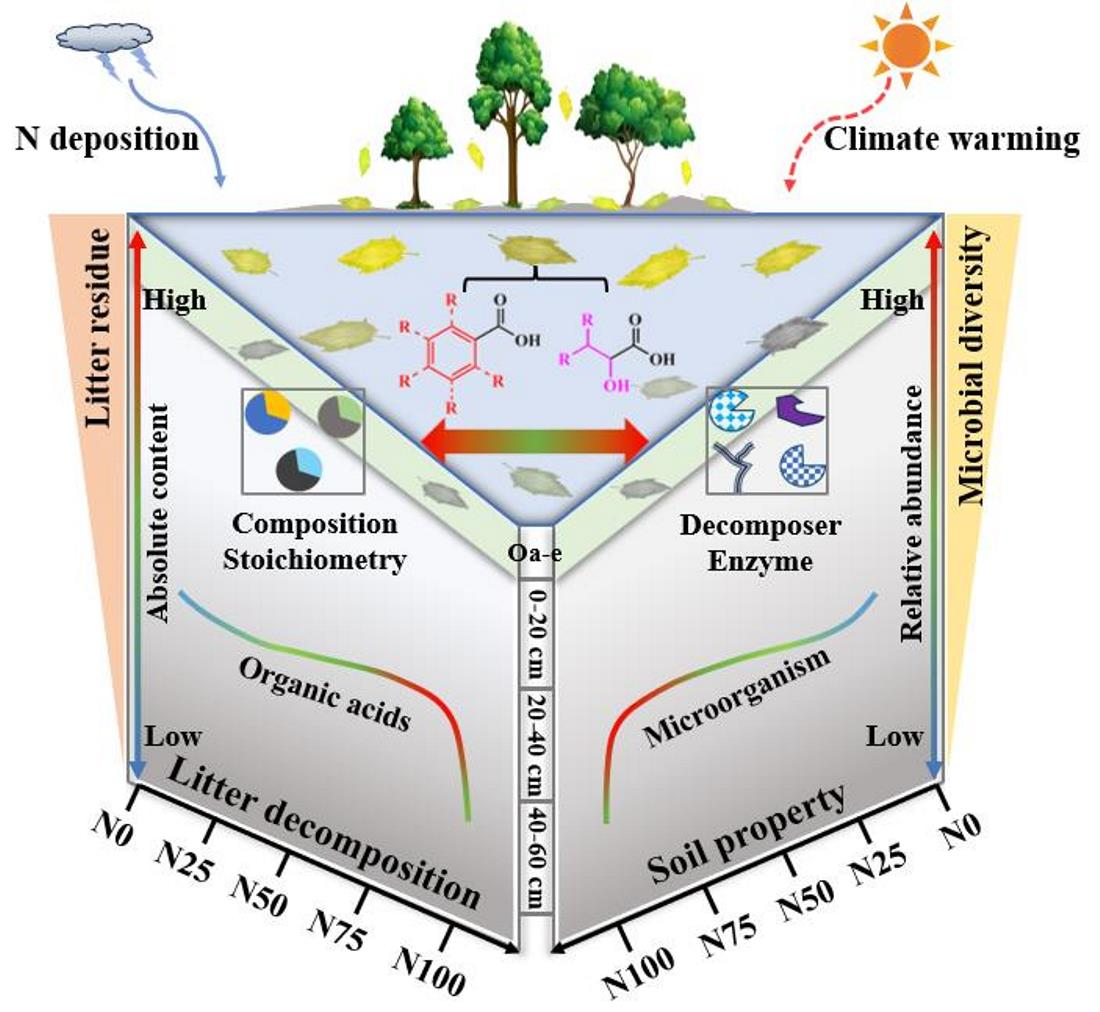
Graphical Abstract

1. Introduction

Forest soil forms a continuous continuum of carbon budget in terrestrial ecosystem functioning [1]. As a critical link in biogeochemical cycle, the input and decomposition of plant litter play pivotal regulatory roles in regulating soil organic carbon formation and nutrient transportation [2,3]. The classical framework for litter decomposition posits that degradation rates are jointly mediated by multiple biotic and abiotic variables, including endogenous substrate accumulation, chemical composition, biological resistance, as well as exogenous factors such as decomposer community and climatic conditions [4,5,6]. However, the complexity and variability of litter types and their derivatives have led to persistent uncertain in the modelling and prediction of long-term decomposition dynamics [7]. Specifically, the interactive mechanisms between litter chemical properties and decomposer communities, as well as their combined effects on litter decomposition and subsequent nutrient cycling, remain poorly understood. Until recently, most studies have examined the response of litter decomposition to the interaction of various variables in isolation [8,9]. This isolated research approach has hindered a comprehensive understanding of biomaterial transport processes in forest ecosystems. To facilitate a more holistic evaluation of the dynamic response of litter decomposition to global change, a systematic shift is therefore required—one that focuses on the synchronisation of residue input and transformations processes.
Against this backdrop, the intensification of atmospheric nitrogen (N) deposition and pollution has emerged as a prominent global environmental concern [10]. Nitrogen deposition can alter litter turnover and accumulation by modifying plant biomass and soil carbon to nitrogen (C:N) ratios [11], with particularly pronounced effects in temperate forests characterized by higher N retention capacity and intense soil microbial competition [12]. However, the spatial distribution of N input is highly uneven, a problem that has become increasingly severe in recent years. Specifically, high N deposition hotspots (>40 kg N ha−1 yr−1) are primarily concentrated in densely populated and intensively farmed regions, including East, South, and Southeast Asia—with the northern and eastern regions of China being key hotspots [13]. A proposed mechanism underlying the impact of N deposition on litter decomposition is that N addition, while altering the chemical composition and stoichiometry of litter quality, can also enhance litter resistance to decomposition [14,15]. For instance, increased lignin concentration in litter, acting as a structurally complex polymer due to its robust chain-bond and recalcitrant derivatives, thereby significantly slow litter decomposition rate [16,17]. Concurrently, soil conditions at the study site, including microbial community composition, extracellular enzyme activities, and major nutrient concentrations, also modulate the efficacy of litter decomposition, which is further influenced by the rate and duration of N addition [18,19]. Notably, Pichon et al. (2020) found that while long-term N addition exceeding threshold concentrations inhibits litter mass loss during decomposition, the responsive changes in litter composition to short-term N addition remain unclear [20]. Furthermore, site-specific conditions that drive the dynamic processes and structural differentiation of litter decomposition, such as litter type, substrate properties, decomposer dominance, and climatic factors, cannot be overlooked [21,22,23]. Consequently, integrating both biotic and abiotic factors is essential to comprehensively understand and predict the impacts of N addition on the dynamic processes of litter decomposition, thereby addressing the existing knowledge gaps highlighted above.
The alteration of N-enriched soils typically occurs either directly or indirectly through plant litter decomposition, which in turn affects the source soil microenvironment and quality [24]. This process is mediated by nutrient-driven regulation of the microbial community, resulting from litter decomposition and subsequent changes in the physicochemical properties of litter residues [5]. Nevertheless, accurately defining the relationship between litter quality and decomposition processes remains a considerable challenge [25], largely because the response of decomposition-related variables to the chemical traits of litter have not yet been fully considered [26,27]. Although extensive research has historically focused on lignocellulose-rich macromolecules, the chemical complexity of certain decomposing components, such as organic acids and pectin, remains poorly elucidated [28,29]. For instance, stable carbon isotopes of pectin and lignin methoxy during natural degradation serve as important reference for characterizing litter decomposition dynamics, owing to their constant initial isotopic characteristics [30,31]. Furthermore, plant leaf wax biomarkers, which primarily composed of n-alkanes and fatty acids, have been widely used in biogeochemical and climatic indicator studies. This is largely attributable to their resilience to biodegradation, distinct molecular distribution characteristics, and unique isotopic compositions [32]. However, critical knowledge gaps persist: changes in the carbon ratio during litter decomposition, as well as the specific chemical structural variations in other secondary organic acids (including fatty acids monoacids, diacids, and phenolic acid isomers), remain unclear [33,34]. Therefore, to fully understand the decomposition dynamics of organic acid components in litter under N-enriched environments, it is essential to identify relevant indicators and characterize their changes over appropriate timescales.
In this study, high-quality litter from single-species natural forests in a planned new specialized botanical garden to investigate the relationship between the characteristics of organic acid components and the source environment during the natural decomposition process under different nitrogen (N) nutrient enrichment regimes. Two hypotheses were tested: (1) the specific component fitness hypothesis, which posits that the decomposition-dependent effects observed are driven by specific chemical components of litter that have adapted to N enrichment in the source soil; (2) decomposer–environment interaction hypothesis, which states that the decomposer community and its associated enzyme activities play a pivotal role in regulating the litter decomposition process, which is itself modulated by the climatic environment. To evaluate the impact of nutrient enrichment and climatic conditions on the decomposition dynamics of litter organic acid composition in natural habitats, a two-year N addition observational experiment was conducted in this study, coupled with systematic sampling and chemical analysis to characterise organic acid composition changes during decomposition.

2. Materials and Methods

2.1. Study Sites and Climatic Conditions

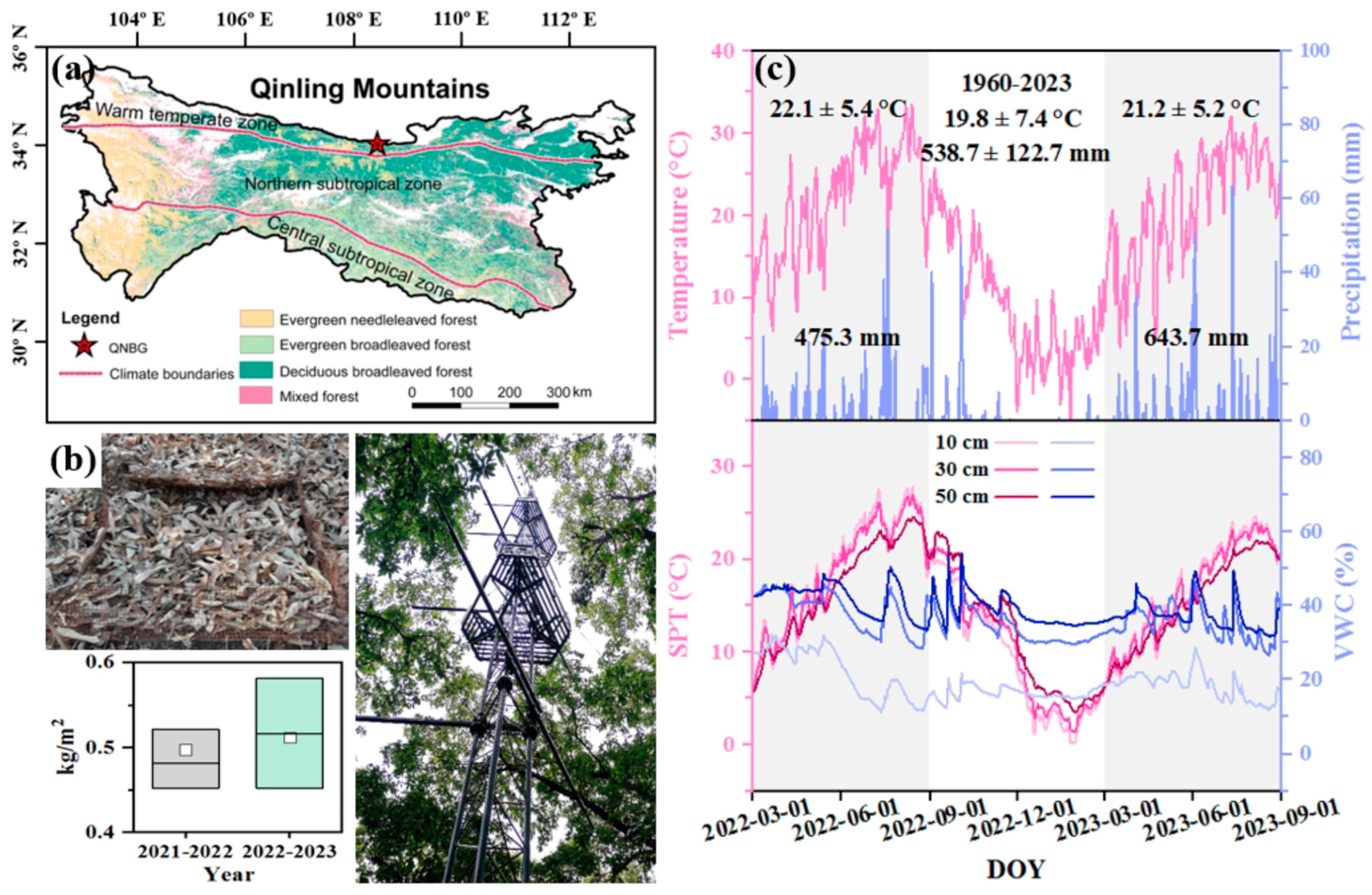
An in situ decomposition experiment was conducted at the Qinling National Botanical Garden (QNBG), which is located in the transition between the warm temperature zone and the northern subtropical zone, within the northern foothills of the Qinling Mountains in central China (Figure 1a). The study site (33°43′ N, 108°13′ E, 619 m a.s.l.) represents a typical, undisturbed low-altitude deciduous broadleaf forest ecosystem, dominated by Quercus variabilis, which accounts for over 95% of the arboreal coverage. Specifically, the leaves of Q. variabilis are narrowly ovate-lanceolate or oblong-elliptic in shape, with a length of 8–15 cm and a width of 2–6 cm, and are characterized by spiny serrated margins. Leaf phenology of this species ranges from germination in early March to litterfall formation in mid-October [35]. Notably, surface litter management and fertilization practices within this forest area are key management tasks for the construction of the secondary specialized garden within QNBG. Since September 2021, seven 1 × 1 m litter collection grids (aperture 10 mm) have been randomly distributed within the Q. variabilis forest (Figure 1b). The inter-annual total biomass of Q. variabilis litter was approximately 0.50 ± 0.08 kg m−2 (0.50 ± 0.07 kg m−2 in 2022 and 0.51 ± 0.09 kg m−2 in 2023, respectively). Concurrently, a flux tower weather station (Beijing Truwel Instruments Co., Ltd., Beijing, China) was installed to accurately assess the microhabitat conditions. This station monitored atmosphere parameters (temperature and precipitation) at heights of 1.5, 5.0, and 10.0 m, as well as soil parameters (temperature, volumetric water content, and electrical conductivity) at depths of 10, 30, and 50 cm, with data recorded at 30 min intervals (Figure 1b) [36]. During the experimental observation period (March to September), the mean temperature and total precipitation were 22.1 ± 5.4 °C and 457.3 mm in 2022, and 21.2 ± 5.2 °C and 643.7 mm in 2023, respectively. For the long-term context, the mean temperature and total precipitation during the same period in this study region from 1960 to 2023 were 19.8 ± 7.4 °C and 538.7 ± 122.7 mm, respectively (Figure 1c). Meteorological water-heat balance indicators, including air relative humidity and soil conductivity, revealed that 2022 was characterised by higher temperatures and reduced precipitation, a phenomenon that has been identified as an extremely hot and dry year in history (Figures S1 and S2) [37]. The study site is dominated by mountain brown forest soil, classified according to the World Reference Base for Soil Resources, with a pH range of 5.8 to 7.0. In the top 0–20 cm soil layer, the concentrations of soil organic carbon and total nitrogen were 17.5–45.5 g kg−1 and 2.0–4.5 g kg−1, respectively [38].

2.2. Experimental Design and Sampling

Since March 2022, fifteen in situ decomposition observation plots (20 m × 20 m each) have been established in the Q. variabilis forest (terrain slope < 5°). Adjacent plots were separated by a 5 m buffer strip to avoid potential horizontal exchange of nutrients and litter. The experimental design of N addition was determined based on the background soil N threshold for forestation carbon sequestration and tree restoration potential [39]. Specifically, five understory N fertilization treatments were established to investigate the variation characteristics of organic acid chemical components during Q. variabilis litter decomposition, including 0, 25, 50, 75, and 100 kg N ha−1 yr−1 (designated as N0, N25, N50, N75 and N100, respectively), with three replications per treatment. Nitrogen was added as an aqueous urea solution, applied quarterly from March to September each year, corresponding to the period of most active tree growth and soil microbial activity. The urea solution was applied in three main applications (spring, summer, and autumn) using a backpack sprayer, with applications conducted on sunny days following precipitation to facilitate nutrient absorption, close to the litter layer. For example, each N50 plot received 1.44 kg of urea (corresponding to 0.67 kg N) dissolved in 25 L of water per application. The control plot (N0) only received an equivalent amount of water without urea. The higher addition dosages of N75 and N100 were selected to simulate the combined effect of the regional total N deposition rate (34.8 kg N ha−1 yr−1) [40] and the garden’s routine fertilization management practices.
To explore the effect of N addition on litter decomposition during the active period of the soil microbial community, the addition experiment was initiated in early March, when soil temperature exceeded 5 °C (Figure 1c) [41]. Corresponding sampling and analysis were conducted in early September, following the conclusion of the summer period. Concurrent with N addition, litterbags were used to estimate litter decomposition efficiency during the same period, quantified by the mass loss percentage (%) and decomposition rate constant (k). A total of 45 litterbags (plastic material, 2 mm mesh size) were prepared, corresponding to 15 observation plots × 3 replicates per N treatment. Each litterbag was filled with 5 ± 0.03 g of air-dried, intact fresh litter, which was collected from the ambient litter collection grids established previously. All litterbags were retrieved after 180 days of field incubation (from March to September). After every retrieval, the litter remaining in each bag was carefully collected, oven-dried at 65 °C to constant mass, and weighted. The mass loss percentage (%) and decomposition rate constant (k value) were then calculated following the methods described by Olson et al. (1963) and Wang et al. (2025) [42,43].
Following six months of N addition treatments, five sampling points (four geographical directions and centre) were selected at random from each plot (20 × 20 m) for the collection of litter residue and soil samples to ensure geographic distribution and representative coverage. Soil was extracted at depths of 0–20, 20–40, and 40–60 cm, respectively, using a 50 mm internal diameter borer. For each plot, samples from the five sampling points were thoroughly mixed and homogenized by passing through a 2 mm sieve to remove any visible stones and fine roots. This was conducted prior to the establishment of a composite sample for each treatment plot. The same operations of N addition and sampling were carried out at the same site in early March and early September, respectively, which also independently occurred in 2022 and 2023. This space-for-time sampling design was adopted to capture continuous variations throughout the litter decomposition process and avoid limitations associated with single-stage sampling [44]. Subsequent to collection, each composite samples of the organic Oa+e and mineral soil samples from five points were divided into two distinct sub-samples. A sub-sample was stored temporarily in liquid nitrogen and subsequently returned to the laboratory for storage at −80 °C for the purpose of microbial community analysis. Moreover, the second sub-sample was transported on ice to the laboratory at 4 °C and freeze-dried for the purpose of determining soil physicochemical properties, enzyme activities, and the chemical composition of litter residual.

2.3. Sample Determination

All soil physical-chemical properties, including pH, total soil organic carbon (SOC), total nitrogen (TN), element Iron (Fe) and Manganese (Mn), available iron (Fe_ava) and Manganese (Mn_ava) were determined according to the standardised methods [45]. Soil pH was measured using a potentiometric method with a pH meter (Mettler-Toledo GmbH, Switzerland) in a suspension of dry soil-to-distilled water ratio of 1:2.5 (w:v). SOC (g kg−1) was determined using potassium dichromate oxidation and titration with ferrous ammonium sulfate. TN (g kg−1) was determined by microwave-assisted concentrated acid digestion and the Kjeldahl method. The total Fe (g kg−1) and Mn (g kg−1) contents were extracted by microwave-assisted concentrated acid digestion, while the available Fe (Fe_ava, mg kg−1) and available Mn (Mn_ava, mg kg−1) were extracted by diethylene-triamine pentaacetic acid extraction. The corresponding concentrations were finally quantified by inductively coupled plasma atomic emission spectrometry. The activities of three common hydrolytic enzymes, including β-D-Glucosidase (BG), Cellobiohydrolase (CBH), and β-N-Acetylglucosaminidase (NAG) and two oxidoreductase involved in Peroxidase (PEO) and polyphenol oxidase (PPO) were quantified using fluorescent substrate addition method [46]. Specifically, soil samples were sonicated in sodium acetate buffer solutions and assayed using a fluorometer (TECAN Infinite M200 PRO, Switzerland) with 4-methylumbelliferyl-β-D-glucopyranoside for BG (μmol g−1 h−1), 4-methylumbelliferyl-β-D-cellobioside for CBH (μmol g−1 h−1), 4-methylumbelliferyl-N-acetyl-β-D-glucosaminide for NAG (μmol g−1 h−1), L-3,4-dihydroxyphenylalanine for PEO (mg g−1 2 h−1), and L-3,4-dihydroxyphenylalanine and H2O2 for PPO (mg g−1 2 h−1), respectively [47].
Genomic DNA of each sample was extracted using the Stool DNA Kit method (DP712 TianGen, Tianjin, China), following the manufacturer’s instructions from 0.5 g of −80 °C soil sample. The V4 region of the bacterial 16S rRNA genes and the ITS1-5F region of fungal ITS were amplified using the respective primer pairs 515F and 806R or pairs ITS5-1737F and ITS1-2043R through PCR using Phusion® High-Fidelity Polymerase chain reaction (PCR) Master Mix (New England Biolabs, Ipswich, MA, USA). All PCRs were carried out with a 15 µL volume, containing 0.2 µM of forward and reverse primers (0.8 µL) and about 10 ng template DNA [48]. Specifically, The PCR thermal cycling program consisted of an initial denaturation step at 98 °C for 1 min, followed by 30 cycles of denaturation at 98 °C for 10 s, annealing at 50 °C for 30 s and 72 °C for 5 min. The reaction was then terminated at 4 °C. Mix same volume of 1 × loading buffer with PCR products and operate electrophoresis on 2% agarose gel for detection. Then, mixture PCR products were purified with Universal DNA purification Kit (DP214 TianGen, Tianjin, China). Finally, high-throughput sequencing were performed using the Illumina MiSeq platform at Novogene Bioinformatics Technology Co., Ltd. (Beijing, China). The raw reads were deposited into the NCBI Sequence Read Archive database (accession codes PRJNA1466099 and PRJNA1466124). Given the well-established consensus that nitrogen addition or deposition generally modulates the structure and diversity of soil microbial communities across terrestrial ecosystems, bacterial α-diversity quantified by the Shannon index showed the most pronounced declining response, particularly in forest soils under urea application [49]. Although the Chao1 index better reflects the richness of rare species, the top 10 dominant genera identified in this study all belong to common microbial taxa with high relative abundance. Therefore, considering that the general microbial community shifts induced by nitrogen enrichment have been widely documented in existing literature, we only focused our targeted analysis on the Shannon and Chao1-based bacterial and fungal α-diversity rather than repeating routine β-diversity assessments (e.g., NMDS, PCoA, and PERMANOVA).
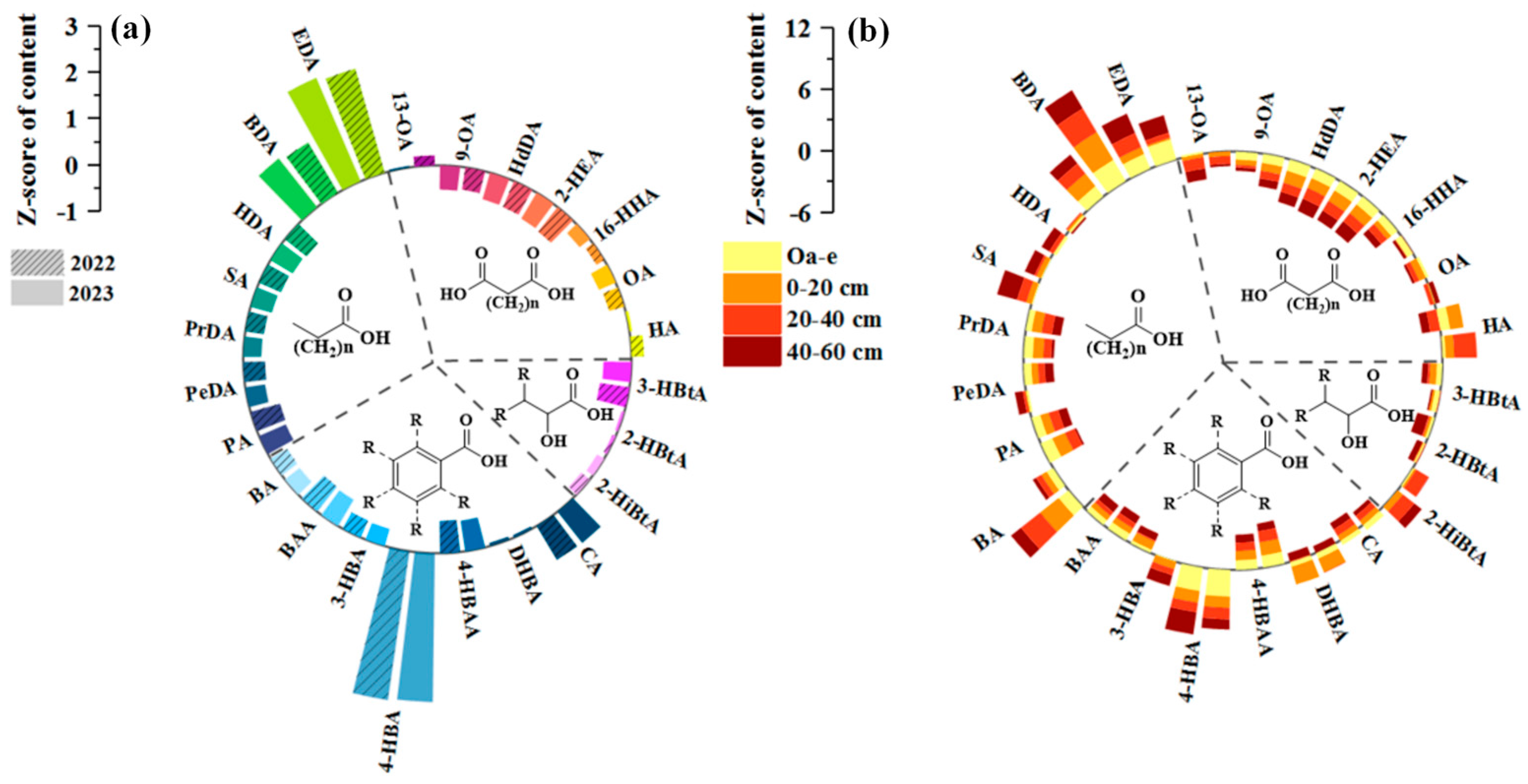
The organic acid components of litter residues and soil profiles were quantified using a series of chemical derivation, extraction, and identification procedures. The qualitative and quantitative determination of the derived organic acid components was analysed by gas chromatography-mass spectrometry (GC-MS, Agilent 7890B-7000D, Santa Clara, CA, USA). In particular, a Monel reactor was employed for oxidation extraction by means of an alkaline cupric oxide (CuO/NaOH) oxidation method, with slight modifications based on the protocol described by previous studies [50]. In brief, oxidation cleavage was conducted in a polytetrafluoroethylene-lined reaction vessel at 170 °C for 90 min vial microwave heating. After liquid–liquid extraction with ethyl acetate, the organic phase was concentrated, re-dissolved, and then derivatized with N,O-bis-(trimethylsilyl)-trifluoroacetamide in pyridine solution for 3 h at 70 °C before GC/MS analysis. DL-12-hydroxy stearic acid was used as the internal standard for secondary fatty acid products of alkaline oxidation. The concentration of a given compound is determined through a comparison of the peak area of the compound of interest in the total ion current with that of the internal standard (for more details in supporting information). This is then normalised to the target sample content. A total of four categories of organic acids were identified in the litter and soil profiles of the same year: namely, long-chain monoacids, short-chain dibasic acids, phenolic acids and butyric acid isomers (Figure 2). Although alkaline CuO oxidation serves as a classic and selective method to depolymerize soil lignin into phenolic monomers and release bound secondary fatty acids, this oxidative cleavage inevitably produces co-eluting interferents, including low-molecular-weight phenolic acids and hydroxyl fatty acids. Nevertheless, target organic acids were selectively identified and quantified using diagnostic mass spectral ions in the present study. Accordingly, the observed elevated abundances of organic acids were only further conceptually applied to characterize the variations in soil organic matter across different N addition treatments. Similarly, the analytical quality control was evaluated via the recovery rates and relative standard deviations (RSDs) of typical secondary fatty acids, with mean recoveries above 80% and RSDs below 6%.

2.4. Statistical Analysis

Prior to statistical analyses, all data (one composite point with three replicated plots per treatment, n = 3) were tested for normality and homogeneity of variance using Shapiro–Wilk test. Logarithmic transformation and Z-score standardization were performed where appropriate. The Shannon indices calculated via the “vegan” package, were used to evaluate the alpha diversity of bacterial and fungal communities. Genus-level stacked bar charts were constructed to visualize the relative abundance of microbial taxa, with only the top 10 dominant genera and common taxonomic groups displayed. Due to the differences in chemical structure and molar concentration of various organic acids, as well as the background interference during derivatization process, only relative content variations were used to characterize the differences across experimental treatments and soil layers. Nonlinear regression transfer functions were established using the relative variation in total organic acid content during litter decomposition as the independent variable to distinguish treatment differences. One-way analysis of variance (ANOVA) combined with Tukey’s multiple comparison test (p < 0.05) was performed to evaluate the effects of N addition treatments on litter decomposition, soil properties, and microbial communities at a relatively independent data level. Notably, this analytical approach was constrained by the limited sample size in the present study. Pearson’s correlation analysis and heatmap visualization were further used to explore relationships among nitrogen addition regimes, litter decomposition components, soil physicochemical properties and microbial community characteristics. Although most identified microorganisms are decomposers, statistically classified microbial groupings only reflect divergent responses of structure-specific organic acid ratios to environmental variations during litter decomposition. Therefore, path analysis was applied to examine causal associations among soil physicochemical properties, microbial groups, enzyme activities, and organic acid ratios. All variables in the model were observed manifest variables, with no latent constructs or measurement models included. The path analysis included 11 observed variables, with 18 significant unidirectional paths and 4 bidirectional correlation paths. The total number of estimated parameters was 33, yielding a model degree of freedom of 33. With an effective sample size of 120 (derived from five treatments, three replicates, two years, and four soil layers), the observation-to-parameter ratio was approximately 3.64, which is marginally below the widely recommended minimum threshold of 5:1 [51]. The nested repeated-measures design of our dataset provides additional information to stabilize parameter estimates. The path analysis is presented here primarily for conceptual exploration of causal relationships, rather than as definitive statistical proof. Some figures were created using Origin 2021 and Chemdraw 16.0.

3. Results

3.1. Variation in the Characteristics of Litter Decomposition Components Across N Additions and Soil Layers

The initial litter quality results support our hypothesis that the litter decomposition exhibits unique characteristics in terms of chemical components and dependence on soil environmental conditions (Figure 2). The chemical spectra showed relatively consistent composition and relative content patterns of the four types of organic acids in undecomposed fresh litter (Figure 2a) across two natural years (2022 and 2023). Such distribution patterns were also stable and specific in undisturbed soil profiles prior to the period of active soil microbial activity (Figure 2b), especially in the organic litter layers (Oa+e) and shallow mineral soils (0–20 cm). Long-chain monoacids (C16–C20) were dominated by aliphatic acids, enoic acids, and their corresponding isomers. Short-chain dicarboxylic acids (C2–C8) consisted of four even-carbon and three odd-carbon diacid homologues. Phenolic acids mainly comprised structural isomers of benzoic acid and phenylacetic acid derivatives. Butyric acid isomers were primarily distinguished by variable hydroxyl substitution positions.
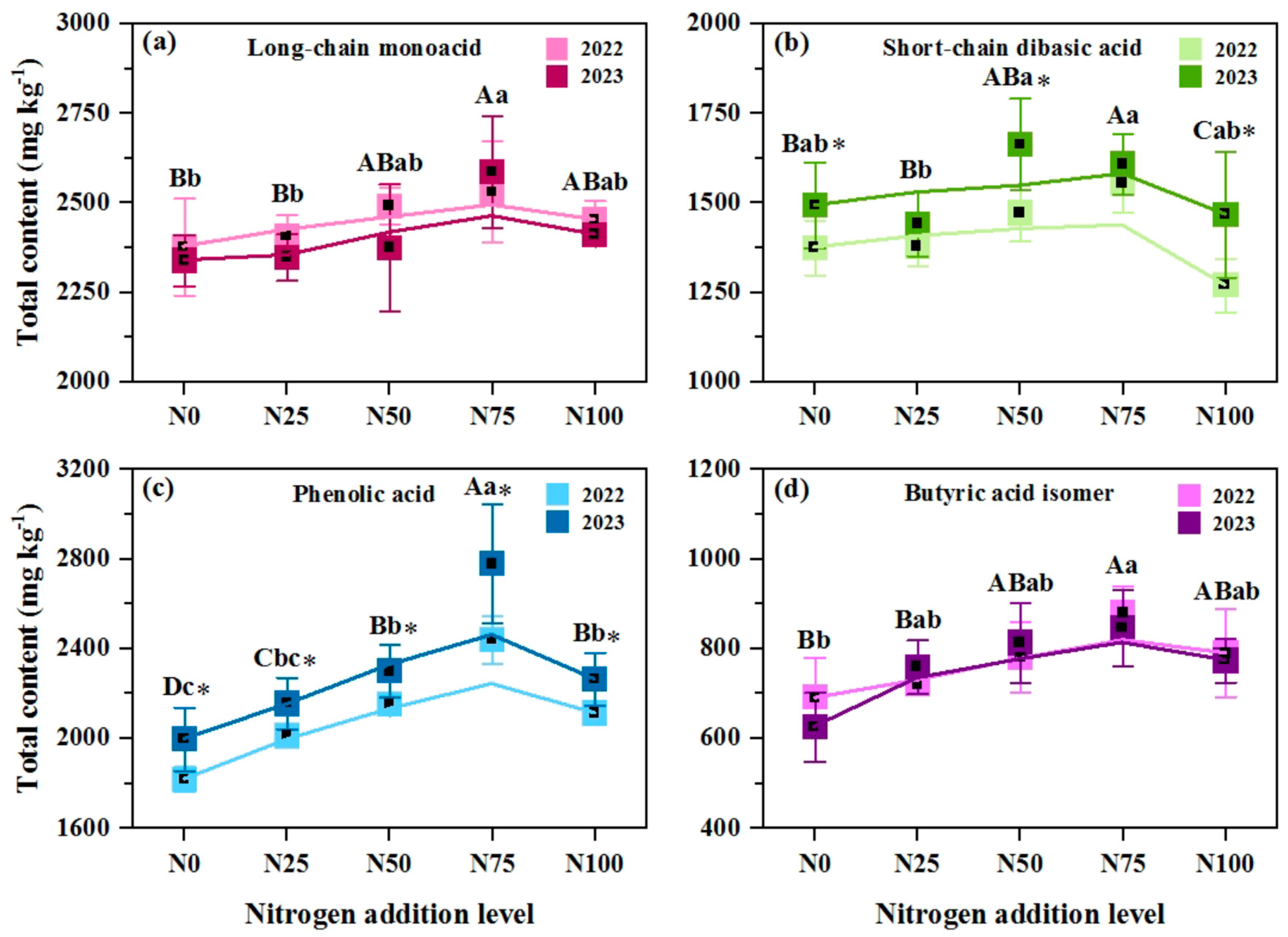
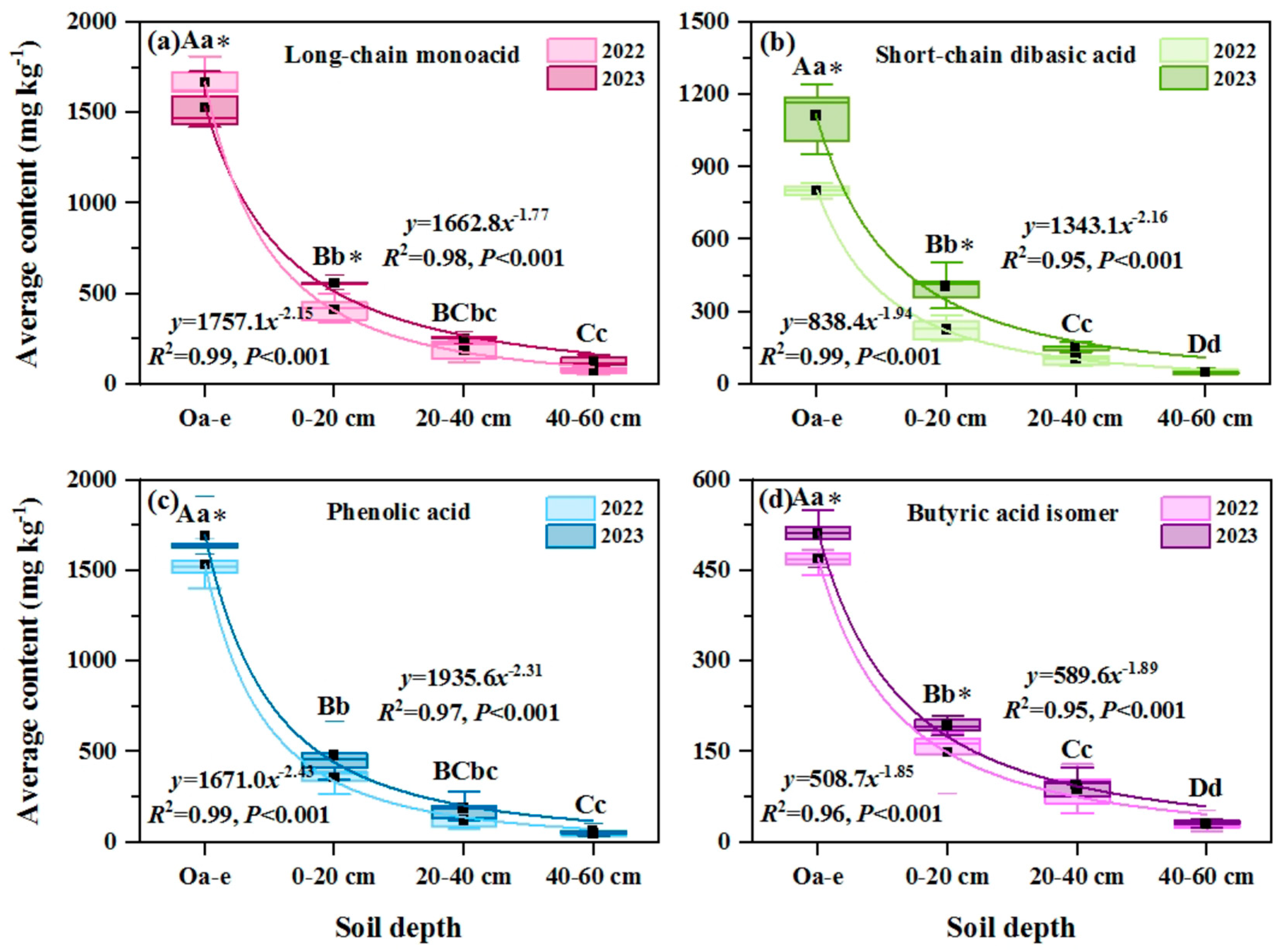
Six months after nitrogen (N) addition, litter decomposition efficiency (assessed via litterbags) varied significantly among experimental plots, with the highest mass loss and decomposition rate observed at the N75 treatment (37.6% and 0.95 year−1, respectively; Figure S3). Furthermore, the content of each organic acid in litter residues exhibited consistent variation patterns with N addition levels and soil depths (Figure 3 and Figure 4). The incorporation of nitrogen resulted in a substantial increase in the total content of each organic acid, with the highest relative content observed at the N75 level (2500 ± 200 mg kg−1, 1500 ± 50 mg kg−1, 2600 ± 250 mg kg−1 and 900 ± 30 mg kg−1 for the four organic acid groups, respectively; Figure 3). While the total relative content long-chain monoacids and butyric acid isomers showed no significant inter-annual variation, short-chain dibasic acids and phenolic acids were significantly higher in the humid year 2023 than in the dry year 2022. Additionally, the absolute content of phenolic acids and butyric acid isomers was significantly higher in 2023 compared to 2022 (Figure S4). With respect to soil depth, the response of different organic acid compounds to N addition levels varied; however, the overall weighted average content declined sharply below 20 cm soil depth (Figure 4 and Figures S5a–S8a). Compared to 20–60 cm layers, significant inter-annual differences were observed in the Oa+e horizon and 0–20 cm soil layer. The only exception to this was the long-chain monoacid content in the OA+e horizon, which was higher in 2022 than in 2023; In contrast, all other organic acid groups exhibited higher concentrations in 2023 relative to 2022.

3.2. Stoichiometric Characteristics of Individual Organic Acids Across N Additions and Soil Layers

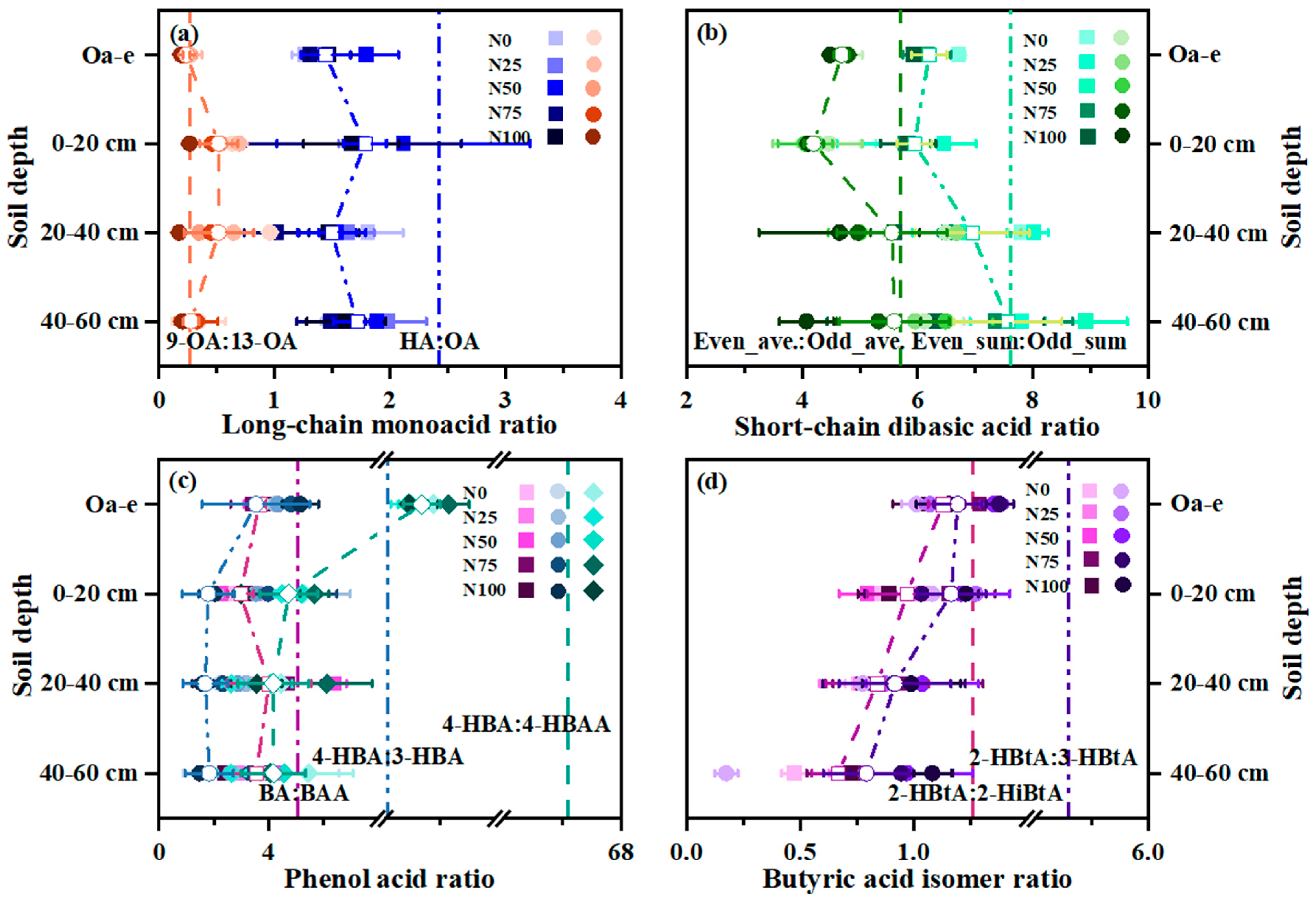
In terms of stoichiometry, N addition strongly affected the proportional composition of individual organic acid compounds with distinct chemical structures (Figure 5). These stoichiometric ratios also varied substantially across years and soil layers (Figures S5b, S6b, S7b and S8b). Specifically, the C16/C18 ratio (HA/OA) of long-chain monoacids in litter residues across each soil layer was markedly lower than the reference litter value of 2.42 obtained from fresh litter (Figure 5a). As shown in Figure 5a and Figure S5b and Table S2, the response of this ratio to increasing N addition differed between shallow and deep soil layers. For instance, the HA/OA ratio displayed divergent depth-dependent responses to N addition, with the minimum ratio consistently occurring near the N75 treatment. For short-chain dicarboxylic acids, both the weighted sum and the arithmetic average ratios of even to odd carbon acids (Even_sum/Odd_sum and Even_ave./Odd_ave.) in litter residues were lower than their respective reference values (7.6 and 5.7), although these ratios tended to increase with soil depth (Figure 5b and Figure S6b and Table S2).
Stoichiometric ratios of phenolic acids with different substituent groups showed no significant differences among soil layers or between years. However, pronounced differences were evident when comparing litter residues with initial fresh litter (Figure 5c and Figure S7b). For instance, the ratios of 4-hydroxybenzoic acid to 3-hydroxybenzoic acid (4-HBA/3-HBA) and 4-hydroxybenzeneacetic acid (4-HBA/4-HBAA) were both considerably lower than their respective reference values of 11.4 and 65.7. Notably, the average 4-HBA/4-HBAA ratio in the OA+e horizon reached 13.3. For butyric acid isomers, the stoichiometric ratios of 2-hydroxybutyric acid to 3-hydroxybutyric acid (2-HBtA/3-HBtA) and 2-hydroxyisobutyric acid (2-HBtA/2-HiBtA) in litter residues declined with increasing soil depth. These ratios also exhibited significant inter-annual differences under different nitrogen addition level (Figure 5d and Figure S8b). In particular, although 2-HBtA/3-HBtA ratios remained far below the reference value of 5.65, both ratios showed their strongest response to nitrogen addition at the N75 level, with overall mean value higher in 2023 than in 2022.

3.3. Relationships Between Stoichiometric Ratios of Organic Acids and Individual Soil Parameters

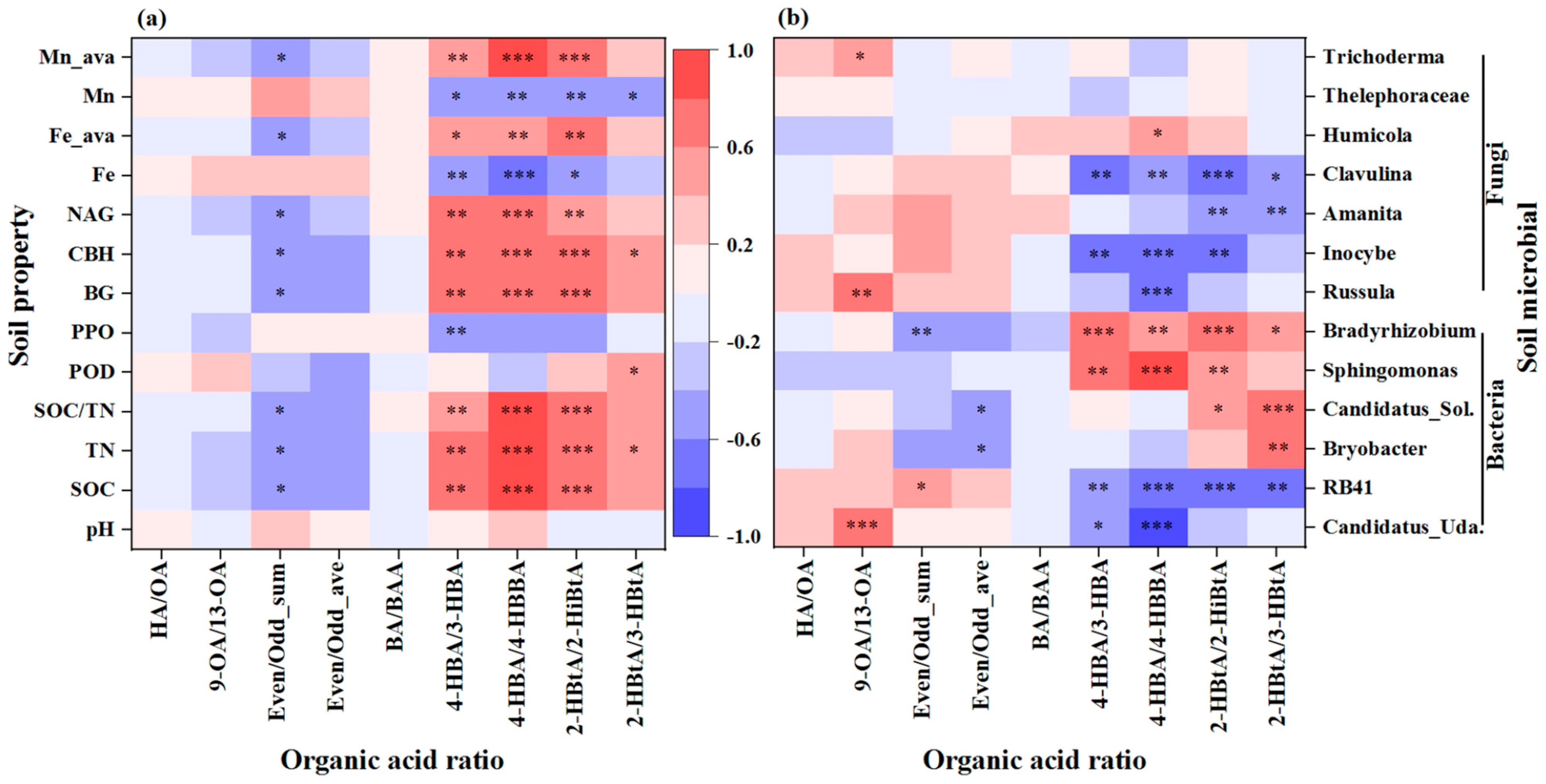
Distinct relationships were observed between organic acid ratios and soil physicochemical properties, enzyme activities, and related metal element concentrations across soil layers (Figure 6a, Figures S11–S13 and S17a). In both 2022 and 2023, the characteristic ratios of long-chain monoacids and short-chain dibasic acids were negatively correlated with soil organic carbon (SOC), total nitrogen (TN), and the SOC/TN ratio (Figure 6a and Figure S17a). These negative correlations became stronger in warmer and wetter year of 2023, particularly for the even-odd ratio of the short-chain dibasic acids (Even_sum/Odd_sum, p < 0.005, Even_ave./Odd_ave. p < 0.01, respectively; Figures S11 and S17a). Similarly, consistent negative correlations were detected between organic acid ratios and soil enzyme activities, with particularly strong relationships for hydrolases (BG, CBH and NAG; p < 0.005 for Even_sum/Odd_sum and p < 0.05 for Even_ave./Odd_ave., respectively). For iron (Fe) and manganese (Mn), which are closely associated with enzyme function, the Even_sum to Odd_sum ratio was positively correlated with total Fe and Mn concentrations in 2023 (p < 0.05), but negatively correlated with their available fractions (p < 0.005). Ratios of phenolic acids and butyric acids also showed significant positive correlation with soil physicochemical indexes and hydrolase activities (Figure 6a, Figures S12–S13 and S17a). Notably, the ratios 4-HBA/3-HBA, 4-HBA/4-HBBA, and 2-HBtA/2-HiBtA were negatively correlated with the total Fe and Mn contents, but positively correlated with their available fractions. Correlation strengths also differed inter-annually: the 4-HBA/3-HBA relationships were more significant in 2023 (all p < 0.01), whereas the 2-HBtA/2-HiBtA relationships were stronger in 2022 (all p < 0.005).
Further correlation analysis of soil microbial community relative abundances revealed that the organic acid stoichiometric ratios were closely associated with microbial species composition during litter decomposition (Figure 6b and Figure S17b). Bacterial and fungal taxa were clearly classified into two subgroups based on their distinct correlation patterns with the four groups of organic acid ratios. Within the bacterial community, the relative abundances of Candidantus_Uda. and RB41 were positively correlated with the ratios of long-chain monoacids and short-chain dibasic acids, but negatively correlated with the phenolic acid (4-HBA/3-HBA, 4-HBA/4-HBBA) and butyric acid isomers ratios (2-HBtA/2-HiBtA). By contrast, other bacterial genera, including Bryobacter, Candidatus_Sol., Sphingomonas and Bradyrhizobium showed the opposite correlation trend. In 2023, Bryobacter and Candidatus_Sol. displayed significant positive correlations mainly with the 2-HBtA/2-HiBtA and 2-HBtA/3-HBtA ratios (all p < 0.01). Similarly, Sphingomonas and Bradyrhizobium were strongly and positively correlated with the 4-HBA/4-HBAA and 2-HBtA/2-HiBtA ratios in 2023 (all p < 0.01). For fungi communities, genera including Russula, Inocybe, Amanita and Clavulina were positively correlated with the ratios of long-chain monoacid and short-chain dibasic acid, but significantly negatively correlated with the 4-HBA/3-HBA, 4-HBA/4-HBBA and 2-HBtA/2-HiBtA ratios (Figure 6b and Figure S17b). Notably, the negative correlations of Russula and Inocybe species with the 4-HBA/3-HBA and 4-HBA/4-HBBA ratios were stronger in 2023 (all p < 0.005) (Figure 6b).

4. Discussion

4.1. Effect of Nitrogen Addition on Organic Acid Composition and Source Soil Conditions in Litter Decomposition

Variations in the relative contents of organic acid during litter decomposition exhibited consistent trends with changes in physicochemical properties, with both showing an inflection point at the N75 treatment level (7.5 g N m−2). Despite evident inter-annual differences between 2022 and 2023, the total and individual relative accumulation of organic acid groups, including long-chain monoacids, short-chain dibasic acids, phenolic acids, and butyric acid isomers, consistently increased from N0 to N75, but declined sharply at N100 level (Figure 3 and Figure 4 and S5a–S8a). This nonlinear response pattern in organic acid relative abundance along the N addition gradient mirrors the soil N-dependent regulation of tree growth and afforestation effects reported previously [52]. The topsoil, as the primary recipient of litter inputs, can function as an effective carbon sink when its total nitrogen stock remains below 8.6 g N m−2; by contrast, N levels exceeding this threshold may trigger carbon emission risks. This threshold response is also consistent with recent evidence that excessive N input (8.6 g N m−2) exerts an inhibitory effect on litter decomposition [53]. Previous studies have confirmed that endogenous chemical substrates of litter differ markedly in their sensitivity to external N enrichment [54,55]. In line with these findings, our observed patterns in organic acid relative abundance agree well with published results for Quercus species: moderate to high N addition (10.0 and 20.0 g N m−2) suppresses litter decomposition by reducing microbial reliance on litter-derived N, whereas low N addition (5.0 g N m−2) accelerates decomposition by optimizing soil nutrient stoichiometry [24,56,57]. Such shifts in litter mass loss driven by chemical legacy effects under environmental nutrient perturbation are widely prevalent, particularly in temperate in Quercus forest species [29].
Consistently, the N75 treatment yielded the highest levels of SOC content, POD activity, and total Mn content, although differences across soil layers and inter-annual variations were not statistically significant. This pattern can be attributed to the pivotal role of N addition in alleviating soil microbial N limitation [58], which in turn enhances mineral-mediated extracellular enzyme activities and thereby accelerates decomposition of cellulose and hemicellulose in litters [59,60]. While it is a widely accepted consensus that soil microbial diversity of Shannon and Chao1 index similarly decreased with increasing soil depth, its response to N addition also shifted from positive to negative at N75 threshold (Figures S14a,c, S15a,c and S16a–d), with high nitrogen level causing a significant decline in diversity. Consistent with recent in situ observations and experimental simulations, shifts in soil microbial nutrient acquisition and N utilisation strategies may underline the reduction in community diversity and relative abundance under high-dose N enrichment [20,48,61]. Thus, despite being based on two-year phased data, varying N addition doses generally exert a shift from promotional to inhibitory effects on litter decomposition and the soil environment, which consistent with the inflection point pattern observed in organic acid relative content changes.
With respect to organic acid monomeric ratios, our results are generally consistent with the first hypothesis (Figures S5b–S8b), confirming that the specific effects of N addition on litter decomposition, reflected in organic acid chemical composition, stem from the adaptation of litter substrate quality to the soil environment. However, it is important to note that, in addition to the biological adaptability, the majority of carbon structure and chemical groups under environmental stress can also selectively regulate the direction of litter decomposition [62]. Compared with fresh litter, the lower and more stable HA/OA ratio in decomposed residue indicates that an increase in C chain length in long-chain monoacid enhances hydrophobicity and the β-oxidation degradation cycle, thereby rendering 18-carbon OA more resistant to decomposition [27]. In the top 40 cm of soil, the 9-OA/13-OA ratio (olefinic acid isomer ratio) decreased with increasing N addition (Figure S5b), which is attributable to the higher propensity of 9-octadecenoic acid to be converted into acetyl-CoA via reactions involving free radicals and fatty acyl-CoA dehydrogenase [63,64]. For short-chain dibasic acids, the lower even-odd ratio in decomposed residues tended to approach the initial ratio of fresh litter with increasing soil depth (Figures S6b). This aligns with observation that odd-numbered carbonic acids possess chemical symmetry and stability [65], facilitating their retention in decomposed residues, particularly under N fertilization [66]. Furthermore, the ratios of chemically stable phenolic acids (e.g., benzoic acid to benzeneacetic acid, BA/BAA) remained relatively constant across soil layers but slightly lower than the reference value (Figure S7b). This phenomenon is associated with the greater molecular hydrophobicity and steric hindrance to enzymatic hydrolysis exhibited by BAA, which has a longer ethyl side chains [67]; however, suitable environmental conditions and adequate N nutrition can positively regulate these degradation processes. Notably, para-hydroxy phenolic acid (e.g., 4-HBA) are more prone to serve as oxidase hydrolytic substrate than meta-hydroxy phenolic acids (e.g., 3-HBA), due to their higher molecular symmetry and conjugation activity [68]. This outcome is consistent with our results, which demonstrate that the 4-HBA/4-HBBA ratio in decomposed residues decreased most significantly from the litter layer to the soil profile, relative to fresh litter. Butyric acid isomer ratios exhibited analogous patterns: the higher detectability of 3-hydroxybutyric acid (with a beta group) is likely due to its greater recognition by dehydrogenase, which promotes its conversion into acetyl-CoA [69]. In contrast, 2-hydroxyisobutyric acid, with a branched-chain structure, is more difficult to degrade, attributed to increased steric hindrance from the branched topology and restricted enzyme accessibility [70]. Collectively, these findings indicate that changes in organic acid relative contents and their individual stoichiometry during litter decomposition are jointly governed by the soil properties of the external environment and the molecular structure of the internal substrates.

4.2. Application Potential of Organic Acid Stoichiometric Indicator in Litter Decomposition Adaption to N Resource Utilization and Climate Environment Change

The present study evaluated the biological and abiotic factors regulating changes in organic acid stoichiometric ratios and examined their contribution to altering litter decomposition under different N addition levels. The observed variations in soil properties (Figures S9 and S10) and microbial community response (Figures S14 and S15) underscore the necessity of considering the interaction between the direct and indirect effects of decomposer communities and climatic environments on the decomposition of litter chemical components [22,71]. Specifically, the year-specific differences observed, particularly in response to inter-annual climatic variations, provide a mechanistic explanation for the litter mass loss induced by source climate changes (Figure S3). In warm and humid years (e.g., 2023), exogenous N input has been shown to enhance soil microbial fixation and utilisation of soil organic N, thereby accelerating litter decomposition rate [72]. Concurrently, abundant rainfall improved the efficacy of N addition in promoting nitrification and nitrate (e.g., NO3) leaching, which in turn reduced soil pH [52].
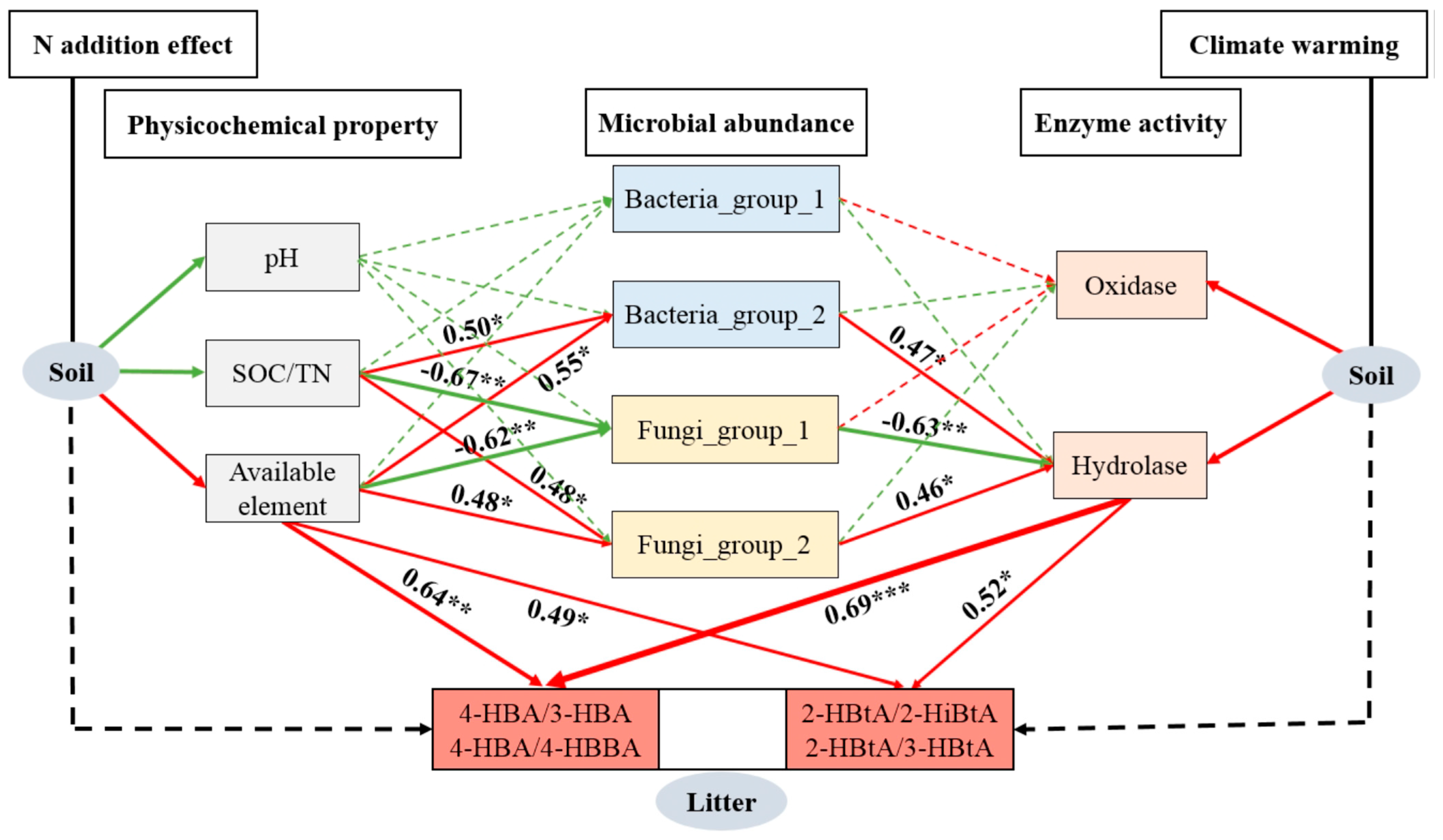
Furthermore, the overall decline in litter quality induced by elevated temperatures and N addition has been demonstrated to inhibit soil microbial carbon use efficiency [73,74]. This finding is also supported by the low SOC/TN ratio observed in the conceptual path analysis of this study (Figure 7). The aggravated microbial C limitation following N addition was attributed to enhanced differences in ecoenzymatic stoichiometric responses, which resulted in increased cellulolytic enzyme activities (e.g., BG, CBH and NAG) and decreased lignin oxidase activities (e.g., POD and PPO) [75,76]. A recent meta-analysis confirmed that the trade-off between these two groups of C-degrading enzymes induced by N addition is a key regulatory factor affecting litter decomposition and SOC sequestration, with this effect being particularly pronounced in forest ecosystems [58]. Additionally, both enzyme groups exhibited increased activities under warm and humid climatic conditions, as regional environmental factors and litter substrate quality jointly determine decomposition rates [77]. Concurrently, soil acidification, an N addition-sensitive process, was accompanied by increased concentrations of non-base cations in available iron and manganese, such as free Fe3+ and Mn2+ [78,79]. Collectively, these changes led to distinct response patterns of organic acid ratios with specific chemical structures, which are closely associated with soil physicochemical properties, enzyme activities, and metal element concentrations under varying N addition levels.
Consistent with a recent global meta-analysis [49], our study confirms that N addition alters soil microbial diversity and community composition, primarily manifested as decreased bacterial diversity and increased fungal diversity (Figures S14 and S15). This finding provides direct validation of the well-documented global pattern of microbial community responses to N enrichment. Furthermore, our results confirm that microbial diversity in forest soils with low sensitivity and high tolerance to N addition shows no significant decline following N input. In contrast, at the N addition threshold of 5–10 g N m−2, microbial relative abundance commonly first increased and then decreased [80,81], which largely aligns with our observations, further validating the universality of this N-dependent microbial response threshold in forest ecosystems. Building on previous work [82,83,84], our study demonstrates that shifts in soil microbial community composition, rather than diversity, drive litter decomposition in temperate forests. This conclusion is reinforced by our in situ litter decomposition data, which show that the relative abundances of dominant bacterial and fungal taxa were species-specifically associated with changes in organic acid stoichiometric ratios (Figure 6b and Figure S17b). For example, within heterotrophic taxa, the bacterium Candidantus_Uda. and fungus Russula significantly influenced changes in the 4-HBA/4-HBBA, 2-HBtA/2-HiBtA, and 2-HBtA/2-HiBtA ratios under high N availability [85,86]. The Gram-negative bacillus Sphingomonas, an aerobic or facultative anaerobic bacterium with antioxidant stress properties [87], was found to hinder the retention of asymmetric long-chain monoacids via oxidative hydrolysis. Based on their functional traits, environmental responses to N addition, and correlations with organic acid stoichiometric ratios, the dominant bacteria and fungi genera were classified into above two sub-groups (Table S3). Collectively, these results suggest that the stoichiometric characteristics of organic acids during litter decomposition are the combined product of decomposer community composition and climatic conditions under N resource utilisation scenarios. This conclusion aligns with consistent with recent reports [25,29], directly supporting our second hypothesis and reinforcing the causal link between N addition, microbial community shifts, and organic acid-mediated litter decomposition.
Path analysis models further conceptually validate that N addition exerts a significant regulatory effect on soil acidification, SOC/TN stoichiometry, and non-basic cation activity (Figure 7). These N-induced changes, in turn, modulate the activities of C-degrading hydrolases and oxidases by altering soil microbial community structure and diversity [58], ultimately driving the accelerated release of metabolizable assimilable C sources with specific chemical structures during litter decomposition. Notably, while our observational data are limited, we cannot overlook the role of site-specific climatic factors in regulating the decomposition and transformation of litter chemical components [88]. Collectively, our findings support an integrated framework of litter decomposition regulation, highlighting that optimizing litter stoichiometric parameters is critical for predicting litter degradation. Here, substrate quality, decomposer communities, and climate synergistically govern decomposition dynamics, bridging the gap between global patterns and site-specific observations of N enrichment effects in forest ecosystems.

5. Conclusions

In the forest ecosystem of the climatic transition zone, the chemical components of organic acids during litter decomposition exhibit distinct structural specificity and stoichiometric variability in response to nitrogen addition. Based on a two-year field N addition gradient experiment, we established conceptual stoichiometric response patterns of typical organic acids in Quercus variabilis litter residues across soil layers. The total relative abundances of the four dominant organic acids displayed a consistent nonlinear trend along the N addition gradient, rising to a maximum at the N75 treatment (7.5 g N m−2) and declining thereafter. This threshold response was more pronounced in the warm and humid year of 2023 than in the warm and dry year of 2022. Although the stoichiometric ratios of individual organic acids in litter and soil layers deviated substantially from those of initial fresh litter, their variations remained strongly dependent on N addition levels. The stoichiometric ratios of typical organic acids exhibited structure-specific correlations with soil environmental properties, reflecting compound-specific responses of litter chemical constituents to enzymatic hydrolysis processes at the molecular level, as modulated by inter-annual climatic conditions. Our preliminary findings highlight that structural stoichiometric indicators of organic acids provide valuable insights for understanding and predicting how N enrichment regulates plant litter decomposition dynamics and soil carbon sequestration in temperate forest ecosystems.

Supplementary Materials

The following supporting information can be downloaded at: https://www.mdpi.com/article/10.3390/f17050622/s1. Figure S1: Temporal variations of the climate and soil parameters for the biodegradation observation period from 1 March 2022 to 1 September 2023 in the Qinling National Botanical Garden; Figure S2: Monthly statistics of the climate and soil parameters; Figure S3: The percent mass loss (%) and decay constant (k) of litter decomposition in different nitrogen addition treatments; Figure S4: The changes of physicochemical, enzyme activity, and element content in soil layers under the different nitrogen addition levels at the highest biodegradation activity period; Figure S5: Two-year average values of physicochemical, enzyme activity, and element content in soil layers under the different nitrogen addition levels; Figure S6: The absolute content of different acids between control and nitrogen addition treatments; Figure S7: Variation characteristics of long-chain monoacids in soil layers under the different nitrogen addition levels; Figure S8: Variation characteristics of short-chain dibasic acids in soil layers under the different nitrogen addition levels; Figure S9: Variation characteristics of phenol acids in soil layers under the different nitrogen addition levels; Figure S10: Variation characteristics of butyric acid isomers in soil layers under the different nitrogen addition levels; Figure S11: The relationship between the log short-chain dibasic acid ratios and the log soil attribute parameters for nitrogen addition levels and soil layers; Figure S12: The relationship between the log phenolic acid ratios and the log soil attribute parameters for nitrogen addition levels and soil layers; Figure S13: The relationship between the log butyric acid isomer ratios and the log soil attribute parameters for nitrogen addition levels and soil layers; Figure S14: Soil microbial diversity and top 10 relative abundance at different soil layers from nitrogen addition treatments in 2022 and 2023; Figure S15: Soil microbial diversity and common relative abundance at different soil layers from nitrogen addition treatments in two-year average levels; Figure S16: Soil microbial diversity of Chao1 index at soil layers and N addition treatments in 2022 and 2023; Figure S17: The response of the log organic acid ratios to log soil property and microbial at different nitrogen addition levels and soil layers in 2022 and 2023; Table S1: The effect of weighted two-year N addition treatment on soil physico-chemical properties and enzymes activities; Table S2: The effect of weighted two-year N addition treatment on origin acid ratios; Table S3: Composition of microbial sub-group in pathway model based on the correlations from organic acid ratios.

Author Contributions

Q.L.: Writing—original draft, Data curation, Software, Funding acquisition. X.C.: Methodology, Investigation, Formal analysis. X.Z.: Data curation, Writing—review & editing, Funding acquisition. J.C.: Writing—review & editing, Funding acquisition. F.C.: Methodology, Formal analysis. G.J.: Writing—review & editing. J.G.: Data curation, Formal analysis. S.Z.: Writing—review & editing, Conceptualization. Z.C.: Methodology, Validation. L.J.: Writing—review & editing, Formal analysis. J.L.: Investigation, Resources. T.L.: Resources. All authors have read and agreed to the published version of the manuscript.

Funding

This work was supported by the National Natural Science Foundation of China (42301053, 42277448), Science and Technology Program of Shaanxi Academy of Sciences (2023k-08), Innovation Capability Support Program of Shaanxi (2024KJXX-107), Shaanxi Province Natural Science Foundation for Distinguished Young Scholar (2024JC-JCQN-32), and Key Research and Development Program of Shaanxi Province (2025NC-YBXM-229).

Data Availability Statement

The data presented in this study are available on request from the corresponding author and first author.

Acknowledgments

We thank Xiaohong Liu for the experiment support, and thank Huhu Kang, Xinyu Zhang, and Yu Zhang for sampling work in the field. We also gratefully acknowledge the editorial board of the journal for their hard work.

Conflicts of Interest

The authors declare that they have no known competing financial interests.

References

  1. Zhang, Y.X.; Guo, X.W.; Chen, L.X.; Kuzyakov, Y.; Wang, R.Z.; Zhang, H.Y.; Han, X.G.; Jiang, Y.; Sun, O.J.X. Global pattern of organic carbon pools in forest soils. Glob. Chang. Biol. 2024, 30, e17386. [Google Scholar] [CrossRef]
  2. Feng, X.J.; Dai, G.H.; Liu, T.; Jia, J.; Zhu, E.X.; Liu, C.Z.; Zhao, Y.P.; Wang, Y.; Kang, E.Z.; Xiao, J.; et al. Understanding the mechanisms and potential pathways of soil carbon sequestration from the biogeochemistry perspective. Sci. China Earth Sci. 2024, 67, 3386–3396. [Google Scholar] [CrossRef]
  3. Pessoa, D.V.; da Cunha, M.V.; de Mello, A.C.L.; dos Santos, M.V.F.; Soares, G.S.C.; Camelo, D.; Apolinário, V.X.O.; Junior, J.C.B.D.; Coelho, J.J. Litter deposition and decomposition in a tropical grass-legume silvopastoral system. J. Soil Sci. Plant Nutr. 2024, 24, 3504–3518. [Google Scholar] [CrossRef]
  4. Beidler, K.V.; Phillips, R.P.; Andrews, E.; Maillard, F.; Mushinski, R.M.; Kennedy, P.G. Substrate quality drives fungal necro mass decay and decomposer community structure under contrasting vegetation types. J. Ecol. 2020, 108, 1845–1859. [Google Scholar] [CrossRef]
  5. Abubakar, A.; Mayer, M.; Neumann, M.; Gao, Q.; Wang, D. Nitrogen addition reduces litter decomposition but does not affect litter production and chemistry in an alpine shrub land. Plant Soil 2025, 509, 795–807. [Google Scholar] [CrossRef]
  6. Chen, H.; Xu, Q.H.; van Groenigen, K.J.; Hungate, B.A.; Smith, P.; Li, D.J.; Moorhead, D.L.; Osborne, B.B.; Ma, Z.L.; Olesen, J.E.; et al. Linking soil extracellular enzymes with soil respiration under altered litter inputs. Agric. For. Meteorol. 2025, 367, 110503. [Google Scholar] [CrossRef]
  7. López, J.; Vancampenhout, K.; Muys, B.; Ponette, Q. Tree community composition modulates early-stage decomposition of standard litter through chemical and physical engineering. For. Ecosyst. 2025, 15, 100387. [Google Scholar] [CrossRef]
  8. Castillo-Figueroa, D. The effect of forest microenvironment on litter decomposition in the Andean tropical mountains. J. For. Res. 2025, 36, 102. [Google Scholar] [CrossRef]
  9. Zhao, Y.D.; Lu, N.; Shi, H.; Huang, J.B.; Fu, B.J. Patterns and driving factors of litter decomposition rates in global dryland ecosystem. Glob. Chang. Biol. 2025, 31, e70025. [Google Scholar] [CrossRef]
  10. Zhang, Q.; Li, Y.N.; Wang, M.R.; Wang, K.; Meng, F.L.; Liu, L.; Zhao, Y.H.; Ma, L.; Zhu, Q.C.; Xu, W.; et al. Atmospheric nitrogen deposition: A review of quantification methods and its spatial pattern derived from the global monitoring networks. Ecotoxicol. Environ. Saf. 2021, 216, 112180. [Google Scholar] [CrossRef] [PubMed]
  11. Cook-Patton, S.C.; Leavitt, S.M.; Gibbs, D.; Harris, N.L.; Lister, K.; Ander-son-Teixeira, K.J.; Briggs, R.D.; Chazdon, R.L.; Crowther, T.W.; Ellis, P.W.; et al. Mapping carbon accumulation potential from global natural forest regrowth. Nature 2020, 585, 545–550. [Google Scholar] [CrossRef]
  12. Zhang, Y.; Zhang, Q.; Yang, W.; Wang, N.; Fan, P.; You, C.; Yu, L.; Gao, Q.; Wang, H.; Zheng, P. Response mechanisms of 3 typical plants nitrogen and phosphorus nutrient cycling to nitrogen deposition in temperate meadow grasslands. Front. Plant Sci. 2023, 14, 1140080. [Google Scholar] [CrossRef]
  13. Yu, G.R.; Jia, Y.L.; He, N.P.; Zhu, J.X.; Chen, Z.; Wang, Q.F.; Piao, S.L.; Liu, X.J.; He, H.L.; Guo, X.B.; et al. Stabilization of atmospheric nitrogen deposition in China over the past decade. Nat. Geosci. 2019, 12, 424–429. [Google Scholar] [CrossRef]
  14. Vogels, J.J.; Van de Waal, D.B.; WallisDeVries, M.F.; Van den Burg, A.B.; Nijssen, M.; Bobbink, R.; Berg, M.P.; Olde Venterink, H.; Siepel, H. Towards a mechanistic understanding of the impacts of nitrogen deposition on producer–consumer interactions. Biol. Rev. 2023, 98, 1712–1731. [Google Scholar] [CrossRef]
  15. Zhang, G.L.; Wu, Y.J.; Ouyang, S.N.; Duan, H.L.; Wang, J.; Tie, L.H. The impact of nitrogen and phosphorus enrichment on litter decomposition: Soil biota roles and biochemical pathways. Plant Soil 2025, 517, 677–698. [Google Scholar] [CrossRef]
  16. Kirui, A.; Zhao, W.C.; Deligey, F.; Yang, H.; Kang, X.; Mentink-Vigier, F.; Wang, T. Carbohydrate-aromatic interface and molecular architecture of lignocellulose. Nat. Commun. 2022, 13, 538. [Google Scholar] [CrossRef]
  17. He, J.H.; Nie, Y.X.; Tan, X.P.; Hu, A.; Li, Z.Q.; Dai, S.P.; Ye, Q.; Zhang, G.X.; Shen, W.J. Latitudinal patterns and drivers of plant lignin and microbial necromass accumulation in forest soils: Disentangling microbial and abiotic controls. Soil Biol. Biochem. 2024, 194, 109438. [Google Scholar] [CrossRef]
  18. Chen, J.; Luo, Y.Q.; Van Groenigen, K.J.; Huang, B.A.; Cao, J.J.; Zhou, X.H.; Wang, R.W.; Wang, Y. A keystone microbial enzyme for nitrogen control of soil carbon storage. Sci. Adv. 2018, 4, eaaq1689. [Google Scholar] [CrossRef] [PubMed]
  19. Li, C.H.; Feng, J.G.; Liu, L.; Sun, X.; Li, J.S.; Qian, Z.Z.; Fu, R.R.; Yu, Q.S.; Zhu, B.; Tao, X. Nitrogen addition weakens home-field advantage of litter decomposition by altering soil pH and bacterial communities in asubtropical forest. J. Plant Ecol. 2025, 18, rtaf089. [Google Scholar] [CrossRef]
  20. Pichon, N.A.; Cappelli, S.L.; Soliveres, S.; Hölzel, N.; Klaus, V.H.; Kleinebecker, T.; Allan, E. Decomposition disentangled: A test of the multiple mechanisms by which nitrogen enrichment alters litter decomposition. Funct. Ecol. 2020, 34, 1485–1496. [Google Scholar] [CrossRef]
  21. Benito-Carnero, G.; Gartzia-Bengoetxea, N.; Arias-González, A.; Rousk, J. Low-quality carbon and lack of nutrients result in a stronger fungal than bacterial home-field advantage during the decomposition of leaf litter. Funct. Ecol. 2021, 35, 1783–1796. [Google Scholar] [CrossRef]
  22. Shigyo, N.; Umeki, K.; Hirao, T. Soil microbial identity explains home-field advantage for litter decomposition. New Phytol. 2024, 243, 2146–2156. [Google Scholar] [CrossRef]
  23. Yang, S.; Jia, Z.; Chang, P.F.; Wu, Y.T.; Huang, J.S.; Wang, J.; Deng, M.F.; Su, J.; Hong, S.B.; He, Y.; et al. Significant impact of UV exposure on litter decomposition across diverse climate zones. Glob. Chang. Biol. 2025, 31, e70456. [Google Scholar] [CrossRef]
  24. Kong, B.S.; Zhou, J.L.; Qi, L.G.; Jiao, S.Y.; Ma, L.J.; Geng, W.W.; Zhao, Y.H.; Gao, T.; Gong, J.; Li, K.; et al. Effects of nitrogen deposition on leaf litter decomposition and soil organic carbon density in arid and barren rocky mountainous regions: A case study of Yimeng Mountain. Forests 2023, 14, 1351. [Google Scholar] [CrossRef]
  25. Chen, J.C.; Bai, E.; Liang, Y.T.; Liu, Z.P.; Ji, Y.X.; Sun, T.T.; Guo, Z.X.; Huo, Y.D.; Liu, S.S.; Berg, B. The origin and succession of the microbial community in decomposing litter. ISME Commun. 2025, 5, ycaf155. [Google Scholar] [CrossRef]
  26. Fanin, N.; Lin, D.; Freschet, G.T.; Keiser, A.D.; Augusto, L.; Wardle, D.A.; Veen, G.G. Home-field advantage of litter decomposition: From the phyllosphere to the soil. New Phytol. 2021, 231, 1353–1358. [Google Scholar] [CrossRef]
  27. Wang, Y.J.; Zhang, W.T.; Wang, Z.Y.; Lyu, S.X. A polylactic acid degrading lipase from Bacillus safensis: Characterization and structural analysis. Int. J. Biol. Macromol. 2024, 268, 131916. [Google Scholar] [CrossRef]
  28. Dao, T.T.; Mikutta, R.; Sauheitl, L.; Gentsch, N.; Shibistova, O.; Wild, B.; Schnecker, J.; Bárta, J.; Čapek, P.; Gittel, A.; et al. Lignin preservation and microbial carbohydrate metabolism in permafrost soils. J. Geophys. Res.-Biogeosci. 2022, 127, e2020JG006181. [Google Scholar] [CrossRef]
  29. Zhang, Z.L.; Bodenheimer, J.; Scott, G.; Dukes, J.S.; Suseela, V. Climatic stress-induced changes in plant chemistry alter the compound-specific degradation of litter during decomposition. New Phytol. 2025, 248, 92–106. [Google Scholar] [CrossRef]
  30. Anhäuser, T.; Greule, M.; Zech, M.; Kalbitz, K.; McRoberts, C.; Keppler, F. Stable hydrogen and carbon isotope ratios of methoxyl groups during plant litter degradation. Isot. Environ. Health Stud. 2015, 51, 143–154. [Google Scholar] [CrossRef] [PubMed]
  31. Lu, Q.Q.; Jia, L.L.; Awasthi, M.K.; Jing, G.H.; Wang, Y.B.; He, L.Y.; Zhao, N.; Chen, Z.K.; Zhang, Z.; Shi, X.W. Variations in lignin monomer contents and stable hydrogen isotope ratios in methoxy groups during the biodegradation of garden biomass. Sci. Rep. 2022, 12, 8734. [Google Scholar] [CrossRef] [PubMed]
  32. Liu, H.; Wang, S.Z.; Wang, H.Y.; Cao, Y.N.; Hu, J.; Liu, W.G. Apparent fractionation of hydrogen isotope from precipitation to leaf wax n-alkanes from natural environments and manipulation experiments. Sci. Total Environ. 2023, 877, 162970. [Google Scholar] [CrossRef]
  33. Bhatnagar, J.M.; Peay, K.G.; Treseder, K.K. Litter chemistry influences decomposition through activity of specific microbial functional guilds. Ecol. Monogr. 2018, 88, 429–444. [Google Scholar] [CrossRef]
  34. Yao, B.; Kong, X.S.; Tian, K.; Zeng, X.Y.; Lu, W.S.; Pang, L.; Sun, S.C.; Tian, X.J. Initial litter chemistry and UV radiation drive chemical divergence in litter during decomposition. Microorganisms 2024, 12, 1535. [Google Scholar] [CrossRef]
  35. Guo, J.Q.; Liu, X.H.; Ge, W.S.; Zhao, L.J.; Fan, W.J.; Zhang, X.Y.; Lu, Q.Q.; Xing, X.Y.; Zhou, Z.H. Tracking photosynthetic phenology using spectral indices at the leaf and canopy scales in temperate evergreen and deciduous trees. Agric. For. Meteorol. 2024, 344, 109809. [Google Scholar] [CrossRef]
  36. Zhang, X.Y.; Kang, H.H.; Liu, X.H.; Zhou, J.; Liu, M.D.; Wang, L.X.; Xing, X.Y.; Lu, Q.Q.; Zeng, X.M.; Wei, N.; et al. Comparative foliar atmospheric mercury accumulation across functional types in temperate trees. Environ. Sci. Technol. 2025, 59, 2082–2094. [Google Scholar] [CrossRef]
  37. Jiang, J.L.; Liu, Y.M.; Mao, J.Y.; Wu, G.X. Extreme heatwave over Eastern China in summer 2022: The role of three oceans and local soil moisture feedback. Environ. Res. Lett. 2023, 18, 044025. [Google Scholar] [CrossRef]
  38. Zhou, S.; Li, Y.; Wang, J.Y.; He, L.E.; Wang, J.; Guo, Y.X.; Zhao, F.Z. Contrasting soil microbial functional potential for phosphorus cycling in subtropical and temperate forests. Forests 2022, 13, 2002. [Google Scholar] [CrossRef]
  39. Bastin, J.F.; Finegold, Y.; Garcia, C.; Mollicone, D.; Rezende, M.; Routh, D.; Zohner, C.M.; Crowther, T.W. The global tree restoration potential. Science 2019, 365, 76–79. [Google Scholar] [CrossRef]
  40. Yang, Z.C.; Guerrieri, R.; Ye, N.; Shao, Y.L.; Yu, F.; Jiao, T.Z.; Yang, H.C.; Chen, J.; Zheng, M.H.; Wang, A.; et al. Underappreciated role of canopy nitrogen deposition for forest productivity. Commun. Earth Environ. 2026, 7, 316. [Google Scholar] [CrossRef]
  41. Wei, L.; Razavi, B.S.; Wang, W.Q.; Zhu, Z.K.; Liu, S.L.; Wu, J.S.; Kuzyakov, Y.; Ge, T.D. Labile carbon matters more than temperature for enzyme activity in paddy soil. Soil Biol. Biochem. 2019, 135, 134–143. [Google Scholar] [CrossRef]
  42. Olson, J.S. Energy storage and the balance of producers and decomposers in ecological systems. Ecology 1963, 44, 322–331. [Google Scholar] [CrossRef]
  43. Wang, X.P.; Ma, Y.S.; Zhang, S.T. Litter quality dependent dynamics of bacteria communities in litter and soil layers during litter decomposition. Plant Soil 2025, 508, 663–675. [Google Scholar] [CrossRef]
  44. Prescott, C.E.; Vesterdal, L. Decomposition and transformations along the continuum from litter to soil organic matter in forest soils. For. Ecol. Manag. 2021, 498, 119522. [Google Scholar] [CrossRef]
  45. Wang, A.; Fang, Y.T.; Chen, D.X.; Phillips, O.; Koba, K.; Zhu, W.X.; Zhu, J.J. High nitrogen isotope fractionation of nitrate during denitrification in four forest soils and its implications for denitrification rate estimates. Sci. Total Environ. 2018, 633, 1078–1088. [Google Scholar] [CrossRef]
  46. Kaiser, C.; Koranda, M.; Kitzler, B.; Fuchslueger, L.; Schnecker, J.; Schweiger, P.; Rasche, F.; Zechmeister-Boltenstern, S.; Sessitsch, A.; Richter, A. Belowground carbon allocation by trees drives seasonal patterns of extracellular enzyme activities by altering microbial community composition in a beech forest soil. New Phytol. 2010, 187, 843–858. [Google Scholar] [CrossRef] [PubMed]
  47. DeForest, J.L. The influence of time, storage temperature, and substrate age on potential soil enzyme activity in acidic forest soils using MUB-linked substrates and L-DOPA. Soil Biol. Biochem. 2009, 41, 1180–1186. [Google Scholar] [CrossRef]
  48. Logue, J.B.; Stedmon, C.A.; Kellerman, A.M.; Nielsen, N.J.; Andersson, A.F.; Laudon, H.; Lindström, E.S.; Kritzberg, E.S. Experimental insights into the importance of aquatic bacterial community composition to the degradation of dissolved organic matter. ISME J. 2016, 10, 533–545. [Google Scholar] [CrossRef] [PubMed]
  49. Wang, X.D.; Feng, J.G.; Ao, G.K.L.; Qin, W.K.; Han, M.G.; Shen, Y.W.; Liu, M.L.; Chen, Y.; Zhu, B. Globally nitrogen addition alters soil microbial community structure, but has minor effects on soil microbial diversity and richness. Soil Biol. Biochem. 2023, 179, 108982. [Google Scholar] [CrossRef]
  50. Heidke, I.; Scholz, D.; Hoffmann, T. Quantification of lignin oxidation products as vegetation biomarkers in speleothems and cave drip water. Biogeosciences 2018, 15, 5831–5845. [Google Scholar] [CrossRef]
  51. Bentler, P.M.; Chou, C.P. Practical issues in structural modeling. Sociol. Methods Res. 1987, 16, 78–117. [Google Scholar] [CrossRef]
  52. Hong, S.B.; Cong, N.; Ding, J.Z.; Piao, S.L.; Liu, L.L.; Peñuelas, J.; Chen, A.P.; Quine, T.A.; Zeng, H.; Houlton, B.Z. Effects of afforestation on soil carbon and nitrogen accumulation depend on initial soil nitrogen status. Glob. Biogeochem. Cycles 2023, 37, e2022GB007490. [Google Scholar] [CrossRef]
  53. Xi, J.Z.; Wang, J.Y.; Zhu, Y.F.; Xu, M.P. Nitrogen deposition reduces the rate of leaf litter decomposition: A Global Study. Forests 2024, 15, 1492. [Google Scholar] [CrossRef]
  54. Vivanco, L.; Austin, A.T. Nitrogen addition stimulates forest litter decomposition and disrupts species interactions in Patagonia, Argentina. Glob. Chang. Biol. 2011, 17, 1963–1974. [Google Scholar] [CrossRef]
  55. DeForest, J.L. Chronic phosphorus enrichment and elevated pH suppresses Quercus spp. leaf litter decomposition in a temperate forest. Soil Biol. Biochem. 2019, 135, 206–212. [Google Scholar] [CrossRef]
  56. Rothwell, J.J.; Futter, M.N.; Dise, N.B. A classification and regression tree model of controls on dissolved inorganic nitrogen leaching from European forests. Environ. Pollut. 2008, 156, 544–552. [Google Scholar] [CrossRef] [PubMed]
  57. Chomel, M.; Guittonny-Larchevque, M.; Baldy, V. Effect of mixing herbaceous litter with tree litters on decomposition and N release in boreal plantations. Plant Soil 2016, 398, 229–241. [Google Scholar] [CrossRef]
  58. Chen, X.; Cao, J.J.; Sinsabaugh, R.L.; Moorhead, D.L.; Bardgett, R.D.; Fanin, K.; Nottingham, A.T.; Zheng, X.H.; Chen, J. Soil extracellular enzymes as drivers of soil carbon storage under nitrogen addition. Biol. Rev. 2025, 100, 1234–1250. [Google Scholar] [CrossRef]
  59. Marshall, J.D.; Peichl, M.; Tarvainen, L.; Lim, H.; Lundmark, T.; Nasholm, T.; Oquist, M.; Linder, S. A carbon-budget approach shows that reduced decomposition causes the nitrogen-induced increase in soil carbon in a boreal forest. For. Ecol. Manag. 2021, 502, 119750. [Google Scholar] [CrossRef]
  60. Zhao, J.N.; Feng, X.H.; Hu, J.; He, M.; Wang, S.Y.; Yang, Y.H.; Chen, L.Y. Mineral and microbial properties drive the formation of mineral-associated organic matter and its response to increased temperature. Glob. Chang. Biol. 2024, 30, e70004. [Google Scholar] [CrossRef]
  61. Mao, Z.X.; Yue, M.; Wang, Y.C.; Li, L.J.; Li, Y. Soil microorganisms mediated the responses of the plant–soil systems of Neotrinia splendens to nitrogen addition and warming in a desert ecosystem. Agronomy 2024, 14, 132. [Google Scholar] [CrossRef]
  62. Erdenebileg, E.; Wang, C.W.; Yu, W.Y.; Ye, X.H.; Pan, X.; Huang, Z.Y.; Liu, G.F.; Cornelissen, J.H.C. Carbon versus nitrogen release from root and leaf litter is modulated by litter position and plant functional type. J. Ecol. 2023, 111, 198–213. [Google Scholar] [CrossRef]
  63. Yin, H.Y.; Xu, L.B.; Porter, N.A. Free radical lipid peroxidation: Mechanisms and analysis. Chem. Rev. 2011, 111, 5944–5972. [Google Scholar] [CrossRef] [PubMed]
  64. Lu, J.X.; Zhang, L.X.; Wang, J.C.; Li, G.; Qiu, Y.Z.; Ren, L.H.; Wang, P. Microbial enzymes for the biodegradation of polylactic acid (PLA): Molecular docking simulation and biodegradation pathway proposal. Environ. Rev. 2024, 33, 1–18. [Google Scholar] [CrossRef]
  65. Qin, N.; Li, L.Y.; Wang, Z.; Shi, S.B. Microbial production of odd-chain fatty acids. Biotechnol. Bioeng. 2023, 120, 917–931. [Google Scholar] [CrossRef]
  66. Thomas, C.L.; Jansen, B.; van Loon, E.E.; Wiesenberg, G.L. Transformation of n- alkanes from plant to soil: A review. Soil 2021, 7, 785–809. [Google Scholar] [CrossRef]
  67. Cook, S.D. An historical review of phenylacetic acid. Plant Cell Physiol. 2019, 60, 243–254. [Google Scholar] [CrossRef]
  68. Nike, P.I.; Pérez Pantoja, D.; de Lorenzo, V. Pyridine nucleotide transhydrogenases enable redox balance of Pseudomonas putida during biodegradation of aromatic compounds: Transhydrogenases, Redox Balance and Biodegradation. Environ. Microbiol. 2016, 18, 3565–3582. [Google Scholar] [CrossRef]
  69. Heng, Y.C.; Wong, G.W.J.; Kittelmann, S. Expanding the biosynthesis spectrum of hydroxy fatty acids: Unleashing the potential of novel bacterial fatty acid hydratases. Biotechnol. Biofuels 2024, 17, 131. [Google Scholar] [CrossRef]
  70. Evangelista, S.; Cooper, D.G.; Yargeau, V. The effect of structure and a secondary carbon source on the microbial degradation of chlorophenoxy acids. Chemosphere 2010, 79, 1084–1088. [Google Scholar] [CrossRef] [PubMed]
  71. Córdova, S.C.; Olk, D.C.; Dietzel, R.N.; Mueller, K.E.; Archontouilis, S.V.; Castellano, M.J. Plant litter quality affects the accumulation rate, composition, and stability of mineral-associated soil organic matter. Soil Biol. Biochem. 2018, 125, 115–124. [Google Scholar] [CrossRef]
  72. Chen, F.S.; Wang, G.G.; Fang, X.M.; Wan, S.Z.; Zhang, Y.; Liang, C. Nitrogen deposition effect on forest litter decomposition is interactively regulated by endogenous litter quality and exogenous resource supply. Plant Soil 2019, 437, 413–426. [Google Scholar] [CrossRef]
  73. Craig, M.E.; Geyer, K.M.; Beidler, K.V.; Brzostek, E.R.; Frey, S.D.; Grandy, A.S.; Liang, C.; Phillips, R.P. Fast-decaying plant litter enhances soil carbon in temperate forests but not through microbial physiological traits. Nat. Commun. 2022, 13, 1229. [Google Scholar] [CrossRef]
  74. Zhou, J.C.; Luo, Y.Q.; Chen, J. Dilemmas in linking microbial carbon use efficiency with soil organic carbon dynamics. Glob. Chang. Biol. 2025, 31, e70047. [Google Scholar] [CrossRef]
  75. Chen, H.; Li, D.J.; Zhao, J.; Zhang, W.; Xiao, K.C.; Wang, K.L. Nitrogen addition aggravates microbial carbon limitation: Evidence from ecoenzymatic stoichiometry. Geoderma 2018, 329, 61–64. [Google Scholar] [CrossRef]
  76. Song, Y.Y.; Song, C.C.; Ren, J.S.; Tan, W.W.; Jin, S.F.; Jiang, L. Influence of nitrogen additions on litter decomposition, nutrient dynamics, and enzymatic activity of two plant species in a peatland in Northeast China. Sci. Total Environ. 2018, 625, 640–646. [Google Scholar] [CrossRef]
  77. Wu, Q.X.; Ni, X.Y.; Sun, X.Y.; Chen, Z.H.; Hong, S.B.; Berg, B.; Zheng, M.H.; Chen, J.; Zhu, J.J.; Ai, L.; et al. Substrate and climate determine terrestrial litter decomposition. Proc. Natl. Acad. Sci. USA 2025, 122, e2420664122. [Google Scholar] [CrossRef]
  78. Tian, D.S.; Niu, S.L. A global analysis of soil acidification caused by nitrogen addition. Environ. Res. Lett. 2015, 10, 024019. [Google Scholar] [CrossRef]
  79. Gao, M.X.; Lin, G.G.; Zhu, F.F.; Wu, Z.; Gundersen, P.; Zeng, D.H.; Hobbie, E.A.; Zhu, W.X.; Fang, Y.T. Higher resistance of larch-broadleaf mixed forests than larch forests against soil acidification under experimental nitrogen addition. Plant Soil 2024, 505, 335–349. [Google Scholar] [CrossRef]
  80. Wu, J.P.; Liu, W.F.; Zhang, W.X.; Shao, Y.H.; Duan, H.L.; Chen, B.D.; Wei, X.H.; Fan, H.B. Long-term nitrogen addition changes soil microbial community and litter decomposition rate in a subtropical forest. Appl. Soil Ecol. 2019, 142, 43–51. [Google Scholar] [CrossRef]
  81. Yang, Y.; Chen, X.L.; Liu, L.X.; Li, T.; Dou, Y.X.; Qiao, J.B.; Wang, Y.Q.; An, S.S.; Chang, S.X. Nitrogen fertilization weakens the linkage between soil carbon and microbial diversity: A global meta-analysis. Glob. Chang. Biol. 2022, 28, 6446–6461. [Google Scholar] [CrossRef]
  82. Sauvadet, M.; Fanin, N.; Chauvat, M.; Bertrand, I. Can the comparison of above-and below-ground litter decomposition improve our understanding of bacterial and fungal successions? Soil Biol. Biochem. 2019, 132, 24–27. [Google Scholar] [CrossRef]
  83. Kroeger, M.E.; DeVan, M.R.; Thompson, J.; Johansen, R.; Galle-gos-Graves, L.V.; Lopez, D.; Runde, A.; Yoshida, T.; Munsky, B.; Sevanto, S.; et al. Microbial community composition controls carbon flux across litter types in early phase of litter decomposition. Environ. Microbiol. 2021, 23, 6676–6693. [Google Scholar] [CrossRef]
  84. Lin, H.; Li, Y.N.; Bruelheide, H.; Zhang, S.R.; Ren, H.B.; Zhang, N.L.; Ma, K.P. What drives leaf litter decomposition and the decomposer community in subtropical forests–The richness of the above-ground tree community or that of the leaf litter? Soil Biol. Biochem. 2021, 160, 108314. [Google Scholar] [CrossRef]
  85. Hobbie, E.A.; Diepen, L.T.A.V.; Lilleskov, E.A.; Ouimette, A.P.; Finzi, A.C.; Hofmockel, K.S. Fungal functioning in a pine forest: Evidence from a 15N-labeled global change experiment. New Phytol. 2014, 201, 1431–1439. [Google Scholar] [CrossRef] [PubMed]
  86. Brewer, T.E.; Handley, K.M.; Carini, P.; Gilbert, J.A.; Fierer, N. Genome reduction in an abundant and ubiquitous soil bacterium ‘Candidatus Udaeobacter copiosus’. Nat. Microbiol. 2016, 2, 16198. [Google Scholar] [CrossRef] [PubMed]
  87. Gabriel, F.L.P.; Giger, W.; Guenther, K.; Kohler, H.P.E. Differential Degradation of Nonylphenol Isomers by Sphingomonas xenophaga Bayram. Appl. Environ. Microbiol. 2005, 71, 1123–1129. [Google Scholar] [CrossRef] [PubMed]
  88. Canessa, R.; van den Brink, L.; Saldaña, A.; Rios, R.S.; Hättenschwiler, S.; Mueller, C.W.; Prater, I.; Tielbörger, K.; Bader, M.Y. Relative effects of climate and litter traits on decomposition change with time, climate and trait variability. J. Ecol. 2021, 109, 447–458. [Google Scholar] [CrossRef]
Figure 1. Field sampling site and monitoring setup of this study. (a) Location of the study area at the Qinling National Botanical Garden (QNBG), situated within the Qinling Mountains in central China; (b) Litter collection and decomposition observations sites, coupled with real-time climate and environmental monitoring. The boxplot illustrates the annual plant litter input (kg m−2) in the study area for 2022 and 2023; (c) Daily variations in meteorological and soil conditions in the study area from 1 March 2022 to 1 September 2023. The upper panel displays the mean air temperature (red line) and total precipitation (blue bars). The lower panel presents soil profile temperature (SPT, red lines) and volumetric water content (VWC, blue lines). Shaded areas represent the meteorological variables during the experimental observation period, while the middle reference values represent the long-term average conditions of the same observation period (March–September) from 1960 to 2023. The gradient of line color (from light to dark) corresponds to the monitored values at soil depths of 10, 30 and 50 cm, respectively.
Forests 17 00622 g001
Figure 2. Z-score normalized statistics of key organic acid substrates associated with litter decomposition. Relative content of distinct organic acid compounds in fresh litter (a) and undisturbed soil layers (b), sampled in early March in 2022 (left panel) and 2023 (right panel). Long-chain monoacids mainly comprise the following acids: n-hexadecanoic acid (HA), octadecanoic acid (OA), 16-hydroxyhexadecanoic acid (16-HHA), 2-hydroxyeicosanoic acid (2-HEA), hexadecanedioic acid (HdDA), 9-octadecenoic acid (9-OA), and 13-octadecenoic acid (13-OA); Short-chain dibasic acids include: ethanedioic acid (EDA), butanedioic acid (BDA), hexanedioic acid (HDA), suberic acid (SA), propanedioic acid (PrDA), pentanedioic acid (PeDA), and pimelic acid (PA); Phenolic acids include: benzoic acid (BA), benzeneacetic acid (BAA), 3-hydroxybenzoic acid (3-HBA), 4-hydroxybenzoic acid (4-HBA), 4-hydroxybenzeneacetic acid (4-HBAA), 3,5-dihydroxybenzoic acid (DHBA), 4-coumaric acid (CA); Butyric acid isomers include: 2-hydroxyisobutyric acid (2-HiBtA), 2-hydroxybutyric acid (2-HBtA), 3-hydroxybutyric acid (3-HBtA).
Forests 17 00622 g002
Figure 3. Total content of four different organic acid groups ((a), long-chain monoacid; (b), short-chain dibasic acid; (c), phenolic acid; (d), butyric acid isomer) in all soil layers (Oa+e, 0–20, 20–40 and 40–60 cm) with various N addition treatments (N0, N25, N50, N75 and N100) in 2022 and 2023. The broken line represents the statistical mean fit of the repeated samples (n = 12). The capital letter denotes a significant difference in 2022, while the small letter indicates the year of 2023. The adjacent averaged smooth lines represent the characteristics of the total organic acid content across N levels. *, the significant difference in the total content between 2022 and 2023.
Forests 17 00622 g003
Figure 4. Average content of four organic acid groups ((a), long-chain monoacid; (b), short-chain dibasic acid; (c), phenolic acid; (d), butyric acid isomer) at different soil layers with various N addition treatments in 2022 and 2023. The curve represents the statistical mean fit of the repeated sample (n = 15). The capital letter denotes a significant difference in 2022, while the small letter indicates the year of 2023. The allometric nonlinear curve fitting and its parameters are indicative of changes in the average content of four organic acids across soil layers under varying N addition levels. *, the significant difference in the average content between 2022 and 2023.
Forests 17 00622 g004
Figure 5. Ratio of typical organic acids ((a) long-chain monoacid, (b) short-chain dibasic acid, (c) phenol acid, (d) butyric acid isomer) across different soil layers under various nitrogen addition treatments on the two-year average (n = 6). Hollow symbols denote the mean values across all nitrogen addition levels. The vertical dotted line represents the baseline ratio of organic acid in undecomposed fresh litter before field incubation.
Forests 17 00622 g005
Figure 6. Response of log-transformed organic acid stoichiometric ratios to log-transformed soil properties (a) and dominant microbial taxa (b), across different soil layers and nitrogen addition treatments (two-year average, n = 60). Significance levels: * p < 0.05, ** p < 0.01, and *** p < 0.005. Candidantus_Sol., Candidantus Solibacter; Candidantus_Uda., Candidantus Udaeobacter.
Forests 17 00622 g006
Figure 7. Pathway model of the multivariate effects of nitrogen addition and climate warming on the stoichiometric ratios of litter organic acids, mediated by changes in soil physicochemical property, microbial abundance, and enzyme activity. The model included 11 observed variables, with 18 significant unidirectional paths and 4 bidirectional correlation paths (33 estimated parameters total, model degree of freedom = 33). The effective sample size was 120 (derived from 5 N treatments, 3 replicates, 2 years, and 4 soil layers), resulting in an observation-to-parameter ratio of ~3.64 (marginally below the recommended minimum threshold of 5:1). The model fit indices were: χ2 = 47.12, df = 33, χ2/df = 1.43, p = 0.059, CFI = 0.94, 90% confidence interval (CI) = [0.032, 0.092], Root Mean Square Error of Approximation (RMSEA) = 0.065, and Standardized Root Mean Square Residual (SRMR) = 0.072, respectively. Solid arrows indicate significant relationships (red = positive, green = negative), while dashed arrows (red and green) indicate insignificant paths. Black dashed arrows represent indirect influence on stoichiometric ratios between soil and litter. Numbers connected arrows are standardized path coefficients. * p < 0.05, ** p < 0.01, and *** p < 0.005.
Forests 17 00622 g007
Disclaimer/Publisher’s Note: The statements, opinions and data contained in all publications are solely those of the individual author(s) and contributor(s) and not of MDPI and/or the editor(s). MDPI and/or the editor(s) disclaim responsibility for any injury to people or property resulting from any ideas, methods, instructions or products referred to in the content.