


Abstract
Logging causes damage on residual trees, with differing characteristics and severities. The causal agent, as well as the size and type of injury, is influenced by the type of machines, the harvesting technology adopted, and the machine operator. This study descriptively documents residual tree damage observed in two sledge-yarding operations conducted under contrasting stand and operational conditions: a beech stand managed with a full-tree system and a Scots pine stand managed with a cut-to-length system. Two stands were selected: the harvesting intensity was 50% in the coniferous stand (salvage logging) and 20% in the deciduous stand (thinning). In each stand, six 20 × 20 m plots (0.04 ha) were delineated to assess residual tree damage. In the two observed cases, the beech operation showed a higher proportion of damaged residual trees, 32.2%, than the Scots pine operation, 5.3%. In the deciduous stand, bark injuries were mainly slight wood exposure (75%), whereas in the coniferous stand, crushed bark (42.9%) was most frequent, followed by slight wood exposure (35.7%). No concerning damage to seedlings was detected. In general, the number of damaged trees and the severity of injuries were considerably lower than those typically observed when extracting with a cable skidder, and especially with an adapted farm tractor. To reduce mechanical damage to residual trees, protective devices can be deployed around trees at risk of root and stem injury. Another effective measure is to financially motivate workers to implement environmentally sound forest operations.
1. Introduction
The increasing mechanization of wood harvesting has delivered substantial gains in productivity and operator safety, but it has also heightened concerns about soil and residual stand damage and its consequences for long-term stand sustainability. The application of any harvesting system, mostly ground-based ones, inevitably disturbs the structural complexity of forest stands [1,2]. Disturbance of surface layers, changes in physico-chemical properties of soils and damage to residual trees are the main consequences of logging operations [1,2]. Damage to the residual stand mainly arises from mechanical injuries to the bark, roots, and boles of the residual trees, often serving as a sensitive indicator of the environmental compatibility of harvesting systems [3,4,5]. Frequency of wounded trees and intensity of wounds during logging operations can have detrimental impacts on stand growth and forest sustainability [6]. Even non-lethal wounds can depress radial growth, create infection entry points for decay fungi, and ultimately reduce log quality and economic value at the time of final harvest [7,8]. Damage to standing trees can occur directly (mechanically) and afterwards indirectly (biologically) [9]. Minimizing residual stand damage is essential in the context of sustainable forest operations (SFO) [10], as the future forest depends on the structural integrity and vigor of the residual stand [11]. Comparative studies have shown that the incidence, size, and spatial distribution of damage vary with harvesting method, silvicultural treatments, terrain, slope, and operator experience [12]. The extraction phase consistently emerges as the most critical; specifically, the winching or pulling of logs towards a carriage or corridor frequently accounts for most injuries, typically concentrated at the lower bole and root collar levels [13]. This problem is exacerbated in steep terrain, where lateral forces during winching increase both the number of wounds per tree and the average wound area [14,15].
Damage rates can exceed 30% in cut-to-length yarder-based systems when corridor layout and operational control are suboptimal, with substantial wound sizes recorded on injured stems. These results indicate that damage levels are influenced not only by the level of mechanization adopted but also by the intensity of harvesting, corridor design, yarding direction, incentive schemes, and the quality of operational planning and supervision [16,17]. Other studies have shown that stand structure and species composition further influence damage typology. For instance, in partial cutting with cable yarding, the probability of injury often declines with increasing distance from the skyline corridor, and larger trees may exhibit lower relative susceptibility [18]. However, interspecific differences in bark resistance [13], wood properties, and compartmentalization capacity can be decisive [19].
Conifers and broadleaves respond differently to mechanical impacts, with root architecture and bark thickness influencing both wound severity and healing potential. In uneven-aged hardwoods and mixed conifer stands, ground-based skidding frequently produces butt-log and root injuries exceeding 5–10% of residual stems per entry [11], with winching distance and proximity to skid trails serving as strong predictors of damage intensity [19]. Tavankar et al. [14] confirmed that ground-based mechanized extraction is the major cause of damage to residual stand when dealing with semi-mechanized harvesting systems. According to Picchio et al. [12], the most suitable actions to reduce stand damage include an effective operational planning, directional felling to open extraction ways, employing skilled operators, and using simple rigging aids to lift or redirect the mainline. Borz et al. [20] demonstrated that using protective devices during winching operations significantly reduces the impact on the residual stand.
Despite extensive literature on cable yarders, skidders, and forwarders, sledge yarding operations remain comparatively under-documented, particularly regarding residual stand damage [11]. Studies on cable-based extraction systems indicate that damage intensity depends not only on the frequency of contact but also on the mechanics of the interaction. Factors such as log mass, pulling angle, line tension, and the degree of log suspension during winching strongly influence the impact on residual trees [21]. When logs are partially or fully lifted, tangential collisions with standing stems tend to decrease. In contrast, ground-dragging configurations generally increase friction and mechanical stress at the root collar and lower bole.
These interactions become particularly critical in structurally complex stands, where irregular spacing and multilayered canopies raise the likelihood of unintended stem collisions during lateral inhaul [22]. Bodaghi et al. [19] suggest that extraction corridor layout plays a key role in shaping damage patterns, with residual damage often following a spatial gradient, the highest concentrations occurring close to the mainline trajectory. Their study indicates that corridor spacing, skyline alignment, and landing placement are not only operational choices but also structural factors influencing stand-level impacts.
Methodologically, assessing residual damage requires more than simply estimating its frequency; accurate evaluation also involves measuring wound size, identifying the position of injuries along the stem, and determining the likely cause of the damage. Distinguishing between abrasion from the mainline, impacts from swinging logs, and secondary contacts from moving stems improves the attribution of damage sources and supports more targeted mitigation strategies. Within this context, important knowledge gaps remain for sledge yarding systems, and several studies are still limited regarding how sledge mainlines interact with different stand structures and silvicultural objectives [22,23,24,25,26]. Given the limited availability of studies on sledge yarding systems and the existing knowledge gaps, this research aims to describe the incidence, causative agents, typology, and spatial distribution of residual stand damage during sledge-yarding operations in two operational contexts: (i) salvage logging in a coniferous stand (Pinus sylvestris L.) and (ii) thinning in a European beech-dominated stand (Fagus sylvatica L.). The analysis focuses on the incidence, causative agents, typology, and spatial distribution of observed damage within each operation. The two harvesting operations were treated as independent case studies characterized by different stand structures, silvicultural treatments, harvesting configurations, and operational conditions. Accordingly, the study was designed to provide a descriptive assessment of damage patterns associated with these specific operations, and the results are therefore interpreted only in relation to the observed conditions of each case study rather than as a formal comparison between coniferous and beech-dominated stands or between harvesting systems.
2. Materials and Methods
2.1. Description of the Site and Yarding Setup
The study was focused on residual tree damage caused by extraction using a Wyssen W-30 HY sledge yarder in subcompartments 20 m and 75-i located on the territory of the Rositsa State Hunting Range, Central Balkan Mountains, Bulgaria. Stand and operational characteristics are shown in Table 1, while the technical characteristics of the Wyssen W-30 HY sledge yarder (Wyssen Seilbahnen AG, Reichenbach, Switzerland) are shown in Table 2. The study covered two corridors, one of each located in a given stand, where each stand exhibited different characteristics. In each stand, six sample plots (SPs) were established in representative forest sections, encompassing both trees adjacent to the cable yarder and those as distant as operationally possible. The sample areas measured 20 × 20 m, equivalent to 0.04 hectares each, and were marked on the ground with paint. Within these sample plots, data were collected on the total number of trees and the number of trees showing damage. For trees identified as damaged due to extraction operations, data were recorded on the location of the damage, the distance of the damaged trees from the projection of the yarder skyline onto the terrain, the size of the damage, the type of damage relative to damage intensity, and the average diameter at breast height (DBH) of the damaged residual trees. Additionally, damage to the understory was documented.
Table 1.
Characteristics of the test site.
Table 2.
Technical data of the Wyssen W-30 HY sledge yarder.
The methodology utilized was based on the approaches described by Meng [27] and Butora and Schwager [28], which were modified to assess the damage to the stand caused by the cable yarder extraction. Damage to the residual trees was classified into four categories based on the location of the damage on the tree (see Table 3). Damage size was classified as detailed in Table 4. For categorization, the damaged residual trees were classified according to their distance from the projection of the skyline on the terrain: 0–2 m, 2.1–4 m, 4.1–6 m, 6.1–8 m, and over 8 m. The classification of bark damage on the residual trees is presented in Table 5.
Table 3.
Classification of the location of damages on the residual trees.
Table 4.
Classification of damage by size.
Table 5.
Classification of severity of bark damages.
2.2. Data Analysis
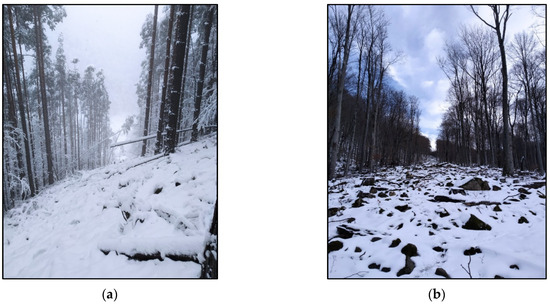
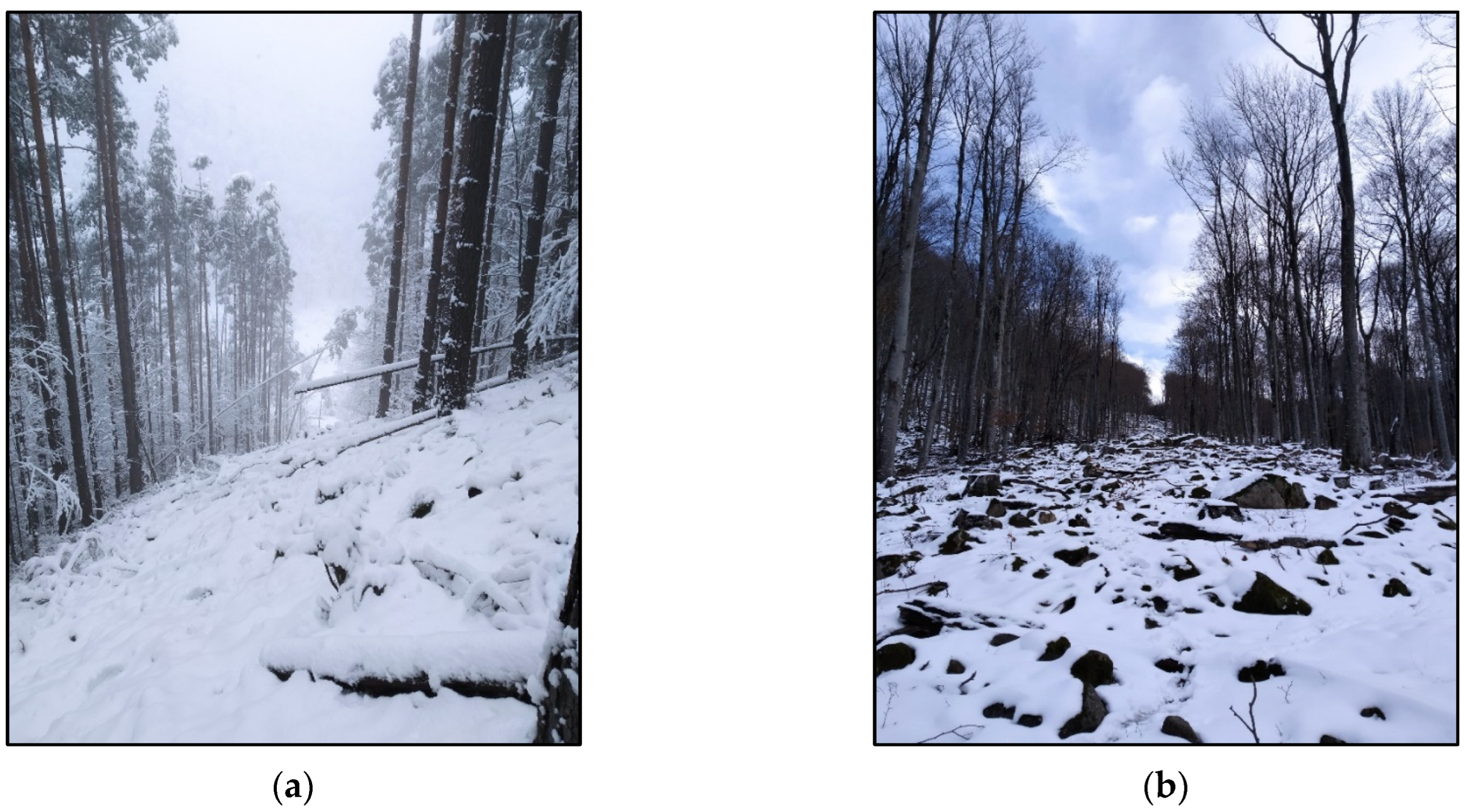
To clearly differentiate and compare among the data, the share of damage was computed as the ratio of the number of damaged trees to total number of trees. The two corridors on which data was sampled were considered as two distinct case studies for which the data was mainly documented and reported descriptively (Figure 1). Accordingly, specific statistics were computed and reported using the same categories and types of damage for both case studies.
Figure 1.
Views of the studied cable corridors (a,b) after timber extraction. (a) Cable corridor in the Scots pine stand. (b) Cable corridor in the European beech stand.
3. Results
3.1. Location of Damages on the Residual Tree
A total of 87 residual trees were examined in the beech case (Table 6). Of these, 28 trees showed damage, corresponding to 32.2% of all residual trees assessed. Among damaged trees, root damage accounted for 7.1%, while buttress-root damage accounted for 3.6%. At a height of 0.3 m to 1.0 m from the stem, they were found on 39.3% of the trees, and damage at a height of more than 1 m from the buttress represented 50% of all damage. This damage was caused by logs pulled by the mainline onto the carriage. Damage recorded at a height of more than 2.0 m was caused by the felling of trees and was not the subject of the study. A total of 262 trees were examined in the coniferous stand. Here, 14 trees were damaged, which represents 5.3% of their total number in the sample plots. Root damage was not recorded. Trees with buttress damages were 4, which represents 28.6%, and damage at a height of 0.3 to 1.0 m on the stem was found on 50% of the trees. Damage located above 1 m on the stem was recorded on 3 trees, accounting for 21.4% of damaged trees. These damages were caused by the logs being pulled by the mainline. As shown in Table 6 and Table 7, in both stands the majority of injuries were associated with the mainline during the inhauling phase toward the carriage. However, the overall incidence of damage differed markedly between the two stands, reaching 32.2% in the beech case and 5.3% in the coniferous stand.
Table 6.
Damage locations on residual trees in beech stands by sample plot (SP) relative to the total number of trees.
Table 7.
Damage locations on residual trees in coniferous stands by sample plot (SP) relative to the total number of trees.
3.2. Size of the Damage
From the sample plots set up in the beech stand, it can be seen that 71.4% of the damages were medium-sized, with an area between 101 and 200 cm2; small damages with an area of 51–100 cm2 covered 28.6% of all damages (Figure 2—Table 8 and Table 9). Damages of other sizes were not reported. The data from the sample plots set up in the coniferous stand shows that very small damages with an area of 11–50 cm2 predominated, representing 57.1%, whereas small damages with an area of 51–100 cm2 covered 42.9% of all damages. The size of damage in both stands was influenced by the average diameter and length of the extracted wood. It is important to note that in the beech stand full trees were hauled in, which were delimbed and crosscut at the yarding corridor. Due to their high size and wide crowns, the hauled trees caused substantial damage to the residual trees. In the coniferous stand, delimbing and crosscutting of the felled trees was carried out at the felling site, causing lower damage by inhauling observed in this case. The damage registered here was minor, mainly in the form of the abrasion of the bark by the mainline, despite the greater relative stocking of the coniferous stand (0.9), compared to that of the beech stand (0.6).
Figure 2.
An overview of damages measured.
Table 8.
Classification of damages by size in the beech stand.
Table 9.
Classification of damages by size in the coniferous stand.
3.3. Distance of Damaged Residual Trees from the Skyline
Table 10 reports the distribution of damaged residual trees among distance categories from the skyline projection. Percentages are calculated relative to the number of damaged trees within each sample plot and therefore should not be interpreted as damage probability or damage rate by distance class. In the beech case, among damaged trees, 10.7% were located within 0–2 m from the skyline projection, 17.9% within 2.1–4 m, 10.7% within 4.1–6 m, 10.7% within 6.1–8 m, and 50.0% at distances greater than 8 m. Among damaged trees, the largest proportion of observed injuries was located at distances greater than 8 m from the skyline projection. Damages located between 0 and 2 m away from the skyline in the coniferous stand represented 7.1% (Table 11), a share that was also specific for damaged trees located at a distance between 2.1 and 4 m. Among damaged trees, the largest proportion was located at distances greater than 8 m from the skyline projection, 42.9%, followed by the 4.1–6 m class, 28.6%. In the studied stands, the ground slope was 32° for the coniferous and 33° for the deciduous stand (Table 1). The yarder corridor in the coniferous stand ran diagonally to the slope, with the direction tree felling from the western part being perpendicular to it. The felled trees fall close to the skyline and this operational configuration may have contributed to the observed distribution of injuries; however, damage probability by distance could not be estimated because the total number of residual trees within each distance class was not available. In the beech stand, tree felling direction coincided with the direction of the slope, but due to the existing regeneration patches that were protected during felling, the direction of felling and the direction of inhauling were not optimal for the residual trees. In the coniferous stand, salvage logging was carried out with an intensity of 50%. As mentioned above, in this case the characteristics of the terrain and the absence of tree felling around regenerated areas influenced the reduction of damage.
Table 10.
Distribution of damaged residual trees by distance category from the skyline projection in the beech case. Percentages are calculated relative to the number of damaged trees within each sample plot.
Table 11.
Distribution of damaged residual trees by distance category from the skyline projection in the Scots pine case. Percentages are calculated relative to the number of damaged trees within each sample plot.
3.4. Bark Damages
According to the data shown in Table 12, the top layer of bark was damaged in the deciduous stand on only one tree. Bark crushed (wrinkled) was not observed. In total, there were 21 cases of wood exposed but undamaged, which represents 75% of all damaged trees in the beech sample plots. Wood exposed, slightly damaged, was observed in 6 damaged trees, corresponding to 21.4% of damaged trees. Table 13 shows the data on damage severity in the coniferous stand. The top layer of bark damage was found on two trees. Crushed bark was the most common damage to the stand and accounted for 42.9% of the damages. Wood exposed but undamaged was found on 35.7% of the damaged trees. Only one tree had wood exposed and slightly damaged. The number of trees with wood exposed but undamaged and slightly damaged dominated in the beech stand. The bark of the European beech is relatively thin and smooth, making it more sensitive to damage compared to the bark of the Scots pine, which is thick and cracked, therefore less sensitive to mechanical damage.
Table 12.
Intensity of bark damages to residual trees in the beech stand.
Table 13.
Intensity of bark damages to residual trees in the coniferous stand.
3.5. Damages to Understory and Root
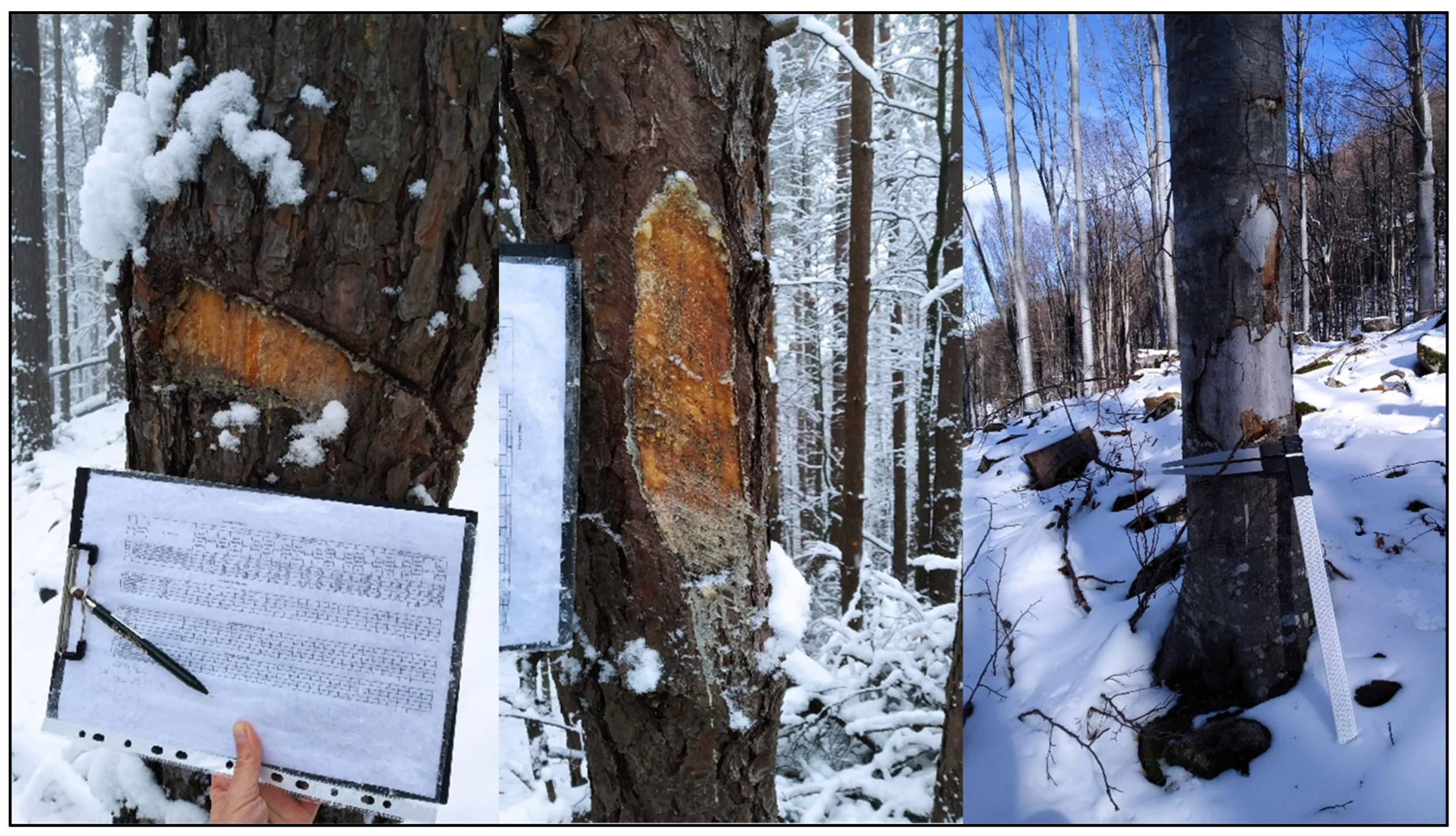
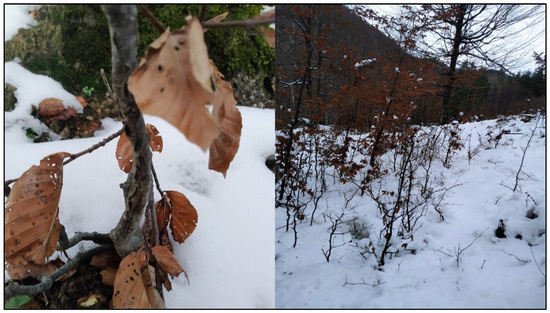
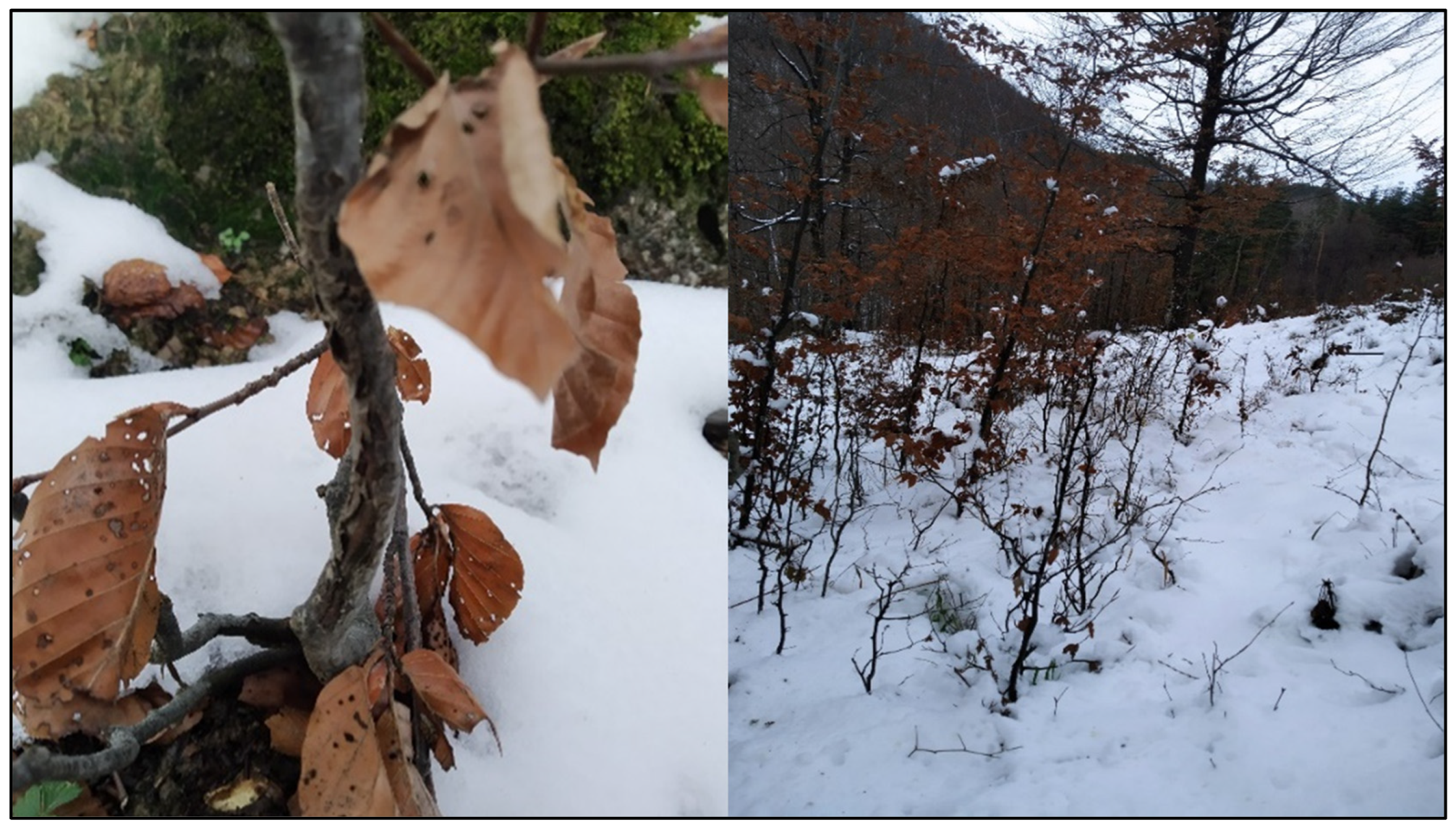
During the field surveys, it was found that no significant damage to the understory occurred. In the coniferous stand, salvage logging was carried out; the age of the tree stand is 50 years, and due to the high relative stocking and canopy coverage, no regeneration has emerged. In the beech stand, a group-shelterwood cut was carried out, and the existing regeneration patches were expanded. The direction of felling and inhauling of the wood materials was consistent with the regenerated areas, and, accordingly, no damage to the understory was recorded from the felling and extraction of the wood. Within the framework of the study, damage from another biotic factor, namely the game, was recorded in the beech stand. There was a massive biting of buds and peeling of the bark of beech saplings, which would worsen both the quality of the individuals that will form the future stand and their completeness, which was directly related to the frequency of conducting regeneration harvests (Figure 3).
Figure 3.
Damages to understory.
In both stands, the damage to the roots was relatively insignificant. The reason for the low damage rate was the biological characteristics of the tree species. European beech forms a powerful root system, with superficial lateral roots that may partially emerge toward the soil surface. In this case, in the beech stand, a strongly stony structure was observed on the soil surface, which has protected the trees from this type of damage. In both stands, stem wounds were concentrated within 0–1 m of the ground, consistent with abrasion caused by the mainline during inhauling.
3.6. Secondary Tree Damage
The ecological assessment of the damage to the residual trees is necessary to determine the risks of cable yarding extraction. As it became clear from this study, the damage to the beech stand was higher, accounting for 32%. The high share of trees with mechanical injuries, with a predominance of damage class of over 200 cm2, may be an enabler for the occurrence of secondary damage to the beech stand from the development of phytopathogens causing rot and insect pests. The ecological requirements for infection of trees with phytopathogenic fungi are the presence of open wounds, and their development is often also determined by climate factors. Such phytopathogens for the European beech are the fungi of the genus Pholiota, causing rot, cancer caused by the fungus Nectria sp., etc. After infection, individuals undergo physiological weakening, which in turn creates an opportunity for the accommodation of insect pests, disrupts the physical and mechanical properties of the wood, and can lead to tree mortality. Damage in the coniferous stand accounted for 5.3%, which places it at low risk for the mass entry of phytopathogens.
4. Discussion and Conclusions
A key limitation of the present study is that the analysis was based on two specific harvesting operations in which stand composition, bark characteristics, silvicultural treatment, harvesting intensity, and harvesting/handling configurations varied simultaneously. However, the observed differences between the two operations should be interpreted carefully in light of the study design. Accordingly, these differences should be regarded as case-specific rather than generalizable. The damage levels observed in the two case studies were within the ranges previously reported for cable-based extraction systems under mountain forest conditions [11,19,29]. In the beech stand, a higher proportion of damaged residual trees and a greater occurrence of medium-sized wounds (101–200 cm2) were documented, whereas in the coniferous stand most injuries were classified as very small to small (11–100 cm2). These observations are consistent with patterns described in earlier studies on residual stand damage associated with cable yarding and winching operations [11,19].
However, the observed differences between the two operations should be interpreted carefully in light of the study design. The two case studies differed simultaneously in several factors, including stand composition, bark characteristics, silvicultural treatment, harvesting intensity, extraction configuration, skyline layout, and average inhaul distance. Consequently, the independent effects of the contributing factors cannot be isolated or quantified, and the observed differences should be interpreted as case-specific rather than generalizable.
In both operations, stem injuries were mainly concentrated between 0.3 and 1.0 m above ground level, with some wounds extending beyond 1.0 m. This vertical distribution aligns with previous observations for cable yarding systems, where cable and log movements during inhauling frequently produce contacts along the lower bole [11,19,24]. Similarly, damaged trees were observed across multiple distance classes from the skyline corridor, including the farthest classes. Since exposure data for all residual trees by distance category were not available, these patterns should be interpreted only as the spatial distribution of observed damage rather than as evidence of increasing or decreasing damage probability with distance.
Differences in wound typology were also observed between the two case studies. In the beech stand, wounds with exposed but undamaged wood were more frequently recorded, whereas crushed bark injuries were more common in the coniferous stand. Likewise, stem-located injuries appeared more frequent in the beech stand, while the coniferous stand was characterized predominantly by smaller wound classes. These patterns can be described in relation to differences in operational conditions and stand-specific characteristics such as bark morphology, stem structure, extraction configuration, and handling procedures, as also discussed in the previous literature [11,19,29]. Nevertheless, these relationships remain interpretative within the context of the present study design and cannot be considered causal.
The larger wound classes observed in the beech stand may have potential implications from a pathological perspective, since previous studies have associated larger wound surfaces with slower closure rates and increased susceptibility to decay and discoloration processes [11,19,29]. Overall, the present findings are consistent with previous evidence indicating that extraction operations represent a major source of residual stand damage in cable-based harvesting systems. In both case studies, most of the observed injuries occurred during phases involving mainline movement.
Within these limitations, the study provides a descriptive contribution to the understanding of residual stand damage associated with sledge yarder operations under mountain forest conditions. The findings also remain consistent with previous studies that have reported generally lower levels of residual stand damage in cable-based extraction systems compared with ground-based extraction systems such as cable skidders or adapted farm tractors [18]. Future studies conducted under more controlled and comparable operational conditions are therefore needed to better isolate and quantify the relative contribution of these factors. From an operational perspective, the adoption of protective and diversion devices around trees at risk, improved corridor planning, optimization of pulling angles, and enhanced operator training combined with appropriate incentive schemes may contribute to reducing mechanical impacts on the residual stand during extraction activities.
Author Contributions
Conceptualization, A.R.P., S.S. and S.A.B.; Methodology, A.R.P., S.S. and S.A.B.; writing—original draft preparation, A.R.P., S.S. and S.A.B.; writing—review and editing, A.R.P., S.S. and S.A.B. All authors have read and agreed to the published version of the manuscript.
Funding
This research received no external funding.
Data Availability Statement
The raw data supporting the conclusions of this article will be made available by the authors upon request.
Acknowledgments
This work was supported by the University of Forestry, Sofia. Some of the activities in this study were funded by the inter-institutional agreement between the University of Forestry (Bulgaria) and the Mediterranean University of Reggio Calabria (Italy).
Conflicts of Interest
The authors declare no conflicts of interest.
References
- Cudzik, A.; Brennenstuhl, M.; Białczyk, W.; Czarnecki, P. Damage to soil and residual trees caused by different logging systems applied to late thinning. Croat. J. For. Eng. 2017, 38, 83–95. [Google Scholar]
- Homolák, M.; Alberto, S.; Mammoliti, A.; Žido, J.; Saeed, H.; Kupka, D.; Pichler, V.; Proto, A.R. Simultaneous Negative Changes in Soil Electrical Resistivity and Porosity in Two Carpathian Mixed Forests Induced by Rubber-Tyred Skidder Traffic. Eur. J. For. Res. 2026, 145, 26. [Google Scholar] [CrossRef] [Scilit]
- Cântar, I.-C.; Ciontu, C.-I.; Dincă, L.; Borlea, G.F.; Crişan, V.E. Damage and tolerability thresholds for remaining trees after timber harvesting: A case study from Southwest Romania. Diversity 2022, 14, 193. [Google Scholar] [CrossRef] [Scilit]
- Vasiliauskas, R. Damage to trees due to forestry operations and its pathological significance in temperate forests: A literature review. Forestry 2001, 74, 319–336. [Google Scholar] [CrossRef] [Scilit]
- Kiser, J. Residual stand damage from logging operations: A review of impacts and mitigation strategies. Int. J. For. Eng. 2011, 22, 1–10. [Google Scholar]
- Tavankar, F.; Nikooy, M.; Picchio, R.; Bonyad, A.; Venanzi, R. Effects of logging wounds on Caucasian alder trees (Alnus subcordata C.A. Mey.) in Iranian Caspian forests. Croat. J. For. Eng. 2017, 38, 73–82. [Google Scholar]
- Hwang, K.; Han, H.-S.; Marshall, S.E.; Page-Dumroese, D.S. Amount and location of damage to residual trees from cut-to-length thinning operations in a young redwood forest in Northern California. Forests 2018, 9, 352. [Google Scholar] [CrossRef] [Scilit]
- Tsioras, P.A.; Liamas, D.K. Residual tree damage along skidding trails in beech stands in Greece. J. For. Res. 2015, 26, 523–531. [Google Scholar] [CrossRef] [Scilit]
- Ursić, B.; Vusić, D.; Papa, I.; Poršinsky, T.; Zečić, Ž.; Đuka, A. Damage to residual trees in thinning of broadleaf stand by mechanised harvesting system. Forests 2022, 13, 51. [Google Scholar] [CrossRef] [Scilit]
- Marchi, E.; Chung, W.; Visser, R.; Abbas, D.; Nordfjell, T.; Mederski, P.S.; McEwan, A.; Brink, M.; Laschi, A. Sustainable Forest operations (SFO): A new paradigm in a changing world and climate. Sci. Total Environ. 2018, 634, 1385–1397. [Google Scholar] [CrossRef] [Scilit]
- Acuña, E.; Sanfuentes, E.; Cancino, J.; Mena, P. Damage to remaining trees by four systems of mechanized harvest in commercial thinning of Pinus radiata. Ciênc. Florest. 2018, 28, 1317–1327. [Google Scholar] [CrossRef] [Scilit]
- Picchio, R.; Mederski, P.S.; Tavankar, F. How and how much do harvesting activities affect forest soil, regeneration and stands? Curr. For. Rep. 2020, 6, 115–128. [Google Scholar] [CrossRef] [Scilit]
- Knežević, J.; Musić, J.; Halilović, V.; Avdagić, A. Damages of skidder and oxen logging to residual trees in uneven-aged mixed forest. Forests 2023, 14, 927. [Google Scholar] [CrossRef] [Scilit]
- Tavankar, F.; Nikooy, M.; Lo Monaco, A.; Latterini, F.; Venanzi, R.; Picchio, R. Short-term recovery of residual tree damage during successive thinning operations. Forests 2020, 11, 731. [Google Scholar] [CrossRef] [Scilit]
- Forkuo, G.O.; Proto, A.R.; Borz, S.A. Detecting severity and extent of soil disturbance in forest operations using mobile LiDAR technology. Croat. J. For. Eng. 2025, 46, 329–345. [Google Scholar] [CrossRef] [Scilit]
- Stańczykiewicz, A.; Szewczyk, G.; Kulak, D. Damage to advance growth resulting from timber harvesting during final cuttings. Balt. For. 2015, 21, 144–151. [Google Scholar]
- Proto, A.R.; Skoupy, A.; Macrì, G.; Zimbalatti, G. Time consumption and productivity of a medium size mobile tower yarder in downhill and uphill configurations: A case study in Czech Republic. J. Agric. Eng. 2016, 47, 216–221. [Google Scholar] [CrossRef] [Scilit]
- Bustos, O.; Egan, A.; Hedstrom, W. A comparison of residual stand damage along yarding trails in a group selection harvest using four different yarding methods. North. J. Appl. For. 2010, 27, 56–61. [Google Scholar] [CrossRef] [Scilit]
- Bodaghi, A.I.; Nikooy, M.; Naghdi, R.; Tavankar, F. Logging damage to residual trees during sustainable harvesting of uneven-age stands in the Hyrcanian forests of Iran. N. Z. J. For. Sci. 2020, 50, 15. [Google Scholar] [CrossRef] [Scilit]
- Borz, S.; Crăciun, B.; Marcu, M.; Iordache, E.; Proto, A.R. Could timber winching operations be cleaner? An evaluation of two options in terms of residual stand damage, soil disturbance and operational efficiency. Eur. J. For. Res. 2023, 142, 475–491. [Google Scholar] [CrossRef] [Scilit]
- Picchio, R.; Tavankar, F.; Bonyad, A.; Mederski, P.S.; Venanzi, R.; Nikooy, M. Detailed analysis of residual stand damage due to winching on steep terrains. Small-Scale For. 2019, 18, 255–277. [Google Scholar] [CrossRef] [Scilit]
- Lee, E.; Lee, S.-T.; Mun, H.-S.; Chung, S.; Oh, J.-H. Assessing the residual stand damage after thinning with different levels of mechanization. Forests 2024, 15, 794. [Google Scholar] [CrossRef] [Scilit]
- Han, H.-S.; Kellogg, L.D. Damage characteristics in young Douglas-fir stands from commercial thinning with four timber harvesting systems. Int. J. For. Eng. 2020, 31, 290–302. [Google Scholar] [CrossRef] [Scilit]
- Kizha, A.R.; Nahor, E.; Coogen, N.; Louis, L.T.; George, A.K. Residual stand damage under different harvesting methods and mitigation strategies. Sustainability 2021, 13, 7641. [Google Scholar] [CrossRef] [Scilit]
- Nakou, A.; Sauter, U.H.; Kohnle, U. Improved models of harvest-induced bark damage. Ann. For. Sci. 2016, 73, 233–246. [Google Scholar] [CrossRef] [Scilit]
- Magagnotti, N.; Spinelli, R. Integrating animal and mechanical operations in protected areas. Croat. J. For. Eng. 2011, 32, 489–499. [Google Scholar]
- Meng, F.R. Logging damage in selection cutting of northern hardwood forests. For. Chron. 1978, 54, 20–23. [Google Scholar]
- Butora, A.; Schwager, G. Holzernteschäden in Durchforstungsbeständen; Swiss Federal Institute of Forestry Research: Birmensdorf, Switzerland, 1986. [Google Scholar]
- Ezzati, S.; Malek, I.; Tavankar, F.; Parsakhoo, A. The Role of Management Practices and Trail Layouts on Postharvest Healing of Residual Trees in Mountain Broadleaves Forests. Eur. J. For. Res. 2025, 144, 621–633. [Google Scholar] [CrossRef] [Scilit]

Disclaimer/Publisher’s Note: The statements, opinions and data contained in all publications are solely those of the individual author(s) and contributor(s) and not of MDPI and/or the editor(s). MDPI and/or the editor(s) disclaim responsibility for any injury to people or property resulting from any ideas, methods, instructions or products referred to in the content. |
© 2026 by the authors. Licensee MDPI, Basel, Switzerland. This article is an open access article distributed under the terms and conditions of the Creative Commons Attribution (CC BY) license.