Administrative Fragmentation Distorts Ecological Networks: Mechanisms, Scale Effects, and Optimization Paths


Abstract
1. Introduction
2. Materials and Methods
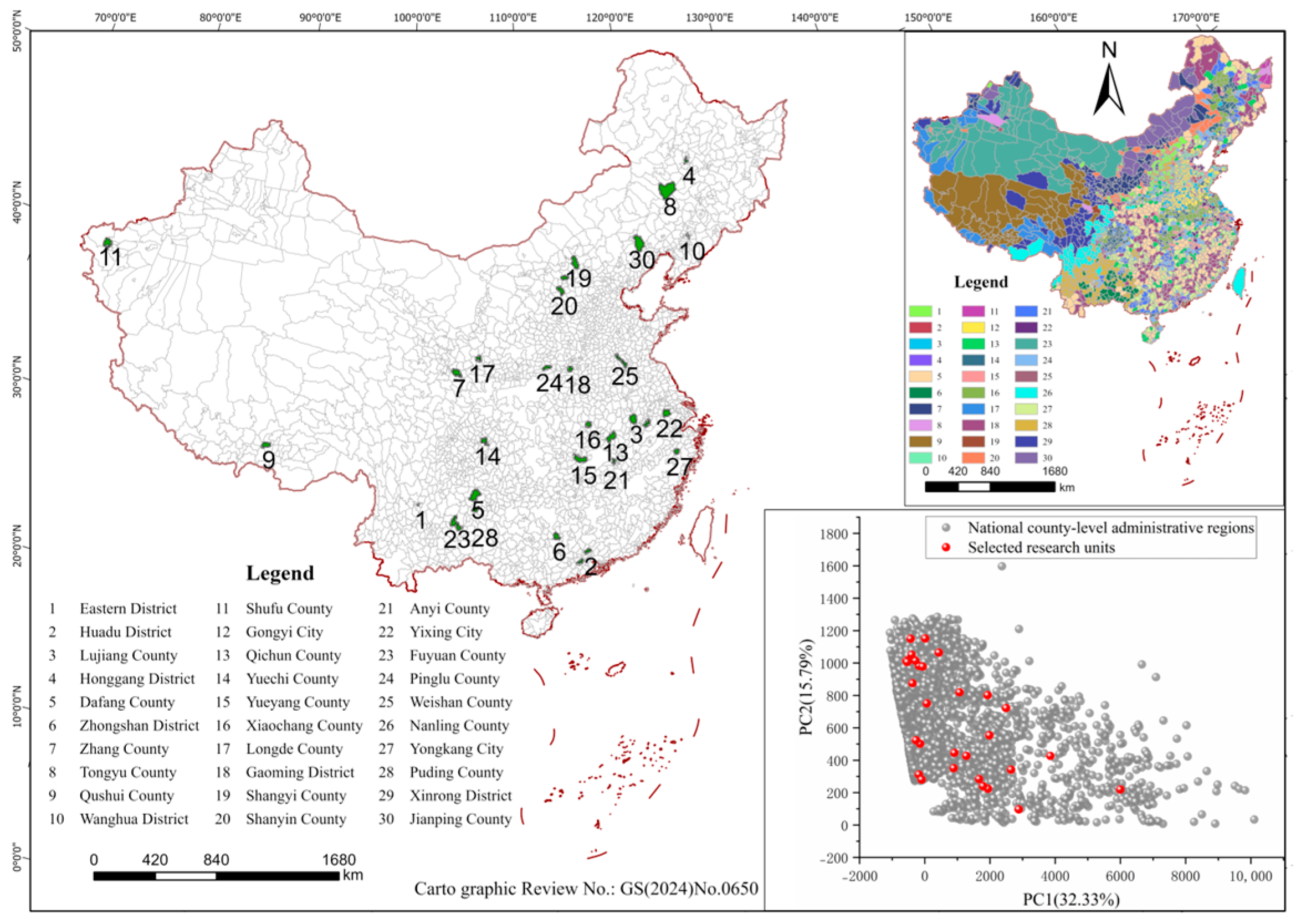
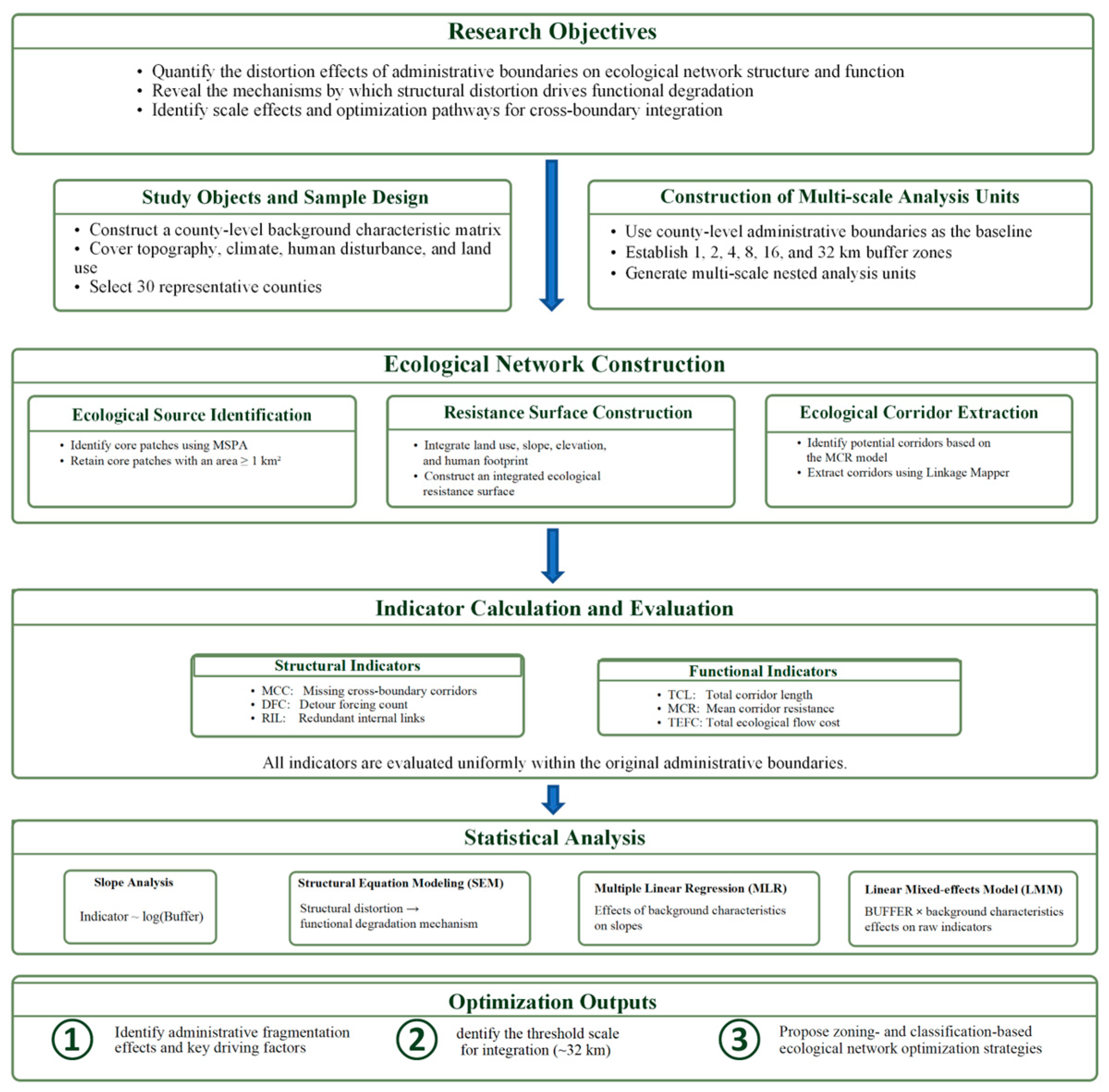
2.1. Study Area and Sampling Design
2.2. Multi-Scale Spatial Analysis Unit Construction
2.3. Ecological Network Construction
2.3.1. Ecological Source Identification
2.3.2. Resistance Surface Construction
2.3.3. Ecological Corridor Identification
2.4. Evaluation Metric System
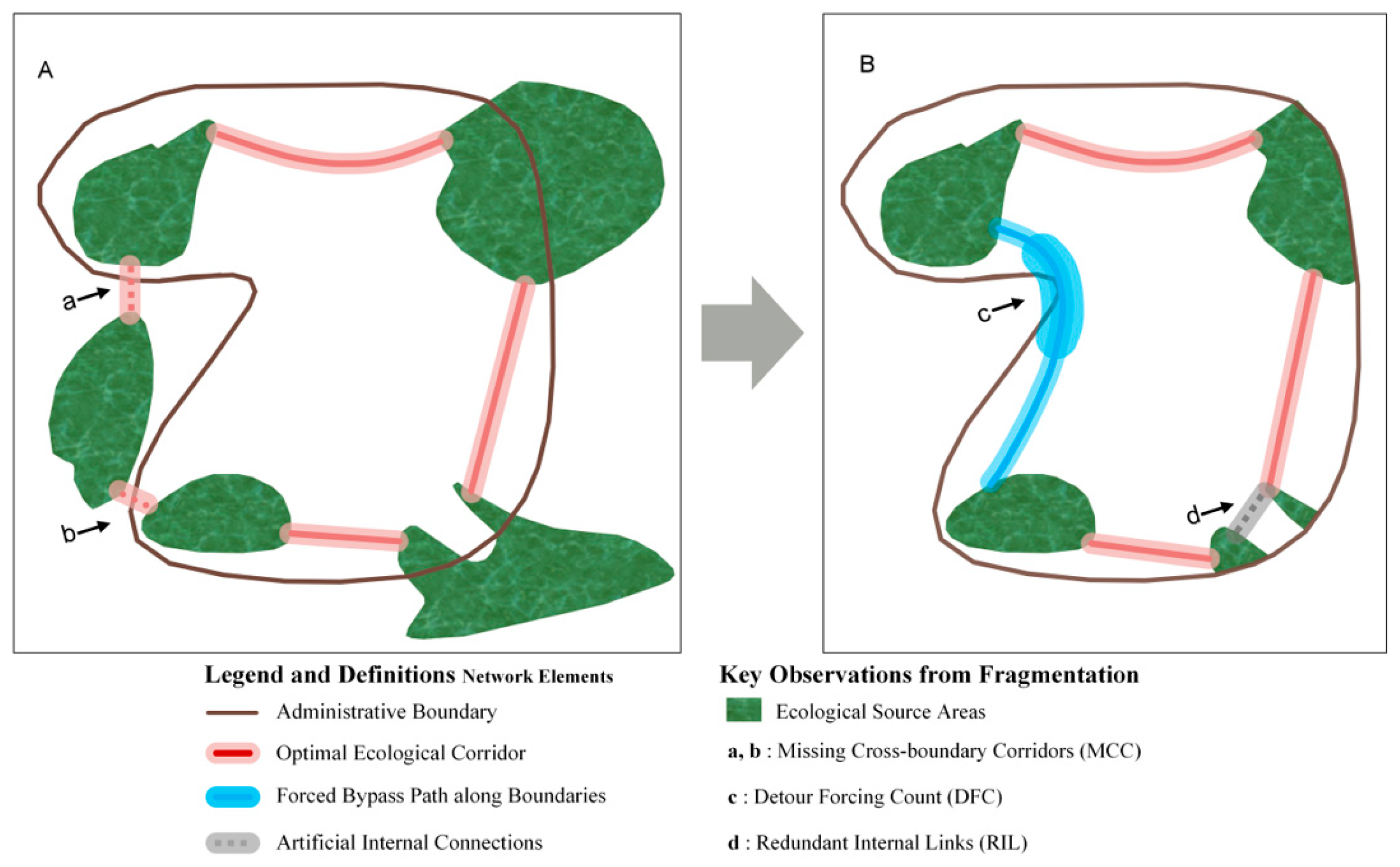
2.4.1. Structural Distortion Diagnostics
2.4.2. Functional Optimization Metrics
2.5. Statistical Analysis
2.5.1. Slope Analysis of Evaluation Metrics with Respect to Buffer Distance
2.5.2. Structural Equation Modeling (SEM)
2.5.3. Multiple Linear Regression Models
2.5.4. Linear Mixed-Effects Models (LMMs)
2.6. GenAI Tool Usage Declaration
- In the statistical analysis process, R 4.3.0 software was employed, and GenAI was leveraged to optimize the code;
- GenAI was used to refine the language of the manuscript.
3. Results
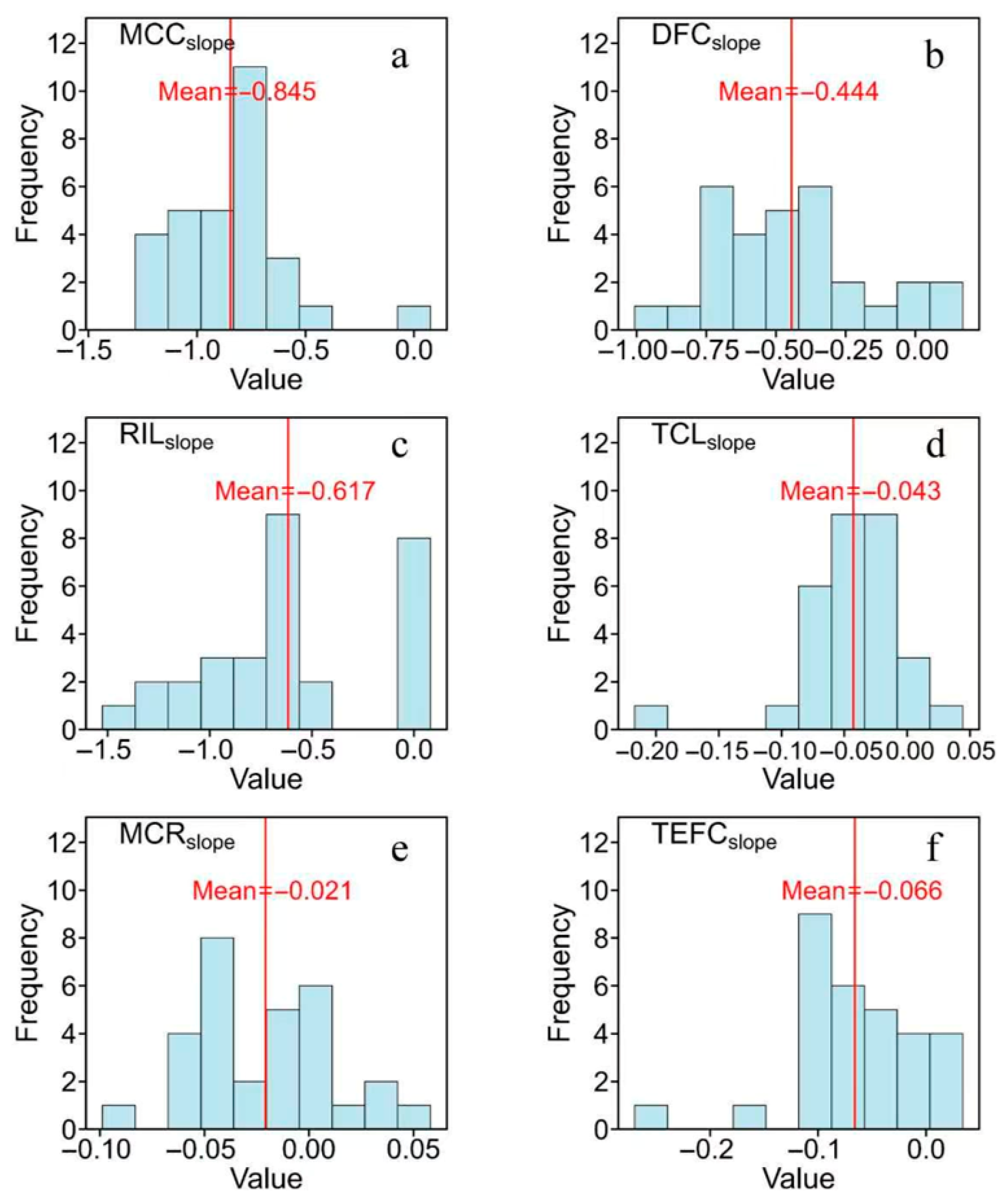
3.1. Administrative Fragmentation Systematically Distorts Network Structure and Function
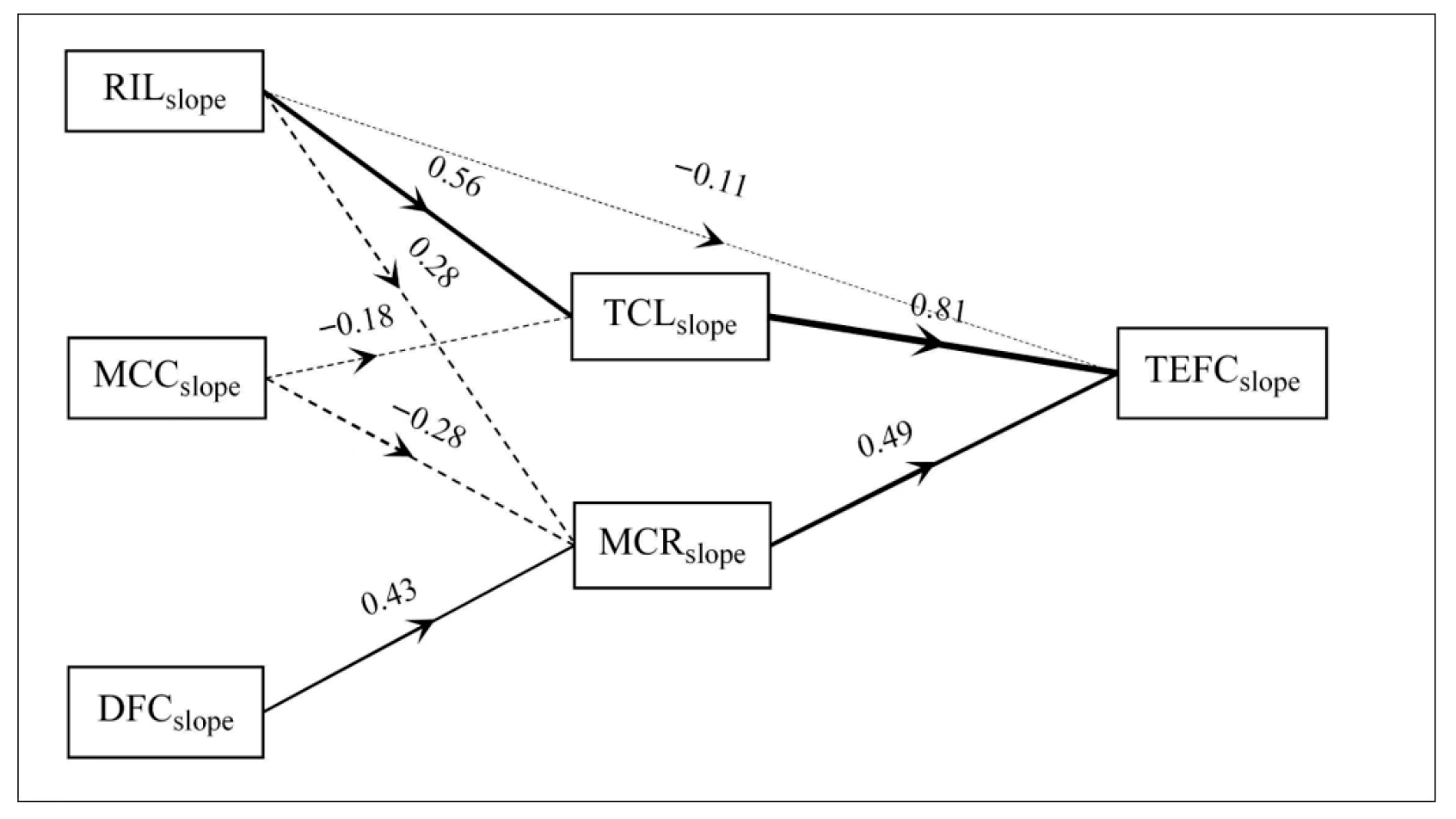
3.2. Structural Distortions Drive Functional Degradation Through Cascading Pathways
3.3. Context-Dependent Sensitivity of Network Responses to Cross-Boundary Integration
3.4. Buffer Distance and Landscape Characteristics Jointly Shape Network Dynamics
4. Discussion
4.1. Mechanisms of Administrative Fragmentation: From Structural Distortion to Functional Degradation
4.2. Unpacking the Chain Mechanism: From Structural Repair to Functional Enhancement
4.3. Differentiated Optimization Strategies Based on Background Characteristics
4.4. Towards an Ecological Process-Based Paradigm for Cross-Administrative Network Planning
4.5. Limitations and Future Prospects
5. Conclusions
Supplementary Materials
Author Contributions
Funding
Data Availability Statement
Acknowledgments
Conflicts of Interest
Abbreviations
| TEFC | Total Ecological Flow Cost |
| MCC | Missing Cross-boundary Corridors |
| DFC | Detour Forcing Count |
| RIL | Redundant Internal Links |
| TCL | Total Corridor Length |
| MCR | Mean Corridor Resistance |
| SHID | Shape Index |
| ELED | Elevation Difference |
| ELEM | Mean Elevation |
| TEMP | Annual Mean Temperature |
| APRE | Annual Precipitation |
| HMFT | Human Footprint |
| ISP | Impervious Surface Proportion |
| FLPR | Forest Land Proportion |
| CLPR | Cropland Proportion |
| SLPR | Shrubland Proportion |
| GLPR | Grassland Proportion |
| MLR | Multiple Linear Regression |
| LMM | Linear Mixed-effects Models |
| SEM | Structural Equation Modeling |
| MSPA | Morphological Spatial Pattern Analysis |
| MCR model | Minimum Cumulative Resistance model |
References
- Fahrig, L. Effects of habitat fragmentation on biodiversity. Annu. Rev. Ecol. Evol. Syst. 2003, 34, 487–515. [Google Scholar] [CrossRef] [Scilit]
- Haddad, N.M.; Brudvig, L.A.; Clobert, J.; Davies, K.F.; Gonzalez, A.; Holt, R.D.; Lovejoy, T.E.; Sexton, J.O.; Austin, M.P.; Collins, C.D.; et al. Habitat fragmentation and its lasting impact on Earth’s ecosystems. Sci. Adv. 2015, 1, e1500052. [Google Scholar] [CrossRef] [Scilit]
- Brondizio, E.S.; Settele, J.; Díaz, S.; Ngo, H.T. Global Assessment Report on Biodiversity and Ecosystem Services of the Intergovernmental Science-Policy Platform on Biodiversity and Ecosystem Services; IPBES Secretariat: Bonn, Germany, 2019. [Google Scholar]
- Liu, J.; Coomes, D.A.; Gibson, L.; Hu, G.; Liu, J.; Luo, Y.; Wu, C.; Yu, M. Forest fragmentation in China and its effect on biodiversity. Biol. Rev. 2019, 94, 1636–1657. [Google Scholar] [CrossRef] [Scilit]
- Jongman, R.H.G.; Külvik, M.; Kristiansen, I. European ecological networks and greenways. Landsc. Urban Plan. 2004, 68, 305–319. [Google Scholar] [CrossRef] [Scilit]
- Saura, S.; Estreguil, C.; Mouton, C.; Rodríguez-Freire, M. Network analysis to assess landscape connectivity trends: Application to European forests (1990–2000). Ecol. Indic. 2011, 11, 407–416. [Google Scholar] [CrossRef] [Scilit]
- Heller, N.E.; Zavaleta, E.S. Biodiversity management in the face of climate change: A review of 22 years of recommendations. Biol. Conserv. 2009, 142, 14–32. [Google Scholar] [CrossRef] [Scilit]
- Oliver, T.H.; Heard, M.S.; Isaac, N.J.B.; Roy, D.B.; Procter, D.; Eigenbrod, F.; Freckleton, R.; Hector, A.; Orme, C.D.L.; Petchey, O.L.; et al. Biodiversity and resilience of ecosystem functions. Trends Ecol. Evol. 2015, 30, 673–684. [Google Scholar] [CrossRef] [Scilit]
- Yu, K. Security patterns and surface model in landscape ecological planning. Landsc. Urban Plan. 1996, 36, 1–17. [Google Scholar] [CrossRef] [Scilit]
- Liu, M.; Peng, J.; Dong, J.; Jiang, H.; Xu, D.; Meersmans, J. Trade-offs of landscape connectivity between regional and interregional ecological security patterns in a junction area of Beijing-Tianjin-Hebei region. Appl. Geogr. 2024, 167, 103272. [Google Scholar] [CrossRef] [Scilit]
- Wu, J. Landscape sustainability science: Ecosystem services and human well-being in changing landscapes. Landsc. Ecol. 2013, 28, 999–1023. [Google Scholar] [CrossRef] [Scilit]
- Secretariat of the Convention on Biological Diversity. Kunming-Montreal Global Biodiversity Framework; Secretariat of the Convention on Biological Diversity: Montreal, QC, Canada, 2022.
- The Central Committee of the Communist Party of China; The State Council. Outline of the "Healthy China 2030" Plan; The Central Committee of the Communist Party of China, The State Council: Beijing, China, 2016.
- Bakker, M.; Alam, S.J.; van Dijk, J.; Rounsevell, M.; Spek, T.; van den Brink, A. The feasibility of implementing an ecological network in The Netherlands under conditions of global change. Landsc. Ecol. 2015, 30, 791–804. [Google Scholar] [CrossRef] [Scilit]
- Dallimer, M.; Strange, N. Why socio-political borders and boundaries matter in conservation. Trends Ecol. Evol. 2015, 30, 132–139. [Google Scholar] [CrossRef] [Scilit]
- Liu, J.; Yong, D.L.; Choi, C.-Y.; Gibson, L. Transboundary frontiers: An emerging priority for biodiversity conservation. Trends Ecol. Evol. 2020, 35, 679–690. [Google Scholar] [CrossRef] [Scilit]
- Mason, N.; Ward, M.; Watson, J.E.M.; Venter, O.; Runting, R.K. Global opportunities and challenges for transboundary conservation. Nat. Ecol. Evol. 2020, 4, 694–701. [Google Scholar] [CrossRef] [Scilit]
- Cumming, G.S.; Schmiegelow, F.K.A.; Beier, P. Scale mismatches in social-ecological systems: Causes, consequences, and solutions. Ecosystems 2006, 9, 142–155. [Google Scholar] [CrossRef] [Scilit]
- Guerrero, A.M.; McAllister, R.R.J.; Corcoran, J.; Wilson, K.A. Scale mismatches, conservation planning, and the value of social-network analyses. Conserv. Biol. 2013, 27, 35–44. [Google Scholar] [CrossRef] [Scilit] [PubMed]
- Cumming, G.S.; Dobbs, K.A. Quantifying social-ecological scale mismatches suggests people should be managed at broader scales than ecosystems. One Earth 2020, 3, 251–259. [Google Scholar] [CrossRef] [Scilit]
- Vogt, P.; Riitters, K.H.; Estreguil, C.; Kozak, J.; Wade, T.G.; Wickham, J.D. Mapping spatial patterns with morphological image processing. Landsc. Ecol. 2006, 22, 171–177. [Google Scholar] [CrossRef] [Scilit]
- Aslan, C.E.; Brunson, M.W.; Sikes, B.A.; Epanchin-Niell, R.S.; Veloz, S.; Theobald, D.M.; Dickson, B.G. Coupled ecological and management connectivity across administrative boundaries in undeveloped landscapes. Ecosphere 2021, 12, e03329. [Google Scholar] [CrossRef] [Scilit]
- Cash, D.W.; Adger, W.N.; Berkes, F.; Garden, P.; Lebel, L.; Olsson, P.; Young, O.R. Scale and cross-scale dynamics: Governance and information in a multilevel world. Ecol. Soc. 2006, 11, 8. Available online: http://www.ecologyandsociety.org/vol11/iss2/art8/ (accessed on 23 March 2026). [CrossRef] [Scilit]
- McRae, B.H.; Dickson, B.G.; Keitt, T.H.; Shah, V.B. Using circuit theory to model connectivity in ecology, evolution, and conservation. Ecology 2008, 89, 2712–2724. [Google Scholar] [CrossRef] [Scilit]
- Ellis, J.; Macpherson, E.; Thrush, S.; Fisher, K.; Pilditch, C.; Jorgensen, E.; Low, J.; Stephenson, F.; Allison, A.; Geange, S.; et al. Scale and ecosystem-based management: Navigating mismatches between socio-ecological systems. Biol. Conserv. 2025, 302, 111000. [Google Scholar] [CrossRef] [Scilit]
- Guerrero, A.M.; McAllister, R.R.J.; Wilson, K.A. Achieving cross-scale collaboration for large scale conservation initiatives. Conserv. Lett. 2014, 8, 107–117. [Google Scholar] [CrossRef] [Scilit]
- Moss, T.; Newig, J. Multilevel water governance and problems of scale: Setting the stage for a broader debate. Environ. Manag. 2010, 46, 1–6. [Google Scholar] [CrossRef] [Scilit]
- Bakker, M.M.; Opdam, P.F.M.; Jongman, R.H.G.; Van den Brink, A. Model explorations of ecological network performance under conditions of global change. Landsc. Ecol. 2015, 30, 763–770. [Google Scholar] [CrossRef] [Scilit]
- Naidoo, R.; Balmford, A.; Costanza, R.; Fisher, B.; Green, R.E.; Lehner, B.; Malcolm, T.R.; Ricketts, T.H. Global mapping of ecosystem services and conservation priorities. Proc. Natl. Acad. Sci. USA 2008, 105, 9495–9500. [Google Scholar] [CrossRef] [Scilit]
- Yang, Y.; Feng, Z.; Wu, K.; Lin, Q. How to construct a coordinated ecological network at different levels: A case from Ningbo city, China. Ecol. Inform. 2022, 70, 101742. [Google Scholar] [CrossRef] [Scilit]
- Saura, S.; Bertzky, B.; Bastin, L.; Battistella, L.; Mandrici, A.; Dubois, G. Protected area connectivity: Shortfalls in global targets and country-level priorities. Biol. Conserv. 2018, 219, 53–67. [Google Scholar] [CrossRef] [Scilit]
- Saura, S.; Torné, J. Conefor Sensinode 2.2: A software package for quantifying the importance of habitat patches for landscape connectivity. Environ. Model. Softw. 2009, 24, 135–139. [Google Scholar] [CrossRef] [Scilit]
- Pröbstl, F.; Zinngrebe, Y.; Böcher, M.; Schmid, S.; Scholz, M.; Stammel, B.; Hüesker, F. Living with the incoherent: Practical insights on implementing European restoration policies for biodiversity policy integration. Ambio 2025, 54, 1635–1647. [Google Scholar] [CrossRef] [Scilit] [PubMed]
- Peng, J.; Xu, D.M.; Tang, H.; Jiang, H.; Dong, J.Q.; Wu, J.G. A landscape ecological approach to spatial conservation planning—Ecological security pattern. Trends Ecol. Evol. 2025, 40, 1010–1022. [Google Scholar] [CrossRef] [Scilit]
- Baguette, M.; Van Dyck, H. Landscape connectivity and animal behavior: Functional grain as a key determinant for dispersal. Landsc. Ecol. 2007, 22, 1117–1129. [Google Scholar] [CrossRef] [Scilit]
- Fahrig, L.; Triantis, K.R. Rethinking patch size and isolation effects: The habitat amount hypothesis. J. Biogeogr. 2013, 40, 1649–1663. [Google Scholar] [CrossRef] [Scilit]
- Beier, P.; Noss, R.F. Do habitat corridors provide connectivity? Conserv. Biol. 1998, 12, 1241–1252. [Google Scholar] [CrossRef] [Scilit]
- Pascual-Hortal, L.; Saura, S. Comparison and development of new graph-based landscape connectivity indices: Towards the priorization of habitat patches and corridors for conservation. Landsc. Ecol. 2006, 21, 959–967. [Google Scholar] [CrossRef] [Scilit]
- Ward, M.; Saura, S.; Williams, B.; Ramírez-Delgado, J.P.; Arafeh-Dalmau, N.; Allan, J.R.; Venter, O.; Dubois, G.; Watson, J.E.M. Just ten percent of the global terrestrial protected area network is structurally connected via intact land. Nat. Commun. 2020, 11, 4452. [Google Scholar] [CrossRef] [Scilit] [PubMed]
- Opdam, P.; Steingröver, E.; Van Rooij, S. Ecological networks: A spatial concept for multi-actor planning of sustainable landscapes. Landsc. Urban Plan. 2006, 75, 322–332. [Google Scholar] [CrossRef] [Scilit]
- Chan, K.M.A.; Shaw, M.R.; Cameron, D.R.; Underwood, E.C.; Daily, G.C. Conservation planning for ecosystem services. PLoS Biol. 2006, 4, e379. [Google Scholar] [CrossRef] [Scilit]
- Saura, S.; Rubio, L. A common currency for the different ways in which patches and links can contribute to habitat availability and connectivity in the landscape. Ecography 2010, 33, 523–537. [Google Scholar] [CrossRef] [Scilit]
- Saura, S.; Pascual-Hortal, L. A new habitat availability index to integrate connectivity in landscape conservation planning: Comparison with existing indices and application to a case study. Landsc. Urban Plan. 2007, 83, 91–103. [Google Scholar] [CrossRef] [Scilit]
- Fahad, A.; Alshatri, N.; Tari, Z.; Alamri, A.; Khalil, I.; Zomaya, A.Y.; Foufou, S.; Bouras, A. A survey of clustering algorithms for big data: Taxonomy and empirical analysis. IEEE Trans. Emerg. Top. Comput. 2014, 2, 267–279. [Google Scholar] [CrossRef] [Scilit]
- Hartigan, J.A.; Wong, M.A. Algorithm AS 136: A k-means clustering algorithm. Appl. Stat. 1979, 28, 100–108. [Google Scholar] [CrossRef] [Scilit]
- Saura, S.; Bastin, L.; Battistella, L.; Mandrici, A.; Dubois, G. Protected areas in the world's ecoregions: How well connected are they? Ecol. Indic. 2017, 76, 144–158. [Google Scholar] [CrossRef] [Scilit] [PubMed]
- Morton, E.R.; McGrady, M.J.; Newton, I.; Rollie, C.J.; Smith, G.D.; Mearns, R.; Oli, M.K. Dispersal: A matter of scale. Ecology 2018, 99, 938–946. [Google Scholar] [CrossRef] [Scilit] [PubMed]
- Zhao, B.; Wang, K.; Wang, F.; Liu, H. The characteristics and changing trend of administrative boundary above county level in China. Geogr. Res. 2021, 40, 2494–2507. [Google Scholar] [CrossRef]
- Ministry of Ecology and Environment of the People’s Republic of China; National Development and Reform Commission. Some Opinions on Drawing and Strictly Observing the Ecological Conservation Red Lines; Ministry of Ecology and Environment of the People’s Republic of China: Beijing, China, 2017. Available online: http://www.mee.gov.cn/ (accessed on 23 March 2026).
- Fahrig, L. Effect of habitat fragmentation on the extinction threshold: A synthesis. Ecol. Appl. 2002, 12, 346–353. [Google Scholar] [CrossRef] [Scilit]
- Galiana, N.; Lurgi, M.; Bastazini, V.A.G.; Bosch, J.; Luciano, C.; Cazelles, K.; Claramunt-López, B.; Emer, C.; Fortin, M.-J.; Grass, I.; et al. Ecological network complexity scales with area. Nat. Ecol. Evol. 2022, 6, 307–314. [Google Scholar] [CrossRef] [Scilit]
- Yu, H.; Wang, Y.; Eme, C.; Fan, X.; Rong, Y.; Zhang, Q.; Liang, Z. Construction of ecological network based on multi-scale conversion and nesting. Water 2021, 13, 1278. [Google Scholar] [CrossRef] [Scilit]
- Jongman, R.H.G.; Bouwma, I.M.; Griffioen, A.; Jones-Walters, L.; Van Doorn, A.M. The Pan European Ecological Network: PEEN. Landsc. Ecol. 2011, 26, 311–326. [Google Scholar] [CrossRef] [Scilit]
- Fahrig, L. Ecological responses to habitat fragmentation per se. Annu. Rev. Ecol. Evol. Syst. 2017, 48, 1–23. [Google Scholar] [CrossRef] [Scilit]
- Ziółkowska, E.; Ostapowicz, K.; Radeloff, V.C.; Kuemmerle, T. Effects of different matrix representations and connectivity measures on habitat network assessments. Landsc. Ecol. 2014, 29, 1551–1570. [Google Scholar] [CrossRef] [Scilit]
- Knaapen, J.P.; Scheffer, M.; Harms, B. Estimating habitat isolation in landscape planning. Landsc. Urban Plan. 1992, 23, 1–16. [Google Scholar] [CrossRef] [Scilit]
- Keeley, A.T.H.; Beier, P.; Jenness, J.S. Connectivity metrics for conservation planning and monitoring. Biol. Conserv. 2021, 255, 109008. [Google Scholar] [CrossRef] [Scilit]
- Byrne, B.M. Structural Equation Modeling with AMOS, 2nd ed.; Routledge: New York, NY, USA, 2016. [Google Scholar]
- Burnham, K.P.; Anderson, D.R. Model Selection and Multimodel Inference: A Practical Information-Theoretic Approach, 2nd ed.; Springer: New York, NY, USA, 2002. [Google Scholar]
- Pinheiro, J.; Bates, D. Mixed-Effects Models in S and S-PLUS; Springer: New York, NY, USA, 2000. [Google Scholar]
- Dong, J.; Peng, J.; Xu, Z.; Liu, Y.; Wang, X.; Li, B. Integrating regional and interregional approaches to identify ecological security patterns. Landsc. Ecol. 2021, 36, 2151–2164. [Google Scholar] [CrossRef] [Scilit]
- Epstein, G.; Pittman, J.; Alexander, S.M.; Berdej, S.; Dyck, T.; Kreitmair, U.; Rathwell, K.J.; Villamayor-Tomas, S.; Vogt, J.; Armitage, D. Institutional fit and the sustainability of social-ecological systems. Curr. Opin. Environ. Sustain. 2015, 14, 34–40. [Google Scholar] [CrossRef] [Scilit]
- Stevens, V.M.; Trochet, A.; Van Dyck, H.; Clobert, J.; Baguette, M. How is dispersal integrated in life histories: A quantitative analysis using butterflies. Ecol. Lett. 2011, 15, 74–86. [Google Scholar] [CrossRef] [Scilit]
- Luo, Y.; Wu, J. Linking the minimum spanning tree and edge betweenness to understand arterial corridors in an ecological network. Landsc. Ecol. 2021, 36, 1549–1565. [Google Scholar] [CrossRef] [Scilit]
- Zeng, J.; Su, K.; Li, C.; Lu, J.; Jiang, X.; You, Y. Construction and analysis of multi-species ecological network, a case study of the Southeast Qinghai–Tibetan Plateau. Forests 2023, 14, 2149. [Google Scholar] [CrossRef] [Scilit]
- Pellerin, F.; Bestion, E.; Winandy, L.; Di Gesu, L.; Richard, M.; Aguilée, R.; Cote, J. Connectivity among thermal habitats buffers the effects of warm climate on life-history traits and population dynamics. J. Anim. Ecol. 2022, 91, 2301–2313. [Google Scholar] [CrossRef] [Scilit]
- Kark, S.; Tulloch, A.; Gordon, A.; Mazor, T.; Bunnefeld, N.; Levin, N. Cross-boundary collaboration: Key to the conservation puzzle. Curr. Opin. Environ. Sustain. 2015, 12, 12–24. [Google Scholar] [CrossRef] [Scilit]
- Sayles, J.S.; Baggio, J.A. Social–ecological network analysis of scale mismatches in estuary watershed restoration. Proc. Natl. Acad. Sci. USA 2017, 114, E1776–E1785. [Google Scholar] [CrossRef] [Scilit]
- Naidoo, R.; Aylward, C.; Elliott, W.; Keeley, A.; Kinnaird, M.; Knight, M.; Papp, C.-R.; Thapa, K.; Antelo, R. From science to impact: Conserving ecological connectivity in large conservation landscapes. Proc. Natl. Acad. Sci. USA 2025, 122, e2410937122. [Google Scholar] [CrossRef] [Scilit]
- Zeller, K.A.; McGarigal, K.; Whiteley, A.R. Estimating landscape resistance to movement: A review. Landsc. Ecol. 2012, 27, 777–797. [Google Scholar] [CrossRef] [Scilit]
- McGarigal, K.; Cushman, S.A.; Ene, E. FRAGSTATS v4: Spatial Pattern Analysis Program for Categorical and Continuous Maps; University of Massachusetts: Amherst, MA, USA, 2012; Available online: http://www.umass.edu/landeco/research/fragstats/fragstats.html (accessed on 23 March 2026).
- Zhang, L.; Qiang, Z.; Xu, E. Improving the Ecological Network Optimization with Landscape Connectivity: A Case Study of Neijiang City, Sichuan Province. Environ. Sci. Pollut. Res. 2023, 30, 94537–94551. [Google Scholar] [CrossRef] [Scilit] [PubMed]
- Rousseeuw, P.J. Silhouettes: A Graphical Aid to the Interpretation and Validation of Cluster Analysis. J. Comput. Appl. Math. 1987, 20, 53–65. [Google Scholar] [CrossRef] [Scilit]
- Pavlopoulos, J.; Vardakas, G.; Likas, A. Revisiting Silhouette Aggregation. arXiv 2024, arXiv:2401.05831. [Google Scholar] [CrossRef] [Scilit]
- McRae, B.H.; Kavanagh, D.M. Linkage Mapper Connectivity Analysis Software; The Nature Conservancy: Seattle, WA, USA, 2011; Available online: https://linkagemapper.org (accessed on 23 March 2026).
- Xu, Y.; Liu, Y.; Lu, Y.; Zhou, H. Construction of Ecological Security Patterns in Hilly Cities Based on Morphological Spatial Pattern Analysis and Minimum Cumulative Resistance Models: A Case Study of Ganzhou, China. Appl. Ecol. Environ. Res. 2024, 23, 1475–1496. [Google Scholar] [CrossRef] [Scilit]
- Williamson, M.A.; Parrott, L.; Carter, N.H.; Ford, A.T. Implementation Resistance and the Human Dimensions of Connectivity Planning. People Nat. 2023, 5, 1922–1936. [Google Scholar] [CrossRef] [Scilit]




| Predictors | MCCslope | DFCslope | RILslope | TCLslope | MCRslope | TEFCslope |
|---|---|---|---|---|---|---|
| SHID | 0.148 *** | 0.084 | −0.051 | — | — | −0.002 |
| ELED | — | 0.099 | −0.257 * | −0.022 * | 0.005 | — |
| HMFT | — | 0.042 | 0.321 ** | — | 0 | — |
| APRE | −0.177 ** | −0.05 | — | −0.016 | 0.003 | — |
| TEMP | 0.224 *** | 0.06 | — | 0.008 | 0 | 0.015 |
| CLPR | — | — | −0.199 | — | — | — |
| FLPR | −0.047 | 0.029 | −0.340 *** | −0.007 | −0.008 | −0.006 |
| SLPR | — | — | — | 0.016 | 0.119 | — |
| GLPR | — | — | — | — | — | 0.017 |
| ISP | −0.042 | 0.034 | −0.471 ** | — | — | — |
| SHID × GLPR | — | — | — | — | — | −0.041 ** |
| TEMP × GLPR | — | — | — | — | — | −0.002 |
| TEMP × SLPR | — | — | — | −0.024 | — | — |
| HMFT × ISP | — | −0.038 | — | — | — | — |
| Adjusted R2 | 0.643 | 0.273 | 0.477 | 0.310 | 0.088 | 0.480 |
| Predictors | MCC | DFC | RIL | TCL | MCR | TEFC |
|---|---|---|---|---|---|---|
| BUFFER | −0.412 *** | −0.441 *** | −0.613 *** | −0.044 *** | −0.021 *** | −0.066 *** |
| SHID | −0.554 *** | −0.475 *** | 0.284 ** | — | — | −0.241 * |
| ELEM | — | −0.453 * | 0.947 ** | −0.916 *** | 0.260 *** | — |
| TEMP | −0.276 * | — | — | −0.578 * | 0.172 ** | −0.755 *** |
| APRE | 0.268 * | — | — | — | −0.103 * | — |
| CLPR | — | — | 1.459 * | — | — | — |
| FLPR | — | — | 1.056 *** | — | — | — |
| SLPR | — | — | — | — | 0.747 *** | — |
| HMFT | — | — | −0.749 *** | — | — | — |
| GLPR | — | — | — | — | — | −1.782 *** |
| ISP | — | −1.050 * | 1.320 *** | — | — | — |
| BUFFER × SHID | 0.163 *** | 0.110 * | — | — | — | — |
| BUFFER × ELEM | — | — | — | — | −0.019 *** | — |
| BUFFER × FLPR | — | — | −0.264 *** | — | — | — |
| BUFFER × TEMP | — | — | 0.225 *** | — | — | — |
| TEMP × HMFT | — | — | — | — | — | −0.070 * |
| TEMP × SLPR | — | — | — | — | −1.650 *** | — |
| TEMP × GLPR | — | — | — | — | — | −0.895 *** |
| SHID × GLPR | — | — | — | — | — | −0.752 *** |
| HMFT × ISP | — | 0.662 * | — | — | — | — |
| Marginal R2 | 0.65 | 0.38 | 0.51 | 0.73 | 0.63 | 0.72 |
Disclaimer/Publisher’s Note: The statements, opinions and data contained in all publications are solely those of the individual author(s) and contributor(s) and not of MDPI and/or the editor(s). MDPI and/or the editor(s) disclaim responsibility for any injury to people or property resulting from any ideas, methods, instructions or products referred to in the content. |
© 2026 by the authors. Licensee MDPI, Basel, Switzerland. This article is an open access article distributed under the terms and conditions of the Creative Commons Attribution (CC BY) license.
Share and Cite
Zhang, X.; Teng, Y.; Fu, W.; Lou, J.; Basir, A.; Chen, S. Administrative Fragmentation Distorts Ecological Networks: Mechanisms, Scale Effects, and Optimization Paths. Forests 2026, 17, 611. https://doi.org/10.3390/f17050611
Zhang X, Teng Y, Fu W, Lou J, Basir A, Chen S. Administrative Fragmentation Distorts Ecological Networks: Mechanisms, Scale Effects, and Optimization Paths. Forests. 2026; 17(5):611. https://doi.org/10.3390/f17050611
Chicago/Turabian StyleZhang, Xuan, Yingxin Teng, Wenjing Fu, Junfeng Lou, Abdul Basir, and Shengbin Chen. 2026. "Administrative Fragmentation Distorts Ecological Networks: Mechanisms, Scale Effects, and Optimization Paths" Forests 17, no. 5: 611. https://doi.org/10.3390/f17050611
APA StyleZhang, X., Teng, Y., Fu, W., Lou, J., Basir, A., & Chen, S. (2026). Administrative Fragmentation Distorts Ecological Networks: Mechanisms, Scale Effects, and Optimization Paths. Forests, 17(5), 611. https://doi.org/10.3390/f17050611