Article

Scenario-Based Assessment of Carbon Stocks and Mitigation Potential in Perigi, South Sumatra, Indonesia

1
Global Forestry Division, Future Forest Strategy Department, National Institute of Forest Science, Seoul 02455, Republic of Korea
2
Forest Carbon Center on Climate Change, Future Forest Strategy Department, National Institute of Forest Science, Seoul 02455, Republic of Korea
*
Author to whom correspondence should be addressed.
Forests 2026, 17(5), 606; https://doi.org/10.3390/f17050606 (registering DOI)
Submission received: 14 April 2026 / Revised: 14 May 2026 / Accepted: 14 May 2026 / Published: 17 May 2026

Abstract

Peatlands cover approximately 3% of the global land area but store about 44% of the world’s soil carbon, making them a major carbon sink. Indonesia alone accounts for about 37% of global tropical peat carbon stocks. However, large-scale carbon emissions caused by fires and drainage during past economic development have transformed peatlands from carbon sinks into carbon sources. In response, restoration efforts have been implemented at both international and national levels. Tropical peatland restoration typically includes rewetting, revegetation, and community-based approaches, highlighting the need for quantitative assessments of carbon storage under different restoration strategies. This study focuses on the Perigi peatland in South Sumatra, Indonesia. We conducted field surveys of vegetation and soils to estimate carbon stocks per unit area and developed time-series land cover maps using satellite imagery. Based on these data, we assessed potential carbon storage under different restoration intensity scenarios. The results show that carbon stocks in the Perigi peatland are lower than the Indonesian average. However, under a full restoration scenario, up to 950,259 tC of additional carbon storage is possible, indicating high restoration potential. In contrast, without restoration, further carbon emissions are likely, underscoring the necessity of restoration efforts. Effective restoration requires a phased strategy from vegetation recovery to peat layer recovery, combined with socioeconomic approaches that consider local livelihoods, enabling degraded tropical peatlands to function as effective carbon mitigation systems.

1. Introduction

Peatlands cover only about 3% of the global land surface but store approximately 44% of the world’s soil carbon, making them a major carbon sink [1,2]. Peatlands are wetland ecosystems characterized by naturally accumulated peat layers formed from partially decomposed plant remains under waterlogged and anoxic conditions [2]. Tropical peatlands, in particular, store exceptionally high amounts of carbon per unit area due to the combination of dense forest biomass and extensive underlying peat layers, making them critical for climate change mitigation [3,4]. Among tropical peatland regions, Indonesia holds approximately 37% of the global tropical peatland carbon stock [5]. However, extensive development has degraded large areas of peatland, releasing carbon that accumulated over thousands of years into the atmosphere. This process has been identified as one of the major drivers accelerating climate change [6,7]. In this context, restoring degraded peatlands has become a key strategy for climate change mitigation and has gained attention as a nature-based solution that can simultaneously reduce carbon emissions and promote ecosystem recovery.
Accordingly, global efforts to reduce carbon emissions through peatland restoration have expanded under frameworks such as REDD+ (Reducing Emissions from Deforestation and Forest Degradation plus) and nature-based solutions [8,9]. In Indonesia, the government has implemented national-level restoration policies, including the establishment of Badan Restorasi Gambut (BRG; Peatland Restoration Agency). The Ministry of Environment and Forestry has also introduced long-term strategies, such as the 2020–2049 strategic plan [10], to support peatland restoration efforts. In Indonesia, peatland restoration includes various approaches, such as rewetting through canal blocking, vegetation restoration using native species, and land-use transitions based on paludiculture [11]. With increasing restoration efforts and related investments, quantifying the amount of carbon reduced or stored through peatland restoration has become increasingly important, beyond simply recognizing its importance [12,13].
Several studies have quantified carbon stocks in restored peatlands [14,15], particularly in tropical wetlands and peat forests. In Indonesian peat forests, ecosystem carbon stocks have been reported under various land-use conditions. Most previous studies compared natural peat forests and degraded peatlands or examined conditions before and after restoration to assess changes in carbon storage [16,17] and the carbon sequestration potential of restored peatlands. Some studies have also quantified carbon storage as well as carbon sequestration and emissions in restored peat forests. However, many existing studies focus on individual carbon pools, such as aboveground biomass or soil organic carbon [18,19]. As a result, studies that evaluate ecosystem-level carbon stocks by integrating aboveground biomass, belowground biomass, and soil organic carbon remain limited. In Indonesian peatlands, a large proportion of ecosystem carbon is stored in peat soil. At the same time, forest degradation and land-use change can substantially reduce aboveground carbon stocks and increase the risk of carbon loss from belowground and soil carbon pools [20,21]. Therefore, evaluating restoration effects from the perspective of total ecosystem carbon stocks that integrate aboveground biomass, belowground biomass, and soil organic carbon is necessary. In addition, carbon storage may vary depending on restoration intensity and management approaches, such as revegetation and land-use management [22,23]. Scenario-based estimation of long-term potential carbon stocks that incorporates these factors can provide a useful basis for comparing restoration strategies and supporting carbon credit estimation and policy development.
This study aimed to evaluate ecosystem carbon stocks at different restoration stages and to estimate potential carbon storage under restoration scenarios in the Perigi, South Sumatra, Indonesia, based on field observations. We assessed three land cover types—peat forest, restoring peatlands, and degraded peatlands—and quantified multiple carbon pools, including aboveground biomass, belowground biomass, and soil organic carbon, through field surveys. Based on these estimates, we quantified potential carbon storage under different restoration scenarios. The results of this study can provide baseline information for carbon management and restoration planning at the site level. In addition, the assessment framework integrating restoration stages with a scenario-based approach may contribute to future assessments of restoration effectiveness in tropical peatlands.

2. Materials and Methods

This study aimed to estimate carbon stocks in Perigi, Indonesia, and to calculate potential carbon storage under restoration scenarios with different levels of restoration intensity. To achieve this aim, we conducted field surveys of soil and vegetation for each land cover type and developed a land cover map of Perigi. We then applied the estimated carbon stocks for each land cover type to the areas derived from each restoration scenario to calculate potential carbon storage. All maps presented in this study were created using ArcGIS Pro 2.9.2 (Esri, Redlands, CA, USA).

2.1. Study Area

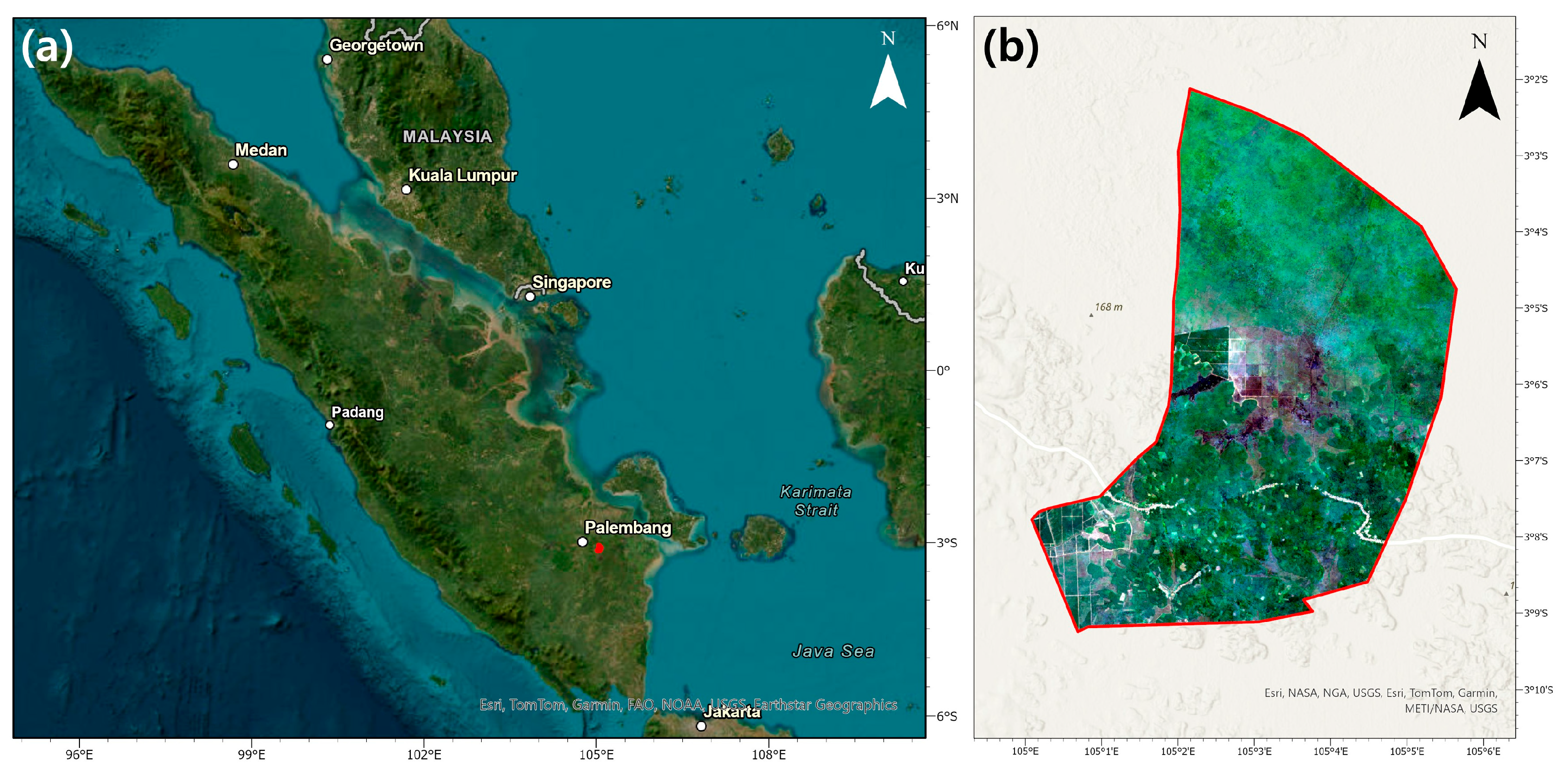
The study area is Perigi Village, located near Pangkalan Lampam in Ogan Komering Ilir Regency, South Sumatra, Indonesia (Figure 1). Although the village is adjacent to the Padang Sugihan Wildlife Reserve, peatland degradation is widespread in the area. However, the site has relatively good accessibility and strong willingness for restoration within the local community [24], and peatland restoration projects are currently in progress across multiple locations.

2.2. Data Collection

We conducted field surveys to estimate carbon stocks according to the level of peatland degradation in the Perigi area. We classified the sites into peat forest, restoring peatland, and degraded peatland. Although no peat forest remained within the study area at the time of the survey, field measurements were conducted in the nearest intact peat forest located adjacent to the study site to establish reference carbon stock values for this land cover type. We collected soil samples and carried out vegetation surveys for each land cover type.
We collected soil samples using a peat auger (Eijkelkamp peat sampler) during two field surveys conducted on 13–18 July and 27–29 July 2024. We collected soil cores at 50 cm intervals to a maximum depth of 300 cm and obtained data from a total of 80 sampling points. The sampling points included 25 in peat forest, 40 in restoring peatland, and 15 in degraded peatland. We selected sampling sites from accessible areas, considering site accessibility and field safety. We analyzed the collected soil samples for moisture content, fresh weight, dry weight, bulk density, and organic carbon content using the loss-on-ignition (LOI) method. We used bulk density and organic carbon content to calculate soil carbon stocks.
We conducted vegetation surveys focusing on woody plants. We identified species and measured height and Diameter Breast Height (DBH) for individuals with a height of at least 120 cm. Because degraded peatlands contained no woody vegetation, vegetation surveys were conducted only in peat forests and restoring peatlands. In peat forests, we established five 20 m × 20 m plots and measured all individuals with a height of at least 120 cm within each plot. The restoring peatland corresponded to a 10ha restoration site, where ten local farmers participated, each managing 1 ha. The site included plantings of Dyera lowii (586 individuals), Shorea balangeran (407), Calophyllum inophyllum (292), and Pongamia pinnata (129), together with additional species preferred by local farmers. Planting for restoration was completed in December 2022, and we conducted the field survey approximately two years after planting.

2.3. Land Cover Map

2.3.1. Land Cover Mapping

We constructed annual land cover maps using satellite imagery to analyze land cover changes across different degrees of peatland degradation in the Perigi area. We used Landsat and Sentinel-2 satellite imagery to develop the land cover maps. Sentinel-2 provides a spatial resolution of 10 m and therefore offers finer spatial information than Landsat imagery. However, because the Sentinel-2 mission began in 2015, it provides limited historical data for long-term time-series analysis. Accordingly, we used Landsat imagery to produce land cover maps for 1990 and 2006, and Sentinel-2 imagery for 2024. To ensure consistency across the different platforms, the Sentinel-2 data was resampled to match the 30 m spatial resolution of the Landsat imagery. The study area is located in a tropical climate, where frequent cloud cover during the rainy season makes it difficult to capture the entire area in a single image. Therefore, we collected all available images covering the Perigi area for each target year and applied cloud masking based on Digital Number values. We then mosaicked the cloud-masked images and applied the median spectral value for each pixel to generate composite images.
We constructed input variables for land cover classification using the composite images. These variables included six spectral bands (Blue, Green, Red, NIR, SWIR1, and SWIR2), six spectral indices (NDVI, NDMI, NDWI, EVI, SAVI, and NBR), and two topographic variables derived from the SRTM DEM (elevation and slope). We classified land cover into six categories: peat forest, general peatland, degraded peatland, general forest, bare land and built-up areas, and plantation. To perform land cover classification, we prepared training samples for each land cover type. Due to the absence of independent field-based reference data for the historical study periods, both training and validation samples were generated through the visual interpretation of satellite imagery. For 1990 and 2006, we labeled training data based on Landsat imagery, whereas for 2024, we used Google Earth Pro and Planet satellite imagery for labeling. Using the labeled dataset, we produced land cover maps using the Random Forest (RF) algorithm. We then evaluated classification performance using a subset of the labeled data that was not used during the training process.

2.3.2. Land Cover Reclassification Based on Time Series

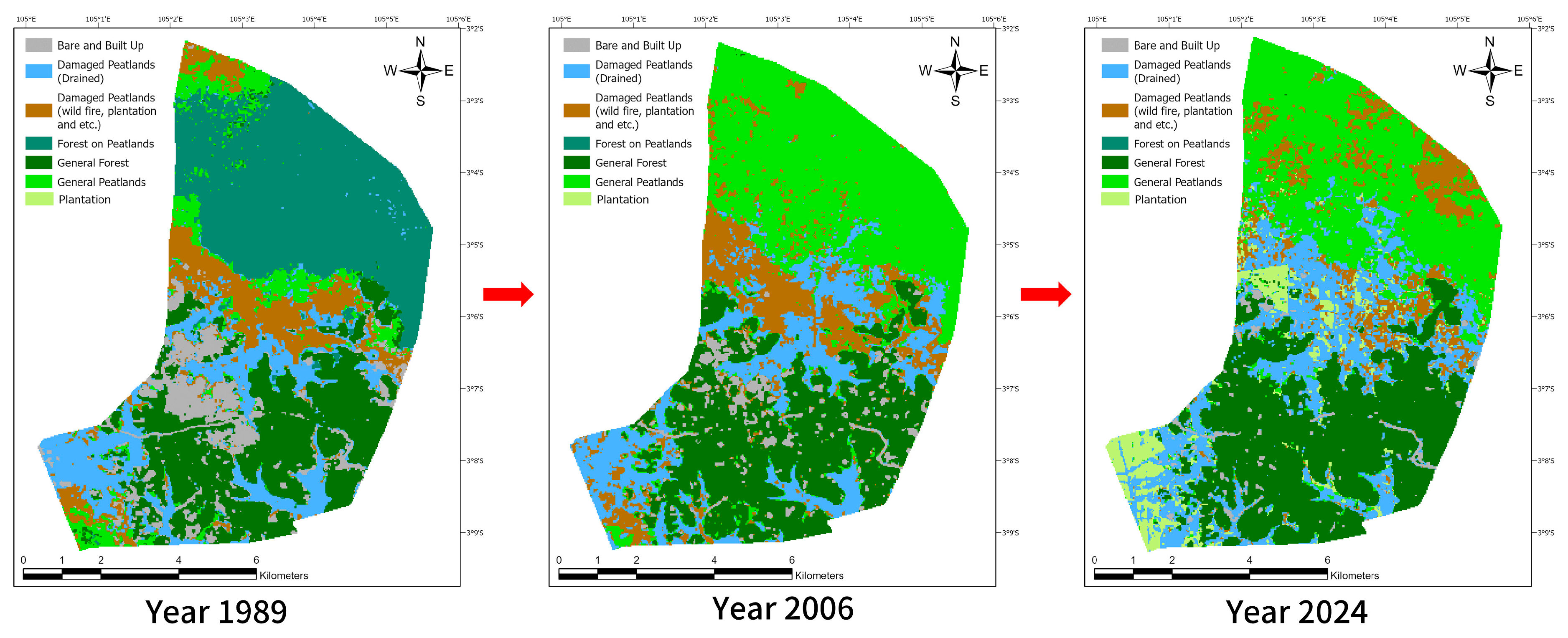
In satellite-based land cover classification, we can generally distinguish land cover types such as peat forest, forest, and bare land or built-up areas relatively clearly even from a single-date image. In contrast, we cannot reliably interpret general peatland from a single-date image because it is difficult to determine whether the area represents peatland where peat forest has been degraded and no vegetation is present, or an area undergoing restoration after drainage and logging [25]. In Indonesia, large-scale development projects have likely degraded many peatland areas in the past. However, the earliest satellite imagery begins in 1989, which limits our ability to determine whether peatlands in Perigi had already been degraded before that time based only on a single-date image. Therefore, we reclassified areas initially labeled as general peatland using time-series interpretation (Figure 2).
To perform the reclassification, we used multi-temporal land cover information derived from the time-series analysis, focusing on areas classified as general peatland in the most recent map for 2024. We defined degraded peatland not only as areas where peat soils were damaged by fire or drainage, but also as areas where peat forests had been logged in the past and are currently classified as general peatland in the land cover map. We also defined restoring peatland to include not only areas where active restoration measures, such as revegetation, have been implemented, but also areas where natural regeneration is occurring due to the absence of additional drainage or management after degradation (Table 1). Based on these definitions, we classified general peatland into degraded peatland and restoring peatland according to land cover transition patterns observed in the time series.

2.4. Carbon Stock Estimation

We estimated carbon stocks for each land cover type using data collected from the field surveys. Carbon stocks included aboveground biomass carbon, belowground biomass carbon, and soil carbon. We excluded carbon stock estimates for deadwood and litter because the high rainfall conditions in tropical peatlands cause litter and deadwood to rapidly decompose and be incorporated into the soil [26].
We estimated both aboveground biomass (AGB) and belowground biomass (BGB) using the allometric equations for tropical moist forests [27,28]. We calculated aboveground biomass using DBH measured for each individual during the vegetation survey and applied the following allometric equation (Equation (1)).
Y = e x p [ 2.289 + 2.649 × l n ( D B H ) 0.021 × ( l n ( D B H ) ) 2 ]
We calculated belowground biomass using the IPCC allometric equation that uses estimated aboveground biomass as the input variable (Equation (2)).
Y = e x p [ 1.0587 + 0.8836 × ln A B D ]
We calculated carbon stocks by applying the IPCC carbon fraction of 0.5 to the estimated aboveground and belowground biomass [29]. We estimated soil carbon stocks by analyzing soil samples collected in the field according to depth. We measured soil organic matter content using the Loss on Ignition (LOI) method and estimated soil organic carbon (SOC) content using the conventional Van Bemmelen conversion factor [30] (Equation (3)).
S O C % = L O I ( % ) × 0.58
We estimated SOC stocks by applying bulk density (BD) and peat depth to the SOC content for each soil layer (Equation (4)). We then summed the values across depths to calculate total soil carbon stocks for each sampling point.
S O C   s t o c k ( t C / h a ) = S O C ( % ) × B D ( g / c m 3 ) × P e a t   d e p t h × 0.1
We calculated the mean values of aboveground and belowground biomass carbon and soil carbon for each land cover type and used these values as representative carbon stocks for each category. For degraded peatlands, where vegetation was absent, we used soil carbon stocks per unit area (tC/ha) for each land cover type as representative values. We then applied these values to the land cover area under each restoration scenario to estimate the total carbon stocks in the Perigi area.

2.5. Restoration Scenario Development

We developed four restoration scenarios to evaluate potential changes in peatland carbon stocks in the Perigi area under different restoration intensities. The scenarios included a baseline scenario, a full restoration scenario, a partial restoration scenario, and a degradation scenario.
The baseline scenario assumes that the total peatland area remains constant without expansion or reduction. Under this scenario, the composition of restoration states within peatlands follows the land cover proportions observed in the historical reference year (1989). Specifically, we applied the relative proportions of peat forest, restoring peatland, and degraded peatland observed in 1989 to the peatland area in 2024 and assumed that these proportions remain constant. The full restoration scenario assumes continuous management and additional restoration activities, under which all existing peatlands gradually recover to the condition of peat forest. This scenario represents the most intensive restoration effort. The partial restoration scenario assumes that areas currently classified as restoring peatland recover to peat forest through additional restoration activities, while degraded peatland remains in its current state without further restoration or additional degradation. This scenario represents selective restoration under limited resources and management capacity. The degradation scenario assumes the absence of additional management or restoration measures. Under this scenario, all peatlands in the Perigi area gradually transition to degraded peatland due to continued disturbances, representing a worst-case condition under long-term management absence.

3. Results

3.1. Summary of Field Survey

Soil organic carbon stocks differed among land cover types. Restoring peatland showed 58.81 ± 16.35 tC/ha, degraded peatland showed 51.15 ± 20.82 tC/ha, and peat forest showed 45.68 ± 17.55 tC/ha (mean ± SD). For vegetation surveys in peat forest, we established five plots and measured woody plants within each plot. The results showed a mean DBH of 13.87 ± 15.48 cm and a mean height of 13.72 ± 2.44 m. In restoring peatland, we established ten plots. However, we measured DBH only for individuals with a height of at least 120 cm. Therefore, we conducted DBH measurements in five plots where woody plants exceeded this height threshold. In these plots, the mean DBH was 4.24 ± 5.33 cm and the mean height was 1.76 ± 0.33 m.

3.2. Land Area Changes by Category

3.2.1. Time-Series Analysis of Land Area Fluctuations

Land cover analysis across the time series revealed distinct changes in the area of each land cover type in the Perigi region (Table 2). Peat forest accounted for nearly half of the total area in 1990 (46.97%), but it disappeared by 2006 and remained absent in 2024. In contrast, degraded peatland showed a continuous increase over time, occupying approximately half of the study area in both 2006 and 2024. General peatland expanded markedly from 10.79% in 1990 to 50.3% in 2006, before decreasing to 40.58% in 2024. From 2006 to 2024, this represents a decrease of 9.72 percentage points. General forest area increased by more than two times during the study period, from 135 ha to 282 ha. Bare land and built-up areas showed a gradual decrease. Plantation areas were absent in 1990 and 2006 but emerged in 2024, accounting for 9.47% of the total area. Overall, peat forest declined substantially over time, whereas degraded peatland and plantation areas increased.

3.2.2. Changes in Land Area Following Land-Use Reclassification

We reclassified the previously generated land cover maps to ensure consistency with the field survey results (Table 3). The reclassification showed that 590 ha of general peatland in the 1990 land cover map corresponded to degraded peatland, increasing the degraded peatland area from 2010 ha to 2600 ha. For the 2024 land cover map, a total of 2219 ha initially classified as general peatland were reclassified, of which 450 ha were identified as restoring peatland and 1770 ha as degraded peatland.

3.3. Carbon Storage by Category

The mean carbon stock per unit area in peat forest was 257.61 tC/ha (Table 4). The mean aboveground biomass carbon was 188.78 ± 256.18 tC/ha, belowground biomass carbon was 23.11 ± 25.38 tC/ha, and soil organic carbon (SOC) was 45.68 ± 17.55 tC/ha. Restoring peatland showed a mean carbon stock of 59.85 tC/ha. The mean aboveground biomass carbon was 0.88 ± 1.32 tC/ha, belowground biomass carbon was 0.13 ± 0.16 tC/ha, and SOC was 58.81 ± 16.35 tC/ha. In degraded peatland, the mean carbon stock was 51.15 tC/ha. Biomass carbon could not be estimated due to the absence of vegetation caused by degradation. The mean SOC was 51.15 ± 20.82 tC/ha, which corresponds to the total carbon stock.

3.4. Carbon Storage in the Perigi and Carbon Storage Under Restoration Scenarios

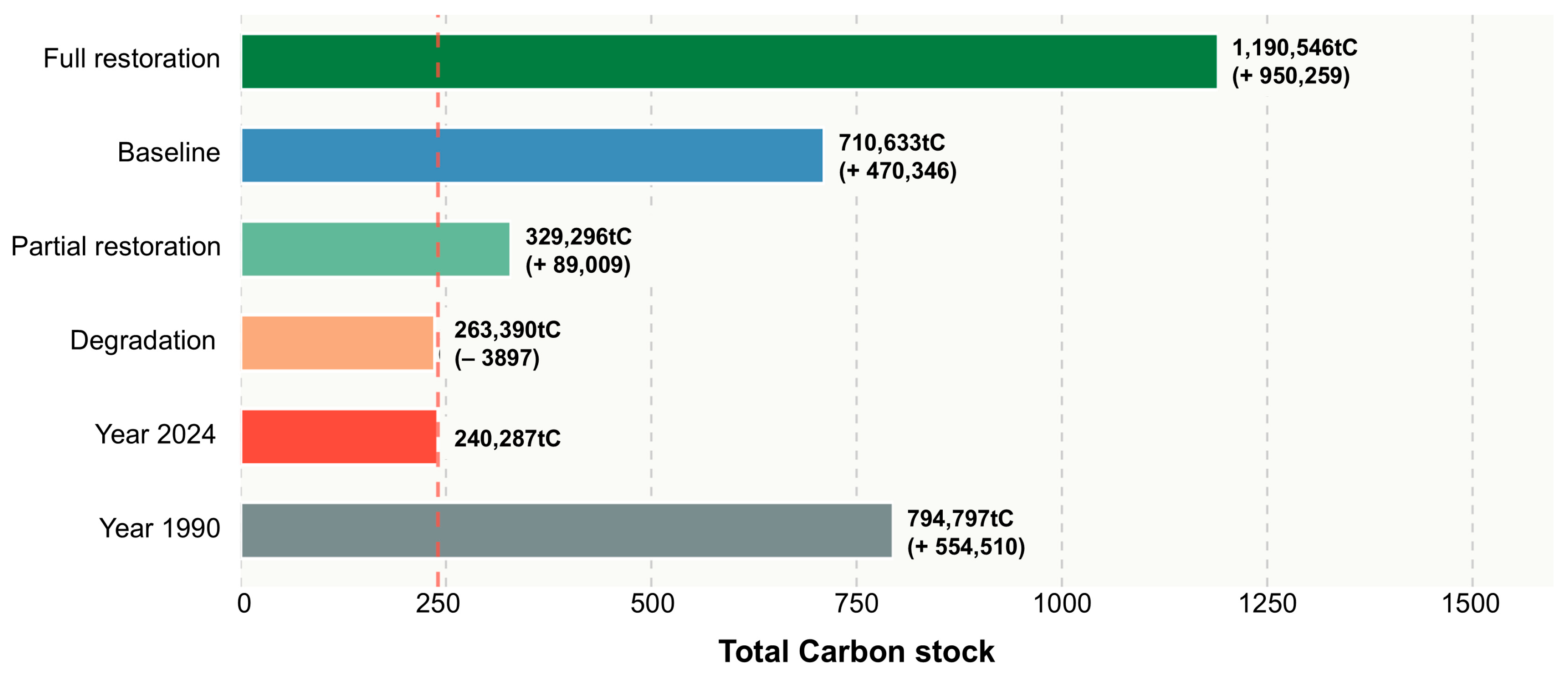
We estimated carbon stocks in the Perigi area for historical periods and for the latest land cover map by applying carbon stock values per unit area for each land cover type to the corresponding land cover maps. The estimation for 1990 showed that peat forest stored 661,818 tC and degraded peatland stored 132,979 tC, resulting in a total carbon stock of 794,797 tC. In 2024, restoring peatland stored 26,914 tC and degraded peatland stored 213,373 tC. Compared with 1990, the total carbon stock in 2024 decreased by 554,510 tC.
Under the baseline scenario, which applies the historical peatland composition observed in 1990 to the current peatland area, peat forest accounted for 49.7% and degraded peatland for 50.3%. When these proportions were applied to the current peatland area in 2024 (4622 ha), peat forest covered 2297 ha and degraded peatland covered 2324 ha. Using the carbon stock values for each land cover type, the total carbon stock under this scenario was estimated at 710,633 tC. Compared with the current carbon stock, this scenario indicates a potential additional carbon reduction of 470,346 tC. Under the full restoration scenario, all 4622 ha of peatland in Perigi would recover to peat forest, resulting in an estimated carbon stock of 1,190,546 tC. This corresponds to an additional 950,259 tC of carbon storage compared with the current carbon stock in Perigi. Under the partial restoration scenario, restoring peatland would recover to peat forest. As a result, carbon storage in these areas would increase from 26,914 tC to 115,924 tC, and the total carbon stock in Perigi would reach 329,296 tC. This represents an increase of 89,009 tC compared with the current condition. Finally, under the degradation scenario, all peatlands in Perigi would transition to degraded peatland. In this case, 450 ha of restoring peatland would convert to degraded peatland, leading to an estimated emission of 3897 tC compared with the current carbon stock. The total carbon stock under this scenario would be 236,390 tC (Figure 3).

4. Discussion

4.1. Characteristics of Carbon Storage and Restoration Potential

In this study, peatland carbon stocks in the Perigi were estimated using three carbon pools. Due to the environmental characteristics of peatlands, such as wet conditions, it is difficult to measure the accumulation of litter and coarse woody debris [31,32]. Therefore, most carbon in peatland ecosystems is effectively stored in soil carbon and in aboveground and belowground biomass [33,34]. Previous studies have often focused on individual carbon pools, which limits the ability to capture carbon storage across the entire peatland ecosystem [18,19]. In contrast, this study addresses this gap by integrating vegetation and soil carbon pools to estimate ecosystem-level carbon stocks. In particular, the field-based data used in this study reflect the characteristic high vegetation biomass of tropical peatlands. Based on the carbon stock estimation for the Perigi area, carbon storage per unit area by land cover type was estimated as 257.61 tC/ha for peat forest, 59.85 tC/ha for restoring peatland, and 51.15 tC/ha for degraded peatland. Peat forest exhibited substantially higher carbon storage compared to the other land cover types. However, the estimated carbon stock of peat forest in this study is considerably lower than the average carbon stock of Indonesian peat forests (approximately 1816 tC/ha) [35]. This may be attributed to large-scale land development projects in the 1970s–1980s, which likely contributed to the degradation of the original peat forest [31,36,37]. In addition, the Perigi area is located relatively far from the central peatland zones according to the national peatland map, suggesting that the peat layer in this region is relatively shallow. These factors may explain the relatively small difference in soil carbon stocks between peat forest and degraded peatland. If peat soils gradually recover to their pre-disturbance conditions over time, the carbon stock of peat forests in the area may increase toward the national average level. Accordingly, the differences in carbon storage among land cover types are expected to become greater than those observed in this study.
In addition, when soil carbon stocks in Perigi were compared across land cover types, no substantial differences were observed. In contrast, biomass carbon stocks showed clear differences among land cover types. The difference in biomass carbon between restoring peatland and degraded peatland was only about 1 tC/ha, whereas this value was markedly lower than that of peat forest, which had approximately 200 tC/ha of biomass carbon. This pattern is likely attributable to the limited tree growth during the early stages of peatland restoration. Despite the low biomass carbon stocks, vegetation restoration can still play an important ecological role. By covering the soil surface, vegetation can reduce soil disturbance caused by direct solar radiation and rainfall [38,39], while also helping to maintain soil moisture conditions. These effects may contribute to reducing carbon emissions associated with peat decomposition [19,40]. Therefore, vegetation restoration is more likely to contribute to the protection of existing peat soil carbon than to direct increases in soil carbon stocks. In this context, early-stage vegetation restoration is more important for conserving existing soil carbon than for increasing carbon storage through biomass accumulation. The recovery of peat layers generally requires a much longer period than tree growth during restoration. Accordingly, the results of this study suggest that a phased restoration strategy is needed, in which biomass accumulation through tree growth is prioritized in the short to medium term, while long-term restoration efforts focus on increasing soil carbon through peat layer recovery.
The estimated carbon stocks under the baseline and full restoration scenarios (153.76 and 257.61 tC/ha, respectively) fall at the upper end of or above the range reported for global forest restoration sites (4–90 tC/ha) [41,42,43], indicating that tropical peatland restoration can achieve comparatively high carbon storage, even with the shallow peat layer characteristic of the Perigi. When converted to carbon dioxide equivalents, the maximum potential storage corresponds to approximately 3.49 MtCO2e. Even though the total peatland area in Perigi covers only 4622 ha, restoring this single site could contribute about 0.5% of Indonesia’s 2030 NDC target for the forestry and land-use sector (500 MtCO2e). This estimate represents the long-term carbon storage potential under a full-restoration scenario and highlights the potential importance of tropical peatland restoration at the landscape scale. This result highlights the high mitigation efficiency of tropical peatland restoration in terms of carbon reduction per unit area. Notably, Perigi peatland has an average peat depth of only around 100 cm, which classifies it as a relatively shallow peatland. Despite this limitation, the site still shows substantial carbon storage potential. If restoration efforts eventually recover degraded peat layers, carbon storage in the area could increase further. In contrast, if restoration activities do not occur, the expansion of degraded peatland could lead to an additional 3897 tC of carbon emissions compared with current conditions. Continued fire events could also release the large amount of peat soil carbon currently stored in degraded peatlands [44,45]. These risks indicate the need to implement restoration measures to prevent further carbon emissions.
Additional carbon storage generated through restoration results from deliberate human intervention rather than natural processes. This characteristic satisfies the additionality requirement of international carbon market mechanisms such as REDD+, which gives the resulting carbon reductions potential market value as carbon credits. In the long term, restoration can also recover the carbon conservation function of peat forest ecosystems, enabling benefits that extend beyond short-term carbon offsetting toward sustained carbon retention. However, peatland degradation in Perigi closely relates to the livelihood activities of local communities. Temporary or one-time physical restoration measures alone are therefore unlikely to ensure long-term restoration outcomes [46]. Effective restoration strategies must combine ecological measures—such as fire prevention, rewetting, and revegetation—with approaches that support local livelihoods. Agroforestry-based restoration provides one possible pathway to enhance restoration sustainability, as it can maintain carbon storage functions while simultaneously generating income for local communities [47]. In addition, mechanisms that return carbon credit revenues generated through restoration to local communities, or provide economic incentives for community participation in restoration activities, should accompany restoration efforts. An integrated approach that considers both ecological and economic dimensions will be necessary to ensure the long-term sustainability of peatland restoration.

4.2. Limitations and Directions for Future Research

Although this study comprehensively evaluated carbon stocks and mitigation potential in the Perigi peatland, several limitations should be acknowledged. First, due to the temporal limitations of available satellite imagery, it was difficult to identify the original land cover conditions prior to the onset of development activities in Indonesia. As a result, the analysis in this study used 1990 as the baseline year, when a certain level of degradation had already occurred. Consequently, the extent of degradation and associated carbon emissions may have been underestimated compared to conditions prior to disturbance. Additionally, historical land cover transitions suggest that bare and built-up land or general peatlands may transition into general forest rather than peat forest, depending on restoration trajectories.
Second, the scenario analysis in this study primarily focused on changes in carbon storage associated with different restoration intensities. The effects of specific restoration approaches, such as rewetting and agroforestry, were not explicitly assessed and should be further examined in future studies. Future research should validate actual carbon accumulation through long-term monitoring data and quantitatively evaluate the carbon storage benefits of rewetting-based restoration as well as the effectiveness of socio-economic restoration strategies, including agroforestry.
Third, carbon stock estimates for the restoring and degraded peatland categories relied on limited field measurements, which may not fully capture the spatial variability of these land cover classes. This is reflected in the wide confidence intervals of our biomass estimates, which stem from the inherent structural heterogeneity of the peat forest. Additionally, the scenario analysis is based on static carbon stock estimates rather than dynamic projections and does not define a timeframe for achieving restoration targets. Future studies incorporating broader field sampling and dynamic modeling approaches would further strengthen the robustness of carbon stock assessments and restoration projections.

5. Conclusions

This study estimated carbon stocks per unit area for different land cover types in the Perigi peatland, South Sumatra, Indonesia, based on field surveys, and evaluated the carbon storage characteristics of the site through comparison with previous studies and other peatland regions. In addition, a time-series land cover dataset was constructed using remote sensing data, and carbon reduction potential was quantitatively assessed through scenario analysis based on different restoration intensities. The field survey results indicate that carbon stocks in the Perigi peatland are lower than those reported for other tropical peatlands. This is likely attributable to relatively shallow peat depth and historical carbon loss caused by past degradation. Nevertheless, despite the relatively low carbon stocks, the comparison of carbon stocks per unit area among land cover types and the restoration scenario analysis indicate that the Perigi peatland retains substantial carbon reduction potential. In particular, the findings suggest that restoration of a relatively small and localized peatland area can still make a meaningful contribution to national greenhouse gas mitigation targets, highlighting the effectiveness of tropical peatland restoration as a carbon mitigation strategy.
To achieve this, a phased restoration strategy is required. In the short term, vegetation restoration should focus on preventing further degradation of the peat layer. In the medium to long term, efforts should aim to increase biomass carbon through tree growth. Ultimately, the long-term goal is to achieve maximum carbon storage through the full recovery of both vegetation and peat layers. Ensuring the long-term sustainability of restoration also requires that ecological restoration efforts be accompanied by socio-economic approaches that support the livelihoods of local communities. Through such an integrated approach, the restoration of degraded tropical peatlands is expected to provide substantial benefits in terms of both carbon mitigation and ecosystem conservation.

Author Contributions

Conceptualization, J.C., E.C. and S.L.; methodology, J.C., E.C. and S.L.; validation, J.C.; investigation, J.C. and E.C.; resources, E.C. and S.L.; data curation, J.C.; writing—original draft preparation, J.C.; writing—review and editing, J.C., E.C. and S.L.; visualization, J.C.; supervision, E.C. and S.L.; project administration, E.C.; funding acquisition, E.C. All authors have read and agreed to the published version of the manuscript.

Funding

This study was funded by the National Institute of Forest Science, Republic of Korea (Grant No. FM0800-2021-03-2025).

Data Availability Statement

The data supporting the findings of this study are not publicly available due to the inclusion of personal information and privacy restrictions. Data may be made available upon reasonable request to the corresponding author and subject to approval from the local authority and ethics committee, where applicable.

Acknowledgments

This study was supported by a research project (No. FM0800-2021-03-2025) of the National Institute of Forest Science, Republic of Korea. The authors extend their gratitude to Sriwijaya University and the Center for International Forestry Research for research support.

Conflicts of Interest

The authors declare no conflict of interest.

References

  1. Leifeld, J.; Menichetti, L. The underappreciated potential of peatlands in global climate change mitigation strategies. Nat. Commun. 2018, 9, 1071. [Google Scholar] [CrossRef] [PubMed]
  2. United Nations Environment Programme. Global Peatlands Assessment: The State of the World’s Peatlands—Evidence for Action Toward the Conservation, Restoration, and Sustainable Management of Peatlands; UNEP: Nairobi, Kenya, 2022; Available online: https://wedocs.unep.org/handle/20.500.11822/41222 (accessed on 14 January 2026).
  3. Hodgkins, S.B.; Richardson, C.J.; Dommain, R.; Wang, H.; Glaser, P.H.; Verbeke, B.; Chanton, J.P. Tropical peatland carbon storage linked to global latitudinal trends in peat recalcitrance. Nat. Commun. 2018, 9, 3640. [Google Scholar] [CrossRef]
  4. Ribeiro, K.; Pacheco, F.S.; Ferreira, J.W.; de Sousa-Neto, E.R.; Hastie, A.; Krieger Filho, G.C.; Ometto, J.P. Tropical peatlands and their contribution to the global carbon cycle and climate change. Glob. Change Biol. 2021, 27, 489–505. [Google Scholar] [CrossRef]
  5. Warren, M.; Hergoualc’h, K.; Kauffman, J.B.; Murdiyarso, D.; Kolka, R. An appraisal of Indonesia’s immense peat carbon stock using national peatland maps: Uncertainties and potential losses from conversion. Carbon Balance Manag. 2017, 12, 12. [Google Scholar] [CrossRef]
  6. Prananto, J.A.; Minasny, B.; Comeau, L.P.; Rudiyanto, R.; Grace, P. Drainage increases CO2 and N2O emissions from tropical peat soils. Glob. Change Biol. 2020, 26, 4583–4600. [Google Scholar] [CrossRef]
  7. Sasmito, S.D.; Taillardat, P.; Adinugroho, W.C.; Krisnawati, H.; Novita, N.; Fatoyinbo, L.; Lupascu, M. Half of land use carbon emissions in Southeast Asia can be mitigated through peat swamp forest and mangrove conservation and restoration. Nat. Commun. 2025, 16, 740. [Google Scholar] [CrossRef]
  8. Mursyid, H.; Ramadhan, R.; Irawan, A.; Sadono, R.; Putra, E.T.S.; Suryanto, P. A global development and dynamics of peatland restoration: A bibliometric analysis. Ecol. Indic. 2025, 177, 113724. [Google Scholar] [CrossRef]
  9. Loisel, J.; Gallego-Sala, A.V.; Amesbury, M.J.; Magnan, G.; Anshari, G.; Beilman, D.W.; Benavides, J.C.; Blewett, J.; Camill, P.; Charman, D.J.; et al. Expert assessment of future vulnerability of the global peatland carbon sink. Nat. Clim. Change 2021, 11, 70–77. [Google Scholar] [CrossRef]
  10. Kementerian Lingkungan Hidup dan Kehutanan. Rencana Perlindungan dan Pengelolaan Ekosistem Gambut Nasional Tahun 2020–2049 [National Peatland Ecosystem Protection and Management Plan 2020–2049]; Keputusan Menteri Lingkungan Hidup dan Kehutanan Nomor SK.246/MENLHK/SETJEN/KUM.1/6/2020; Kementerian Lingkungan Hidup dan Kehutanan: Jakarta, Indonesia, 2020.
  11. Yuwati, T.W.; Rachmanadi, D.; Pratiwi; Turjaman, M.; Indrajaya, Y.; Nugroho, H.Y.S.H.; Qirom, M.A.; Narendra, B.H.; Winarno, B.; Lestari, S.; et al. Restoration of Degraded Tropical Peatland in Indonesia: A Review. Land 2021, 10, 1170. [Google Scholar] [CrossRef]
  12. Escobar, D.; Manzoni, S.; Tapasco, J.; Vestin, P.; Belyazid, S. Evaluation of long-term carbon dynamics in a drained forested peatland using the ForSAFE-Peat model. Biogeosciences 2025, 22, 2023–2047. [Google Scholar] [CrossRef]
  13. Hooijer, A.; Vernimmen, R.; Mulyadi, D.; Triantomo, V.; Hamdani; Lampela, M.; Agusti, R.; Page, S.E.; Doloksaribu, J.; Setiawan, I.; et al. Benefits of tropical peatland rewetting for subsidence reduction and forest regrowth: Results from a large-scale restoration trial. Sci. Rep. 2024, 14, 10721. [Google Scholar] [CrossRef]
  14. Kauffman, J.B.; Adame, M.F.; Adinugroho, W.C.; Anshari, G.; Basuki, I.; Donato, D.; Gangga, A.; Murdiyarso, D.; Ritonga, R.P.; Warren, M.; et al. Total ecosystem carbon stocks of tropical peat forests and greenhouse gas emissions from their disturbance. For. Ecol. Manag. 2025, 593, 122840. [Google Scholar] [CrossRef]
  15. Jalilov, S.M.; Rochmayanto, Y.; Hidayat, D.C.; Raharjo, J.T.; Mendham, D.; Langston, J.D. Unveiling economic dimensions of peatland restoration in Indonesia: A systematic literature review. Ecosyst. Serv. 2025, 71, 101693. [Google Scholar] [CrossRef]
  16. Astiani, D.W.I.; Mujiman, R.A.; Rafiastanto, A. Forest type diversity on carbon stocks: Cases of recent land cover conditions of tropical lowland, swamp, and peatland forests in West Kalimantan, Indonesia. Biodiversitas J. Biol. Divers. 2017, 18, 137–144. [Google Scholar] [CrossRef]
  17. Fiantis, D.; Rudiyanto; Ginting, F.I.; Agtalarik, A.; Arianto, D.T.; Wichaksono, P.; Irfan, R.; Nelson, M.; Gusnidar, G.; Jeon, S.; et al. Mapping peat thickness and carbon stock of a degraded peatland in West Sumatra, Indonesia. Soil Use Manag. 2024, 40, e12954. [Google Scholar] [CrossRef]
  18. Kiely, L.; Spracklen, D.V.; Arnold, S.R.; Papargyropoulou, E.; Conibear, L.; Wiedinmyer, C.; Knote, C.; Adrianto, H.A. Assessing costs of Indonesian fires and the benefits of restoring peatland. Nat. Commun. 2021, 12, 7044. [Google Scholar] [CrossRef]
  19. Asyhari, A.; Gangga, A.; Putra, C.A.S.; Ritonga, R.P.; Candra, R.A.; Anshari, G.Z.; Bowen, J.C.; Perryman, C.R.; Novita, N. Quantifying the fluxes of carbon loss from an undrained tropical peatland ecosystem in Indonesia. Sci. Rep. 2024, 14, 11459. [Google Scholar] [CrossRef] [PubMed]
  20. Novita, N.; Asyhari, A.; Ritonga, R.P.; Gangga, A.; Anshari, G.Z.; Jupesta, J.; Bowen, J.C.; Lestari, N.S.; Kauffman, J.B.; Hoyt, A.M.; et al. Strong climate mitigation potential of rewetting oil palm plantations on tropical peatlands. Sci. Total Environ. 2024, 952, 175829. [Google Scholar] [CrossRef] [PubMed]
  21. Darusman, T.; Murdiyarso, D.; Impron; Anas, I. Effect of rewetting degraded peatlands on carbon fluxes: A meta-analysis. Mitig. Adapt. Strateg. Glob. Change 2023, 28, 10. [Google Scholar] [CrossRef]
  22. Sinclair, A.L.; Graham, L.; Grover, S.P. More field-based carbon monitoring of tropical peatland restoration is urgently needed: Findings from a systematic literature review. Mires Peat 2024, 30, 1–23. [Google Scholar] [CrossRef]
  23. Burnham, B.S.; Cousins, J.; Burley, B.; Campbell, D.; Cadman, D. Review of High-Resolution Remote Sensing Methods to Monitor Peatland Restoration Efficacy on Actively Eroding Blanket Bogs; NatureScot Research Report 1325; NatureScot: Inverness, UK, 2024; Available online: https://www.nature.scot/doc/naturescot-research-report-1325-review-high-resolution-remote-sensing-methods-monitor-peatland (accessed on 23 March 2026).
  24. Choi, E.; Jeong, J.; Artati, Y.; Yang, H.; Adriani, D.; Yang, A.R. Local Perspectives on Agrosilvofishery in Peatlands: A Case Study of Perigi Village, South Sumatra, Indonesia. Land 2024, 13, 539. [Google Scholar] [CrossRef]
  25. Reynolds, N.; Mota, B.; Nightingale, J.M. Open-access satellite data for peatland condition and restoration monitoring in the UK: A review. Front. Environ. Sci. 2025, 13, 1685165. [Google Scholar] [CrossRef]
  26. Darusman, T.; Murdiyarso, D.; Impron, I.; Chaniago, I.A.; Lestari, D.P. Carbon Dynamics in Rewetted Tropical Peat Swamp Forests. Climate 2022, 10, 35. [Google Scholar] [CrossRef]
  27. Brown, S. Estimating Biomass and Biomass Change of Tropical Forests: A Primer; FAO Forestry Paper 134; Food and Agriculture Organization of the United Nations: Rome, Italy, 1997. [Google Scholar]
  28. Penman, J.; Gytarsky, M.; Hiraishi, T.; Krug, T.; Kruger, D.; Pipatti, R.; Buendia, L.; Miwa, K.; Ngara, T.; Tanabe, K.; et al. Good Practice Guidance for Land Use, Land-Use Change and Forestry; Institute for Global Environmental Strategies (IGES) for the IPCC: Kanagawa, Japan, 2003. [Google Scholar]
  29. Eggleston, H.S.; Buendia, L.; Miwa, K.; Ngara, T.; Tanabe, K. 2006 IPCC Guidelines for National Greenhouse Gas Inventories; Institute for Global Environmental Strategies (IGES): Kanagawa, Japan, 2006; Available online: https://www.ipcc-nggip.iges.or.jp/public/2006gl/pdf/4_Volume4/V4_04_Ch4_Forest_Land.pdf (accessed on 30 March 2026).
  30. Mäkipää, R.; Liski, J.; Guendehou, S.; Malimbwi, R.; Kaaya, A. Soil Carbon Monitoring Using Surveys and Modelling: General Description and Application in the United Republic of Tanzania; Food and Agriculture Organization of the United Nations: Rome, Italy, 2012. [Google Scholar]
  31. Lawson, I.T.; Kelly, T.J.; Aplin, P.; Boom, A.; Dargie, G.; Draper, F.C.H.; Hassan, P.N.Z.B.P.; Hoyos-Santillan, J.; Kaduk, J.; Large, D.; et al. Improving estimates of tropical peatland area, carbon storage, and greenhouse gas fluxes. Wetl. Ecol. Manag. 2015, 23, 327–346. [Google Scholar] [CrossRef]
  32. Verwer, C.C.; Van der Meer, P.J. Carbon Pools in Tropical Peat Forest: Towards a Reference Value for Forest Biomass Carbon in Relatively Undisturbed Peat Swamp Forests in Southeast Asia. 2010. Available online: https://edepot.wur.nl/160910 (accessed on 30 March 2026).
  33. Murdiyarso, D.; Donato, D.; Kauffman, J.B.; Kurnianto, S.; Stidham, M.; Kanninen, M. Carbon Storage in Mangrove and Peatland Ecosystems: A Preliminary Account from Plots in Indonesia. 2009. Available online: https://research.fs.usda.gov/treesearch/37148 (accessed on 30 December 2025).
  34. Asante, W.; Jengre, N. Carbon Stocks and Soil Nutrient Dynamics in the Peat Swamp Forests of the Amanzule Wetlands and Ankobra River Basin; USAID Integrated Coastal and Fisheries Governance Program for the Western Region of Ghana; Nature Conservation and Research Centre: Accra, Ghana, 2012; Available online: https://www.crc.uri.edu/download/GH2009DAZ003_508.pdf (accessed on 30 March 2026).
  35. Novita, N.; Kauffman, J.B.; Hergoualch, K.; Murdiyarso, D.; Tryanto, D.H.; Jupesta, J. Carbon stocks from peat swamp forest and oil palm plantation in Central Kalimantan, Indonesia. In Climate Change Research, Policy and Actions in Indonesia: Science, Adaptation and Mitigation; Springer International Publishing: Cham, Switzerland, 2020; pp. 203–227. [Google Scholar] [CrossRef]
  36. Imanudin, M.S.; Sulistiyani, P.; Armanto, M.E.; Madjid, A.; Saputra, A. Land Suitability and Agricultural Technology for Rice Cultivation on Tidal Lowland Reclamation in South Sumatra. J. Suboptimal Lands 2021, 10, 91–103. [Google Scholar] [CrossRef]
  37. Pernis, T. Water Management for Rice in Tidal Lowland Reclamation Areas of South Sumatera, Indonesia. Environ. Manag. Study 2023, 1, 19–24. [Google Scholar] [CrossRef]
  38. Limpens, J.; Holmgren, M.; Jacobs, C.M.; Van der Zee, S.E.; Karofeld, E.; Berendse, F. How does tree density affect water loss of peatlands? A mesocosm experiment. PLoS ONE 2014, 9, e91748. [Google Scholar] [CrossRef] [PubMed]
  39. Marques, M.J.; Bienes, R.; Jiménez, L.; Pérez-Rodríguez, R. Effect of vegetal cover on runoff and soil erosion under light intensity events. Rainfall simulation over USLE plots. Sci. Total Environ. 2007, 378, 161–165. [Google Scholar] [CrossRef]
  40. Swindles, G.T.; Mullan, D.J.; Brannigan, N.T.; Fewster, R.E.; Sim, T.G.; Gallego-Sala, A.; Blaauw, M.; Lamentowicz, M.; Jassey, V.E.; Marcisz, K.; et al. Climate and water-table levels regulate peat accumulation rates across Europe. PLoS ONE 2025, 20, e0327422. [Google Scholar] [CrossRef]
  41. Lu, F.; Hu, H.; Sun, W.; Zhu, J.; Liu, G.; Zhou, W.; Yu, G. Effects of national ecological restoration projects on carbon sequestration in China from 2001 to 2010. Proc. Natl. Acad. Sci. USA 2018, 115, 4039–4044. [Google Scholar] [CrossRef]
  42. Ko, H.P.; Hong, T.P.; Duong, N.T. Blue carbon stock assessment and climate resilience potential of mangrove forest in Hung Thang commune, Vietnam. Appl. Environ. Res. 2026, 48, 1–14. [Google Scholar] [CrossRef]
  43. Ren, Z.; Li, C.; Wang, S.; Zhou, W.; Stringer, L.C.; Fu, B. Effects of land-use change on soil total carbon pool: A meta-analysis. Agric. Ecosyst. Environ. 2026, 396, 110021. [Google Scholar] [CrossRef]
  44. Granath, G.; Moore, P.A.; Lukenbach, M.C.; Waddington, J.M. Mitigating wildfire carbon loss in managed northern peatlands through restoration. Sci. Rep. 2016, 6, 28498. [Google Scholar] [CrossRef] [PubMed]
  45. Krisnawati, H.; Adinugroho, W.C.; Imanuddin, R.; Weston, C.J.; Volkova, L. Carbon balance of tropical peat forests at different fire history and implications for carbon emissions. Sci. Total Environ. 2021, 779, 146365. [Google Scholar] [CrossRef]
  46. Alam, M.J.; Rengasamy, N.; bin Dahalan, M.P.; Halim, S.A.; Nath, T.K. Socio-economic and ecological outcomes of a community-based restoration of peatland swamp forests in Peninsular Malaysia: A 5Rs approach. Land Use Policy 2022, 122, 106390. [Google Scholar] [CrossRef]
  47. Widiyanto, A.; Sanudin, S.; Hani, A. Agroforestry on peatland: Livelihood options for community resilience to climate change adaptation. Sustain. For. 2023, 6, 2714. [Google Scholar] [CrossRef]
Figure 1. Study area: (a) Location of South Sumatra in Indonesia (red dot indicates the location of the study area), (b) Perigi, South Sumatra.
Forests 17 00606 g001
Figure 2. Time-series Analysis of Land Cover Changes.
Forests 17 00606 g002
Figure 3. Carbon Stock Estimates across Restoration Scenarios.
Forests 17 00606 g003
Table 1. Example of General Peatland Reclassification through Land Cover Change Analysis.
Before Year 1990Year 2006Year 2024Reclassify
Peat ForestBare and Built UpGeneral PeatlandsRestoring Peatlands
Peat ForestDegraded PeatlandsGeneral PeatlandsRestoring Peatlands
Peat ForestGeneral PeatlandsGeneral PeatlandsRestoring Peatlands
Peat ForestBare and Built UpGeneral PeatlandsDegraded Peatlands
Peat ForestGeneral PeatlandsGeneral PeatlandsDegraded Peatlands
General PeatlandsGeneral PeatlandsGeneral PeatlandsDegraded Peatlands
Table 2. Changes in Land Cover Area by Type.
YearPeat ForestGeneral PeatlandsDegraded PeatlandsPeatland
ha%ha%ha%ha%
19902569.0746.97590.1710.792009.6136.745168.8594.5
2006002751.0850.32485.7745.455236.8595.75
2024002219.4740.582402.0443.924621.5184.49
YearGeneral ForestBare/Built UpPlantation
ha%ha%ha%
1990135.462.48165.273.0200
2006177.643.2555.091.0100
2024281.955.1548.420.89517.719.47
Table 3. Land Cover Reclassification Results for Perigi in 1990 and 2024.
Year 1990Year 2024
Initial ClassifiedReclassifiedInitial ClassifiedReclassified
Peat forest25692569--
General peatland590-2219-
Restoring peatland---450
Degraded peat2010260024024172
Table 4. Carbon Stock Assessment by Land Cover Type: AGB, BGB, and SOC. Values represent mean ± SD.
Peat ForestRestoring PeatlandDegraded Peat
AGB188.78 ± 256.180.88 ± 1.32-
BGB23.11 ± 25.380.13 ± 0.16-
Soil45.68 ± 17.5558.81 ± 16.3551.15 ± 20.82
Total257.6159.8551.15
Disclaimer/Publisher’s Note: The statements, opinions and data contained in all publications are solely those of the individual author(s) and contributor(s) and not of MDPI and/or the editor(s). MDPI and/or the editor(s) disclaim responsibility for any injury to people or property resulting from any ideas, methods, instructions or products referred to in the content.