Article

Dimensional Stability and Mechanical Performance of Exterior-Grade Particleboard and MDF After Accelerated Aging


1
Renewable Materials Research Centre (CRMR), Faculty of Forestry, Geography, and Geomatics, Université Laval, Quebec, QC G1V 0A6, Canada
2
Service de Recherche et D’expertise en Transformation des Produits Forestiers (SEREX), Amqui, QC G5J 1K3, Canada
*
Author to whom correspondence should be addressed.
Forests 2026, 17(5), 614; https://doi.org/10.3390/f17050614
Submission received: 15 April 2026 / Revised: 7 May 2026 / Accepted: 15 May 2026 / Published: 19 May 2026
(This article belongs to the Special Issue Development and Properties of Wood Fiber-Based Products)

Abstract

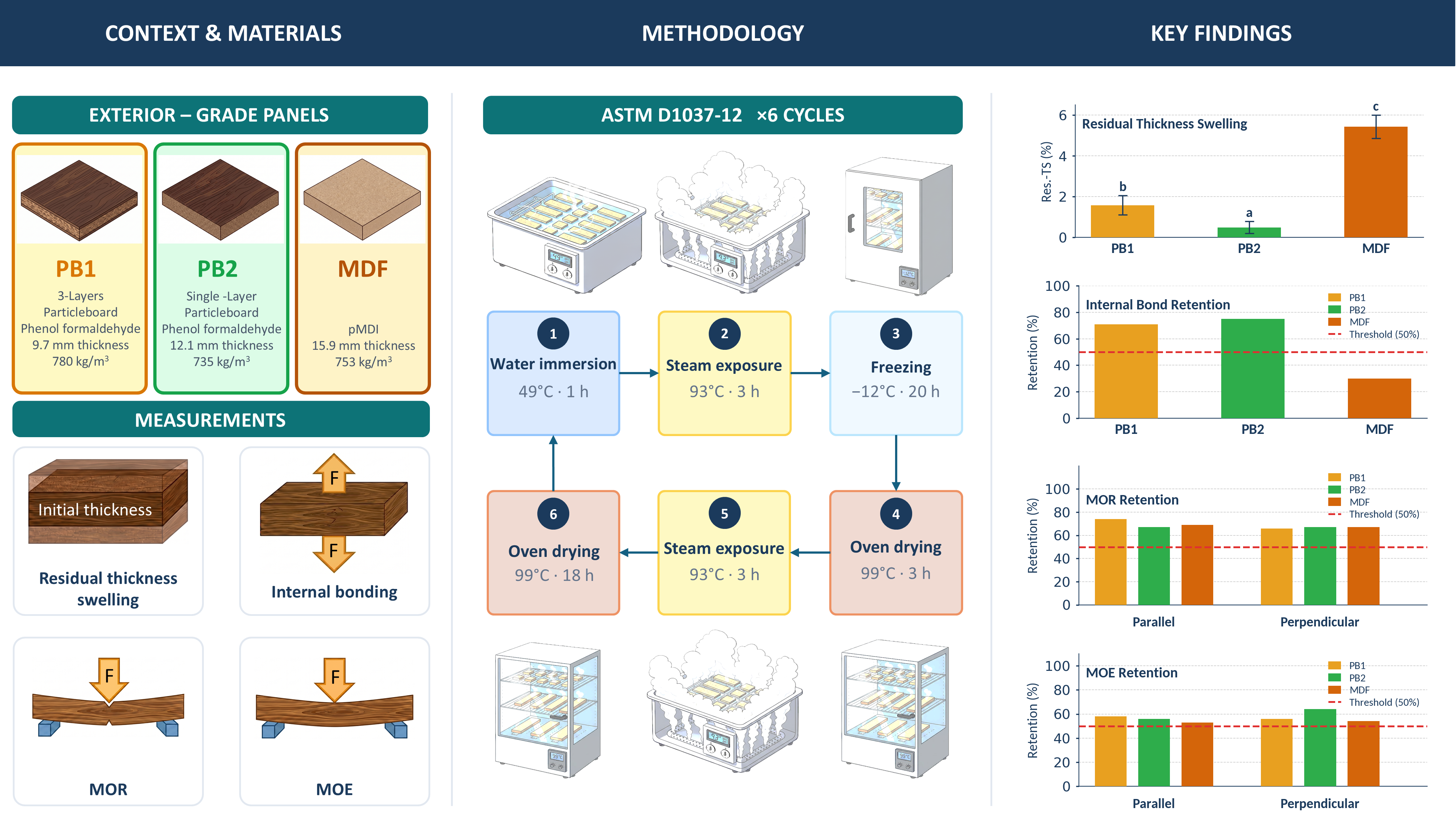
Wood-based panels are increasingly used in exterior applications; however, comprehensive evaluations of their durability under standardized aging conditions remain limited. This study evaluates the dimensional stability and mechanical performance of three industrial panels designed for exterior use: a three-layer particleboard (PB1) and a single-layer particleboard (PB2), both bonded with phenol–formaldehyde adhesive, and a medium-density fibreboard (MDF), bonded with polymeric methylene diphenyl diisocyanate through accelerated aging. The panels were subjected to six accelerated aging cycles according to the ASTM D1037-12 (2020) standard. Equilibrium moisture content, residual thickness swelling (Residual-TS), bending modulus of rupture (MOR), modulus of elasticity (MOE) in both parallel and perpendicular directions, and internal bond (IB) strength were measured under aged and non-aged conditions. PB2 demonstrated superior dimensional stability (Residual-TS: 0.49%) and strong mechanical retention (MOR: 67%, MOE: 56%–64%, IB: 75%). PB1 showed intermediate dimensional stability and mechanical retention (Residual-TS: 1.58%; MOR: 66%–74%, MOE: 56%–58%, IB: 71%), while MDF exhibited higher sensitivity to aging, with excessive Residual-TS (5.43%) and lower IB strength retention (30%). Specimen orientation did not affect dimensional stability but did influence the bending properties of the particleboard after aging, specifically MOR in PB2 and MOE in PB1. The results demonstrate that PB2 offers superior performance for demanding exterior applications, while PB1 and MDF are suitable for semi-protected uses. All panels were tested in an unfinished state, although surface coatings in actual applications may further enhance the resistance to aging.

Graphical Abstract

1. Introduction

Particleboard and medium-density fibreboard (MDF) are engineered non-structural wood-based composites widely used in furniture, cabinetry and a wide range of industrial applications. Together, these panel products account for approximately 60% of global wood-based composite panel production. The particleboard industry has experienced remarkable growth in recent years, with global production increasing from 105 million m3 in 2022 to approximately 123 million m3 in 2024, while MDF production has remained relatively stable at around 100 million m3 per year during the same period [1]. The advantages of these materials include availability, dimensional uniformity, cost-effectiveness, and the use of wood residues, recycled wood, and agricultural by-products as raw materials [2,3,4]. However, one drawback is their sensitivity to moisture, which can limit their use outdoors because exposure to the elements often leads to dimensional instability, loss of mechanical strength, and the gradual deterioration of adhesive bonds [5,6]. For panels suitable for exterior construction and humid environments, durability and long-term performance under moisture exposure have become essential considerations [7,8].
The performance of wood-based panels exposed to moisture is influenced by multiple material characteristics and manufacturing parameters. The density of a panel significantly affects its mechanical properties and moisture resistance, as a higher density generally improves bending and bonding properties but may increase susceptibility to moisture-induced stress [5,6,9]. Panel thickness also affects moisture penetration rates and the magnitude of swelling stresses, particularly in panels with pronounced vertical density profiles [6,10]. The fibre or particle size distribution significantly affects the mechanical properties of panels. In particleboards, larger particles generally result in higher bending properties, while smaller particles can improve internal bond (IB) strength by increasing contact area and reducing voids. However, they may also result in lower adhesive availability per unit surface area, which can negatively affect bonding. Therefore, the effect of particle size on IB depends on the surface-specific adhesive amount [11,12,13]. The geometry and orientation of an element affect the surface area for bonding and swelling stresses [14,15]. The type of adhesive used is another factor in determining moisture resistance. Phenol–formaldehyde (PF) adhesives perform better than urea–formaldehyde (UF) adhesives when exposed to moisture, while panels bonded with polymeric methylene diphenyl diisocyanate (pMDI) are highly moisture-resistant [14,16,17]. UF and PF adhesives mainly rely on mechanical adhesion mechanisms, such as adhesive penetration into the wood structure and mechanical interlocking after curing [18]. In contrast, pMDI adhesives have been shown to provide superior bonding performance and moisture resistance, partly due to stronger interactions with wood polymers through covalent linkages and favourable absorption [19,20]. pMDI generally requires lower adhesive contents than PF or UF to achieve equivalent or superior bond strength, which is important when considering performance differences under moisture exposure [18]. The adhesion mechanisms in mat-formed wood-based panels depend strongly on the adhesive system. In particleboard and MDF, bonding occurs through numerous localized contact points between particles or fibres. When exposed to moisture, swelling induces stresses at discrete bond sites, which are prone to rupture. This results in a gradual decline in bonding efficiency and mechanical performance [7,21].
Water absorption in wood-based panels causes swelling due to the hygroscopic expansion of the cell walls of wood and the springback of compressed particles or fibres [14,22]. This phenomenon results in a permanent increase in thickness during wetting–redrying cycles, indicating the release of accumulated compression stresses and reflecting fundamental structural damage to the panel [8,23]. Repeated wetting and drying cycles cause progressive damage to bonding points, leading to fatigue failure even when individual cycles do not exceed the immediate bond strength [16,24]. An increase in moisture content has pronounced effects on the mechanical performance of wood-based panels. Conditioning from an oven-dry state to a moisture content of approximately 15%–20% generally results in a 30%–50% reduction in modulus of rupture (MOR), while modulus of elasticity (MOE) exhibits a comparable, though slightly less pronounced, decrease. IB strength is consistently the most moisture-sensitive property, with strength losses frequently exceeding 60%–70% following moisture conditioning or aging treatments. This pronounced sensitivity reflects the vulnerability of inter-particle or inter-fibre bonds to swelling-induced stresses and bond-line degradation [9,14,15].
According to Kojima et al. [25], thickness swelling is an important durability indicator because it reflects the cumulative effects of springback, bond-line failure, and micro-crack formation in mat-formed wood-based panels, and shows strong correlations with the degradation of mechanical properties. Panels with poor bond integrity and limited resistance to swelling-induced stresses exhibit rapid increases in thickness swelling, often exceeding 15%–20% under accelerated aging or severe moisture exposure. In contrast, panels with well-developed, continuous bonding networks exhibit low thickness swelling, typically below 3%–4%, even after severe laboratory aging or long-term outdoor exposure. This clear distinction in thickness swelling behaviour has been consistently linked to differences in IB retention and the overall durability performance of wood-based panels [14,15,25].
Natural weathering provides the most realistic assessment of durability by exposing panels to environmental stresses, including precipitation, temperature changes, ultraviolet radiation, freeze–thaw cycles, and biological attack [14,26]. Outdoor tests provide valuable data on real-world performance, forming the basis for service-life estimates and lab correlations [27]. However, natural weathering has limitations: it takes at least 5 years to obtain reliable data, regional climate variability complicates standardization, weather conditions are unpredictable, and outdoor testing is resource-intensive [7]. These issues have led to accelerated aging methods that apply intensified stresses, reducing degradation from years to days or weeks while replicating natural damage mechanisms [28]. Laboratory methods enable quick comparisons of designs under controlled moisture, temperature, and drying cycles [29]. Typical aging conditions include water immersion (20 °C to boiling), exposure to steam at 93 °C, vacuum soaking, freezing at −12 °C, and oven drying at 60–107 °C, with varying sequences and cycles to maximize degradation [29,30]. The ASTM D1037-12 (2020) six-cycle method [29] is one of the harshest methods; others, such as European V313, APA D-1, and Japanese standards, differ in severity and duration, and are used in industrial quality assurance and research for MDF and particleboard [15,31,32].
Despite extensive research on the durability of wood-based panels, significant gaps remain in understanding the long-term performance of particleboard and MDF panels specifically manufactured for exterior applications under accelerated aging conditions. While individual studies have examined specific panel types, comprehensive comparative assessments evaluating multiple products simultaneously remain limited. Furthermore, the influence of potential particle/fibre orientation on thickness swelling and bending properties across different panel types has not been systematically investigated under identical aging conditions. In this context, this study investigates the dimensional stability and mechanical performance of three industrial panels designed for outdoor use by measuring changes in MOR, MOE, and IB strength of panels under accelerated aging conditions. This work makes a novel contribution by comparing commercially available exterior-grade particleboard and MDF products under standardized aging conditions. Additionally, it examines how specimen orientation affects both dimensional stability and mechanical performance.

2. Materials and Methods

2.1. Materials

In this study, three industrial panels manufactured by an industrial partner were evaluated. The panels included two types of particleboard, each measuring 1210 mm × 1210 mm (length × width), and an MDF measuring 1210 mm × 2420 mm (length × width). The length corresponds to the mat formation direction, while the width corresponds to the direction perpendicular to the mat formation. All samples were unfinished products, without any surface coatings.
The first particleboard (PB1) had a nominal thickness of 9.7 mm (3/8″) and consisted of a three-layer structure, with fine particles on the surface layers and coarse particles in the core layer. The second particleboard (PB2) had a nominal thickness of 12.1 mm (1/2″) and consisted of a single layer of uniformly distributed fine particles. Both particleboards were manufactured from a 50/50 blend of softwood and hardwood particles and bonded with PF adhesive at the same adhesive content. PB1 and PB2 are designed for siding applications, featuring one smooth face intended as the interior surface and one textured face with a distinctive embossed pattern created by the press caul during manufacturing. The textured face is intended to withstand weather exposure and serves as the exterior surface exposed to weathering in service. It is important to note that in practical applications, the exterior surface is typically coated with a protective paint. These uncoated particleboards exhibited a brown colour, resulting from a PF reaction during hot pressing. The MDF panel had a nominal thickness of 15.9 mm (5/8″) and was manufactured from 100% softwood fibres and bonded with a pMDI adhesive. Due to proprietary considerations, the manufacturer did not disclose detailed formulation parameters for any of the panels, including adhesive and wax contents, particle/fibre size distribution (granulometry), and the surface/core layer ratio in PB1. The principal characteristics of the panels are summarized in Table 1.

2.2. Vertical Density Profile Measurements

The vertical density profiles (VDPs) of the panels were measured using X-ray densitometry with an XQMS QDP-01X profiler (Quintek Measurement Systems, Inc., Knoxville, TN, USA). Specimens measuring 50 mm × 50 mm were scanned across the panel thickness at a spatial resolution of 0.01 mm.
For each VDP, three density parameters were obtained: (i) mean density over the total panel thickness (average density), (ii) maximum density in the surface layers (surface density), and (iii) minimum density in the core layer zone (core density). Twelve specimens from each panel type were used to measure the VDPs and were subsequently tested for IB strength. For each panel type, the VDP represents the average profile calculated from all measured specimens and was used to determine both maximum surface density and minimum core density values.

2.3. Accelerated Aging

Accelerated aging was conducted on the particleboards and MDF panels according to the six-cycle method specified in ASTM D1037-12 (2020) [29], a standard aging test for mat-formed wood-based panel products. Each cycle consisted of the following sequential conditioning steps: (1) immersion in water at 49 ± 2 °C for 1 h, (2) exposure to steam at 93 ± 3 °C for 3 h, (3) freezing at −12 ± 3 °C for 20 h, (4) oven drying in forced air at 99 ± 2 °C for 3 h, (5) re-exposure to steam at 93 ± 3 °C for 3 h, and (6) final oven drying in forced air at 99 ± 2 °C for 18 h. This six-step sequence was repeated six times for all samples subjected to accelerated aging.
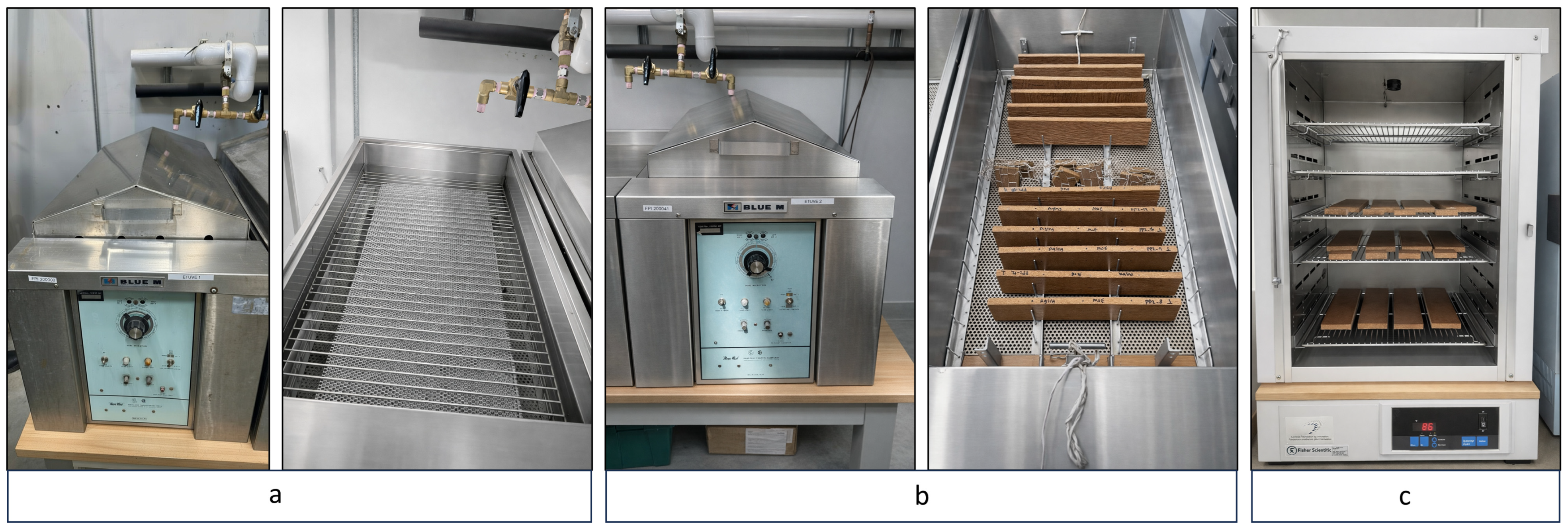
The water immersion and steam exposure treatments were carried out in a Blue M Electric Company Magni Whirl Bath, model MW-1130A-1 (Blue M Electric Company, Blue Island, IL, USA) (Figure 1a,b). The drying steps were conducted in a Fisher Scientific Isotemp laboratory oven equipped with forced air circulation (Fisher Scientific, Waltham, MA, USA) (Figure 1c). The freezing step at –12 °C was performed in a climate-controlled chamber in the Renewable Materials Research Center (CRMR) laboratories at Université Laval, ensuring stable sub-zero conditions throughout the 20 h freezing period as specified by the ASTM D1037-12 (2020) [22] standard.
The overall duration of the aging procedure was approximately three weeks. After completion of the sixth cycle, all specimens were conditioned at 20 ± 3 °C and 65 ± 2% relative humidity (RH) for at least 48 h to reach equilibrium moisture conditions before testing.

2.4. Residual Thickness Swelling Measurement

Residual thickness swelling (Residual-TS) was measured to assess the dimensional stability of the panels after accelerated aging. It should be noted that the Residual-TS parameter used here differs from the thickness swelling after water immersion used to determine the water absorption characteristics of panels, as defined in ASTM D1037-12 (2020) [29]. In this study, the Residual-TS refers to the irreversible increase in specimen thickness resulting from the aging treatment, measured after reconditioning to equilibrium moisture content (EMC). The thickness of the bending MOR and MOE test specimens was measured both before and after the aging cycles using a digital micrometre with an accuracy of ±0.001 mm. For each specimen, thickness measurements were taken at three specific locations in the middle of the specimen width at one-quarter, one-half, and three-quarters of the specimen length. The mean value of these three measurements was calculated to represent the average thickness of each specimen. The initial thickness (T0) was measured after conditioning the specimens at 20 °C and 65% RH until EMC was reached prior to aging tests. The final thickness (T1) was measured after completion of the accelerated aging cycles and subsequent reconditioning at the same temperature and RH conditions. The Residual-TS was then calculated using the following equation:
R e s i d u a l - T S ( % ) = T 1 T 0 T 0 × 100
where Residual-TS = residual thickness swelling (%) after accelerated aging; T0 = initial thickness after sample conditioning and before aging treatment (mm); and T1 = thickness after aging treatment and reconditioning (mm).

2.5. Measurement of Mechanical Properties

Mechanical properties of the particleboards and MDF panels were evaluated according to ASTM D1037-12 (2020), and values were compared with ANSI A135.6-2012 for siding and ANSI A208.2-2022 for the MDF, when applicable [29,33]. To assess panel durability after accelerated aging, static bending tests were conducted. The bending MOR and MOE were determined for both non-aged specimens (control) and specimens subjected to accelerated aging.
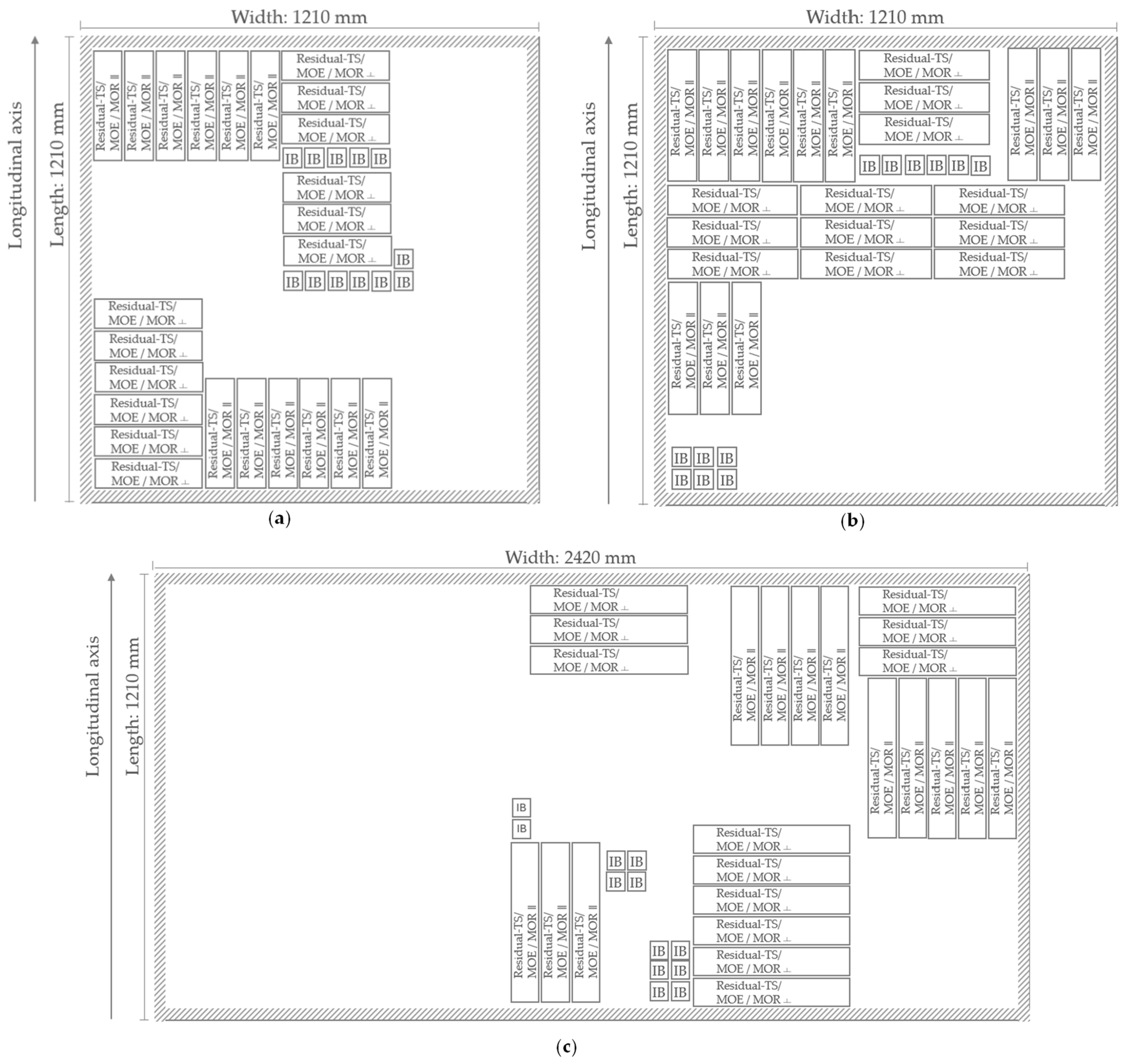
To assess anisotropy related to the panel production direction, specimens were cut both parallel and perpendicular to the mat formation direction, as required by the ANSI A135.6-2012 standard [34]. A total of 24 specimens were prepared for each panel type for bending tests: 12 in the parallel direction and 12 in the perpendicular direction. From each 12-specimen group, 6 specimens were subjected to accelerated aging, and 6 were tested in the non-aged condition. The cutting plan for test specimens is shown in Figure 2, indicating the positions and orientations of the specimens prepared for mechanical and physical property testing.
The MOR/MOE specimen dimensions were determined based on panel thickness according to the ASTM D1037-12 (2020) [29] standard: 282.8 mm × 76.2 mm (length × width) for PB1 (9.7 mm thickness), 340.4 mm × 76.2 mm for PB2 (12.1 mm thickness), and 431.6 mm × 76.2 mm for the MDF (15.9 mm thickness). The corresponding test spans were 232.8 mm, 290.4 mm, and 381.6 mm for PB1, PB2, and the MDF, respectively, and were maintained constant for both non-aged and aged specimens to enable a direct comparison of mechanical properties. Static bending tests were performed in accordance with the ASTM D1037-12 (2020) standard [29], with loading rates of 4.7 mm/min, 5.8 mm/min, and 7.6 mm/min applied to PB1, PB2, and MDF specimens, respectively. The bending MOR and MOE were calculated using the following equations:
M O R = 3 P m a x L 2 b d 2
M O E = L 3 4 b d 3 P y
where MOR = the bending modulus of rupture (MPa); Pmax = maximum load (N); L = span length (mm); b = specimen width (mm); d = specimen thickness (mm); MOE = bending modulus of elasticity (MPa); and ΔP/Δy = the slope of the linear portion of the load-deflection curve (N/mm). The slope ΔP/Δy was determined from the linear regression of the load-deflection data between 10% and 40% of Pmax.
The moisture content of the MOR/MOE specimens was determined according to the ASTM D1037-12 (2020) standard [29]. After completing the bending tests, all tested MOR/MOE specimens, both non-aged and aged, were weighed immediately to determine their initial mass under the testing conditions. The specimens were then placed in a forced-air oven at 103 ± 2 °C for 48 h to achieve a constant oven-dry mass. Moisture content was calculated as the ratio of water mass to oven-dry mass, expressed as a percentage. The moisture content of all specimens from each panel was averaged to determine the EMC for that panel type.
The IB strength was evaluated using 12 specimens, measuring 50 mm × 50 mm, per panel type in accordance with ASTM D1037-12 [29]. Six specimens from each panel type were tested in the non-aged condition, and the remaining 6 specimens were subjected to accelerated aging before IB testing. All mechanical property tests were conducted using an MTS QTest/5 universal testing machine with a load capacity of 5 kN (MTS Systems Corporation, Eden Prairie, MN, USA).
The strength retention rates were calculated using Equation (4):
R e t e n t i o n   r a t e   % = P a g e d P n o n - a g e d × 100
where P a g e d = the average property value (MOR, MOE, or IB strength) of aged specimens, and P n o n - a g e d = the average property value of non-aged specimens.

2.6. Statistical Analysis

Statistical analyses were performed using the R software (v 4.4.1). For Residual-TS comparison between panel types, a one-way analysis of variance (ANOVA) followed by Tukey’s HSD post hoc test was conducted. Independent t-tests were performed to compare bending properties (MOR, MOE) between parallel and perpendicular directions, and between non-aged and aged conditions for each panel type. The same approach was applied to compare IB strength between non-aged and aged specimens. The normality of data and homoscedasticity were evaluated with the Shapiro–Wilk and Levene’s tests, respectively. Welch’s t-test was used when homoscedasticity was not met. The significance level was established at α = 0.05.

3. Results and Discussion

3.1. Vertical Density Profile

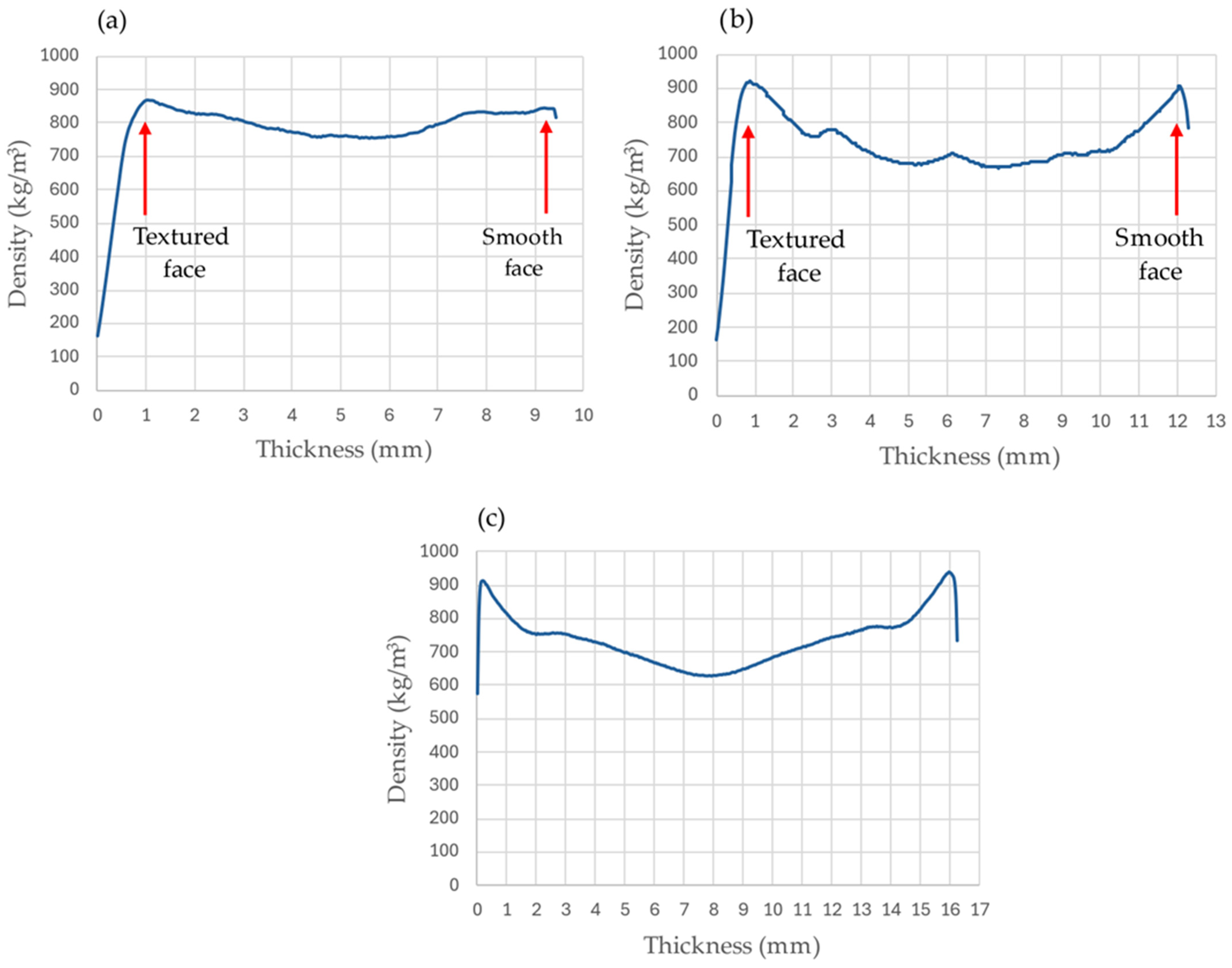
Figure 3 presents the VDPs of particleboards and MDF panels. The asymmetric VDP observed for PB1 and PB2 can be attributed to the difference in surface texture between the two faces of these panels. The textured face (press caul side) corresponds to the left side of the profiles, whereas the smooth face corresponds to the right side. PB1 exhibited a VDP with a maximum surface density of 898 kg/m3 and a minimum core density of 737 kg/m3 (Table 2). The average density of PB1 was 780 kg/m3.
PB2 exhibited a more pronounced U-shaped profile across thickness than PB1, characterized by a higher difference between surface and core layer densities. The maximum surface density was 959 kg/m3, while the minimum core density was 654 kg/m3. Despite its homogeneous, single-layer structure with fine particles throughout, the density difference between the surface and core layers was approximately 300 kg/m3, which is notably higher than that of PB1. According to previous studies, VDPs in particleboard and MDF primarily result from interactions between heat transfer, mass transfer, and mechanical deformation during hot pressing [35]. Surface layers, in direct contact with the hot platens, densify earlier and more intensively than the core, resulting in higher surface densities. Experimental studies have also shown that particle size alone does not necessarily induce significant changes in VDPs [12]. Therefore, the steeper density gradient in PB2 is more likely associated with differences in overall consolidation behaviour during pressing rather than solely with particle size effects. The average density of PB2 was 735 kg/m3.
The MDF exhibited a moderate U-shaped profile across thickness, with a maximum surface density of 923 kg/m3 and a minimum core density of approximately 625 kg/m3. The density gradient exhibited relative smoothness and symmetry, with a variation of approximately 300 kg/m3 between the surface and core densities. The average density of the MDF panels was 753 kg/m3.
The VDP is an indicator of the panel’s mechanical performance. Higher densities in the surface layers are primarily responsible for bending performance, since these regions carry the highest tensile and compressive stresses during flexural loading and therefore strongly influence the MOR and MOE [36]. In contrast, the core layer density influences IB strength. A low core density is particularly vulnerable to bond-line failure and internal cracking [37]. Consequently, variations in surface and core densities provide a clear mechanistic explanation for the observed differences in MOR, MOE, and IB strength among panels.

3.2. Equilibrium Moisture Content

Table 2 presents the EMC of non-aged and aged panels measured after conditioning at 20 ± 3 °C and 65 ± 2% RH. The EMCs of non-aged panels ranged from 8.2% to 10.2%. PB1 and PB2 showed higher values (10.2% and 9.9%, respectively) than the MDF (8.2%).
After conditioning at 20 ± 3 °C and 65 ± 2% RH, the EMC of aged particleboards ranged from 8.4% in the MDF to 9.7% in PB1 and PB2. Despite the panels being subjected to six cycles of severe moisture conditions during aging tests, no significant increase in EMC was observed. This stability indicates that all panels maintained their EMC following the aging cycles. Similar EMCs in non-aged and aged panels also suggest that differences in mechanical properties are primarily due to degradation of the bonding system rather than variations in moisture content at the time of testing.

3.3. Residual Thickness Swelling

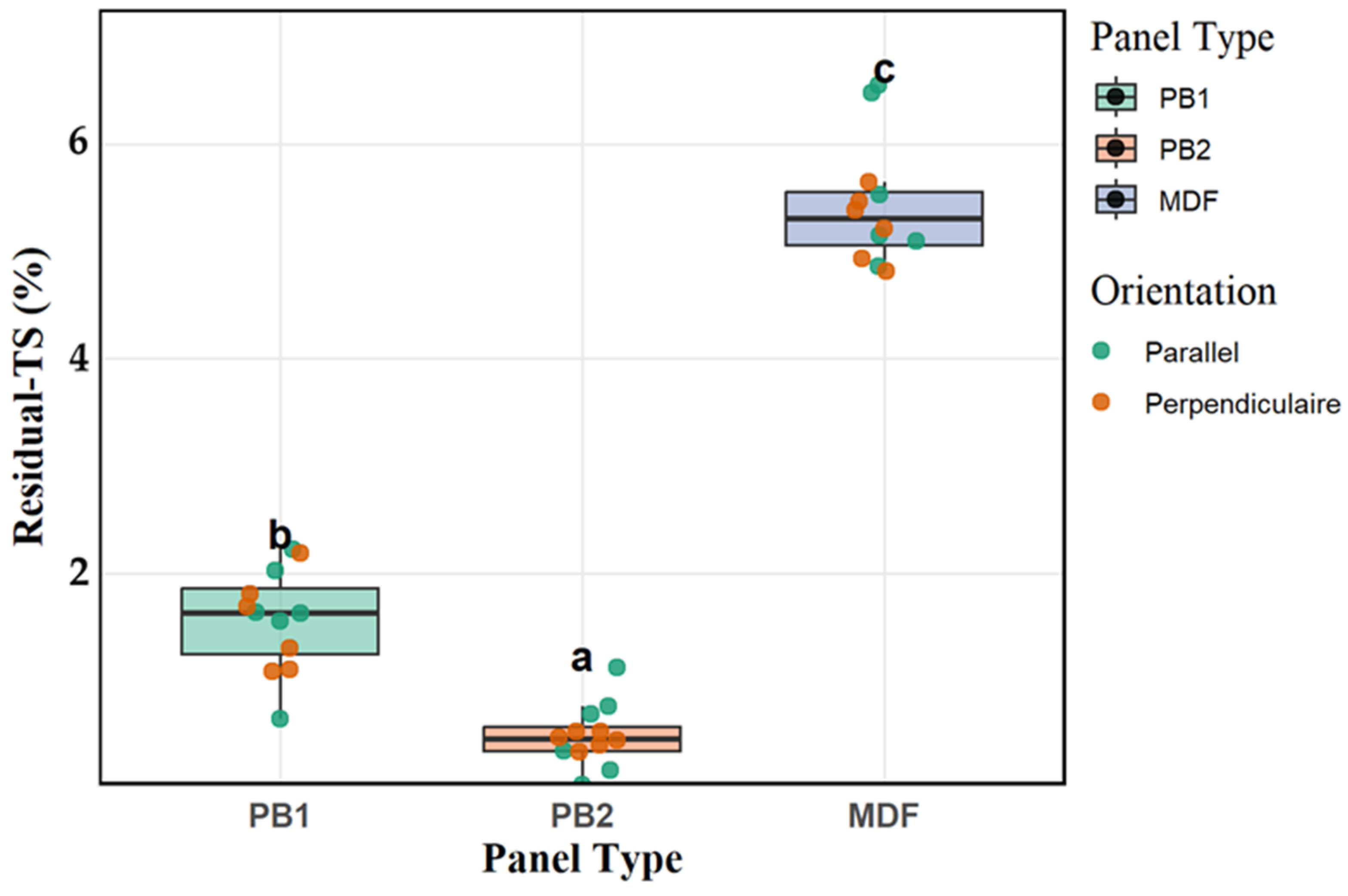
As shown in Figure 4, accelerated aging resulted in significant differences in Residual-TS across panel types (F = 667.89, p < 0.001). PB2 showed the lowest Residual-TS percentage (0.49 ± 0.29%), significantly outperforming PB1 (1.58 ± 0.47%) and MDF (5.43 ± 0.57%). All pairwise comparisons were statistically significant, indicating that PB2 has better dimensional stability after accelerated aging, with Residual-TS values 3.2 and 11.1 times lower than those for PB1 and MDF, respectively.
The significantly lower Residual-TS observed in PB2, compared to PB1, highlights the importance of internal structural configuration and density distribution for maintaining dimensional stability. Although PB2 exhibited pronounced surface densification, as shown in its VDP (Figure 3), its lower average density, particularly in the core, likely reduced compressive stresses induced during hot pressing, thereby limiting stress recovery upon moisture exposure. In addition, its homogeneous fine-particle structure likely reduced void content and permeability, slowing water penetration and influencing stress distribution and moisture response differently from the three-layer configuration of PB1. Previous studies have demonstrated that particle geometry, particularly slenderness ratio, influences void formation, packing efficiency, and overall panel performance [38]. Smaller and more uniformly sized particles tend to reduce void content and improve mat compaction, which can affect heat and moisture transfer during pressing [39]. Variations in density distribution and adhesive–particle interaction have also been shown to significantly influence thickness swelling behaviour [40]. For example, Kelemwork et al. (2009) reported that increasing the proportion of fine particles in the face layers significantly modified the VDP and reduced thickness swelling by up to 21% [39].
Moreover, thickness swelling in the particleboard is partly governed by stress recovery associated with the release of compressive deformation accumulated during hot pressing [41]. Panels with highly densified surface layers may store compressive strain energy that can be released upon moisture exposure, contributing to irreversible thickness recovery [22]. However, in the case of PB2, this effect appears to be mitigated by its lower core density and more uniform internal structure, which may have limited localized stress accumulation and release. Therefore, the lower Residual-TS of PB2, despite its surface densification, suggests that the combined effects of reduced internal stresses and improved particle packing played a dominant role compared to the three-layer structure of PB1. In contrast, the substantially higher Residual-TS observed in the MDF reflects a fundamentally different governing mechanism. The literature indicates that VDP characteristics strongly influence thickness swelling in MDF panels [42]. Additionally, the MDF consists of a continuous fibre network with a high specific surface area, making it inherently more sensitive to moisture-induced expansion [21]. The combination of density profile characteristics, particularly the lower core density resulting in higher porosity, and hygroscopic fibre expansion, likely contributed to the greater dimensional response observed in MDF compared to particleboard.

3.4. Mechanical Properties

3.4.1. Static Bending Properties

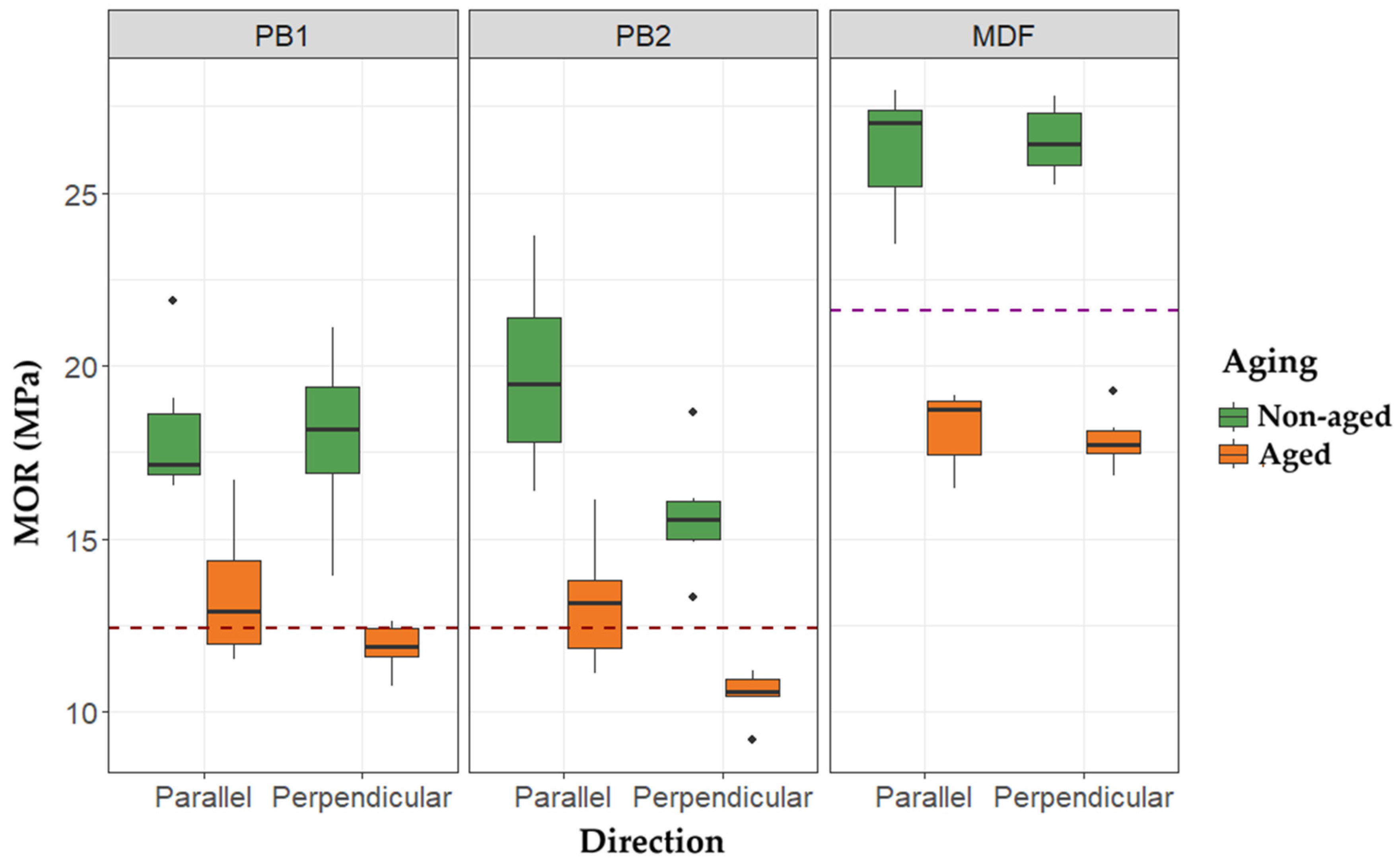
Although the ANSI A135.6-2012 standard establishes requirements for engineered wood siding (particleboard), it does not specify MOE or IB criteria. For the MDF, the ANSI A208.2-2022 was used as a reference for mechanical performance, although this standard is primarily developed for an interior-grade MDF. Figure 5 shows the bending MOR of particleboards and MDF in parallel and perpendicular directions for non-aged and aged conditions. The MOR values of the PB1 and PB2 panels were compared with the minimum values specified in ANSI A135.6-2012 [34], while the MDF was evaluated against A208.2-2022 [33].
For non-aged condition, both particleboards, PB1 and PB2, exceeded the minimum MOR values of 12.4 MPa specified by ANSI A135.6-2012 [34] in both the parallel and perpendicular directions (Figure 5). Regarding the MDF, the non-aged panels exhibited the highest MOR values in both directions, with average values of 26.5 MPa in the parallel direction and 26.3 MPa in the perpendicular direction. This performance exceeded the minimum requirement of 21.6 MPa for Grade 130 as outlined in ANSI A208.2-2022 [33].
All panels showed a significant reduction in MOR after accelerated aging, in both parallel and perpendicular directions, with retention rates ranging from 66% to 74% across panel types (Table 3). Both PB1 (66%–74% MOR retention rate) and PB2 (67% MOR retention rate) retained more than 50% of their original MOR in both directions after accelerated aging, confirming their suitability for exterior applications. For the MDF, ANSI A208.2-2022 (Section 4.3.5 of the standard) specifies 50% MOR retention for advanced bond integrity (MR30 designation), though this standard is intended for interior applications. The MDF panels achieved 69%–67% MOR retention in the parallel and perpendicular directions, respectively, demonstrating a performance that exceeds the criteria required for advanced bond integrity panels.
The comparison between parallel and perpendicular MOR values revealed that only PB2 showed significant differences in both the non-aged and aged conditions, with MOR 25% higher in the parallel direction (Table 3). PB1 and MDF showed no significant differences in MOR between the parallel or perpendicular directions.
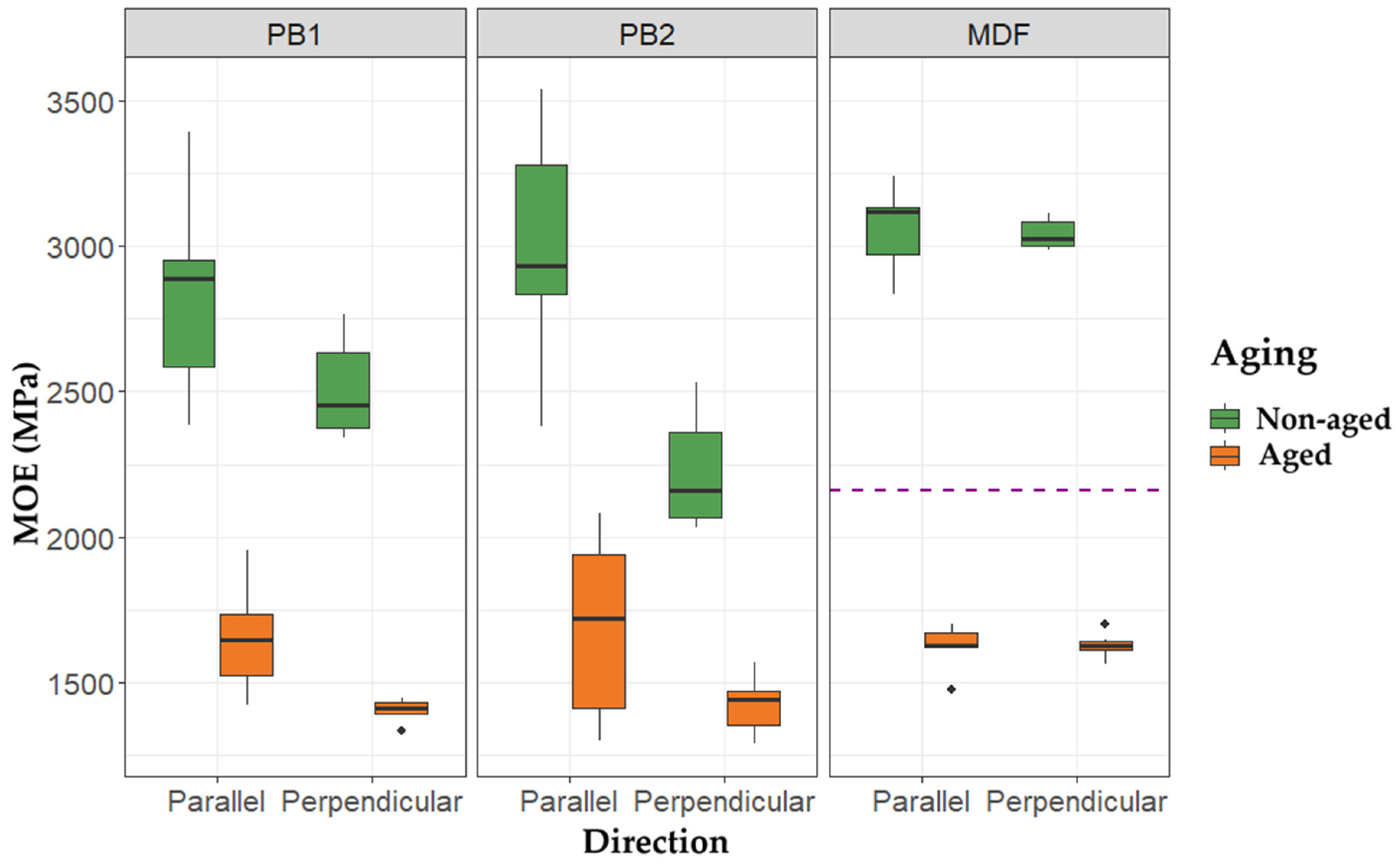
Figure 6 shows the bending MOE values of particleboards and MDFs in parallel and perpendicular directions for non-aged and aged conditions. Regarding non-aged particleboards, PB1 showed average MOE values of 2835 MPa (parallel) and 2510 MPa (perpendicular), while PB2 exhibited MOEs of 2996 MPa (parallel) and 2225 MPa (perpendicular). The ANSI A135.6-2012 [34] standard for engineered wood siding does not specify MOE requirements. Non-aged MDF exhibited the highest MOE values in both directions, with average values of 3060 MPa in the parallel direction and 3040 MPa in the perpendicular direction. The MDF performance exceeded the minimum requirement of 2160 MPa for Grade 130 by 42% specified in ANSI A208.2-2022 [33].
All panels showed significant reductions in MOE after accelerated aging, with retention rates of 53%–64% (Table 4), which were notably lower than the MOR retention rates (66%–74%) (see Table 3). Despite the lower retention rate in MOE compared to MOR, all panels maintained adequate stiffness for structural applications after accelerated aging, exceeding a 50% threshold. A greater reduction in MOE compared to MOR is commonly observed in wood-based composites subjected to moisture cycling [5]. This behaviour is attributed to moisture-induced damage mechanisms, such as springback, debonding, and microstructural deterioration [14,22], which reduce the bending stiffness of the material to a greater extent than its bending strength. As a result, there is a greater loss in the MOE than in the MOR of wood-based panels [14]. PB2 demonstrated the highest MOE retention in the perpendicular direction (64%), while MDF showed the most consistent retention across both directions (53%–54%).
The comparison of parallel and perpendicular MOE values revealed a significant difference in PB2, but only under non-aged conditions, with a 35% higher MOE in the parallel direction (Table 4). The directional dependency observed for both MOR and MOE in PB2 under non-aged conditions suggests a stiffness-related structural origin, potentially associated with preferential particle alignment during mat formation. However, further microstructural characterization is needed to confirm this mechanism. PB1 and MDF showed no significant anisotropy in MOE in the non-aged condition. Following accelerated aging, a significant difference was observed between the parallel and perpendicular MOE of PB1, with an 18% higher parallel MOE. This indicates that the particles may have some orientation within the mat, primarily established during its formation. The MOE of MDF panels was not affected by direction (parallel vs. perpendicular), demonstrating that the fibres were randomly distributed in the mat without any specific orientation.

3.4.2. Internal Bond Strength

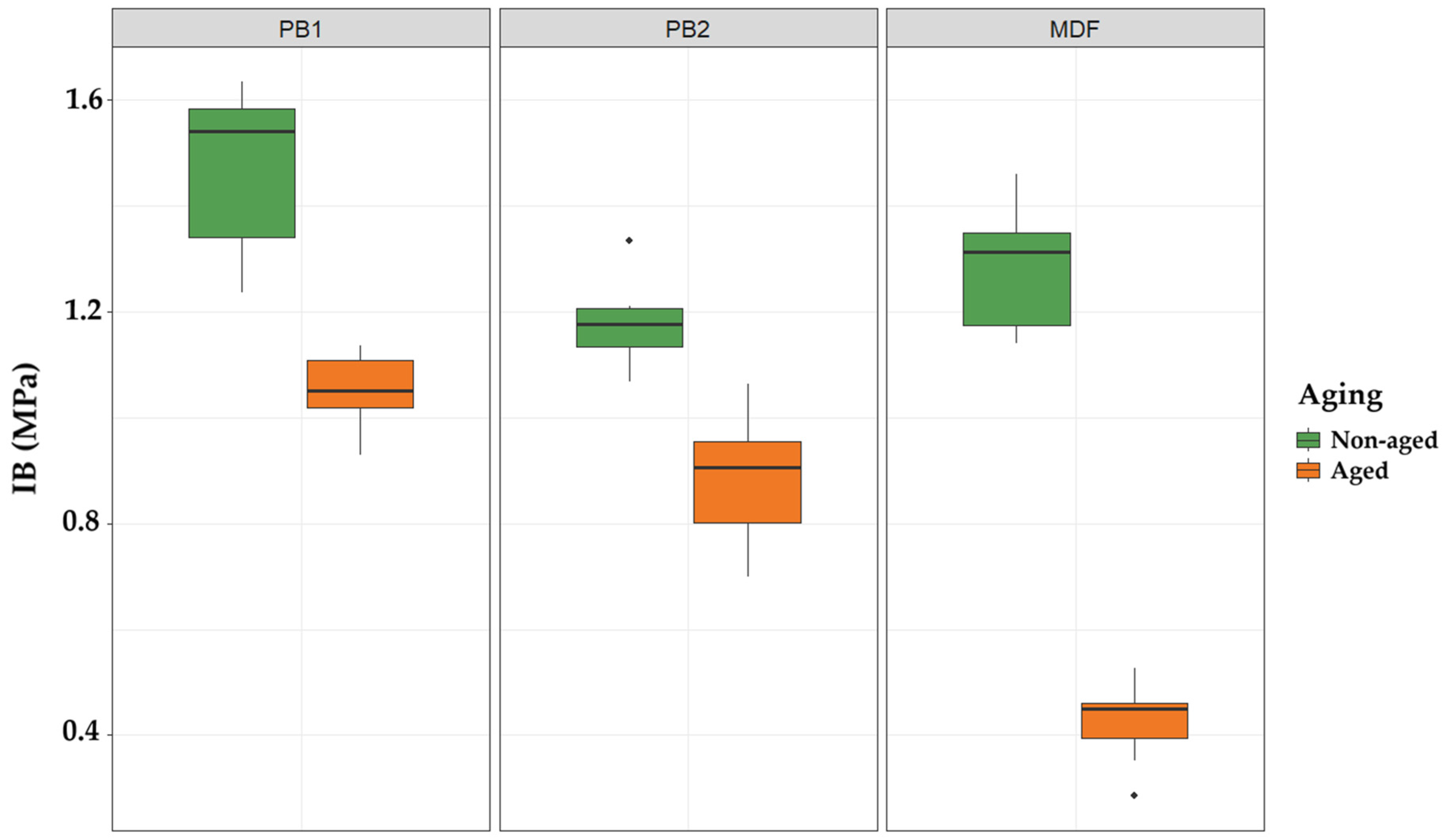
Figure 7 presents the IB strength of particleboards and MDF under non-aged and aged conditions. For the non-aged condition, PB1 exhibited the highest average IB strength at 1.47 MPa, followed by MDF at 1.28 MPa, and PB2 at 1.18 MPa. The ANSI A135.6-2012 standard does not specify IB requirements. However, IB strength was evaluated in this study to provide additional insight into the internal integrity of the panels.
After accelerated aging, the IB of all panels decreased significantly, as shown in Figure 7 and Table 5. Particleboards demonstrated high IB retention rates of 71% and 75% for PB1 and PB2, respectively. In contrast, MDF showed a substantially lower IB retention of 30% (0.43 MPa), indicating higher sensitivity to moisture-induced degradation.
The lower IB retention observed in MDF after accelerated aging may result from a combination of factors. MDF fibres have a substantially higher specific surface area than the wood particles used in a particleboard. As a result, adhesive droplets, which cover only a limited portion of the fibres’ surface, are distributed over a larger total surface area. This leads to a lower adhesive coverage per unit fibre surface. This can result in fewer, more widely spaced bond points per unit surface area, reducing bonding. Consequently, the fibre–adhesive interface may be more susceptible to moisture-induced swelling and stiffness reduction. In addition, direct comparisons between particleboards and MDFs are inherently challenging because these panel types differ in terms of raw material morphology, adhesive chemistry, and adhesive content. All these factors influence the moisture resistance of the bond interface under moisture exposure. When moisture is absorbed, the resulting swelling can weaken or disrupt these discrete bond points in MDF, potentially leading to a greater reduction in IB strength than in particleboard [43,44]. It is important to note that MDF panels are generally designated for use with a surface finish, such as coating or paint, whereas the results presented here are derived from tests conducted on unfinished panels. The application of these finishes generally improves the panel’s durability [45].

4. Conclusions

This study provides a comprehensive comparative evaluation of three industrial exterior-grade panels—two PF-bonded particleboards (PB1: three-layer; PB2: single-layer) and one pMDI-bonded MDF—subjected to six accelerated aging cycles according to ASTM D1037-12 (2020), offering important insights into their suitability for exterior applications. PB2 demonstrated superior overall performance, combining exceptional dimensional stability (Residual-TS: 0.49%) with a strong retention of mechanical properties (MOR: 67%, MOE: 56%–64%, IB: 75%). PB1 exhibited intermediate performance, with good dimensional stability (Residual-TS: 1.58%) and adequate mechanical retention after aging (MOR: 66%–74%, MOE: 56%–58%, IB: 71%). MDF showed comparatively lower resistance to accelerated aging, characterized by excessive Residual-TS (5.43%) and substantial IB strength loss (retention: 30%), indicating higher sensitivity to moisture-induced degradation under unprotected exterior applications.
Dimensional stability across thickness showed no dependence on specimen orientation (parallel vs. perpendicular), but mechanical properties exhibited direction-dependent effects that varied by panel type and aging condition. Notably, PB2 showed significant anisotropy in both MOR (25% higher parallel) and MOE (35% higher parallel in non-aged condition), likely related to particle alignment during mat formation. Post-aging, PB1 developed significant MOE anisotropy (18% higher in the parallel direction), whereas the MDF remained isotropic.
These findings underscore the critical importance of material selection for exterior applications. PB2 is strongly recommended for demanding outdoor environments requiring improved dimensional stability and structural integrity. PB1 and MDF offer suitable performance for semi-protected applications. It should be noted that all panels were evaluated in an unfinished condition, whereas in practical applications, they are typically coated, which can further enhance their durability.
These findings provide practical guidelines for material selection in exterior construction and establish a benchmark for future studies on the resistance to aging of wood-based panels for exterior applications. Future research should investigate the effectiveness of protective coating and correlate long-term outdoor exposure with accelerated-aging results to further validate material selection guidelines for specific service conditions.

Author Contributions

Conceptualization, methodology, validation, and writing—review and editing, T.M., A.C., R.G. and A.L.; formal analysis and investigation, T.M.; data curation, writing—original draft preparation, and visualization, T.M.; resources, supervision, project administration, and funding acquisition, A.C. All authors have read and agreed to the published version of the manuscript.

Funding

This paper was prepared as part of the research activities of the Wood-Based Composite Panel Research Consortium (Corepan-Bois) at Université Laval. This research was funded by the Natural Sciences and Engineering Research Council of Canada (NSERC) [grant number ALLRP 571660-21], the Ministère des Ressources naturelles et des Forêts (MRNF), the Conseil de l’industrie forestière du Quebec (CIFQ) [grant number PIP-2019-12], and Corepan-Bois’s partners: Arbec Forest Products, FPInnovations, SACOPAN, SEREX, Tafisa Canada, and Uniboard Canada.

Data Availability Statement

The original contributions presented in this study are included in the article. Further inquiries can be directed to the corresponding author.

Acknowledgments

The authors wish to express their gratitude to the technical staff of the Renewable Materials Research Centre at Université Laval for their invaluable assistance.

Conflicts of Interest

The authors declare no conflicts of interest. The funders had no role in the design of the study; in the collection, analyses, or interpretation of data; or in the writing of the manuscript. The partners reviewed the manuscript and approved it for publication.

Abbreviations

The following abbreviations are used in this manuscript:
ANOVAAnalysis of variance
ANSIAmerican National Standards Institute
ASTMAmerican Society for Testing and Materials
CRMRRenewable Materials Research Center
EMCEquilibrium moisture content
IBInternal bond
MDFMedium-density fibreboard
MOEBending modulus of elasticity
MORBending modulus of rupture
PFPhenol–formaldehyde
pMDIPolymeric methylene diphenyl diisocyanate
PB1Particleboard type 1
PB2Particleboard type 2
RHRelative humidity
Residual-TSResidual thickness swelling
Tukey’s HSDTukey’s honestly significant difference test
UFUrea–formaldehyde
VDPVertical density profile

References

  1. FAO. FAOSTAT: Forestry Production and Trade. Available online: https://www.fao.org/faostat/en/#data/FO/visualize (accessed on 20 January 2026).
  2. Kojima, Y.; Shimoda, T.; Suzuki, S. Evaluation of the Weathering Intensity of Wood-Based Panels under Outdoor Exposure. J. Wood Sci. 2011, 57, 408–414. [Google Scholar] [CrossRef] [Scilit]
  3. Savov, V.; Antov, P.; Dudeva, V.; Panchev, C. Properties of Medium-Density Fiberboards with Different Contents of Recycled Fibers and Urea–Formaldehyde Resin. Fibers 2025, 13, 40. [Google Scholar] [CrossRef] [Scilit]
  4. Varanda, L.D.; Alesi, L.S.; Yamaji, F.M.; Panzera, T.H.; Christoforo, A.L.; Lahr, F.A.R. Mechanical Properties of Accelerated Aging Particleboards. Sci. For. 2019, 46, 387–393. [Google Scholar] [CrossRef] [Scilit]
  5. Wang, J.; Cao, X.; Liu, H. A Review of the Long-Term Effects of Humidity on the Mechanical Properties of Wood and Wood-Based Products. Eur. J. Wood Prod. 2021, 79, 245–259. [Google Scholar] [CrossRef] [Scilit]
  6. Ganev, S.; Gendron, G.; Cloutier, A.; Beauregard, R. Mechanical Properties of MDF as a Function of Density and Moisture Content. Wood Fiber Sci. 2005, 37, 314–326. [Google Scholar]
  7. Kojima, Y.; Shimoda, T.; Suzuki, S. Modified Method for Evaluating Weathering Intensity Using Outdoor Exposure Tests on Wood-Based Panels. J. Wood Sci. 2012, 58, 525–531. [Google Scholar] [CrossRef] [Scilit]
  8. Saad, S.; Kobori, H.; Kojima, Y.; Suzuki, S. Performance Evaluation of Wood-Based Panels under a Mild Accelerated Aging Treatment. J. Wood Sci. 2016, 62, 324–331. [Google Scholar] [CrossRef] [Scilit]
  9. Bekhta, P.; Niemz, P. Effect of Relative Humidity on Some Physical and Mechanical Properties of Different Types of Fibreboard. Eur. J. Wood Prod. 2009, 67, 339–342. [Google Scholar] [CrossRef] [Scilit]
  10. Korai, H.; Saotome, H.; Ohmi, M. Effects of Water Soaking and Outdoor Exposure on Modulus of Rupture and Internal Bond Strength of Particleboard. J. Wood Sci. 2014, 60, 127–133. [Google Scholar] [CrossRef] [Scilit]
  11. Engehausen, N.; Benthien, J.T.; Lüdtke, J. Influence of Particle Size on the Mechanical Properties of Single-Layer Particleboards. Fibers 2024, 12, 32. [Google Scholar] [CrossRef] [Scilit]
  12. Choupani Chaydarreh, K.; Lin, X.; Guan, L.; Hu, C. Interaction between Particle Size and Mixing Ratio on Porosity and Properties of Tea Oil Camellia (Camellia oleifera Abel.) Shells-Based Particleboard. J. Wood Sci. 2022, 68, 43. [Google Scholar] [CrossRef] [Scilit]
  13. Hashim, R.; Saari, N.; Sulaiman, O.; Sugimoto, T.; Hiziroglu, S.; Sato, M.; Tanaka, R. Effect of Particle Geometry on the Properties of Binderless Particleboard Manufactured from Oil Palm Trunk. Mater. Des. 2010, 31, 4251–4257. [Google Scholar] [CrossRef] [Scilit]
  14. River, B.H. Outdoor Aging of Wood-Based Panels and Correlation with Laboratory Aging. For. Prod. J. 1994, 44, 55–65. [Google Scholar]
  15. Kojima, Y.; Suzuki, S. Evaluation of Wood-Based Panel Durability Using Bending Properties after Accelerated Aging Treatments. J. Wood Sci. 2011, 57, 126–133. [Google Scholar] [CrossRef] [Scilit]
  16. Kojima, Y.; Suzuki, S. Evaluating the Durability of Wood-Based Panels Using Internal Bond Strength Results from Accelerated Aging Treatments. J. Wood Sci. 2011, 57, 7–13. [Google Scholar] [CrossRef] [Scilit]
  17. Bertolini, M.d.S.; Lahr, F.A.R.; do Nascimento, M.F.; Agnelli, J.A.M. Accelerated Artificial Aging of Particleboards from Residues of CCB Treated Pinus sp. and Castor Oil Resin. Mater. Res. 2013, 16, 293–303. [Google Scholar] [CrossRef] [Scilit]
  18. Gonçalves, D.; Bordado, J.M.; Marques, A.C.; Galhano dos Santos, R. Non-Formaldehyde, Bio-Based Adhesives for Use in Wood-Based Panel Manufacturing Industry—A Review. Polymers 2021, 13, 4086. [Google Scholar] [CrossRef] [Scilit]
  19. Li, M.; Wang, Y.; Tang, Y.; Qing, Y.; Li, X.; Li, L.; Wu, Y.; Liu, M.; Zuo, Y. Sustainably Modified UF/pMDI Hybrid Resin: Extended Shelf Life, Low Emissions, and Particleboard Bonding Performance. Ind. Crops Prod. 2025, 233, 121437. [Google Scholar] [CrossRef] [Scilit]
  20. Wibowo, E.S.; Park, B.-D. Surface Adhesion of pMDI Resin on Wood Biopolymer Model Films. Eur. J. Wood Prod. 2023, 81, 1305–1312. [Google Scholar] [CrossRef] [Scilit]
  21. Ganev, S.; Cloutier, A.; Beauregard, R.; Gendron, G. Effect of Panel Moisture Content and Density on Moisture Movement in MDF. Wood Fiber Sci. 2003, 35, 68–82. [Google Scholar]
  22. Halligan, A.F. A Review of Thickness Swelling in Particleboard. Wood Sci. Technol. 1970, 4, 301–312. [Google Scholar] [CrossRef] [Scilit]
  23. Xu, W.; Suchsland, O. Modulus of Elasticity of Wood Composite Panels with a Uniform Vertical Density Profile: A Model. Wood Fiber Sci. 1998, 30, 293–300. [Google Scholar]
  24. Suzuki, S.; Saito, F. Fatigue Properties of Particleboards I. Effects of Aging Treatment on Tensile Properties Parallel to the Surface. J. Jpn. Wood Res. Soc. 1988, 34, 590–596. [Google Scholar]
  25. Kojima, Y.; Norita, H.; Suzuki, S. Evaluating the Durability of Wood-Based Panels Using Thickness Swelling Results from Accelerated Aging Treatments. For. Prod. J. 2009, 59, 35–41. [Google Scholar]
  26. Sekino, N.; Suzuki, S. Durability of Wood-Based Panels Subjected to Ten-Year Outdoor Exposure in Japan. Bull. Iwate Univ. For. 2003, 34, 23–36. [Google Scholar]
  27. Brischke, C.; Rapp, A.O. Influence of Wood Moisture Content and Wood Temperature on Fungal Decay in the Field: Observations in Different Micro-Climates. Wood Sci. Technol. 2008, 42, 663–677. [Google Scholar] [CrossRef] [Scilit]
  28. McNatt, J.D.; Link, C.L. Analysis of ASTM D 1037 Accelerated-Aging Test. For. Prod. J. 1989, 39, 51–57. [Google Scholar]
  29. ASTM D1037-12; Standard Test Methods for Evaluating Properties of Wood-Base Fiber and Particle Panel Materials. ASTM International: West Conshohocken, PA, USA, 2020.
  30. American Plywood Association. Performance Standards and Qualification Policies for Wood Structural Panels; APA—The Engineered Wood Association: Tacoma, WA, USA, 2021. [Google Scholar]
  31. Kajita, H.; Mukudai, J.; Yano, H. Durability Evaluation of Particleboards by Accelerated Aging Tests. Wood Sci. Technol. 1991, 25, 239–249. [Google Scholar] [CrossRef] [Scilit]
  32. EN 321:2001; Wood-Based Panels—Determination of Moisture Resistance Under Cyclic Test Conditions. European Committee for Standardization (CEN): Brussels, Belgium, 2001.
  33. ANSI A208.2-2022; Medium Density Fiberboard (MDF). ANSI: New York, NY, USA; Composite Panel Association: Leesburg, VA, USA, 2022.
  34. ANSI A135.6-2012; Hardboard—Standard Specification. ANSI: New York, NY, USA, 2012.
  35. Wei, P.; Rao, X.; Yang, J.; Guo, Y.; Chen, H.; Zhang, Y.; Chen, S.; Deng, X.; Wang, Z. Hot Pressing of Wood-Based Composites: A Review. For. Prod. J. 2016, 66, 419–427. [Google Scholar] [CrossRef] [Scilit]
  36. Zatloukal, P.; Brabec, M.; Hassan, K.; Klímová, H.; Tippner, J. Material Model of Medium-Density Fibreboard for Simulations of Static and Dynamic Mechanical Response. Wood Mater. Sci. Eng. 2024, 21, 484–497. [Google Scholar] [CrossRef] [Scilit]
  37. Hunt, J.F.; Tajvidi, M. Vertical Density Profile and Internal Bond Strength of Wet-Formed Particleboard Bonded with Cellulose Nanofibrils. Wood Fiber Sci. 2017, 49, 413–423. [Google Scholar]
  38. Arabi, M.; Faezipour, M.; Layeghi, M.; Enayati, A.A. Interaction Analysis between Slenderness Ratio and Resin Content on Mechanical Properties of Particleboard. J. For. Res. 2011, 22, 461–464. [Google Scholar] [CrossRef] [Scilit]
  39. Kelemwork, S.; Tahir, P.M.; Ding, W.E.; Sudin, R. Effects of Face to Core Particle Size Ratios on Properties of Particleboard Manufactured from Ethiopian Highland Bamboo-Yushania alpina. J. Bamboo Ratt. 2009, 8, 1–11. [Google Scholar]
  40. Sarmin, S.N.; Zakaria, S.A.K.Y.; Kasim, J.; Shafie, A. Influence of Resin Content and Density on Thickness Swelling of Three-Layered Hybrid Particleboard Composed of Sawdust and Acacia Mangium. BioResources 2013, 8, 4864–4872. [Google Scholar] [CrossRef] [Scilit]
  41. Korai, H.; Ling, N. Effects of Sealed Press on Improving the Properties of Particleboard. J. Wood Sci. 2011, 57, 208–213. [Google Scholar] [CrossRef] [Scilit]
  42. Candan, Z.; Akbulut, T.; Wang, S.; Zhang, X.; Faruk Sisci, A. Layer Thickness Swell Characteristics of Medium Density Fibreboard (MDF) Panels Affected by Some Production Parameters. Wood Res. 2012, 57, 441–452. [Google Scholar]
  43. Magalhães, R.; Nogueira, B.; Costa, S.; Paiva, N.; Ferra, J.M.; Magalhães, F.D.; Martins, J.; Carvalho, L.H. Effect of Panel Moisture Content on Internal Bond Strength and Thickness Swelling of Medium Density Fiberboard. Polymers 2020, 13, 114. [Google Scholar] [CrossRef] [Scilit] [PubMed]
  44. Benthien, J.T.; Sieburg-Rockel, J.; Engehausen, N.; Koch, G.; Lüdtke, J. Analysis of Adhesive Distribution over Particles According to Their Size and Potential Savings from Particle Surface Determination. Fibers 2022, 10, 97. [Google Scholar] [CrossRef] [Scilit]
  45. Erdinler, E.S.; Koc, K.H.; Dilik, T.; Hazir, E. Layer Thickness Performances of Coatings on MDF: Polyurethane and Cellulosic Paints. Maderas. Cienc. Tecnol. 2019, 21, 317–326. [Google Scholar] [CrossRef] [Scilit]
Figure 1. Equipment used for accelerated aging: (a) water soaking bath, (b) steam treatment bath, and (c) forced-air oven.
Forests 17 00614 g001
Figure 2. Panel cutting plan showing specimen positions for mechanical and physical tests of particleboards and MDF panels: (a) PB1; (b) PB2; (c) MDF. The longitudinal axis indicates the direction of mat formation. MOE/MOR‖ and MOE/MOR⊥: modulus of elasticity and modulus of rupture in parallel (‖) and perpendicular (⊥) directions, respectively. Residual-TS: residual thickness swelling. IB: internal bond strength.
Forests 17 00614 g002
Figure 3. Average VDPs (n = 12) for the tested exterior-grade panels: (a) PB1, (b) PB2, and (c) MDF.
Forests 17 00614 g003
Figure 4. Residual-TS of exterior-grade particleboards (PB1, PB2) and MDF panels after accelerated aging. Different letters indicate significant differences in Residual-TS between panel types, as determined by Tukey’s test (p < 0.05). Points represent individual samples, coloured by sample orientation (parallel or perpendicular).
Forests 17 00614 g004
Figure 5. Bending MOR of exterior-grade particleboards (PB1 and PB2) and MDFs measured in parallel and perpendicular directions, under non-aged and aged conditions. Dashed horizontal lines represent minimum requirements for engineered wood siding (12.4 MPa; ANSI A135.6-2012 [34], red) and for Grade 130 MDF for interior applications (21.6 MPa; ANSI A208.2-2022 [33], purple). Dots represent outliers (individual data points falling outside 1.5 times the interquartile range).
Forests 17 00614 g005
Figure 6. Bending MOE of exterior-grade particleboards (PB1, PB2) and MDFs measured in parallel and perpendicular directions, under non-aged and aged conditions. Dashed horizontal line represents minimum requirements for Grade 130 MDF for interior applications (2160 MPa; ANSI A208.2-2022 [33]). Dots represent outliers (individual data points falling outside 1.5 times the interquartile range).
Forests 17 00614 g006
Figure 7. IB strength of exterior-grade particleboards (PB1, PB2) and MDFs under non-aged and aged conditions. Dots represent outliers (individual data points falling outside 1.5 times the interquartile range).
Forests 17 00614 g007
Table 1. Characteristics of the three industrial panels used in this study.
Panel CodePanel TypeIntended UseMat StructureAdhesive TypePanel Nominal Thickness (mm)
PB1ParticleboardExterior sidingTree-layers (fine particles in surface layers, coarse particles in the core layer)PF9.7
PB2ParticleboardExterior sidingSingle-layer (fine particles) PF12.1
MDFMedium-density fibreboardOutdoor furniture, exterior mouldingHomogeneous, fibrespMDI15.9
Table 2. VDP variables and EMC of exterior-grade particleboards (PB1, PB2) and MDF panels under non-aged and aged conditions.
Panel TypeVDP (kg/m3)EMC 1 (%)
Average DensityMaximum Surface DensityMinimum Core DensityNon-AgedAged
PB1780 (4.3) 898 (6.7)737 (4.9)10.2 (1.3)9.7 (1.6)
PB2735 (6.2)959 (5.3)654 (6.8)9.9 (5.8)9.7 (2.4)
MDF753 (7.2)923 (10.5)625 (3.1)8.2 (1.4)8.4 (1.8)
1 Equilibrium moisture content at 20 ± 3 °C and 65 ± 2% RH. Values in parentheses correspond to the coefficient of variation, expressed as a percentage.
Table 3. Bending MOR values for particleboards (PB1, PB2) and MDF panels under non-aged and aged conditions, in both parallel and perpendicular directions, along with corresponding MOR retention rates.
Panel TypeMOR (MPa)MOR Retention Rate (%)
DirectionCondition
Non-AgedAgedt-Test 1
PB1Parallel18.1 (11.4)13.4 (14.8)−4.0 *74
Perpendicular17.9 (14.2)11.9 (5.9)−5.6 *66
t-test 20.119 ns1.815 ns
PB2Parallel19.7 (14.4)13.2 (13.8)−4.8 *67
Perpendicular15.7 (11.2)10.5 (6.8)−6.6 *67
t-test2.947 *3.333 *
MDFParallel26.3 (6.8)18.2 (6.2)−9.4 *69
Perpendicular26.5 (3.9)17.9 (4.6)−15.9 *67
t-test−0.288 ns0.577 ns
Values in parentheses represent the coefficient of variation (%). 1 t-test: non-aged vs. aged (same direction). 2 t-test: parallel vs. perpendicular (same condition). * significant at 0.05 probability level. ns: not significant.
Table 4. Bending MOE values for particleboards (PB1, PB2) and MDF panels under non-aged and aged conditions, in both parallel and perpendicular directions, along with corresponding MOE retention rates.
Panel TypeMOE (MPa)MOE Retention Rate (%)
DirectionCondition
Non-AgedAgedt-Test 1
PB1Parallel2835 (12.8)1653 (11.7)−7.01 *58
Perpendicular2510 (7.1)1405 (3.0)−14.9 *56
t-test 21.976 ns3.069 *
PB2Parallel2996 (13.9)1690 (19.4)−6.0 *56
Perpendicular2225 (9.2)1424 (7.3)−8.5 *64
t-test4.078 *1.901 ns
MDFParallel3060 (4.9)1622 (5.0)−20.6 *53
Perpendicular3040 (1.8)1630 (2.8)−49.2 *54
t-test0.311 ns−0.194 ns
Values in parentheses represent the coefficient of variation (%). 1 t-test: non-aged vs. aged (same direction). 2 t-test: parallel vs. perpendicular (same condition). * significant at a 0.05 probability level. ns: not significant.
Table 5. IB strength of particleboards (PB1, PB2) and MDF panels under non-aged and aged conditions, along with corresponding IB retention rates.
Panel TypeIB Strength (MPa)IB Retention Rate (%)
Non-AgedAgedt-Test
PB11.47 (11.4)1.05 (7.3) −5.6 *71
PB21.18 (6.7)0.89 (14.7)−5.4 *75
MDF1.28 (9.0)0.43 (18.8)−13.9 *30
Values in parentheses represent the coefficient of variation (%). * significant at a 0.05 probability level.
Disclaimer/Publisher’s Note: The statements, opinions and data contained in all publications are solely those of the individual author(s) and contributor(s) and not of MDPI and/or the editor(s). MDPI and/or the editor(s) disclaim responsibility for any injury to people or property resulting from any ideas, methods, instructions or products referred to in the content.