Article

Diel Activity Patterns of the Forest Dormouse (Dryomys nitedula, Pallas, 1779) in a Lowland Forest Mosaic in Northern Greece


by
Artemis Papafoti
1,†,
Dimitrios Tsioutsiourigas
2,*,†,
Marialena Argyraki
1,
Christos Astaras
3,
Nikolaos Markos
3 and
Dionisios Youlatos
1,4,*
1
Department of Zoology, School of Biology, Aristotle University of Thessaloniki, 54124 Thessaloniki, Greece
2
Department of Ecology, Faculty of Science, Charles University, Vinična 7, CZ-12800 Prague, Czech Republic
3
Forest Research Institute, ELGO-DIMITRA, 57006 Vasilika, Greece
4
International Center for Biodiversity and Primate Conservation, Dali University, Dali 671003, China
*
Authors to whom correspondence should be addressed.
†
These authors contributed equally to this work.
Forests 2026, 17(5), 607; https://doi.org/10.3390/f17050607
Submission received: 17 April 2026 / Revised: 11 May 2026 / Accepted: 14 May 2026 / Published: 17 May 2026

Abstract

The forest dormouse (Dryomys nitedula) is a small, nocturnal, arboreal rodent widely distributed across Central and Eastern Europe. Yet, it remains one of the least studied European glirid species, with information on its ecology in southern populations being scarce. This study presents the first systematic investigation of the diel (24 h) activity patterns of D. nitedula in Greece. From March to December 2024, camera traps were deployed on trees facing branches or artificial nest boxes at 26 locations within a 30 ha forest–meadow mosaic in Northern Greece. Based on 958 independent detections at 22 sites, activity was highest at nest boxes and exhibited two nocturnal peaks that were consistent across seasons: a major one around midnight and a secondary one before sunrise. Temporal activity overlap between nest-box cameras and branch-facing cameras was high across all seasons. Activity, measured as the number of independent detections per night, was highest during short, humid nights with low levels of moonlight. Temperature and precipitation were not good predictors of activity levels. These findings confirm that the behavior of D. nitedula is predominantly nocturnal and reveal key environmental drivers shaping its activity in the Mediterranean region. Moreover, this study highlights the value of camera trapping as a non-invasive method for monitoring small arboreal mammals and provides essential baseline data for future ecological and conservation research on this understudied species.

1. Introduction

The forest dormouse (Dryomys nitedula) is a small, nocturnal, arboreal glirid (Family: Gliridae, Order: Rodentia). Of all dormice species, it has the widest geographic distribution, ranging from Central–Eastern Europe through Western Asia [1,2]. Despite this extensive distribution, it remains one of the least studied of the five dormouse species occurring in Europe, with incomplete information regarding its ecology, behavior and conservation status [3]. The species is protected under Appendix IV of the EU Habitats Directive and Annex III of the Bern Convention [4]. In Greece, the National Red Data Book classifies the species as being of “Least Concern” [5].
The forest dormouse occurs in a variety of habitats [1,2,4,5]. It appears to prefer dense deciduous, mixed, or coniferous forests and occurs in forested patches within meadows, rocky areas, and montane habitats at elevations of up to 3500 m [6,7]. The species shows a preference for habitats with dense undergrowth, especially areas with numerous shrubs and young trees, which are important for its survival [8,9]. In Greece, the species has also been reported to have been seen in sparse woodlands and Mediterranean maquis under moderate or heavy livestock grazing pressure [10].
The duration of its annual activity varies across its geographic range [11,12]. Northern populations, in Lithuania and Russia, are active for approximately 4.5 months, whereas for Southern European populations (e.g., those in Bulgaria), this period may extend to eight months (April–November) [11]. In Israel, the species is active year-round, though in mountainous regions, individuals may hibernate for some hours during the day in winter [12]. The forest dormouse is primarily nocturnal, beginning activity shortly after sunset and ending before sunrise [13]. Diurnal activity is rare, consisting mainly of brief inspections of nest-box entrances around midday during autumn with no movements between boxes [13]. However, observations of captive individuals have occasionally revealed daytime activity during winter [12]. Camera trap studies show foraging activity peaks shortly after sunset, around midnight, and before sunrise [13,14]. Additionally, studies on captive animals also demonstrate that activity levels are strongly influenced by ambient temperature: activity increases when the average 24 h temperature exceeds 11.6 °C and decreases at lower temperatures [15].
In mammals, diel activity patterns reflect interactions between circadian rhythms and extrinsic environmental factors, such as photoperiod, temperature, resource availability and predation pressure [16,17]. Diel activity constitutes an important ecological trait in small mammals, including glirids, because it strongly influences foraging efficiency and reproductive success [18,19]. Despite its ecological importance, information on the forest dormouse remains scarce. To address this gap, the present study examines the diel activity patterns of the forest dormouse in Northern Greece through the use of camera-trap data, which allow for continuous and non-invasive monitoring of animal activity. In particular, we aim to determine whether the species exhibits a predominantly nocturnal activity pattern consistent with that reported for populations at higher latitudes or whether local environmental conditions may lead to deviations from this pattern. We hypothesized that forest dormice are mainly active during the night, with peak activity occurring shortly after sunset. Furthermore, we expected that both the duration and intensity of activity would show seasonal variation, reflecting changes in environmental factors such as temperature, food availability, and photoperiod.

2. Materials and Methods

This research complies with the animal research and welfare regulations of the Hellenic Ministry of the Environment (ΥΠΕΝ/ΔΔΔ/59335/2007 23/07/2024).

2.1. Study Area

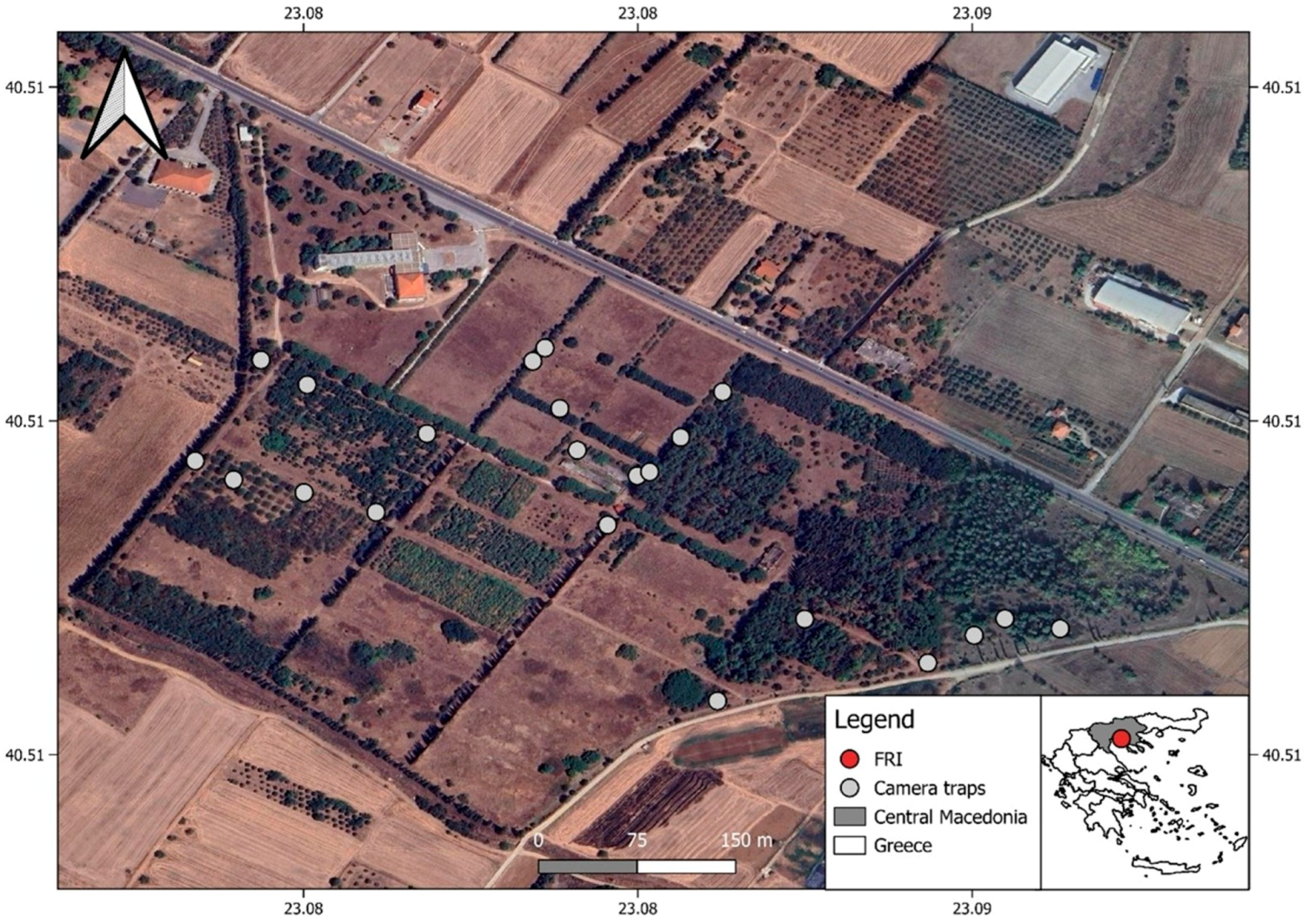
This research was conducted within the 30 ha field station of the Forest Research Institute (ELGO-DIMITRA) located on the outskirts of the city of Thessaloniki, Central Macedonia, in Northern Greece (40.51° N, 23.08° E) (Figure 1). The field station is composed of a mosaic of native and introduced forest stands and open fields/meadows. The tree stands consist mainly of pines (Pinus brutia, Pinus pinea, and Pinus halepensis), oaks (Quercus ilex, Quercus aegilops, Quercus suber, Quercus coccifera, and Quercus macedonica) and Robinia pseudoacacia, connected with tree lines consisting mostly of Cupressus arizonica and occasionally Pistacia lentiscus, Thugia orientalis, and Celtis australis. The area falls under the Mediterranean climate category according to the Köppen climate classification system, characterized by hot, dry summers and mild, wet winters [20]. The mean annual temperature and precipitation are 15.7 °C and 449.6 mm, respectively. The forest dormouse is the sole glirid present at the study site, offering a unique opportunity to investigate its species-specific activity patterns and ecological strategies in the absence of competition with other syntopic glirids. Based on our ongoing field study, the population is estimated to consist of approximately 20 to 25 adult individuals (unpublished data). Rats (Rattus spp.) and woodmice (Apodemus spp.) are also present in the area and may represent potential competitors. Moreover, there are potential predators, including the stone marten (Martes foina), the domestic cat (Felis catus), the Caspian whipsnake (Dolichophis caspius), the eagle owl (Bubo bubo), the barn owl (Tito alba), the scops owl (Otus scops), and the little owl (Athene noctua).

2.2. Data Collection

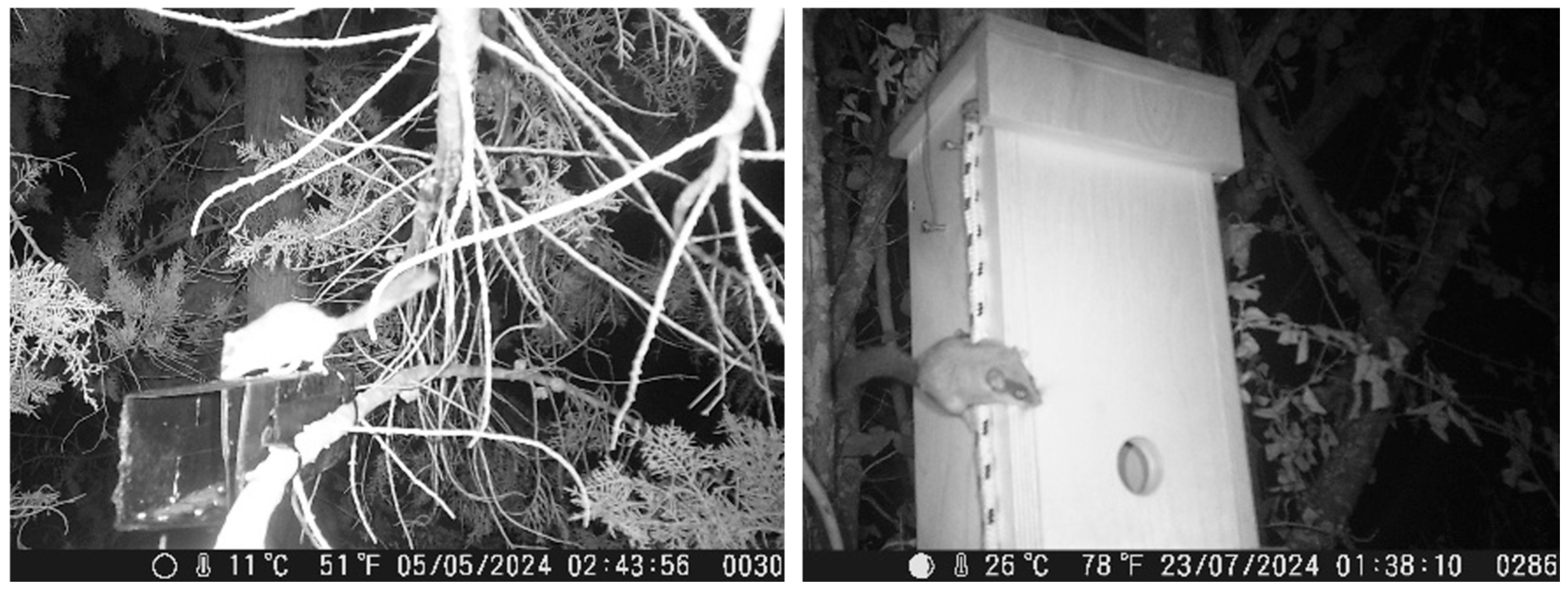
Forest dormouse activity was recorded using Technaxx WildCam TX-117 camera traps (Technaxx Deutschland GmbH & Co. KG, Schöneck, Germany). The cameras were set at medium trigger sensitivity to minimize false activations from moving vegetation. Each capture sequence consisted of three consecutive photos and a 15 s video with a two-minute lag between each capture. Cameras were deployed in three different setups to maximize detection opportunities: (i) on branches baited once with peanut butter and fitted with the outer shell of a nest tube to offer some cover to passing dormice; (ii) facing wooden nest boxes; and (iii) inside a small number of nest boxes (Figure 2). We opted for this non-random, stratified design to capture forest dormouse activity in different microhabitats, including at nesting sites. To maximize the number of detections, cameras that did not record any dormice for more than three weeks were relocated to new locations.
The study period lasted from March to early December 2024, covering the entire active period of the species at the site, as determined from previous in situ fieldwork conducted using nest boxes and nest tubes. Weather data, such as temperature (minimum, maximum and mean), humidity, wind velocity, cloud cover, and precipitation, were obtained from the meteorological weather station located within the Forest Research Institute. The study period was characterized by highly variable environmental conditions, with air temperature ranging from −2.40 to 41.18 °C (Figure S1), relative humidity ranging from 32.50 to 99.96% (Figure S2), and precipitation ranging from 0 to 18.2 mm (Figure S3). Precipitation was infrequent, occurring on only ~6% of observation days.
Twenty camera traps were deployed across 26 locations, with forest dormice detected at 22 of these locations. Of the 22 sites with dormice records, 11 were on branches fitted with empty nest tubes, nine were positioned outside nest boxes (with three of these paired with cameras inside), and two were inside nest boxes only. Cameras were installed at heights between 1.5 and 3 m, distributed across different types of habitats, including oak (Quercus spp.), black locust (Robinia pseudoacacia), pine (Pinus spp.) and cypress (Cupressus spp.) stands. This sampling strategy is in accordance with the design of a previous broad-scale survey within the field station, which confirmed the species’ presence across a diverse range of habitats [21].

2.3. Data Analysis

For analysis, the data were organized into two categories: (i) cameras facing branches (NT) and (ii) cameras positioned outside or inside nest boxes (NBs). To prevent duplicate counting, we focused specifically on animal entries and exits. For nest boxes equipped with both internal and external cameras, we prioritized the external footage, using internal detections only if the external camera missed an event. In boxes with only an internal camera, all entry and exit detections were used.
We used the package Overlap [22] for R 4.4.1 (R Core Team 2014, Vienna, Austria) to estimate the overlap of forest dormouse activity patterns on branches (NT) and around nest boxes (NBs), considering detections at the same camera with at least 30 min difference from a previous one as a separate (independent) event. Following Ridout and Linkie’s approach [23], we fitted kernel density functions to the circular activity data. The degree of similarity was quantified using the coefficient of overlap (Δ̂, Dhat). This metric ranges from 0 (no overlap in activity patterns) to 1 (complete overlap) and represents the area under the minimum of the two density curves at each time point, providing an intuitive measure of how similarly the two groups use time over a 24 h cycle. The specific estimator and its associated smoothing constant (adjust) were selected according to established performance criteria based on the size of the smaller sample in each comparison. For comparisons where the smaller sample size was greater than 75 observations, we employed the (Dhat4) estimator with a smoothing constant of 1. In cases where the smaller sample size was less than 75, the (Dhat1) estimator was used with a smoothing constant of 0.8, as this combination has been shown to minimize the root-mean-squared error for smaller datasets.
To assess the potential influence of environmental variables on overall dormice diel activity at a given camera, we employed generalized linear mixed-effect models with the number of independent dormouse detections per night as the response variable and night duration (hours from sunset to sunrise), temperature (minimum, maximum, and mean in °C), precipitation (mm), humidity (%), dew point (°C), moon phase (%), wind speed (km/h), and cloud cover (%) as predictors, with site (camera trap) as a nested random effect (fixed slope, random intercept). Because the data were non-normally distributed (Shapiro–Wilk test < 0.05) and included many days with zero detections, we tried using zero-inflated negative binomial linear mixed-effects models in R (glmmTMB) [24]. However, these models did not improve model performance during model selection and were therefore not retained in the final analyses.
To determine which variables to include in the final model while managing model complexity, we first assessed each variable’s performance (using a univariate model) against a baseline model that included only the intercept as a fixed parameter. Model selection was guided by the Akaike Information Criterion (AIC) [25]. Variables for which the univariate models produced a higher AIC than the baseline model (i.e., precipitation, cloud cover, and windspeed) were not considered further. To address potential multicollinearity, we pairwise-correlated all the considered variables. For variables that were positively or negatively correlated with each other, with an r higher than 0.65, we retained only those that performed better in the univariate models against the baseline model. As such, mean, min and max temperature were excluded from further analyses given their significant correlation with night duration. Using this final set of fixed variables, we generated all possible multivariate combinations (R package MuMIn:dredge) [26]. Since multiple models had ΔAIC < 2, a common threshold for identifying competing best models, we calculated the model-averaged coefficients for these top models using MuMIn:mod.avg. The goodness of fit for the global model was evaluated using pseudo-R2 [26]. All analyses were performed in R software (v4.4.1).

3. Results

A total of 958 independent detections of forest dormice were recorded across all locations (mean ± SD = 43.4 ± 82.9 detections per location; range: 1–333). Forest dormice were the most frequently detected species for all cameras (Tables S1 and S2). There was notable seasonal variation in the number of daily detections across the camera trap grid, with a strong concentration of detections at locations with nest-facing cameras. Activity peaked during autumn, with the highest detection frequency recorded in September, declining in May and again in October. The detections with higher activity were concentrated around nest-facing cameras. Nest box (NB) cameras recorded an average of 74.7 ± 110.3 detections per location, while there were only 12.4 ± 11.5 detections for the branch-based (NT) cameras (Table 1).
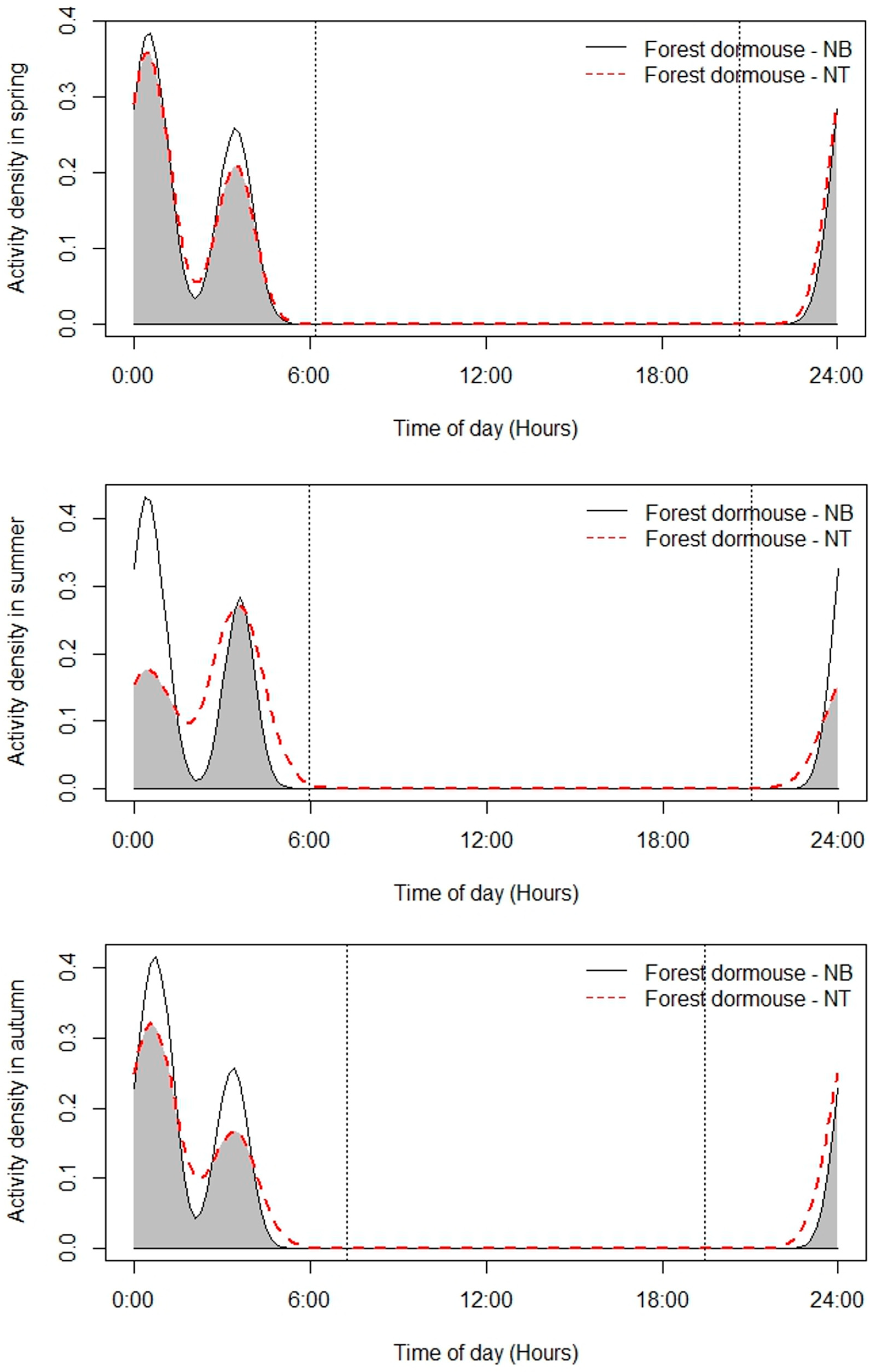
The activity patterns between the cameras facing nest boxes (NBs) and branches (NT) showed generally high overlap in spring (Dhat4 = 0.913; 95% CI: 0.847–0.961) and autumn (Dhat1 = 0.835; 95% CI: 0.741–0.915), with moderate overlap during summer (Dhat1 = 0. 0.725; 95% CI: 0.576–0.832).
Activity was characterized by two distinct peaks: a major peak shortly after midnight between 00:00 and 01:00 and a second peak before sunrise around 04:00 to 06:00 (Figure 3 and Figure S4). In spring, the first peak occurred at midnight, with NB cameras detecting slightly more activity than NT cameras. During summer, the first peak at the nest boxes also occurred around midnight, while branch activity appeared more dispersed across the early hours of the night. Notably, while activity was primarily nocturnal, there were three detections of juveniles during the day. In autumn, activity again showed a first peak at midnight followed by a second peak shortly before sunrise, with branch cameras recording slightly higher movement around the sunrise period. These results suggest consistent temporal activity overlap between NB and NT cameras across seasons, with minor variations in peak timing and intensity related to seasonal behavioral changes such as breeding, raising young, and preparing for hibernation (Figure 3).
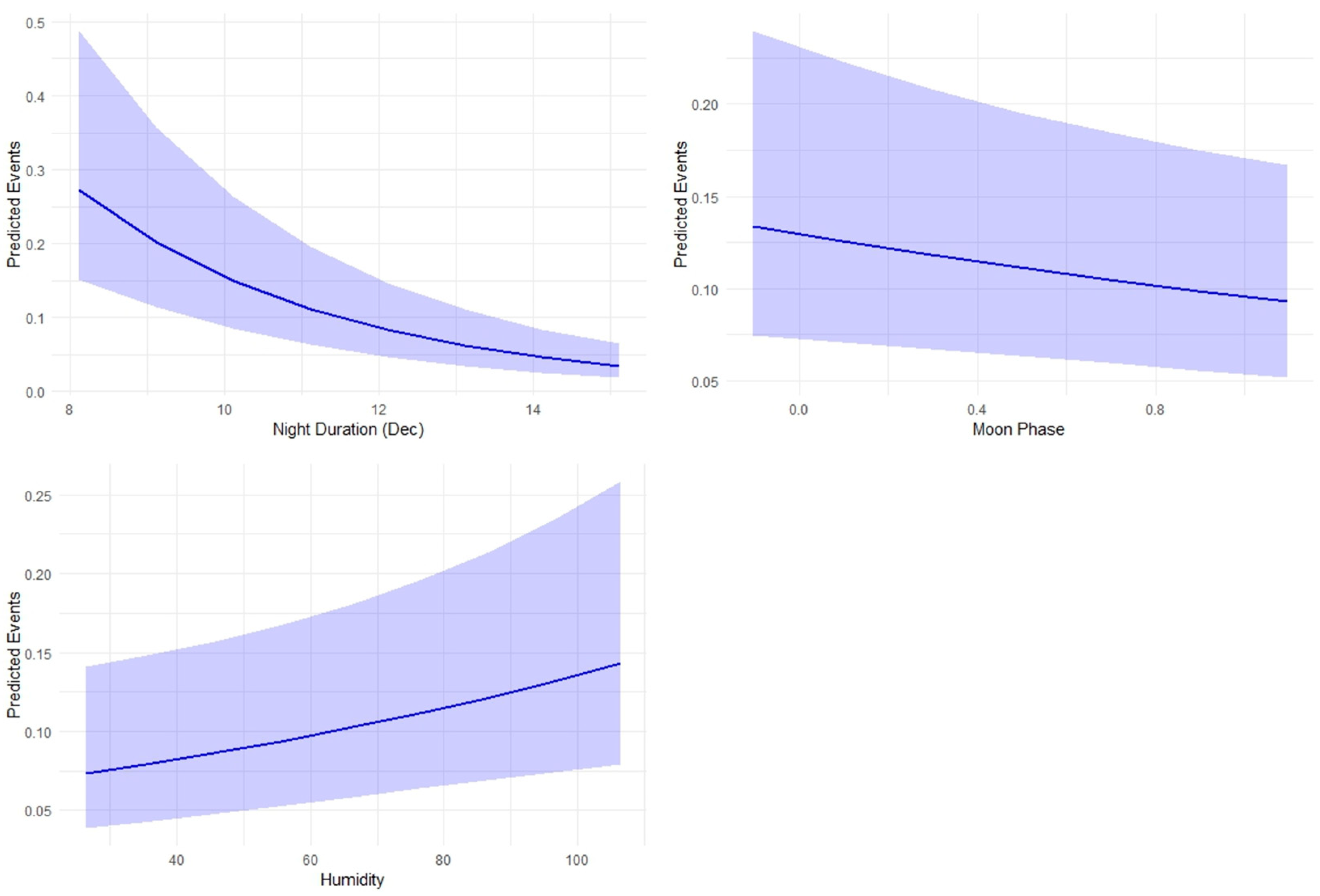
The generalized linear mixed-effects model (GLMM) assessing factors influencing dormouse activity per day per site (camera) revealed habitat site (nest box (NB) or branches (NT)), humidity, moon phase, and night duration had significant effects [pseudo-R2 (conditional) = 0.505] (Table 2). Night duration was the most statistically significant predictor of dormouse activity, showing a significant negative effect (Table 2). Similarly, moon phase had a significant negative effect, with forest dormice being significantly less active during moonlit nights, including during a full moon (Table 2). In contrast, forest dormouse activity was significantly higher when humidity was higher. Additionally, habitat site had a positive effect, with nest-boxes showing more activity. The other environmental variables that we assessed were not good predictors of dormouse activity. Overall, these results highlight night duration as the primary driver of dormouse activity, with additional effects from moon phase and humidity (Figure 4).

4. Discussion

This study provides the first systematic investigation of the diel activity patterns of the forest dormouse in Greece. In our study, the forest dormouse exhibits a mostly nocturnal and crepuscular activity pattern, consistent with findings from other parts of its range [27,28]. Activity was characterized by a major peak shortly after midnight and a secondary peak before sunrise, a finding in line with previous reports for this species [13]. Those results also concur with previous research on the hazel (Muscardinus avellanarius, Linnaeus, 1758), woolly (Dryomys laniger, Felten & Storch, 1968), edible (Glis glis, Linnaeus, 1766) and garden dormouse (Eliomys quercinus, Linnaeus, 1766) [18,29,30,31,32,33], suggesting there is a consistent diel rhythm within the family Gliridae. Although the species is primarily nocturnal, we recorded three detections of juveniles outside the nest boxes during daylight hours. This observation of daytime activity mirrors the findings of Duma and Giurgiu [13], who reported infrequent diurnal movements near nest-box entrances. The presence of juveniles outside a nest box during the day is most likely related to their increased exploration activity or their high energetic demands during ontogeny [34,35].
The activity, recorded by cameras placed on tree branches and at nest boxes, showed a consistently high degree of temporal overlap, indicating that diel rhythms are consistent across microhabitats. The slightly higher activity detected in nest boxes suggests that the dormice spend more time around the nest boxes since they use them as nesting sites. The behaviors observed close to the nest boxes, especially around midnight, may serve as a mechanism with which to confirm the safety and security of their nesting sites. Such activity could also represent important social interactions that individuals engage in to exchange information or reinforce social bonds [11,13].
Forest dormouse activity is influenced primarily by night duration, along with moon phase and humidity. Night duration was the most robust predictor, with shorter nights linked to increased nocturnal movement. Photoperiod significantly influences pan-seasonal activity, including activity start time, end time, and duration [36]. This suggests that the species adjusts its behavior according to the length of night hours, potentially as an adaptive strategy to optimize feeding time and energy use during the active season [37]. Gliridae activity is shaped by photoperiod, but as day length is correlated with temperature and vegetation, these patterns likely reflect multiple environmental cues as opposed to photoperiod alone [18,38].
Moon phase had negative effects, with reduced activity during bright nights, particularly around the full moon. This aligns with “lunar phobia”—the prediction that nocturnal rodents reduce movement under bright conditions to avoid predators [39,40]. Comparable behaviors have been observed in other glirids, including the edible dormouse [28,33,41], as well as in various other nocturnal rodents [42,43].
Humidity had a positive relationship with activity, with higher humidity corresponding to increased nocturnal movement. This may reflect physiological benefits such as reduced dehydration risk or more favorable foraging conditions, as increased humidity is associated with greater availability of insects, a primary protein source for many nocturnal mammals [44,45], including the forest dormouse.
Temperature is widely recognized as a key factor influencing activity patterns in glirids. In this study, maximum temperature showed a positive association with activity levels, suggesting that warmer conditions may promote increased movement. However, this variable was excluded from the final models due to its strong collinearity with respect to night duration, which likely captures similar seasonal and environmental effects. This pattern is consistent with findings regarding hazel dormice, for which higher ambient temperatures have been linked to increased activity, particularly during daylight hours, presumably due to enhanced foraging opportunities and reduced thermoregulatory constraints [37,44,46]. Similarly, edible dormice adjust their activity based on radiant heat during the day, increasing movement when temperatures are favorable for maintaining their body temperatures [47]. This lack of significance may be attributed to the Mediterranean climate of the study area, where temperatures remained consistently high after emergence from hibernation, potentially staying above the threshold that triggers torpor.
Similarly, precipitation had no significant effects on the activity of forest dormice. In contrast, precipitation markedly restricts the activity of the Japanese dormouse (Glirulus japonicus, Schinz, 1845) and the hazel dormouse [36,48], for which both the duration and intensity of rainfall directly affect nightly activity, leading to reduced activity duration. This is likely due to the low intensity of rainfall during the survey period, which may have been insufficient to disrupt foraging behavior or movement.
This study provides new data on the diel activity of a population of forest dormice in Northern Greece. Nevertheless, some limitations should be acknowledged. The number of detections from camera traps facing branches was limited, potential biasing results related to microhabitat activity. Additionally, the study covered only a single active season. Data collection is ongoing, and this longer-term approach will enhance the robustness and reliability of the findings.

5. Conclusions

Despite any limitations, this study provides the first systematic research on forest dormouse activity in Greece. Our findings offer important baseline information for understanding the ecology of the species in the Mediterranean region. These findings highlight the importance of environmental variables with respect to both the seasonal and daily activity of dormice while also demonstrating the effectiveness of camera trapping as a non-invasive method for monitoring arboreal small mammals. By minimizing disturbance of the animals, camera traps provide reliable data that can enhance our understanding of elusive species like the forest dormouse.
Beyond its methodological contribution, this study provides a foundation for developing more effective monitoring protocols for the forest dormouse. For instance, identifying the months and times of day when activity is highest can help inform other data collection protocols (e.g., timing of nest-box checks and live camera trapping), making long-term monitoring more efficient. It can also help us interpret the impact of glirid competition on forest dormouse activity when compared with similar data from sites where more glirids co-occur. Finally, it can help us understand the impact of ever-warming summers, drought duration, and heat waves on the species.

Supplementary Materials

The following supporting information can be downloaded at https://www.mdpi.com/article/10.3390/f17050607/s1. Figure S1: Temperature (°C) ranges from March to December 2024. Figure S2: Humidity (%) ranges from March to December 2024. Figure S3: Precipitation (mm) ranges from March to December 2024. Figure S4: Twenty-four-hour activity of forest dormice during the 24 h (number of detections per hour). Table S1. Percentage of total independent detections of forest dormice, other mammals, birds, and lizards for all camera traps during the period of March to December 2024. Table S2: Animals detected by camera traps during the period of March to December 2024.

Author Contributions

A.P. and D.T. contributed equally to this project. Conceptualization, A.P., C.A. and D.Y.; methodology, A.P. and C.A.; software, D.T.; validation, A.P., D.T. and C.A.; formal analysis, D.T. and A.P.; investigation, A.P. and D.T.; resources, A.P., N.M. and M.A.; data curation, A.P.; writing—original draft preparation, A.P. and D.T.; writing—review and editing, A.P., D.T., C.A. and D.Y.; visualization, A.P. and C.A.; supervision, C.A. and D.Y.; project administration, C.A. and D.Y. All authors have read and agreed to the published version of the manuscript.

Funding

This research received no external funding.

Data Availability Statement

The data presented in this study are available on request from the corresponding author, as a portion of the dataset is part of ongoing research and unpublished analysis, and any revelation of the exact placement could jeopardize the deployed equipment.

Acknowledgments

All authors would like to acknowledge the assistance they received throughout field research, data collection, and data analysis of this study. Special thanks are extended to Savvas Kazantzidis, for granting permission to conduct fieldwork in the study area. We are also particularly indebted to the three anonymous reviewers for their constructive comments and valuable suggestions, which substantially improved this manuscript.

Conflicts of Interest

All authors declare that the research was conducted in the absence of any commercial or financial relationships that could be construed as a potential conflict of interest.

References

  1. Kryŝtufek, B.; Vohralík, V. Distribution of the forest dormouse Dryomys nitedula (Pallas, 1779) (Rodentia, Myoxidae) in Europe. Mammal Rev. 1994, 24, 161–177. [Google Scholar] [CrossRef] [Scilit]
  2. Andreychev, A. Distribution and population density forest dormouse (Dryomys nitedula, Rodentia, Gliridae) in a region of the Middle Volga, Russia. Ecol. Environ. Conserv. 2021, 27, 369–373. [Google Scholar]
  3. Lang, J.; Büchner, S.; Meinig, H.; Bertolino, S. Do We Look for the Right Ones? An Overview of Research Priorities and Conservation Status of Dormice (Gliridae) in Central Europe. Sustainability 2022, 14, 9327. [Google Scholar] [CrossRef] [Scilit]
  4. Batsaikhan, N.; Kryštufek, B.; Amori, G.; Yigit, N. Dryomys nitedula; The IUCN Red List of Threatened Species: 2016; e.T6858A115084761. Available online: https://www.iucnredlist.org/species/6858/115084761 (accessed on 8 March 2026).
  5. Youlatos, D.; Rammou, K. Dryomys nitedula; The Greek Red List of Threatened Species, 2024. Available online: https://redlist.necca.gov.gr/en/assessment/?id=226377166 (accessed on 8 March 2026).
  6. Ściński, M.; Borowski, Z. Home ranges, nest sites and population dynamics of the forest dormouse Dryomys nitedula (Pallas) in an oak-hornbeam forest: A live-trapping and radio-tracking study. Pol. J. Ecol. 2006, 54, 391–396. [Google Scholar]
  7. Kubista, C.; Resch, C.; Resch, S.; Rotter, B. Historic and current distribution of the forest dormouse (Dryomys nitedula intermedius Nehring, 1902) in Austria. Eur. J. Wildl. Res. 2025, 71, 88. [Google Scholar] [CrossRef] [Scilit]
  8. Pilāts, V.; Pilāte, D.; Ornicāns, A.; Karkliņš, A. Microhabitat utilization by forest dormice (Dryomys nitedula) in boreo-nemoral forest—Preliminary results. In Proceedings of the 8th International Dormouse Conference, Ostritz, Germany, 22–27 September 2011. [Google Scholar]
  9. Juškaitis, R.; Balčiauskas, L.; Šiožinytė, V. Nest site preference of forest dormouse Dryomys nitedula (Pallas) in the north-western corner of the distribution range. Pol. J. Ecol. 2012, 60, 815–826. [Google Scholar]
  10. Astaras, C.; Migli, D.; Karmiris, I.; Pleniou, M.; Mitsainas, G.; Youlatos, D. Distribution and habitat use by sympatric dormice species in two Natura 2000 sites in central Macedonia, Greece. ARPHA Conf. Abstr. 2022, 5, e82802. [Google Scholar] [CrossRef] [Scilit]
  11. Juškaitis, R. Ecology of the forest dormouse Dryomys nitedula (Pallas 1778) on the north-western edge of its distributional range. Mammalia 2015, 79, 33–41. [Google Scholar] [CrossRef] [Scilit]
  12. Nevo, E.; Amir, E. Geographic variation in reproduction and hibernation patterns of the forest dormouse. J. Mammal. 1964, 45, 69–87. [Google Scholar] [CrossRef] [Scilit]
  13. Duma, I.I.; Giurgiu, S. Circadian activity and nest use of Dryomys nitedula as revealed by infrared motion sensor cameras. Folia Zool. 2012, 61, 49–53. [Google Scholar] [CrossRef] [Scilit]
  14. Juškaitis, R.; Baltrūnaitė, L. Seasonal variability in the diet of the forest dormouse, Dryomys nitedula, on the north-western edge ofits distributional range. Folia Zool. 2013, 62, 311–318. [Google Scholar] [CrossRef] [Scilit]
  15. Nowakowski, W.K. 24-h activity in the forest dormouse (Dryomys nitedula). Nat. Croat. 1998, 7, 19–29. [Google Scholar]
  16. Refinetti, R. Circadian Physiology, 3rd ed.; CRC Press: Boca Raton, FL, USA, 2016. [Google Scholar]
  17. Halle, S.; Stenseth, N.C. Activity Patterns in Small Mammals: An Ecological Approach; Springer: Berlin/Heidelberg, Germany, 2000; Volume 141. [Google Scholar] [CrossRef] [Scilit]
  18. Bieber, C.; Ruf, T. Summer dormancy in edible dormice (Glis glis) without energetic constraints. Naturwissenschaften 2009, 96, 165–171. [Google Scholar] [CrossRef] [Scilit] [PubMed]
  19. Ruf, T.; Geiser, F. Daily torpor and hibernation in birds and mammals. Biol. Rev. 2015, 90, 891–926. [Google Scholar] [CrossRef] [Scilit]
  20. Lionello, P.; Malanotte-Rizzoli, P.; Boscolo, R.; Alpert, P.; Artale, V.; Li, L.; Luterbacher, J.; May, W.; Trigo, R.; Tsimplis, M.; et al. The Mediterranean climate: An overview of the main characteristics and issues. In Developments in Earth and Environmental Sciences; Lionello, P., Malanotte-Rizzoli, P., Boscolo, R., Eds.; Elsevier: Amsterdam, The Netherlands, 2006; Volume 4, pp. 1–26. [Google Scholar] [CrossRef] [Scilit]
  21. Nikolaidou, R. Study of the Status, Distribution and Spatial Ecology of the Forest Dormouse (Dryomys nitedula) in the Forestry Research Institute, ELGO-DIMITRA. Bachelor’s Thesis, School of Biology, Aristotle University of Thessaloniki, Thessaloniki, Greece, 2023. [Google Scholar]
  22. Meredith, M.; Ridout, M. Overview of the Overlap Package. 2020. Available online: https://CRAN.R-project.org/package=overlap (accessed on 3 May 2026).
  23. Ridout, M.S.; Linkie, M. Estimating overlap of daily activity patterns from camera trap data. J. Agric. Biol. Environ. Stat. 2009, 14, 322–337. [Google Scholar] [CrossRef] [Scilit]
  24. Kuznetsova, A.; Brockhoff, P.B.; Christensen, R.H.B. R Package, Version 1.1.2. GlmmTMB: Generalized Linear Mixed Models Using Template Model Builder. The R Foundation for Statistical Computing: Vienna, Austria, 2024. Available online: https://CRAN.R-project.org/package=glmmTMB (accessed on 18 February 2026).
  25. Burnham, K.P.; Anderson, D.R. Statistical Theory and Numerical Results. In Model Selection and Multimodel Inference: A Practical Information-Theoretic Approach, 2nd ed.; Springer: New York, NY, USA, 2002; pp. 352–436. [Google Scholar]
  26. Bartoń, K. R Package, Version 1.48.4. MuMIn: Multi-Model Inference. The Comprehensive R Archive Network: Vienna, Austria, 2024. Available online: https://CRAN.R-project.org/package=MuMIn (accessed on 18 February 2026).
  27. Juskaitis, R.; Siozinyte, V. Habitat requirements of the common dormouse (Muscardinus avellanarius) and the fat dormouse (Glis glis) in mature mixed forest in Lithuania. Ekológia 2008, 27, 143–151. [Google Scholar]
  28. Kryštufek, B. Glis glis (Rodentia: Gliridae). Mamm. Species 2010, 42, 195–206. [Google Scholar] [CrossRef] [Scilit]
  29. Bright, P.W.; Morris, P.A. Ranging and nesting behaviour of the dormouse (Muscardinus avellanarius), in diverse low-growing woodland. J. Zool. 1991, 224, 177–190. [Google Scholar] [CrossRef] [Scilit]
  30. Kart Gür, M.; Bulut, Ş.; Gür, H.; Refinetti, R. Body temperature patterns and use of torpor in an alpine glirid species, woolly dormouse. Acta Theriol. 2014, 59, 299–309. [Google Scholar] [CrossRef] [Scilit]
  31. Randler, C.; Kalb, N. Circadian activity of the fat dormouse Glis glis measured with camera traps at bait stations. Mammal Res. 2021, 66, 627–634. [Google Scholar] [CrossRef] [Scilit]
  32. Rodolfi, G. Dormice Glis glis activity and hazelnut consumption. Acta Theriol. 1994, 39, 215–220. [Google Scholar] [CrossRef] [Scilit]
  33. Queckenstedt, H.H.; Ansorge, H.; Lang, J.; Büchner, S. Diel Activity Patterns of Garden Dormice Eliomys quercinus (Linnaeus, 1766) (Rodentia: Gliridae) Assessed by Camera Trap Data. Acta Zool. Bulg. 2024, 9–13. [Google Scholar]
  34. Valentin, S.; Baudoin, C. Behavioural development of the garden dormouse, Eliomys quercinus L.: II) an open-field study. Behav. Process. 1984, 9, 271–275. [Google Scholar] [CrossRef] [Scilit] [PubMed]
  35. Giroud, S.; Zahn, S.; Criscuolo, F.; Chery, I.; Blanc, S.; Turbill, C.; Ruf, T. Late-born intermittently fasted juvenile garden dormice use torpor to grow and fatten prior to hibernation: Consequences for ageing processes. Proc. R. Soc. B Biol. Sci. 2014, 281, 20141131. [Google Scholar] [CrossRef] [Scilit]
  36. Bright, P.W.; Morris, P.A.; Wiles, N.J. Effects of weather and season on the summer activity of dormice Muscardinus avellanarius. J. Zool. 1996, 238, 521–530. [Google Scholar] [CrossRef] [Scilit]
  37. Bright, P.W.; Mitchell, P.; Morris, P.A. Dormouse distribution: Survey techniques, insular ecology and selection of sites for conservation. J. Appl. Ecol. 1994, 31, 329–339. [Google Scholar] [CrossRef] [Scilit]
  38. Walhovd, H. The activity of a pair of common dormice Muscardinus avellanarius in conditions of captivity. Oikos 1971, 22, 358–363. [Google Scholar] [CrossRef] [Scilit]
  39. Halle, S. Ecological relevance of daily activity patterns. In Activity Patterns in Small Mammals: An Ecological Approach; Halle, S., Stenseth, N.C., Eds.; Springer: Berlin/Heidelberg, Germany, 2000; Volume 141, pp. 67–90. [Google Scholar] [CrossRef] [Scilit]
  40. Bischof, R.; Vallejo-Vargas, A.F.; Semper-Pascual, A.; Schowanek, S.D.; Beaudrot, L.; Turek, D.; Jansen, P.A.; Rovero, F.; Johnson, S.E.; Moreira Lima, M.G.; et al. The moon’s influence on the activity of tropical forest mammals. Proc. R. Soc. B Biol. Sci. 2024, 291, 20240683. [Google Scholar] [CrossRef] [Scilit]
  41. Mori, E.; Sangiovanni, G.; Corlatti, L. Gimme shelter: The effect of rocks and moonlight on occupancy and activity pattern of an endangered rodent, the garden dormouse Eliomys quercinus. Behav. Process. 2020, 170, 103999. [Google Scholar] [CrossRef] [Scilit]
  42. Daly, M.; Behrends, P.R.; Wilson, M.I.; Jacobs, L.F. Behavioural modulation of predation risk: Moonlight avoidance and crepuscular compensation in a nocturnal desert rodent, Dipodomys merriami. Anim. Behav. 1992, 44, 1–9. [Google Scholar] [CrossRef] [Scilit]
  43. Orrock, J.L.; Danielson, B.J.; Brinkerhoff, R.J. Rodent foraging is affected by indirect, but not by direct, cues of predation risk. Behav. Ecol. 2004, 15, 433–437. [Google Scholar] [CrossRef] [Scilit]
  44. Juškaitis, R. The Common Dormouse Muscardinus avellanarius: Ecology, Population Structure and Dynamics, 2nd ed.; Nature Research Centre: Vilnius, Lithuania, 2014; pp. 53–64. [Google Scholar]
  45. Campera, M.; Balestri, M.; Stewart, A.N.; Nekaris, K.A.I. Influence of Moon Luminosity, Seasonality, Sex and Weather Conditions on the Activity Levels of the Nocturnal Javan Slow Loris. Ecologies 2022, 3, 257–266. [Google Scholar] [CrossRef] [Scilit]
  46. Cartledge, E.L.; Bellis, J.; White, I.; Hurst, J.L.; Stockley, P.; Dalrymple, S. Current and future climate suitability for the hazel dormouse in the UK and the impact on reintroduced populations. Conserv. Sci. Pract. 2024, 6, e13254. [Google Scholar] [CrossRef] [Scilit]
  47. Mrosovsky, N.; Melnyk, R.B.; Lang, K.; Halloquist, J.D.; Boshes, M.; Joy, J.E. Infradian cycles in dormice (Glis glis). J. Comp. Physiol. 1980, 137, 315–339. [Google Scholar] [CrossRef] [Scilit]
  48. Suzuki, K.K.; Ando, M. Effect of rainfall on nocturnal activity of the Japanese dormouse. Clim. Res. 2019, 78, 205–209. [Google Scholar] [CrossRef] [Scilit]
Figure 1. Map of all camera trap locations within the 30 ha Forest Research Institute’s field station.
Forests 17 00607 g001
Figure 2. Forest dormouse captured by camera traps on branches (left); forest dormouse captured by camera traps facing nest boxes (right).
Forests 17 00607 g002
Figure 3. Activity overlap of forest dormice between nest boxes (NBs) and branches (NT) from March to November, divided into three active seasons. (Top): Activity density for spring nest boxes (NBs) (n = 195) and branches (NT) (n = 87). (Middle): Activity density for summer nest boxes (NBs) (n = 412) and branches (NT) (n = 25). (Bottom): Activity density for autumn nest boxes (NBs) (n = 214) and branches (NT) (n = 24).
Forests 17 00607 g003
Figure 4. Response curves showing the predicted event response number for night duration (hours), humidity (%) and moon phase (proportion of lunar illumination). Predictions were made based on the GLMM negative binomial model; 95% confidence intervals are shown in the shaded areas.
Forests 17 00607 g004
Table 1. Summary of the forest dormouse detection locations, camera configurations, monitoring periods (2024), independent detections and dominant vegetation types.
LocationsCamera PlacementSurvey PeriodIndependent
Detections
Dominant Vegetation Type
FRI2Nest box (NB)08.04–06.1231Deciduous forest
FRI3Branch (NT)14.03–12.07, 29.07–06.125Mixed woodland
FRI4Nest box (NB)15.03–12.07, 29.07–06.1219Deciduous forest
FRI5Nest box (NB)15.03–06.12333Non-native/Plantation
FRI6Branch (NT)15.03–12.07, 29.07–06.1225Coniferous forest
FRI7Branch (NT)15.03–06.1229Deciduous forest
FRI8Branch (NT)15.03–06.122Coniferous forest
FRI9Branch (NT)15.03–06.127Coniferous forest
FRI10Branch (NT)15.03–06.123Deciduous forest
FRI11Nest box (NB)19.03–06.12233Coniferous forest
FRI12Nest box (NB)19.03–06.1291Mixed woodland
FRI14Branch (NT)24.05–12.07, 29.07–06.1210Coniferous forest
FRI15Nest box (NB)19.03–12.072Mixed woodland
FRI16Nest box (NB)19.03–12.0719Mixed woodland
FRI17Branch (NT)20.03–06.1227Coniferous forest
FRI18Branch (NT)20.03–06.1225Coniferous forest
FRI20Nest box (NB)28.05–06.1289Deciduous forest
FRI22Branch (NT)10.04–12.071Mixed woodland
FRI23Branch (NT)29.07–06.122Non-native/Plantation
FRI24Nest box (NB)24.07–06.123Coniferous forest
FRI25Nest box (NB)29.07–06.121Coniferous forest
FRI26Nest box (NB)16.09–06.121Deciduous forest
Table 2. Estimates and significance of the fixed-effect variables predicting dormouse activity in terms of events per day per site (camera) [pseudo-R2 (conditional) = 0.505; generalized linear mixed effect model with Site as a random effect (intercept only)].
VariableEstimateStd. ErrorPr (>|z|)
(Intercept)−3.5180.402<0.001 ***
Habitats1.292 0.5630.021 *
Humidity0.008 0.0030.011 *
Moon Phase−0.3050.1380.027 *
Night duration−0.2960.033<0.001 ***
*: p < 0.05; ***: p < 0.001.
Disclaimer/Publisher’s Note: The statements, opinions and data contained in all publications are solely those of the individual author(s) and contributor(s) and not of MDPI and/or the editor(s). MDPI and/or the editor(s) disclaim responsibility for any injury to people or property resulting from any ideas, methods, instructions or products referred to in the content.