




Medicina, Volume 61, Issue 3 (March 2025) – 187 articles
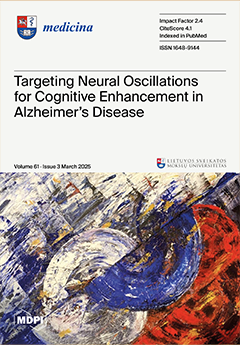
Cover Story (view full-size image):
Alzheimer’s disease (AD), the most common cause of dementia, is characterized by progressive cognitive decline and marked by amyloid plaques, tau tangles, and disrupted neural connectivity. Emerging evidence highlights the role of aberrant neural oscillations in AD pathophysiology, linking them to impaired cognition and network dysfunction. Modulating these oscillations has shown therapeutic promise, with preclinical and clinical studies demonstrating improved memory, synaptic function, and reduced pathology. This paper reviews current neuromodulation strategies targeting oscillatory dysfunction and their potential to enhance cognitive outcomes in AD. View this paper
- Issues are regarded as officially published after their release is announced to the table of contents alert mailing list.
- You may sign up for e-mail alerts to receive table of contents of newly released issues.
- PDF is the official format for papers published in both, html and pdf forms. To view the papers in pdf format, click on the "PDF Full-text" link, and use the free Adobe Reader to open them.
Previous Issue
Next Issue
