
Skip to Content

Fishes

Fishes is an international, peer-reviewed, scientific, open access journal covering fishes and aquatic animals research, and is published monthly online by MDPI.
The Iberian Society of Ichthyology (SIBIC) and Brazilian Society of Aquaculture and Aquatic Biology (Aquabio) are affiliated with Fishes and their members receive a discount on the article processing charges.
Quartile Ranking JCR - Q1 (Marine and Freshwater Biology)

Get Alerted

Add your email address to receive forthcoming issues of this journal.

All Articles (2,780)

  • Perspective
  • Open Access

Fishes represent an extremely diverse group of organisms, both within and among species. This diversity reflects their association with the environment and resources like habitat and food. Here, examples from diverse life histories of fishes are used to illustrate the significance of the patterns and processes involved in the ongoing dynamic relationships organisms have with their environment. This exploration relates directly to an ongoing paradigm shift in evolutionary biology, where organismal development is at the core. This paper applies knowledge of phenotypic plasticity and transgenerational plasticity in fishes in concert with biosemiotics to explain this kind of approach. It is concluded that the role of signals and cues involved in organismal interpretation and responses to changing conditions play a key role in understanding how new opportunities for development and evolution become realised through complex pathways influencing phenotypic variation within and across generations. Because of their diversity and responsiveness, especially in developmental and life history strategies, fishes are excellent subjects to study this further both theoretically and empirically.

30 May 2026

A conceptual model exploring the interactions among ecological (ECO), evolutionary (EVO) and developmental (DEVO) processes. The key interactions and pathways within this ECO–EVO–DEVO model can be summarised as follows. In ECO–EVO, the environment influences the evolution of populations through natural selection; in EVO–ECO, evolutionary responses (i.e., phenotypic changes across generations) influence ecological processes in an ecosystem (often referred to as ECO–EVO feedbacks or niche construction); in ECO–DEVO, the environment affects the developmental processes of individual organisms (broadly encompassing any form of individual plasticity and parental effects); in DEVO–ECO, within-generation developmental responses of individuals influence the response of populations and, subsequently, ecosystems to environmental change; in EVO–DEVO, evolutionary processes across generations provide inherited signals (e.g., direct genetic and non-genetic - including epigenetic - variation) that influence phenotypic development; and in DEVO–EVO, selection acts on phenotypic variation from development. In nature, ECO–EVO–DEVO processes interact and are likely to act dynamically, that is, via reciprocal feedback responses. The figure is originally from Skúlason et al. [4]. This figure is distributed under the terms of the Creative Commons Attribution 4.0 International License (CC BY 4.0) (http://creativecommons.org/licenses/by/4.0/).

Content of Short-Lived Radionuclides (125Sb, 131I, 141Ce, and 144Ce) in Fish

  • Nataliia E. Zarubina,
  • Vladislav Semak and
  • Liliia P. Ponomarenko

This review is part of a series of studies on short-lived radionuclide accumulation in aquatic organisms following nuclear weapons testing, routine facility discharges, and accidental releases. It examines the pathways of uptake, accumulation, and internal redistribution of 125Sb, 131I, 141Ce, and 144Ce in fish representing different ecological groups. The analysis combines published literature data with our original findings obtained from studies conducted in the cooling pond of the Chornobyl Nuclear Power Plant and the Kaniv Reservoir during the post-accident period. It has been established that radionuclide accumulation is governed by their physicochemical properties, environmental speciation, and the trophic characteristics of fish. 125Sb demonstrates high bioavailability and accumulates in internal organs, gills, roe, and muscle depending on its chemical form in the aquatic environment. 131I is characterized by high solubility, rapid incorporation into biological processes, and transient retention in tissues. 141Ce and 144Ce exhibit low mobility, strong association with particulate matter, and preferential accumulation in the gastrointestinal tract, external, and mineralized tissues. At the same time, the presence of 144Ce in the muscle tissue of carnivores and piscivores suggests possible trophic transfer and does not exclude potential manifestations of limited biomagnification of this radionuclide under conditions of elevated environmental contamination. It has been determined that the ratio of 125Sb to 144Ce can be used to identify contamination sources: their co-occurrence is interpreted as evidence of fuel particle input, explaining their predominant localization in the gastrointestinal tract and, to a lesser extent, in external tissues. Conversely, their separate detection reflects differences in mobility and bioavailability. It has been shown that the principal pathways for the uptake of the investigated radionuclides by fish are particle ingestion and absorption from the dissolved phase; thus, trophic dilution predominates over biomagnification, although trophic transfer of 144Ce cannot be excluded.

30 May 2026

Cooling Pond of the Chornobyl Nuclear Power Plant: left, 2013; right, 2009 (photo by N. Zarubina).

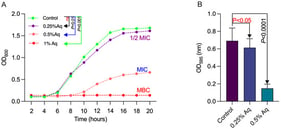
This study evaluated the anti-virulence effect of AuraAqua (Aq), a natural mixture of organic acids, against Pseudomonas. fluorescens. The minimum inhibitory concentration (MIC) and minimum bactericidal concentration (MBC) of Aq against P. fluorescens were 0.5% and 1% (v/v), respectively. Growth curve analysis confirmed concentration-dependent inhibition of planktonic growth, while sub-inhibitory Aq (0.25%; 1/2 MIC) significantly reduced biofilm formation. Rhodamine-based assays revealed membrane depolarisation at both 0.25% and 0.5% Aq, with decreased intracellular protein levels, indicating impaired membrane integrity under the tested conditions. In fibronectin adherence assays, the presence of Aq during bacterial contact markedly reduced adherence, whereas short pre-treatment alone produced limited, non-persistent effects, suggesting that continuous exposure is required to interfere with host matrix binding. Supernatants and lysates from Aq-exposed P. fluorescens induced lower extracellular protease activity in a concentration-dependent manner and mitigated P. fluorescens-induced cytotoxicity in primary shrimp (SGP) and tilapia (TGP) gut cells, as measured by lactate dehydrogenase (LDH) release after exposure to bacterial supernatants and lysates. Aq treatment was associated with decreased P. fluorescens internalisation into SGP and TGP cells. Collectively, these data show that Aq exerts multi-target inhibitory and virulence-attenuating effects on P. fluorescens, supporting its potential use in aquaculture environments.

30 May 2026

Growth inhibition and biofilm formation of P. fluorescens. (A) Growth curves of P. fluorescens in nutrient broth at 30 °C for 24 h in the presence of increasing concentrations of Aq (0, 0.25%, 0.5%, and 1%). Optical density at 600 nm (OD600) was measured at 2 h intervals. The minimum inhibitory concentration (MIC) and minimum bactericidal concentration (MBC) of Aq against P. fluorescens were determined as 0.5% and 1%, respectively. (B) Quantification of biofilm formation by P. fluorescens after 24 h incubation at 30 °C in the presence of sub-inhibitory concentrations of Aq (0.25%) and MIC (0.5%). Data represent mean ± standard deviation of three independent experiments (n = 3). A significant reduction in biofilm formation was observed at 0.25% Aq (p < 0.05) and a highly significant reduction at 0.5% Aq (p < 0.0001) compared with the untreated control. The One-way ANOVA (p < 0.0001) and Šídák’s test for multiple comparisons were used to assess statistical significance. Only significant p values are indicated on graphs.

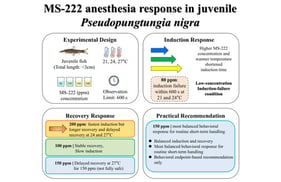
The black shinner Pseudopungtungia nigra is an endangered freshwater fish endemic to Korea, and standardized anesthetic protocols are needed for conservation-related hatchery handling. This study evaluated the effects of water temperature and MS-222 concentration on anesthetic induction and recovery responses in hatchery-reared juvenile P. nigra of approximately 3 cm total length. Juveniles were exposed to four MS-222 concentrations, 80, 100, 150, and 200 mg L−1, at three water temperatures, 21, 24, and 27 °C. Induction time, recovery time, and recovery success within 600 s were assessed using behavioral endpoints. The 80 mg L−1 treatment induced anesthesia within 600 s only at 27 °C, whereas fish exposed at 21 and 24 °C failed to reach the defined anesthetic stage within 600 s; therefore, this treatment was treated as a low-concentration induction-failure condition. In the main 3 × 3 factorial analysis using 100, 150, and 200 mg L−1, induction time decreased significantly with increasing MS-222 concentration and water temperature, with significant effects of temperature, concentration, and their interaction. In contrast, recovery time increased with increasing MS-222 concentration, indicating a clear trade-off between rapid induction and recovery stability. Although 200 mg L−1 produced the shortest induction times, it also resulted in the longest recovery times and delayed recovery at 24 and 27 °C. The 100 mg L−1 treatment showed stable recovery but required prolonged induction, especially at lower temperatures. Overall, 150 mg L−1 provided the most balanced behavioral response by substantially reducing induction time compared with 100 mg L−1 while avoiding the greater recovery burden observed at 200 mg L−1. These findings suggest that 150 mg L−1 MS-222 is a practical concentration for routine short-term handling of hatchery-reared juvenile P. nigra under the tested temperature and handling conditions. However, this recommendation should be interpreted as a behavioral handling guideline because physiological stress responses and long-term post-anesthetic outcomes were not evaluated.

29 May 2026

Trade-off among induction time, recovery time, and delayed recovery in juvenile P. nigra. The x-axis indicates mean induction time, the y-axis indicates mean recovery time among fish that recovered within 600 s, and point size indicates the proportion of individuals showing delayed recovery beyond 600 s. Therefore, the y-axis should be interpreted together with point size because delayed-recovery individuals were excluded from mean recovery-time calculation. The 150 mg L−1 treatment showed the most balanced response between induction efficiency and recovery stability.

News & Conferences

Volumes

Latest Issues

Open for Submission

Editor's Choice

Reprints of Collections

Advances in Aquaculture Feed Additives
Reprint

Advances in Aquaculture Feed Additives

Editors: Adolfo Jatobá, Delano Dias Schleder
Underwater Acoustic Technologies for Sustainable Fisheries
Reprint

Underwater Acoustic Technologies for Sustainable Fisheries

Editors: Jianfeng Tong, Yong Tang, Tohru Mukai
XFacebookLinkedIn
Fishes - ISSN 2410-3888