

Review

Content of Short-Lived Radionuclides (125Sb, 131I, 141Ce, and 144Ce) in Fish

by
Nataliia E. Zarubina
1,*,
Vladislav Semak
2,* and
Liliia P. Ponomarenko
3
1
Institute for Nuclear Research, National Academy of Sciences of Ukraine, 03028 Kyiv, Ukraine
2
Center for Biomedical Technology, Department for Biomedical Research, University for Continuing Education Krems, 3500 Krems, Austria
3
Department of Physics and Mathematics, Igor Sikorsky Kyiv Polytechnic Institute, National Technical University of Ukraine, 03056 Kyiv, Ukraine
*
Authors to whom correspondence should be addressed.
Fishes 2026, 11(6), 328; https://doi.org/10.3390/fishes11060328
Submission received: 27 April 2026 / Revised: 16 May 2026 / Accepted: 27 May 2026 / Published: 30 May 2026
(This article belongs to the Section Environment and Climate Change)

Abstract

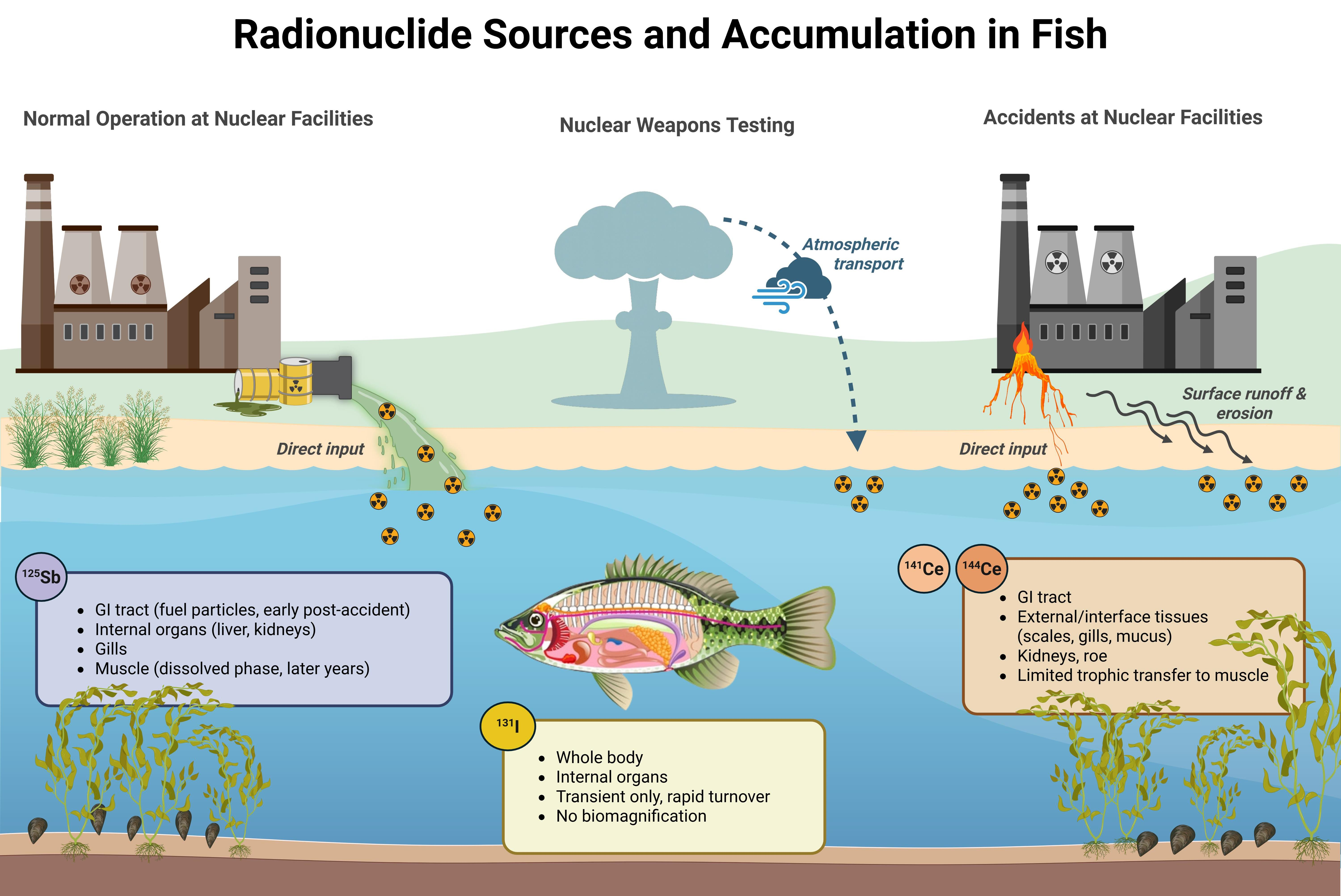
This review is part of a series of studies on short-lived radionuclide accumulation in aquatic organisms following nuclear weapons testing, routine facility discharges, and accidental releases. It examines the pathways of uptake, accumulation, and internal redistribution of 125Sb, 131I, 141Ce, and 144Ce in fish representing different ecological groups. The analysis combines published literature data with our original findings obtained from studies conducted in the cooling pond of the Chornobyl Nuclear Power Plant and the Kaniv Reservoir during the post-accident period. It has been established that radionuclide accumulation is governed by their physicochemical properties, environmental speciation, and the trophic characteristics of fish. 125Sb demonstrates high bioavailability and accumulates in internal organs, gills, roe, and muscle depending on its chemical form in the aquatic environment. 131I is characterized by high solubility, rapid incorporation into biological processes, and transient retention in tissues. 141Ce and 144Ce exhibit low mobility, strong association with particulate matter, and preferential accumulation in the gastrointestinal tract, external, and mineralized tissues. At the same time, the presence of 144Ce in the muscle tissue of carnivores and piscivores suggests possible trophic transfer and does not exclude potential manifestations of limited biomagnification of this radionuclide under conditions of elevated environmental contamination. It has been determined that the ratio of 125Sb to 144Ce can be used to identify contamination sources: their co-occurrence is interpreted as evidence of fuel particle input, explaining their predominant localization in the gastrointestinal tract and, to a lesser extent, in external tissues. Conversely, their separate detection reflects differences in mobility and bioavailability. It has been shown that the principal pathways for the uptake of the investigated radionuclides by fish are particle ingestion and absorption from the dissolved phase; thus, trophic dilution predominates over biomagnification, although trophic transfer of 144Ce cannot be excluded.
Key Contribution: This study provides a comprehensive quantitative assessment of the bioaccumulation of 125Sb, 131I, 141Ce, and 144Ce in fish, shows that it is governed by the physicochemical properties and environmental speciation of radionuclides in aquatic ecosystems, which control their uptake pathways and distribution in biological tissues, and demonstrates for the first time that the 125Sb/144Ce ratio can be effectively used as a diagnostic tool to distinguish between contamination sources associated with particulate and dissolved forms of radionuclides in freshwater ecosystems.

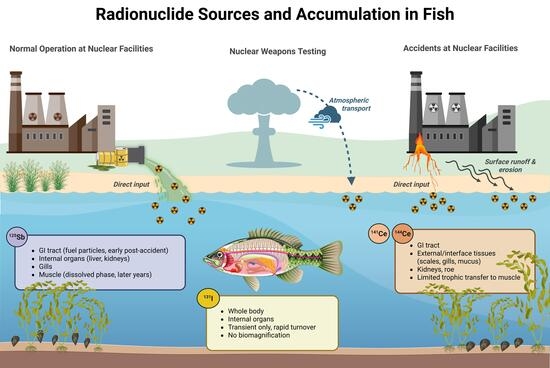
Graphical Abstract

1. Introduction

This review examines the accumulation of three chemical elements in aquatic ecosystems: antimony (Sb), a metalloid (heavy metal); iodine (I), an essential trace element; and cerium (Ce), a representative of the rare earth elements (REEs). These elements differ in their biological functions and environmental behaviour, and each has short-lived radioactive isotopes (125Sb, 131I, 141Ce, and 144Ce) that enter aquatic environments under conditions of anthropogenic radioactive contamination. Despite these differences, these elements are unified by the presence of short-lived radioactive isotopes capable of entering aquatic environments under conditions of anthropogenic impact. Such inputs may occur as a result of nuclear waste disposal, routine discharges associated with the nuclear fuel cycle, nuclear weapons production and testing, accidental releases from terrestrial nuclear facilities, as well as maritime accidents or losses involving nuclear materials [1].
Among the radionuclides considered, 125Sb has a half-life (T½) of 2.8 years; 131I, 8.0 days; 141Ce, 32.5 days; and 144Ce, 285 days [2,3]. Differences in biological significance, half-life, and chemical properties largely determine the environmental persistence, migration patterns, and overall ecological relevance of these radionuclides. In radioecological classifications, anthropogenic radionuclides are commonly divided into conservative and non-conservative (particle-reactive) categories. Conservative radionuclides, which include radioisotopes of iodine, are highly soluble in seawater and may remain in the dissolved phase for extended periods. In contrast, particle-reactive radionuclides, among them cerium isotopes, exhibit a pronounced affinity for suspended matter and natural particle surfaces, which promotes their relatively rapid removal from the water column through sedimentation and downward particle flux processes [4].
The environmental pathways of the radionuclides under consideration reflect their physicochemical properties and modes of release. 125Sb, a fission product, may enter aquatic systems both in dissolved form and in association with suspended particles and bottom sediments, demonstrating a general tendency toward particulate binding while retaining a fraction in bioavailable form. 131I is released into the environment primarily during accidental discharges from nuclear installations and atmospheric nuclear weapons testing; owing to its short half-life, its presence in aquatic ecosystems is largely transient, although it may be rapidly incorporated into biological processes during the initial post-deposition period. Similarly, cerium isotopes (141Ce and 144Ce), generated during nuclear fission and dispersed during weapons testing or nuclear accidents, are transported predominantly via atmospheric pathways and deposited through precipitation. After deposition, these radionuclides tend to associate with particulate matter and may accumulate in bottom sediments, reflecting their limited solubility and particle-reactive behaviour [5]. Their detection in global fallout confirms their participation in large-scale atmospheric and hydrological transport processes and their entry into aquatic systems via precipitation and surface runoff [6].

1.1. Radionuclide Release from Nuclear Weapons Testing

Nuclear weapons testing represented one of the earliest and most significant global sources of artificial radionuclides to aquatic environments. According to data from the Stockholm International Peace Research Institute, a total of 2053 nuclear tests were conducted worldwide between 1945 and 2006. Of these, 85% were carried out by the United States and the Soviet Union between 1945 and 1992; 14.5% (300 tests) by the United Kingdom, France, and China; and less than 1% by India, Pakistan, and North Korea. Tests were conducted in the atmosphere, underground, and underwater. Over several decades, aquatic basins, both marine and freshwater, functioned as long-term repositories for radionuclides originating from global fallout. A substantial fraction of radioactive particles released into the atmosphere was ultimately deposited onto the surface of oceans, seas, lakes, and rivers. Although isotopes such as 137Cs and 90Sr are traditionally regarded as principal components of fallout, iodine isotopes (including 131I and the long-lived 129I) were also consistently detected in aquatic environments [6].
Temporal patterns of fallout deposition further illustrate the role of radionuclide half-life. During the period of maximum global fallout intensity, short-lived radionuclides such as 131I reached peak deposition rates in 1962, whereas longer-lived nuclides such as 144Ce exhibited peak deposition in 1963 [7]. These patterns reflect both the chronology of atmospheric testing and the differing environmental persistence of individual isotopes.
Concrete examples from specific test series demonstrate how these global processes translate into regional contamination of aquatic ecosystems. The United States test series, including the thermonuclear test “Castle Bravo” (1 March–14 May 1954), conducted in the Bikini–Enewetak region of the Marshall Islands, resulted in substantial emissions of radionuclides detected both on land and in adjacent coastal waters. A portion of the fallout was adsorbed onto suspended particles or dissolved in seawater, subsequently accumulating in bottom sediments and aquatic organisms [8]. Seawater samples collected on 20 June 1954 at a distance of 450 km from Bikini Atoll contained, among other radionuclides, 141Ce and 144Ce [9]. Soil samples obtained in 1957 on Kabelle Island at seabird nesting sites revealed the presence of radioactive isotopes of Sb and Ce: 144Ce constituted 41.7% of the identified radionuclide inventory, 125Sb 3.74%, and 137Cs 0.81% [10]. Although radioactive Ce was not detected in living organisms, stable Sb was present in very small quantities in non-planktonic algae, fish, tunicates, and seawater [10]. According to [8], biological effects of radioisotopes in the marine environment were expected to be most pronounced in the Bikini–Enewetak region. On a broader scale, following global fallout, the proportion of 141Ce in plankton of the World Ocean was approximately 2%, whereas 144Ce accounted for less than 1%.
Continental atmospheric nuclear tests conducted by the United States in Nevada and New Mexico (94 tests between 1945 and 1962) led to widespread fallout across the United States. Artificial radionuclides, including 131I, 137Cs, 90Sr, and other fission products, were deposited in soils and aquatic systems, affecting both surface waters and groundwater [11]. These events demonstrate that even inland test sites contributed to contamination of distant aquatic environments through atmospheric transport and hydrological redistribution.
In addition to military programs, the United States conducted nuclear tests aimed at exploring peaceful applications of nuclear energy. The experiment codenamed “Cabriolet” (Nevada Test Site, 1968) investigated the feasibility of creating artificial canals, harbors, or reservoirs. Subsequent laboratory studies examined radionuclide accumulation in freshwater and marine organisms exposed to materials released by this explosion [12]. The highest concentrations of 124Sb (T½ = 60.2 days [2]) were recorded in freshwater mollusks. In contrast, concentrations of 131I in biota did not exceed those measured in water during the experiment. The highest 131I levels were observed in internal organs of crayfish, whereas in fish and mollusk tissues, the concentrations were lower than those in the surrounding water. In crabs, 131I was detected in both muscle tissue and visceral organs; in marine fish, it accumulated predominantly in non-muscular tissues at levels comparable to those in water. 144Ce, largely present in a dispersed particulate fraction, was likely not fully bioavailable for uptake by aquatic organisms.
The Soviet Union conducted parallel activities at the Novaya Zemlya test site, where numerous atmospheric, near-surface, and underwater nuclear tests were carried out. Subsequent investigations established that underwater nuclear weapons tests conducted in the 1950s in Chernaya Bay, Novaya Zemlya, resulted in the contamination of sediments, water, polychaetes, the mollusk Macoma calcarea (Gmelin, 1791), and macroalgae (Laminaria sp. and Fucus sp.) with radionuclides including 137Cs, 60Co, and transuranic elements 239,240Pu. The influence of discharges from Chernaya Bay extended over considerable distances (up to 100 km) to the northwest along the coast of Novaya Zemlya. Radionuclides formed as a result of radioactive fallout were detected as well as in the bottom sediments of the Barents Sea and the Kara Sea, as well as in the water column, indicating their transport into Arctic marine ecosystems [13,14]. On the western coast of Norway, total beta activity of 1–10 Bq/m3 associated with Novaya Zemlya tests was recorded in 1962 [7], illustrating the transboundary character of radioactive contamination.
Between 1966 and 1974, France conducted 41 atmospheric and 137 underground nuclear tests in French Polynesia at the Mururoa and Fangataufa atolls in the southeastern Tuamotu Archipelago [15]. These tests resulted in substantial radioactive contamination due to significant atmospheric releases of fission products, followed by their deposition into marine and lagoon ecosystems [6]. Reconstruction studies indicate that fallout included a broad spectrum of radionuclides, among them radioactive isotopes of 131I, 125Sb, 141Ce, and 144Ce, as well as 137Cs, 90Sr, and transuranic elements. These radionuclides were deposited onto the ocean surface, dissolved or remained suspended in the water column, accumulated in bottom sediments and biota, and became the principal source of radioactive contamination in the regional marine environment [15]. As emphasized in [6], the principal ecological consequences of radionuclide inputs into marine ecosystems are associated with their accumulation in biota, which ultimately determines the scale and persistence of biological effects.
Thus, consideration of nuclear weapons testing provides a historical framework for understanding the large-scale introduction of radioactive isotopes of Sb, I, and Ce into aquatic ecosystems and establishes the basis for subsequent analysis of their environmental behavior, migration pathways, and biological accumulation.

1.2. Radionuclide Release from Normal Operation of Nuclear Facilities

Following the period of intensive atmospheric nuclear weapons testing, which constituted the first large-scale global source of artificial radionuclides to aquatic systems, a second, structurally different but chronically significant source emerged: routine discharges associated with the normal operation of civilian nuclear facilities and spent fuel reprocessing plants. In contrast to accidental releases, these inputs are characterized not by short-term pulses but by sustained, regulated emissions extending over decades. Their cumulative impact has been most clearly documented in European marine environments, particularly in the North Sea and adjacent basins.
One of the earliest and most influential sources of anthropogenic radionuclides in the marine environment was the Windscale Works plant operated by the United Kingdom Atomic Energy Authority (UKAEA) at Sellafield (Cumberland). Beginning in 1952, radioactive liquid effluents were discharged via pipeline into the Irish Sea. Investigations conducted in 1959–1960 confirmed the presence of 144Ce among other radionuclides in these effluents [16]. This finding demonstrated that anthropogenic 144Ce had become a persistent component of the coastal marine environment already in the early phase of nuclear industry development.
Although 144Ce was confirmed in early releases, it has not emerged as a dominant indicator of routine discharges. As of 1 January 2000, newly authorized atmospheric release limits for Sellafield were established at 70 GBq·yr−1 for 129I, 55 GBq·yr−1 for 131I, and 5 GBq·yr−1 for 125Sb, while permitted liquid discharge limits were set at 2 TBq·yr−1 for 129I and 8 TBq·yr−1 for 144Ce [17]. These regulatory values reflect the comparatively lower radiological importance assigned to cerium under routine operating conditions.
The Windscale coastal monitoring programme, initiated in 1961, provided further insight into the spatial behavior of 144Ce. The radionuclide was detected in beach sand, mud, and the marine alga Porphyra umbilicalis ((Linnaeus) Kützing, 1843) at varying distances from the discharge point, yet it was not detected in fish muscle tissue, seawater, or bottom sediments [18]. This distribution underscores its localized occurrence and strong association with particulate matter rather than with dissolved transport pathways.
Bioindicator investigations near the UKAEA discharge pipeline at Windscale demonstrated that in plaice (Pleuronectes platessa L.), the principal isotope detected in muscle tissue was 137Cs, whereas 144Ce was found mainly in intestinal contents [19], indicating limited systemic incorporation of 144Ce into fish tissues.
As monitoring programmes expanded, it became evident that long-lived 129I (T½ = 1.6 × 10⁷ years [2]) represents one of the most environmentally significant products of routine discharges. The occurrence of anthropogenic 129I in the waters of the North Sea, the Irish Sea, the Baltic Sea, and the English Channel is primarily associated with regular liquid and gaseous releases from the Sellafield (United Kingdom) and La Hague (France) reprocessing plants [20,21].
By 2005, cumulative marine discharges amounted to approximately 1380 kg from Sellafield and 3330 kg from La Hague [20].
In contrast to particle-reactive radionuclides, 129I exhibits conservative behavior in seawater, resulting in a markedly broader spatial footprint. Discharges from the La Hague facility dominate its distribution in North Sea surface waters. Brown seaweed (Fucus vesiculosus (Linnaeus, 1753)) collected along the Swedish coast in 1982 contained 129I at concentrations ranging from 0.82 to 5.89 × 10⁹ atoms·g−1 [22,23]. Elevated levels were also recorded in the Baltic Sea, which exchanges water with the North Sea through the Danish Straits; surface water concentrations reached up to 16 × 10−13 g·L−1 [23]. These findings illustrate the ability of 129I to undergo regional-scale marine transport over prolonged periods.
A similar pattern of incomplete characterization applies to 125Sb. Although its chemical speciation in effluents from Sellafield Ltd. remains insufficiently described in the open literature, available data indicate that 125Sb discharged from the La Hague reprocessing plant is more soluble than 60Co, 154Eu, and 155Eu [24]. This greater solubility enhances its potential mobility compared with strongly particle-bound activation products.
A comparable, though quantitatively less intense, transport pathway is associated with the Marcoule reprocessing plant, from which fourteen artificial radionuclides are conveyed via the Rhône River to the Mediterranean Sea. The mean total activity is approximately 70 GBq·day−1, an order of magnitude lower than La Hague discharges. Suspended particles constitute the principal carrier of radioactivity, except for 125Sb and likely isotopes of Ru, which are transported predominantly in dissolved form; notably, 125Sb was detected exclusively in the “organic” fraction (>75%) [25]. This observation again highlights the intermediate geochemical behavior of antimony between fully conservative and strongly particle-reactive elements.
The dispersion of anthropogenic 129I extends beyond European seas. Studies of Chinese marginal seas have documented the presence of anthropogenic 129I in coastal marine sediments, reflecting long-range transport via atmospheric circulation and marine currents, including contributions from European reprocessing releases [26]. Thus, routine reprocessing discharges can contribute to hemispheric-scale redistribution of long-lived iodine isotopes.
Similar processes occur in other regions, though generally at smaller scales. The Korea Atomic Energy Research Institute (KAERI) in Daejeon operates a Radioisotope Production Facility (RIPF) processing approximately 1000 Ci of 131I annually. Although 131I was not detected in surface waters within the RIPF site, it was recorded in wastewater downstream of treatment facilities. Over one year, 131I concentrations in aquatic plants near the discharge outlet ranged from 27.9 to 627.6 Bq·kg−1, while fish contained 11.35 Bq·kg−1 in common carp and 3.93 Bq·kg−1 in crucian carp. The authors suggested that environmental 131I may also originate from medical facilities utilizing radioisotopes [27].
In Japan, studies were conducted on the environmental pollution resulting from the operation of the commercial nuclear fuel reprocessing plant in Rokkasho (Aomori Prefecture) under both laboratory and field conditions. Laboratory exposure of olive flounder (Paralichthys olivaceus (Temminck & Shlegel, 1846)) demonstrated minimal incorporation of 125I into viscera, with the highest accumulation in gills after seven days [28], consistent with branchial uptake of dissolved iodine species. Field investigations of marbled flounder (Pseudopleuronectes yokohamae (Günther, 1877) and olive flounder (P. olivaceus) showed that during the fishing season, the 129I/127I ratio in fish tissues did not differ from seawater (p > 0.1), whereas after the fishing season, the ratio in fish was significantly higher (p < 0.05). Although stronger effects might be expected in benthivorous species if sediments were the principal source, this trend was not confirmed [29].
The plant’s influence was also assessed in Lake Obuchi, where concentrations of stable 127I and 129I in coastal sediments were associated with both terrestrial inputs (riverine particles and terrestrial plant material) and marine sources (particles settling from plankton) [30]. Maximum 129I concentrations (wet weight) were recorded as 1.5 × 10⁻⁷ Bq·g−1 in Zostera marina (Linnaeus, 1753), 3.9 × 10⁻⁸ Bq·g−1 in Hypomesus nipponensis (McAllister, 1963), 9.7 × 10⁻⁸ Bq·g−1 in Chaenogobius annularis (Gill, 1859), and 6.4 × 10⁻⁸ Bq·g−1 in Crassostrea nippona (Seki, 1934) [31], demonstrating incorporation into coastal trophic networks.
In North America, civilian nuclear power plants are subject to stringent environmental monitoring programs conducted under the supervision of regulatory authorities. Long-term environmental monitoring programs include systematic measurements of isotopes most commonly associated with reactor operations, notably tritium (3H) and gamma-emitting radionuclides [32], as well as measurements in water, air, and soil surrounding facilities regulated by the U.S. Nuclear Regulatory Commission (NRC) and the Canadian Nuclear Safety Commission (CNSC). Published scientific data on less frequently measured radionuclides, such as 125Sb or 144Ce, in waters near nuclear power plants are scarce in the available literature. This likely reflects the very low concentrations of these isotopes in routine reactor discharges.
Monitoring programs also include systematic measurements of iodine isotopes in surrounding waters, notably 129I, reflecting both accidental and routine releases from reactors and industrial sources. For example, in waters off the coast of California and the Pacific Northwest of the United States, a series of 129I concentration measurements in seawater has been conducted as part of ongoing monitoring following the Fukushima Daiichi Nuclear Power Plant accident and background sources [33].
Taken together, these observations demonstrate that routine nuclear facility operation produces a geographically differentiated yet persistent anthropogenic influence on aquatic systems. The scale and mechanism of dispersion of 129I, 125Sb, and 144Ce are determined primarily by their physicochemical properties, iodine behaving conservatively, cerium exhibiting strong particle reactivity, and antimony occupying an intermediate position, resulting in distinct patterns of transport and ecological incorporation.

1.3. Radionuclide Release from Accidents at Nuclear Facilities

In addition to global fallout from nuclear weapons testing and radionuclide inputs associated with the routine operation of nuclear facilities, severe reactor accidents have constituted episodic yet highly significant sources of radioactive contamination of aquatic ecosystems. Unlike chronic and regulated releases, accidental emissions occur abruptly and involve large amounts of radionuclides in diverse physicochemical forms. Their subsequent environmental behavior depends not only on the total activity released, but also on volatility, chemical speciation, and the degree of association with aerosol particles or fuel fragments. These factors determine atmospheric transport, deposition pathways, entry into surface waters, partitioning between dissolved and particulate matter, and long-term redistribution within river basins and marine systems.
One of the most serious nuclear accidents prior to Chornobyl was the Kyshtym disaster on 29 September 1957 at the Mayak Production Association in the Soviet Union (INES level 6 of 7). The total release activity was approximately 740 PBq (20 MCi), with about 91% attributable to short-lived isotopes, notably 144Ce and 95Zr, which were the primary components of the radioactive fallout. Precise data regarding 131I, 125Sb, or 141Ce in open sources are limited due to the secrecy regime prevailing at that time; however, 144Ce was part of the main release, whereas less volatile nuclides, including 125Sb, potentially contributed to localized contamination. Following atmospheric dispersion, radioactive dust settled onto terrestrial surfaces within the affected catchment area. Subsequent remobilization by precipitation and surface runoff facilitated the transfer of radionuclides into the Techa River system. There, they accumulated both in the water column and, more persistently, in bottom sediments, forming long-term contamination reservoirs [34]. This sequence of atmospheric deposition, hydrological transport, and sediment accumulation illustrates how accident-derived fallout may exert prolonged effects on freshwater ecosystems even when the initial release is predominantly terrestrial.
In the same year, another serious accident occurred at Reactor No. 1 of the Windscale Works complex (now Sellafield) in Cumbria, United Kingdom (INES level 5 of 7) on 10 October 1957 [35,36]. In contrast to Kyshtym, where refractory elements such as 144Ce dominated the fallout, the Windscale fire was characterized by the predominance of volatile radionuclides. According to reconstructions, 131I was the dominant radionuclide released, whereas 137Cs and 210Po principally determined the long-term radiological impact after deposition [35,37]. The total activity of 131I in the release is estimated in the hundreds of terabecquerels (approximately 600–740 TBq) [36]. In addition to iodine, 144Ce was present in the release but in significantly smaller amounts than 131I [38].
As a result of atmospheric transport and deposition, 131I contaminated a large area extending beyond the United Kingdom into parts of Western and Northern Europe, as confirmed by measurements of 131I activity in the radioactive plume and associated precipitation [39]. Analysis of the long-lived isotope 129I in bottom sediments provides evidence of fallout deposition and the subsequent input of radionuclide material into aquatic systems, thereby demonstrating transfer to freshwater ecosystems [40].
Concentrations of 131I in reservoirs and streams near Windscale during the first ten days after the accident ranged from 3.7 to 37 Bq·L−1 [35]. Contamination of marine algae near Hunterston by fission products, notably 106Ru and 144Ce, has been attributed primarily to the Windscale accident [41]. Thus, compared to the pattern of radionuclide dominance in sediments observed after Kyshtym, the Windscale event demonstrated the rapid transfer and short-term predominance of volatile iodine in aquatic environments.
The accident at the Three Mile Island Nuclear Generating Station on 28 March 1979 remains the most significant event in the history of commercial nuclear power in the United States. The principal radioactive component of the releases resulting from the accident was 133Xe. According to the official technical investigation prepared for the U.S. Nuclear Regulatory Commission, the total release of 131I into the atmosphere was estimated at approximately 13–17 Ci (≈0.5–0.6 TBq) [42]. Shortly after the accident on March 28, more than 100 drinking water sources were identified within a 20-mile radius of the station. A sampling program was developed for these water sources, including locations along the Susquehanna River where local communities obtained their drinking water. No significant concentrations of radioactive materials were detected in these water samples. Analysis of water from the Delaware River likewise indicated that no airborne radioactive substances were detected within this watershed [43]. Overall, the data do not demonstrate any statistically significant or long-term effects on aquatic ecosystems associated with the release of 131I.
The accident at the Chornobyl NPP on 26 April 1986 (INES level 7 of 7) represented the largest uncontrolled nuclear accident in the history of civilian nuclear power and resulted in an unprecedented release of radionuclides into the environment. The reactor explosion and subsequent core fire discharged a substantial amount of fission products into the atmosphere, including volatile isotopes (131I) and less volatile isotopes (141Ce, 144Ce, 125Sb).
It is estimated that the total activity of released 131I was about 1760 PBq, which determined its dominant role in the early radioecological impact. The activity of 141Ce is estimated at approximately 84 PBq, and that of 144Ce at approximately 116 PBq; these isotopes belonged to the so-called “refractory elements,” which tended to deposit together with fuel particles and settle onto soil and water surfaces. The estimated activity of 125Sb in the total release was considerably lower than that of major volatile radionuclides such as 131I and 137Cs [11].
Contamination of terrestrial and aquatic ecosystems within the 30 km zone around the Chornobyl NPP was especially intense, including the lower reaches of the Pripyat River and the upper part of the Kyiv Reservoir. The accident caused a sharp deterioration of the radioecological situation in the Dnipro catchment. In the first weeks after the accident, total water radioactivity was determined mainly by 131I: during the first month, its contribution was 80–90%, and in June, it was around 30%. Beginning in the second half of June, owing to the decay of 131I, total water radioactivity was defined by short-lived radionuclides, 89Sr, 140Ba, 103Ru, 141Ce, 144Ce, 95Zr, as well as, to a lesser extent, 134Cs and 137Cs. Over time, their contributions decreased, and long-lived radionuclides, 90Sr, 137Cs, 238Pu, 239Pu, 240Pu, and 241Am, began to play a leading role [44].
The behaviour of individual radionuclides in aquatic systems reflects their intrinsic physicochemical properties. 131I is characterized by high volatility and environmental mobility. Following atmospheric transport, it was deposited primarily with precipitation, entering rivers, lakes, and reservoirs through direct fallout onto water surfaces and via runoff from contaminated catchments. Owing to its high solubility, 131I exhibited substantial mobility within the water column and was temporarily incorporated into aquatic food webs during the early post-deposition phase. Monitoring data from several European countries indicated a rapid increase in 131I concentrations in surface waters within weeks after the Chornobyl accident [45].
Cerium isotopes (141Ce and 144Ce), in contrast, were predominantly associated with aerosol particles and fuel fragments. They settled with the solid phase of fallout and entered aquatic systems via surface runoff and erosion processes. 141Ce and 144Ce were also detected in distant marine waters, including the Mediterranean Sea, after the passage of radioactive fallout. Calmet et al. (1991) [46] demonstrated the presence of these isotopes in seawater and biota (marine plants), confirming their broad geographic distribution and incorporation into aquatic trophic chains.
125Sb was part of the global fallout and was transported mainly in aerosol form. After deposition, it entered aquatic systems through surface runoff and partly in dissolved form; however, to a large extent, it remained associated with suspended particles and bottom sediments [47].
On a broader scale, inputs of 125Sb, 131I, 141Ce, and 144Ce into aquatic ecosystems following the Chornobyl accident occurred through atmospheric transport, wet and dry deposition, and subsequent hydrological runoff. The high mobility of 131I led to its short-lived but substantial presence in the water column, whereas Ce isotopes and 125Sb predominantly accumulated in bottom sediments, forming secondary sources of redistribution. Studies of aquatic biota confirmed the incorporation of Chornobyl-derived radionuclides into various components of marine and freshwater ecosystems [46,48,49,50,51].
The accident at Fukushima Dai-ichi NPP on 11 March 2011 represented another large-scale source of radionuclide input into aquatic environments, combining significant atmospheric releases with direct discharges of radioactively contaminated water into the ocean (INES level 6 of 7). According to source term reconstructions, the principal radionuclide was 131I. Total atmospheric releases of 131I are estimated in the range of 100–500 PBq [52,53], with most estimates near 200 PBq [54,55]. The highest rate of release (1016 Bq·hr−1) was recorded on 15 March 2011 [55].
Iodine occurred in both gaseous and aerosol forms. Based on approximately 210 paired measurements carried out up to 12 April, the average gas/total 131I ratio in Europe was 77.2% ± 13.6%, indicating the predominance of the gaseous form during atmospheric transport. About 1 PBq of 131I passed over Europe (<1% of the total release). Less volatile isotopes, including 141Ce, 144Ce, and 125Sb, were identified in samples of aerosols, soils, and bottom sediments, although their quantities were several orders of magnitude lower than those of 131I and 137Cs [53].
Radionuclides entered the ocean both by atmospheric deposition and through direct discharge of contaminated emergency water. It is estimated that approximately 10–40 PBq of 131I and 3–6 PBq of 137Cs were discharged directly into the Pacific Ocean [56,57]. In seawater near the reactor, 3H, 14C, 134Cs, 137Cs, 60Co, 125Sb, 90Sr, 129I, 99Tc, 106Ru, and 238Pu were detected [58].
Post-accident observations demonstrated the transfer of radionuclides into marine biota. After the accident, concentration ratios (CR_water) for 144Ce ranged from 23 to 100 for pelagic and benthic fish, octopuses, crustaceans, and macroalgae [59]. Brown algae effectively concentrated 131I (CR ≈ 104), although, due to its short half-life, its activity declined rapidly [56]. 131I, 134Cs, and 137Cs were detected in Japanese sardine (Sardinops sagax (Jenyns, 1842)) and Japanese anchovy (Engraulis japonicus (Temminck & Schlegel, 1846). Concentrations of 131I were higher in internal organs than in muscle; maximum values for anchovy (24 March 2011) were 309.1 ± 2.1 Bq·kg−1 (131I), 61.0 ± 0.5 Bq·kg−1 (134Cs), and 59.6 ± 0.4 Bq·kg−1 (137Cs) [60].

1.4. Accumulation of Stable Isotopes of Antimony, Iodine, and Cerium in Aquatic Ecosystems

In contrast to radionuclide inputs associated with nuclear activities and accidents, stable isotopes of Sb, I, and Ce are continuously present in aquatic ecosystems as natural trace constituents and as products of diffuse anthropogenic emissions. Their environmental behavior is governed primarily by geochemical controls, speciation, and biological uptake mechanisms. Data on the distribution of these elements in water bodies and aquatic organisms provide a basis for understanding accumulation patterns, organ-specific partitioning, and trophic transfer.
Ce is generally characterized by low background concentrations in aquatic systems and comparatively weak enrichment relative to many other trace metals. According to [61], Sb concentrations in freshwater and marine algae range from 0.1 to 0.2 µg·g−1 dry weight, placing it among the least abundant trace metals in algal biomass. This relatively limited enrichment at the primary producer level influences its subsequent transfer through trophic chains.
Studies of fish demonstrate a pronounced organ-specific distribution of Sb. In Salmo trutta (Linnaeus, 1758), the highest Sb content was detected in the kidneys, with the following sequence of distribution among organs: kidneys > gills > intestine > gonads > liver > muscles [62]. Other investigations of the same species reported elevated Sb levels in the gills and liver [63], indicating that accumulation patterns may vary depending on environmental conditions, exposure pathways, and physiological status.
Comparative analyses of different species further illustrate the role of ecological behavior in Sb uptake. In Carassius auratus (Linnaeus, 1758), Sb concentrations in the gills were higher than in Ctenopharyngodon idella (Valenciennes, 1844) [64]. This difference has been attributed to the benthic feeding habits of crucian carp, which increase contact with contaminated bottom sediments and suspended particles. In contrast, muscles, swim bladder, and skin exhibited lower accumulation coefficients [64], reflecting limited redistribution of Sb into less metabolically active tissues.
Field investigations across aquatic ecosystems consistently demonstrate the absence of Sb biomagnification within trophic chains [65,66]. The highest concentrations were recorded in benthic invertebrates (up to 316 µg·g−1), whereas levels in fish were substantially lower [66]. Such patterns indicate trophic dilution rather than progressive biomagnification along food webs.
Laboratory experiments with Danio rerio (Hamilton, 1822) confirm these observations, showing that the liver serves as the primary site of Sb accumulation, followed by the gills and muscles, while the lowest concentrations were measured in the brain [67,68]. Together, field and experimental data confirm the organ-specific and exposure-dependent nature of Sb distribution in aquatic organisms.
Iodine exhibits a markedly different biogeochemical behavior. Investigations of lakes in North America and Europe indicate that the dominant fraction of iodine in both aqueous and solid phases consists of organically bound forms. Comparable patterns have been documented in atmospheric aerosols and precipitation [69,70,71], underscoring the central role of organic matter in iodine cycling. This strong association with organic compounds influences its mobility, transformation processes, and availability to aquatic biota.
In contrast, Ce belongs to the rare earth elements (REEs) and is among the most abundant representatives of this group in the Earth’s crust. Its environmental distribution reflects both lithogenic inputs and geochemical fractionation processes characteristic of REEs. Numerous studies demonstrate that REEs, including Ce, accumulate predominantly in bottom sediments and in organisms occupying lower trophic levels, whereas concentrations in fish muscle tissue generally remain low. In most examined ecosystems, trophic dilution rather than biomagnification has been observed [72,73,74,75].
Within the REE group, Ce may display relatively high or moderate proportions depending on prevailing redox and geochemical conditions. Elevated concentrations are most frequently reported in benthic fish species [76,77], consistent with the tendency of Ce to associate with particulate matter and sediments. This sediment affinity enhances exposure of bottom-dwelling organisms and shapes the vertical distribution of Ce within aquatic food webs.
Laboratory investigations focusing on Ce dioxide nanoparticles (n-CeO2) further elucidate uptake pathways and tissue distribution. Experiments with Oncorhynchus mykiss (Walbaum, 1792) demonstrated predominant accumulation in the gills, while liver concentrations were comparatively lower [78,79]. Oral ingestion was identified as the principal uptake pathway for n-CeO2; nevertheless, penetration through the gill epithelium or skin is also possible [80]. These findings highlight the importance of both dietary and direct aqueous exposure routes in determining cerium bioavailability.
Taken together, available evidence indicates that stable Sb, I, and Ce display distinct but internally consistent patterns of distribution in aquatic ecosystems. Sb and Ce tend to associate with particulate matter and bottom sediments, leading to higher concentrations in benthic organisms and specific target organs, whereas iodine is largely controlled by organic complexation processes. In all cases considered, trophic dilution predominates over biomagnification, and accumulation is strongly influenced by ecological niche, exposure pathway, and physicochemical speciation.
Comparative analysis, therefore, reveals several common features for Sb, I, and Ce in both radioactive and stable forms: predominance of organ-specific accumulation, preferential association with metabolically active tissues or particulate matters, minimal presence in muscle tissue, and the absence of clearly expressed biomagnification in aquatic trophic networks.
At the same time, a review of the literature highlights the limited availability of systematized data on 125Sb, 131I, 141Ce, and 144Ce in aquatic ecosystems, particularly regarding organ distribution patterns and long-term ecological dynamics. Compared with extensively studied radionuclides such as cesium and strontium, the behavior of these isotopes within aquatic food webs remains insufficiently characterized. Existing evidence is often fragmentary and restricted to case-specific investigations, underscoring the need for comprehensive, integrative, and long-term research addressing their migration, bioavailability, and trophic transfer in diverse aquatic environments. Simultaneous or separate detection of 125Sb and 144Ce in fish tissues is also considered an indicator of the source of contamination, making it possible to distinguish between the intake into the organism of fuel particles containing both of these isotopes in large quantities and the accumulation of 125Sb alone from the condensation component of fallout.

2. Methodology

2.1. Literature Sources and Search Strategy

The literature search strategy followed that described in our previous works [81,82]. The databases Scopus, PubMed, and Google Scholar were searched using Boolean operators, with key terms including bioaccumulation, fish, radionuclides, antimony, iodine, cerium, Chernobyl, Chornobyl, nuclear testing, global fallout, and nuclear facilities. No restriction on publication year was applied; the review includes studies measuring short-lived radionuclides in fish and other aquatic biota from the mid-1950s to 2025, with sampling campaigns conducted within a few half-lives of the respective source events (e.g., Chornobyl: 1986 to the early 1990s; Fukushima: 2011 to the mid-2010s; weapons tests: 1950s to 1960s). Publications from national scientific journals were additionally accessed through the library of the Institute for Nuclear Research of the National Academy of Sciences of Ukraine in Kyiv.

2.2. Observational Data Collection and Analytical Procedures

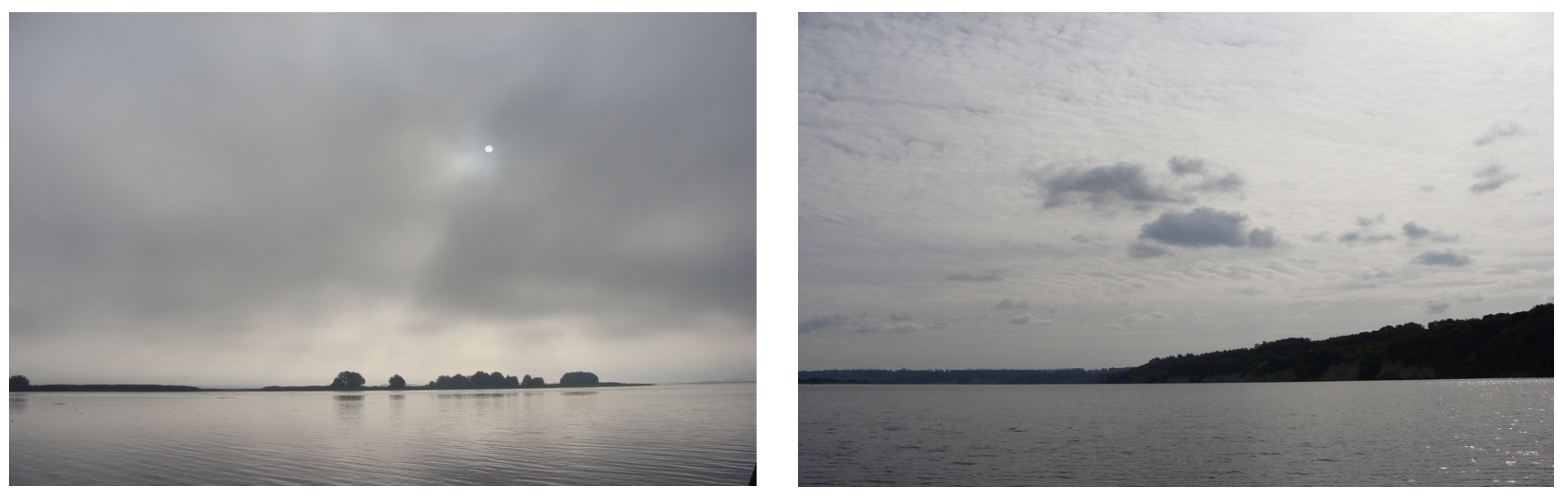
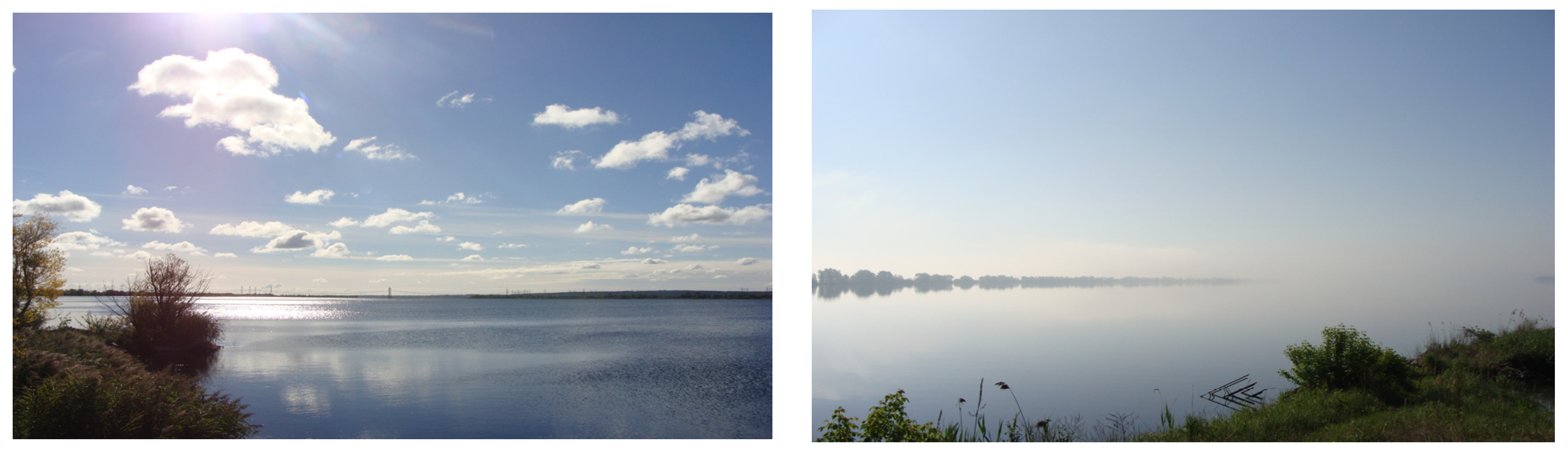
Illustrative observational data provided in Tables 1–4 and Figures 3–8 were collected as part of routine environmental monitoring of the ChNPP Cooling Pond and the Kaniv Reservoir on the Dnipro River, in the area between the village of Staiky and the town of Rzhyshchiv (Figure 1 and Figure 2).
Samples were obtained from water, aquatic plants, mollusks, and fish. Sampling methods, sample preparation, and radionuclide analyses followed procedures described previously [83]. The specific activities of 125Sb, 131I, 141Ce, and 144Ce were determined using non-ashed tissue samples, as ashing has been shown to cause substantial loss of short-lived radionuclides, leading to false-negative results. Activity concentrations in fish organs and tissues are expressed on a fresh weight basis; those in aquatic plants are expressed on a dry weight basis.

3. Discussion

Case Study: Radionuclide Content in Aquatic Vegetation and Fish of the ChNPP Cooling Pond and Kaniv Reservoir

Unlike 54Mn, 60Co, 65Zn, and 95Zr [81,82], the radionuclides 125Sb, 131I, 141Ce, and 144Ce were not detected in either the Chornobyl Nuclear Power Plant cooling pond or the Kaniv Reservoir prior to the Chornobyl accident.
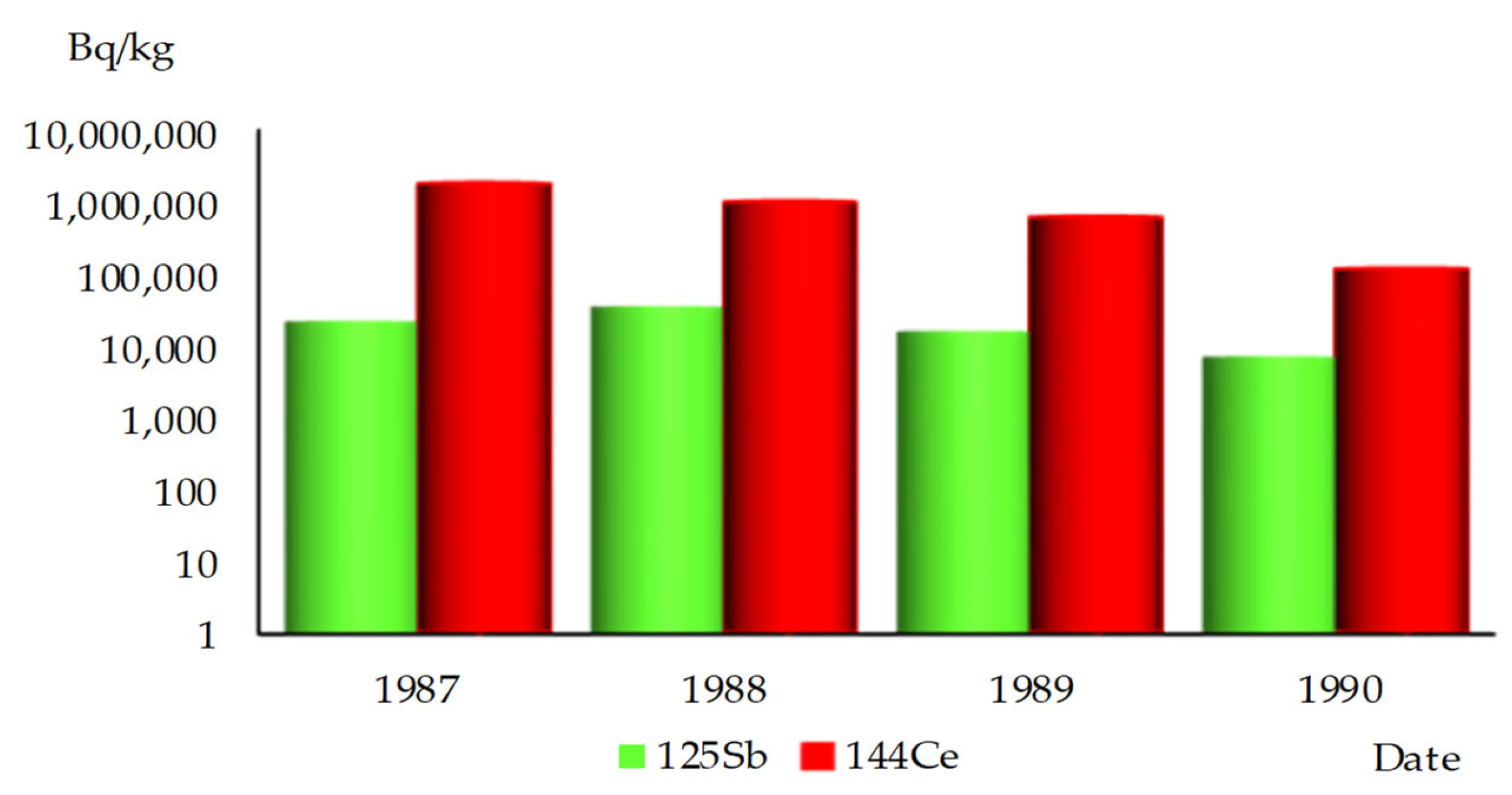
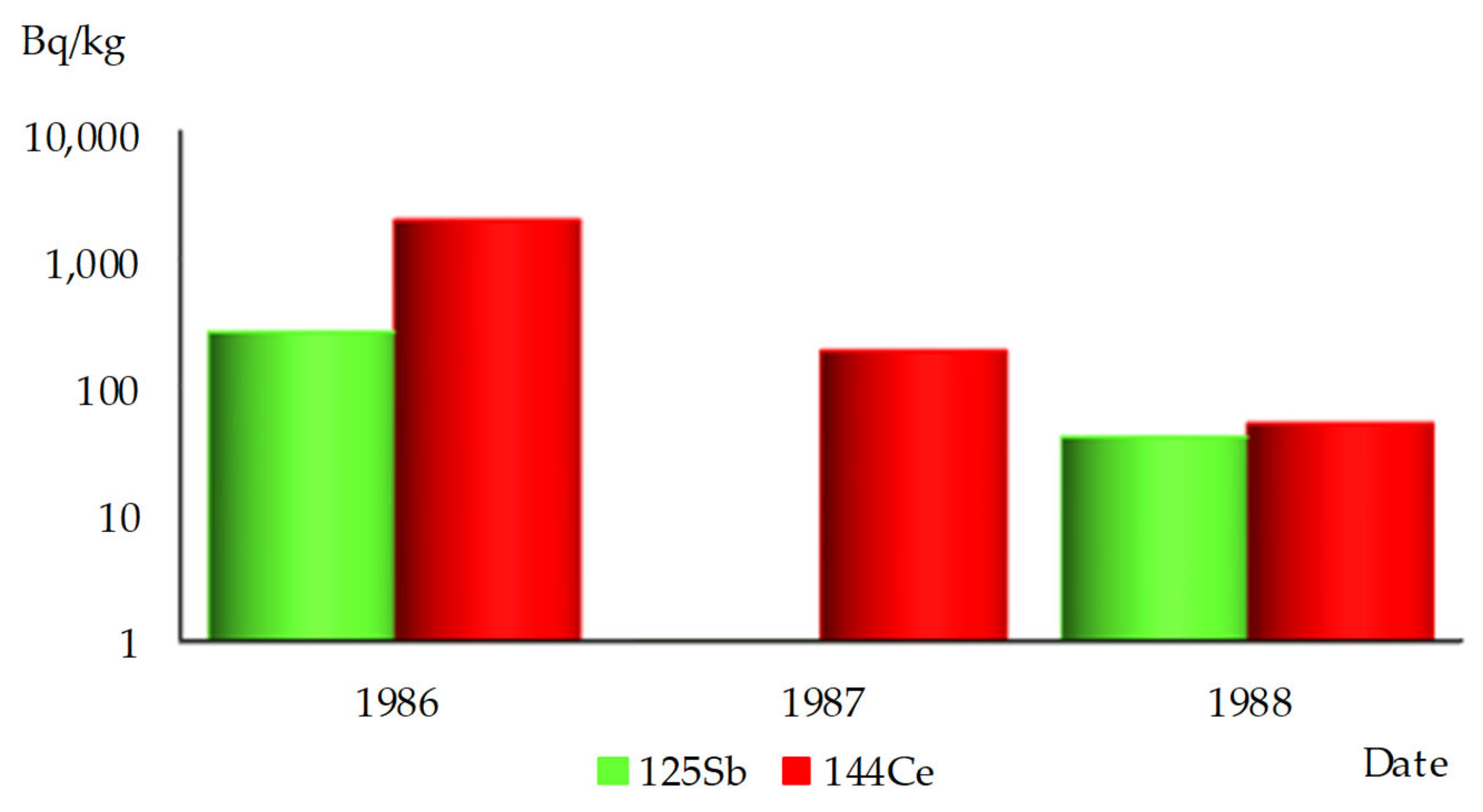
Antimony 125Sb: According to [84], approximately 4 MCi of 125Sb (1.48 × 10¹⁷ Bq) was present in the reactor of Unit 4 of the Chornobyl Nuclear Power Plant at the time of the accident. It is noted in [85] that nearly all 125Sb released into the environment was associated with fuel particles. Compared to other accident-derived radionuclides, the contribution of this isotope to the contamination of various components of aquatic ecosystems was relatively minor. The highest specific activity levels of 125Sb were recorded in aquatic vegetation of the cooling pond, particularly in Cladophora spp. Figure 3 presents the content of this radionuclide in Cladophora spp. from the cooling pond in comparison with the content of 144Ce in the same species.
The maximum value over the entire observation period was recorded in Cladophora spp. in August 1987 and amounted to 36,820 ± 3820 Bq/kg dry weight. A similar pattern was observed in the Kaniv Reservoir, where the highest specific activity levels of 125Sb were also associated with algae (Figure 4).
Despite the fact that 125Sb has the longest half-life among the radionuclides studied, it was detected in samples only up to and including 1990. During the period from 1986 to 1990, approximately 1800 fish samples were collected in the cooling pond of the Chornobyl NPP. This radionuclide was detected in only 88 samples, 42 of which were found in planktivorous Hypophthalmichthys molitrix (Valenciennes, 1844) [86]. Table 1 presents data on the content of radioactive antimony in fish from the Chornobyl NPP cooling pond.
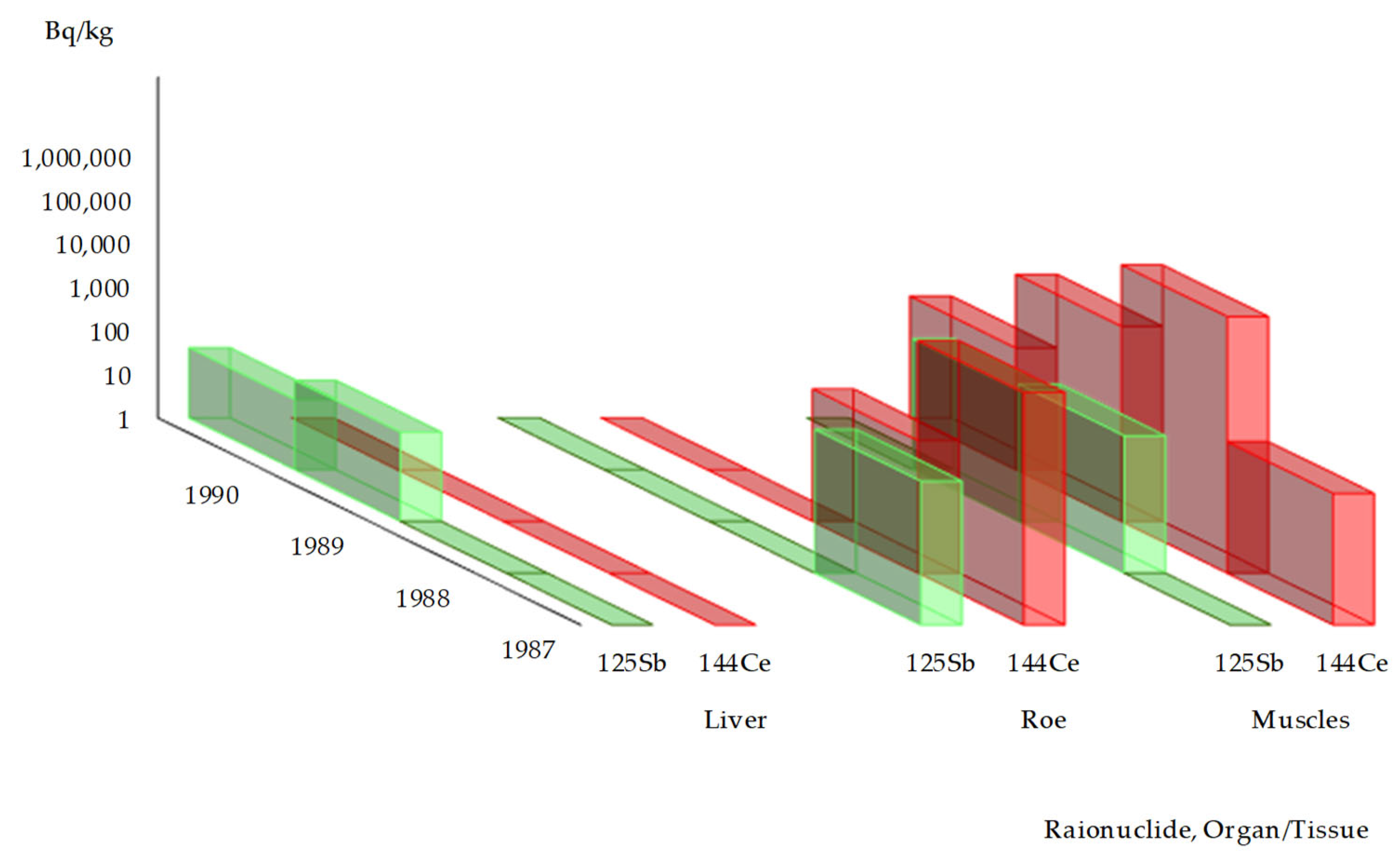
The highest concentrations were recorded in the internal organs of fish belonging to Omnivores and Planktivores (H. molitrix, Abramis brama (Linnaeus, 1758) Cyprinus carpio (Linnaeus, 1758)). The main proportion of accumulation occurred in the internal organs, including the stomach and intestines, which is particularly characteristic of fish at lower trophic levels. It should be noted that the highest content of 125Sb in muscle tissue was recorded only in March 1989 in Planktivores H. molitrix (Figure 5).
In Carnivores Ictalurus punctatus (Rafinesque, 1818), 125Sb was detected much less frequently: once in internal organs (1989), once in the head (1988), once in the gills in 1987 and 1988, and twice in the fins (1987 and 1989). In Piscivores Sander lucioperca (Linnaeus, 1758) and Aspius aspius (Linnaeus, 1758), this radionuclide was recorded in internal organs only once, in S. lucioperca in 1989. At the same time, in this species, it was also detected in the gills in 1989 and 1990, and, notably, in the roe in 1990. In A. aspius, 125Sb was recorded only once, in the head in 1988.
In the Kaniv Reservoir, 125Sb was not detected in the first samples collected on 3 May 1986. In general, its accumulation pattern in this reservoir differed from that in the cooling pond: a very low frequency of occurrence was observed in the internal organs of fish across all ecological groups. However, in 1986 this radionuclide was detected in Piscivores Esox lucius (Linnaeus, 1758) in a whole-body sample, and in 1988 it was recorded once in the kidneys and scales (Table 2).
Iodine (131I). Due to the fact that the first samples of fish and algae in the Chornobyl NPP cooling pond were collected only in August 1986, and the main sampling began in November 1986, 131I was not detected in these samples.
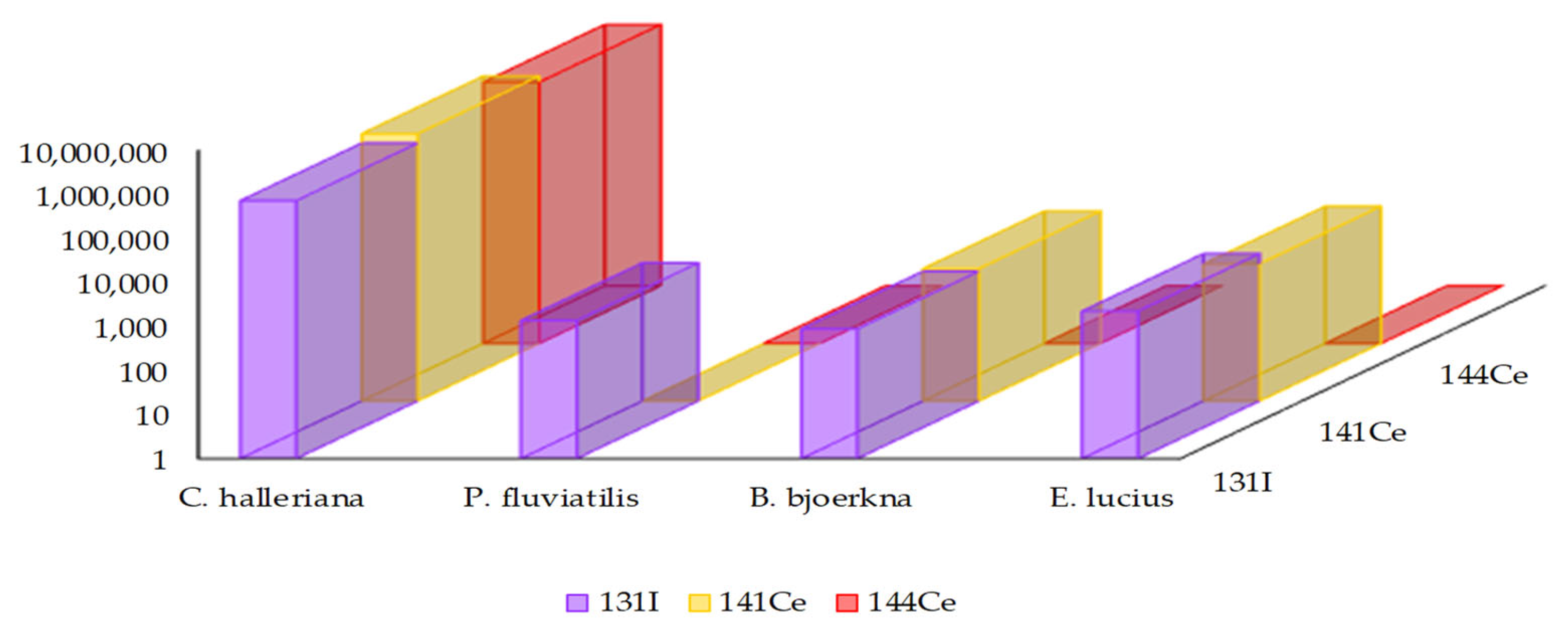
In contrast, in the Kaniv Reservoir, where the first samples were collected on 3 May 1986, 131I was detected both in algae and in fish. The maximum content of this radionuclide was recorded in a higher aquatic plant, sedge, and amounted to 727,390 ± 54,370 Bq/kg dry weight (Figure 6). In Cladophora spp. collected on 15 May 1986, the content of 131I was 11,880 ± 1110 Bq/kg.
In fish, 131I was detected only in whole-body samples, and it was recorded in representatives of all studied ecological groups: A. aspius and E. lucius—Piscivores; Perca fluviatilis (Linnaeus, 1758)—Carnivores; Alburnus alburnus (Linnaeus, 1758)—Planktivores; Abramis brama, Blicca bjoerkna (Linnaeus, 1758), Carassius carassius (Linnaeus, 1758), Tinca tinca (Linnaeus, 1758), and Rutilus rutilus (Linnaeus, 1758)—Omnivores. In addition, this radionuclide was several times detected in internal organs (stomach and intestinal contents) of A. brama and A. aspius in May and June 1986 (Figure 6).
The specific activity of 131I in Piscivores (E. lucius) reached 2200 Bq/kg and was significantly higher compared to fish of lower trophic levels (890 Bq/kg in B. bjoerkna) [87].
Cerium (141Ce): The highest concentrations of 141Ce among all studied radionuclides were recorded in aquatic vegetation of the Kaniv Reservoir in May 1986 at the sampling sites (Figure 2). Specifically, on 3 and 5 May, in Phragmites australis australis ((Cav.) Trin. ex Steud., 1841) of the previous year’s vegetation, the content of this radionuclide amounted to 1,191,487 ± 84,698 and 3,758,636 ± 271,189 Bq/kg dry weight, respectively. The fact that such high concentrations were observed in plants of the previous year’s vegetation indicates surface contamination caused by the deposition of fuel particles. In the same species of plants, but of the current (1986) vegetation, the content of 141Ce in September was 2490 ± 25 Bq/kg dry weight. This contamination was likely also associated with fuel particles that could have been present in bottom sediments or migrated within the water column.
In Cladophora spp., the maximum content of 141Ce was recorded on 15 May, at 45,038 ± 3322 Bq/kg. By mid-November, the concentration of this radionuclide decreased to 403 ± 144 Bq/kg, which is likely related to its short half-life. The lower levels in Cladophora spp. compared to P. australis may indicate the predominance of atmospheric transport of the radionuclide from the Chornobyl NPP rather than waterborne pathways. In addition, partial “washing off” of surface contamination due to water flow cannot be excluded. In Potamogeton perfoliatus (Linnaeus, 1753), collected in September, October, and November 1986, the content of 141Ce was 83 ± 21, 25 ± 6, and 23 ± 5 Bq/kg dry weight, respectively.
In the Chornobyl NPP cooling pond, 141Ce was not detected in aquatic plants in 1986, which is likely due to the fact that plant sampling began only in October–November. However, in P. perfaliatus, this radionuclide was recorded once in February 1987 at a level of 2235 Bq/kg dry weight. After this, 141Ce was not detected in the aquatic vegetation of the cooling pond.
In fish of the Kaniv Reservoir, 141Ce was recorded in May and June 1986 (Table 2). All recorded cases of its detection were associated with covering tissues or internal organs. The highest concentrations were observed in May in fish belonging to different ecological groups, E. lucius, B. bjoerkna, and Gymnocephalus cernua (Linnaeus, 1753), in whole-body samples.
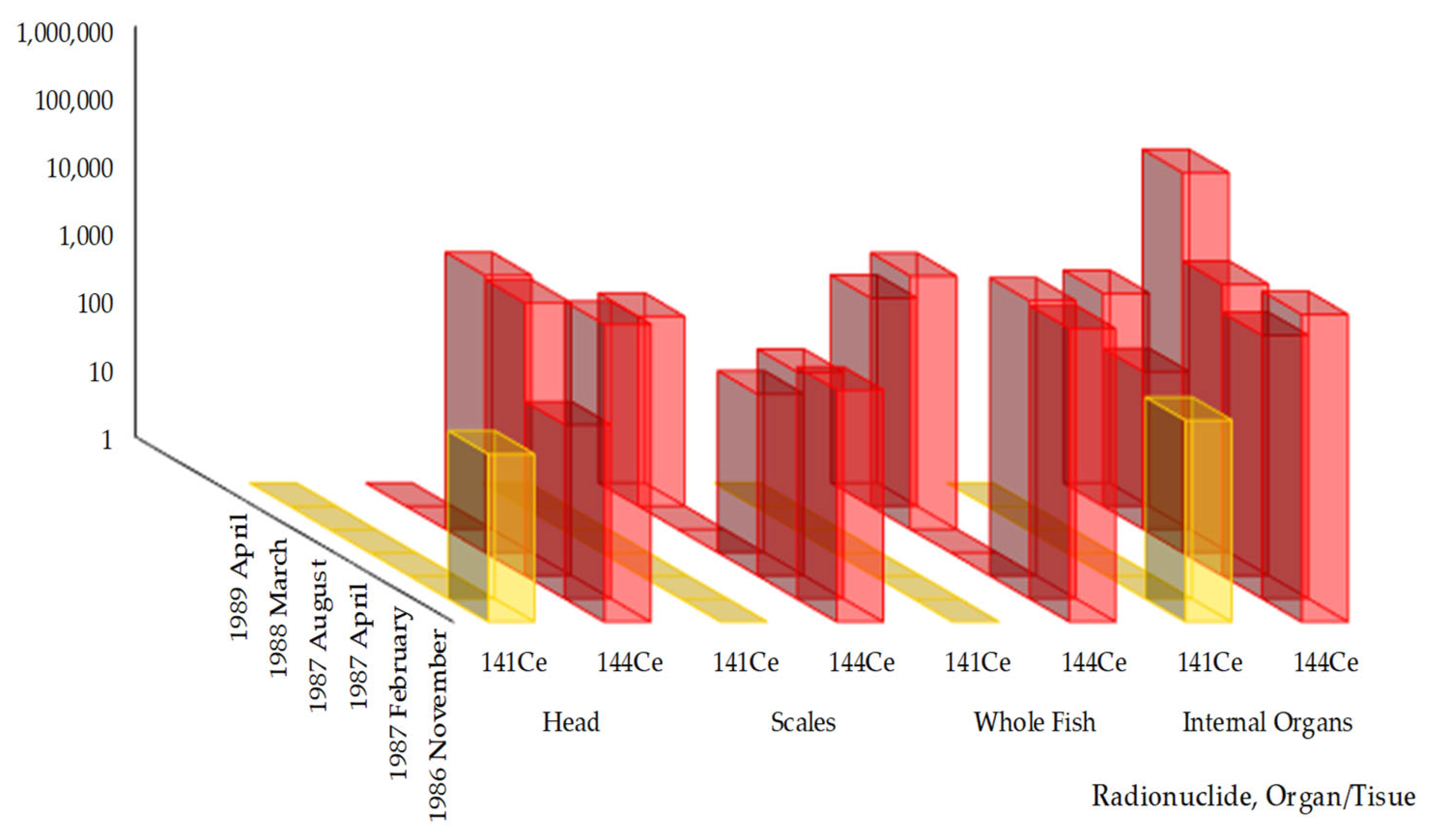
In the cooling pond of the Chornobyl NPP, 141Ce was most frequently detected in whole-body samples and internal organs of fish belonging to various ecological groups, including C. carpio, I. punctatus, Alburnus alburnus (Linnaeus, 1753), and H. molitrix. The dynamics of 144Ce in C. carpio across different organs and tissues are shown together with 141Ce in Figure 7.
In the head and internal organs of this species, 141Ce was detected only in 1986. After March 1987, 141Ce was no longer recorded in fish from the cooling pond. At the same time, in H. molitrix, this radionuclide was detected in roe in March 1987 (Table 3).
Cerium (144Ce): Similar to 141Ce, the maximum content of 144Ce in the Kaniv Reservoir was recorded in P. australis of the previous year’s vegetation in May 1986; however, the concentrations were lower, 865,287 ± 64,432 and 2,923,240 ± 209,660 Bq/kg for the same samples. In plants of the current year’s vegetation, the content in September was 26,589 ± 2072 Bq/kg. The last detection in this species occurred in the summer of 1987.
In Cladophora spp. of the Kaniv Reservoir, the content of 144Ce was noticeably lower, which may indicate the predominance of atmospheric transport of the radionuclide. Its detection in this species continued until the end of October 1988 (Figure 4).
In P. perfaliatus, the content of 144Ce was the lowest among the studied plant species; the maximum value was recorded in November 1986 and amounted to 518 ± 91 Bq/kg, after which this radionuclide was no longer detected in this species.
In fish of the Kaniv Reservoir, the highest content of 144Ce was recorded on 2 May 1986, in a whole-body sample of A. brama, 435 ± 113 Bq/kg. Subsequently, a significant decrease in concentrations was observed. The last detections were recorded in October 1988 in E. lucius and P. fluviatilis (whole-body samples), 35 ± 6 and 37 ± 11 Bq/kg, respectively. In internal organs, this radionuclide was recorded three times: in October 1986 in B. bjoerkna (119 ± 27 Bq/kg wet weight), in June 1987 in A. aspius (20 ± 4 Bq/kg wet weight), and in T. tinca (45 ± 7 Bq/kg wet weight). A single case of detection in the head of a fish was recorded in June 1987 in P. fluviatilis (Table 2).
In the Chornobyl NPP cooling pond, concentrations of 144Ce in aquatic plants of different species exceeded 1,000,000 Bq/kg during the period 1987–1989. In P. perfoliatus, the content in November 1986 was 111,995 ± 8008 Bq/kg, and in August 1987 it increased to 2,897,525 ± 205,891 Bq/kg. By the end of 1988, specific activity decreased and generally did not exceed 1,000,000 Bq/kg, except in one case: in March 1988, a value of 16,157,037 ± 1,142,822 Bq/kg was recorded in this species, representing the highest level of this radionuclide in the biota of the cooling pond over the entire post-accident study period. By 1990, the content of this radionuclide decreased and ranged between 7031 and 50 Bq/kg. The last detection of 144Ce in P. perfoliatus was recorded in November 1994 at a level of 2450 ± 1020 Bq/kg.
In Cladophora spp., 144Ce was not detected in 1986; it was first identified in March 1987 (Figure 3). By 1990, a gradual decrease in its concentrations was observed.
Out of approximately 1800 fish samples collected in the water area of the Chornobyl NPP cooling pond, 144Ce was detected in about 800 cases (Table 4).
The highest levels of this radionuclide were observed in fish belonging to the Planktivores and Omnivores [88].
In fish, the content of 144Ce was lower than in aquatic plants and generally did not exceed 370,000 Bq/kg. An exception was recorded in October 1987, when the concentration in the internal organs of H. molitrix reached 7,504,518 ± 536,566 Bq/kg. This radionuclide was detected in the internal organs of fish belonging to various ecological groups: Omnivores (B. bjoerkna, C. carpio, A. brama), Herbivores (Scardinius erythrophthalmus (Linnaeus, 1753)), Carnivores (I. punctatus), Planktivores (H. molitrix), and Piscivores (A. aspius) (Table 4).
Unlike 141Ce, 144Ce was detected both in covering tissues and in various internal organs of fish. The highest concentrations were observed in mucus and stomach contents, which indicates the dominant role of the particulate fraction. In the liver, this radionuclide was recorded only once, in September 1988, in C. carpio; in the kidneys of different fish species, it was detected up to 1990.
In fish roe of different species, 144Ce was detected during the period from 1987 to 1990, which may indicate its involvement in biological and reproductive processes.
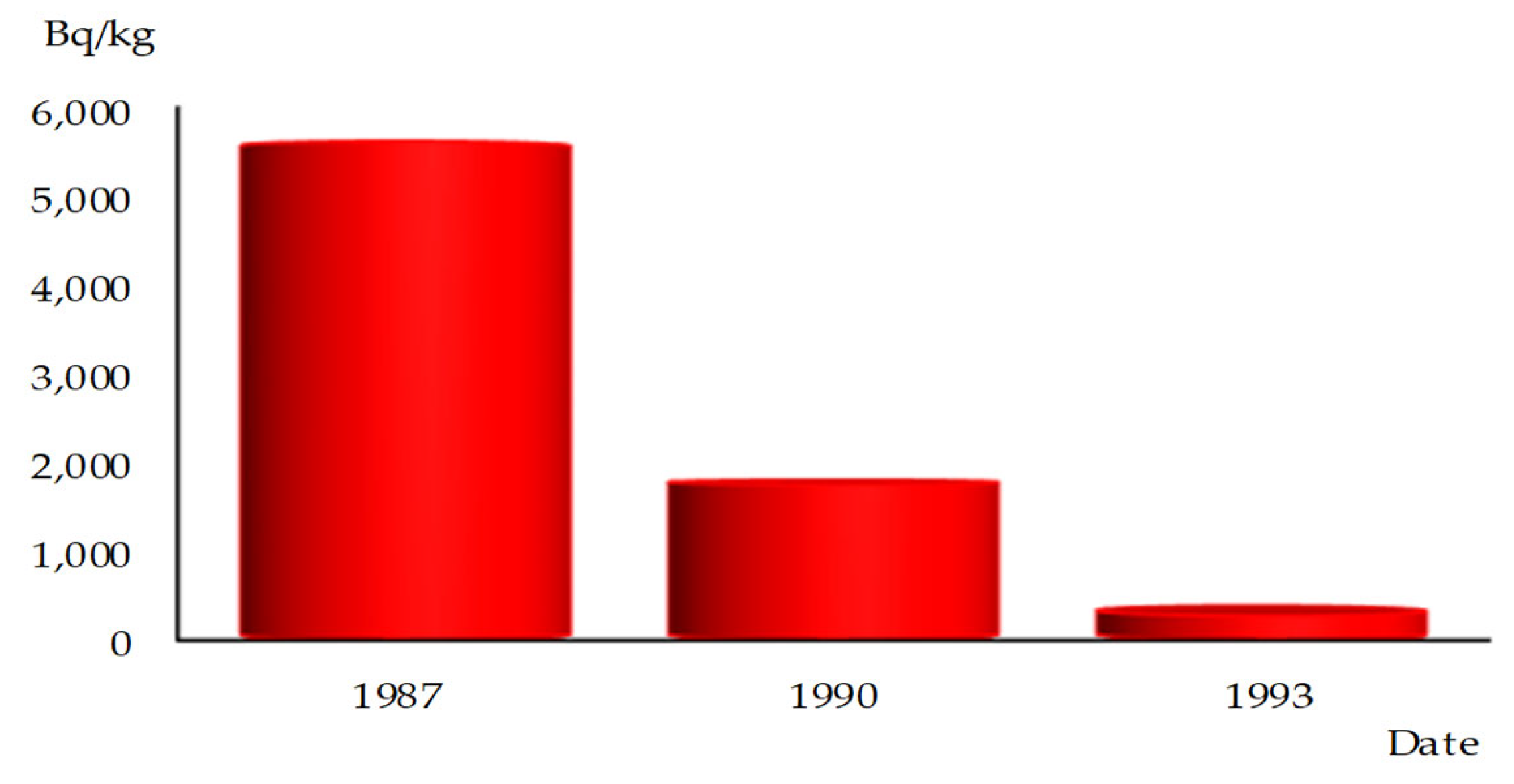
144Ce was widely present in the muscle tissue of fish from different ecological groups until 1989; however, from 1990 onward, it was detected only in a limited number of species, namely S. glanis, I. punctatus, S. lucioperca, and H. molitrix. The last detection in muscle tissue dates to March 1993 (I. punctatus, 272 ± 19 Bq/kg), indicating prolonged retention of the radionuclide in organisms despite an overall decline in environmental levels.
This temporal pattern, in which 144Ce is no longer detected over time in the muscle tissue of fish from lower trophic groups but persists for a longer period in predatory species, reflects not only a general decrease in its environmental abundance but also an uneven distribution among organisms with different feeding strategies. When considered together with earlier detections of this radionuclide in the muscle tissue of fish occupying various trophic positions, these observations suggest that under conditions of elevated contamination, 144Ce may persist for longer periods in higher levels of the food chain.
Under such conditions, the accumulation of 144Ce along the food chain cannot be excluded, i.e., biomagnification, which is atypical for a chemical element that is not biologically essential and is traditionally considered to be only weakly involved in metabolic processes.
In our previous work on 54Mn, 60Co, 65Zn, 95Zr, 95Nb, 103Ru, and 106Ru, as well as in the published literature, muscle tissue has consistently shown the lowest radionuclide concentrations among fish tissues. The prolonged detection of 144Ce in muscle tissue until 1993, as well as the persistence of 125Sb in the muscle of planktivores, therefore does not fully conform to this general pattern. It is noteworthy that the exceptionally high initial activities of 144Ce recorded in the cooling pond in the early post-accident period may have extended its effective environmental availability beyond what would be expected based solely on its physical half-life, thereby providing sufficient exposure time for accumulation processes in muscle tissue to become operative.
A similar delayed accumulation in muscle tissue was previously reported for 106Ru in fish from the same water body [82]. The temporal dynamics of 144Ce in the muscle tissue of I. punctatus from the Chornobyl Nuclear Power Plant Cooling Pond (Figure 8) further support this pattern, although the underlying mechanism responsible for such behaviour in particle-associated radionuclides with low biological mobility remains to be elucidated. At the same time, the pronounced decrease in 144Ce content by 1993 is associated with the relatively short half-life of this radionuclide.
The co-occurrence or separate detection of 125Sb and 144Ce in fish tissues provides a direct means of distinguishing the two principal contamination pathways following the Chornobyl accident: input via fuel particles and input via dissolved or aerosol-derived forms. The presented data clearly demonstrate fundamental differences in the behavior and accumulation of 144Ce and 125Sb in fish, reflecting both their physicochemical properties and their modes of occurrence in the environment.
Cases where high concentrations of both 144Ce and 125Sb are observed simultaneously, particularly in 1987 and in internal organs or the gastrointestinal tract, strongly suggest the intake of both radionuclides as components of fuel particles. For example, in C. carpio in early 1987, extremely high concentrations of 144Ce (exceeding 300,000 Bq/kg) accompanied by 125Sb levels of several thousand Bq/kg represent a typical signature of the fuel component. A similar pattern is observed in the intestine and its contents in 1988–1989, where elevated levels of both radionuclides persist, likely due to the retention of particles in the digestive tract or their continuous ingestion with food.
At the same time, a significant number of cases are characterized by the presence of only 144Ce without the accompanying 125Sb. Such patterns prevail in most tissues, including bones, scales, fins, gills, and even muscles. This reflects the low mobility of 144Ce: it is either not absorbed from the intestine and is subsequently excreted, or it becomes fixed in tissues associated with mineral metabolism. For example, in numerous samples of C. carpio, S. lucioperca, and I. punctatus collected in 1987–1988, this radionuclide is detected in bones or scales in the complete absence of antimony, indicating its inert behavior and tendency to precipitate. At the same time, the detection of 144Ce in the muscles of Piscivorous fish, in particular A. aspius and S. lucioperca, in 1987, 1988, and 1990, may indicate biomagnification of this radionuclide, which is consistent with general concepts of trophic transfer of low-mobility elements. In this context, it should be noted that radionuclides released into the environment after the Chornobyl accident as components of fuel particles (for example, 106Ru), even with relatively short half-lives, can gradually accumulate in fish muscles provided that they are present in sufficient quantities in the water body [82].
The most illustrative cases for understanding the differences between these radionuclides are those in which only 125Sb is detected in tissues without 144Ce. Although less frequent, these cases show a clear pattern: they are more common in later years (1988–1990) and in tissues directly exposed to water or characterized by high physiological activity. This is consistent with the data presented in Figure 5 for H. molitrix, where 125Sb persists in the liver, roe, and muscles even under conditions of substantially reduced 144Ce levels. For instance, only 125Sb was detected in the gills of S. lucioperca in 1989–1990, in the head of A. aspius in 1988, and similarly in the liver of H. molitrix in 1989–1990, as well as in the roe of A. brama and S. lucioperca in 1990. In these cases, the absence of 144Ce is explained by its low solubility and limited ability to penetrate tissues, whereas 125Sb in dissolved form readily enters through the gills or intestine and is transported to internal organs.
Thus, the presence of 125Sb alone in internal organs does not indicate greater “biological significance” compared to 144Ce, but rather reflects its substantially higher bioavailability and mobility. 125Sb behaves as a typical dissolved radionuclide capable of active incorporation into physiological processes. This is particularly evident in the later post-accident period, when 144Ce is largely fixed in bottom sediments or has decayed, whereas 125Sb continues to circulate in the aquatic environment.

4. Summary

This study presents a comprehensive analysis of the accumulation patterns of short-lived radionuclides (125Sb, 131I, 141Ce, and 144Ce) in fish, based on the integration of the literature data and results obtained in the Chornobyl Nuclear Power Plant cooling pond and the Kaniv Reservoir. The findings indicate that radionuclide behavior, bioavailability, and tissue distribution are primarily governed by their physicochemical properties, environmental forms, and ecological characteristics of fish [4,6].
Antimony (125Sb) shows intermediate behavior between conservative and particle-reactive radionuclides. In the present study, its accumulation depends on environmental form. When associated with fuel particles, it co-occurs with 144Ce and accumulates in the gastrointestinal tract. When present independently, it reflects dissolved or aerosol-derived forms and shows higher bioavailability, accumulating in internal organs and muscles. No biomagnification was observed, in agreement with published data [4].
Iodine (131I) is highly soluble and conservative. Literature indicates rapid incorporation into biological processes [28,31,33]. In this study, it was detected mainly in early post-accident samples. Its short half-life leads to transient presence [53]. Its accumulation reflects rapid uptake and turnover rather than biomagnification [28].
Cerium isotopes (141Ce and 144Ce) exhibit a pronounced tendency to associate with particulate matter in aquatic environments. According to the literature, 144Ce is predominantly bound to suspended particles and bottom sediments [4,5], which leads to enhanced accumulation in benthic organisms and external tissues, whereas concentrations in muscle tissue are typically low, and biomagnification is generally considered absent or highly unlikely.
Within the present study, these general patterns are broadly confirmed; however, several important features were identified. In particular, very high activities of 144Ce were recorded, especially in omnivorous and planktivorous fish species, with maximum values observed in the gastrointestinal tract, intestinal contents, mucus, and external tissues (see Table 4). This indicates that ingestion of contaminated particles represents the primary pathway of uptake.
At the same time, our results demonstrate the presence of 144Ce in muscle tissue, kidneys, and roe over several years following the accident, indicating a gradual internal redistribution of the radionuclide within organisms. Importantly, the detection of 144Ce in the muscle tissue of piscivorous fish may suggest possible trophic transfer and limited biomagnification.
Notably, 144Ce was detected in muscle tissue until 1993, later than in most other organs and tissues, which is consistent with the pattern previously reported for 106Ru in fish from the same water body [82]. This may indicate prolonged redistribution processes and slow elimination of the radionuclide from muscle tissue, potentially creating conditions for its persistence in higher trophic levels.
The analysis of the relationship between 125Sb and 144Ce indicates fundamentally different pathways of their input and accumulation in fish and allows differentiation of the main forms of radioactive contamination following the Chornobyl accident. It was established that simultaneously high activities of both radionuclides, particularly characteristic of the early post-accident period, are associated with the input of fuel particles and reflect their common origin and limited mobility. In contrast, the predominance of 144Ce alone in most tissues indicates its strong association with the particulate matter, low solubility, and limited bioavailability, resulting in its accumulation mainly in external and mineralized structures. At the same time, cases where only 125Sb is detected, especially in later post-accident years and in physiologically active organs, reflect its occurrence in dissolved form, higher mobility, and greater capacity for uptake and internal transport. Thus, differences in the accumulation of these radionuclides reflect the combined influence of two principal contamination pathways, particulate and dissolved, and determine their contrasting bioavailability and tissue distribution in fish.

5. Conclusions

  • The accumulation patterns of 125Sb, 131I, 141Ce, and 144Ce in fish are primarily controlled by their physicochemical properties and environmental forms (dissolved vs. particulate), rather than by their radioactive nature.
  • 125S exhibits higher mobility and bioavailability, accumulating in internal organs (liver, kidneys, gills) and, under certain conditions, in muscle tissue, reflecting uptake from dissolved forms.
  • 131I shows high mobility and rapid biological incorporation, with a short-term presence in fish tissues, mainly in internal organs and whole-body samples.
  • 141Ce and 144Ce are predominantly associated with particulate matter and accumulate mainly in the gastrointestinal tract, external tissues, and mineralized structures, with limited but detectable redistribution into internal organs and muscles.
  • In general, accumulation patterns of radionuclides are consistent with those of their stable analogues; no fundamental qualitative differences were identified.
  • Biomagnification is not a dominant process for the studied elements; trophic dilution prevails, although limited trophic transfer for 144Ce may occur under specific conditions.
  • The co-occurrence of radionuclides (especially 144Ce and 125Sb) serves as an indicator of fuel particle contamination, while their separate occurrence reflects different environmental pathways and bioavailability.

Author Contributions

Conceptualization, N.E.Z. and V.S.; methodology, N.E.Z. and L.P.P.; formal analysis, L.P.P.; data curation, N.E.Z. and V.S.; writing—original draft preparation, N.E.Z. and L.P.P.; writing—review and editing, N.E.Z. and V.S.; visualization, V.S. All authors have read and agreed to the published version of the manuscript.

Funding

Open Access Funding by the University for Continuing Education, Krems.

Institutional Review Board Statement

Not applicable.

Informed Consent Statement

Not applicable.

Data Availability Statement

Data are contained within the article; further inquiries can be directed to the corresponding authors.

Acknowledgments

The authors are deeply grateful to Oleg L. Zarubin (1961–2017), whose systematic fieldwork on radionuclide accumulation in aquatic organisms of the ChNPP Cooling Pond and the Kaniv Reservoir was initiated in the immediate aftermath of the 1986 accident and yielded a unique observational dataset. His dedicated scientific contribution made it possible to bring together and interpret the collected field evidence, serving as the basis for this series of articles on the accumulation of short-lived radionuclides in fish. During manuscript preparation, we used DeepL, Grammarly, Perplexity Comet AI, and Microsoft Copilot for translation, language editing, and reference formatting. All AI-assisted outputs were reviewed and edited by the authors, and all scientific content, data, interpretations, and conclusions are the original work of the authors.

Conflicts of Interest

The authors declare no conflicts of interest.

References

  1. Carlson, L.; Holm, E. Radioactivity in Fucus vesiculosus L. from the Baltic Sea following the Chernobyl accident. J. Environ. Radioact. 1992, 15, 231–248. [Google Scholar] [CrossRef]
  2. NuDat 3. Available online: https://www.nndc.bnl.gov/nudat3/ (accessed on 22 April 2026).
  3. Iosjpe, M.; Isaksson, M.; Joensen, H.P.; Jónsson, G.; Suolanen, V. Application of Biokinetic Parameters for Some Representative Accident Cases Based on State-of-the-Art Modelling (BIOAPP); Norwegian Radiation and Nuclear Safety Authority: Østerås, Norway, 2023.
  4. International Atomic Energy Agency. Worldwide Marine Radioactivity Studies (WOMARS): Radionuclide Levels in Oceans and Seas; IAEA: Vienna, Austria, 2004. [Google Scholar]
  5. United Nations Scientific Committee on the Effects of Atomic Radiation. Sources and Effects of Ionizing Radiation; United Nations: New York, NY, USA, 2008. [Google Scholar]
  6. Prăvălie, R. Nuclear weapons tests and environmental consequences: A global perspective. Ambio 2014, 43, 729–744. [Google Scholar] [CrossRef] [PubMed]
  7. Bergan, T.D. Radioactive fallout in Norway from atmospheric nuclear weapons tests. J. Environ. Radioact. 2002, 60, 189–208. [Google Scholar] [CrossRef] [PubMed]
  8. Seymour, A.H. Fish and Radioactivity; University of Washington: Seattle, WA, USA, 1960. [Google Scholar]
  9. Miyake, Y.; Sugiura, Y. The Radiochemical Analysis of Radio-Nuclides in Sea Water Collected near Bikini Atoll. Pap. Meteorol. Geophys. 1955, 6, 33–37. [Google Scholar] [CrossRef]
  10. Palumbo, R.F.; Lowman, F.G. The Occurrence of Antimony-125, Europium-155, Iron-55, and Other Radionuclides in Rongelap Atoll Soil; University of Washington: Seattle, WA, USA, 1958. [Google Scholar]
  11. United Nations Scientific Committee on the Effects of Atomic Radiation. Sources and Effects of Ionizing Radiation; United Nations: New York, NY, USA, 2000. [Google Scholar]
  12. Harrison, F.L. Availability to aquatic animals of short-lived radionuclides from a Plowshare cratering event. Health Phys. 1973, 24, 331–343. [Google Scholar] [CrossRef]
  13. Smith, J.N.; Ellis, K.M.; Naes, K.; Dahles, S.; Matishov, D. Sedimentation and mixing rates of radionuclides in Barents Sea sediments off Novaya Zemlya. Deep Sea Res. Part II Top. Stud. Oceanogr. 1995, 42, 1471–1493. [Google Scholar] [CrossRef]
  14. Smith, J.N.; Ellis, K.M.; Polyak, L.; Ivanov, G.; Forman, S.L.; Moran, S.B. 239,240Pu transport into the Arctic Ocean. Cont. Shelf Res. 2000, 20, 255–279. [Google Scholar] [CrossRef]
  15. Drozdovitch, V.; de Vathaire, F.; Bouville, A. Ground deposition of radionuclides in French Polynesia. J. Environ. Radioact. 2020, 214–215, 106176. [Google Scholar] [CrossRef]
  16. Mauchline, J.; Templeton, W.L. Dispersion in the Irish Sea of radioactive effluent. Nature 1963, 198, 623–626. [Google Scholar] [CrossRef]
  17. Ould-Dada, Z.; Tucker, S.; Webbe-Wood, D.; Mondon, K.; Hunt, J. Food-chain doses from radioactive discharges. J. Environ. Radioact. 2002, 59, 273–291. [Google Scholar] [CrossRef]
  18. International Atomic Energy Agency. Methods of Surveying and Monitoring Marine Radioactivity; IAEA: Vienna, Austria, 1965. [Google Scholar]
  19. Pentreath, R.J.; Jefferies, D.F. Uptake of radionuclides by plaice. J. Mar. Biol. Assoc. UK 1971, 51, 963–976. [Google Scholar] [CrossRef]
  20. Michel, R.; Daraoui, A.; Gorny, M.; Jakob, D.; Sachse, R.; Tosch, L.; Nies, H.; Goroncy, I.; Herrmann, J.; Synal, H.-A.; et al. Iodine-129 in European seawaters. Sci. Total Environ. 2012, 419, 151–169. [Google Scholar] [CrossRef]
  21. Hou, X.L.; Dahlgaard, H.; Nielsen, S.P.; Kucera, J. Level and Origin of Iodine-129 in the Baltic Sea. J. Environ. Radioact. 2002, 61, 331–343. [Google Scholar] [CrossRef] [PubMed]
  22. Gómez-Guzmán, J.M.; Holm, E.; Enamorado-Báez, S.M.; Abril, J.A.; Pinto-Gómez, A.R.; López-Gutiérrez, J.M.; García-León, M. Pre- and post-Chernobyl levels of radionuclides. J. Environ. Radioact. 2013, 115, 134–142. [Google Scholar] [CrossRef] [PubMed]
  23. Hou, X.; Roos, P. Speciation of radionuclides and environmental behavior. In Radioactivity in the Environment; Elsevier: Amsterdam, The Netherlands, 2008; pp. 221–285. [Google Scholar]
  24. McCartney, M.; Kershaw, P.J.; Woodhead, D.S.; Denoon, D.C. Artificial radionuclides in the surface sediments of the Irish Sea, 1968–1988. Sci. Total Environ. 1994, 141, 103–138. [Google Scholar] [CrossRef]
  25. Martin, J.M.; Thomas, A.J. Origins, concentrations and distributions of artificial radionuclides discharged by the Rhône River to the Mediterranean Sea. J. Environ. Radioact. 1990, 11, 105–139. [Google Scholar] [CrossRef]
  26. Wang, Y.; Guo, T.; Fan, Y.; Zhang, L.; Guo, Z.; Cheng, P.; Lan, J.; Liu, Q.; Hou, X. Anthropocene 129I record in the Yellow Sea sediments and its indication for river-delivered radioactive pollution. Environ. Sci. Technol. 2024, 58, 12633–12642. [Google Scholar] [CrossRef]
  27. Lee, U.; Kim, M.J.; Kim, H.R. Radioactive iodine analysis in environmental samples around nuclear facilities. Nucl. Eng. Technol. 2018, 50, 1355–1363. [Google Scholar] [CrossRef]
  28. Imai, S.; Tani, T.; Ishikawa, Y.; Tako, Y.; Takaku, Y.; Hisamatsu, S. Short-term metabolism of biologically incorporated 125I in olive flounder. J. Environ. Radioact. 2020, 214–215, 106161. [Google Scholar] [CrossRef]
  29. Satoh, Y.; Kakiuchi, H.; Ueda, S.; Akata, N.; Hisamatsu, S. Concentrations of iodine-129 in environmental products around Rokkasho. Environ. Monit. Assess. 2019, 191, 61. [Google Scholar] [CrossRef]
  30. Satoh, Y.; Ueda, S. Stable (127I) and radioactive (129I) iodine in surface sediments. Sci. Total Environ. 2025, 1000, 180418. [Google Scholar] [CrossRef]
  31. Ueda, S.; Kakiuchi, H.; Hasegawa, H.; Kawamura, H.; Hisamatsu, S. Concentration of 129I in aquatic biota. Radiat. Prot. Dosim. 2015, 167, 176–180. [Google Scholar] [CrossRef]
  32. Harris, J.T. Radiological releases and environmental monitoring at nuclear power plants. In Nuclear Power—Operation, Safety and Environment; IntechOpen: Rijeka, Croatia, 2011. [Google Scholar] [CrossRef]
  33. Chang, C.C.; Burr, G.S.; Jull, A.T.; Russell, J.; Priyadarshi, A.; Lin, M.; Thiemens, M.; Biddulph, D. Measurements of 129I in the Pacific Ocean. Sci. Total Environ. 2019, 689, 1023–1029. [Google Scholar] [CrossRef]
  34. International Atomic Energy Agency. The Radiological Accident in the Mayak Production Association; IAEA: Vienna, Austria, 2018. [Google Scholar]
  35. Crick, M.J.; Linsley, G.S. Radiological impact of the Windscale reactor fire. Int. J. Radiat. Biol. Relat. Stud. Phys. Chem. Med. 1984, 46, 479–506. [Google Scholar] [CrossRef]
  36. Crabtree, J. Travel and diffusion of radioactive material during the Windscale accident. Q. J. R. Meteorol. Soc. 1959, 85, 362–370. [Google Scholar] [CrossRef]
  37. Johnson, C.A.; Kitchen, K.P.; Nelson, N. Movement of radioactive material during the Windscale fire. Atmos. Environ. 2007, 41, 3921–3937. [Google Scholar] [CrossRef]
  38. Garland, J.A.; Wakeford, R. Atmospheric emissions from the Windscale accident. Atmos. Environ. 2007, 41, 3904–3920. [Google Scholar] [CrossRef]
  39. Stewart, S.G.; Crooks, R.N.; Fisher, E.M.R. Measurements of the radioactivity of the Windscale cloud. J. Radiol. Prot. 2020, 40, 633–645. [Google Scholar] [CrossRef] [PubMed]
  40. Gallagher, D.; McGee, E.J.; Mitchell, P.I.; Alfimov, V.; Aldahan, A.; Possnert, G. Retrospective evidence of the 1957 Windscale fire using 129I. Environ. Sci. Technol. 2005, 39, 2927–2935. [Google Scholar] [CrossRef]
  41. Mitchell, N.T. Radioactivity in Surface and Coastal Waters of the British Isles; Fisheries Radiobiological Laboratory: Lowestoft, UK, 1971.
  42. U.S. Nuclear Regulatory Commission. Generic Environmental Impact Statement for License Renewal of Nuclear Plants (NUREG-1437); NRC: Washington, DC, USA, 2019. Available online: https://www.nrc.gov/reading-rm/doc-collections/nuregs/staff/sr1437/v1/part05.html (accessed on 20 May 2026).
  43. Rogovin, M.; Frampton, G.T. Three Mile Island: A Report to the Commissioners and to the Public; Nuclear Regulatory Commission: Washington, DC, USA, 1980.
  44. Romanenko, V.D. Fundamentals of Hydroecology; Geneza: Kyiv, Ukraine, 2004; ISBN 966-504-358-7. [Google Scholar]
  45. Smith, J.T.; Beresford, N.A. Chernobyl: Catastrophe and Consequences; Springer: Berlin/Heidelberg, Germany, 2005. [Google Scholar]
  46. Calmet, D.; Charmasson, S.; Gontier, G.; Meinesz, A.; Boudouresque, C.F. Chernobyl radionuclides in Mediterranean seagrass. J. Environ. Radioact. 1991, 13, 157–173. [Google Scholar] [CrossRef]
  47. International Atomic Energy Agency. Environmental Consequences of the Chernobyl Accident and Their Remediation; IAEA: Vienna, Austria, 2010. [Google Scholar]
  48. McDonald, P.; Baxter, M.S.; Fowler, S.W. Distribution of radionuclides in mussels, winkles and prawns. J. Environ. Radioact. 1993, 18, 181–202. [Google Scholar] [CrossRef]
  49. Snoeijs, P.; Notter, M. Benthic diatoms as monitoring organisms for radionuclides in a brackish-water environment. J. Environ. Radioact. 1993, 18, 23–52. [Google Scholar] [CrossRef]
  50. Whitehead, N.E.; Ballestra, S.; Holm, E.; Huynh-Ngoc, L. Chernobyl radionuclides in shellfish. J. Environ. Radioact. 1988, 7, 107–121. [Google Scholar] [CrossRef]
  51. Ishida, J.; Miyagawa, N.; Watanabe, H.; Asano, T.; Kitahara, Y. Environmental radioactivity around Tokai Works after Chernobyl. J. Environ. Radioact. 1988, 7, 17–27. [Google Scholar] [CrossRef]
  52. Cooke, M.W.; Trudel, M.; Gurney-Smith, H.J.; Kellogg, J.P.; Cullen, J.T.; Francisco, B.B.A.; Mercier, J.F.; Chen, J. Radioactivity in fish and shellfish after Fukushima. J. Environ. Radioact. 2022, 251–252, 106934. [Google Scholar] [CrossRef] [PubMed]
  53. Masson, O.; Baeza, A.; Bieringer, J.; Brudecki, K.; Bucci, S.; Cappai, M.; Carvalho, F.; Connan, O.; Cosma, C.; Dalheimer, A.; et al. Tracking airborne radionuclides from Fukushima. Environ. Sci. Technol. 2011, 45, 7670–7677. [Google Scholar] [CrossRef] [PubMed]
  54. Kobayashi, T.; Nagai, H.; Chino, M.; Kawamura, H. Source term estimation of Fukushima releases. J. Nucl. Sci. Technol. 2013, 50, 255–264. [Google Scholar] [CrossRef]
  55. Chino, M.; Nakayama, H.; Nagai, H.; Terada, H.; Katata, G.; Yamazawa, H. Preliminary estimation of 131I and 137Cs releases. J. Nucl. Sci. Technol. 2011, 48, 1129–1134. [Google Scholar] [CrossRef]
  56. Buesseler, K.O.; Aoyama, M.; Fukasawa, M. Impacts of Fukushima on marine radioactivity. Environ. Sci. Technol. 2011, 45, 9931–9935. [Google Scholar] [CrossRef]
  57. Buesseler, K.O.; Jayne, S.R.; Fisher, N.S.; Rypina, I.I.; Baumann, H.; Baumann, Z.; Breier, C.F.; Douglass, E.M.; George, J.; Macdonald, A.M.; et al. Fukushima-derived radionuclides in the ocean. Proc. Natl. Acad. Sci. USA 2012, 109, 5984–5988. [Google Scholar] [CrossRef]
  58. Bendriss, H.; El Bakkali, J.; Chakir, E.M.; Doudouh, A.; Yachou, S. Voxel-based computational phantom for marine radiation protection. J. Environ. Radioact. 2025, 285, 107657. [Google Scholar] [CrossRef]
  59. Tagami, K.; Uchida, S. Marine and freshwater concentration ratios: Review of Japanese data. J. Environ. Radioact. 2013, 126, 420–426. [Google Scholar] [CrossRef]
  60. Morita, T.; Takagi, K.; Fujimoto, K.; Ambe, D.; Kaeriyama, H.; Shigenobu, Y.; Miki, S.; Ono, T.; Watanabe, T. Detection of radionuclides in small epipelagic fishes off Japan. In Impacts of the Fukushima Nuclear Accident on Fish and Fishing Grounds; Springer: Tokyo, Japan, 2015; pp. 147–160. [Google Scholar] [CrossRef]
  61. Filella, M.; Belzile, N.; Lett, M.-C. Antimony in the environment: Natural waters. Earth Sci. Rev. 2007, 80, 195–217. [Google Scholar] [CrossRef]
  62. Foata, J.; Quilichini, Y.; Torres, J.; Pereira, E.; Spella, M.M.; Mattei, J.; Marchand, B. Arsenic and antimony in brown trout. Arch. Environ. Contam. Toxicol. 2009, 57, 581–589. [Google Scholar] [CrossRef]
  63. Heier, L.S.; Lien, I.B.; Strømseng, A.E.; Ljønes, M.; Rosseland, B.O.; Tollefsen, K.-E.; Salbu, B. Speciation of metals in water draining a shooting range. Sci. Total Environ. 2009, 407, 4047–4055. [Google Scholar] [CrossRef]
  64. Fu, Z.; Wu, F.; Amarasiriwardena, D.; Mo, C.; Liu, D.; Zhu, J.; Deng, Q.; Liao, H. Antimony, arsenic and mercury in the aquatic environment and fish in a large antimony mining area in Hunan, China. Sci. Total Environ. 2009, 408, 3403–3410. [Google Scholar] [CrossRef] [PubMed]
  65. Obiakor, M.O.; Tighe, M.; Pereg, L.; Wilson, S.C. Bioaccumulation and ecotoxicity of antimony. Crit. Rev. Environ. Sci. Technol. 2017, 47, 2208–2258. [Google Scholar] [CrossRef]
  66. Telford, K.; Maher, W.; Krikowa, F.; Foster, S.; Ellwood, M.J.; Ashley, P.M.; Lockwood, P.V.; Wilson, S.C. Bioaccumulation of antimony and arsenic. Environ. Chem. 2009, 6, 133–143. [Google Scholar] [CrossRef]
  67. Xu, K.; Zou, H.; Yang, A.; Yao, Q.; Li, Q.; Zhang, J.; Hu, X. Effects of antimony on zebrafish. Comp. Biochem. Physiol. Part C Toxicol. Pharmacol. 2024, 286, 110013. [Google Scholar] [CrossRef]
  68. Zou, H.; Xu, K.; Yang, A.; Hu, X.; Niu, A.; Li, Q. Antimony accumulation in zebrafish. Aquat. Toxicol. 2022, 252, 106297. [Google Scholar] [CrossRef] [PubMed]
  69. Gilfedder, B.S.; Petri, M.; Wessels, M.; Biester, H. Iodine mass balance for Lake Constance. Geochim. Cosmochim. Acta 2010, 74, 3090–3111. [Google Scholar] [CrossRef]
  70. Gilfedder, B.S.; Petri, M.; Biester, H. Iodine speciation and cycling in fresh waters. J. Limnol. 2009, 68, 396–408. [Google Scholar] [CrossRef]
  71. Tiffany, M.A.; Winchester, J.W.; Loucks, R.H. Natural and pollution sources of halogens in the Great Lakes. Water Pollut. Control Fed. 1969, 41, 1319–1329. [Google Scholar]
  72. Prabhath, R.K.; Arunachalam, K.D.; Sathyapriya, R.S.; Murali, S. Quantification of cerium in marine biota. In Proceedings of the 15th International Conference on Modern Trends in Activation Analysis (MTAA-15), Mumbai, India, 17–22 November 2019; p. 105. [Google Scholar]
  73. Pastorino, P.; Squadrone, S.; Berti, G.; Esposito, G.; Bondavalli, F.; Renzi, M.; Pizzul, E.; Kazmi, S.S.U.H.; Barceló, D.; Abete, M.C.; et al. Rare earth elements in freshwater ecosystems. Environ. Res. 2024, 240, 117455. [Google Scholar] [CrossRef]
  74. Marginson, H.; MacMillan, G.A.; Grant, E.; Gérin-Lajoie, J.; Amyot, M. Rare earth element bioaccumulation in subarctic biota. Sci. Total Environ. 2023, 879, 163024. [Google Scholar] [CrossRef]
  75. González, N.; Domingo, J.L. Levels of rare earth elements in food. Biol. Trace Elem. Res. 2024, 203, 2240. [Google Scholar] [CrossRef]
  76. Bakhshalizadeh, S.; Rostamzadeh, A.; Mora-Medina, R.; Ayala-Soldado, N. Bioaccumulation of rare earth elements in mullet. Environ. Geochem. Health 2023, 45, 6533–6542. [Google Scholar] [CrossRef]
  77. Miao, X.; Wei, X.; Zhao, X.; Hao, Y.; Bao, W. Bioaccumulation and health risk of rare earth elements in fish. Animals 2024, 14, 3567. [Google Scholar] [CrossRef]
  78. Gagnon, C.; Bruneau, A.; Turcotte, P.; Pilote, M.; Gagné, F. Fate of cerium oxide nanoparticles in waters. J. Nanomed. Nanotechnol. 2018, 9, 489. [Google Scholar] [CrossRef]
  79. Correia, A.T.; Rebelo, D.; Marques, J.; Nunes, B. Chronic exposure to cerium dioxide nanoparticles. Environ. Toxicol. Pharmacol. 2019, 68, 27–36. [Google Scholar] [CrossRef]
  80. Naiel, M.A.E.; Abdel-Latif, H.M.R.; Abd El-Hack, M.E.; Khafaga, A.F.; Elnesr, S.S.; Dawood, M.A.O.; Alkazmi, L.; Elhady, H.A.; Batiha, G.E.-S.; Alagawany, M.; et al. Cerium oxide nanoform and ecotoxicity in aquatic environments. Aquat. Living Resour. 2022, 35, 9. [Google Scholar] [CrossRef]
  81. Zarubina, N.E.; Semak, V.; Ponomarenko, L.P.; Burdo, O.S. Content of short-lived radionuclides (54Mn, 60Co, and 65Zn) in fish. Fishes 2025, 10, 90. [Google Scholar] [CrossRef]
  82. Zarubina, N.E.; Semak, V.; Ponomarenko, L.P. Content of short-lived radionuclides (95Zr, 95Nb, 103Ru and 106Ru) in fish. Fishes 2025, 10, 330. [Google Scholar] [CrossRef]
  83. Zarubina, N.E.; Semak, V.; Burdo, O.S.; Ponomarenko, L.P. Ecological Half-Life of 137Cs in Fish. Ecologies 2023, 4, 463–477. [Google Scholar] [CrossRef]
  84. Bariakhtar, V.H. (Ed.) The Chornobyl Catastrophe; Naukova Dumka: Kyiv, Ukraine, 1995; ISBN 5-12-004061-6. [Google Scholar]
  85. Loshchilov, I.A. Radiation problems in agriculture after the Chernobyl accident. In Problems of Agricultural Radiology: Collection of Scientific Papers; UkrNIINTI: Kyiv, Ukraine, 1991; pp. 1–8. [Google Scholar]
  86. Zarubin, O.L. 125Sb content in aquatic ecosystems after the Chernobyl NPP accident. In Ecology and Human Health. Protection of Air and Water Basins. Waste Utilization: Proceedings of the XV International Scientific and Practical Conference; Saga Publishing House: Kharkiv, Ukraine, 2007; Volume 2, pp. 233–239. ISBN 978-966-2918-24-3. [Google Scholar]
  87. Zarubin, O.L.; Laktionov, V.A.; Moshna, B.A.; Babenko, V.V.; Lytvynska, T.A.; Kostiuk, V.A.; Maliuk, I.A. Technogenic radionuclides in freshwater fish of Ukraine after the Chornobyl accident. Nucl. Phys. At. Energy 2011, 12, 192–197. [Google Scholar] [CrossRef]
  88. Zarubin, O.L. 144Ce in components of aquatic and coastal ecosystems of the cooling pond and the Kaniv Reservoir after the Chernobyl NPP accident. In Environmental Safety: Problems and Solutions: Proceedings of the III International Scientific and Practical Conference; UkrNDIEP Ryder: Kharkiv, Ukraine, 2007; Volume 1, pp. 217–220. ISBN 978-966-8246-83-8. [Google Scholar]
Figure 1. Cooling Pond of the Chornobyl Nuclear Power Plant: left, 2013; right, 2009 (photo by N. Zarubina).
Fishes 11 00328 g001
Figure 2. Fish sampling site at the Kaniv Reservoir, Kyiv south region, Ukraine, in 2009 (photo by N. Zarubina).
Fishes 11 00328 g002
Figure 3. Radionuclides in Cladophora spp. from the ChNPP Cooling Pond.
Fishes 11 00328 g003
Figure 4. Radionuclides in Cladophora spp. from the Kaniv reservoir. Note: 125Sb was not detected in 1987.
Fishes 11 00328 g004
Figure 5. Radionuclides in H. molitrix from the Cooling Pond of the ChNPP.
Fishes 11 00328 g005
Figure 6. Radionuclide content in different objects of the Kaniv Reservoir, sampled on 3 May 1986 (Bq/kg).
Fishes 11 00328 g006
Figure 7. 141Ce and 144Ce Radionuclides in C. carpio from the Cooling Pond of the ChNPP (Bq/kg).
Fishes 11 00328 g007
Figure 8. 144Ce in I. punctatus—muscle from the Cooling Pond of the ChNPP.
Fishes 11 00328 g008
Table 1. Content of 125Sb in fish tissues and organs (Bq/kg, fresh weight) from the Cooling Pond of the ChNPP, with sampling periods in the early years following the Chornobyl accident.
Sample Collection PeriodTissue or Organ125Sb Min125Sb MaxFish Ecological Groups
August 1987–March 1990Head1241020Omnivores, Planktivores, Carnivores, Piscivores
October 1987–March 1990Gills27112Carnivores, Piscivores
March 1988–April 1989Muscles3126768Omnivores, Planktivores
February 1987–March 1990Internal Organs1217191Omnivores, Planktivores, Carnivores, Piscivores
September 1988–March 1990Liver35257Omnivores, Planktivores
March 1987–February 1990Roe1591917Omnivores, Planktivores, Piscivores
March 1988–March 1990Fat1465Omnivores, Planktivores
February 1987–October 1987Swimming Bladder335403Planktivores, Carnivores
April 1987–April 1989Fins1001458Omnivores, Planktivores, Carnivores
February 1987–April 1989Scales2001851Planktivores
March 1988Skin4781074Planktivores, Piscivores
April 1987Mucus1576Carnivores
March 1988Whole Fish294445Omnivores, Planktivores
Table 2. Content of radionuclides (125Sb, 131I, 141Ce, and 144Ce) in fish tissues and organs (Bq/kg, fresh weight) from the Kaniv Reservoir, with sampling periods in the early years following the Chornobyl accident.
Sample Collection PeriodTissue or Organ125Sb Min125Sb MaxFish Ecological Groups
November 1987Roe41Omnivores
May 1988Kidneys20Piscivores
October 1986Internal Organs3164Omnivores
June 1987Fins17Omnivores
May 1988Scales150Piscivores
October 1986–March 1987Whole Fish821Omnivores, Piscivores
131I min131I max
May 1986Internal Organs1736Piscivores
May 1986–June 1986Whole Fish1482245Omnivores, Carnivores, Piscivores
141Ce min141Ce max
May 1986Internal Organs167Piscivores
May 1986–June 1986Whole Fish3121307Omnivores
144Ce min144Ce max
May 1986–October 1986Internal Organs20119Omnivores, Carnivores, Piscivores
June 1987Head29Carnivores
May 1986–October 1988Whole Fish12435Omnivores, Carnivores, Piscivores
Table 3. Content of 141Ce in fish tissues and organs (Bq/kg, fresh weight) from the Cooling Pond of the ChNPP, with sampling periods in the early years following the Chornobyl accident.
Sample Collection PeriodTissue or Organ141Ce Min141Ce MaxFish Ecological Groups
November 1986Head287Omnivores
November 1986–April 1987Internal Organs1544364Omnivores, Planktivores
March 1987Roe920Planktivores
November 1986–December 1986Whole Fish182820Omnivores, Planktivores
Table 4. Content of 144Ce in fish tissues and organs (Bq/kg, fresh weight) from the Cooling Pond of the ChNPP, with sampling periods in the early years following the Chornobyl accident.
Sample Collection PeriodTissue or Organ144Ce Min144Ce MaxFish Ecological Groups
November 1986–March 1990Head4127,355Omnivores, Planktivores, Carnivores
November 1986–March 1990Internal Organs1077,504,518Omnivores, Planktivores, Phytivores, Carnivores, Piscivores
February 1987–March 1990Gills9410,348Omnivores, Planktivores, Carnivores, Piscivores
March 1987–February 1990Roe128202,662Omnivores, Planktivores
August 1987–February 1990Fat251726Omnivores, Planktivores, Carnivores
March 1987–March 1990Intestines with Content160105,802Omnivores, Planktivores, Phytivores, Carnivores, Piscivores
August 1987–March 1990Skin1355770Omnivores, Planktivores, Carnivores, Piscivores
August 1987–March 1990Bones9212,254Omnivores, Planktivores, Carnivores, Piscivores
October 1987–August 1993Muscles27272,039Omnivores, Planktivores, Carnivores, Piscivores
September 1988Liver150Omnivores
November 1986–March 1990Fins7689,367Omnivores, Planktivores, Phytivores, Carnivores, Piscivores
August 1987–March 1990Kidneys2941534Omnivores, Planktivores, Carnivores, Piscivores
April 1987Mucus11,196196,875Carnivores
November 1986–March 1990Scales7611,051Omnivores, Planktivores, Piscivores
November 1986–March 1990Whole Fish26735,445Omnivores, Planktivores, Piscivores
Disclaimer/Publisher’s Note: The statements, opinions and data contained in all publications are solely those of the individual author(s) and contributor(s) and not of MDPI and/or the editor(s). MDPI and/or the editor(s) disclaim responsibility for any injury to people or property resulting from any ideas, methods, instructions or products referred to in the content.