Skip to Content

Beverages

Beverages is an international, peer-reviewed, open access journal on beverage research and development published monthly online by MDPI.

Get Alerted

Add your email address to receive forthcoming issues of this journal.

All Articles (1,005)

Bee Pollen as a Multifunctional Nutrient Source in Spontaneous Mead Fermentation: Impact on Phenolic Profile and Antioxidant Capacity

  • Cynthia Brasil da Nóbrega de Teive Argollo,
  • Edna Santos de Barros and
  • Aline Camarão Telles Biasoto
  • + 6 authors

A growing global demand exists for natural alcoholic beverages produced through spontaneous fermentation with reduced use of commercial additives. In this context, the present study evaluated the impact of bee pollen addition as a nutrient source for wild yeasts on the physicochemical composition, color, phenolic compound profile, and antioxidant capacity of mead. Three distinct meads were produced by applying spontaneous fermentation of Apis mellifera honey: a control (honey diluted in water to 22 °Brix); honey diluted in water and supplemented with bee pollen (30 g L−1); and honey diluted in water and supplemented with a commercial fermentation activator composed of ammonium phosphate (0.4 g L−1). The use of nitrogen sources for wild yeasts reduced the fermentation time by up to 14 days. Notably, only bee pollen caused darkening of the mead, resulting in a more yellowish color. Seventeen phenolic compounds were identified in the meads, including phenolic acids, flavonols, and flavanols. The mead supplemented with bee pollen exhibited higher antioxidant capacity and a greater content of identified phenolic compounds, particularly quercetin-3-β-D-glucoside, at a concentration 100 times higher than that in the control (23.5 mg L−1). These findings indicate that bee pollen acts as a multifunctional fermentative modulator, improving the fermentative performance of wild yeasts and promoting phenolic enrichment, thereby supporting its application in the development of mead.

15 May 2026
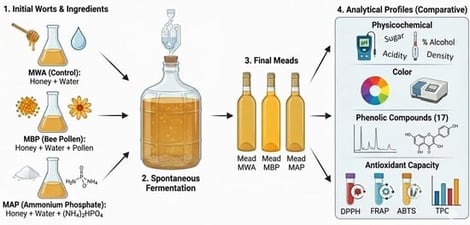
In vitro antioxidant activity of meads produced from Apis mellifera honey and fermented with wild yeasts and different sources of nitrogen. Different letters indicate significant differences among the samples according to Tukey’s test (p ≤ 0.05). Caption: MWA = fermented mead without a nutrient source for the wild yeasts. MBP = fermented mead with the addition of 30 g L−1 of bee pollen as a natural nutrient source for the wild yeasts. MAP = fermented mead with the addition of 0.4 g L−1 of a commercial fermentation activator (Gesferm Plus, composed of ammonium phosphate, B vitamins, and cellulose) as an artificial nutrient source for the fermentation of wild yeasts. TE = Trolox equivalent.

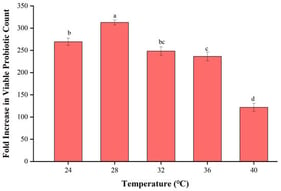
This study aimed to develop a high-value plant-based probiotic beverage via the co-fermentation of Lactobacillus plantarum (P8) and Bifidobacterium animalis subsp. lactis (V9) with almond hull homogenate as the fermentation substrate. Single-factor experiments combined with Box–Behnken response surface methodology were adopted to optimize the key fermentation parameters (compound bacteria ratio, inoculation amount, temperature, and fermentation time), with the probiotic proliferation multiple set as the response value. Furthermore, the physicochemical properties, active component contents, and antioxidant-related indicators of the fermented product were systematically determined and analyzed. The results showed that the optimal fermentation conditions were as follows: a P8:V9 ratio of 1:1, an inoculation amount of 0.1%, a fermentation temperature of 28 °C, and a fermentation time of 66 h. Under these optimal conditions, the viable probiotic count increased by 320-fold relative to the initial viable count, and the fermentation effectively induced the transformation of the bound bioactive components in the almond hull, with the free-flavonoid content increasing by 20.40% and the total polyphenol content decreasing by 6.16% in the fermented product, which reflected the dynamic conversion of nutrient components during the fermentation process. Meanwhile, the antioxidant capacity of the almond hull fermented product was significantly improved compared with the unfermented control. This study confirms the feasibility of almond hull as a suitable matrix for probiotic fermentation, and the findings provide a scientific basis for the development of plant-based synbiotic products and the high-value resource utilization of almond hull as an agricultural by-product.

14 May 2026

Effect of temperature on probiotic proliferation multiple in almond hull enzymatic hydrolysate. Data are presented as mean ± SD (n = 3). Normality was confirmed by the Shapiro-Wilk test, and homogeneity of variances was verified via Levene’s test. Intergroup differences were analyzed by independent-samples t-test with Benjamini-Hochberg FDR correction for multiple testing, and a q-value < 0.05 was considered statistically significant. Only 2 pairwise comparisons (24 °C vs. 36 °C, 32 °C vs. 36 °C) exhibited no statistically significant difference, with adjusted q-values > 0.05.

Use of Pecan Shell Extract and Green Tea in a Kombucha-Vinegar-Based Beverage with Enhanced Antioxidant Properties

  • Cinthia Berwanger,
  • Emily da Luz Monteiro and
  • Luciane Maria Colla
  • + 2 authors

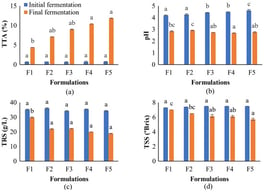
We aimed to develop kombucha-vinegar beverages inspired by switchel (a beverage that combines apple cider vinegar and ginger extract), using pecan shell aqueous extract (PSE) and green tea infusion (GTI) in the preparation of kombucha vinegar, and to assess its effects on physicochemical characteristics, antioxidant activity, and sensory acceptance. Combinations of PSE and GTI (100:0, 75:25, 50:50, 25:75, and 0:100) were tested as substrates to produce kombucha vinegar with an initial sugar concentration of 80 g/L. After, the initial sucrose concentration was tested (80 to 60 g/L) using two of the previous formulations (50% of PSE and 50% of GTI; 25% of PSE and 75% of GTI), that showed better results in antioxidant capacity and sensory characteristics, particularly bitterness, which was attributed to the addition of higher amounts of pecan nutshell extract (100 and 75%). The formulation with 60 g/L of sucrose and higher pecan shell extract (50%) was chosen, allowing a beverage with less sugar at the end of kombucha fermentation. An increase in antioxidant potential was observed during the fermentations, with this being a highlight of this study. Kombucha vinegar beverages inspired by switchel were developed (50% PSE and 50% GTI, 60 g/L of sucrose), with the use of ginger extract or juice fruits (apple, pineapple, or white grape), in order to make the beverage palatable to consumers. The samples without ginger showed the highest antioxidant capacity values. In the sensory evaluation using acceptability and the check all that apply method (CATA), the beverages without ginger showed acceptability ranging from 74.4% (addition of white grape juice) to 84.0% (addition of pineapple juice), being described as refreshing, healthy, and energizing.

14 May 2026

Values of (a) total titratable acidity (TTA, expressed as % acetic acid), (b) pH (hydrogen ion potential), (c) total reducing sugars (TRS, expressed as g glucose per liter of sample), (d) total soluble solids (TSS, expressed in ºBrix) of the kombucha vinegars at the initial and final fermentation times for the experiments of Stage 1. Formulations F1 to F5 presented the following ratios of PSE (pecan shell extract) and GTI (green tea infusion), respectively: 100:0, 75:25, 50:50, 25:75, and 0:100. Different letters in the columns of the same color indicate statistically significant differences among samples according to Tukey’s test (p < 0.05). Results are expressed as mean ± standard deviation (n = 3).

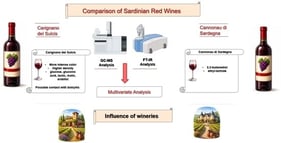
To protect wine authenticity and quality, two Sardinian red wines, Carignano del Sulcis and Cannonau di Sardegna, were characterized using an FT-IR and untargeted GC–MS integrated approach. FT-IR-derived oenological parameters, together with GC–MS profiles of polar low-molecular-weight metabolites, were subjected to multivariate statistical analysis. Compared with Cannonau, Carignano exhibited higher color intensity, greater density, and higher contents of glucose, lactic acid, and malic acid. Discriminant analysis of GC-MS data revealed that Carignano was characterized by uronic acids and arabitol, suggesting possible exposure to Botrytis. In contrast, Cannonau was characterized by 2,3 butanediol and ethyl-tartrate, indicating more pronounced yeast fermentative activity, consistent with the lower residual glucose content measured by FT-IR. Classification analysis demonstrated that the different wineries exert significant influence on the final characteristics of the wine. Overall, the findings demonstrated the effectiveness of this integrated analytical approach as a promising tool for wine authentication.

12 May 2026

PCA scores and loadings biplot in the first and third components (explained variance in brackets) of GC-MS data for Carignano (red circles) and Cannonau (blue circles) wines (3 components, R2Xcum = 0.49, Q2cum = 0.14). Acetic acid (AcetA); arabinitol (Ara-ol); butanediol (But-2,3); butanetriol (3-OH-But); citramalic acid (CitMalA); citric acid (CitrA); ethyl tartaric acid (Eth-Tart); ethyl-phosphonic acid (Eth-PhA); ethyl-succinic acid (Eth-Succ); galacturonic acid (GalactA); gallic acid (GallicA); gluconic acid (GlucA); glucose (Glucose); glyceric acid (GlyA); hydroxy-butanoic acid (4OH-ButA); hydroxy-propanoic acid (3OH-PrA); malic acid (MalicA); monopalmitin (MonoPalm); monostearin (MonoSt); oxo-proline (PyrogA); palmitic acid (PalmA); pentanedioic acid (PentA); stearic acid (StA); succinic acid (SuccA); tartaric acid (TartA); trihydroxybutyric acid (3OH-ButA).

News & Conferences

Volumes

Latest Issues

Open for Submission

Editor's Choice

Reprints of Collections

Advances in Analysis of Flavors and Fragrances
Reprint

Advances in Analysis of Flavors and Fragrances

Chemistry, Properties and Applications in Food Quality Improvement
Editors: Ana Leahu, Maria Soledad Prats Moya, Cristina Ghinea
Emerging Trends in Beverage Processing
Reprint

Emerging Trends in Beverage Processing

Editors: Antonio Morata
XFacebookLinkedIn
Beverages - ISSN 2306-5710