


Abstract
A growing global demand exists for natural alcoholic beverages produced through spontaneous fermentation with reduced use of commercial additives. In this context, the present study evaluated the impact of bee pollen addition as a nutrient source for wild yeasts on the physicochemical composition, color, phenolic compound profile, and antioxidant capacity of mead. Three distinct meads were produced by applying spontaneous fermentation of Apis mellifera honey: a control (honey diluted in water to 22 °Brix); honey diluted in water and supplemented with bee pollen (30 g L−1); and honey diluted in water and supplemented with a commercial fermentation activator composed of ammonium phosphate (0.4 g L−1). The use of nitrogen sources for wild yeasts reduced the fermentation time by up to 14 days. Notably, only bee pollen caused darkening of the mead, resulting in a more yellowish color. Seventeen phenolic compounds were identified in the meads, including phenolic acids, flavonols, and flavanols. The mead supplemented with bee pollen exhibited higher antioxidant capacity and a greater content of identified phenolic compounds, particularly quercetin-3-β-D-glucoside, at a concentration 100 times higher than that in the control (23.5 mg L−1). These findings indicate that bee pollen acts as a multifunctional fermentative modulator, improving the fermentative performance of wild yeasts and promoting phenolic enrichment, thereby supporting its application in the development of mead.
1. Introduction
Mead, also known as “honey wine,” is one of the most ancient alcoholic beverages known to humanity. Alcoholic fermentation of honey diluted in water at various proportions results in different types of mead with generally 8–14% ethanol content [1]. Fruits, herbs, spices, and other ingredients are commonly added to confer unique sensory profiles to mead [2,3]. Mead production shows considerable potential as an alternative for developing novel honey-based products [4], and its economic relevance has increased due to the functional properties attributed to honey [5]. Currently, more than 2.5 billion liters of honey-based alcoholic beverages are consumed worldwide, with mead accounting for approximately 72% of this volume, and more than 60 countries producing commercial mead [6].
The quality of mead can be evaluated by analyzing various parameters, including the contents of reducing sugars, hydroxymethylfurfural, organic acids, and volatile and phenolic compounds [7]. The phenolic compound profile of mead depends not only on the origin of the honey but also on the raw materials and processing steps, particularly fermentation. Phenolic compounds affect sensory quality and play a significant techno-functional role in beverage stability because they act as natural preservatives. Moreover, phenolic compounds can provide biological activities such as antioxidant, anti-inflammatory, antibacterial, and cancer-preventive effects [8]. Therefore, knowledge of the phenolic compound composition and content of mead is essential for managing and controlling its quality and for predicting the sensory attributes and oxidative stability of the product [9].
Accordingly, previous studies have proposed the use of natural antioxidant sources, such as bee pollen, to develop phenolic-rich beverages with potential protective effects against chronic diseases [8]. Currently, multiple fermented beverage types are produced with bee pollen, including kombucha, wine, and yogurt, indicating an emerging trend in food products [10]. Bee pollen is an apicultural product composed of flower pollen, nectar, and salivary secretions that can be collected without harming the colony. Bee pollen is a nutrient-dense functional food with promising antioxidant, anti-inflammatory, metabolic, antibacterial, hepatoprotective, and nephroprotective effects, largely mediated by its polyphenols, amino acids, carotenoids, fatty acids, vitamins, and minerals. In addition, bee pollen is considered a good nitrogen source, an important substrate for yeasts during fermentation, with a total amino acid content that can reach 287.7 mg g−1 [11]. According to Roldán et al. [1], the addition of bee pollen (30 g L−1) to mead improves alcoholic fermentation kinetics and the physicochemical and sensory characteristics of the final beverage.
Despite previous studies reporting the use of bee pollen to improve fermentation performance, its dual role as both a nitrogen source and a contributor to the phenolic composition of spontaneously fermented mead remains poorly understood. In particular, studies evaluating how bee pollen simultaneously modulates fermentation kinetics driven by indigenous microbiota and enhances the bioactive profile of the final beverage are limited.
Therefore, this study aims to investigate, for the first time, the multifunctional role of bee pollen in spontaneous mead fermentation by assessing its impact not only as a natural nutrient source for wild yeasts but also as a modulator of phenolic composition and antioxidant capacity in mead produced from Apis mellifera honey from the Brazilian Caatinga biome. In this study, wild yeasts refer to the indigenous, non-inoculated microbial population naturally present in the honey and processing environment, responsible for driving spontaneous fermentation without the addition of selected starter cultures.
2. Materials and Methods
2.1. Raw Materials and Inputs Used in Elaborating the Mead
Wildflower honey from the Caatinga biome, produced by bees of the species Apis mellifera, was obtained directly from a beekeeper in Petrolina (−9.212689 S, 40.403688 W), PE, Brazil. According to the report of the physicochemical analyses performed to assess honey quality, the honey contained 73.29 g 100 g−1 of reducing sugars, 3.21 g 100 g−1 of sucrose, 82.85 °Brix of soluble solids, 0.03 g 100 g−1 of insoluble solids, 13.82 mg kg−1 of hydroxymethylfurfural, 15.34% moisture, 0.44 g 100 g−1 of total minerals, and 25.96 meq kg−1 of titratable acidity, and exhibited an amber color [12]. Microbiological analysis confirmed the absence of Salmonella spp. and coliforms and detected 43 CFU mL−1 of molds and yeasts [13].
Additionally, dehydrated bee pollen (Prodapy brand; multifloral, botanical origin not specified), containing 4.57 g of N 100 g−1 according to the label, was acquired from Alimentos Terra Viva, São Paulo, SP, Brazil. Natural mineral water (Indaiá, Belo Horizonte, MG, Brazil) was purchased on the local market. A commercial fermentation activator developed for winemaking (Gesferm Plus, composed of ammonium phosphate, B vitamins, and cellulose) and potassium metabisulfite (K2S2O5), used as a source of sulfur dioxide (SO2), was acquired from Amazon Group (Bento Gonçalves, RS, Brazil). Food-grade tartaric and lactic acids were obtained from Synth (São Paulo, SP, Brazil), and the fining agents silica (Eversol) and gelatin (Collagel) were purchased from Ever (Pramaggiore, VE, Italy).
2.2. Solvents, Reagents, and Analytical Standards
The following chemicals were obtained from Sigma–Aldrich (São Paulo, Brazil): Folin–Ciocalteu reagent, DPPH (2,2-diphenyl-1-picryl-hydrazyl), ABTS (2,2′-azino-bis(3-ethylbenzothiazoline-6-sulfonic acid)), TPTZ (2,4,6-tris(2-pyridyl)-s-triazine), and Trolox (6-hydroxy-2,5,7,8-tetramethylchroman-2-carboxylic acid). Phosphoric acid (Fluka) was purchased from Honeywell (Lower Saxony, Germany), ferric (III) chloride was obtained from Êxodo Científica (São Paulo, SP, Brazil), and acetonitrile and methanol (both HPLC-grade) were acquired from J.T. Baker (Phillipsburg, NJ, USA).
Analytical standards with purity ranging from 95 to 99% were used. The ferulic acid (≥98%) was obtained from ChemService (West Chester, PA, USA). Caffeic acid (≥98%), trans-caftaric acid (≥97%), p-coumaric acid (≥98%), chlorogenic acid (≥95%), and gallic acid (≥98%) were acquired from Sigma–Aldrich (St. Louis, MO, USA). The standards (−)-epicatechin gallate, (−)-epigallocatechin gallate, (+)-catechin, (−)-epicatechin, procyanidin B1, procyanidin B2, kaempferol-3-O-glucoside, quercetin 3-β-D-glucoside, isorhamnetin-3-O-glucoside, rutin, and myricetin were obtained from Extrasynthese (Genay, France) and presented purity ≥ 95%, according to the manufacturers’ certificates.
2.3. Production of the Mead
To prepare the mead, methods reported by Roldán et al. [1] and Czabaj et al. [14] were followed. Three treatments were conducted: MWA (control, without the addition of any nitrogen source to the wild yeasts during alcoholic fermentation), MBP (addition of bee pollen at 30 g L−1 as a natural nitrogen source to the wild yeasts), and MAP (addition of the commercial fermentation activator Gesferm at 0.4 g L−1 as a synthetic nitrogen source to the wild yeasts). Each treatment was conducted in triplicate. Apis mellifera honey was diluted in mineral water (1:0.4 to water and honey) until 22 °Brix to achieve an expected final alcohol content of approximately 12% (v/v). Subsequently, 75 mg L−1 of potassium metabisulfite (SO2) was added, the pH was adjusted to 3.6 with tartaric acid (0.116 g L−1), and the mixture was transferred into nine glass microvinification carboys (10 L) fitted with S-shaped glass airlock valves.
Water was used to dilute the honey due to its high soluble solids content, thereby enabling adjustment of the must to an appropriate °Brix for the initiation of alcoholic fermentation. Dilution of honey with water (e.g., potable, mineral, or distilled water) constitutes a fundamental and widely adopted practice in mead production because it enables adjustment of the must to suitable soluble solids levels for efficient yeast fermentation.
Alcoholic fermentation occurred spontaneously, without the addition of commercial yeast, and was driven by indigenous yeasts naturally present in the honey and environment. This approach aimed to mimic natural mead production conditions and to assess nutrient availability (bee pollen and Gesferm Plus) under realistic fermentation conditions involving indigenous yeasts.
Subsequently, the treatments were maintained at 18 ± 2 °C to facilitate spontaneous alcoholic fermentation, as recommended by Czabaj et al. [14]. After 24 h, bee pollen was added to the MBP treatment at the concentration proposed by Roldán et al. [1], and the commercial fermentation activator Gesferm Plus (composed of ammonium phosphate, B vitamins, and cellulose) was added to the MAP treatment. The concentration of bee pollen (30 g L−1) was selected based on previous studies demonstrating its effectiveness in improving alcoholic fermentation kinetics and mead sensory acceptability [1]. In contrast, the commercial fermentation activator (0.4 g L−1) was applied according to the maximum manufacturer recommendation for winemaking.
These concentrations are not directly comparable on a mass basis because bee pollen constitutes a complex natural matrix containing proteins, amino acids, vitamins, minerals, and phenolic compounds, whereas the commercial activator provides a concentrated and readily assimilable inorganic nitrogen source, primarily ammonium phosphate. Therefore, the comparison performed in this study is functional rather than compositional and aims to evaluate the effectiveness of natural versus synthetic nitrogen sources under practical conditions of use.
Alcoholic fermentation was considered complete when the density remained constant and was below 1.000 g cm−3. After confirming completion of the fermentation, the reducing sugar and alcohol contents of the samples were determined. Subsequently, the liquid was transferred to another glass carboy (first racking), and the total acidity was adjusted to 5.4 g L−1 using lactic acid. Colloidal stabilization and clarification were performed using silica (1.1 g L−1) and gelatin (0.4 g L−1) at 0 ± 1 °C for 30 days to remove haze-active protein and the excess of polyphenols. Thereafter, a second racking was performed, and the mead was transferred into 750 mL olive-green glass bottles. A nitrogen gas flush was applied to fill the headspace. The bottles were sealed with cork stoppers and stored horizontally in an air-conditioned wine cellar (18 ± 2 °C), followed by analysis after 30 days.
2.4. Physicochemical Characterization of the Mead
The physicochemical characterization of the meads was conducted in triplicate (three bottles from each batch per treatment) according to the methodologies proposed by OIV [15], with the following parameters determined: density, obtained by direct reading of the samples using a Super Alcomat hydrostatic electronic scale (Gibertini Elettronica, Novate Milanese, MI, Italy); soluble solids content, determined by direct reading using a PAL-3 portable refractometer (Atago, Tokyo, Japan); pH, measured by direct reading using a HI 2020-02 pH meter (Hanna Instruments, Woonsocket, RI, USA); titratable acidity, determined by titration with 0.1 M NaOH using phenolphthalein as the indicator; volatile acidity, determined by titration with 0.1 M NaOH and phenolphthalein as the indicator after steam distillation of the sample using a SDEE oenological distiller (Gibertini Elettronica, Novate Milanese, MI, Italy); and alcohol content and dry extract, determined by densitometry through direct reading of the samples using a Super Alcomat hydrostatic electronic scale after simple distillation of the sample using a SDEE oenological distiller (Gibertini Elettronica, Novate Milanese, MI, Italy). Reducing sugar content was determined according to the methodology proposed by Miller [16] using the reaction with 3,5-dinitrosalicylic acid (DNS).
2.5. Colorimetric Evaluation
The colorimetric parameters: L* (luminosity [white (100) to black (0)]), a* (red/green coordinate [red (+) to green (−)]), b* (yellow/blue coordinate [yellow (+) to blue (−)]), C* (chromaticity or saturation), and h angle (hue) were determined using the CIELab and CIEL*C*h systems and measured with a Delta Vista 450G portable spectrophotometer (Delta Color, São Leopoldo, RS, Brazil). Color intensity was determined using a Multiskan GO spectrophotometer (Thermo Fisher Scientific, Waltham, MA, USA) at 420 nm [1].
2.6. Determination of Mead Phenolic Compounds
Seventeen phenolic compounds were quantified in the meads using the methodologies proposed by Natividade et al. [17] and Costa et al. [18], which were validated under the same analytical conditions (validation parameters are presented in Table 1). A Waters model Alliance e2695 (Waters Corporation, Milford, MA, USA) liquid chromatograph (HPLC) equipped with a Gemini-NX C18 column (150 mm × 4.60 mm × 3 μm) and a Gemini-NX C18 pre-column (4.0 mm × 3.0 mm), both from Phenomenex (Torrance, CA, USA), and simultaneously coupled to diode array (DAD; 280, 320, and 360 nm) and fluorescence (FD; excitation at 280 nm and emission at 360 nm) detectors, was used. The samples (40 μL) were automatically injected into the system after filtration through a 13 mm-diameter nylon membrane with a pore size of 0.45 µm (Analítica, Araxá, MG, Brazil). The mobile phase consisted of a 0.85% phosphoric acid solution in ultrapure water obtained from a PURELAB Option Q system (Elga Labwater, High Wycombe, UK) as phase A and acetonitrile as phase B. The gradient program was initiated at 0 min with 100% solvent A and adjusted to 93% A and 7% B at 10 min; 90% A and 10% B at 20 min; 88% A and 12% B at 30 min; 77% A and 23% B at 40 min; 65% A and 35% B at 45 min; and 100% solvent B at 55 min, with a total run time of 60 min. The column temperature was maintained at 40 °C, and the flow rate was set at 0.5 mL min−1.
Table 1.
Validation parameters for the identification and quantification of phenolic compounds in meads by HPLC–DAD–FD.
The total phenolic compounds (TPCs) content was determined as described by Singleton and Rossi [19], with modifications. A colorimetric analysis was conducted using 100 µL of sample and 400 µL of acetone (70%, v/v), together with a saturated sodium carbonate solution (7.5%, w/v) and Folin–Ciocalteu reagent (10%, v/v). The absorbance of the samples was measured at 760 nm and compared with a gallic acid calibration curve (R2 = 0.9981). The results are expressed as gallic acid equivalents (GAEs).
2.7. Determination of In Vitro Antioxidant Activity
Different methods were used to evaluate the antioxidant activity of the meads using a Multiskan GO spectrophotometer. Trolox (6-hydroxy-2,5,7,8-tetramethylchroman-2-carboxylic acid) was used to prepare the calibration curves for all three assays, and the results are expressed in mmol L−1 TE.
The DPPH• (2,2′-diphenyl-1-picrylhydrazyl) radical scavenging assay was conducted using the method described by Brand-Williams et al. [20], with modifications proposed by Carvalho et al. [17]. A 3900 μL aliquot of a 0.06 mmol L−1 DPPH solution was added to 100 μL of the sample, and the absorbance was measured after 60 min at 515 nm.
The ABTS (2,2′-azinobis(3-ethylbenzothiazoline-6-sulfonic acid)) assay was conducted according to the method described by Re et al. [21], with modifications described by Lima et al. [22]. The ABTS•+ radical solution was prepared to exhibit an absorbance of 0.700 ± 0.050 at 734 nm. A 30 μL aliquot of the mead sample was added, followed by 3000 μL of the ABTS•+ solution. The mixture was stirred, and the absorbance was measured after 6 min at 734 nm.
The FRAP (Ferric Reducing Antioxidant Power) assay was performed using the method described by Benzie and Strain [23], with modifications suggested by Thaipong et al. [24]. The FRAP reagent was prepared at 37 °C using a 300 mmol L−1 acetate buffer, 10 mmol L−1 TPTZ [2,4,6-tris(2-pyridyl)-s-triazine], and a 20 mmol L−1 ferric chloride solution. A 150 μL aliquot of the mead sample was added, followed by 2850 μL of the FRAP reagent. The mixture was stirred, and the absorbance was measured after 30 min at 593 nm.
2.8. Statistical Analysis
Three bottles per batch of each treatment were analyzed for the physicochemical analyses, quantification of phenolic compounds, and evaluation of antioxidant activity. The results were subjected to analysis of variance (ANOVA) followed by Tukey’s test (p ≤ 0.05) using XLStat version 2015 (Addinsoft, Paris, France). Principal component analysis (PCA) was applied to identify differences and similarities among the mead samples using the same software, and the graphs were generated using OriginPro version 8.1 (OriginLab Corporation, Northampton, MA, USA).
3. Results and Discussion
3.1. Physicochemical Characterization of the Meads
The fermentation processes lasted 14, 21, and 28 days for MAP, MBP, and MWA (control), respectively. As anticipated based on nitrogen limitation, the control exhibited the longest fermentation time and the lowest ethanol yield. The results of the physicochemical analyses of the mead (Table 2) show that MWA exhibited a lower alcohol content (10.79% v/v). Honey can be deficient in several key substrates required by yeast for optimal fermentation, particularly nitrogen. Accordingly, the addition of bee pollen to the honey must (MBP) shortened the fermentation time by seven days and produced mead with a higher alcohol content (11.12% v/v). However, this value was not statistically different from that of MWA (p ≤ 0.05). In contrast, superior alcoholic fermentation performance was observed for the MAP treatment, which included a commercial fermentation activator (containing nitrogenous compounds, cellulose, and B vitamins), shortening the fermentation time by half compared to the control and producing mead with an alcohol content of 11.65% v/v. Ethanol plays an important role in facilitating the extraction of bioactive compounds from raw materials and contributes to the shelf life of alcoholic beverages [25].
Table 2.
Physicochemical parameters and color of meads produced from Apis mellifera honey and fermented with wild yeasts and different sources of nitrogen.
In the present study, the reducing sugar content of the meads ranged from 6.90 to 6.97 g L−1 (Table 2), which is higher than that reported by Roldán et al. [1] for mead fermented with commercial yeast. Notably, a recent study indicated that consumers prefer sweet meads with a higher alcohol content (≥10%). Consistent with this observation, the review by Starowicz and Granvog [26] stated that sweetness plays a key role in determining the overall consumer acceptability of mead.
The pH values of the meads ranged from 3.13 to 3.56, with MAP exhibiting the lowest value. According to Iglesias et al. [4], lower pH values inhibit microbial growth and enhance the antiseptic properties of sulfur dioxide preservatives (free sulfur dioxide content), thereby improving mead stability and shelf life. The total acidity of all treatments was adjusted to 5.4 g L−1 with lactic acid before bottling because honey naturally contains a low concentration of organic acids [27]. After 30 days of storage, the total acidity varied by less than 10%, ranging from 4.89 to 5.20 g L−1, with the MAP values significantly lower than those of MBP and MWA.
Furthermore, the volatile acidity values were low, ranging from 0.48 to 0.59 g L−1, with the MBP and MAP treatments exhibiting the lowest values and differing significantly only from the MWA treatment. These findings comply with the legal limit of volatile acidity (1.1 g L−1) specified for wine [28] and are consistent with values reported in previous studies [2,25].
3.2. Colorimetric Evaluation
The values obtained for the color parameters are presented in Table 2. The luminosity (L*) value was lower for the MBP treatment (37.17), indicating a darker color. In addition, MBP exhibited a higher color intensity (absorbance at 420 nm). The values for the a* component were negative (green) for the MWA and MAP samples, with no significant difference between them, and positive (red) for the MBP sample. Furthermore, the values for the b* component were positive (yellow) for all treatments; however, MBP was significantly more yellow than the other treatments. The MBP treatment also exhibited nearly twice the color saturation values (chromaticity, C*) compared with the other treatments, which were statistically similar. Regarding the hue angle (h), which represents tonality, all treatments were distant from 0° (red) and shifted toward the 90° axis (yellow), consistent with the values observed for the b* component. An analysis of the phenolic compound profile of white wines by Martin et al. [29] demonstrated a correlation between phenolic compound content and CIELab coordinates, suggesting that higher phenolic contents are associated with more yellow tones. Similarly, Roldán et al. [1] reported changes in the color parameters of mead produced with the addition of bee pollen (10–50 g L−1) and suggested that phenolic compounds present in bee pollen contribute to variations in color intensity and turbidity. Nevertheless, the authors reported higher consumer acceptability for meads produced with bee pollen compared with the control.
3.3. Phenolic Compounds
Table 3 presents the total phenolic compound content (TPC) of the meads, which ranged from 231.33 to 751.83 mg GAE L−1. The mead produced with bee pollen (MBP) exhibited a TPC approximately three times higher than that of the other treatments, indicating that bee pollen serves as a strong natural alternative for enhancing bioactive compound content and the functional potential of meads. This finding confirms that pollen grains are rich sources of phenolic compounds [30]. Socha et al. [3] evaluated five commercial “Trójniaki” meads supplemented with rowan juice and reported a maximum TPC of 21.51 mg L−1. In contrast, Kawa-Rygielska et al. [2] reported TPC values ranging from 200 to 250 mg L−1 in mead produced from Apis mellifera multifloral honey and grape seeds. Nevertheless, these values are substantially lower than those obtained for the MBP mead in the present study.
Table 3.
Phenolic compound profiles of meads produced from Apis mellifera honey and fermented with wild yeasts and different sources of nitrogen.
The mead fermented without the addition of a nitrogen source (MWA, control) exhibited the lowest TPC (231.33 mg L−1). Comparable values were reported by Wintersteen et al. [25], who conducted a comparative study of commercial white wine (227.50 mg L−1) and commercial mead (232.07 mg L−1). The TPC value observed for MAP (250.36 mg L−1) is similar to that reported by Czabaj et al. [14]. The addition of nitrogen-containing compounds, such as ammonium phosphate, during mead production is a common practice due to the need to provide nutrients for yeast growth and to stimulate fermentation kinetics [1,5]; however, such supplementation exerts limited influence on increasing phenolic compound content, as observed for MAP.
Seventeen phenolic compounds were identified and quantified by HPLC–DAD–FD in the meads, comprising non-flavonoids (phenolic acids) and flavonoids (flavonols and flavanols) (Table 3). In general, the phenolic compound profiles of the MWA and MAP treatments were similar, whereas the MBP treatment differed by exhibiting greater diversity and higher concentrations of phenolic compounds.
Honey composition varies according to botanical origin, bee species, and climatic conditions in the production region. Phenolic compounds represent the principal antioxidant constituents of honey and are derived from floral nectar, pollen, and propolis [31]. The phenolic profile of honey has been extensively studied and consists primarily of gallic, caffeic, p-coumaric, ferulic, and chlorogenic acids, as well as quercetin, kaempferol, and myricetin, among others, with flavonoids representing the main functional components [32]. Starowicz and Granvogl [26] reported that the quality of honey used in mead production significantly influences its phenolic composition. The literature reports more than 5000 flavonoids and phenolic acids identified in honey. Similarly, bee pollen constitutes another apicultural product rich in bioactive compounds, with flavonoids representing the predominant phenolic group. The primary compounds identified in bee pollen include phenolic acids such as chlorogenic, gallic, ferulic, cinnamic, caffeic, hydroxycinnamic, ortho-coumaric, and p-coumaric acids. Prominent flavonoids include kaempferol, quercetin, and their glycosides (e.g., rutin and quercetin-3-β-D-glucoside), as well as myricetin and its glycosylated derivatives, including isorhamnetin-3-O-glucoside [33].
In the present study, the total phenolic acid content was higher in the MBP mead (4.77 mg L−1), with a value more than twice that observed in the other treatments (Table 3). Trans-caftaric acid (2.09 mg L−1) was the major contributor, followed by gallic acid (1.54 mg L−1), whereas, for MWA and MAP, gallic acid predominated among the phenolic acids (ranging from 1.25 to 1.43 mg L−1). This compound exhibits high antioxidant capacity due to its three accessible hydroxyl groups and is recognized for its neuroprotective and anticarcinogenic effects, in addition to serving as a precursor of hydrolysable tannins in fermented beverages such as wine [33,34]. Among hydroxycinnamic acids, caffeic, coumaric, and ferulic acids are commonly found in white wines, often conjugated with tartaric acid, as in trans-caftaric acid. These compounds are readily oxidizable, contribute to wine browning, and act as precursors of volatile phenolic compounds [35]. Švecová et al. [9] analyzed twenty-two traditional meads, including aged samples and those supplemented with fruits and herbs, and identified gallic, caffeic, ferulic, and ρ-coumaric acids. However, only the mead sample supplemented with cassis exhibited higher levels of all these acids than the meads evaluated in the present study.
Similarly, the total flavonol content was significantly higher in the mead supplemented with bee pollen (24.79 mg L−1). Isorhamnetin-3-O-glucoside and myricetin were detected only in the MBP sample, and the quercetin-3-β-D-glucoside content was 100 times higher in this sample than in the other two (23.54 mg L−1), highlighting the effect of pollen addition in mead. Freire et al. [3] identified kaempferol-3-O-glucoside, isorhamnetin-3-O-glucoside, myricetin, quercetin-3-β-D-glucoside, and rutin in Brazilian bee pollen, indicating that the significant increases observed in rutin, quercetin-3-β-D-glucoside, and kaempferol-3-O-glucoside in the MBP sample may be attributed to the incorporation of bee pollen into the mead wort. Quercetin, myricetin, and isorhamnetin-3-O-glucoside are well recognized as potent antioxidants in wines, particularly for their role in inhibiting the oxidation of low-density lipoproteins in humans [23]. Although most flavonols occur in glycosylated forms, which may reduce their antioxidant activity due to steric hindrance, these conjugated forms generally exhibit greater bioavailability than their free aglycone counterparts, thereby potentially enhancing their overall biological efficacy [33].
The total flavanol content was also higher in the MBP sample (4.18 mg L−1) than in the MWA and MAP treatments (Table 3). Among the flavanol compounds in the MBP sample, (−)-epicatechin gallate was predominant and was detected exclusively in this treatment, suggesting its origin from the pollen. The hierarchical distribution of flavanols was similar across all treatments: (−)-epigallocatechin gallate > procyanidin B1 > procyanidin B2 > (+)-catechin > (−)-epicatechin. Reports on the presence of flavanols in mead remain limited. However, (+)-catechin and procyanidins have been previously quantified, as reported by Kawa-Rygielska et al. [2], Akalin et al. [28], and Kahoun et al. [36]. Findings from wine studies provide relevant insights into the technological and functional roles of these compounds in honey-based fermented beverages. Flavanols such as (+)-catechin, (−)-epicatechin, and their galloylated derivatives, as well as procyanidins B1 and B2, enhance oxidative stability, contribute to color retention, and influence astringency, bitterness, and aromatic complexity in red wines. In addition, the presence of (+)-catechin and (−)-epicatechin has been associated with cardiovascular health benefits due to their metal-chelating capacity and free radical scavenging activity [33]. Moreover, (+)-catechin exhibits higher bioavailability than (−)-epicatechin, despite both compounds having the same molecular weight [37].
3.4. Antioxidant Activity
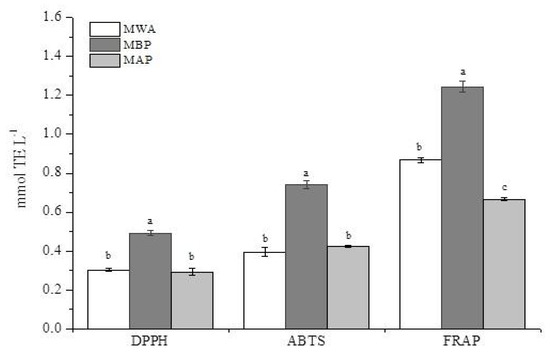
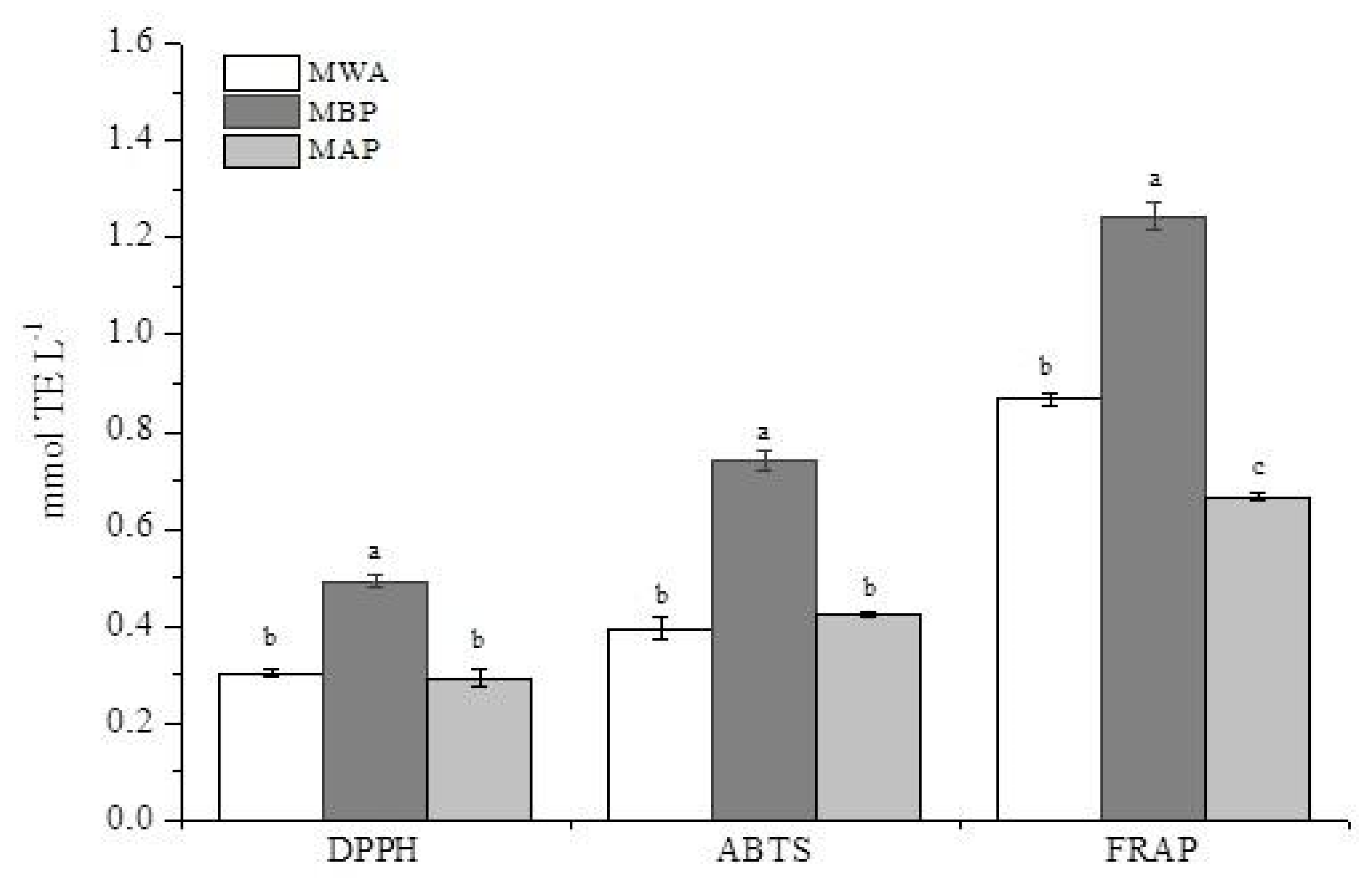
The antioxidant activity of the meads was estimated using three in vitro assays (Figure 1). These methods are based on distinct but complementary mechanisms, including free radical scavenging (DPPH and ABTS) and ferric ion reduction (FRAP), which together provide a comprehensive assessment of antioxidant potential. Using the DPPH, ABTS, and FRAP assays, the antioxidant activity of the meads ranged from 0.294 to 0.493 mmol L−1 TE, 0.395 to 0.743 mmol L−1 TE, and 0.667 to 1.245 mmol L−1 TE, respectively. The superior antioxidant activity observed in all tests for the pollen-enriched mead (MBP) is attributed to its higher TPC and elevated contents of phenolic acids, flavonols, and flavanols, which are bioactive compounds known for their ability to donate electrons or hydrogen atoms and stabilize reactive species. Consistent with these findings, Kawa-Rygielska et al. [2] reported that mead produced with the addition of grape seeds exhibited antioxidant activity values comparable to those observed for the MBP mead using the DPPH and FRAP methods [38]. Therefore, the incorporation of bee pollen represents an effective strategy to enhance the concentration of phenolic compounds in meads, and consequently, their antioxidant capacity.
Figure 1.
In vitro antioxidant activity of meads produced from Apis mellifera honey and fermented with wild yeasts and different sources of nitrogen. Different letters indicate significant differences among the samples according to Tukey’s test (p ≤ 0.05). Caption: MWA = fermented mead without a nutrient source for the wild yeasts. MBP = fermented mead with the addition of 30 g L−1 of bee pollen as a natural nutrient source for the wild yeasts. MAP = fermented mead with the addition of 0.4 g L−1 of a commercial fermentation activator (Gesferm Plus, composed of ammonium phosphate, B vitamins, and cellulose) as an artificial nutrient source for the fermentation of wild yeasts. TE = Trolox equivalent.
3.5. Principal Component Analysis (PCA)
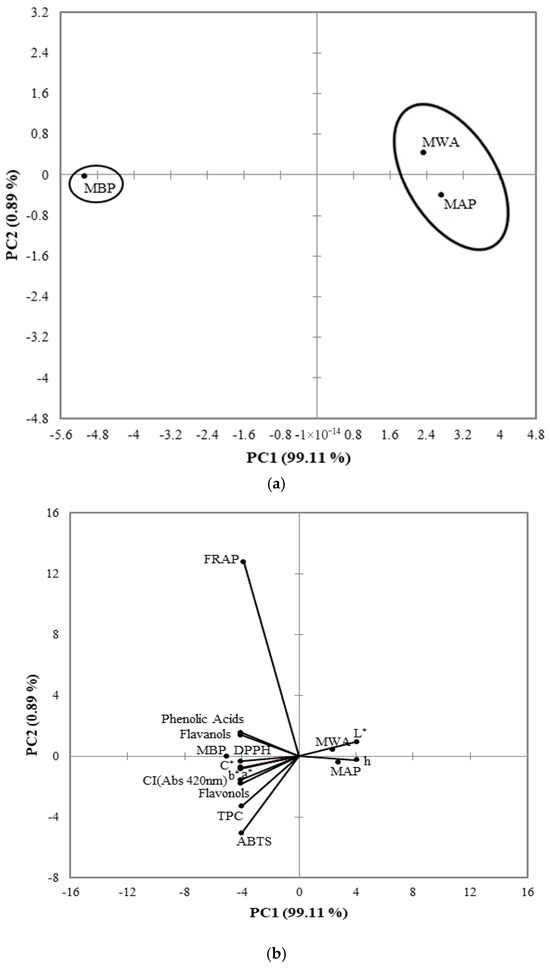
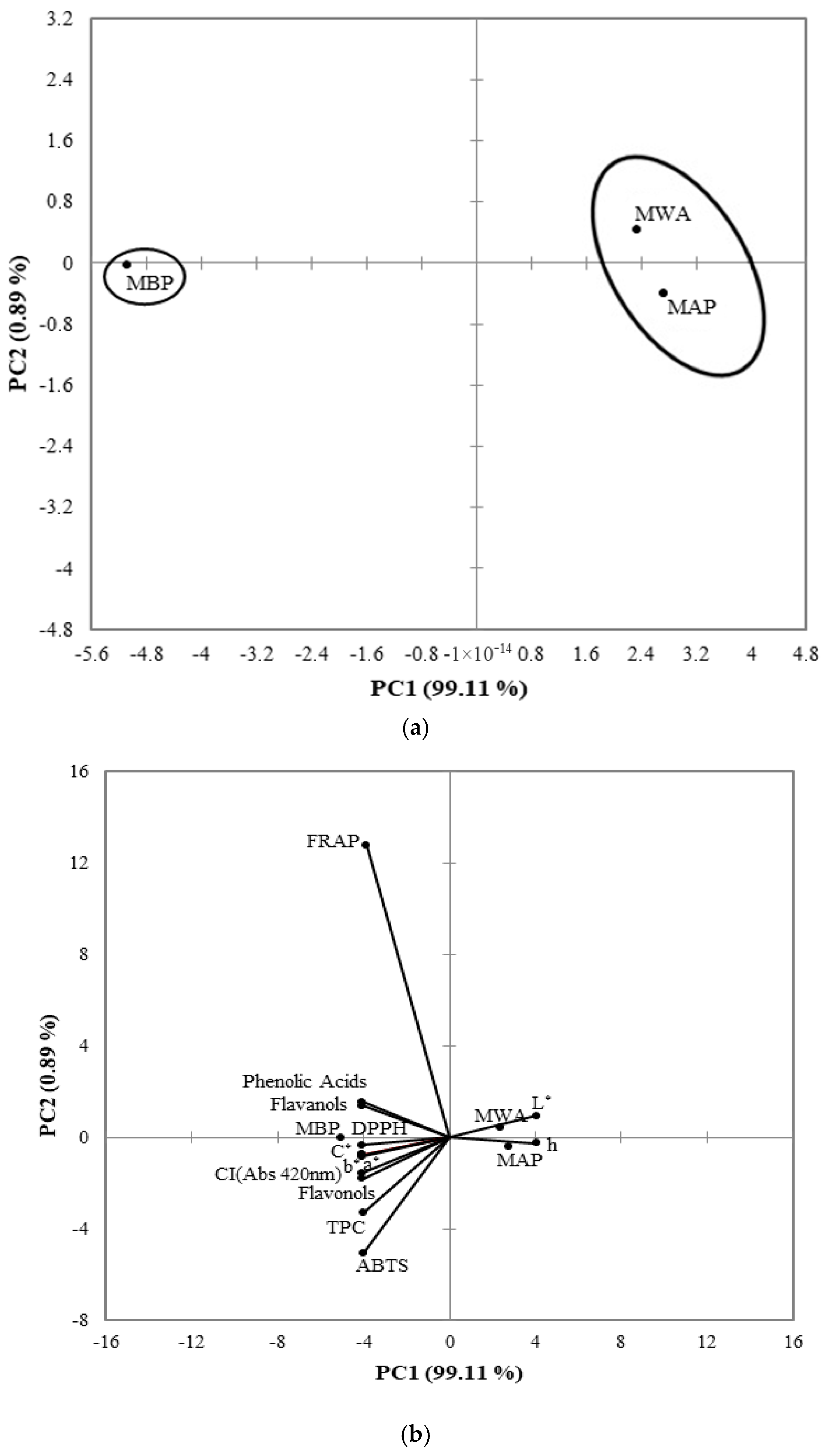
PCA was used to differentiate the meads based on their phenolic profile, antioxidant activity, and color. The first two principal components explained 100.00% of the total variation, with 99.11% explained by PC1 and 0.89% by PC2. The proximity of the MWA and MAP meads in Figure 2a indicates that these samples were most similar in terms of phenolic content, antioxidant capacity, and color, whereas the MBP sample was clearly different from them. Accordingly, the mead samples were primarily distinguished along PC1, which reflects compositional differences, forming two groups clearly differentiated by the addition of bee pollen as a nitrogen source for the wild yeasts. The MBP mead (Figure 2b) exhibited the highest values of TPC, total phenolic acids, total flavanols, total flavonols, antioxidant activity (measured by DPPH, ABTS, and FRAP assays), color intensity at 420 nm (CI), and the C*, a*, and b* parameters.
Figure 2.
Principal component analysis obtained from the evaluation of phenolic compounds, antioxidant capacity, and color in meads produced from Apis mellifera honey and fermented with wild yeasts and different sources of nitrogen. (a) Graph showing the scores of the mead samples, and (b) graph showing the loadings of the variables. Captions: MWA = fermented mead without a nutrient source for the wild yeasts. MBP = fermented mead with the addition of 30 g L−1 of bee pollen as a natural nutrient source for the wild yeasts. MAP = fermented mead with the addition of 0.4 g L−1 of a commercial fermentation activator (Gesferm Plus, composed of ammonium phosphate, B vitamins, and cellulose) as an artificial nutrient source for the fermentation of wild yeasts. TPC = total phenolic compounds. CI = color intensity.
4. Limitations
This study presents several limitations that should be considered when interpreting the results and extrapolating the findings beyond the experimental conditions. First, mead production was conducted using a single type of Apis mellifera honey originating from the Brazilian Caatinga biome and a single commercial bee pollen source. Because the chemical composition of both honey and pollen is strongly influenced by botanical and geographical origin, the observed effects on fermentation performance, phenolic compound profile, and antioxidant capacity may not be directly generalizable to other honeys and/or bee pollen sources. In addition, the experiment was conducted at a laboratory scale, which may differ from industrial-scale production in terms of oxygen transfer, temperature gradients, and process stability. Furthermore, only one concentration of bee pollen was evaluated, which restricts the scope of the conclusions.
Another limitation of this study is the lack of identification of the indigenous yeast population. The authors acknowledge that the characterization of wild yeasts in the honey could provide additional information regarding microbial diversity. However, the primary objective of the present study was to evaluate mead obtained through spontaneous fermentation, rather than to perform microbial identification. Moreover, variations in native microbiota may significantly affect fermentation kinetics and metabolite production, thereby limiting the reproducibility of the results under different processing conditions.
An additional limitation is the relatively short storage period of the mead bottles prior to analysis (30 days). Potential changes in phenolic composition, physicochemical properties, sensory characteristics, pollen colloidal stability, and antioxidant capacity during extended aging were not evaluated and may influence the long-term quality and functional potential of the product.
Finally, the antioxidant potential of the meads was inferred based on in vitro assays without in vivo validation. Therefore, the bioavailability of phenolic compounds remains to be investigated.
5. Conclusions
The results revealed that spontaneous fermentation can successfully produce mead with relevant phenolic composition and antioxidant potential, reinforcing the technological feasibility of minimally processed fermentative systems.
Bee pollen supplementation acted as a multifunctional ingredient, simultaneously improving fermentation performance and enhancing the bioactive composition of mead. In addition to shortening spontaneous alcoholic fermentation time, bee pollen significantly increased the concentration of phenolic compounds and the in vitro antioxidant capacity of the beverage. The enrichment of mead with compounds such as quercetin-3-β-D-glucoside and trans-caftaric acid, together with the exclusive detection of isorhamnetin-3-O-glucoside, myricetin, and (−)-epicatechin gallate in pollen-supplemented samples, highlights the important contribution of bee pollen to the phenolic and functional complexity of mead. In this context, the term “bioactive ingredient” refers to the enrichment of the beverage with compounds associated with antioxidant activity, without implying any specific health claim.
Overall, the findings indicate that bee pollen represents a promising natural alternative to commercial fermentation additives, contributing to improved fermentative efficiency while meeting the growing consumer demand for naturally fermented beverages with higher added value and enhanced bioactive composition. Furthermore, this study contributes to the advancement of knowledge regarding spontaneous mead fermentation, particularly for products derived from Apis mellifera honey produced in the Caatinga biome, an ecosystem still poorly explored in fermented beverage research.
Future studies should focus on the identification of wild yeasts associated with Apis mellifera honey from the Caatinga biome, aiming to elucidate the role of indigenous microbiota and bee pollen interactions in fermentation dynamics, phenolic compound biotransformation, aroma development, sensory profile modulation, and mead typicity.
Author Contributions
Conceptualization, C.B.d.N.d.T.A. and A.C.T.B.; methodology, C.B.d.N.d.T.A. and A.C.T.B.; software, C.B.d.N.d.T.A., R.T.d.S.e.S., E.S.d.B. and A.C.T.B.; formal analysis, A.C.T.B. and R.T.d.S.e.S.; investigation, C.B.d.N.d.T.A., E.S.d.B., L.H.P.d.S.T. and R.T.d.S.e.S.; resources, M.d.F.R., F.d.M.P., A.C.T.B. and C.O.d.S.; data curation, C.B.d.N.d.T.A. and A.C.T.B.; writing—original draft preparation, C.B.d.N.d.T.A. and P.B.; writing—review and editing, A.C.T.B., P.B. and C.B.d.N.d.T.A.; visualization, C.B.d.N.d.T.A. and R.T.d.S.e.S.; supervision, A.C.T.B. and M.d.F.R. All authors have read and agreed to the published version of the manuscript.
Funding
This research received no external funding.
Institutional Review Board Statement
Not applicable.
Informed Consent Statement
Not applicable.
Data Availability Statement
The datasets presented in this article are not readily available because data are part of an ongoing study. Requests to access the datasets should be directed to aline.biasoto@embrapa.br.
Acknowledgments
The authors would like to acknowledge Embrapa and the Federal University of Bahia for the use of the laboratory and the donations of all materials.
Conflicts of Interest
The authors declared no potential conflicts of interest with respect to the research, authorship and/or publication of this article.
References
- Roldán, A.; Van Muiswinkel, G.C.J.; Lasanta, C.; Palacios, V.; Caro, I. Influence of pollen addition on mead elaboration: Physicochemical and sensory characteristics. Food Chem. 2011, 126, 574–582. [Google Scholar] [CrossRef] [Scilit]
- Kawa-Rygielska, J.; Adamenko, K.; Kucharska, A.Z.; Szatkowska, K. Fruit and herbal meads—Chemical composition and antioxidant properties. Food Chem. 2019, 283, 19–27. [Google Scholar] [CrossRef] [Scilit] [PubMed]
- Socha, R.; Pająk, P.; Fortuna, T.; Buksa, K. Phenolic Profile and Antioxidant Activity of Polish Meads. Int. J. Food Prop. 2015, 18, 2713–2725. [Google Scholar] [CrossRef] [Scilit]
- Iglesias, A.; Pascoal, A.; Choupina, A.B.; Carvalho, C.A.; Feás, X.; Estevinho, L.M. Developments in the fermentation process and quality improvement strategies for mead production. Molecules 2014, 19, 12577–12590. [Google Scholar] [CrossRef] [Scilit] [PubMed]
- Mendes-Ferreira, A.F.; Cosme, A.C.; Barbosa, A.V.; Falco, B.A.; Inês, A.; Mendes-Faia, A. Optimization of honey-must preparation and alcoholic fermentation by Saccharomyces cerevisiae for mead production. Int. J. Food Microbiol. 2010, 144, 193–198. [Google Scholar] [CrossRef] [Scilit] [PubMed]
- Mead Market Size, Share, Growth, and Industry Analysis, By Type (Herbs Type, Spices Type, Fruits Type), By Application (Convenience Store, Supermarket and Hypermarket, Bars, Others), Regional Insights and Forecast to 2035. Available online: https://www.industryresearch.biz/market-reports/mead-market-111094 (accessed on 10 March 2026).
- Webster, C.E.; Barker, D.; Deed, R.C.; Pilkington, L.I. Mead production and quality: A review of chemical and sensory mead quality evaluation with a focus on analytical methods. Food Res. Int. 2025, 202, 115655. [Google Scholar] [CrossRef] [Scilit]
- Corbo, M.R.; Bevilacqua, A.; Petruzzi, L.; Casanova, F.P.; Sinigaglia, M. Functional Beverages: The Emerging Side of Functional Foods. Compr. Rev. Food Sci. Food Saf. 2014, 13, 1192–1206. [Google Scholar] [CrossRef] [Scilit]
- Švecová, B.; Bordovská, M.; Kalvachová, D.; Hájek, T. Analysis of Czech meads: Sugar content, organic acids content and selected phenolic compounds content. J. Food Compos. Anal. 2015, 38, 80–88. [Google Scholar] [CrossRef] [Scilit]
- Kostić, A.Ž.; Milinčić, D.D.; Barać, M.B.; Shariati, M.A.; Tešić, Ž.L.; Pešić, M.B. The Application of Pollen as a Functional Food and Feed Ingredient—The Present and Perspectives. Biomolecules 2020, 10, 84. [Google Scholar] [CrossRef] [Scilit]
- El Ghouizi, A.; Bakour, M.; Laaroussi, H.; Ousaaid, D.; El Menyiy, N.; Hano, C.; Lyoussi, B. Bee Pollen as Functional Food: Insights into Its Composition and Therapeutic Properties. Antioxidants 2023, 12, 557. [Google Scholar] [CrossRef] [Scilit]
- AOAC. Official Methods of Analysis of AOAC International, 22nd ed.; AOAC International: Gaithersburg, MD, USA, 2023. [Google Scholar]
- Salfinger, Y.; Tortorello, M.L. (Eds.) Compendium of Methods for the Microbiological Examination of Foods, 5th ed.; American Public Health Association/APHA Press: Washington, DC, USA, 2015. [Google Scholar]
- Czabaj, S.; Kawa-Rygielska, J.; Kucharska, A.; Kliks, J. Effects of Mead Wort Heat Treatment on the Mead Fermentation Process and Antioxidant Activity. Molecules 2017, 22, 803. [Google Scholar] [CrossRef] [Scilit]
- OIV. Compendium of International Methods of Wine and Must Analysis, 2023rd ed.; International Organisation of Vine and Wine: Dijon, France, 2023. [Google Scholar]
- Miller, G.L. Use of Dinitrosalicylic Acid Reagent for Determination of Reducing Sugar. Anal. Chem. 1959, 31, 426–428. [Google Scholar] [CrossRef] [Scilit]
- Natividade, M.M.P.; Corrêa, L.C.; Souza, S.V.C.; Pereira, G.E.; Lima, L.C.O. Simultaneous analysis of 25 phenolic compounds in grape juice for HPLC: Method validation and characterization of São Francisco Valley samples. Microchem. J. 2013, 110, 665–674. [Google Scholar] [CrossRef] [Scilit]
- Costa, R.R.; Rodrigues, A.A.M.; De Vasconcelos, V.A.F.; Costa, J.P.D.; De Lima, M.A.C. Trellis systems, rootstocks and season influence on the phenolic composition of ‘Chenin Blanc’ grape. Sci. Agric. 2020, 77, e20180207. [Google Scholar] [CrossRef] [Scilit]
- Singleton, V.L.; Rossi, J.A. Colorimetry of Total Phenolic Compounds with Phosphomolybdic-Phosphotungstic Acid Reagents. Am. J. Enol. Vitic. 1965, 16, 144–158. [Google Scholar] [CrossRef] [Scilit]
- Brand-Williams, W.; Cuvelier, M.E.; Berset, C. Use of a free radical method to evaluate antioxidant activity. LWT—Food Sci. Technol. 1995, 28, 25–30. [Google Scholar] [CrossRef] [Scilit]
- Re, R.; Pellegrini, N.; Proteggente, A.; Pannala, A.; Yang, M.; Rice-Evans, C. Antioxidant activity applying an improved ABTS radical cation decolorization assay. Free Radic. Biol. Med. 1999, 26, 1231–1237. [Google Scholar] [CrossRef] [Scilit] [PubMed]
- Lima, M.D.S.; Silani, I.D.S.V.; Toaldo, I.M.; Corrêa, L.C.; Biasoto, A.C.T.; Pereira, G.E.; Bordignon-Luiz, M.T.; Ninow, J.L. Phenolic compounds, organic acids and antioxidant activity of grape juices produced from new Brazilian varieties planted in the Northeast Region of Brazil. Food Chem. 2014, 161, 94–103. [Google Scholar] [CrossRef] [Scilit] [PubMed]
- Benzie, I.F.F.; Strain, J.J. The Ferric Reducing Ability of Plasma (FRAP) as a Measure of ‘‘Antioxidant Power’’: The FRAP Assay. Anal. Biochem. 1996, 239, 70–76. [Google Scholar] [CrossRef] [Scilit] [PubMed]
- Thaipong, K.; Boonprakob, U.; Crosby, K.; Cisneros-Zevallos, L.; Byrne, D.H. Comparison of ABTS, DPPH, FRAP, and ORAC assays for estimating antioxidant activity from guava fruit extracts. J. Food Compos. Anal. 2006, 19, 669–675. [Google Scholar] [CrossRef] [Scilit]
- Wintersteen, C.L.; Andrae, L.M.; Engeseth, N.J. Effect of heat treatment on antioxidant capacity and flavor volatiles of mead. J. Food Sci. 2005, 70, 119–126. [Google Scholar] [CrossRef] [Scilit]
- Starowicz, M.; Granvogl, M. Trends in food science & technology an overview of mead production and the physicochemical, toxicological, and sensory characteristics of mead with a special emphasis on flavor. Trends Food Sci. Technol. 2020, 106, 402–416. [Google Scholar] [CrossRef] [Scilit]
- Sroka, P.; Satora, P. The influence of hydrocolloids on mead wort fermentation. Food Hydrocoll. 2017, 63, 233–239. [Google Scholar] [CrossRef] [Scilit]
- Akalin, H.; Bayram, M.; Anli, R.E. Determination of some individual phenolic compounds and antioxidant capacity of mead produced from different types of honey. J. Inst. Brew. 2017, 123, 167–174. [Google Scholar] [CrossRef] [Scilit]
- Martín, J.J.D.; Andrés-Lacueva, C.; Diaz-Romero, C.; Lamuela-Raventós, R.M. Phenolic profile in varietal White wines made in the Canary Islands. Eur. Food Res. Technol. 2008, 226, 871–876. [Google Scholar] [CrossRef] [Scilit]
- Amores-Arrocha, A.; Roldán, A.; Jiménez-Cantizano, A.; Caro, I.; Palacios, V. Evaluation of the use of multiflora bee pollen on the volatile compounds and sensorial profile of Palomino fino and Riesling white young wines. Food Res. Int. 2018, 105, 197–209. [Google Scholar] [CrossRef] [Scilit]
- Nascimento, K.S.; Sattler, J.A.G.; Macedo, L.F.L.; González, C.V.S.; Melo, I.L.P.; Araújo, E.S.; Granato, D.; Sattler, A.; Almeida-Muradian, L.B. Phenolic compounds, antioxidant capacity and physicochemical properties of Brazilian Apis mellifera honeys. LWT—Food Sci. Technol. 2018, 91, 85–94. [Google Scholar] [CrossRef] [Scilit]
- Silva, P.M.; Gauche, C.; Gonzaga, L.V.; Costa, A.C.O.; Fett, R. Honey: Chemical composition, stability and authenticity. Food Chem. 2016, 196, 309–323. [Google Scholar] [CrossRef] [Scilit]
- Rzepecka-Stojko, A.; Stojko, J.; Kurek-Górecka, A.; Górecki, M.; Kabała-Dzik, A.; Kubina, R.; Moździerz, A.; Buszman, E. Polyphenols from bee pollen: Structure, absorption, metabolism and biological activity. Molecules 2015, 20, 21732–21749. [Google Scholar] [CrossRef] [Scilit]
- Gutiérrez-Escobar, R.; Aliaño-González, M.J.; Cantos-Villar, E. Wine polyphenol content and its influence on wine quality and properties: A review. Molecules 2021, 26, 718. [Google Scholar] [CrossRef] [Scilit] [PubMed]
- Ćorković, I.; Pichler, A.; Šimunović, J.; Kopjar, M. A comprehensive review on polyphenols of white wine: Impact on wine quality and potential health benefits. Molecules 2024, 29, 5074. [Google Scholar] [CrossRef] [Scilit] [PubMed]
- Kahoun, D.; Řezková, S.; Veškrnová, K.; Královský, J.; Holčapek, M. Determination of phenolic compounds and hydroxymethylfurfural in meads using high performance liquid chromatography with coulometric-array and UV detection. J. Chromatogr. A 2008, 1202, 19–33. [Google Scholar] [CrossRef] [Scilit] [PubMed]
- Motilva, M.J.; Macià, A.; Romero, M.P.; Rubió, L.; Mercader, M.; González-Ferrero, C. Human bioavailability and metabolism of phenolic compounds from red wine enriched with free or nano-encapsulated phenolic extract. J. Funct. Foods 2016, 25, 80–93. [Google Scholar] [CrossRef] [Scilit]
- Paixão, N.; Perestrelo, R.; Marques, J.C.; Câmara, J.S. Relationship between antioxidant capacity and total phenolic content of red, rosé and white wines. Food Chem. 2007, 105, 204–214. [Google Scholar] [CrossRef] [Scilit]

Disclaimer/Publisher’s Note: The statements, opinions and data contained in all publications are solely those of the individual author(s) and contributor(s) and not of MDPI and/or the editor(s). MDPI and/or the editor(s) disclaim responsibility for any injury to people or property resulting from any ideas, methods, instructions or products referred to in the content. |
© 2026 by the authors. Licensee MDPI, Basel, Switzerland. This article is an open access article distributed under the terms and conditions of the Creative Commons Attribution (CC BY) license.