
Sustainability 2026, 18(17), 8847; https://doi.org/10.3390/su18178847 (registering DOI) - 28 Aug 2026
Abstract
The transition towards a circular economy is widely expected to reduce dependence on primary resources, yet higher levels of circularity do not necessarily translate into proportional reductions in absolute material use. This study investigates the relationship between circular material use and dematerialization across
[...] Read more.
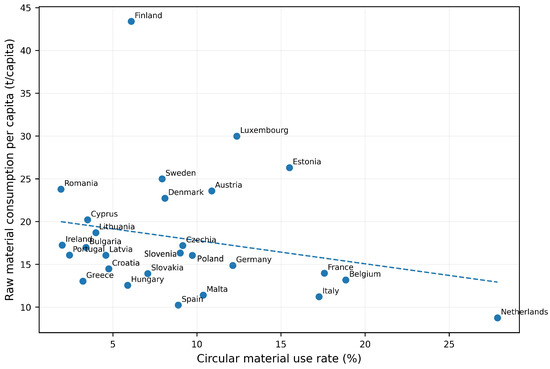
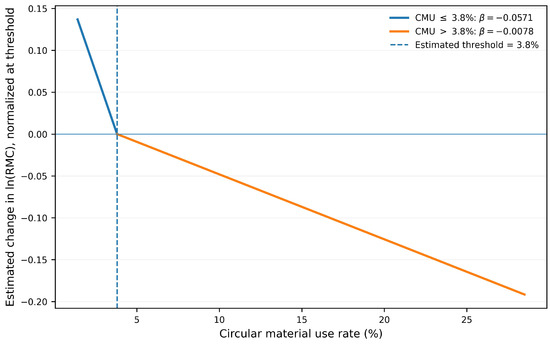
The transition towards a circular economy is widely expected to reduce dependence on primary resources, yet higher levels of circularity do not necessarily translate into proportional reductions in absolute material use. This study investigates the relationship between circular material use and dematerialization across the EU-27 over the period 2010–2024, with particular attention to whether this relationship remains constant at different levels of circularity. Using Eurostat data, the empirical analysis combines descriptive statistics with linear panel regression models and nonlinear threshold regression. Domestic material consumption (DMC) and raw material consumption (RMC) are employed as complementary indicators of material use. The results indicate that higher circular material use is associated with lower material consumption after controlling for country-specific heterogeneity and common time effects. However, this relationship is not constant across different levels of circularity. The threshold analysis identifies a significant nonlinear relationship for RMC, showing that the negative association between circularity and material use is substantially stronger at lower levels of circularity and weakens as circularity increases. A robustness analysis using DMC reveals a similar regime-dependent pattern, although the statistical evidence for threshold nonlinearity is weaker. These findings do not provide evidence of a circular economy rebound effect in the strict sense but instead suggest diminishing marginal dematerialization effects as circularity advances. Overall, the results indicate that increasing circularity remains an important component of sustainable resource management but is unlikely to achieve substantial reductions in absolute material use without complementary structural changes. Circular economy policies should therefore combine material recirculation with measures promoting resource-efficient design, product longevity, reuse, and reductions in overall material demand.
Full article
(This article belongs to the Special Issue Circular Economy and Green Technology for Sustainable Development)
►
Show Figures
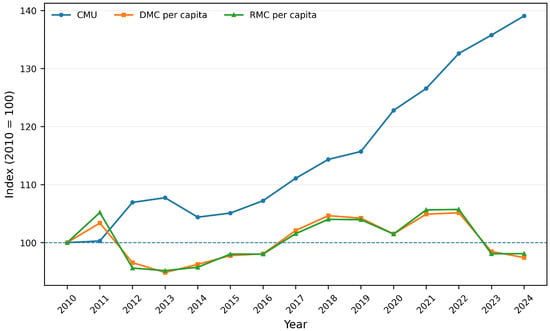
Figure 1