
 Open Access
 - Article

19 Pages
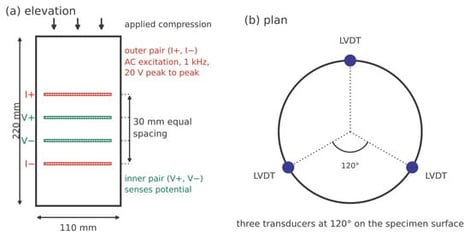
The loading sensitivity of a self-sensing cementitious composite depends on the stress amplitude at which it is measured. That dependence is established, but its consequence for the protocol used to obtain the sensitivity has not been examined. Conventional protocols apply a few cycles at ascending amplitude levels, so the between-level component of cycle number is fixed by amplitude. The present study treats this as an identification problem: only the within-level repeated information can inform a cycle trend, and the data cannot identify a general cycle-history effect independently of amplitude. Three multi-walled carbon nanotube concrete cylinders of identical composition, one for each conditioning history, were investigated using a four-probe alternating-current method at 1 kHz under a three-level stepped-amplitude protocol in two loading variants, then loaded monotonically to failure. Across the six cyclic records, the correlation between cycle number and peak stress is r = 0.87 to 0.90, and 60% to 92% of the variance in loading sensitivity lies between amplitude levels rather than within them. With amplitude held fixed, within-level slopes are small and inconsistent in sign; however, three cycles per level cannot establish that a cycle effect is absent. Sensitivity magnitude falls between the middle and highest amplitude blocks in all six records, at 2.3 to 11.2 standard errors of the difference, three of which exceed their comparison-specific Welch critical value. At the lower amplitude step, the largest resolved difference is 0.673%/MPa in the continuous record of C1, whereas the partially saturated C2 records show no resolvable difference. Because amplitude and block order advance together under this protocol, these are differences among amplitude blocks and are not attributed to amplitude in isolation. The moisture-related pattern is an association across three individual specimens, not a replicated moisture effect. Monotonic loading provides a within-specimen extrapolation demonstration under the selected response family, not independent predictive validation. An experimental design with fixed-amplitude replication and a nominal precision calculation is specified.
Sensors
8 October 2026