Skip to Content
  • 3.6
    Impact Factor
  • 5.3
    CiteScore
  • 25 days
    Submission to First Decision
  • 5 days
    Acceptance to Publication

Scientia Pharmaceutica

Scientia Pharmaceutica is an international, peer-reviewed, open access journal related to the pharmaceutical sciences, published quarterly online. It is the official journal of the Austrian Pharmaceutical Society (ÖPhG). Society members receive discounts on the article processing charges.

Get Alerted

Add your email address to receive forthcoming issues of this journal.

All Articles (1,690)

  • Article
  • Open Access

Andrographolide (Ang) is a bioactive diterpenoid whose bioaccessibility may be circumstantially limited by low pharmaceutical availability and proneness to chemical decomposition. This study investigated the impact of selected drug delivery systems (polymeric, lipid-based, and hybrid carriers) and intermediates in their preparation (e.g., relevant solvents and excipients) on Ang’s solubility and structural integrity. Nonlinear regression was used to fit zero-, first-, and second-order kinetic models to the degradation data. An expedient HPLC method was proposed for the simultaneous identification and quantification of Ang and 14-deoxyandrographolide (14-deoxyAng; a related impurity of Ang) in the test formulations, while an UV–Vis spectrophotometric procedure was elaborated as an alternative assay, where eligible. Ang appeared to be very slightly soluble in water, with a saturation point of 0.100 ± 0.002 mg/mL at 25 °C. Among the excipients, chitosan 0.5% (w/v) and λ-carrageenan 0.1% (w/v) yielded the highest increase in the compound’s apparent solubility (by 2.35-fold and 1.74-fold, respectively), whereas poloxamer 407, in contrast, did not demonstrate a solubilizing effect. Stability was strongly influenced by the pH of the surrounding environment, being greatest under the acidic conditions of an acetic acid 1% (v/v) intermediate (pH 3.0) and lowest under the alkaline conditions of a phosphate donor intermediate (pH 8.0). A hybrid system of chitosan-stabilized lipid vesicles exhibited the greatest potential for Ang stabilization, exceeding the corresponding features of non-modified vesicular carriers and solely chitosan nanoparticles. These results highlight the importance of considering drug stability and solubility along with carrier choice and provide a basis for further optimization and characterization of Ang delivery systems.

Sci. Pharm.

24 November 2026

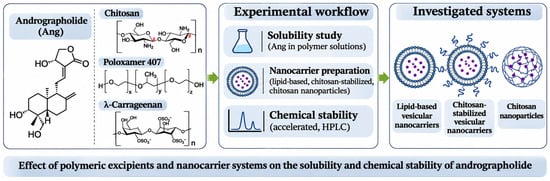
Schematic representation of the investigated materials, nanocarrier systems, and experimental approach for evaluating andrographolide (Ang) solubility and chemical stability. The figure was conceptualized by the authors and visually refined with the assistance of ChatGPT (OpenAI, GPT-6).
  • Article
  • Open Access

The dual-specificity tyrosine-regulated kinase 1A (DYRK1A) is implicated in numerous neuropathologies and cancers, yet its in vivo role in these diseases remains poorly understood. As no DYRK1A radiotracer has been reported to date, DYRK1A PET imaging would constitute a valuable tool to map its distribution in vivo. We selected the thiazolo[5,4-f]quinazoline imidate EHT1610, a highly potent DYRK1A inhibitor previously described by our group, as a radiotracer candidate. An innovative carbon-11 labeling strategy was developed from the cyanophenol precursor 3, combining in a single step O-11C-methylation with in situ formation of the imidate function. The automated radiosynthesis afforded [11C]EHT1610 in 22 ± 4% radiochemical yield (n = 8) within 60 min, with radiochemical and chemical purities above 98% and a molar activity of 118 ± 19 GBq/µmol. In healthy rats, [11C]EHT1610 underwent moderate radiometabolization in plasma and liver, contrasting with a much slower metabolism in the brain. However, brain uptake remained negligible, detectable only by ex vivo counting and not by imaging. Comparison of healthy and transgenic rats revealed significant uptake differences in the lung and heart. Beyond this novel radiochemistry, this study provides the first insight into potential in vivo DYRK1A distribution, although further radiotracer optimization is required.

Sci. Pharm.

24 November 2026

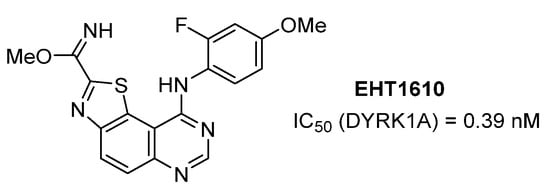
Chemical structure of methyl 9-[(2-fluoro-4-methoxyphenyl)amino]thiazolo-[5,4-f]quinazoline-2-carbimidate (EHT1610), used as a reference DYRK1A inhibitor.
  • Review
  • Open Access

Medicated Chewing Gums: Development Challenges and Expansion of SeDeM-MCG-Based Preformulation Screening

  • Svetlana I. Kosenkova,
  • Artemiy K. Shulchenko and
  • Elena O. Bakhrushina
  • + 5 authors

Medicated chewing gums (MCGs) are a promising dosage form for systemic and local delivery of active substances; however, their development is complicated by an underdeveloped regulatory framework and the absence of systematic preformulation approaches. In this review, we present a critical analysis of 42 original studies from 2005 to 2026 devoted to the design, technology, and standardization of MCGs. It is shown that pharmacopeial tests, including the “Dissolution” test, exhibit limited predictive ability due to the use of standardized mechanical parameters and buffer media that do not account for the enzymatic activity of saliva, variability of chewing forces, and mucosal adsorption. It was revealed that the choice of manufacturing method (direct compression or melting) determines structural–mechanical properties and release kinetics, with direct compression being preferable for hydrophilic thermolabile compounds and melting favored for lipophilic ones. A reliable in vitro–in vivo correlation is lacking, which is associated with systematic discrepancies in testing conditions. To bridge the methodological gap, a hypothetical expanded SeDeM-MCG-based preformulation assessment system is proposed, including three additional parameters: the granulometric compatibility index (Δd), elastic recovery index (ERI), and wetting contact angle (θ). Preliminary threshold values for the parameters are substantiated by data from the literature; however, their universality requires mandatory experimental validation. This review can serve as a conceptual foundation for developers of MCGs and for planning experimental studies to verify the proposed criteria.

Sci. Pharm.

23 November 2026

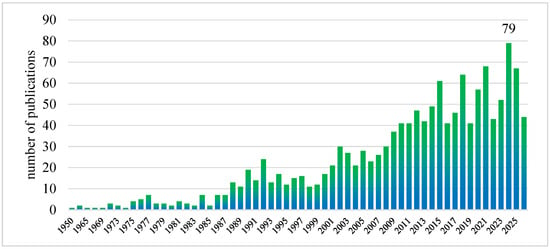
Number of publications according to PubMed data for the query “Medicated Chewing Gums” (date of access 20 September 2026).
  • Article
  • Open Access

Ex vivo human skin explant culture preserves the structural and cellular complexity of native skin, offering a pharmacologic relevant model for investigating cutaneous responses under controlled conditions. This study aimed to establish a multi-parameter platform for integrated evaluation of skin responses to environmental stressors and topical interventions. Full-thickness human skin explants were maintained under survival culture and challenged with particulate matter (PM10) and UV-A irradiation. A topical active mixture (1-LGVTY) was applied to assess modulation of tissue responses. Biomarkers were selected to reflect key dimensions of skin homeostasis, including oxidative stress, inflammation, extracellular matrix remodeling, CD44-related cell–matrix interactions, pigmentation, and antimicrobial defenses. Endpoints were evaluated by immunohistology, image analysis, and biochemical assays. Environmental exposure was associated with consistent alterations in inflammatory and structural markers. Treatment with 1-LGVTY in our protocol was associated with attenuation of several stress-induced changes and with changes in selected markers related to tissue integrity and immune function. The integrated biomarker panel enabled simultaneous assessment across multiple skin compartments. This study supports the potential of human skin explants as an integrated, physiologically relevant model for the exploratory evaluation of skin responses and topical bioactivity. The approach provides an integrated, multi-parameter view beyond single biomarkers and may, with further validation, serve as a scalable platform for exploratory efficacy assessment, particularly when expanded to include multiple donors and broader readouts.

Sci. Pharm.

22 November 2026

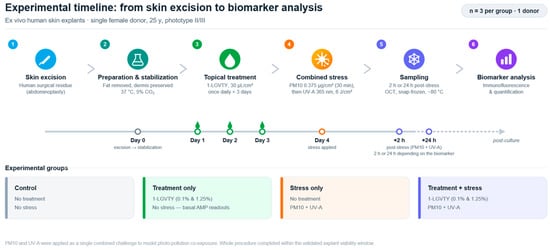
Overview of the experimental timeline. Full-thickness human skin explants from a single donor (female, 25 y, phototype II/III) were prepared from surgical residue, stabilized in survival culture (37 °C, 5% CO2), then treated topically with 1-LGVTY (30 µL/cm2, once daily for 3 consecutive days). On day 4, explants were exposed to a combined PM10 + UV-A challenge (urban dust, 0.375 µg/cm2, 30 min contact, followed by UV-A, 365 nm, 6 J/cm2) and sampled at 2 h and 24 h post-irradiation for cryopreservation (OCT, −80 °C) and biomarker analysis by immunofluorescence. Four experimental groups (n = 3 per condition). AMP, antimicrobial peptide.

Highly Accessed Articles

News & Conferences

Latest Issues

Open for Submission

Journal Sections

XFacebookLinkedIn
Sci. Pharm. - ISSN 2218-0532