
 Open Access
 - Article

31 Pages
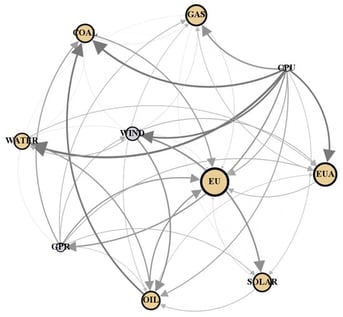
This paper employs the established time-varying parameter vector autoregressive connectedness framework (TVP-VAR-DY) based on generalized forecast error variance decomposition (GFEVD) to characterize the nonlinear, time-dependent risk spillover network linking carbon and multi-sector energy financial assets. Our core empirical contribution is to integrate three distinct categories of uncertainty risks with a 10-dimensional carbon-energy financial system in a unified analytical framework. We construct a 10-dimensional stochastic financial system comprising EUA carbon futures, fossil energy commodity futures (crude oil, natural gas, coal), and clean energy equity indices (wind, solar, hydropower). By utilizing monthly logarithmic return stationary time series spanning 2011–2025, we perform numerical estimations of static connectedness matrices, dynamic total spillover indices, directional pairwise spillover networks, and net risk transmission metrics under three distinct multidimensional uncertainty risk factors: geopolitical risk (GPR), economic policy uncertainty (EPU), and climate policy uncertainty (CPU). The empirical results show three key findings. First, spillover effects of multidimensional uncertainty risks exhibit heterogeneous patterns: climate policy uncertainty acts as the primary risk transmitter, followed by geopolitical risk, while economic policy uncertainty exerts weaker and mostly indirect transmission. External uncertainties (climate policy and geopolitical risks) are associated with spillover effects between carbon and energy markets far more strongly than endogenous uncertainties, and extreme events coincide with structural surges in total spillover magnitude. Second, carbon markets function as an intermediary bridge in risk transmission: they absorb upstream uncertainty spillovers and propagate volatility to all energy subsectors, gradually evolving from net risk receivers to neutral market participants alongside improved climate governance frameworks. Third, different shock types generate distinct spillover patterns: sudden emergencies are linked to rapid, large-magnitude yet short-lived spillovers, whereas policy-driven shocks exert stable, persistent impacts; policy factors play a pivotal guiding role in market volatility and the energy transition. This study integrates three categories of uncertainty into a unified analytical framework, clarifies differentiated risk response logics across energy segments via quantitative network analysis, and provides empirical evidence and quantitative references for global climate governance and cross-market risk supervision.
Mathematics
18 October 2026