
Skip to Content
  • 9.8
    CiteScore
  • 24 days
    Submission to First Decision
  • 4 days
    Acceptance to Publication

International Journal of Environmental Research and Public Health

International Journal of Environmental Research and Public Health (IJERPH) is a transdisciplinary, peer-reviewed, open access journal that covers global health, healthcare sciences, behavioral and mental health, infectious diseases, chronic diseases and disease prevention, exercise and health related quality of life, environmental health and environmental sciences, and is published monthly online by MDPI. The International Society Doctors for the Environment (ISDE), Italian Society of Environmental Medicine (SIMA) and Environmental Health Association of Québec (ASEQ‑EHAQ) are affiliated with IJERPH and their members receive discounts on the article processing charges.

Get Alerted

Add your email address to receive forthcoming issues of this journal.

All Articles (66,842)

  • Systematic Review
  • Open Access

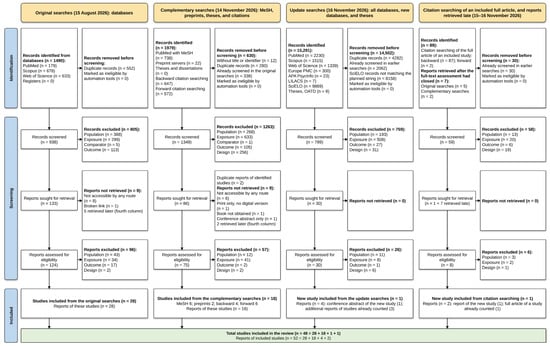
Older adults’ sleep reports often diverge from objective recordings. This systematic review examined whether this subjective–objective sleep discrepancy (SOSD) is associated with cognition. PubMed, Scopus, and Web of Science were searched on 15 August 2026, with complementary searches on 14 November 2026 and an update on 16 November 2026 that added APA PsycInfo, LILACS, SciELO, and a theses repository. Two independent reviewers, with third-reviewer adjudication, selected observational studies of older adults (mean age ≥ 60 years) that contrasted subjective and objective sleep and assessed cognition, extracted data, and appraised quality with the Mixed Methods Appraisal Tool. Findings were synthesized narratively following the Synthesis Without Meta-analysis (SWiM) guideline, and certainty was rated with the Grading of Recommendations Assessment, Development and Evaluation (GRADE) approach. Forty-eight studies (12,111 older adults analyzed) were included; all analyses were cross-sectional, which precludes causal inference. Of the 11 studies that tested individual-level associations, seven linked misestimation with poorer cognition, in directions that varied by parameter. In six studies (370 participants), people with dementia reported more or better sleep than was recorded (up to 115 min more total sleep time; very low certainty). Insomnia was associated with underestimation of sleep (five studies; low certainty). Findings for cognitive domains, mild cognitive impairment, and Alzheimer’s disease biomarkers were inconsistent (very low certainty). Evidence from nursing homes and acute hospitals was limited to one study each, so considerations for these settings are theoretical proposals extrapolated by the authors. SOSD may be a direction-dependent correlate of cognitive status; whether it predicts decline is unknown.

Preferred Reporting Items for Systematic Reviews and Meta-Analyses (PRISMA) 2020 flow diagram of study identification, screening, and inclusion for the original searches (15 August 2026), the complementary searches (14 November 2026), the update searches (16 November 2026), and the citation searching of the full article of an included study, together with the reports from earlier searches retrieved after the full-text assessment had closed (15–16 November 2026). Exclusion reasons are given by eligibility component: P, population; E, exposure; C, comparator; O, outcome; D, design. Abbreviations: MeSH, Medical Subject Headings; OATD, Open Access Theses and Dissertations; PMC, PubMed Central.
  • Perspective
  • Open Access

Measuring Active Ageing: Conceptual and Methodological Proposals for Public Health Research

  • Andrea Bosco,
  • Alessandro Oronzo Caffò and
  • Angelo Vacca
  • + 33 authors

Ageing populations necessitate a shift towards proactive health management. The Italian AmICA project (Intelligent Holistic Support for Active Ageing in Indoor and Outdoor Ecosystems) integrates ubiquitous computing, the Internet of Medical Things (IoMT), and wearable devices for continuous remote monitoring. Assessing active ageing across heterogeneous populations presents conceptual and psychometric challenges. This perspective integrates findings from three previous publications: a scoping review of measurement tools across seven content areas, a methodological analysis of the University of Jyväskylä Active Ageing Scale (UJACAS) and its additive scoring model, and an empirical investigation of administration-order effects and associations with disability and environmental barriers, interpreted through the Capability, Opportunity, Motivation—Behaviour (COM-B) framework. Terminological and conceptual heterogeneity complicates comparisons across instruments. The UJACAS distinguishes activity from willingness, perceived ability, and opportunity, although combining these components into a total score raises interpretative concerns. In 76 older adults, no statistically significant differences were detected between the administration orders examined; this finding does not establish equivalence or general instrument stability. In a separate sample of 74 older adults, canonical correlation analysis suggested a prominent role for perceived opportunity in associations with functional limitations and environmental barriers. These findings remain preliminary and require confirmation in larger, more diverse samples. Building on this evidence, we propose an integrated assessment architecture for AmICA that connects behavioural, motivational, functional, contextual, and digital-access information to personalised intervention planning and outcome monitoring. Its practical usefulness and contribution to greater independence require prospective evaluation.

  • Article
  • Open Access

The COVID-19 pandemic disrupted children’s physical activity, but its association with their physical fitness (PF) remains unclear. This study aimed to compare PF among primary school children assessed in 2015–2019 and 2022. This repeated cross-sectional study included 25,749 assessments from 19,553 children aged 10–12 years in a rural Belgian province, including 6196 children assessed twice in consecutive years. Eight field-based tests assessed abdominal endurance, flexibility, upper- and lower-limb explosive strength, cardiorespiratory endurance, and speed. Linear mixed models adjusted for grade and sex and accounted for clustering by school site, school site-year, and child. Compared with 2015–2019, children assessed in 2022 showed higher abdominal endurance (+6.74 repetitions; 95% CI 6.02 to 7.46; standardized difference 0.62) and lower cardiorespiratory endurance (−62.51 m; 95% CI −76.61 to −48.42; standardized difference −0.17). Differences in other PF components were generally small. Year-by-year comparisons revealed substantial pre-pandemic variability. PF differences between 2015–2019 and 2022 varied across components, with higher abdominal endurance but lower cardiorespiratory endurance in 2022. This latter finding is of particular interest to public health, as the decline appeared to have begun before the pandemic. These findings highlight the importance of long-term monitoring of PF.

  • Perspective
  • Open Access

This Perspective addresses a gap in how the health effects of buildings are assessed: environmental conditions are evaluated domain by domain, whereas their health relevance depends on how stressors and recovery resources interact over time. Its objective is to propose and specify how to test stress-regulating capacity (SRC): the configuration of built ecosystem conditions and available affordances expected to shape avoidable stressor load, buffering, adaptive options and recovery. The approach is a purposive, non-systematic synthesis of stress physiology, allostatic load theory, restorative-environment research and evidence on heat, air, light, noise, nature contact and social architecture, with Italy, where population aging and Mediterranean heat converge, as a contextual lens. SRC is proposed only as an integrative research framework, not as a validated index. Three safeguards make it testable: it is indexed solely from exposure- and resource-side variables measured before outcomes; its integrated form must improve out-of-sample prediction of pre-specified recovery outcomes over flexible additive and mixture models using the same variables; and the pre-registered results that would lead to its abandonment are stated in advance. A worked validation design for heat adaptation in older adults’ housing shows how SRC could inform heat–health planning, housing standards and retrofit evaluation.

Highly Accessed Articles

News & Conferences

Latest Issues

Open for Submission

Journal Sections

XFacebookLinkedIn
Int. J. Environ. Res. Public Health - ISSN 1660-4601