


Highlights
Public health relevance—How does this work relate to a public health issue?
- Visual and interactive science-art SciArt interventions, combined with guided explanations of core viral concepts, epidemiology, and prevention, can help bridge the gap between complex virological science and public understanding.
- Highly visual and tactile formats may lower learning barriers across all age groups, engaging children from an early age and promoting lifelong public health literacy in informal settings.
Public health significance—Why is this work of significance to public health?
- Suggests that taking public health education to high-traffic cultural events (such as international arts festivals) can broaden population reach and engagement with crucial biomedical topics.
- Provides descriptive evidence of a highly favorable self-reported reception of an approach combining science, art, and mediation to make biomedical knowledge more accessible across diverse age cohorts.
Public health implications—What are the key implications or messages for practitioners, policymakers and/or researchers in public health?
- Public health authorities should leverage popular, high-concourse public spaces and cultural platforms to deploy interactive visual outreach on disease prevention and epidemiology.
- Policymakers can utilize scalable, inclusive SciArt exhibitions in non-traditional venues to foster early childhood scientific interest and build long-term community resilience against viral threats.
Abstract
Despite the critical public health implications of viral disease transmission, limited public understanding of virology often fosters widespread misinformation, inadequate risk perception, and stigma. This study describes ‘Viruscopia,’ an interdisciplinary public health communication initiative that bridges biology and art, using physical 3D models as a narrative tool intended to support health literacy and viral risk awareness. During the Loja International Festival of Living Arts (FIAVL 2025 in spanish) in Ecuador, ten high-fidelity physical 3D models representing viral structures were exhibited to the public through guided interactive tours. Public perception of the intervention was assessed after the visit through a mixed-methods approach, using an ad hoc questionnaire with high internal consistency (α = 0.88) voluntarily completed by 480 of approximately 800 visitors. Descriptive results showed a predominant positive perception, with median scores of 5.0 across most items, indicating a marked ceiling effect. Inferential analysis using the Kruskal–Wallis test revealed significant age-based variations in the “Reflection” variable (p < 0.05), with the over–65 cohort showing a strong concentration of responses at the maximum score (Me = 5.0; IQR = 0.00) compared with participants aged 12–17. No significant differences were found regarding biological sex. The results suggest that integrating physical 3D models with artistic interpretation was well received as a public health risk communication resource. From this perspective, art goes beyond simple illustration; combined with scientific content and guided explanations, it can serve as a preventive communication tool that helps demystify complex pathogen structures and may support viral health literacy and informed reflection on public health challenges. Consequently, this approach offers a useful model for making complex scientific knowledge more accessible to the public, although, given the single-group, post-visit design, these findings reflect self-reported perceptions rather than objectively measured learning outcomes.
1. Introduction
Virology focuses on the systematic study and classification of viral agents [1,2,3]. Today, this field has become a critical global health priority, as viral spread is accelerated by a complex mix of factors, including air and maritime transport, unplanned urbanization, inadequate sanitation, and climate change [4,5]. Furthermore, factors like rapid global growth and closer contact between humans and animals have increased the risk of emerging zoonotic threats [6,7]. Beyond their health impact, viral infections cause millions of deaths annually and place a heavy burden on public healthcare systems, disease control infrastructure, and social activities [4,8].
Despite the profound public health relevance of virology, specialized knowledge remains largely confined to academic and clinical spaces due to its technical complexity and a historical lack of transdisciplinary communication frameworks [9]. This communication gap often leaves specialized knowledge inaccessible to the general public, leading to confusion, distorted risk perception, and misinformation, challenges that became highly visible during the COVID-19 pandemic [10,11,12,13]. To bridge this gap, public health communication interventions should be adapted to a general audience and evaluated through clear, validated instruments such as Likert scales [14,15,16,17]. By engaging multiple senses, these integrated methods can reduce cognitive barriers, stimulate critical reflection on emerging health threats, and improve health literacy [18] in an intuitive and accessible manner through immersive visual design elements [19].
Scientific outreach (or divulgación científica) connects academic research with society by translating complex discourse into accessible language that empowers citizens in health decision-making [19,20]. However, traditional deficit-model communication often fails to resonate across diverse social, cultural, and political landscapes [21]. The arts offer a transformative methodology by integrating empathy and sensory engagement, thereby challenging the rigid barriers of conventional scientific communication [22]. By translating abstract technical data into visual, interactive, and auditory representations, arts-based interventions facilitate conceptual assimilation and stimulate public interest [23,24]. According to Lesen et al. [25], artistic practices constitute effective tools for science communication due to their ability to transform complex information into accessible experiences that stimulate curiosity, critical reflection, and active audience engagement [26]. Furthermore, contemporary art has evolved beyond a merely illustrative function, serving as an educational tool that helps audiences make sense of invisible biological threats that are otherwise difficult to comprehend [27]. Similarly, Ricci et al. [26] found that educational experiences integrating art and science enhance public interest and improve the understanding of concepts related to disease biology and ecology, particularly when scientific information is presented through visual and experiential approaches. In addition, Duckett et al. [28] showed that activities combining artistic expression with microbiological content increase levels of participation and scientific understanding across diverse social groups, opening inclusive spaces for dialogue between experts and communities. Collectively, these studies highlight the potential of artistic methodologies to strengthen public engagement with science, promote knowledge accessibility, and support the social appropriation of preventive health information through meaningful and participatory experiences [29,30].
Specifically, 3D visualization has emerged as a significant tool for enhancing public comprehension of complex structural biological concepts and sub-microscopic pathogen anatomy [31,32]. Furthermore, artistic competencies can facilitate learning processes that transcend the mere acquisition and memorization of information, promoting critical thinking, reflective inquiry, and the capacity to construct informed perspectives on complex social, sanitary, and epidemiological issues [33,34,35].
Building on this premise, the “Viruscopia” creates an interactive collaboration between art and science as a strategic framework for public health engagement and risk communication. By utilizing physical 3D models paired with narrative-driven artistic works, this project seeks to translate biomedical and environmental virology for a general audience to foster preventive awareness. Consequently, this study addresses the following research question: How do visitors perceive an interdisciplinary art–science strategy, centered on 3D visualization and informative artistic works, in terms of its contribution to public health literacy, viral risk perception, and scientific literacy within the context of the Loja International Festival of Living Arts (FIAVL) 2025? Given its single-group, post-visit design, the study is framed as an evaluation of public perception and reception of the strategy rather than of its causal effect on learning.
2. Materials and Methods
2.1. Development of Physical 3D Viral Models as Public Health Communication Tools
Ten viruses of biomedical, zoonotic, and public health relevance were selected for this study: Human Papillomavirus (HPV), Human Immunodeficiency Virus (HIV), SARS-CoV-2, bacteriophage T4, Herpes Simplex Virus type 1 (HSV-1), Hepatitis B Virus (HBV), Adenovirus, Ebolavirus, Rabies virus, and Zika Virus. Bacteriophage T4 was included as a non-pathogenic model of environmental virology and of the potential therapeutic use of phages. The development process combined rigorous structural virology with aesthetic design to optimize public risk communication. To maintain high morphological accuracy of key surface antigens and viral capsids, fine arts graduates initially created hand-drawn conceptual blueprints. The hand-drawn sketches constituted the initial stage of the project’s conceptual and formal exploration. These two-dimensional representations were translated into 3D digital models and then produced as physical 3D models using both manual sculpting techniques and digital tools. This approach combined the detail of manual drawing with the precision and editing capabilities of digital design. As noted by Zakaria [36], integrating traditional sculpting methods with digital modeling enhances spatial reasoning and accuracy, supporting a more reliable development of contemporary visual forms.
Each sculptural piece (physical 3D models) was presented as part of an installation designed to communicate virological knowledge and preventive information to the public. To provide epidemiological context, each model was paired with scientific data organized into visual narratives. This content included clinical and epidemiological details, such as transmission mechanisms, target organs and cell tropism, clinical interventions, global prevalence, and disease prevention/safety protocols. The information was presented through infographics, data visualizations, and interactive elements, aiming to demystify complex pathogen biology and improve health literacy among non-specialized audiences (Video S1).
2.2. Public Health Risk Communication Intervention: FIAVL 2025
The intervention was carried out over 14 consecutive days during FIAVL 2025 as an inclusive, open-access exhibition in which visitors of all ages could interact freely with the physical 3D models and preventive health content. Trained guides led the tours and adapted their explanations to each visitor’s background.
The study was conducted in accordance with the Declaration of Helsinki and approved by the Human Research Ethics Committee (Comité de Ética de Investigación en Seres Humanos, CEISH) of Universidad Técnica Particular de Loja (UTPL) (Official Letter CEISH-UTPL-(09)-(2025) No. 16; Protocol Code 2025-08-INT-EO-SR-007; approved on 18 September 2025). Of the approximately 800 visitors who completed the guided tour, 480 voluntarily agreed to answer the evaluation questionnaire (response rate = 60%). Inclusion criteria were: (i) completion of the guided tour; (ii) age ≥ 12 years; (iii) acceptance of the electronic informed consent; and (iv) for participants aged 12–17 years, in-person consent from an accompanying parent or legal guardian. Because participants self-selected, the sample is a convenience sample and is not statistically representative of all festival visitors.
The questionnaire was self-administered online. At the end of the tour, the guides displayed a QR code that participants scanned with their own mobile devices. The first screen presented the informed consent statement, and only those who accepted it could proceed to the questions. The guides did not assist with, interpret, or influence the answers, and no interviewers were involved in data collection.
Forty-one participants were minors (12–17 years). In all cases, consent was given in person by an accompanying parent or legal guardian, who was also among the respondents, and the minors confirmed their own willingness to participate on the assent or consent screen before answering. No contact details or identification numbers were requested. The names that some minors typed into the assent field were removed, so the dataset deposited as Table S1, which includes the survey and consent responses, is fully anonymized. Data were handled exclusively by the research team under the confidentiality and data-protection conditions established in the approved protocol.
2.3. Mixed-Methods Analytical Framework for Public Perception and Health Literacy
To evaluate public perception of the Viruscopia integrative initiative on public health literacy and risk perception, a mixed-methods data analysis framework was employed. The evaluation captured both the structured, ordinal responses of the participants and the open-ended textual feedback regarding health concepts and emotional reflection. Quantitative data were processed to identify demographic patterns in risk reflection, while qualitative content analysis was used to decode the core thematic axes of public perception. All statistical analyses, text mining, and data visualizations were subsequently performed using R Software version 4.3.3 [37].
2.3.1. Quantitative Instrument Validation and Inferential Statistics of Health Perceptions
The questionnaire was designed ad hoc for this study and comprised three sections: (i) sociodemographic data (age group and biological sex); (ii) 25 closed items rated on a 5-point Likert scale (1 = strongly disagree to 5 = strongly agree); and (iii) four open-ended questions exploring the knowledge acquired, the perception of viral risk, emotional re-flection, and recommendations for future editions. Each closed item addressed one aspect of the visitor experience, and the items were organized into four conceptual domains: (a) comprehension and learning (Understanding, Acquired Knowledge, Learning, Clarity, Language, Learning Interest, and Enrichment); (b) cognitive and emotional engagement (Stimulation, Reflection, Critical Reflection, Emotions, Interest, Motivation, Engagement, and Creativity); (c) assessment of the exhibition and its resources (Methodology, Re-sources, Satisfaction, Relevance, Exhibition Contribution, and Contribution); and (d) sociocultural value and continuity (Promotion of Values, Cultural Development, Continuation of the Exhibition, and New Exhibition). These domains were defined conceptually, and their structure was not tested through factor analysis; therefore, each item was analyzed individually as an ordinal variable. The instrument measured self-reported perceptions and did not include objective knowledge items.
The internal consistency of the 25-item scale was assessed using Cronbach’s Alpha, yielding a coefficient of α = 0.88 (95% CI: 0.87–0.90). Given the ordinal nature of the Likert data, non-parametric inferential statistical analyses were conducted to evaluate differences across demographic groups (age cohorts and biological sex).
Main effect comparisons were performed using the Kruskal–Wallis H test for age groups (five groups) and the Mann–Whitney U test for biological sex (two groups), with a significance level of 0.05. Significant variations were subsequently examined via Dunn’s post hoc test, applying a Bonferroni adjustment to control for Type I error inflation during multiple pairwise comparisons. Finally, to determine the magnitude and practical relevance of the observed variations in health reflection beyond statistical significance, effect sizes were rigorously estimated using Epsilon-squared (ϵ2).
2.3.2. Descriptive Text Mining and Qualitative Content Analysis of Health Perceptions
To complement the inferential framework, a descriptive text mining approach was applied to the open-ended questions. For the three questions assessing health knowledge acquisition, risk perception, and emotional reflection, responses were subjected to lexical normalization in the R environment. This preprocessing included the removal of low-semantic stop words and the manual unification of morphological variations (e.g., singular/plural forms and clinical verbal inflections). Terms with an absolute frequency threshold below five occurrences were filtered out to minimize noise.
Based on this refined corpus, a descriptive word co-occurrence network was constructed, where nodes represented individual health-related terms (sized by their degree connection) and edges reflected co-occurrence frequency (indicated by edge thickness). To partition the network into distinct public health thematic axes, the Louvain community detection algorithm was applied, mapping the discourse into five primary clusters: general virological knowledge, disease prevention measures, public health implications, emotional responses, and learning processes.
Conversely, institutional feedback regarding recommendations for future public health communication editions was analyzed via descriptive content analysis. Following an identical textual cleaning protocol, a word frequency analysis was performed, generating a word cloud where the relative size of each term corresponds directly to its occurrence frequency within the feedback corpus.
3. Results
3.1. Physical 3D Models and Public Health Intervention
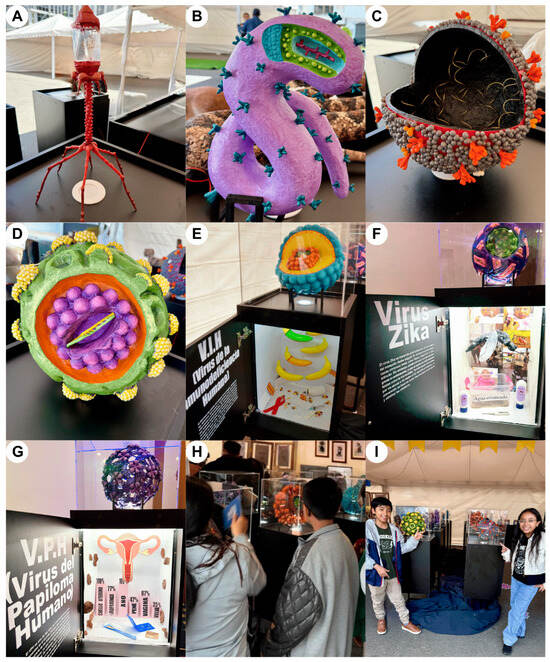
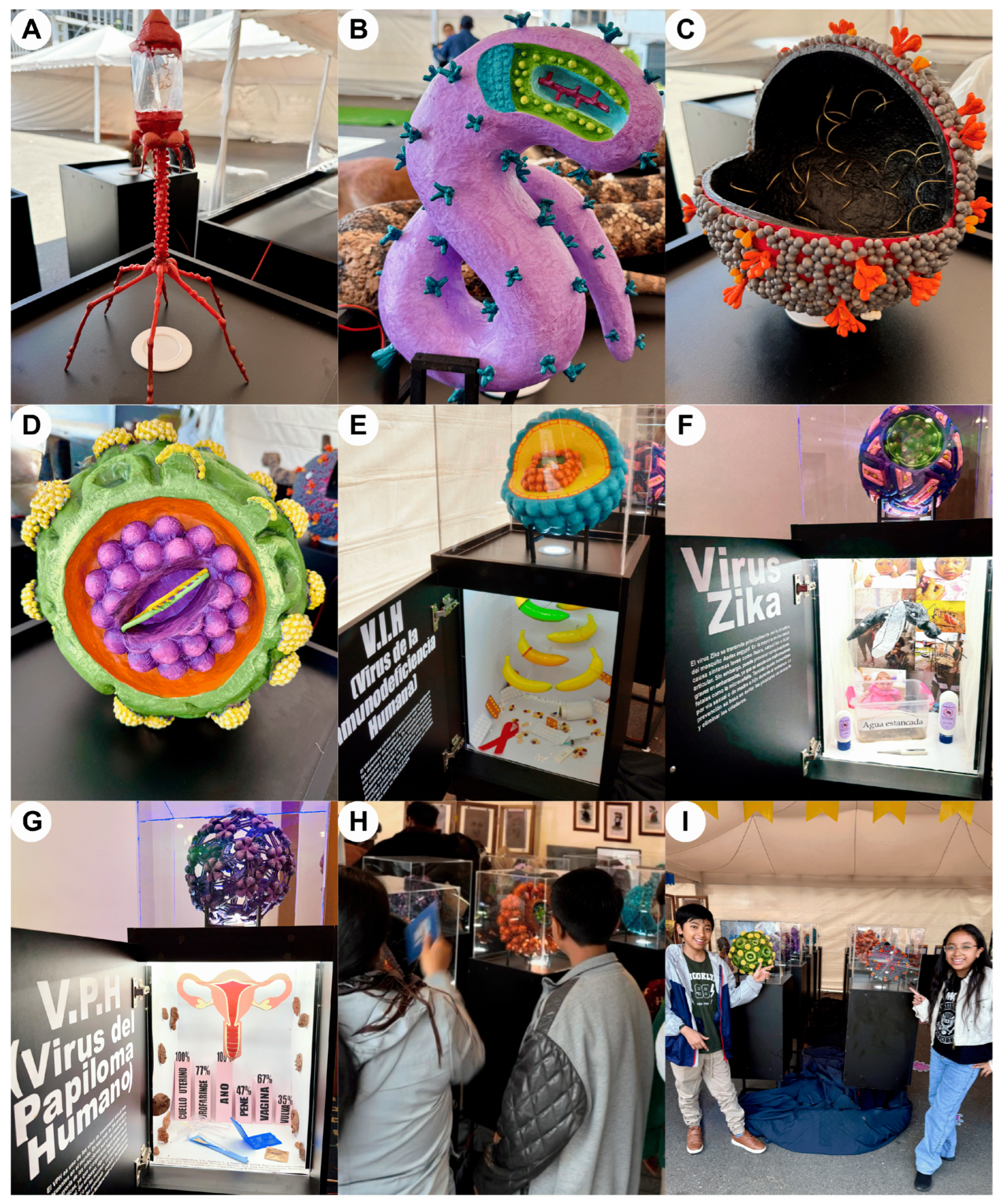
As part of the Viruscopia integrative initiative at FIAVL 2025, the exhibition featured ten physical 3D models serving as visual risk communication tools (Figure 1A–D). These models presented complex viral architectures, such as the icosahedral symmetry of Adenoviruses and the filamentous, pleomorphic structure of Ebolavirus, enabling the public to visualize the physical structure of major human viral pathogens and of a model bacteriophage. Field observations and photographic records showed active engagement, as participants interacted with the models through tactile and visual exploration (Figure 1E–G). This interaction allowed the public to visualize clinical virology concepts and disease prevention mechanisms through the artistic staging (Figure 1H,I).
Figure 1.
“Viruscopia” exhibition at FIAVL 2025; (A–D) physical 3D models of viruses displayed on exhibition stands, including supplemental information on transmission modes and prevention strategies; (A) T4 bacteriophage showing the double-stranded DNA genome packaged within the capsid (translucent plastic); (B) Ebolavirus, a filamentous enveloped virus, showing the single-stranded, negative-sense RNA genome (purplish-red) within the helical nucleocapsid (green), beneath the viral envelope; (C) SARS-CoV-2 showing the spike (S) glycoproteins (orange) on the envelope and the single-stranded, positive-sense RNA (gold) associated with the nucleocapsid (N) protein in a helical ribonucleoprotein complex; (D) Hepatitis B virus showing the partially double-stranded, relaxed circular DNA (rcDNA) genome within the icosahedral nucleocapsid (core, purple), underneath the viral envelope bearing the surface antigen (HBsAg); (E–G) epidemiological and clinical data on the distribution, transmission, and replication mechanisms of the viruses (E) HIV; (F) Zika Virus; (G) HPV; (H,I) attendees of people interacting with the physical 3D models and preventive health narratives at the Viruscopia exhibition; (I) underage participants (published with explicit parental authorization by the corresponding author). Colors are didactic conventions, and the models are not to scale.
3.2. Psychometric Validation of the Health Literacy Instrument
The internal consistency of the evaluation instrument yielded a Cronbach’s Alpha value of α = 0.88 (95% CI: 0.87–0.90) and an average inter-item correlation of 0.23, indicating high internal consistency of the scale. The ‘alpha if item dropped’ analysis showed no significant increase in the overall coefficient upon the removal of any single item, while item-total correlations consistently remained above 0.40.
3.3. Central Tendency and Descriptive Analysis of Community Response
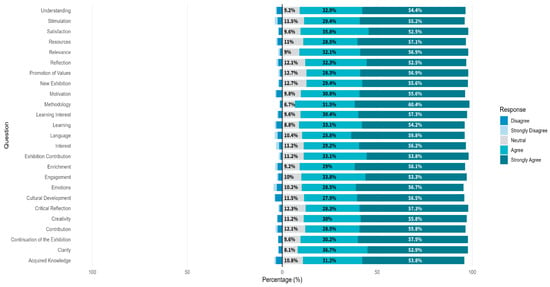
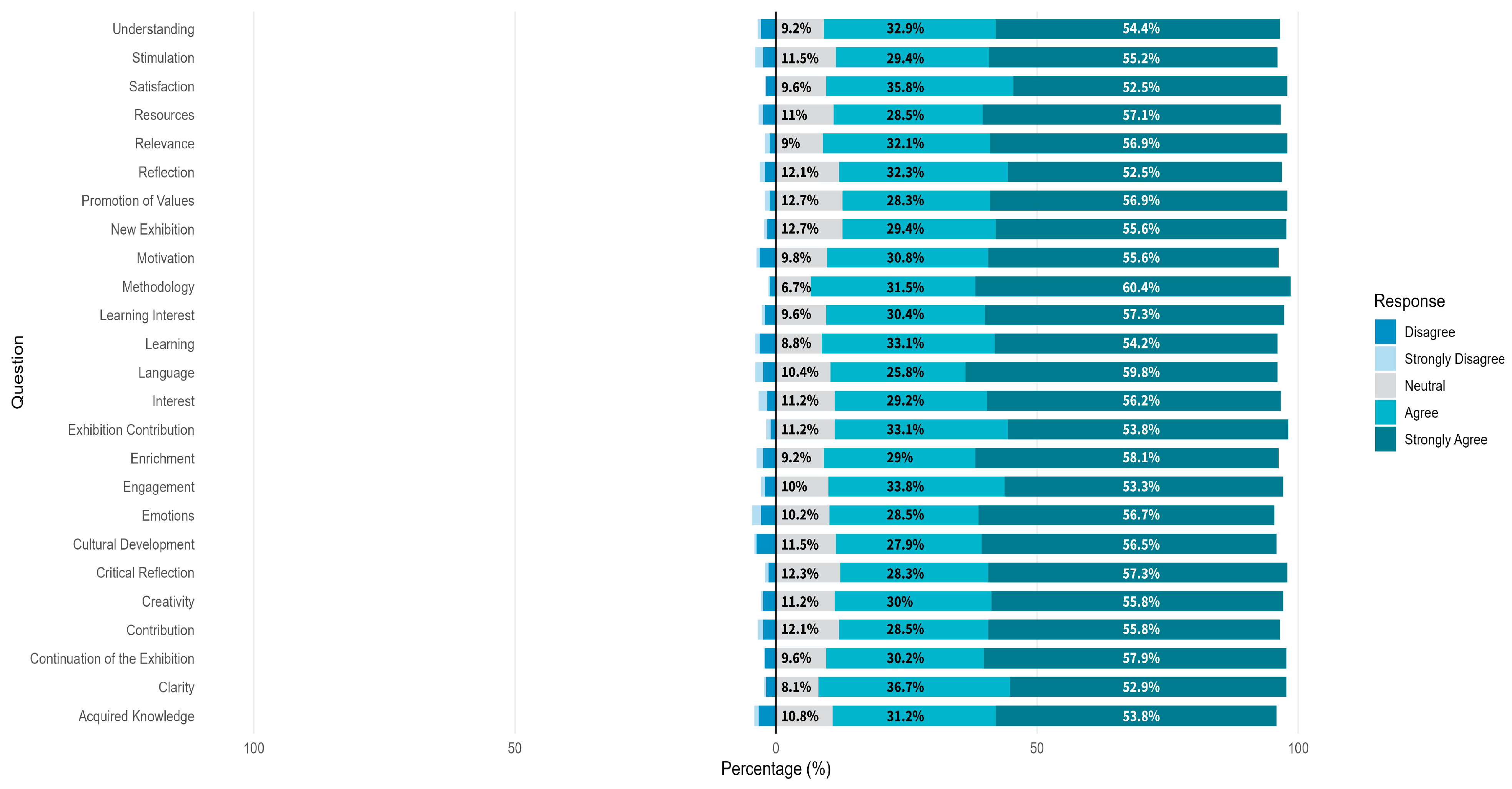
Out of approximately 800 total visitors who completed the guided tour, 480 voluntarily completed the questionnaire after providing informed consent (response rate = 60%). By age group, the sample comprised participants aged 12–17 (n = 41), 18–25 (n = 193), 26–40 (n = 161), 41–65 (n = 73), and over 65 years (n = 12); by biological sex, 297 were female, 175 male, and 8 preferred not to say. Analysis of the 5-point Likert-scale responses across the 25 questionnaire items showed a marked distribution toward the highest valuation categories. For the majority of the items, both the median and mode reached a value of 5, with responses concentrated in the ‘Agree’ and ‘Strongly Agree’ categories. This convergence of median and mode values reflects a homogeneous trend in the public’s favorable evaluation of the initiative as a public health risk communication strategy (Figure 2). However, this pattern also reflects a pronounced ceiling effect: for every item, at least 84% of responses fell in the two highest categories, which limits the discriminative capacity of the scale and the variability available for between-group comparisons.
Figure 2.
Percentage distribution of responses to the 25 questionnaire items on a 5-point Likert scale (n = 480). Negative responses are centered to the left and positive responses to the right of the neutral midpoint.
3.4. Inferential Statistical Analysis by Demographic Groups
Given the ordinal nature of the Likert scales and the non-normal distribution of the data, non-parametric tests were employed to evaluate demographic differences in health literacy and risk reflection.
3.4.1. Age—Based Variations in Risk Reflection
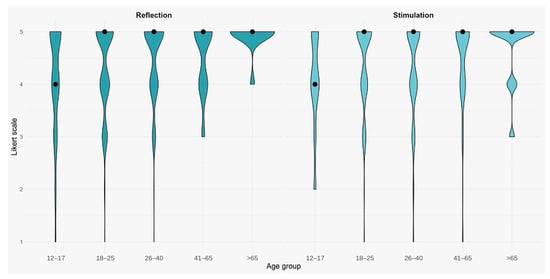
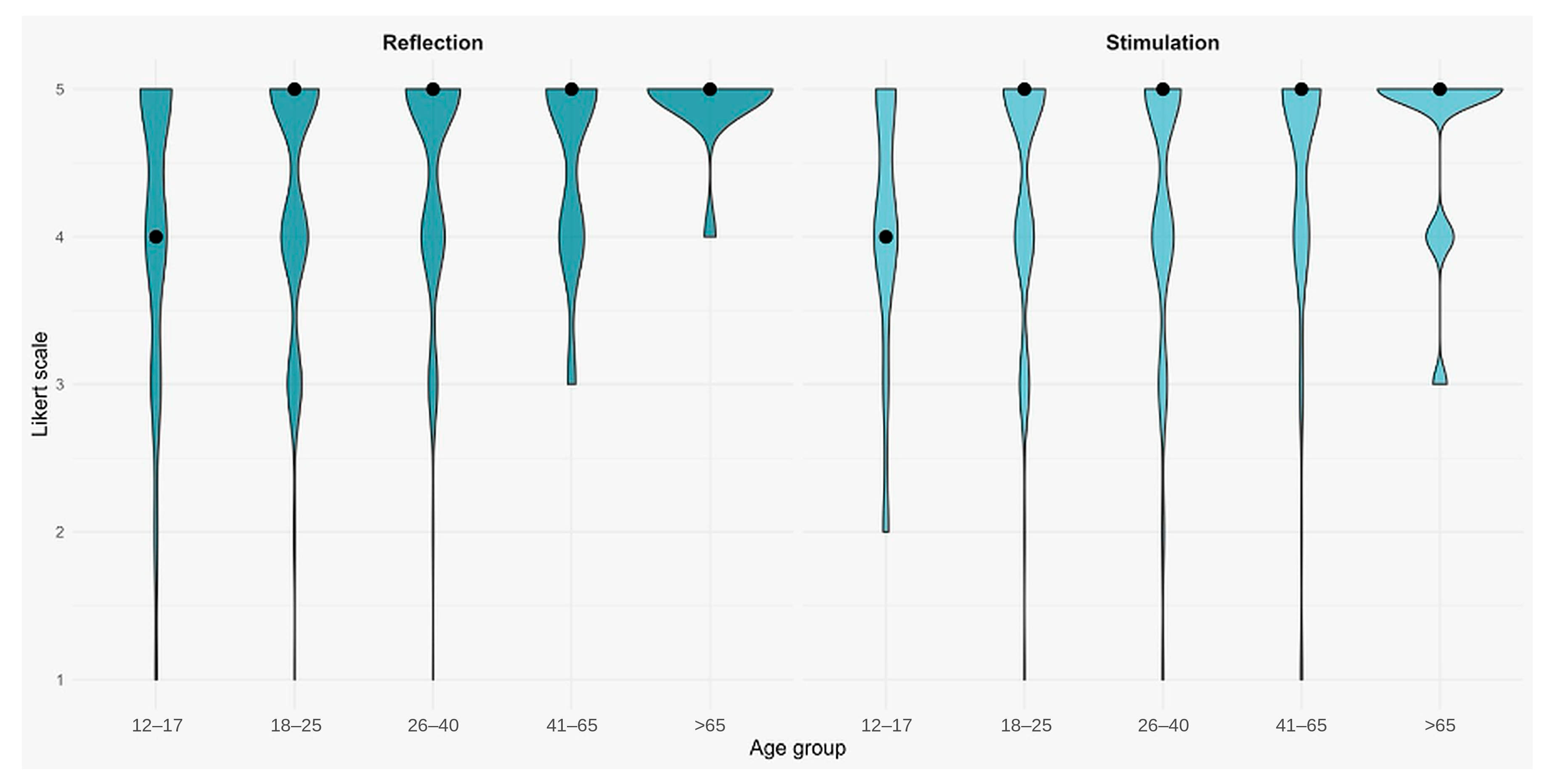
The Kruskal–Wallis H test revealed statistically significant differences across age groups for the variables “Stimulation” and “Reflection” (p < 0.05) (Stimulation: H(4) = 10.95, p = 0.027, ε2 = 0.023; Reflection: H(4) = 12.39, p = 0.015, ε2 = 0.026; small effect sizes in both cases) (Table 1). However, following Dunn’s post hoc analysis with Bonferroni correction, significant pairwise differences persisted only for the “Reflection” variable, specifically between the 12–17 age group and participants over 65 years (adjusted p = 0.038; z = −2.90).
Table 1.
Central Tendency and Dispersion Measures for Statistically Significant Variables.
As shown in Table 1 and illustrated in the violin plots (Figure 3), there was a marked concentration of responses at the upper end of the Likert scale (4–5) across all age groups. For “Reflection”, the over-65 cohort showed the strongest concentration at the maximum scale value (Me = 5.0; Q1 = 5.0; IQR = 0.00), as reflected in the narrow shape of the violins, indicating near-consensus among older adults regarding the health reflection prompted by the exhibition. In contrast, the 12–17 age group showed a median of 4 for both variables, and the broader distribution in the younger groups suggests a more heterogeneous self-reported reflection.
Figure 3.
Distribution of responses for the “Reflection” and “Stimulation” variables across age groups, displayed via violin plots. Black dots indicate the group medians.
3.4.2. Comparative Analysis by Biological Sex
To ensure statistical robustness, participants who identified as “prefer not to say” were excluded from this analysis due to insufficient sample size. Comparisons between male and female participants using the Mann–Whitney U test showed no statistically significant differences for any item after Bonferroni correction. The only nominally significant comparison was “Creativity” (U = 23,476, p = 0.049), which did not remain significant after correction. These results indicate that the strategy was perceived similarly by female and male participants.
3.5. Descriptive Text Mining and Qualitative Content Analysis of Public Perception
3.5.1. Word Co-Occurrence Network and Health Knowledge Clusters
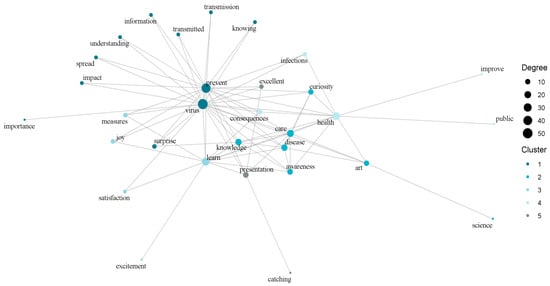
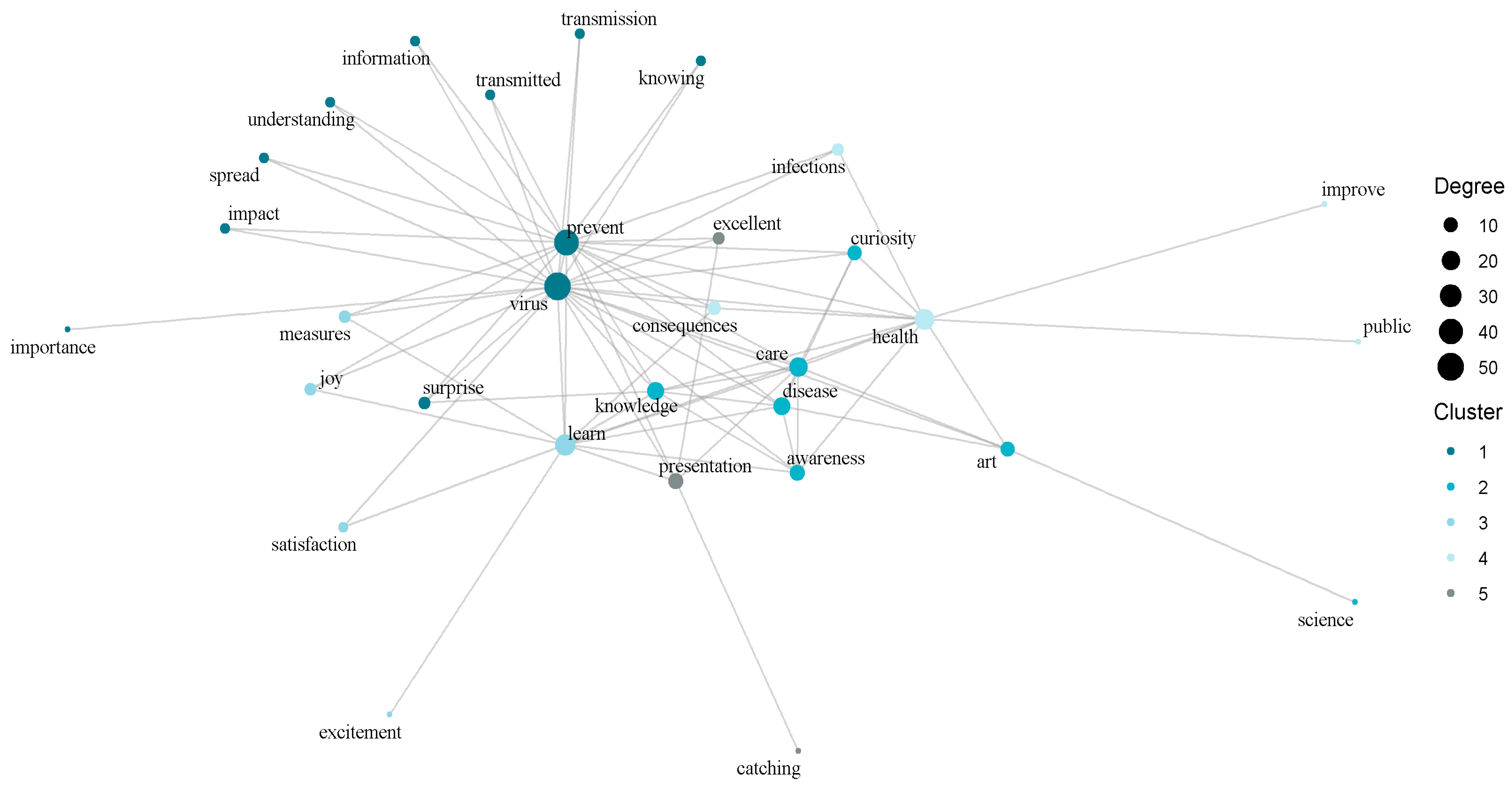
The word co-occurrence network identified “virus” and “prevent” as the central and largest nodes (Figure 4), highlighting their role as primary conceptual hubs connecting viral biology with public health action. Although the network was segmented into distinct clusters, these thematic groups were highly interconnected. Specifically, terms denoting knowledge acquisition (e.g., learn, knowledge, information) were robustly linked to clinical and epidemiological nodes (e.g., health, disease, infections), suggesting that, in participants’ own words, knowledge about viral biology was associated with public health awareness.
Figure 4.
Word co-occurrence network of open-ended responses on knowledge, health perception, and viral risk. Node size indicates degree, edge thickness reflects co-occurrence frequency, and colors represent Louvain clusters.
Furthermore, disease prevention concepts (e.g., prevent, transmission, measures) were systematically distributed throughout the network, reinforcing their continuous relevance in community risk perception. Concurrently, affective engagement was evidenced by the prominent positioning of terms such as curiosity, surprise, and impact, suggesting that the art-science integration elicited both emotional engagement and cognitive reflection on health risks. Conversely, peripheral nodes captured lower-frequency, specific terms that functioned as specialized subthemes. Topology analysis thus suggests that public perceptions integrate virological knowledge, disease prevention, healthcare awareness, and emotional resonance into a unified framework.
3.5.2. Word Cloud Analysis and Institutional Feedback for Health Promotion
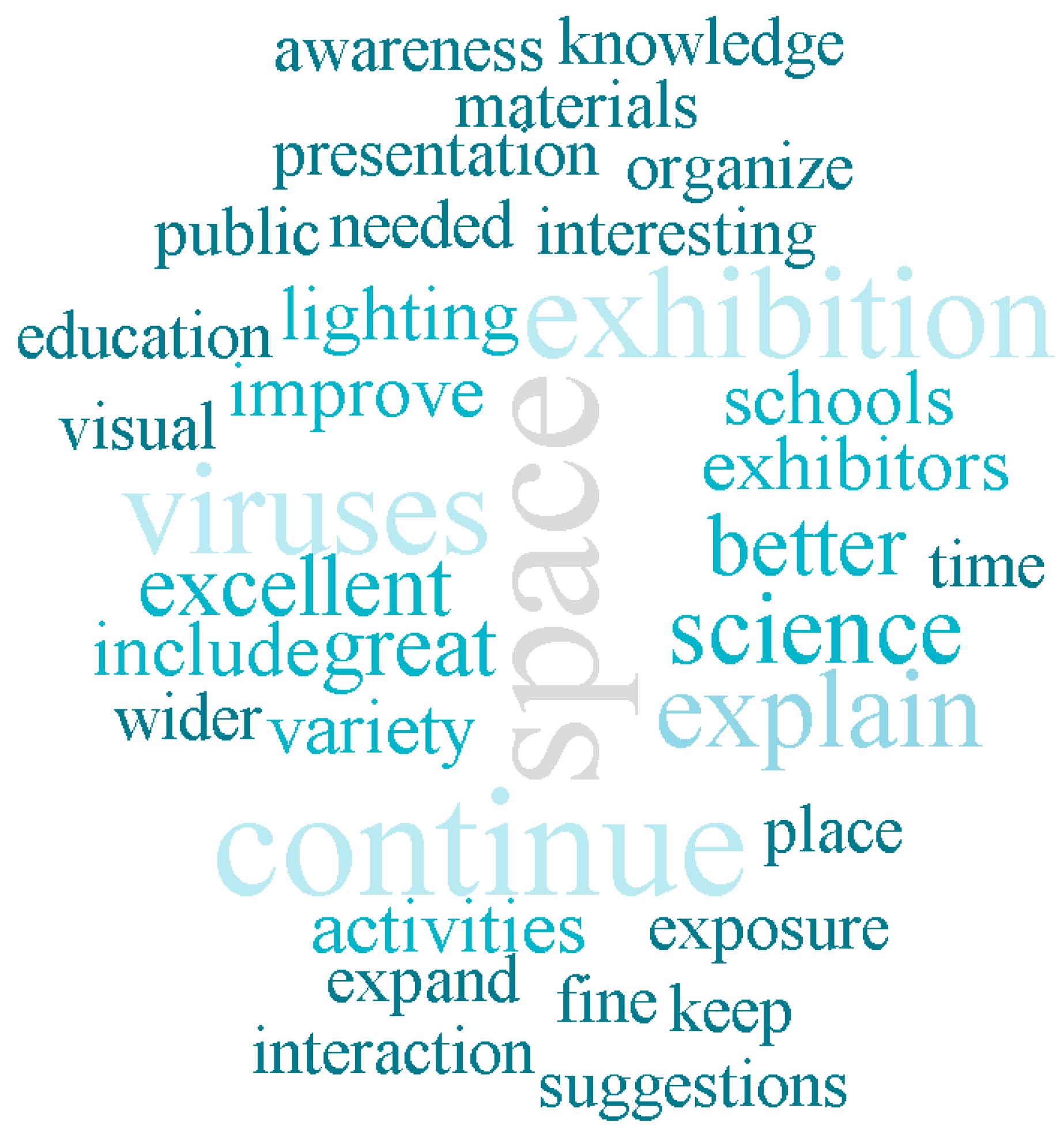
Qualitative content analysis of the institutional feedback revealed a highly favorable overall evaluation of the “Viruscopia” exhibition, driven by a predominant distribution of positive descriptors such as excellent, great, and interesting (Figure 5). Moreover, the high recurrence of action-oriented terms—specifically continue, schools, public, and education—indicates a strong public demand for integrating this risk communication strategy into formal educational institutions and public health promotion campaigns.
Figure 5.
Word cloud of participant suggestions for future editions that could include public health communication. Word size corresponds directly to the relative frequency of terms within the text corpus. Colors are used for visual distinction only and carry no additional meaning.
Regarding constructive recommendations for future editions, the high-frequency vocabulary concentrated on specific logistical variables, led by the terms space, lighting, and time. These suggestions point to the need to optimize the spatial and perceptual conditions of the exhibitions, taking into account both the increasing number of visitors and the specific visualization requirements of the physical 3D models. The expansion of exhibition areas, together with the enhancement of lighting conditions and the reorganization of guided tour routes, could improve the audience’s aesthetic and cognitive experience. Such curatorial and museographic strategies could foster deeper public engagement with the viral models, strengthening processes of interpretation, health learning, and visitor participation.
4. Discussion
The Viruscopia initiative suggests that the intersection of physical 3D models and informative narratives is a well-received resource for health literacy and risk communication. By employing Likert-scale evaluations alongside qualitative text mining, this study explored perceived health and scientific literacy, understood not merely as the accumulation of factual knowledge, but as the capacity to engage with complex biological concepts as a reflective citizen [31,32,38,39].
Our quantitative results reveal a predominantly favorable perception across all demographic groups (Me = 5), suggesting that arts-based interventions may help overcome technical hermeticism often associated with virology [40,41,42]. This is consistent with the semantic network topology, where the central prominence of the hubs ‘virus’ and ‘prevent’ indicates that the exhibition successfully established a dominant, accessible discourse, aligning with communication models observed in other scientific disciplines [43,44]. The deployment of physical 3D models mirrors the cognitive benefits of virtual 3D approaches [19], transforming invisible, abstract viral structures into tangible entities and lowering the cognitive threshold required for public engagement [45,46,47]. This cognitive mitigation is qualitatively evidenced by the strong structural link between knowledge-acquisition nodes (learn, knowledge, information) and clinical-epidemiological dimensions (health, disease, infections). Such topological coupling suggests that the audience’s comprehension of viral mechanics was linked to public health awareness. This finding contrasts with traditional public health campaigns, which frequently struggle to translate complex molecular virology for lay audiences [38,48], suggesting that arts-based physical models may offer a useful complementary framework for strengthening public health literacy [26,28].
A particularly significant quantitative finding was the age-related variation in the “Reflection” variable. While younger participants (12–17 years) showed high interest, the older cohort (>65 years) showed a strong concentration of maximum scores in self-reported reflection (Me = Q1 = 5.0; IQR = 0.00). For populations that experienced the peak risks of recent global viral crises [49], the dialogue between science and art provided a necessary space for the re-signification of fear into reflective understanding [50,51]. Furthermore, the prominent positioning of affective nodes such as curiosity, surprise, and impact within the network’s topological clusters suggests that this interdisciplinary fusion elicited emotional and cognitive responses [52]. This shift actively challenges the traditional ‘deficit model’ of science communication in favor of an empathetic, poetic-scientific dialogue in public health engagement [21,52,53]. In this sense, artistic practice functions not merely as a communicative medium but as an epistemic framework through which complex biological knowledge can be interpreted, experienced, and socially negotiated, thereby expanding the possibilities for meaningful public engagement and collective meaning-making regarding infectious threats [54,55].
Finally, the qualitative feedback regarding future editions offers an institutional roadmap for scalability in public health outreach. While descriptor tokens such as excellent, great, and interesting confirmed a highly favorable reception, the recurrence of nodes like continue, schools, and education reflects a clear public demand to transition this intervention into formal educational settings and preventative health campaigns. The logistical challenges identified—specifically the need to optimize physical space, lighting, and temporal dynamics—represent predictable constraints driven by the exceptionally high visitor attendance during the 14-day intervention at FIAVL 2025. Far from being isolated operational flaws, these spatial and temporal dimensions align closely with the Contextual Model of Learning [56], which establishes that the physical and social setting is an essential component in the construction of meaningful museum experiences. Crucially, these logistical suggestions were framed within an enthusiastic public endorsement, emphasizing that technical areas for improvement did not compromise the overarching educational value of the intervention but rather underscore its potential for sustainable, long-term scalability in community risk communication.
Rather than compromising the intervention’s value, these practical recommendations highlight the necessity of expanding physical layouts and optimizing operational dynamics. Addressing these spatial constraints may enhance the long-term efficiency and resilience of the pedagogical ecosystem in future public health communication.
This study has some limitations. Learning was assessed through participants’ self-reported perceptions after the visit; although these results provide consistent evidence of perceived learning and engagement, a pre/post design with objective knowledge measures would allow the magnitude of these learning gains to be quantified. In addition, the marked ceiling effect and the voluntary, self-selected participation (480 of approximately 800 visitors) may have favored positive responses. Future editions should incorporate these designs, together with a psychometric validation of the instrument, to further strengthen the evidence obtained.
5. Conclusions
The Viruscopia initiative suggests that integrating artistic physical 3D models with informative narratives and specialized mediation is a well-received framework for public health communication and viral risk awareness. The mixed-methods evaluation indicates that participants perceived this intersection of art and biology—by combining visual, aesthetic, and emotional resonance—as lowering cognitive barriers and supporting their understanding of viral mechanics and disease prevention. While future expositions require logistical adjustments in terms of space, lighting, and time management to accommodate high visitor attendance, the qualitative demand for institutional expansion highlights the project’s scalability for broader health promotion and preventative education. Ultimately, this art-science interdisciplinary approach offers a promising community-centered model for transitioning from unidirectional health dissemination toward active public engagement, risk perception, and scientific health literacy in the population. Future studies using pre/post designs with objective knowledge measures and comparison groups are needed to confirm its educational effect.
Supplementary Materials
The following supporting information can be downloaded at: https://www.mdpi.com/article/10.3390/ijerph23101341/s1, Video S1: Visual documentation of the “Viruscopia” exhibition, showcasing the ten physical 3D viral sculptures alongside their explanatory infographic panels. The video highlights the integration of biological accuracy with artistic narratives, as well as public engagement with the interdisciplinary installation during the event; Table S1: Raw survey dataset and participants’ informed consent responses.
Author Contributions
Conceptualization, D.C., A.J.-R., K.C., G.M. and M.F.S.; methodology, D.C. and A.J.-R.; formal analysis, A.J.-R., R.S., D.A. and L.E.; investigation, D.C. and A.J.-R.; data curation, A.J.-R., R.S., D.A. and L.E.; writing—original draft preparation, D.C., A.J.-R., R.S. and D.A.; writing—review and editing, L.E., C.B. and M.G.; funding acquisition, D.C. and A.J.-R. All authors have read and agreed to the published version of the manuscript.
Funding
This research was funded with three thousand American dollars (3000 USD) into the internal project PROY_INV_CBA_2025_5115 by the Vicerrectorado de Investigación of the Universidad Técnica Particular de Loja.
Institutional Review Board Statement
The study was conducted in accordance with the Declaration of Helsinki and approved by the Human Research Ethics Committee (Comité de Ética de Investigación en Seres Humanos, CEISH) of Universidad Técnica Particular de Loja (UTPL) (Official Letter CEISH-UTPL-(09)-(2025) No. 16; Protocol Code 2025-08-INT-EOSR-007; approved on 18 September 2025).
Informed Consent Statement
Informed consent was obtained from all subjects involved in the study. For participants aged 12–17 years, consent was given in person by a parent or legal guardian, and the minors provided their assent. Parental authorization was obtained to publish the photographs of minors shown in Figure 1.
Data Availability Statement
Publicly available project records and institutional resources related to this study can be accessed via the Universidad Técnica Particular de Loja (UTPL) official repository at: https://data.utpl.edu.ec/resource/cf260bb7-5439-bb75-387b-82edca191cfe (accessed on 10 September 2026). Additionally, the official institutional program and public scheduling confirming the execution of the intervention within the framework of the Festival Internacional de Artes Vivas de Loja (FIAVL 2025) are publicly archived and available for consultation at: https://eventos.utpl.edu.ec/api/drupal-file?path=%2Fsites%2Fdefault%2Ffiles%2Fmigracion-eventos%2Fbody%2FAgenda_20fiavl_2025_20_5__20_1_.pdf (accessed on 10 September 2026).
Acknowledgments
The authors express their gratitude to the Vicerrectorado de Investigación of the Universidad Técnica Particular de Loja (UTPL) for funding this research. We sincerely thank the Biology students of the Universidad Técnica Particular de Loja for their valuable support as facilitators during the 14 days of the exhibition at FIAVL 2025. During the preparation of this manuscript, the authors used Gemini for the purposes of language editing and stylistic refinement. The authors have reviewed and edited the output and take full responsibility for the content of this publication.
Conflicts of Interest
Authors Karina Cruz and María Fernanda Sánchez are affiliated and employed by the companies Karuz_artetextil and MAR. The remaining authors declare that the research was conducted in the absence of any commercial or financial relationships that could be construed as a potential conflict of interest.
Abbreviations
The following abbreviations are used in this manuscript:
| FIAVL | Festival Internacional de Artes Vivas de Loja |
| HPV | Human Papillomavirus |
| HIV | Human Immunodeficiency Virus |
| SARS-CoV-2 | Severe Acute Respiratory Syndrome Coronavirus 2 |
| HSV-1 | Herpes Simplex Virus Type 1 |
| HBV | Hepatitis B Virus |
References
- Koonin, E.V.; Krupovic, M.; Agol, V.I. The Baltimore Classification of Viruses 50 Years Later: How Does It Stand in the Light of Virus Evolution? Microbiol. Mol. Biol. Rev. 2021, 85, e00053-21. [Google Scholar] [CrossRef] [Scilit]
- Gorbalenya, A.E.; Lauber, C. Bioinformatics of Virus Taxonomy: Foundations and Tools for Developing Sequence-Based Hierarchical Classification. Curr. Opin. Virol. 2022, 52, 48–56. [Google Scholar] [CrossRef] [Scilit]
- Simmonds, P. Methods for Virus Classification and the Challenge of Incorporating Metagenomic Sequence Data. J. Gen. Virol. 2015, 96, 1193–1206. [Google Scholar] [CrossRef] [Scilit]
- Baker, R.E.; Mahmud, A.S.; Miller, I.F.; Rajeev, M.; Rasambainarivo, F.; Rice, B.L.; Takahashi, S.; Tatem, A.J.; Wagner, C.E.; Wang, L.F.; et al. Infectious Disease in an Era of Global Change. Nat. Rev. Microbiol. 2022, 20, 193–205. [Google Scholar] [CrossRef] [Scilit]
- Sikkema, R.S.; Koopmans, M. Viral Emergence and Pandemic Preparedness in a One Health Framework. Nat. Rev. Microbiol. 2026, 24, 29–44. [Google Scholar] [CrossRef] [Scilit]
- Plowright, R.K.; Parrish, C.R.; McCallum, H.; Hudson, P.J.; Ko, A.I.; Graham, A.L.; Lloyd-Smith, J.O. Pathways to Zoonotic Spillover. Nat. Rev. Microbiol. 2017, 15, 502–510. [Google Scholar] [CrossRef] [Scilit]
- Ruiz-Aravena, M.; McKee, C.; Gamble, A.; Lunn, T.; Morris, A.; Snedden, C.E.; Yinda, C.K.; Port, J.R.; Buchholz, D.W.; Yeo, Y.Y.; et al. Ecology, Evolution and Spillover of Coronaviruses from Bats. Nat. Rev. Microbiol. 2022, 20, 299–314. [Google Scholar] [CrossRef] [Scilit]
- Bloom, D.E.; Cadarette, D. Infectious Disease Threats in the Twenty-First Century: Strengthening the Global Response. Front. Immunol. 2019, 10, 549. [Google Scholar] [CrossRef] [Scilit]
- Greenhalgh, T.; Wieringa, S. Is It Time to Drop the “Knowledge Translation” Metaphor? A Critical Literature Review. J. R. Soc. Med. 2011, 104, 501–509. [Google Scholar] [CrossRef] [Scilit]
- van der Linden, S.; Roozenbeek, J.; Compton, J. Inoculating Against Fake News About COVID-19. Front. Psychol. 2020, 11, 566790. [Google Scholar] [CrossRef] [Scilit]
- Suarez-Lledo, V.; Alvarez-Galvez, J. Prevalence of Health Misinformation on Social Media: Systematic Review. J. Med. Internet Res. 2021, 23, e17187. [Google Scholar] [CrossRef] [Scilit]
- Zarocostas, J. How to Fight an Infodemic. Lancet 2020, 395, 676. [Google Scholar] [CrossRef] [Scilit]
- Van Bavel, J.J.; Baicker, K.; Boggio, P.S.; Capraro, V.; Cichocka, A.; Cikara, M.; Crockett, M.J.; Crum, A.J.; Douglas, K.M.; Druckman, J.N.; et al. Using Social and Behavioural Science to Support COVID-19 Pandemic Response. Nat. Hum. Behav. 2020, 4, 460–471. [Google Scholar] [CrossRef] [Scilit]
- Grand-Guillaume-Perrenoud, J.A.; Geese, F.; Uhlmann, K.; Blasimann, A.; Wagner, F.L.; Neubauer, F.B.; Huwendiek, S.; Hahn, S.; Schmitt, K.U. Mixed Methods Instrument Validation: Evaluation Procedures for Practitioners Developed from the Validation of the Swiss Instrument for Evaluating Interprofessional Collaboration. BMC Health Serv. Res. 2023, 23, 83. [Google Scholar] [CrossRef] [Scilit]
- Jamieson, S. Likert Scales: How to (Ab)Use Them. Med. Educ. 2004, 38, 1217–1218. [Google Scholar] [CrossRef] [Scilit]
- McKnight, P.E.; Najab, J. Kruskal-Wallis Test. In The Corsini Encyclopedia of Psychology; Weiner, I.B., Craighead, W.E., Eds.; Wiley: Hoboken, NJ, USA, 2010; p. 1. [Google Scholar] [CrossRef] [Scilit]
- Hyde, J.S. The Gender Similarities Hypothesis. Am. Psychol. 2005, 60, 581–592. [Google Scholar] [CrossRef] [Scilit]
- Moro, C.; Štromberga, Z.; Raikos, A.; Stirling, A. The Effectiveness of Virtual and Augmented Reality in Health Sciences and Medical Anatomy. Anat. Sci. Educ. 2017, 10, 549–559. [Google Scholar] [CrossRef] [Scilit]
- Radianti, J.; Majchrzak, T.A.; Fromm, J.; Wohlgenannt, I. A Systematic Review of Immersive Virtual Reality Applications for Higher Education: Design Elements, Lessons Learned, and Research Agenda. Comput. Educ. 2020, 147, 103778. [Google Scholar] [CrossRef] [Scilit]
- Burns, T.W.; O’Connor, D.J.; Stocklmayer, S.M. Science Communication: A Contemporary Definition. Public Underst. Sci. 2003, 12, 183–202. [Google Scholar] [CrossRef] [Scilit]
- Simis, M.J.; Madden, H.; Cacciatore, M.A.; Yeo, S.K. The Lure of Rationality: Why Does the Deficit Model Persist in Science Communication? Public Underst. Sci. 2016, 25, 400–414. [Google Scholar] [CrossRef] [Scilit]
- Smilan, C.; Miraglia, K.M. Art Teachers as Leaders of Authentic Art Integration. Art Educ. 2009, 62, 39–45. [Google Scholar] [CrossRef] [Scilit]
- Illingworth, S. Creative Communication—Using Poetry and Games to Generate Dialogue between Scientists and Nonscientists. FEBS Lett. 2020, 594, 2333–2338. [Google Scholar] [CrossRef] [Scilit]
- Greenwood, J. Arts-Based Research: Weaving Magic and Meaning. Int. J. Educ. Arts 2012, 13, 1–19. Available online: http://www.ijea.org/v13i1/ (accessed on 1 July 2026).
- Lesen, A.E.; Rogan, A.; Blum, M.J. Science Communication Through Art: Objectives, Challenges, and Outcomes. Trends Ecol. Evol. 2016, 31, 657–660. [Google Scholar] [CrossRef] [Scilit]
- Ricci, K.; McLauchlin, B.; Hua, J. Impact of a Science Art Exhibit on Public Interest and Student Comprehension of Disease Ecology Research. J. Microbiol. Biol. Educ. 2023, 24, e00162-22. [Google Scholar] [CrossRef] [Scilit]
- Dolese, M.J.; Kozbelt, A. Communication and Meaning-Making Are Central to Understanding Aesthetic Response in Any Context. Front. Psychol. 2020, 11, 473. [Google Scholar] [CrossRef] [Scilit]
- Duckett, C.J.; Hargreaves, K.E.; Rawson, K.M.; Allen, K.E.; Forbes, S.; Rawlinson, K.E.; Shaw, H.; Lacey, M. Nights at the Museum: Integrated Arts and Microbiology Public Engagement Events Enhance Understanding of Science Whilst Increasing Community Diversity and Inclusion. Access Microbiol. 2021, 3, 000231. [Google Scholar] [CrossRef] [Scilit]
- Jensen, E.; Buckley, N. Why People Attend Science Festivals: Interests, Motivations and Self-Reported Benefits of Public Engagement with Research. Public Underst. Sci. 2014, 23, 557–573. [Google Scholar] [CrossRef] [Scilit]
- Stilgoe, J.; Lock, S.J.; Wilsdon, J. Why Should We Promote Public Engagement with Science? Public Underst. Sci. 2014, 23, 4–15. [Google Scholar] [CrossRef] [Scilit]
- Jensen, E.A.; Borkiewicz, K.; Naiman, J.P.; Levy, S.; Carpenter, J. Picture Perfect Science Communication: How Public Audiences Respond to Informational Labels in Cinematic-Style 3D Data Visualization. PLoS ONE 2024, 19, e0307733. [Google Scholar] [CrossRef] [Scilit]
- Jensen, E.A.; Borkiewicz, K.; Carpenter, J.; Levy, S.; Naiman, J.P. Transforming Science Narratives? The Impact of Explanatory Labels of 3D Data Visualization on Public Understanding of Space Science. Int. J. Sci. Educ. Part B 2025, 15, 562–580. [Google Scholar] [CrossRef] [Scilit]
- Zhang, C.; Jia, B. Enriching STEAM Education with Visual Art: Education Benefits, Teaching Examples, and Trends. Discov. Educ. 2024, 3, 247. [Google Scholar] [CrossRef] [Scilit]
- Yupanqui, E.C.; Peralta Guzmán, C.A.; Luján Villegas, J.F.; Mendoza Alva, C.E. Aprendizaje Basado en las Habilidades Artísticas: Un Abordaje a Partir de Deleuze. Espac. Abierto 2024, 33, 35–55. [Google Scholar] [CrossRef]
- Hetland, L.; Winner, E.; Veenema, S.; Sheridan, K.M. Studio Thinking 2: The Real Benefits of Visual Arts Education, 2nd ed.; Teachers College Press: New York, NY, USA, 2013. [Google Scholar]
- Zakaria, M.R. Hubungan antara Pemodelan 3D Sculpting Teknik Tradisional dengan Teknik Digital. GESTALT J. Desain Komun. Vis. 2023, 5, 1–14. [Google Scholar] [CrossRef] [Scilit]
- R Core Team. R: A Language and Environment for Statistical Computing; R Foundation for Statistical Computing: Vienna, Austria, 2024; Available online: https://www.R-project.org/ (accessed on 1 August 2026).
- Howell, E.L.; Brossard, D. (Mis)Informed about What? What It Means to Be a Science-Literate Citizen in a Digital World. Proc. Natl. Acad. Sci. USA 2021, 118, e1912436117. [Google Scholar] [CrossRef] [Scilit]
- McNew-Birren, J.; Gaul-Stout, J. Understanding Scientific Literacy through Personal and Civic Engagement: A Citizen Science Case Study. Int. J. Sci. Educ. Part B 2022, 12, 126–142. [Google Scholar] [CrossRef] [Scilit]
- Fraaije, A.; van der Meij, M.G.; Kupper, F.; Broerse, J.E.W. Art for Public Engagement on Emerging and Controversial Technologies: A Literature Review. Public Underst. Sci. 2022, 31, 694–710. [Google Scholar] [CrossRef] [Scilit]
- Zaelzer, C. The Value in Science-Art Partnerships for Science Education and Science Communication. eNeuro 2020, 7, ENEURO.0238-20.2020. [Google Scholar] [CrossRef] [Scilit]
- Besley, J.C.; Dudo, A.; Yuan, S.; Lawrence, F. Understanding Scientists’ Willingness to Engage. Sci. Commun. 2018, 40, 559–590. [Google Scholar] [CrossRef] [Scilit]
- Skulmowski, A.; Rey, G.D. Visualizing Pathogens: Disfluent Shapes of Pathogens Increase Their Perceived Complexity and Danger While Realism and Disfluency Boost the Credibility of Visualizations. Hum. Behav. Emerg. Technol. 2021, 3, 316–323. [Google Scholar] [CrossRef] [Scilit]
- Manches, A.; Ainsworth, S. Learning about Viruses: Representing COVID-19. Front. Educ. 2022, 6, 736744. [Google Scholar] [CrossRef] [Scilit]
- Huk, T. Who Benefits from Learning with 3D Models? The Case of Spatial Ability. J. Comput. Assist. Learn. 2006, 22, 392–404. [Google Scholar] [CrossRef] [Scilit]
- Fleck, S.; Hachet, M. Making Tangible the Intangible: Hybridization of the Real and the Virtual to Enhance Learning of Abstract Phenomena. Front. ICT 2016, 3, 30. [Google Scholar] [CrossRef] [Scilit]
- Teplá, M.; Teplý, P.; Šmejkal, P. Influence of 3D Models and Animations on Students in Natural Subjects. Int. J. STEM Educ. 2022, 9, 65. [Google Scholar] [CrossRef] [Scilit]
- Howell, M.E.; van Dijk, K.; Booth, C.S.; Helikar, T.; Couch, B.A.; Roston, R.L. Visualizing the Invisible: A Guide to Designing, Printing, and Incorporating Dynamic 3D Molecular Models to Teach Structure–Function Relationships. J. Microbiol. Biol. Educ. 2018, 19, 19.3.100. [Google Scholar] [CrossRef] [Scilit]
- Williamson, E.J.; Walker, A.J.; Bhaskaran, K.; Bacon, S.; Bates, C.; Morton, C.E.; Curtis, H.J.; Mehrkar, A.; Evans, D.; Inglesby, P.; et al. Factors Associated with COVID-19-Related Death Using OpenSAFELY. Nature 2020, 584, 430–436. [Google Scholar] [CrossRef] [Scilit]
- Drageset, S.; Ellingsen, S.; Haugan, G. Salutogenic Nursing Home Care: Antonovsky’s Salutogenic Health Theory as a Guide to Wellbeing. Health Promot. Int. 2023, 38, daad017. [Google Scholar] [CrossRef] [Scilit]
- Graso, M.; Fousiani, K.; Clark, C.; Chen, F.X. Accountability-Embracing Science Communication Increases Public Engagement with Scientists Post-COVID-19. Soc. Sci. Med. 2026, 404, 119440. [Google Scholar] [CrossRef] [Scilit]
- Reincke, C.M.; Bredenoord, A.L.; van Mil, M.H.W. From Deficit to Dialogue in Science Communication. EMBO Rep. 2020, 21, e51278. [Google Scholar] [CrossRef] [Scilit]
- Davies, S.R. STS and Science Communication: Reflecting on a Relationship. Public Underst. Sci. 2022, 31, 305–313. [Google Scholar] [CrossRef] [Scilit]
- Davies, S.R.; Horst, M. Science Communication: Culture, Identity and Citizenship; Palgrave Macmillan: London, UK, 2016. [Google Scholar] [CrossRef] [Scilit]
- Pelowski, M.; Markey, P.S.; Lauring, J.O.; Leder, H. Visualizing the Impact of Art: An Update and Comparison of Current Psychological Models of Art Experience. Front. Hum. Neurosci. 2016, 10, 160. [Google Scholar] [CrossRef] [Scilit]
- Falk, J.H.; Dierking, L.D. The Museum Experience Revisited; Routledge: New York, NY, USA, 2016. [Google Scholar] [CrossRef] [Scilit]

Disclaimer/Publisher’s Note: The statements, opinions and data contained in all publications are solely those of the individual author(s) and contributor(s) and not of MDPI and/or the editor(s). MDPI and/or the editor(s) disclaim responsibility for any injury to people or property resulting from any ideas, methods, instructions or products referred to in the content. |
© 2026 by the authors. Licensee MDPI, Basel, Switzerland. This article is an open access article distributed under the terms and conditions of the Creative Commons Attribution (CC BY) license.