
Skip to Content
  • Tracked for
    Impact Factor
  • Indexed in
    Scopus
  • 38 days
    Submission to First Decision
  • 20 days
    Acceptance to Publication

DNA

DNA is an international, peer-reviewed, open access journal on DNA and DNA-related technologies published quarterly online by MDPI.

Get Alerted

Add your email address to receive forthcoming issues of this journal.

All Articles (203)

  • Article
  • Open Access

Background/Objectives: Candida glabrata (Nakaseomyces glabratus) is a major opportunistic human fungal pathogen and the second most common species among Candida isolates after Candida albicans. Histone post-translational modifications play pivotal roles in C. glabrata adaptation in the host environment by modulating chromatin organization. H3K4 methylation is associated with fungal development, stress adaptation, genome stability, and virulence. However, its significance in C. glabrata–macrophage interaction is not well studied. Methods: Employing bioinformatics and biochemical approaches, we analyzed H3K4 methylation status in fungal pathogens upon exposure to environmental stressors and infection of human macrophages. Results: We show that macrophage phagocytosis led to increased H3K4 demethylation in C. glabrata. In contrast, exposure to other environmental stressors did not elicit H3K4 demethylation. Analysis of H3K4 methylation at intermediate and late stages of macrophage infection further demonstrated that this response is transient and dynamic, with H3K4 methylation levels being restored at the late stage. Importantly, we found that the transient increase in H3K4 demethylation following macrophage infection is also observed in other fungal pathogens, C. albicans, Aspergillus fumigatus, and S. cerevisiae, suggesting that this response may represent a conserved feature of fungal adaptation to the macrophage intracellular environment. Conclusions: Collectively, our findings identify a previously unrecognized temporal H3K4 demethylation response to macrophage infection and suggest that dynamic regulation of H3K4 methylation represents a conserved epigenetic adaptation to the intracellular host environment.

DNA

23 November 2026

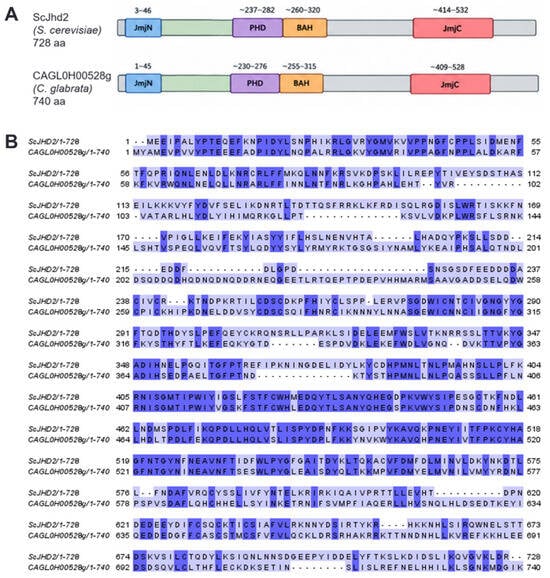
CAGL0H00528g encodes an ortholog of the histone demethylase Jhd2 of S. cerevisiae. (A), Illustrative model of CgJhd2 domains generated by scanning the translated amino acid sequence encoded by CgJHD2 with the EXPASY ProSite tool. (B), Pairwise sequence alignment of amino acid sequences encoded by CAGL0H00528g and ScJHD2 genes in C. glabrata and S. cerevisiae, respectively. Dark and light blue shaded amino acid residues represent identical and similar amino acids, respectively.
  • Review
  • Open Access

Background/Objectives: Genetic identification of human remains from aquatic environments is a recurring forensic challenge. Hydrolysis, oxidation, and microbial degradation alter DNA at rates that vary substantially across media, yet no prior synthesis has translated this evidence into an operational framework for analytical decision-making. This review examines how immersion medium, biological matrix, exposure duration, substrate, and temperature interact to determine genetic profiling viability across freshwater, saltwater, and peat bog settings. Methods: A narrative literature review was conducted across PubMed/MEDLINE, Google Scholar, and ResearchGate (2000–2026). Of 66 articles identified, 20 were included as primary data sources reporting empirical DNA preservation or profiling outcomes. Four studies reporting individual-level outcomes (N = 1700 samples) were compared study by study without pooling; the remaining 16 were synthesised descriptively. Results: In the largest dataset (tsunami victims), STR profiling succeeded in 79% of bone samples, whereas nuclear typing of teeth was largely unviable and mtDNA sequencing succeeded in 51%. Saltwater preserved soft tissue better than freshwater over short immersion, but ionic inhibitors may compromise PCR amplification from mineralised structures. Prolonged deep marine immersion can favour skeletal DNA preservation under cold, anoxic conditions. Peat bogs preserve soft tissue externally through sphagnan-mediated tanning, while acid hydrolysis renders standard PCR-based profiling largely ineffective. Substrate porosity, water temperature, and post-recovery handling modulated DNA persistence independently of water type. Conclusions: Reduced-amplicon mini-STR assays are supported by case and experimental evidence when quantification indicates fragmentation or larger loci drop out. mtDNA sequencing is the most consistently documented option under advanced fragmentation. Environment-specific extraction protocols remain an unmet need.

DNA

17 November 2026

  • Article
  • Open Access

Background/Objectives: Triple-negative breast cancer (TNBC) carries a poor prognosis; while PARP inhibitors (PARPi) are approved for BRCA-mutated disease, other homologous recombination deficiency (HRD) pathways may be actionable targets. This study characterizes germline mutations in Portuguese TNBC and explores exploratory associations with clinicopathologic features and outcomes. Methods: A multicentric retrospective cohort of women diagnosed with TNBC (2022–2024) that harbored a pathogenic variant (PV), likely pathogenic variant (LPV), or variant of uncertain significance (VUS) across six Portuguese institutions. Clinicopathologic variables were compared between groups. Overall (OS) and progression-free survival (PFS) were estimated in patients eligible for curative-intent therapy with PV/LPV, using Kaplan–Meier and log-rank methods. Results: Among 109 patients, 38.5% carried a PV and 11.0% an LPV. BRCA1/2 predominated among PV carriers (59.5%), followed by PALB2 (9.5%), RAD51C (7.1%), and RAD51D (4.8%). Additionally, 53.2% harbored a VUS, mainly ATM (22.4%), CHEK2/BRCA2 (8.6% each), and NF1 (6.9%). Mean age was 49.7 ± 12.1 years; 49.5% had advanced-stage disease (>cT2/N+); 61.5% received neoadjuvant immunotherapy; 1.8% received adjuvant PARPi. For efficacy analysis, BRCA (n = 26) and non-BRCA (n = 25) carriers were well balanced. Pathologic complete response occurred in 60.9% of non-BRCA versus 82.6% of BRCA carriers (p = 0.190). BRCA carriers had numerically higher PFS (p = 0.09): 92.3% versus 69.7% at 24 months. OS was comparable (p = 0.16); median OS not reached. Conclusions: This study characterizes the germline landscape of Portuguese TNBC, revealing diverse HRD-pathway mutations beyond BRCA. In this small exploratory analysis, BRCA status was not associated with a statistically significant difference in PFS, pathologic response, or OS.

DNA

12 November 2026

  • Review
  • Open Access

Genetic and Molecular Basis of Heat Stress Resilience in Pigs: Mechanisms, Genomic Regions, and Breeding Perspectives

  • Vasileios G. Papatsiros,
  • Georgios I. Papakonstantinou and
  • Georgios Michailidis
  • + 4 authors

Background/Objectives: Heat stress is one of the most economically and physiologically important constraints on pig (Sus scrofa domesticus) production, affecting welfare, reducing feed intake, growth, and reproductive efficiency, while increasing morbidity and mortality; because pigs lack functional eccrine sweat glands and have a limited capacity for evaporative heat dissipation, their ability to cope with high ambient temperature depends heavily on behavioral, physiological, and cellular stress-response mechanisms, which vary among individuals and genetic backgrounds. This review synthesizes current knowledge of the genetic and molecular pathways underlying the pig heat-stress response, spanning the HSF1–heat shock protein axis and epigenetic regulation, as well as genomic regions, candidate genes, nutrigenomic modulation, and reproductive consequences in boars and sows. Methods: A narrative literature review, informed by key principles of the PRISMA 2020 statement, synthesized 58 peer-reviewed transcriptomic, genomic, epigenomic, proteomic, and physiological studies published mainly between 1998 and 2026. Results: Heat exposure activates HSF1-driven heat shock protein transcription, oxidative stress, gut tight-junction disruption, hypothalamic–pituitary proteomic remodeling, and sex-dimorphic apoptotic/inflammatory transcriptional programs that also compromise boar semen quality. GWAS and QTL studies have mapped genomic regions and candidate genes for thermoregulatory, reproductive, and growth traits. At the same time, breed comparisons suggest, but do not prove on their own, a genetic contribution to the smaller physiological responses observed in some tropical and Mediterranean-adapted breeds. Heritability estimates for individual heat-stress-related traits, rather than for heat tolerance as a composite phenotype, range from low (0.02–0.20) for reproductive traits, to moderate (0.35–0.39) for thermoregulatory traits in lactating sows, to moderate-to-high (0.49–0.83) for physiological responses to acute heat challenge in gilts; circulating cortisol (h2 ≈ 0.68) is a heritable biomarker of the stress response rather than a measure of heat tolerance itself. Conclusions: Several traits associated with the response to heat stress in pigs are heritable and polygenic, supporting the potential of genomic selection, reaction-norm modeling, and marker-assisted introgression, although functional validation of candidate genes and larger multi-population studies, together with an explicit definition of heat tolerance as a composite selection objective, remain priorities.

DNA

5 November 2026

Featured Articles of Last Quarter

Highly Accessed Articles

News & Conferences

Latest Issues

Open for Submission

Journal Sections

XFacebookLinkedIn
DNA - ISSN 2673-8856