Skip to Content

Cardiogenetics

Cardiogenetics is an international, peer-reviewed, open access journal, published quarterly online by MDPI (from Volume 10, Issue 2 - 2020).

Get Alerted

Add your email address to receive forthcoming issues of this journal.

All Articles (234)

  • Article
  • Open Access

Mosaic loss of the Y chromosome (mLOY) is a common karyotype alteration. The accumulation of LOY cells leads to genetic mosaicism and affects the development of pathological conditions in elderly men. Emerging data suggest that this phenomenon might be associated with an increased risk of cardiovascular disease (CVD) and several clinical and demographic parameters. However, the short-term dynamics of mLOY remain insufficiently investigated. Therefore, this study aimed to evaluate the short-term dynamics of mLOY in peripheral blood and its association with various features in men with high CVD risk. The study included healthy young volunteers (control group; n = 48) and male patients with a high risk of cardiovascular disease (HCR group; n = 65). Peripheral blood was obtained for the mLOY analysis from the HCR group at two time points: initially and after 6 months. mLOY was analyzed using a self-designed assay targeting SRY and EIF2C1 as a reference for digital droplet PCR. This assay demonstrated a high degree of linearity for Y chromosome copy numbers (CNs) from 0.9 to 0.6 (R2 = 0.9986) in mLOY models. In the control group, the CNs varied from 0.9 to 1.1. mLOY was detected in 6 of 65 patients in the HCR group (CNs below 0.9). This study revealed preliminary, hypothesis-generating associations between mLOY and sedentary lifestyle and family history of early-onset CVDs (p < 0.05; however, the former did not retain significance after adjusting for age). Analysis of temporal variations of mLOY demonstrated heterogeneous dynamics: in some patients, mLOY resolved, whereas in others, Y chromosome CN decreased even further with time. However, given the low mLOY incidence rate in the investigated cohort, these results should be considered preliminary and exploratory. Further studies are warranted to determine the potential utility of mLOY and its temporal dynamics for assessing CVD risk.

Cardiogenetics

23 September 2026
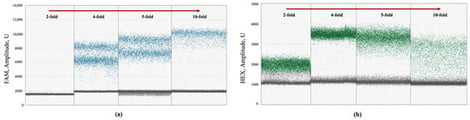
Representative 1D ddPCR plots illustrating the effect of restriction mixture dilution on cluster separation. (a) Distribution of FAM-positive (blue) droplets corresponding to the Y chromosome. (b) Distribution of HEX-positive (green) droplets corresponding to chromosome 1. 2-, 4-, 5-, and 10-fold dilutions were performed. FAM, 6-carboxyfluorescein; HEX, hexachlorofluorescein.
  • Editorial
  • Open Access

The 2025 Editor’s Choice papers [...]

Cardiogenetics

1 October 2026

  • Article
  • Open Access

Background: Hypertrophic cardiomyopathy (HCM) exhibits clinical heterogeneity and age-related penetrance, yet its molecular basis across adulthood remains incompletely understood. This study aimed to characterize age-dependent transcriptomic signatures and identify conserved molecular features across adult HCM. Methods: Left ventricular RNA sequencing data from the GSE141910 dataset were analyzed by comparing three age-stratified HCM groups (18–39, 40–59, and ≥60 years) with corresponding age-matched controls. Differentially expressed genes (DEGs) were identified using GEO2R, followed by functional enrichment and protein–protein interaction (PPI) network analysis. Results: A total of 498 DEGs were shared across all age tertiles, while 439, 594, and 353 DEGs were specific to the youngest, middle-aged, and oldest groups, respectively. Shared DEGs exhibited an extracellular matrix (ECM)-related functional profile and formed PPI modules associated with ECM homeostasis and immune regulation. Age-specific analyses revealed enrichment of adaptive immune pathways in younger patients, cell cycle- and interferon-associated processes in the middle-aged group, and ECM remodeling together with senescence-associated processes in older patients. Hub gene analysis further highlighted distinct age-dependent molecular signatures. Conclusions: Our findings suggest that adult HCM is characterized by a conserved fibrotic core accompanied by age-dependent biological programs, providing a framework for future studies investigating age-informed biomarkers and therapeutic targets.

Cardiogenetics

23 September 2026

  • Review
  • Open Access

Background: Ischemic stroke (IS) is a major cause of global disability, with outcomes increasingly dictated by post-ischemic neuroinflammation. Despite advances in reperfusion, many patients experience neurological decline due to divergent inflammatory responses. Objectives: This review synthesizes current evidence on inflammatory signaling, stroke genetics, and genetically informed precision medicine relevant to the interplay between interleukin-6 (IL-6), tumor necrosis factor-alpha (TNF-α), and ischemic stroke outcomes. Methods: We reviewed evidence from genome-wide association studies, Mendelian randomization analyses, experimental studies, observational biomarker cohorts, and relevant cardiovascular anti-inflammatory trials. Evidence from non-stroke populations is identified as indirect and is not interpreted as proof of efficacy in ischemic stroke. Results: IL-6 and TNF-α signaling involves receptor- and context-dependent mechanisms that may have both harmful and protective effects after cerebral ischemia. Multi-omic studies of the chromosome 9p21 locus and ANRIL suggest potential links among vascular-cell regulation, inflammation, and atherosclerotic risk, although stroke-specific mechanistic evidence remains limited. Elevated inflammatory-marker concentrations have been associated with greater stroke severity and unfavorable outcomes; however, their independent prognostic value and optimal sampling strategy require further validation. Selective anti-inflammatory approaches provide biologically plausible strategies for future study, but genotype-guided anti-cytokine treatment is not established for acute ischemic stroke or post-stroke recovery. Conclusions: Stroke genetics and multi-omic approaches may contribute to future precision-medicine strategies, but their clinical utility requires validation in prospective, stroke-specific studies. Current evidence does not support routine cytokine genotyping or genotype-guided anti-cytokine treatment in ischemic stroke.

Cardiogenetics

11 September 2026

Featured Articles of Last Quarter

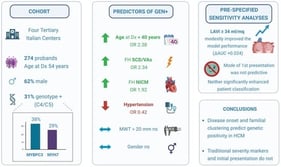
Percentage distribution of genetic variants. Legend: Pathogenic/likely pathogenetic variants (P/LP) defining genotype positivity are depicted in blue (n = 86 patients), while variants of uncertain significance (VUS) are depicted in red (n = 67 patients).

Highly Accessed Articles

News & Conferences

Latest Issues

Open for Submission

Journal Sections

XFacebookLinkedIn
Cardiogenetics - ISSN 2035-8148