
Skip Content
You are currently on the new version of our website. Access the old version .

All Articles (34,929)

Background/Objectives: Repurposed cAMP-elevating agents may personalize fluoropyrimidine therapy by exploiting pathway-specific vulnerabilities. Methods: We tested the PDE3 inhibitor milrinone and the β2-agonist terbutaline alone or combined with 10 μM 5-fluorouracil (5-FU) in UM-UC-5 (bladder), A549 (lung), and PC-3 (prostate) cells. Viability, migration, clonogenicity, and intracellular ROS (DCFDA) were measured; drug interactions used Chou–Talalay/CompuSyn. Results: In UM-UC-5, both agents reduced viability, migration, and clonogenicity and synergized with 5-FU (CI < 1 across Fa ≈ 0.42–0.57). 5-FU increased ROS, whereas terbutaline consistently lowered ROS below baseline and blunted 5-FU-induced oxidative signals; milrinone showed a dose-dependent redox profile without consistent ROS suppression. A549 combinations did not outperform 5-FU; PC-3 was largely unresponsive. Conclusions: cAMP modulators selectively potentiate 5-FU in bladder cancer cells and modulate redox programs (notably with terbutaline), supporting a biomarker-guided combination strategy (e.g., β2-AR/PDE3/PI3K–Akt features) for personalized therapy in bladder cancer; mechanistic and in vivo validation are warranted.

9 February 2026
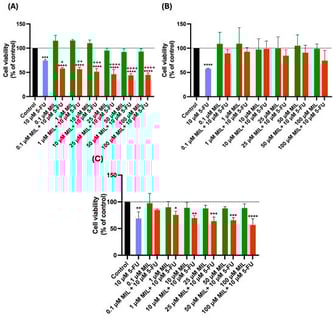
Cell viability of (A) UM-UC-5, (B) PC-3 and (C) A549 cells treated with the drug milrinone alone and in combination of 5-FU. Values are expressed as percentages of control and represent means ± SD. Each experiment was done three times independently (n = 3); Statistical significance: * p &lt; 0.05, ** p &lt; 0.01, *** p &lt; 0.001, **** p &lt; 0.0001 vs. control; + p &lt; 0.05, ++ p &lt; 0.01, +++ p &lt; 0.001, ++++ p &lt; 0.0001 vs. 10 µM 5-FU.

Molecular Targets of Cervical Cancer and Its Microenvironment: Advances in Treatment

  • Joe Youssef,
  • Amal El Masri and
  • Wassim Abou-Kheir
  • + 6 authors

Cervical cancer remains one of the most commonly diagnosed cancers in women worldwide, with an elevated number of associated annual deaths, even though effective preventive vaccines are available. The pathophysiology of cervical cancer is well understood, with high-risk HPV as the main culprit in carcinogenesis, in addition to cell proliferation signaling alteration and tumor immune microenvironment modulation. This understanding of the disease’s molecular signatures has led to the development of several lines of treatment, especially for advanced, recurrent, persistent, or metastatic disease. For instance, Bevacizumab, a monoclonal antibody targeting angiogenesis factors, as well as Endostar, a recombinant human endostatin, have been studied and shown to improve survival in advanced disease. In contrast, anti-angiogenic Tyrosine Kinase Inhibitors had limited efficacy. Furthermore, antibody-drug conjugates such as Tisotumab Vedotin allow to deliver a highly toxic payload directly to the tumor site by binding to tissue factor, which is highly expressed in cervical tumor cells. Moreover, immunotherapy has emerged as a key treatment modality in cervical cancer by inhibiting immune checkpoint inhibitors (PD1, PD-L1, and CTLA4). In addition, therapeutic vaccines have been investigated for the treatment of localized disease by enhancing cell-mediated immunity against E6 and E7 proteins. However, more robust clinical trials are needed before these vaccines can be effectively and safely used clinically. Finally, several ongoing trials are currently evaluating new therapeutic modalities and combinations of the currently available tools in the cervical cancer treatment armamentarium.

9 February 2026

Osteosarcoma remains a highly aggressive malignancy with limited therapeutic progress and poor outcomes, particularly in metastatic or recurrent cases. Conventional treatment approaches, primarily based on surgery and high-dose chemotherapy, are hindered by significant drawbacks, including severe toxicity, high relapse rates, and drug resistance, underscoring the inadequacy of current standard approaches. This review examines emerging advances in precision medicine and drug discovery, including targeted inhibitors, immunomodulatory agents, combination treatments, and advanced biomaterials, that promise to transform osteosarcoma care. Recent advances, such as combinations of immune checkpoint inhibitors with novel agents or nanoparticle-based drug delivery systems, as well as CRISPR-Cas9 gene-editing applications, offer new strategies to overcome the inherent challenges of conventional therapies. In addition, cutting-edge research leveraging multi-omics analyses and digital pathology is refining our understanding of the tumour microenvironment, paving the way for more individualised treatment strategies.

9 February 2026

Background: Human papillomavirus (HPV)-based screening has substantially improved sensitivity for cervical cancer detection but remains limited by low specificity, leading to unnecessary colposcopy referrals. MicroRNAs (miRNAs) represent promising biomarkers for improving triage of HPV-positive women. This study evaluated the diagnostic and regulatory roles of selected miRNAs in cervical lesion progression using liquid-based cytology (LBC) specimens. Methods: Expression of six biologically relevant miRNAs (miR-15a-5p, miR-16-5p, miR-20b-5p, miR-155-5p, miR-34a-5p, and miR-140-3p) was analyzed across NILM, CIN II, CIN III, and cervical cancer (CC) samples. All miRNA analyses were performed using residual cellular material derived from the same liquid-based cytology (LBC) specimens collected during the HPV screening visit, without requiring any additional sampling prior to colposcopy. Diagnostic performance was assessed using ROC analysis. To capture regulatory dynamics beyond expression magnitude, correlation, and differential correlation (Δρ), network analyses were applied. Results: Stage-dependent changes in miRNA expression were observed across disease categories; however, expression magnitude alone did not fully explain diagnostic performance. Upregulated miRNAs, particularly miR-16-5p, miR-20b-5p, and miR-155-5p, demonstrated high diagnostic accuracy for distinguishing NILM from high-grade lesions and invasive cancer. In contrast, downregulated miRNAs showed limited diagnostic utility. Correlation analyses revealed progressive remodeling of miRNA co-expression networks, with the most pronounced changes occurring during the CIN II–to–CIN III transition. Notably, miRNAs with strong diagnostic performance did not uniformly function as network hubs, indicating distinct roles as biomarkers versus regulators of network dynamics. Conclusions: Cervical lesion progression is characterized not only by changes in miRNA expression levels but also by stage-specific reorganization of miRNA regulatory networks. Integrating diagnostic performance with network-level analysis enables improved identification of clinically robust triage markers and provides additional insight into regulatory instability associated with progression.

9 February 2026

News & Conferences

Issues

Open for Submission

Editor's Choice

Reprints of Collections

Management of Pancreatic Cancer
Reprint

Management of Pancreatic Cancer

Editors: Traian Dumitrascu
Advances in Pediatric and Adolescent Psycho-Oncology
Reprint

Advances in Pediatric and Adolescent Psycho-Oncology

Editors: Lori Wiener, Amanda L. Thompson

Get Alerted

Add your email address to receive forthcoming issues of this journal.

XFacebookLinkedIn
Cancers - ISSN 2072-6694