You are currently viewing a new version of our website. To view the old version click .

Chemistry, Volume 5, Issue 2

June 2023 - 51 articles

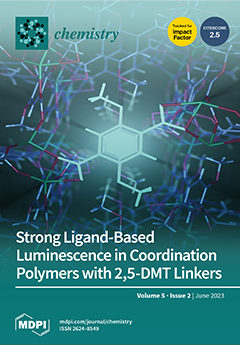
Cover Story: Luminescent MOFs (metal–organic frameworks) have been proven to be promising materials for sensory applications, as a change in wavelength or a decrease in signal upon adsorbate uptake can be easily detected. Luminescence can be either metal- or linker-based, including ligand-to-metal (LMCT) and metal-to-ligand charge transfer (MLCT) processes. There is a large number of publications in this field, but linker-based luminescence has been investigated to a much lower extent, even though it contains many promising perspectives due to direct interaction between the linker and the adsorbate, which should in principle lead to higher sensitivity. In this context, we present our investigations on four coordination polymers and MOFs with the 2,5-DMT ligand (2,5-dimethoxyterephthalate), with three of them showing strong ligand-based luminescence. View this paper
  • Issues are regarded as officially published after their release is announced to the table of contents alert mailing list .
  • You may sign up for email alerts to receive table of contents of newly released issues.
  • PDF is the official format for papers published in both, html and pdf forms. To view the papers in pdf format, click on the "PDF Full-text" link, and use the free Adobe Reader to open them.

Articles (51)

  • Article
  • Open Access
1 Citations
2,740 Views
12 Pages

23 May 2023

Large biomolecules often have multiple intramolecular hydrogen bonds. In the cases where these interact, it requires special tools to disentangle the patterns. Such a tool could be deuterium isotope effects on chemical shifts. The use of theoretical...

  • Feature Paper
  • Article
  • Open Access
10 Citations
3,408 Views
15 Pages

Fe Doping Enhances the Peroxidase-Like Activity of CuO for Ascorbic Acid Sensing

  • Boyu Yan,
  • Ying Yang,
  • Yinyun Xie,
  • Jinzhao Li and
  • Kun Li

23 May 2023

Although significant advances have been witnessed in the application of nanozymes in recent years, exploring new strategies to enhance the enzyme-like activity of nanozymes is of urgent importance. Herein, we investigate the feasibility of accelerati...

  • Article
  • Open Access
4 Citations
3,884 Views
14 Pages

On the Redox Equilibrium of TPP/TPPO Containing Cu(I) and Cu(II) Complexes

  • Stephanie L. Faber,
  • Nesrin I. Dilmen and
  • Sabine Becker

17 May 2023

Copper(II) clusters of the type [CuII4OCl6L4] (L = ligand or solvent) are a well-studied example of inverse coordination compounds. In the past, they have been studied because of their structural, magnetic, and spectroscopic features. They have long...

  • Article
  • Open Access
1 Citations
3,237 Views
17 Pages

17 May 2023

A new synthetic route to 1H-1,2,3-triazole-4,5-dithiols (tazdtH2) as ligands for the coordination of NiII, PdII, PtII and CoIII via the dithiolate unit is presented. Different N-protective groups were introduced with the corresponding azide via a cli...

  • Article
  • Open Access
1 Citations
3,396 Views
15 Pages

17 May 2023

The dehydroaromatization of methane (MDA) is of great interest as a promising process for processing natural and associated petroleum gases, the main component of which is methane. The rapid loss of catalyst activity because of coke formation hinders...

  • Article
  • Open Access
8 Citations
2,702 Views
13 Pages

Modification of the Bridging Unit in Luminescent Pt(II) Complexes Bearing C^N*N and C^N*N^C Ligands

  • Stefan Buss,
  • María Victoria Cappellari,
  • Alexander Hepp,
  • Jutta Kösters and
  • Cristian A. Strassert

15 May 2023

In this work, we explored the synthesis and characterization of Pt(II) complexes bearing different tri- and tetradentate luminophores acting as C^N*N- and C^N*N^C-chelators. Thus, we investigated diverse substitution patterns in order to improve thei...

  • Article
  • Open Access
2,118 Views
10 Pages

12 May 2023

Radical translocation reactions are finding various uses in organic synthesis, in particular the stereospecific formation of complex natural products. In this work, the syntheses and single-crystal structures of two substituted 2-iodo-phenyl methyl-a...

  • Article
  • Open Access
1 Citations
2,923 Views
13 Pages

11 May 2023

A styrylpyridine-containing cyclophane with diethylenetriamine linkers is presented as a host system whose association with representative nucleotides was examined with photometric and fluorimetric titrations. The spectrometric titrations revealed th...

  • Article
  • Open Access
2 Citations
3,425 Views
17 Pages

10 May 2023

While the use of l-proline-derived peptides has been proven similarly successful with respect to enantioselectivity, the physico-chemical and conformational properties of these organocatalysts are not fully compatible with transition state and interm...

  • Article
  • Open Access
3 Citations
3,162 Views
13 Pages

Tweaking of Peripheral Moieties in Catalytic Amyloid for Modulating Hydrogel Strength and Hydrolase Activity

  • Soumya Patra,
  • Nimisha A. Mavlankar,
  • Lakshminarayan Ramesan,
  • Ashmeet Singh and
  • Asish Pal

10 May 2023

The de novo design and synthesis of peptide-based biocatalysts that can mimic the activity of natural enzymes is an exciting field with unique opportunities and challenges. In a natural enzyme, the active site is composed of an assembly of different...

of 6

Get Alerted

Add your email address to receive forthcoming issues of this journal.

XFacebookLinkedIn
Chemistry - ISSN 2624-8549