



Next Issue
Volume 9, August
Previous Issue
Volume 9, June


Ceramics, Volume 9, Issue 7 (July 2026) – 9 articles
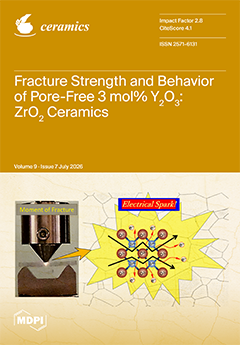
Cover Story (view full-size image): In general, fracture in ceramics originates at microstructural defects such as voids, resulting in linear and continuous crack propagation. In zirconia where voids have been completely eliminated, no intrinsic fracture origins remain. Consequently, a greater amount of fracture energy can be stored within the material before fracture. When the accumulated energy reaches the critical limit, fracture does not proceed from a single origin. Instead, a finite volume of the material collapses simultaneously into fine fragments. Within this region, lattice bonds are ruptured almost instantaneously, releasing a large number of shared electrons. The sudden emission of these electrons generates intense electrical discharges, which appear as bright fracture-induced sparks. View this paper
  • Issues are regarded as officially published after their release is announced to the table of contents alert mailing list.
  • You may sign up for e-mail alerts to receive table of contents of newly released issues.
  • PDF is the official format for papers published in both, html and pdf forms. To view the papers in pdf format, click on the "PDF Full-text" link, and use the free Adobe Reader to open them.
Order results
Result details
Select all
Export citation of selected articles as:
20 pages, 3755 KB  
Article
Development of an IoT-Based Control and Monitoring System for Industrial Ceramic Stamping and Painting Processes
by Benchalak Muangmeesri, Sekporn Tansripraparsiri, Sasithorn Khonthon, Sirima Emwong and Dechrit Maneetham
Ceramics 2026, 9(7), 72; https://doi.org/10.3390/ceramics9070072 - 21 Jul 2026
Viewed by 551
Abstract
Thailand’s ceramic manufacturing tradition possesses a long and distinguished history, reflecting the nation’s rich cultural heritage, artistic excellence, and capacity for technological adaptation. Traditional Thai ceramics extend beyond their functional purposes, serving as important expressions of indigenous knowledge, craftsmanship, social values, and religious [...] Read more.
Thailand’s ceramic manufacturing tradition possesses a long and distinguished history, reflecting the nation’s rich cultural heritage, artistic excellence, and capacity for technological adaptation. Traditional Thai ceramics extend beyond their functional purposes, serving as important expressions of indigenous knowledge, craftsmanship, social values, and religious beliefs that have been transmitted across generations. While preserving their distinctive Thai characteristics, these ceramic traditions have continuously evolved through cultural exchanges with neighboring civilizations, particularly China and India, as well as later influences from the West. Among the various decorative techniques employed in Thai ceramics, stamping and hand-painted ornamentation are recognized as two of the most significant methods, contributing to the aesthetic and cultural value of ceramic works. These techniques enable ceramic products to embody both artistic expression and practical functionality by harmoniously integrating aesthetic design with reliable craftsmanship. In contemporary manufacturing environments, traditional stamping and painting methods are increasingly integrated with semi-automated processes and advanced ceramic machinery to enhance production efficiency while preserving cultural authenticity. This study proposes an Internet of Things (IoT)-based control system for ceramic stamping and painting machines, designed to support remote operation, real-time monitoring, and performance evaluation, with particular attention given to response time and error characteristics. By incorporating sensors, controllers, and networked communication technologies into ceramic manufacturing equipment, the proposed system establishes a meaningful connection between intelligent automation and traditional artistic practices. Full article
(This article belongs to the Special Issue Advances in Ceramics, 3rd Edition)
►▼ Show Figures

Figure 1

19 pages, 14933 KB  
Article
Phosphate-Activated Fayalite-Based Geopolymer Foam
by Aleksandar Nikolov, Mihail Tarassov, Liliya Tsvetanova, Zlatka Delcheva, Nicolai Jordanov, Nikolay Velinov and Ivan Rostovsky
Ceramics 2026, 9(7), 71; https://doi.org/10.3390/ceramics9070071 - 17 Jul 2026
Viewed by 528
Abstract
This study presents the development of a one-part phosphate-activated geopolymer foam based on fayalite flotation residue from the copper industry. The solid activator consisted of triple superphosphate, enabling a dry-mix binder that requires only water addition prior to use. Foamed materials were characterized [...] Read more.
This study presents the development of a one-part phosphate-activated geopolymer foam based on fayalite flotation residue from the copper industry. The solid activator consisted of triple superphosphate, enabling a dry-mix binder that requires only water addition prior to use. Foamed materials were characterized by XRD, FTIR, Mössbauer spectroscopy, DSC-TG, hot-stage microscopy, SEM-EDX and physical and mechanical testing. The foaming of the geopolymer reduced the densities between 0.753 and 2.15 g/cm3, relative porosities up to 73.6%, and compressive strengths ranging from 1.4 to 28.8 MPa. The foamed geopolymer maintained dimensional stability up to about 1000 °C. The thermal conductivity coefficient measured on large-sized specimen blocks was 0.099 W/mK at a density of 0.753 g/cm3. These results demonstrate that fayalite slag can be effectively utilized as a precursor for sustainable geopolymer foams combining low thermal conductivity, high thermal stability, and the utilization of industrial by-products. Full article
(This article belongs to the Special Issue The Production Processes and Applications of Geopolymers, 2nd Edition)
►▼ Show Figures

Graphical abstract

11 pages, 1451 KB  
Article
Fabrication of Pomegranate-Shaped Silicon Microparticles Using Ultrasonic Spray Pyrolysis
by Seung-Hwan Son, Seok-Hyeon Lee, Kwang-Taek Hwang, Jung-Hoon Choi, Jin-Ho Kim, Ung-Soo Kim and Kyu-Sung Han
Ceramics 2026, 9(7), 70; https://doi.org/10.3390/ceramics9070070 - 16 Jul 2026
Viewed by 466
Abstract
Silicon nanoparticles have attracted considerable attention as high-capacity anode materials for lithium ion batteries. However, the high specific surface area of nanoparticles results in excessive formation of the solid electrolyte interphase, leading to limitations in achieving high energy density. To overcome these limitations, [...] Read more.
Silicon nanoparticles have attracted considerable attention as high-capacity anode materials for lithium ion batteries. However, the high specific surface area of nanoparticles results in excessive formation of the solid electrolyte interphase, leading to limitations in achieving high energy density. To overcome these limitations, pomegranate-shaped silica microparticles composed of aggregated silica nanoparticles were prepared using ultrasonic spray pyrolysis. Spherical silica nano sols with sizes ranging from 60 to 90 nm were employed as a precursor for the ultrasonic spray pyrolysis, yielding pomegranate-shaped silica microparticles. Subsequent magnesiothermic reduction and acid leaching converted silica into the silicon phase. The resulting silicon microparticles maintained a mean particle size of 2.37 μm with an average internal pore diameter of approximately 30 nm, preserving the structural morphology. Electrochemical evaluation revealed initial charge and discharge capacities of 3179 and 2416 mAh g−1, respectively. After 50 cycles, the discharge capacity stabilized at 500.9 mAh g−1. Full article
(This article belongs to the Special Issue Advances in Ceramics, 3rd Edition)
►▼ Show Figures

Graphical abstract

12 pages, 5281 KB  
Article
Luminescence Properties in a New Dy3+-Doped Self-Activated Vanadate Sr2NaMg2V3O12 Phosphor
by Yuan Tu, Jiawen Li, Chaoyong Deng and Min Zhang
Ceramics 2026, 9(7), 69; https://doi.org/10.3390/ceramics9070069 - 10 Jul 2026
Viewed by 566
Abstract
A novel Dy3+-doped self-activated Sr2NaMg2V3O12 (SNMVO) phosphor was synthesized via a high-temperature solid-state reaction method. Its microstructure, surface morphology, valence state, and luminescence properties were investigated. The results showed that the prepared phosphor exhibited [...] Read more.
A novel Dy3+-doped self-activated Sr2NaMg2V3O12 (SNMVO) phosphor was synthesized via a high-temperature solid-state reaction method. Its microstructure, surface morphology, valence state, and luminescence properties were investigated. The results showed that the prepared phosphor exhibited bright green emission at 521 nm and yellow emission at 575 nm under 345 nm excitation. The luminescence intensity showed a strong concentration dependence, with an optimal Dy3+ ion doping concentration of 0.05 mol, and the concentration quenching (CQ) mechanism was dipole–dipole (d-d) interaction. Energy transfer between vanadate and Dy3+ was observed, with a maximum transfer efficiency of 63.5%. The thermal activation energy (0.1859 eV) indicated good thermal stability. Furthermore, this phosphor can be used as a yellow phosphor for white light-emitting diodes (wLEDs) and for anti-counterfeiting patterns. Full article
(This article belongs to the Special Issue Advances in Ceramics, 3rd Edition)
►▼ Show Figures

Figure 1

21 pages, 9204 KB  
Article
Finite Element Modeling of Ceramic Green Part Warping Induced by Shrinkage During the Stereolithography Printing Process
by Dylan Vallet, Philippe Michaud, Yaasin Mayi, Wen Zhang and Vincent Pateloup
Ceramics 2026, 9(7), 68; https://doi.org/10.3390/ceramics9070068 - 2 Jul 2026
Cited by 1 | Viewed by 661
Abstract
The shrinkage strain, occurring upon UV curing and aging, leads to non-uniform dimensional changes that can compromise the part’s final geometry. This study investigates the deformation of green parts during the stereolithography process. Based on experimental measurements, a finite element model (FEM) is [...] Read more.
The shrinkage strain, occurring upon UV curing and aging, leads to non-uniform dimensional changes that can compromise the part’s final geometry. This study investigates the deformation of green parts during the stereolithography process. Based on experimental measurements, a finite element model (FEM) is developed to account for different phenomena contributing to the structural distortion of the part, like polymerization shrinkage and the adhesion between the part and the build platform during printing. In addition, the time dependency of the degree of conversion is also considered to integrate the aging of green parts, and elastoplastic material behavior is also considered to include non-reversible deformations. This novel model makes it possible to predict stress generation during the stereolithography process and simulate part warping over time. The resulting simulations provided a numerical validation for part shapes observed experimentally, as well as insights to better understand the deformation mechanisms and optimize the dimensional fidelity of stereolithography-manufactured components. Full article
(This article belongs to the Special Issue Advances in Ceramics, 3rd Edition)
►▼ Show Figures

Graphical abstract

22 pages, 5834 KB  
Article
Thermophysical–Infrared Emission Synergistic Optimization Mechanism of Sc2O3–CeO2 Co-Doped YSZ Ceramics
by Chenxi Xia, Min Xie, Bianlei Hao, Yonghe Zhang, Congru Peng, Lele Du, Zhigang Wang, Rende Mu and Xiwen Song
Ceramics 2026, 9(7), 67; https://doi.org/10.3390/ceramics9070067 - 30 Jun 2026
Viewed by 375
Abstract
Conventional 8YSZ thermal barrier ceramics suffer from limited phase stability and insufficient infrared radiation regulation at high temperatures. Sc2O3 doping can reduce thermal conductivity and improve phase stability, but the improvement remains limited because the fixed-valence substitution of Sc3+ [...] Read more.
Conventional 8YSZ thermal barrier ceramics suffer from limited phase stability and insufficient infrared radiation regulation at high temperatures. Sc2O3 doping can reduce thermal conductivity and improve phase stability, but the improvement remains limited because the fixed-valence substitution of Sc3+ cannot effectively increase defect concentration or regulate carrier behavior. In this work, CeO2 with tunable valence states was incorporated into the Sc-stabilized YSZ system to realize the synergistic modulation of lattice thermal conductivity and photon thermal conductivity. A series of Sc2O3–CeO2 co-doped YSZ ceramics were fabricated via solid-state sintering, and the effects of co-doping on phase structure, defect evolution, thermal conductivity, infrared emissivity, and bandgap characteristics were systematically investigated. The results show that all co-doped samples maintained a stable tetragonal fluorite structure with relative densities higher than 96%. Among them, Sc0.08Ce0.005Y0.005Zr0.91O2 exhibited the best comprehensive performance. Its thermal conductivity at 1000 °C reached 2.073 W·m−1·K−1, which was 11.9% lower than that of conventional 8YSZ. Meanwhile, the average infrared emissivity in the 3–5 μm band increased to 0.779. XPS analysis indicated that Ce incorporation promoted oxygen-vacancy formation, which enhanced phonon scattering and reduced lattice thermal conductivity. In addition, co-doping narrowed the band gap and facilitated carrier excitation, thereby strengthening infrared absorption and emission behavior. The enhanced infrared emissivity further contributed to the suppression of radiative thermal transport at elevated temperatures. This work demonstrates that Sc2O3–CeO2 co-doping provides an effective strategy for simultaneously regulating phonon transport and photon transport in YSZ-based ceramics. The results provide new insight into the design of advanced thermal barrier materials with low thermal conductivity and enhanced high-temperature infrared radiation performance. Full article
►▼ Show Figures

Figure 1

16 pages, 10589 KB  
Article
Clay-Based Filter for Industrial Liquid Purification and Separation
by Maja Kokunešoski, Zivan Gojkovic and Jovana Ružić
Ceramics 2026, 9(7), 66; https://doi.org/10.3390/ceramics9070066 - 26 Jun 2026
Viewed by 992
Abstract
Clay, as a sediment material, is an attractive option for the production of porous ceramics due to its low price and high abundance. Porous ceramics possess a combination of essential properties of clay-based materials, including high porosity and thermal and chemical stability, making [...] Read more.
Clay, as a sediment material, is an attractive option for the production of porous ceramics due to its low price and high abundance. Porous ceramics possess a combination of essential properties of clay-based materials, including high porosity and thermal and chemical stability, making them suitable for various industrial applications, such as filters, heat insulators, and absorbents. In this study, thermally and chemically purified clay was mixed with boric acid as a pore-forming agent. Obtained results reveal that different contents of boric acid (2 wt.% and 0.5 wt.%) and variations in synthesis conditions, including low pressing pressures up to 60 MPa and low sintering temperatures of 1150 °C and 1300 °C, optimize the production of a filter medium with good separation and mechanical properties. Further, these findings indicate that an adequate combination of boric acid content and synthesis conditions positively affects mechanical properties, including values of hardness, Young’s modulus, compressive and tensile strength of clay-based filters. The clay-based filter with 2 wt.% boric acid exhibited a larger maximum pore diameter of nearly 0.2 mm, compared to the one with 0.5 wt.% boric acid. The filtering efficiencies of both filters were tested on pharmaceutical-grade ciprofloxacin with removal efficiency above 80% for two tested concentrations (6 μM and 9 μM). Full article
►▼ Show Figures

Figure 1

38 pages, 20094 KB  
Article
Sustainable Ceramic Tiles from Recycled Glass and Bentonite: Microstructure, Properties and Energy-Efficient Processing
by Farid Lachibi, Djamila Aboutaleb, Cristina Siligardi, Peter Futas, Catrina Sgarlata, Brahim Safi, Alena Pribulová and Mariusz Łucarz
Ceramics 2026, 9(7), 65; https://doi.org/10.3390/ceramics9070065 - 23 Jun 2026
Viewed by 909
Abstract
This study aims to develop eco-efficient ceramic tiles through the valorization of recycled glass (GW; soda–lime glass cullet) as a partial raw material substituent, enabling a reduction in sintering temperature and, consequently, a decrease in thermal energy demand, carbon-equivalent emissions, and the depletion [...] Read more.
This study aims to develop eco-efficient ceramic tiles through the valorization of recycled glass (GW; soda–lime glass cullet) as a partial raw material substituent, enabling a reduction in sintering temperature and, consequently, a decrease in thermal energy demand, carbon-equivalent emissions, and the depletion of virgin mineral resources. Ceramic tiles were elaborated by partially substituting natural bentonite with 30–50 wt.% GW and fired at 900 °C and 950 °C. Use of GW promoted liquid-phase sintering, driving significant densification evidenced by a marked reduction in open porosity and water absorption. SEM images confirm a denser, more homogeneous structure with reduced porosity, leading to improved mechanical strength and chemical durability. Compositions containing 30–35 wt.% bentonite exhibit the most optimized microstructure, characterized by well-dispersed crystalline phases embedded within a dense vitreous matrix. These findings demonstrate that high-performance ceramic tiles meeting standard classification thresholds can be manufactured at sub-1000 °C firing temperatures through judicious incorporation of recycled glass waste. This approach offers a viable pathway toward reduced energy consumption, diminished reliance on primary mineral resources, and enhanced circularity within the construction ceramics industry. Full article
►▼ Show Figures

Figure 1

10 pages, 4971 KB  
Article
Fracture Strength and Behavior of Pore-Free 3 mol% Y2O3:ZrO2 Ceramics
by Akio Ikesue and Yan Lin Aung
Ceramics 2026, 9(7), 64; https://doi.org/10.3390/ceramics9070064 - 23 Jun 2026
Viewed by 650
Abstract
Hot isostatic pressing (HIP) was employed to fabricate 3 mol% Y2O3-stabilized ZrO2 ceramics with nearly pore-free microstructures. Zirconia ceramics containing residual pores (size: ~0.3 μm, <0.1%) exhibited a four-point bending strength of 1.11 GPa. In contrast, pore-free specimens [...] Read more.
Hot isostatic pressing (HIP) was employed to fabricate 3 mol% Y2O3-stabilized ZrO2 ceramics with nearly pore-free microstructures. Zirconia ceramics containing residual pores (size: ~0.3 μm, <0.1%) exhibited a four-point bending strength of 1.11 GPa. In contrast, pore-free specimens achieved significantly higher strengths of 1.74 GPa for samples containing a small fraction of cubic grains and 2.29 GPa for specimens composed solely of the tetragonal phase. At the moment of fracture in the high-strength specimens, intense electrical discharges (visible sparks) were observed near the fracture origin. Post-fracture observations revealed that zirconia containing residual pores fractured into two pieces with relatively smooth fracture surfaces, whereas pore-free zirconia exhibited extensive fragmentation, producing highly irregular fracture surfaces. This behavior is likely associated with extensive rupture of Zr–O bonds within the crystal lattice during catastrophic fracture. These results demonstrate that the elimination of residual pores by HIP markedly enhances the attainable strength of zirconia ceramics and significantly alters their fracture behavior. Full article
(This article belongs to the Special Issue Advances in Ceramics, 3rd Edition)
►▼ Show Figures

Figure 1

Previous Issue
Next Issue
Back to TopTop
