Article

Phosphate-Activated Fayalite-Based Geopolymer Foam

1
Institute of Mineralogy and Crystallography, Bulgarian Academy of Sciences, Acad. G. Bonchev Str., bl. 107, 1113 Sofia, Bulgaria
2
Institute for Physical Chemistry, Bulgarian Academy of Sciences, Acad. G. Bonchev Str., Bl. 11, 1113 Sofia, Bulgaria
3
Institute of Catalysis, Bulgarian Academy of Sciences, Acad. G. Bonchev Str., bl. 11, 1113 Sofia, Bulgaria
4
Department of Building Materials and Insulations, Faculty of Civil Engineering, University of Architecture, Civil Engineering and Geodesy, blvd. “Hristo Smirnenski” 1, 1046 Sofia, Bulgaria
*
Author to whom correspondence should be addressed.
Ceramics 2026, 9(7), 71; https://doi.org/10.3390/ceramics9070071
Submission received: 11 June 2026 / Revised: 10 July 2026 / Accepted: 14 July 2026 / Published: 17 July 2026
(This article belongs to the Special Issue The Production Processes and Applications of Geopolymers, 2nd Edition)

Abstract

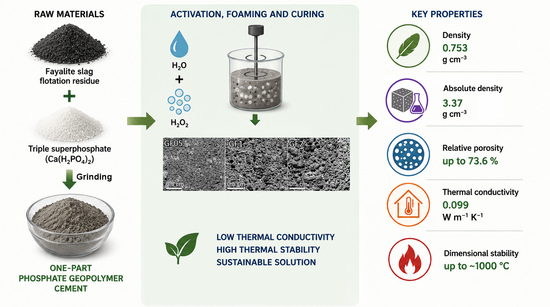
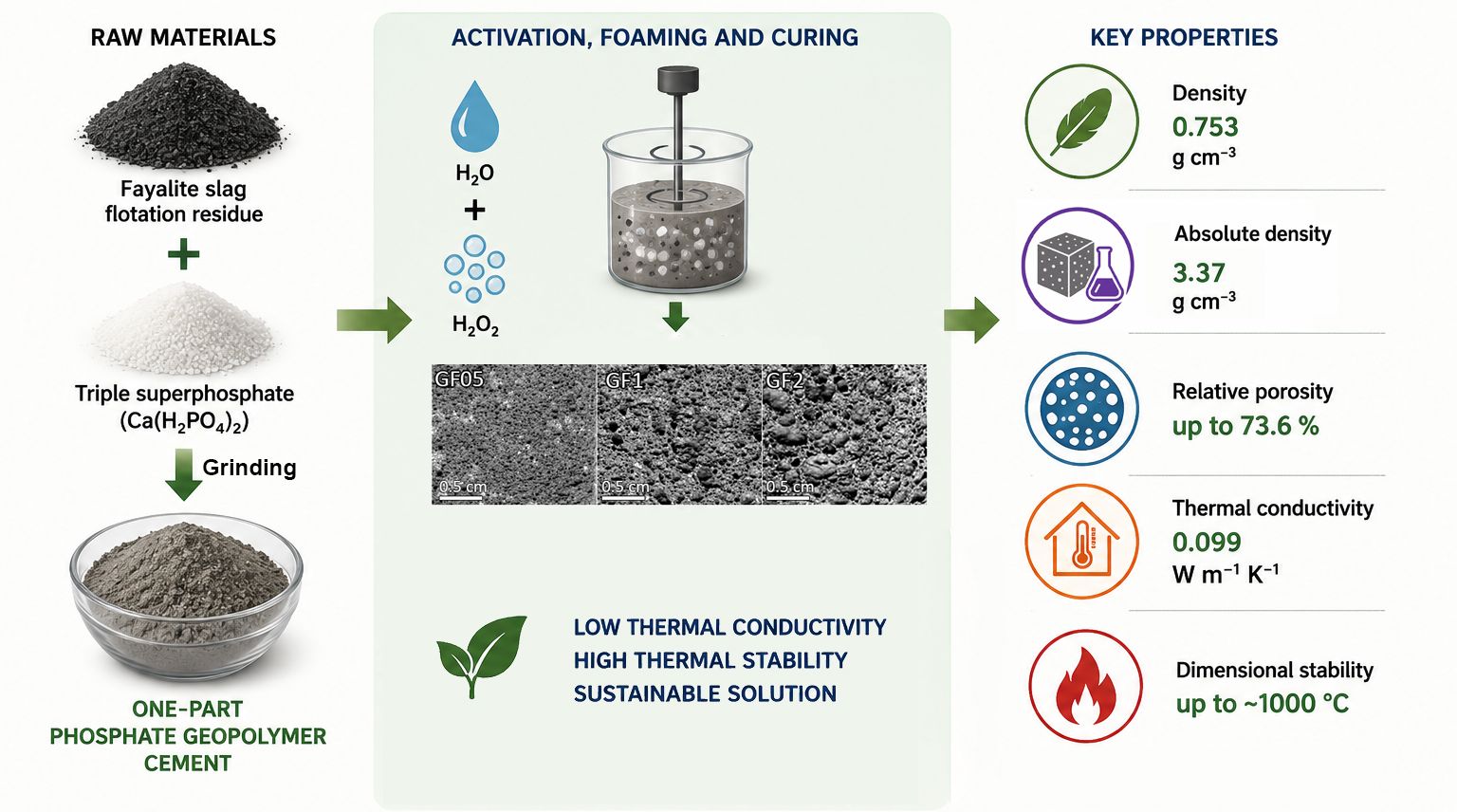
This study presents the development of a one-part phosphate-activated geopolymer foam based on fayalite flotation residue from the copper industry. The solid activator consisted of triple superphosphate, enabling a dry-mix binder that requires only water addition prior to use. Foamed materials were characterized by XRD, FTIR, Mössbauer spectroscopy, DSC-TG, hot-stage microscopy, SEM-EDX and physical and mechanical testing. The foaming of the geopolymer reduced the densities between 0.753 and 2.15 g/cm3, relative porosities up to 73.6%, and compressive strengths ranging from 1.4 to 28.8 MPa. The foamed geopolymer maintained dimensional stability up to about 1000 °C. The thermal conductivity coefficient measured on large-sized specimen blocks was 0.099 W/mK at a density of 0.753 g/cm3. These results demonstrate that fayalite slag can be effectively utilized as a precursor for sustainable geopolymer foams combining low thermal conductivity, high thermal stability, and the utilization of industrial by-products.

Graphical Abstract

1. Introduction

The construction sector faces growing pressure to reduce greenhouse gas emissions and dependence on primary raw materials. Although cement and concrete are irreplaceable for modern infrastructure, their production contributes substantially to global carbon emissions, driving the search for low-carbon alternatives [1]. Consequently, considerable research efforts have focused on the development of alternative inorganic binders derived from industrial by-products and secondary resources. Among these materials, geopolymers have attracted extensive attention because of their low-temperature synthesis, superior properties, chemical and thermal stability, and possibility to utilize large amounts of industrial waste [2,3,4]. The development of geopolymers has been largely associated with alkali activation of aluminosilicate precursors, resulting in a substantial body of literature on alkali-activated systems and a comparatively limited understanding of their acid-activated counterparts [5]. However, phosphoric acid-based geopolymers have recently attracted increasing attention due to their high thermal stability up to 1550 °C, reduced efflorescence, chemical resistance, high early strength and ultimate strength [6,7,8].
Acid-activated geopolymers are produced by activating aluminosilicate precursors with phosphate-based activators, resulting in the formation of a three-dimensional aluminosilicate–phosphate network through polycondensation reactions [9]. Similar or the same materials have also been described as chemically bonded phosphate ceramics [10] or aluminosilicate phosphate cements [11]. The reaction mechanism is analogous to alkali activation and involves the dissolution of the precursor followed by polycondensation and the formation of phosphate-containing inorganic polymer networks dominated by Si-O-P-O-Al and Al-O-P bonds [12,13]. The most commonly used precursors include calcined clays [9,14], fly ashes [15,16], iron-rich metallurgical slags [17,18] and other aluminosilicate-rich industrial by-products [5,19,20]. Phosphoric acid is the most widely used acid activator, although highly reactive precursors may induce rapid and strongly exothermic reactions. Phosphate salts are often used to obtain a more controlled reaction: NaH2PO4, KH2PO4, [21,22] and Ca(H2PO4)2 [23]. Furthermore, using alternative sources of dry phosphates enables the development of one-part phosphate geopolymer systems which offer many technological benefits [24]. Our previous study demonstrated the feasibility of producing a one-part phosphate-based geopolymer from fayalite slag and dry phosphate fertilizer, thereby eliminating the need for handling concentrated phosphoric acid solutions [23]. The growing diversity of precursors and activators has significantly broadened the scope of phosphate geopolymers and their potential applications.
In recent years, porous geopolymers and geopolymer foams have emerged as particularly promising materials for sustainable building applications combining low density, thermal insulation and fire resistance properties [25,26,27]. Porous geopolymer systems are typically produced through chemical or mechanical foaming methods. Chemical, also known as direct, foaming is most commonly achieved using hydrogen peroxide, aluminum powder or metallic foaming agents that release gases during the setting process [28,29]. Direct foaming was also found to be promising in acid-activated geopolymer systems. Among the mentioned foaming agents, alkaline compounds such as waste marble dust, limestone, and sugar beet lime residue in acid-activated phosphate systems also produce foaming [30,31,32]. Recent studies demonstrated that phosphoric acid-activated metakaolin-based geopolymer foams synthesized using hydrogen peroxide exhibit low thermal conductivity and exceptional fire resistance, reporting that the foams maintained reverse-side temperatures near 220 °C after exposure to a direct 1100 °C flame for 2 h [33]. Similarly, Jouin et al. [34] produced insulating phosphoric acid-based geopolymer foams with thermal conductivity values between 61 and 75 mW m−1 K−1 while retaining structural stability after freeze–thaw cycling and exposure to 1200 °C. However, most currently available studies of acid-activated geopolymer foams are focused on metakaolin-based systems, whereas other potential precursors such as industrial wastes remain insufficiently explored.
Among industrial by-products, fayalite slag generated during copper production represents a significant secondary resource with high potential for geopolymer production [35,36]. Previous investigations demonstrated that fayalite slag mixed with metakaolin can be successfully activated under alkaline conditions to produce dense materials with high strength and thermal resistance up to 1150 °C [37]. The high-strength geopolymer paste was subsequently used to produce the first alkali-activated fayalite-based geopolymer foams [38]. The high iron content of fayalite slag results in a high-specific-gravity geopolymer paste, making the formation and stabilization of the cellular structure challenging. At the same time, this characteristic makes foaming especially attractive, as it can substantially reduce the density of an otherwise heavy geopolymer while improving its thermal insulation performance. On the other hand, acid activation of fayalite slag was explored and found to have several advantages, including rapid setting, high fayalite utilization and one-part cement preparation [18,23]. To the best of our knowledge, no studies have reported the production of phosphate-based geopolymer foams using fayalite slag.
The present study investigates a previously developed one-part phosphate geopolymer cement based on fayalite slag floatation residue as a matrix for lightweight insulating foam. The effects of foaming on the density, porosity, microstructure, mechanical properties, thermal conductivity, thermal stability, and fire resistance were therefore investigated to assess the potential of copper industry residues as precursors for sustainable lightweight construction materials.

2. Materials and Methods

The main geopolymer precursor used in this study was a fayalite-dominated copper slag flotation residue, commercially known as iron silicate fines, generated during the flotation treatment of copper smelting slags from furnace and converter operations at Aurubis Bulgaria (Pirdop, Bulgaria). The activator used in this study was triple superphosphate (TSP), a commercially available granulated phosphate fertilizer containing 46 wt.% water-soluble P2O5, supplied by Agropolychim AD (Devnya, Bulgaria). The chemical composition of the used TSP was reported previously [23]. The use of a solid phosphate activator enables the development of one-part geopolymer systems, where water is added directly before mixing, similarly to conventional Portland cement-based materials. The one-part geopolymer phosphate cement was prepared by co-grinding the fayalite slag flotation residue and TSP in a ceramic ball mill for 2.5 h. This step is essential to homogenize and mechanically activate the mixture, producing a homogeneous and reactive one-part binder. A fayalite slag-to-TSP mass ratio of 10:3 was adopted based on the results of earlier investigations [23]. The particle size distribution of the resulting material was determined using a Mastersizer 3000 laser diffraction analyzer (Malvern Panalytical, Malvern, UK) operating in dry dispersion mode.
The chemical composition of the one-part geopolymer cement and the microstructure of the geopolymer foams were studied on a ZEISS SEM EVO 25LS scanning electron microscope with an EDAX Trident system (Carl Zeiss SMT Ltd., Cambridge, UK). The one-part geopolymer cement was finely ground in an agate mortar for 20 min for better homogenization and then pressed on a pellet at a pressure of 35 bar. The obtained sample was mounted on a SEM stub, coated with carbon and then analyzed (EDX analysis) in SEM at an acceleration voltage of 18 kV using an EDAX SDD Apollo 10 EDS detector (EDAX Inc., AMETEK, Inc., Montvale, NJ, USA) and Genesis V. 6.2 software and a set of reference standards—hematite (for Fe), diopside (for Ca, Mg), sanidine (for K, Al, Si), albite (for Na, Al, Si), rutile (for Ti), rhodonite (for Mn), monazite (for P), anhydrite (for S), cuprite (for Cu), and sphalerite (for Zn). EDX spectra of the sample and the standards were obtained on scanning regime (area analysis) at 1000× magnification. The sample pellet was analyzed in 4 different areas, and the final composition was obtained as the average of the 4 area analyses. To study the microstructure of the geopolymer foams, fragments of them were mechanically broken off, mounted on the SEM holder and coated with carbon, and then examined using secondary electron (SE) and backscattered electron (BSE) at 18 kV acceleration voltage.
The phase compositions of the one-part geopolymer cement and geopolymer foams were studied using powder X-ray diffraction (XRD) analysis on an Empyrean Diffractometer system, Cu anode, 40 V, 30 mA (Malvern Panalytical, Malvern, UK). FT-IR spectra were collected from KBr pellets (13 mm diameter) containing 2 mg of sample using a JASCO 4X spectrometer (Tokyo, Japan). Measurements were performed in the mid-infrared region from 4000 to 400 cm−1 at a spectral resolution of 4 cm−1 using 64 accumulated scans.
The Mössbauer spectra were recorded at room temperature using a Wissel electromechanical spectrometer (Wissenschaftliche Elektronik GmbH, Starnberg, Germany) operating in constant acceleration mode. A57Co/Rh source with an activity of 20 mCi and an α-Fe reference standard was employed for calibration. The obtained spectra were processed and fitted with the CONFIT2000 software package (v4.12.26) [39]. The hyperfine interaction parameters, including isomer shift (δ), quadrupole splitting (ΔEq), effective internal magnetic field (B), experimental line width (Γexp), and relative spectral area (G), were determined from the fitted spectral components.
The DTA-TG-MS were performed on a SETSYS2400 analyzer, SETARAM (Caluire-et-Cuire, France), at the following conditions: a temperature range from 20 to 900 °C, in a static air atmosphere, with a heating rate of 10 °C min−1, and 10–15 mg sample weight. Simultaneous analysis of the evolved gases was performed via mass spectrometry using an OmniStar mass spectrometer (Pfeiffer Vacuum GmbH, Asslar, Germany) connected to the TG apparatus. The intensities related to the main m/z value of the following volatiles H2O (18), CO2 (44) were examined.
The physical and mechanical properties were determined using three samples from each series, with the results reported as mean values accompanied by calculated standard deviations where meaningful. The apparent density of the obtained foams was determined by the hydrostatic weighing method. The water absorption was determined by measuring their mass in the dry state and after immersion in water until constant mass was achieved. Absolute density was determined using a gas pycnometer (AccuPyc 1330, Micromeritics, Norcross, GA, USA). Prior to the measurements, the samples were ground and sieved to a particle size below 25 μm. The relative porosity was calculated from the ratio between the apparent density and the absolute density. The compressive strength of the foamed materials was determined using three cubic specimens from each series, with a loading surface area of 10 cm2. The tests were performed using an ALFA Test 200 kN universal testing machine (ALFA Testing Equipment, Ankara, Turkey) at a constant rate of 150 N s−1.
The thermal conductivity coefficient was measured under steady-state conditions using a FOX 314 Heat Flow Meter (TA Instruments, New Castle, DE, USA). The measurements were performed on oven-dried geopolymer foam specimens with dimensions of about 130 × 120 × 30 mm and polished surfaces.

3. Results

3.1. Characterization of the One-Part Fayalite-Based Geopolymer Cement

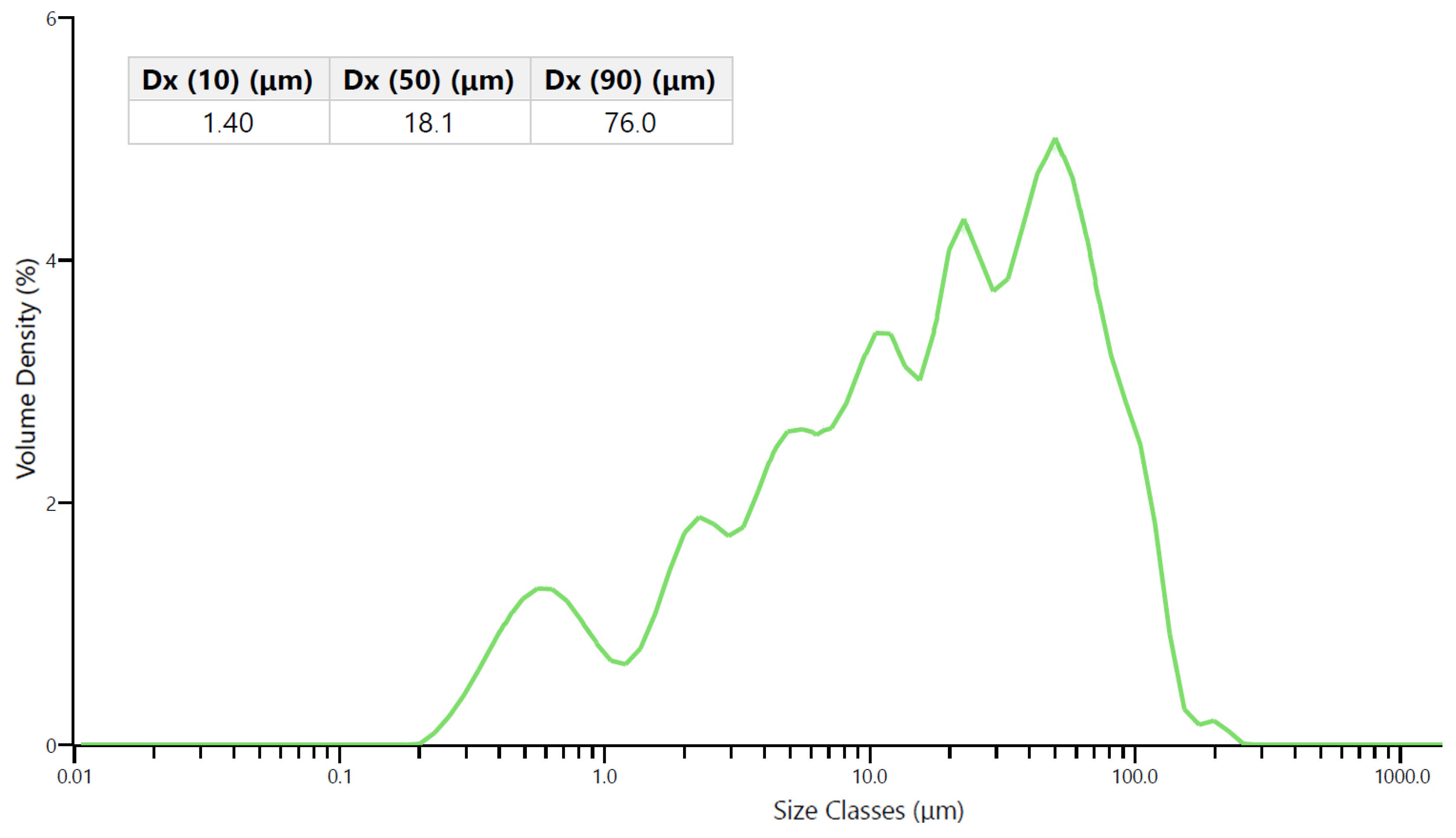
The particle size analysis of the co-ground one-part geopolymer cement based on fayalite slag floatation residue and TSP showed that 90% of the particles were below 76 μm, which is typical for cementitious materials (Figure 1). The particle size of the obtained binder is a key parameter because it directly influences the geopolymerization process by governing the reactivity, water demand, and the rheological behavior of the fresh paste. These characteristics are also expected to affect the foaming process, as paste viscosity and reaction kinetics influence gas retention, bubble growth, and the stability of the cellular structure. The particle distribution curve exhibits a broad multimodal character, indicating the presence of both fine and coarser particle fractions. The relatively low Dx(10) equal to 1.4 µm indicates the presence of a significant ultrafine fraction, which is expected to contribute to reactivity. The combination of fine and coarse particles is also expected to improve particle packing and promote a more homogeneous distribution of the solid phosphate activator throughout the matrix. The presence of coarse particles may be associated predominantly with the harder fayalite and magnetite-rich slag components or agglomerated particles [40]. However, the influence of particle size distribution on foaming kinetics was not investigated directly in the present study.
The EDX analysis showed that the one-part geopolymer cement is dominated by Fe2O3 (37.67 ± 0.88 wt.%), followed by SiO2 (21.65 ± 0.35 wt.%), P2O5 (16.63 ± 0.39 wt.%), and CaO (9.42 ± 0.18 wt.%) (Table 1). Minor constituents include Al2O3 (3.68 ± 0.17 wt.%), MgO (1.49 ± 0.05 wt.%), and SO3 (1.40 ± 0.08 wt.%), while other established components such as K2O, Na2O, TiO2, MnO, CuO and ZnO are present in concentrations below 1 wt.%.
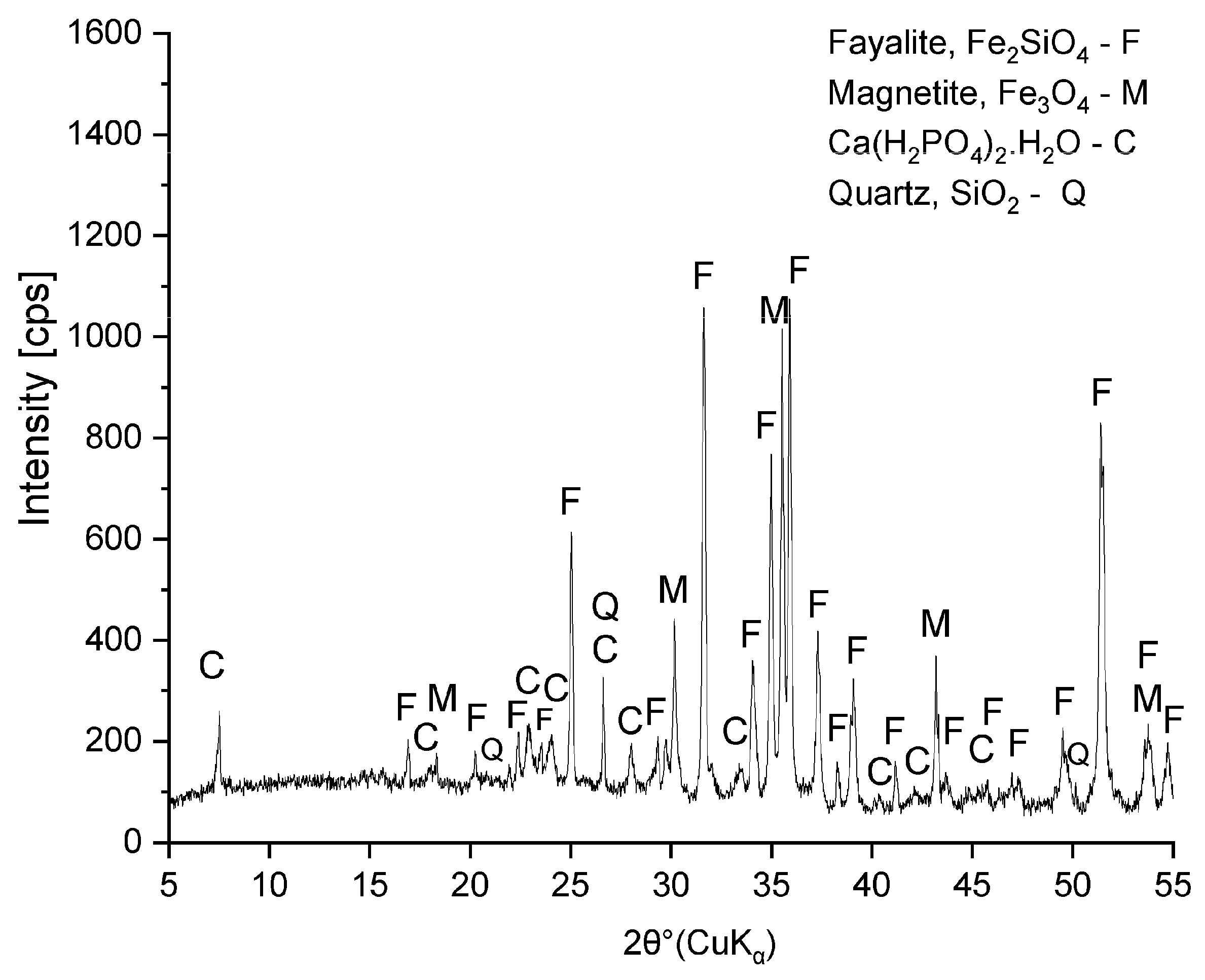
The powder X-ray diffraction pattern of the obtained one-part geopolymer cement revealed the presence of several crystalline phases inherited from both the fayalite slag precursor and the phosphate activator (Figure 2). The dominant mineral phases identified were fayalite (Fe2SiO4) and magnetite (Fe3O4), originating from the copper slag flotation residue, together with monocalcium phosphate monohydrate, Ca(H2PO4)2·H2O, derived from the triple superphosphate activator. Minor amounts of quartz were also detected.
The XRD pattern was characterized by an elevated background and significant noise signal. This effect is due to fluorescence (emission of FeKα by a material when irradiated with CuKα) due to the high iron content in the fayalite slag. The presence of Fe-rich minerals increases the fluorescent FeKα radiation under CuKα excitation, resulting in the deterioration of the signal-to-noise ratio and reduced peak resolution. Despite the fluorescence effects, the major crystalline phases could be clearly identified.

3.2. Geopolymer Foam Synthesis and Characterization

Four geopolymer series were prepared using different amounts of gas-forming agent corresponding to 0, 0.5, 1.0, and 2.0 wt.% hydrogen peroxide solution (30%). In all series, the water-to-cement ratio was fixed at 0.16. The fresh mixtures were prepared in a planetary mixer operating at a rotational speed of 285 rpm and a planetary motion speed of 125 rpm. All ingredients were initially mixed for 90 s, followed by manual scraping of the material adhering to the walls of the mixing vessel using a plastic spatula. The mixture was then subjected to an additional 30 s of mixing to ensure complete homogenization of the fresh geopolymer paste. The fresh pastes were poured into steel molds and cured under laboratory conditions at 20 °C and 60% relative humidity. In the next 20 min or so, the material expanded due to oxygen release from the gas-forming agent. After 24 h, the specimens were demoulded and further cured under laboratory conditions and unwrapped until testing.

3.3. Physical and Mechanical Properties

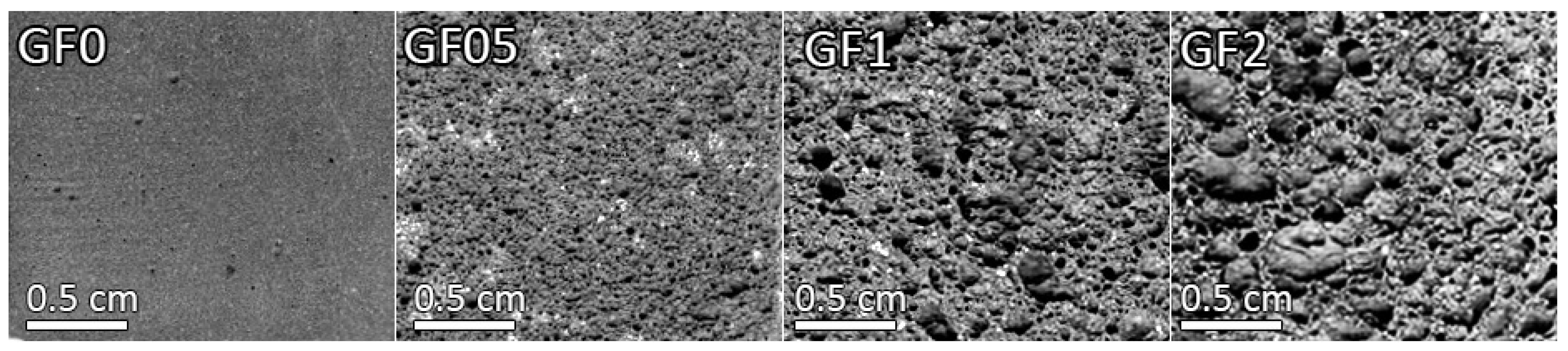
The physical and mechanical characterization of the foamed fayalite-based geopolymers revealed a strong dependence of density, porosity, water absorption, and compressive strength on the amount of gas-forming agent used during synthesis (Figure 3 and Table 2). The reference non-foamed geopolymer (GF0) exhibited an apparent density of 2.15 g cm−3 and a relative porosity of 36.2%. The moderately high porosity of the non-foamed matrix indicates that a considerable number of intrinsic pores was already generated during the mixing and hardening processes.
The introduction of the gas-forming agent resulted in a pronounced reduction in density and a simultaneous increase in total porosity. The density decreased from 2.15 g/cm3 for GF0 to 1.16, 1.02, and 0.89 g/cm3 for GF05, GF1, and GF2, respectively. Correspondingly, the relative porosity increased from 36.2% to 65.6–73.6%. The most significant decrease in density occurred at the lowest dosage of the gas-forming agent, whereas further increases produced comparatively smaller changes. This behavior suggests that pore formation becomes progressively less efficient at higher dosages, likely due to pore coalescence, the instability of larger gas bubbles, and the partial collapse of the cellular structure during setting.
Water absorption followed a similar trend to total porosity, increasing from 15.8% for the dense reference specimen to 37.0% for the most highly foamed series. High water absorption indicates the presence of interconnected pores that are accessible to water within the geopolymer matrix. Such behavior is characteristic of chemically foamed geopolymers, where gas generated in situ expands the fresh paste and commonly produces a network of interconnected macropores, in addition to isolated closed pores [28].
The development of the porous network resulted in a significant decrease in compressive strength. The non-foamed geopolymer achieved a compressive strength of 28.8 MPa, while the foamed specimens exhibited significantly lower values down to 1.4 MPa for GF2. The reduction in strength is directly associated with the increased porosity. However, the obtained materials maintained sufficient mechanical stability for potential applications as lightweight insulating and non-structural construction materials.

3.4. Powder XRD

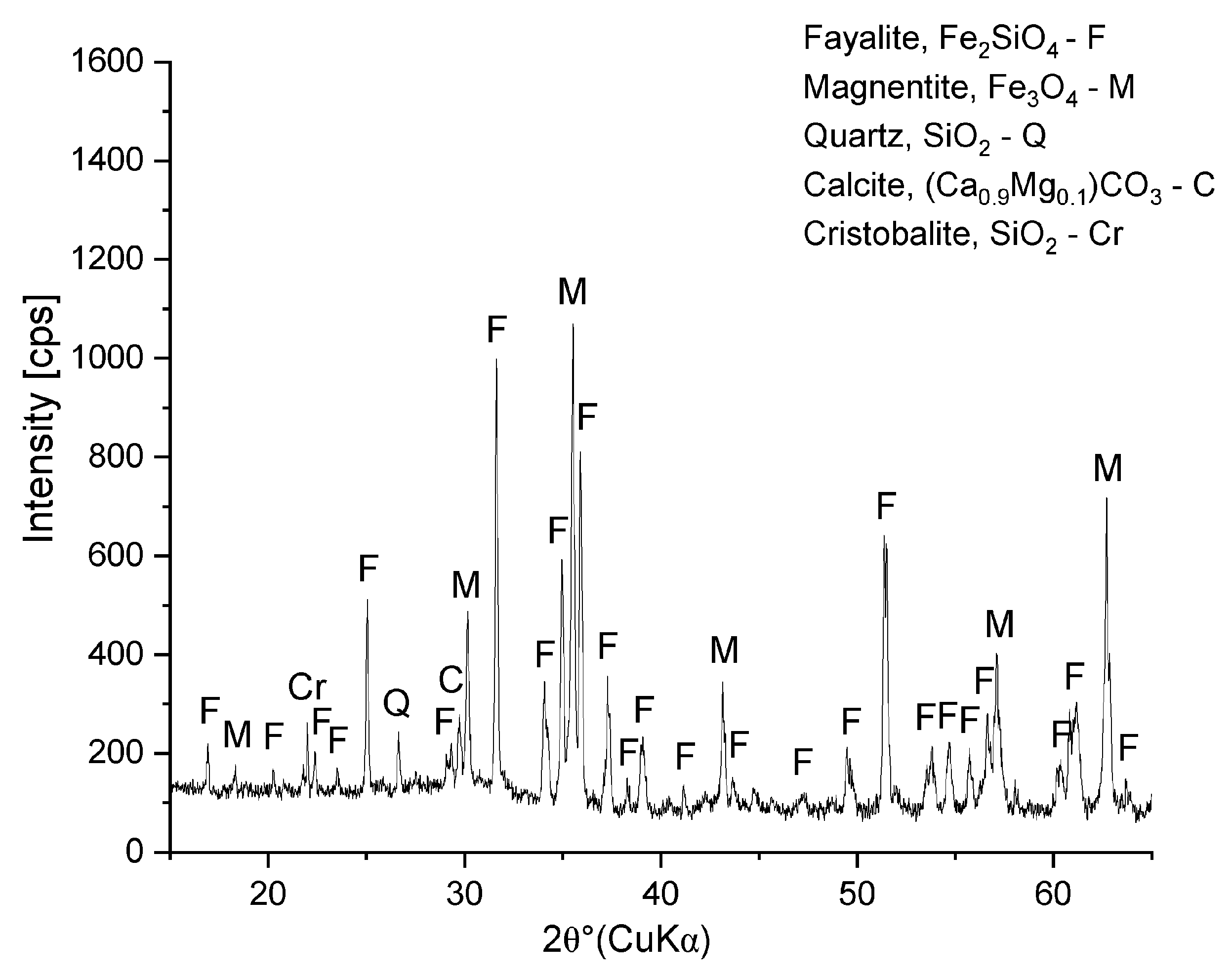
The results from powder XRD analysis on hardened geopolymer showed that the dry activator calcium monophosphate monohydrate reacted completely during hardening (Figure 4). A slight amorphous halo is observed between 25° and 40° 2θ, which is characteristic of amorphous phosphate-based geopolymer gels. No crystalline phosphate-containing reaction products, such as berlinite, dihydrogen phosphate, or phosphocristobalite, were detected [14,41]. This finding is consistent with previous studies on phosphoric acid-activated fayalite-based geopolymers [17,18].
The XRD patterns of the hardened geopolymer foams were dominated by reflections from the crystalline phases present in the fayalite slag precursor—fayalite (Fe2SiO4) and magnetite (Fe3O4)—indicating the persistence of these crystalline phases after geopolymerization. A slight reduction in the relative intensity of the fayalite reflections was observed, suggesting that a fraction of the fayalite participated in the geopolymerization reaction. Similar behavior was previously reported for both alkali- and acid-activated fayalite slag systems, where fayalite and magnetite remained largely unreacted while only a minor fraction contributed to gel formation [18,35].
Weak reflections attributed to cristobalite were also detected. This phase may originate from silica-rich constituents in the raw materials or from local structural rearrangements occurring during the hardening process.
A calcite-type carbonate phase was identified in the geopolymer foams, most likely formed through the carbonation of calcium released from the phosphate activator. The formation of carbonates is attributed to the contact with atmospheric CO2 during curing and storage. The highly porous cellular structure facilitates CO2 ingress and promotes carbonate precipitation. The main carbonate reflection at d ≈ 3.00 Å suggests the presence of a calcite with partial isomorphic substitution of calcium. Given the availability of Mg and Fe in the fayalite slag, the carbonate phase is likely a calcite–magnesite–siderite solid solution (ferroan–magnesian calcite). Nash and Pittman [42] reported that iron and magnesium readily substitute in the calcite lattice. Thus, the carbonate phases identified as magnesian calcite may correspond to ferroan–magnesian calcite.

3.5. Mossbauer Spectroscopy

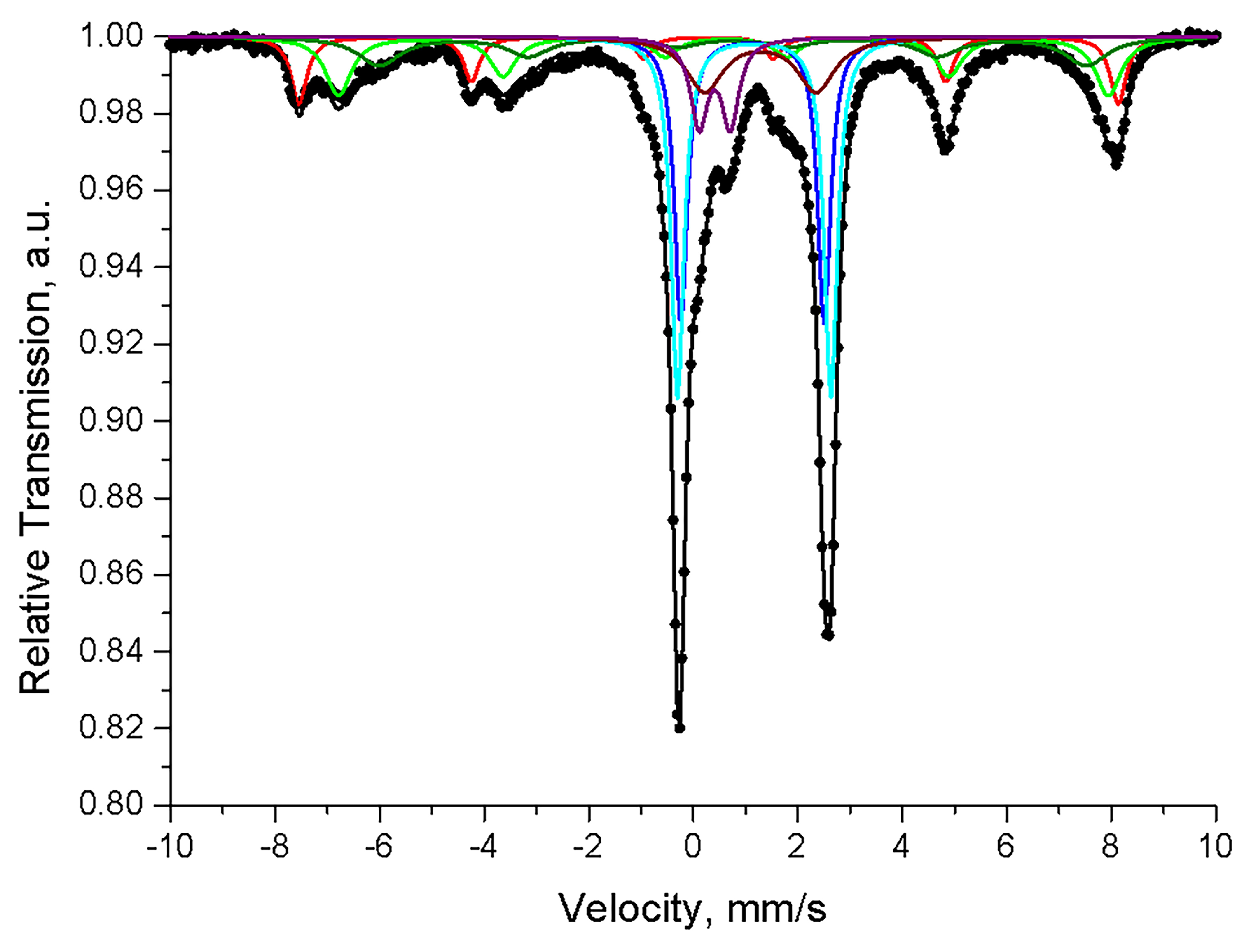
The experimental spectrum of geopolymer sample GF2 consists of sextet and doublet components (Figure 5). For the mathematical fitting, a model containing three sextets and four doublets was used. The parameters of the sextet components correspond to the mineral magnetite: Sx1—tetrahedrally coordinated Fe3+ ions; Sx2—octahedrally coordinated Fe2.5+ ions (existing due to very quick electron exchange between Fe2+ and Fe3+ ions); and Sx3—also octahedrally coordinated Fe2.5+ ions with non-iron nearest cation neighbors in the spinel structure, such as Al or Mg [43]. The results of the fitting of the Mössbauer spectrum are presented in Table 3. The parameters of the doublet components Db1 and Db2 correspond to the two different positions of Fe2+ ions in the structure of the mineral fayalite (Fe2SiO4). The doublet component Db3, characterized by an isomer shift greater than 1.00 mm/s, is attributed to Fe2+ in an amorphous phase previously identified in the fayalite slag [18]. Following geopolymerization, a new doublet (Db4) appears, which is assigned to Fe3+ ions in an amorphous phase [43]. Similar Mössbauer parameters have been reported for iron-phosphate glasses and phosphate-bonded amorphous iron species [44,45]. Therefore, Db4 is probably attributed to Fe3+ incorporated into the amorphous iron-phosphate geopolymer gel formed during the reaction.
The Mössbauer spectrum of the investigated geopolymer sample (GF2) is generally similar to the spectrum of a geopolymer sample prepared with phosphoric acid solution and published earlier [18]. A notable difference is the lower content of newly formed Fe3+ ions (8%) in the amorphous phase of sample GF2 compared to series P1 (15%). This difference may be related to the different reaction pathways of the activators. In the present system, the solid phosphate activator first dissolves before participating in the geopolymerization reactions, resulting in a slower release of reactive phosphate species and a lower oxidation potential during the early stages of hardening, compared to the liquid phosphate activator. Consequently, a smaller fraction of Fe2+ appears to be oxidized to Fe3+ and incorporated into the amorphous reaction products.

3.6. FTIR

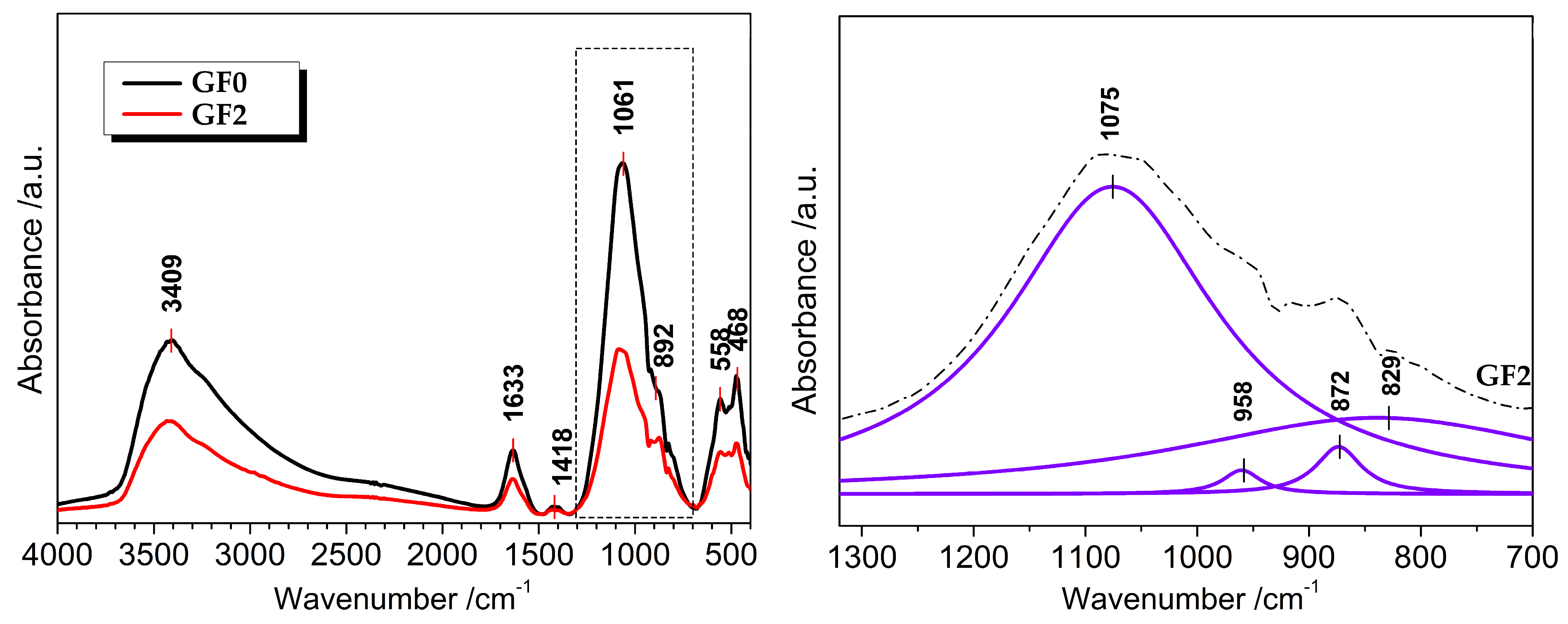
The FTIR spectra of the dense geopolymer (GF0) and the geopolymer foam (GF2) are shown in Figure 6. Both spectra exhibit a broad absorption band at approximately 3408 cm−1 and a weaker band at 1632 cm−1, corresponding to the stretching and bending vibrations of absorbed and chemically bound water, respectively [46]. The most prominent feature in both spectra is a broad absorption band in the region 1300–700 cm−1. The broad character of the spectra supports the predominantly amorphous nature of the geopolymer. This band was deconvoluted using Lorentzian functions (Figure 6, right). The deconvolution in this region indicates that the main band consists of several overlapping vibrations. The main component at 1075 cm−1 is associated with the reaction between the fayalite slag and the phosphate activator and is consistent with the formation of the amorphous binding phase, as previously observed for phosphoric acid-activated fayalite slag [18]. Together with the Mössbauer evidence for the appearance of the Fe3+ doublet (Db4), this supports the formation of an iron-containing phosphate geopolymer gel. The position of this band lies within the range reported for asymmetric stretching vibrations of Si–O–T (T = Si, Al) structural units in geopolymers [47], while also overlapping with P–O stretching vibrations characteristic of phosphate-based geopolymers [48,49], iron-phosphate minerals [50] and phosphate glasses [51]. This overlap suggests the formation of a mixed silicate–phosphate network rather than discrete silicate and phosphate phases. In agreement with this interpretation, Tchakouté et al. [51] proposed that bands in this spectral region are associated with phosphorosiloxo (–Si–O–P–O–Si–) linkages formed during phosphate geopolymerization [52].
The bands at approximately 958 cm−1 and 872 cm−1 are attributed to residual fayalite, indicating that a fraction of the precursor remained unreacted after geopolymerization.
A weak absorption band at 1418 cm−1 is assigned to the ν3 asymmetric stretching vibration of carbonate (CO32−) groups, most likely resulting from natural carbonation during curing and storage. The low intensity of this band indicates that carbonation is limited and probably confined to the near-surface region of the specimens. This interpretation is consistent with the detection of magnesian calcite by XRD.
The combined XRD, Mössbauer and FTIR results indicate the formation of an amorphous iron-phosphate/silicate binding phase during geopolymerization, which is consistent with the development of the continuous matrix responsible for the observed mechanical strength. The appearance of the Fe3+ doublet (Db4) together with the broad FTIR band at approximately 1075 cm−1 supports the development of a mixed silicate–phosphate network that binds the slag particles. Residual fayalite identified by XRD and FTIR indicates incomplete precursor reaction, suggesting that the hardened material consists of unreacted slag particles embedded in a continuous amorphous geopolymer matrix.

3.7. Thermal Properties

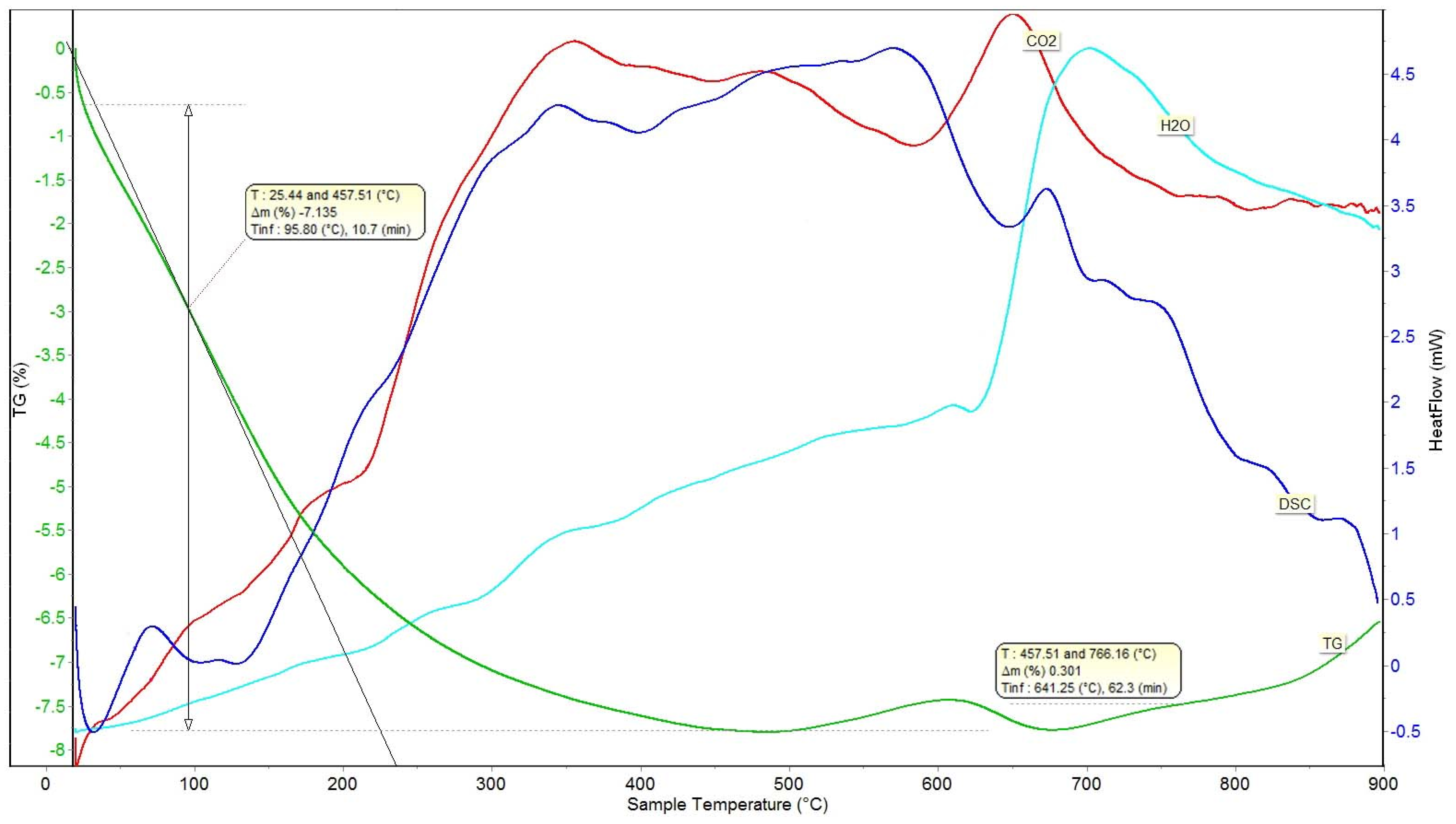
Thermogravimetric analysis coupled with differential scanning calorimetry and mass spectrometry (DSC-TG-MS) revealed a total mass loss of approximately 7% up to 500 °C for the GF2 geopolymer foam series (Figure 7). This mass loss was primarily associated with the release of physically adsorbed water and structurally bound water from the geopolymer matrix. In the range of 500–770 °C, an additional mass change (~0.3%) is observed, accompanied by clear signals in the MS data for the release of H2O and CO2. The CO2 peak around 650–680 °C is related to the decomposition of the carbonate phases, while the intense H2O signal in the region of 680–730 °C is due to the dehydroxylation of the geopolymer material. These processes overlap with oxidation reactions of iron-bearing phases from the fayalite slag. Previous thermal analysis of the raw fayalite slag showed that oxidation of fayalite and magnetite phases occurs over a broad temperature range, from about 400 to 1000 °C, and produces an overall mass gain of approximately 2% and the progressive formation of hematite [23]. The superposition of dehydroxylation, carbonate decomposition, and iron oxidation reactions complicates the interpretation of the thermal behavior in this broad temperature interval.
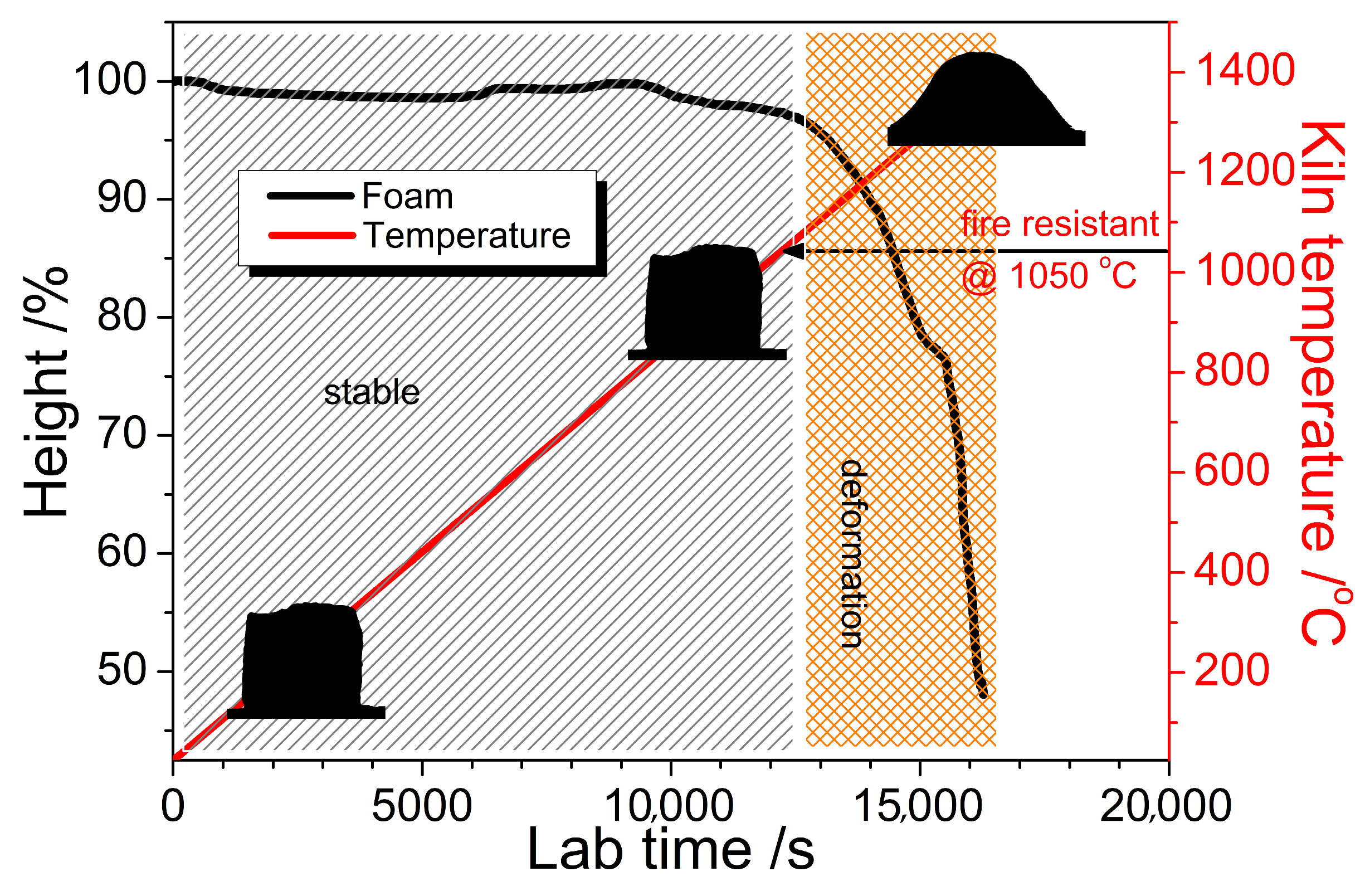
The thermal dimensional stability of the geopolymer foam was evaluated by hot-stage microscopy. Figure 8 presents the evolution of specimen height (%) as a function of time during linear heating. The material exhibited excellent dimensional stability over a wide temperature range, with negligible shrinkage or expansion observed during heating up to approximately 1000–1050 °C. Above this temperature, the onset of shrinkage was detected, indicating the beginning of thermally induced deformation. The observed dimensional stability demonstrates that the geopolymer foam retains its dimensions up to about 1000 °C despite the progressive removal of chemically bound water, oxidation, decarbonation, and phase transformations occurring within the matrix observed at DSC-TG-MS. However, the present hot-stage microscopy results evaluate dimensional stability only and do not provide information on the residual mechanical or structural integrity of the material after thermal exposure.
Above approximately 1050 °C, the specimen began to deform, indicating the onset of softening and viscous flow. This behavior is associated with the formation of a partially molten phase and the reduction in mechanical rigidity at elevated temperatures.
The observed thermal behavior demonstrates the excellent refractory character of the phosphate-activated geopolymer foam. This thermal stability highlights the potential of the developed geopolymer foam as a fire-resistant insulating material. The results indicate that the material can withstand temperatures up to about 1000 °C without significant loss of dimensional stability.

3.8. SEM

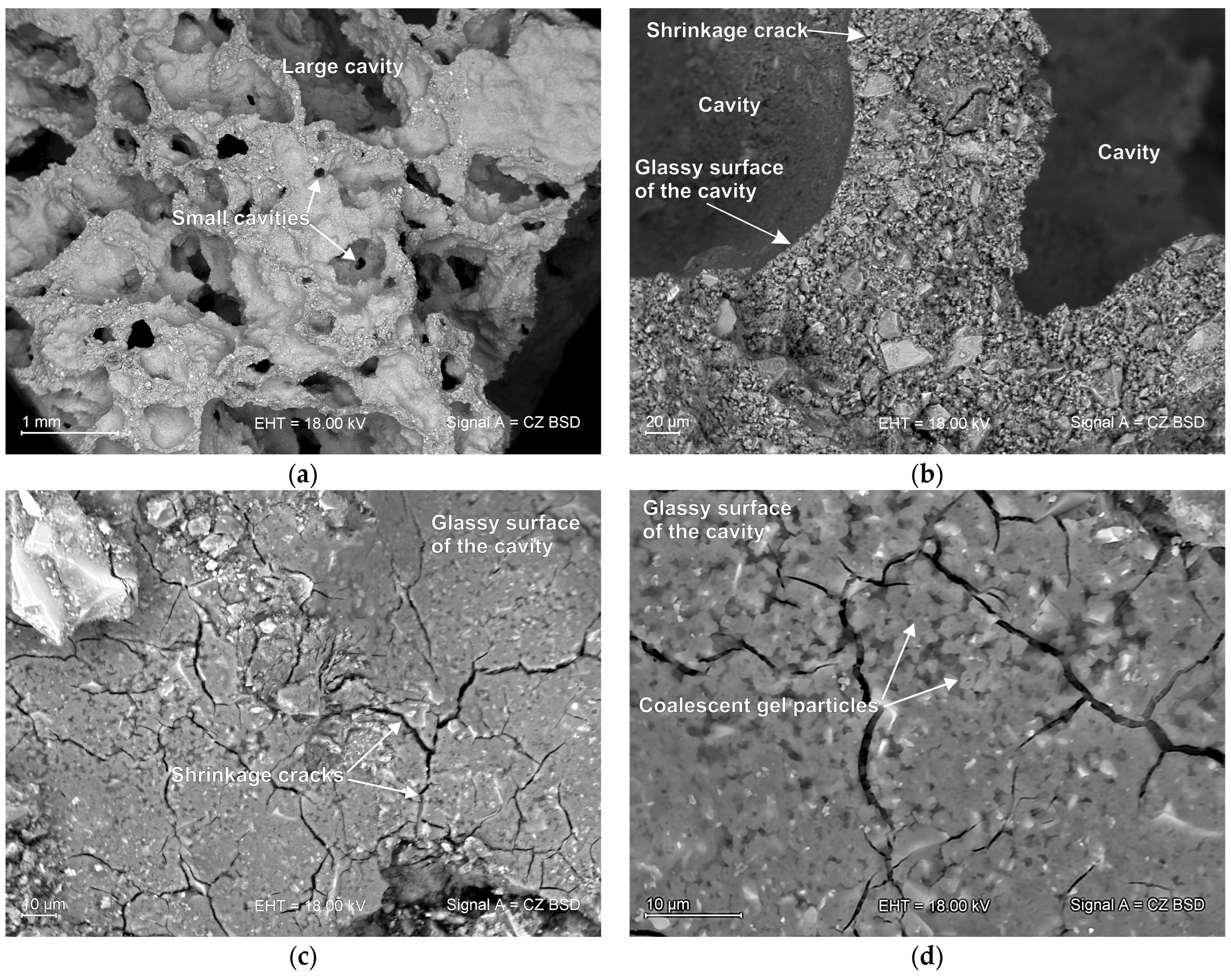
SEM examination of the geopolymer foam series GF2 revealed the presence of pores of several orders and sizes (Figure 9). The largest cavities, approximately 3–5 mm in size, have distinctly asymmetric shape (Figure 9a) as a result of the predominantly vertical movement of gas bubbles and vertical merging of smaller cavities. The preserved smaller cavities, <0.3 mm in size, have a more isometric form. Regardless of the cavity size, the thickness of their walls is almost uniform throughout the sample and ranges from 100 to 150 µm (Figure 9b). The walls consist of well-cemented grains of precursor material. Shrinkage cracks sometimes appear between adjacent cavities. The inner surface of the cavities is covered by a dense glassy material 1–3 µm thick (Figure 9c,d), consisting of coalescent 0.5–1 µm gel particles and demonstrating well-developed shrinkage cracks. The glassy material probably corresponds to amorphous phosphate binding phase and mechanically stabilizes the entire geopolymer structure. Similar microstructural features have been reported for fayalite-based alkali-activated geopolymer foams [38].

3.9. Thermal Conductivity

For thermal conductivity measurements, a larger geopolymer foam specimen was prepared using the GF2 formulation. The fresh mixture was cast into steel molds with dimensions of 160 × 160 × 40 mm, which is about 32 times bigger in volume compared to the cubic specimens prepared for physical and mechanical properties. After curing, a specimen was cut and polished to obtain a test sample with dimensions of approximately 131 × 121 × 31 mm. Prior to testing, the specimen was dried at 105 °C to constant mass, and its dimensions were accurately measured.
The apparent density of the large specimen was determined to be 0.753 g/cm3 (Table 4), which is approximately 15% lower than the density measured for the small cubic specimens used for mechanical testing. This difference can be partly attributed to the specimen preparation method. The small cubes were tested in their as-cast condition and therefore included the relatively dense surface layer formed at the interface between the geopolymer paste and the steel mould. This contact zone contained fewer pores due to wall effects and the partial suppression of bubble growth near the mould surface. In addition, the foaming process is highly sensitive to processing parameters such as the water-to-solid ratio, mixing intensity and duration, batch volume, and casting conditions [38].
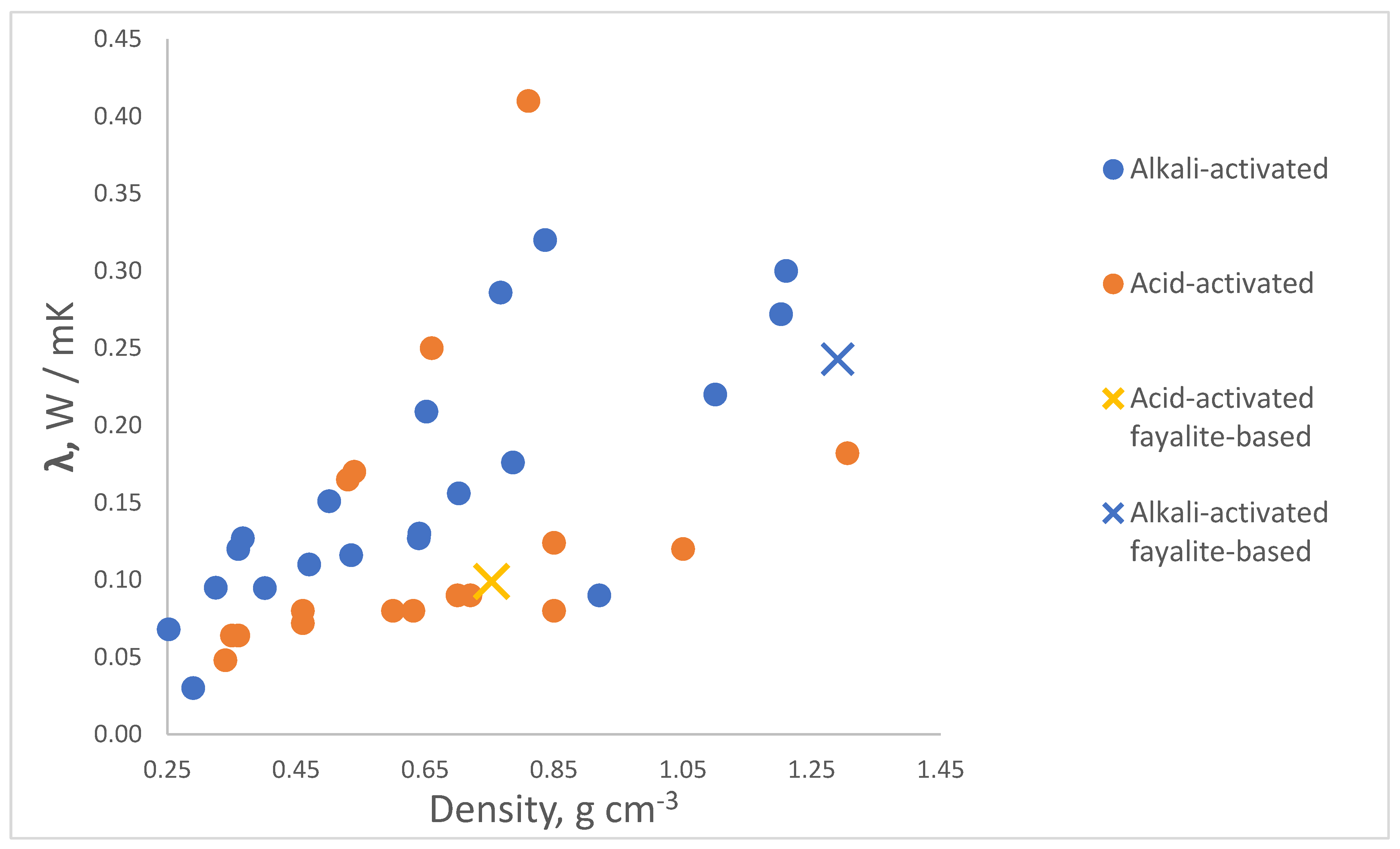
The geopolymer foam exhibited a thermal conductivity of 0.099 W·m−1·K−1 (Table 4). For comparison, alkali-activated fayalite-based geopolymer foam panels were previously reported to have a thermal conductivity of 0.243 W·m−1·K−1 at a density of 1.29 g/cm3 [38]. The lower thermal conductivity achieved in the present study is associated with the lower density. Figure 10 illustrates the thermal conductivity and density of the developed phosphate-activated fayalite-based geopolymer foam among geopolymer foams reported in the literature. The developed foam combines a relatively low thermal conductivity with a moderate density, placing it near the lower boundary of the density–thermal conductivity relationship observed for the data in the literature. However, direct comparison between studies should be interpreted with caution because thermal conductivity is also influenced by pore morphology, pore connectivity, precursor composition, and testing methodology. The relatively low thermal conductivity at a certain density obtained in the present study may be related to the intrinsically high density of the fayalite and magnetite phases. The presence of these iron-rich minerals increases the bulk density of the material without proportionally increasing heat transfer through the highly porous cellular structure. Consequently, fayalite-based foams may exhibit lower thermal conductivity than would be expected based solely on density. These results demonstrate that foaming effectively transforms dense phosphate-activated fayalite-based geopolymers into lightweight materials with significantly reduced thermal conductivity. The successful production of larger specimens confirms the scalability of the foaming process and suggests the feasibility of manufacturing insulation panels under practical conditions.

4. Conclusions

A novel phosphate geopolymer foam was successfully synthesized from fayalite slag flotation residue and dry triple superphosphate. The developed foams exhibited densities between 0.89 and 2.15 g cm−3, relative porosities up to 73.6%, and compressive strengths ranging from 1.4 to 28.8 MPa. The lowest-density foam achieved a thermal conductivity of 0.099 W m−1 K−1 and maintained dimensional stability up to approximately 1000 °C, demonstrating its potential as a fire-resistant insulating material.
The microstructural analysis showed that geopolymerization resulted in the formation of an amorphous iron-phosphate/silicate binding phase, while fayalite and magnetite remained only partially reactive. Calcium released from the phosphate activator reacted with atmospheric CO2 during curing to form carbonate phases detected by DSC, XRD and FTIR.
The combination of low thermal conductivity and high thermal stability up to 1000 °C makes the developed material a promising candidate for fire-resistant and thermal insulation applications in the construction sector. In addition, the relatively high density of the studied iron-rich geopolymer foam may provide potentially sound insulation and thermal capacity, making it attractive for multifunctional building elements in thermal and acoustic systems. Future studies are needed for the optimization of the pore structure, long-term durability, fire performance under realistic service conditions, acoustic properties, thermal capacity, leaching tests, etc.

Author Contributions

Conceptualization, A.N.; methodology, A.N., M.T., L.T., Z.D., N.J., N.V. and I.R.; validation, A.N., M.T. and I.R.; formal analysis, A.N., M.T., L.T., Z.D., N.J., N.V. and I.R.; investigation, A.N., M.T., L.T., Z.D., N.J., N.V. and I.R.; resources, A.N. and I.R.; data curation, A.N., M.T., L.T., Z.D., N.J., N.V. and I.R.; writing—original draft preparation, A.N., M.T., L.T., Z.D., N.J., N.V. and I.R.; writing—review and editing, A.N. and M.T.; visualization, A.N., M.T., L.T., Z.D., N.J., N.V. and I.R.; supervision, A.N.; project administration, A.N.; funding acquisition, A.N. All authors have read and agreed to the published version of the manuscript.

Funding

This research was funded by Bulgarian National Science Fund (BNSF)—project No. KП-06-H77/9 from 4 December 2023.

Institutional Review Board Statement

Not applicable.

Informed Consent Statement

Not applicable.

Data Availability Statement

The data presented in this study are available on request from the corresponding author. The data are not publicly available.

Acknowledgments

The authors gratefully acknowledge Aurubis Bulgaria AD for providing the fayalite slag floatation residue (iron silicate fines).

Conflicts of Interest

The authors declare no conflicts of interest.

Abbreviations

The following abbreviations are used in this manuscript:
DSCDifferential Scanning Calorimetry
EDXEnergy-Dispersive X-ray Spectroscopy
FTIRFourier-Transform Infrared Spectroscopy
MSMass Spectrometry
SEMScanning Electron Microscopy
TGAThermogravimetric Analysis
TSPTriple Superphosphate (conventional fertilizer)
XRDX-ray Diffraction

Appendix A

Table A1 summarizes density and thermal conductivity values reported for geopolymer foams in the literature. The data show a clear relationship between bulk density and thermal conductivity. In general, thermal conductivity decreases with decreasing density due to the higher volume of entrapped air within the porous structure. However, the relationship is not strictly linear because thermal performance is also influenced by pore size distribution, pore connectivity, cell wall thickness, and the proportion of open and closed pores. The literature data provide a useful benchmark for evaluating the thermal insulation performance of the geopolymer foam developed in the present study.
Table A1. Relationship between density and thermal conductivity of geopolymer foams reported in the literature.
Type of the Geopolymer ActivationDensity, g cm−3Thermal Conductivity Coefficient, W m−1K−1References
Alkali0.310.08[53]
Alkali0.410.10[53]
Alkali0.6400.127[53]
Alkali0.2520.068[53]
Alkali0.3600.120[54]
Alkali1.2020.272[54]
Alkali0.7860.176[54]
Alkali0.7020.156[54]
Alkali1.1000.220[55]
Alkali0.3250.095[56]
Alkali0.4700.110[57]
Alkali1.2100.300[57]
Alkali0.4010.095[58]
Alkali0.6410.130[58]
Alkali0.3670.127[59]
Alkali0.6520.209[59]
Alkali0.5350.116[60]
Alkali0.5010.151[60]
Alkali0.7670.286[59]
Alkali0.8360.320[59]
Alkali0.2900.030[61]
Alkali1.2900.243[38]
Acid0.3500.064[34]
Acid0.4600.072[34]
Acid0.5400.170[33]
Acid0.5300.165[33]
Acid0.3600.064[33]
Acid0.3400.048[33]
Acid0.6000.080[62]
Acid0.7000.090[62]
Acid0.7200.090[63]
Acid1.3050.182[64]
Acid1.0500.120[65]
Acid0.8500.080[65]
Acid0.8100.410[66]
Acid0.6600.250[66]
Acid0.6320.080[31]
Acid0.8500.124[30]

References

  1. Luhar, S.; Ashour, A.; Luhar, I. Decarbonising the Cement and Concrete Industry—A Step Forward to a Sustainable Future. J. Compos. Sci. 2026, 10, 226. [Google Scholar] [CrossRef] [Scilit]
  2. Duxson, P.; Fernández-Jiménez, A.; Provis, J.L.; Lukey, G.C.; Palomo, A.; van Deventer, J.S. Geopolymer technology: The current state of the art. J. Mater. Sci. 2007, 42, 2917–2933. [Google Scholar] [CrossRef] [Scilit]
  3. Singh, B.; Ishwarya, G.; Gupta, M.; Bhattacharyya, S. Geopolymer concrete: A review of some recent developments. Constr. Build. Mater. 2015, 85, 78–90. [Google Scholar] [CrossRef] [Scilit]
  4. Castillo, H.; Collado, H.; Droguett, T.; Vesely, M.; Garrido, P.; Palma, S. State of the art of geopolymers: A review. e-Polymers 2022, 22, 108–124. [Google Scholar] [CrossRef] [Scilit]
  5. Park, J.A.; Pimenta, M.M.; Bezerra, A.C.d.S. Acid activation in low-carbon binders: A systematic literature review. Buildings 2023, 14, 83. [Google Scholar] [CrossRef] [Scilit]
  6. Liu, L.; Cui, X.-M.; He, Y.; Liu, S.-D.; Gong, S.-Y. The phase evolution of phosphoric acid-based geopolymers at elevated temperatures. Mater. Lett. 2012, 66, 10–12. [Google Scholar] [CrossRef] [Scilit]
  7. Perera, D.S.; Hanna, J.V.; Davis, J.; Blackford, M.G.; Latella, B.A.; Sasaki, Y.; Vance, E.R. Relative strengths of phosphoric acid-reacted and alkali-reacted metakaolin materials. J. Mater. Sci. 2008, 43, 6562–6566. [Google Scholar] [CrossRef] [Scilit]
  8. Zhang, C.; Guo, H.; Shi, L.; Hou, X.; Kong, X.; Yu, B. Corrosion resistance of polymer-modified hardened cement paste and phosphoric acid-activated metakaolin geopolymer in carbonic acid solution. Constr. Build. Mater. 2024, 445, 137950. [Google Scholar] [CrossRef] [Scilit]
  9. Zribi, M.; Baklouti, S. Phosphate-based geopolymers: A critical review. Polym. Bull. 2022, 79, 6827–6855. [Google Scholar]
  10. Wagh, A.S. Chemically bonded phosphate ceramics-a novel class of geopolymers. In Proceedings of the Advances in Ceramic Matrix Composites X: Proceedings of the 106th Annual Meeting of the American Ceramic Society; Ceramic Transactions: Indianapolis, IN, USA, 2004; p. 107. [Google Scholar]
  11. Katsiki, A. Aluminosilicate phosphate cements—A critical review. Adv. Appl. Ceram. 2019, 118, 274–286. [Google Scholar] [CrossRef] [Scilit]
  12. He, Y.; Liu, L.; He, L.; Cui, X. Characterization of chemosynthetic H3PO4–Al2O3–2SiO2 geopolymers. Ceram. Int. 2016, 42, 10908–10912. [Google Scholar] [CrossRef] [Scilit]
  13. Wang, Y.-S.; Provis, J.L.; Dai, J.-G. Role of soluble aluminum species in the activating solution for synthesis of silico-aluminophosphate geopolymers. Cem. Concr. Compos. 2018, 93, 186–195. [Google Scholar] [CrossRef] [Scilit]
  14. Wang, Y.-S.; Dai, J.-G.; Ding, Z.; Xu, W.-T. Phosphate-based geopolymer: Formation mechanism and thermal stability. Mater. Lett. 2017, 190, 209–212. [Google Scholar] [CrossRef] [Scilit]
  15. Bernasconi, D.; Viani, A.; Zárybnická, L.; Mácová, P.; Bordignon, S.; Caviglia, C.; Destefanis, E.; Gobetto, R.; Pavese, A. Phosphate-based geopolymer: Influence of municipal solid waste fly ash introduction on structure and compressive strength. Ceram. Int. 2023, 49, 22149–22159. [Google Scholar] [CrossRef] [Scilit]
  16. Pu, S.; Xu, B.; Duan, W.; Yao, H.; Wu, Z.; Mei, G.; Cai, G. A green phosphate-based geopolymer adsorbent or binder with high specific surface area for environmental applications. Constr. Build. Mater. 2023, 408, 133738. [Google Scholar] [CrossRef] [Scilit]
  17. Katsiki, A.; Peys, A.; Pontikes, Y.; Rahier, H. Activation of fayalite slag towards inorganic polymers. In Proceedings of the 5th International Slag Valorisation Symposium, Leuven, Belgium, 3–5 April 2017; pp. 3–5. [Google Scholar]
  18. Nikolov, A.; Titorenkova, R.; Velinov, N.; Delcheva, Z. Characterization of novel geopolymer based on acid-activated fayalite slag from local copper industry. Bulg. Chem. Commun. 2018, 50, 54–61. [Google Scholar]
  19. Shilar, F.A.; Alqahtani, D.A.; Shilar, M.; Khan, T.Y. Valorization of agricultural and industrial wastes in geopolymer foam concrete, a ternary binder approach using corncob ash, red mud, and fly ash. Case Stud. Constr. Mater. 2025, 24, e05716. [Google Scholar] [CrossRef] [Scilit]
  20. Santos, A.; Andrejkovičová, S.; Řimnáčová, D.; Perná, I.; Almeida, F.; Rocha, F. Synthesis and Characterization of Lightweight Foamed Geopolymers from Iron Tailings for Energy-Efficient Construction. J. Build. Eng. 2026, 120, 115414. [Google Scholar] [CrossRef] [Scilit]
  21. Mahyar, M.; Erdoğan, S.T. Phosphate-activated high-calcium fly ash acid-base cements. Cem. Concr. Compos. 2015, 63, 96–103. [Google Scholar] [CrossRef] [Scilit]
  22. Wagh, A.S. Recent progress in chemically bonded phosphate ceramics. Int. Sch. Res. Not. 2013, 2013, 983731. [Google Scholar] [CrossRef] [Scilit]
  23. Nikolov, A. Novel one-part ferro-phosphate geopolymer cement. Rev. Bulg. Geol. Soc. 2020, 81, 43–45. [Google Scholar]
  24. Ghazy, M.F.; Abd Elaty, M.A.; Mostafa, S.M. Properties of one-part versus two-part geopolymers composites—A review. Am. J. Eng. Res. 2022, 11, 1–14. [Google Scholar] [CrossRef] [Scilit]
  25. Shilar, F.A.; Shilar, M. Foam geopolymer synthesis macro-to micro-properties. J. Mater. Sci. 2025, 60, 23176–23226. [Google Scholar] [CrossRef] [Scilit]
  26. Korniejenko, K.; Pławecka, K.; Bazan, P.; Figiela, B.; Kozub, B.; Mróz, K.; Łach, M. Green building materials for circular economy—Geopolymer foams. Proc. Eng. Technol. Innov. 2023, 25, 26–34. [Google Scholar] [CrossRef] [Scilit]
  27. Amin, M.N.; Iftikhar, B.; Khan, K.; Othman, N.A.; Qadir, M.T. Foamed geopolymers as low carbon materials for fire-resistant and lightweight applications in construction: A review. Rev. Adv. Mater. Sci. 2025, 64, 20250096. [Google Scholar] [CrossRef] [Scilit]
  28. Yu, H.; Xu, M.x.; Chen, C.; He, Y.; Cui, X.m. A review on the porous geopolymer preparation for structural and functional materials applications. Int. J. Appl. Ceram. Technol. 2022, 19, 1793–1813. [Google Scholar] [CrossRef] [Scilit]
  29. Abdellatief, M.; Hassanien, A.E.; Mortagi, M.; Hamouda, H. Geopolymer foam concrete: A review of pore characteristics, compressive strength and artificial intelligence in GFC strength simulations. Discov. Concr. Cem. 2025, 1, 4. [Google Scholar] [CrossRef] [Scilit]
  30. Rashad, A.M.; Refaie, F.A.Z.; Mokhtar, M. Waste marble powder as a promising candidate for use as a foaming agent for metakaolin geopolymer activated with H3PO4. Constr. Build. Mater. 2024, 450, 138583. [Google Scholar] [CrossRef] [Scilit]
  31. Rashad, A.M.; Gharieb, M.; Shoukry, H.; Mokhtar, M. Valorization of sugar beet waste as a foaming agent for metakaolin geopolymer activated with phosphoric acid. Constr. Build. Mater. 2022, 344, 128240. [Google Scholar] [CrossRef] [Scilit]
  32. Kristina, G.; Yunis, G. Synthesis and foaming of a novel type of porous geopolymer material via salt activation. RSC Adv. 2025, 15, 39832–39846. [Google Scholar] [CrossRef] [Scilit] [PubMed]
  33. Shuai, Q.; Xu, Z.; Yao, Z.; Chen, X.; Jiang, Z.; Peng, X.; An, R.; Li, Y.; Jiang, X.; Li, H. Fire resistance of phosphoric acid-based geopolymer foams fabricated from metakaolin and hydrogen peroxide. Mater. Lett. 2020, 263, 127228. [Google Scholar] [CrossRef] [Scilit]
  34. Jouin, J.; Fekoua, J.N.; Ouamara, L.; Piolet, E.; Gharzouni, A.; Rossignol, S. Insulating phosphoric acid-based geopolymer foams with water and high temperature resistance. Constr. Build. Mater. 2023, 398, 132406. [Google Scholar] [CrossRef] [Scilit]
  35. Nikolov, A. Alkali-activated geopolymers based on iron-rich slag from copper industry. In Proceedings of the IOP Conference Series: Materials Science and Engineering; IOP Publishing: Bristol, UK, 2020; p. 012006. [Google Scholar]
  36. Adediran, A. Alkali Activation of Fayalite Slag. Master’s Thesis, University of Oulu, Oulu, Finland, 2017. [Google Scholar]
  37. Nikolov, A.; Karamanov, A. Thermal properties of geopolymer based on fayalite waste from copper production and metakaolin. Materials 2022, 15, 2666. [Google Scholar] [CrossRef] [Scilit] [PubMed]
  38. Nikolov, A.; Tarassov, M.; Rostovsky, I.; Raykovska, M.; Georgiev, I.; Korniejenko, K. Fayalite-based geopolymer foam. Ceramics 2025, 8, 77. [Google Scholar] [CrossRef] [Scilit]
  39. Žák, T.; Jirásková, Y. CONFIT: Mössbauer spectra fitting program. Surf. Interface Anal. Int. J. Devoted Dev. Appl. Tech. Anal. Surf. Interfaces Thin Films 2006, 38, 710–714. [Google Scholar] [CrossRef] [Scilit]
  40. Nikolov, A. Alkali and acid activated geopolymers based on iron-silicate fines-by-product from copper industry. Int. Sci. J. “Mach. Technol. Mater.” 2020, 14, 37–39. [Google Scholar]
  41. Ma, S.; Zhang, Z.; Liu, X. Comprehensive understanding of aluminosilicate phosphate geopolymers: A critical review. Materials 2022, 15, 5961. [Google Scholar] [CrossRef] [Scilit] [PubMed]
  42. Nash, A.J.; Pittman, E.D. Ferro-magnesian calcite cement in sandstones. J. Sediment. Res. 1975, 45, 258–265. [Google Scholar] [CrossRef] [Scilit]
  43. Greenwood, N.N. Mössbauer Spectroscopy; Springer Science & Business Media: Berlin/Heidelberg, Germany, 2012. [Google Scholar]
  44. Stoch, P.; Szczerba, W.; Bodnar, W.; Ciecinska, M.; Stoch, A.; Burkel, E. Structural properties of iron-phosphate glasses: Spectroscopic studies and ab initio simulations. Phys. Chem. Chem. Phys. 2014, 16, 19917–19927. [Google Scholar] [CrossRef] [Scilit] [PubMed]
  45. Sunakawa, K.; Higashinaka, R.; Matsuda, T.; Aoki, Y.; Kuzmann, E.; Homonnay, Z.; Perović, M.; Bošković, M.; Naka, T.; Nakane, T. 57Fe-Mössbauer and Magnetic Susceptibility Studies of Iron Phosphate Glass Prepared by Sol-Gel Method. In MECAME 2018 Book of Abstracts; Institut Ruđer Bošković: Zagreb, Croatia, 2018; p. 13. [Google Scholar]
  46. Wan, Q.; Zhang, R.; Zhang, Y. Structure and properties of phosphate-based geopolymer synthesized with the spent fluid catalytic-cracking (SFCC) catalyst. Gels 2022, 8, 130. [Google Scholar] [CrossRef] [Scilit] [PubMed]
  47. Valcke, S.L.; Pipilikaki, P.; Fischer, H.R.; Verkuijlen, M.H.; van Eck, E.R. FT-IR and 29Si-NMR for evaluating aluminium–silicate precursors for geopolymers. Mater. Struct. 2015, 48, 557–569. [Google Scholar]
  48. Zribi, M.; Samet, B.; Baklouti, S. Mechanical, microstructural and structural investigation of phosphate-based geopolymers with respect to P/Al molar ratio. J. Solid State Chem. 2020, 281, 121025. [Google Scholar] [CrossRef] [Scilit]
  49. Gao, L.; Zheng, Y.; Tang, Y.; Yu, J.; Yu, X.; Liu, B. Effect of phosphoric acid content on the microstructure and compressive strength of phosphoric acid-based metakaolin geopolymers. Heliyon 2020, 6, e03853. [Google Scholar] [CrossRef] [Scilit] [PubMed]
  50. Frost, R.L.; Martens, W.; Williams, P.A.; Kloprogge, J. Raman and infrared spectroscopic study of the vivianite-group phosphates vivianite, baricite and bobierrite. Mineral. Mag. 2002, 66, 1063–1073. [Google Scholar] [CrossRef] [Scilit]
  51. Brow, R.K. The structure of simple phosphate glasses. J. Non-Cryst. Solids 2000, 263, 1–28. [Google Scholar] [CrossRef] [Scilit]
  52. Tchakouté, H.K.; Rüscher, C.H.; Kamseu, E.; Andreola, F.; Leonelli, C. Influence of the molar concentration of phosphoric acid solution on the properties of metakaolin-phosphate-based geopolymer cements. Appl. Clay Sci. 2017, 147, 184–194. [Google Scholar] [CrossRef] [Scilit]
  53. Łach, M.; Mierzwiński, D.; Korniejenko, K.; Mikuła, J. Geopolymer foam as a passive fire protection. In Proceedings of the MATEC Web of Conferences; EDP Sciences: Les Ulis, France, 2018; p. 00031. [Google Scholar]
  54. Yatsenko, E.A.; Goltsman, B.M.; Izvarin, A.I.; Kurdashov, V.M.; Smoliy, V.A.; Ryabova, A.V.; Klimova, L.V. Recycling ash and slag waste from thermal power plants to produce foamed geopolymers. Energies 2023, 16, 7535. [Google Scholar] [CrossRef] [Scilit]
  55. Prałat, K.; Ciemnicka, J.; Koper, A.; Buczkowska, K.E.; Łoś, P. Comparison of the thermal properties of geopolymer and modified gypsum. Polymers 2021, 13, 1220. [Google Scholar] [CrossRef] [Scilit] [PubMed]
  56. Cui, Y.; Wang, D.; Zhao, J.; Li, D.; Ng, S.; Rui, Y. Effect of calcium stearate based foam stabilizer on pore characteristics and thermal conductivity of geopolymer foam material. J. Build. Eng. 2018, 20, 21–29. [Google Scholar] [CrossRef] [Scilit]
  57. Jaya, N.A.; Yun-Ming, L.; Cheng-Yong, H.; Abdullah, M.M.A.B.; Hussin, K. Correlation between pore structure, compressive strength and thermal conductivity of porous metakaolin geopolymer. Constr. Build. Mater. 2020, 247, 118641. [Google Scholar] [CrossRef] [Scilit]
  58. Łach, M.; Korniejenko, K.; Mikuła, J. Thermal insulation and thermally resistant materials made of geopolymer foams. Procedia Eng. 2016, 151, 410–416. [Google Scholar] [CrossRef] [Scilit]
  59. Henon, J.; Alzina, A.; Absi, J.; Smith, D.; Rossignol, S. Analytical estimation of skeleton thermal conductivity of a geopolymer foam from thermal conductivity measurements. Eur. Phys. J. Spec. Top. 2015, 224, 1715–1723. [Google Scholar] [CrossRef] [Scilit]
  60. Bazan, P.; Figiela, B.; Kozub, B.; Łach, M.; Mróz, K.; Melnychuk, M.; Korniejenko, K. Geopolymer foam with low thermal conductivity based on industrial waste. Materials 2024, 17, 6143. [Google Scholar] [CrossRef] [Scilit] [PubMed]
  61. Vaou, V.; Panias, D. Thermal insulating foamy geopolymers from perlite. Miner. Eng. 2010, 23, 1146–1151. [Google Scholar] [CrossRef] [Scilit]
  62. Gualtieri, M.L.; Romagnoli, M.; Gualtieri, A.F. Preparation of phosphoric acid-based geopolymer foams using limestone as pore forming agent–Thermal properties by in situ XRPD and Rietveld refinements. J. Eur. Ceram. Soc. 2015, 35, 3167–3178. [Google Scholar] [CrossRef] [Scilit]
  63. Laala, I.; Bouzidi, N.; Pérez-Villarejo, L.; Bouzeriba, H.; Eliche-Quesada, D. Physico-mechanical, microstructural and thermal properties of foamed ceramics based on Algerian phosphate wastes. Eur. J. Environ. Civ. Eng. 2026, 30, 2620441. [Google Scholar] [CrossRef] [Scilit]
  64. Morsy, M.; Rashad, A.M.; Shoukry, H.; Mokhtar, M. Potential use of limestone in metakaolin-based geopolymer activated with H3PO4 for thermal insulation. Constr. Build. Mater. 2019, 229, 117088. [Google Scholar] [CrossRef] [Scilit]
  65. En-Naji, S.; Mabroum, S.; Khatib, K.; Benzaazoua, M.; Hakkou, R. Development of geopolymers from phosphate by-products for thermal insulation applications. Minerals 2023, 13, 1480. [Google Scholar] [CrossRef] [Scilit]
  66. Yang, X.; Wu, Y.; Sun, Z.; Li, Y.; Jia, D.; Zhang, D.; Xiong, D.; Wang, M. Preparation and properties of phosphoric acid-based porous geopolymer with high magnesium nickel slag and fly ash. Minerals 2023, 13, 564. [Google Scholar] [CrossRef] [Scilit]
Figure 1. Mie-sizing and particle size distribution parameters of the co-ground cement based on fayalite slag and calcium superphosphate.
Ceramics 09 00071 g001
Figure 2. Powder XRD of the obtained one-part geopolymer cement based on fayalite slag floatation residue and TSP.
Ceramics 09 00071 g002
Figure 3. Porous structure of fayalite-based geopolymer foams visualized by digital optical images captured on a 2D scanner from polished cross-sections of the foam samples.
Ceramics 09 00071 g003
Figure 4. Powder XRD patterns of the geopolymer foam series GF2.
Ceramics 09 00071 g004
Figure 5. Mossbauer spectrum of geopolymer series GF2.
Ceramics 09 00071 g005
Figure 6. FTIR spectra of the dense geopolymer (GF0) and foamed geopolymer (GF2) (left). The deconvolution of the main band is associated with overlapping vibrations of silicate and phosphate stretching regions in the GF2 spectrum (right).
Ceramics 09 00071 g006
Figure 7. DSC-TG-MS (CO2, H2O) data for fayalite geopolymer foam material (series GF2) in the temperature range 20–900 °C.
Ceramics 09 00071 g007
Figure 8. Full linear thermal scan of a fayalite foam sample in a hot-stage thermal–optical system.
Ceramics 09 00071 g008
Figure 9. SEM images of GF2 geopolymer foam. (a) Large and small cavities of the geopolymer foam. (b) Example of a cross-section of a cavity wall between two adjacent geopolymer cavities. (c) The inner surface of the cavities covered with a dense glassy material 1–3 µm thick. (d) Presence of coalescent gel particles of 0.5–1 µm in size and well-developed shrinkage cracks.
Ceramics 09 00071 g009
Figure 10. Relationship between density and thermal conductivity of geopolymer foams reported in the literature and the fayalite-based geopolymer foam developed in the present study. Data from the literature are listed in Appendix A, Table A1.
Ceramics 09 00071 g010
Table 1. Chemical composition of one-part geopolymer cement according to SEM-EDX analysis (in wt.%).
OxidesFe2O3 *SiO2P2O5CaOAl2O3MgONa2OK2OSO3TiO2MnOCuOZnO
wt.%37.67 ± 0.8821.65 ± 0.3516.63 ± 0.399.42 ± 0.183.68 ± 0.171.49 ± 0.050.57 ± 0.060.87 ± 0.021.40 ± 0.080.24 ± 0.020.07 ± 0.050.45 ± 0.060.76 ± 0.04
* Total iron is presented as Fe2O3.
Table 2. Physical and mechanical properties of the foamed fayalite-based geopolymers.
SeriesH2O2 (30%),
g/100 g Cement
Density, g cm−3Absolute Density, g cm−3Relative Porosity, %Water Absorption, %Compressive Strength, MPa
GF002.151 ± 0.0063.370 ± 0.00236.2 ± 0.215.8 ± 0.328.8 ± 0.3
GF050.51.158 ± 0.0083.369 ± 0.00265.6 ± 0.227.7 ± 0.33.5 ± 0.2
GF111.019 ± 0.0093.368 ± 0.00269.7 ± 0.333.7 ± 0.22.2 ± 0.2
GF220.890 ± 0.0133.372 ± 0.00273.6 ± 0.437.0 ± 0.21.4 ± 0.2
Table 3. Mossbauer parameters of the geopolymer foam series GF2.
Componentsδ,
mm s−1
Δ Eq,
mm s−1
B, TΓexp, mm s−1G, %
Sx1-Fe3O4, Fe3+tetra0.29048.60.3611
Sx2-Fe3O4, Fe2.5+octa0.60−0.0545.70.5916
Sx3-Fe3O4, Fe2.5+octa0.76042.00.9812
Db1-Fe2SiO4, Fe2+–M11.132.74-0.3019
Db2-Fe2SiO4, Fe2+–M21.172.93-0.3024
Db3-Fe2+1.282.14-0.8610
Db4-Fe3+0.410.60-0.398
Table 4. Properties of the prepared geopolymer foam specimen for thermal conductivity measurements.
SampleSize of the Specimen, mm Density, g cm−3Thermal Conductivity Coefficient, W m−1 K−1
GF2131 × 121 × 32 0.7530.099
Disclaimer/Publisher’s Note: The statements, opinions and data contained in all publications are solely those of the individual author(s) and contributor(s) and not of MDPI and/or the editor(s). MDPI and/or the editor(s) disclaim responsibility for any injury to people or property resulting from any ideas, methods, instructions or products referred to in the content.