


Abstract
Conventional 8YSZ thermal barrier ceramics suffer from limited phase stability and insufficient infrared radiation regulation at high temperatures. Sc2O3 doping can reduce thermal conductivity and improve phase stability, but the improvement remains limited because the fixed-valence substitution of Sc3+ cannot effectively increase defect concentration or regulate carrier behavior. In this work, CeO2 with tunable valence states was incorporated into the Sc-stabilized YSZ system to realize the synergistic modulation of lattice thermal conductivity and photon thermal conductivity. A series of Sc2O3–CeO2 co-doped YSZ ceramics were fabricated via solid-state sintering, and the effects of co-doping on phase structure, defect evolution, thermal conductivity, infrared emissivity, and bandgap characteristics were systematically investigated. The results show that all co-doped samples maintained a stable tetragonal fluorite structure with relative densities higher than 96%. Among them, Sc0.08Ce0.005Y0.005Zr0.91O2 exhibited the best comprehensive performance. Its thermal conductivity at 1000 °C reached 2.073 W·m−1·K−1, which was 11.9% lower than that of conventional 8YSZ. Meanwhile, the average infrared emissivity in the 3–5 μm band increased to 0.779. XPS analysis indicated that Ce incorporation promoted oxygen-vacancy formation, which enhanced phonon scattering and reduced lattice thermal conductivity. In addition, co-doping narrowed the band gap and facilitated carrier excitation, thereby strengthening infrared absorption and emission behavior. The enhanced infrared emissivity further contributed to the suppression of radiative thermal transport at elevated temperatures. This work demonstrates that Sc2O3–CeO2 co-doping provides an effective strategy for simultaneously regulating phonon transport and photon transport in YSZ-based ceramics. The results provide new insight into the design of advanced thermal barrier materials with low thermal conductivity and enhanced high-temperature infrared radiation performance.
1. Introduction
Thermal barrier coatings (TBCs) are extensively applied in aero-engines and gas turbines to shield metallic substrates from severe high-temperature conditions [1,2,3,4]. Among the available ceramic systems, 8 wt% yttria-stabilized zirconia (8YSZ) is the most widely employed TBC material owing to its low thermal conductivity, relatively high coefficient of thermal expansion, and favorable chemical stability [5,6]. However, the service temperature of 8YSZ is generally limited to below 1200 °C. At higher temperatures, phase instability and accelerated thermal radiation significantly reduce its thermal protection capability [7,8,9]. In addition to phase stability and thermophysical properties, mechanical integrity is also a core indicator that dictates the service life of thermal barrier coatings (TBCs). During high-temperature thermal cycling service, TBCs are subjected to periodic thermal stresses and external impact loads; their crack growth resistance directly governs the coating’s degradation resistance and structural reliability. Kulyk et al. [10] systematically investigated the regulatory mechanism of sintering temperature on the crack propagation resistance of YSZ ceramics, confirming that microstructure optimization can effectively enhance the material’s crack propagation resistance, which is critical for ensuring the mechanical integrity of the coating. Zhou et al. [11] also pointed out that advanced thermal barrier materials tailored for ultra-high-temperature operating conditions must balance thermal insulation performance and mechanical properties, and superior fracture toughness and deformation resistance serve as essential foundations for the long-term stable service of the coatings.
At elevated temperatures, thermal radiation gradually becomes an important heat transfer mode. According to Planck’s radiation law and Wien’s displacement law, most thermal radiation energy above 1000 °C is concentrated in the infrared region [12]. Therefore, high-temperature thermal insulation is controlled not only by lattice thermal conductivity, but also by radiative thermal transport. Traditional studies on YSZ mainly focus on reducing phonon thermal conduction, while the regulation of infrared radiation behavior is still insufficiently understood.
Sc2O3 is considered one of the most promising stabilizers for zirconia-based TBC materials. Previous studies have shown that Sc-doped YSZ ceramics possess lower thermal conductivity and better phase stability than conventional 8YSZ [13,14]. Incorporating Sc3+ into the system intensifies lattice distortion and promotes phonon scattering [15,16]. However, Sc3+ is a fixed-valence ion. Under constant stabilizer concentration, the oxygen vacancy concentration remains relatively stable. As a result, the improvement in phonon scattering and infrared radiation regulation is still limited. In contrast, variable-valence ions can modulate the lattice structure and electronic structure via local defect engineering, thereby further tailoring the thermophysical and infrared radiation properties of the material.
Cerium dioxide (CeO2) is a typical variable-valence oxide. In a defective environment, Ce ions can induce local charge compensation and variations in oxygen vacancy concentration, which further modulates carrier transition behavior, thereby regulating the infrared emissivity of the material [17,18,19]. Thus, the incorporation of CeO2 into the Sc–YSZ system is expected to simultaneously modulate the behaviors of phonon thermal conductivity and high-temperature radiative thermal conductivity.
Thus far, Hao and co-workers [19] have examined how changing the Sm2O3 concentration influences the infrared emissivity of Ce0.8Sm0.2–xCaxO2–δ ceramics, while Guo et al. [17] have studied the changes in infrared emissivity of CeO2 following doping with Gd3+, Na+, and Eu3+; and Xia et al. [16] have examined the influence of Sc2O3 doping concentration on the infrared emissivity of Sc-YSZ ceramics. Conversely, investigations of Sc2O3–CeO2 co-doped ZrO2 materials have largely concentrated on sintering stability, mechanical performance [20], and corrosion behavior [17]. Nevertheless, there is still a lack of research on their infrared emissive characteristics and on the cooperative regulation mechanism linking emissivity with thermal conductivity.
Notably, the correlation mechanism linking defect structure, energy band variations, and high-temperature radiative thermal conductivity remains poorly understood.
Building upon the existing research on Sc2O3-Y2O3-stabilized ZrO2 [16], this study first selects the composition with the optimal performance from Sc-YSZ ceramic materials. On this basis, Ce ions with variable valence states (i.e., via CeO2 doping) are further introduced to replace partial Sc2O3 or Y2O3, thus preparing 8YSZ and SCZ series ceramics: Sc0.08Y0.01Zr0.91Ox(ScYSZ), Sc0.07Ce0.01Y0.01Zr0.91Ox(711/SCZ), Sc0.08Ce0.01Zr0.91Ox(ScCeSZ), Sc0.08Ce0.005Y0.005Zr0.91Ox(ScCeYSZ), and Sc0.09Zr0.91Ox(ScSZ) (collectively referred to as the SCZ series). The objective of this study is not only to improve thermal insulation performance, but also to establish the correlation between defect evolution and radiative heat-transfer behavior. The prepared ceramics were comprehensively examined in terms of their phase composition, microscopic morphology, heat-transfer capability, oxygen-vacancy content, infrared radiation properties, and band-gap behavior. Particular attention was paid to the synergistic regulation mechanism of lattice thermal transport and radiative thermal transport induced by Sc2O3–CeO2 co-doping. This work provides a new strategy for designing advanced thermal barrier ceramics with simultaneously reduced thermal conductivity and enhanced infrared radiation capability.
2. Experimental Procedure
2.1. Sample Preparation
Ceramic samples in the 8YSZ and SCZ series were prepared by a traditional high-temperature solid-state reaction route, using Sc2O3, CeO2, Y2O3 and ZrO2 as starting powders (purity ≥ 99%, supplied by Inner Mongolia Baotou Steel Rare Earth International Trade Co., Ltd., Baotou, China). The stoichiometric ratios of the components used are presented in Table 1, and the detailed synthesis procedure is described as follows:
Table 1.
The stoichiometric ratio of each component.
The raw materials Sc2O3, CeO2, Y2O3 and ZrO2 were accurately weighed in accordance with their respective stoichiometric ratios for the target compositions, followed by the synthesis of 8YSZ, ScYSZ, 711/SCZ, ScCeSZ, ScCeYSZ and ScSZ powders. The powder was combined with absolute ethanol and zirconia milling media, and subsequently subjected to ball milling at 450 r/min for 24 h. The resulting suspension was dried at 70 °C and passed through a 100-mesh sieve. The obtained powder was first shaped into green compacts by uniaxial pressing at 6 MPa, and then further consolidated by cold isostatic pressing (CIP) at 200 MPa to increase the density of the green bodies. The green compacts were sintered in a high-temperature muffle furnace with a programmed heating profile: ramped at 5 °C/min to 1000 °C, then at 2 °C/min to 1450 °C, and held at 1450 °C for 8 h. After sintering, the samples were cooled to room temperature at a rate of 100 °C/h, yielding dense ceramic discs and blocks. To satisfy the dimensional requirements of subsequent testing equipment, the ceramic discs were ground to a diameter of 12.7 mm and a thickness of 1.5 mm, while the ceramic blocks were machined to dimensions of 20 × 3 × 4 mm (length × width × height).
2.2. Phase Composition and Microstructural Characterization
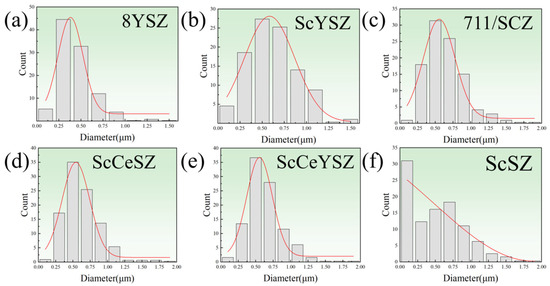
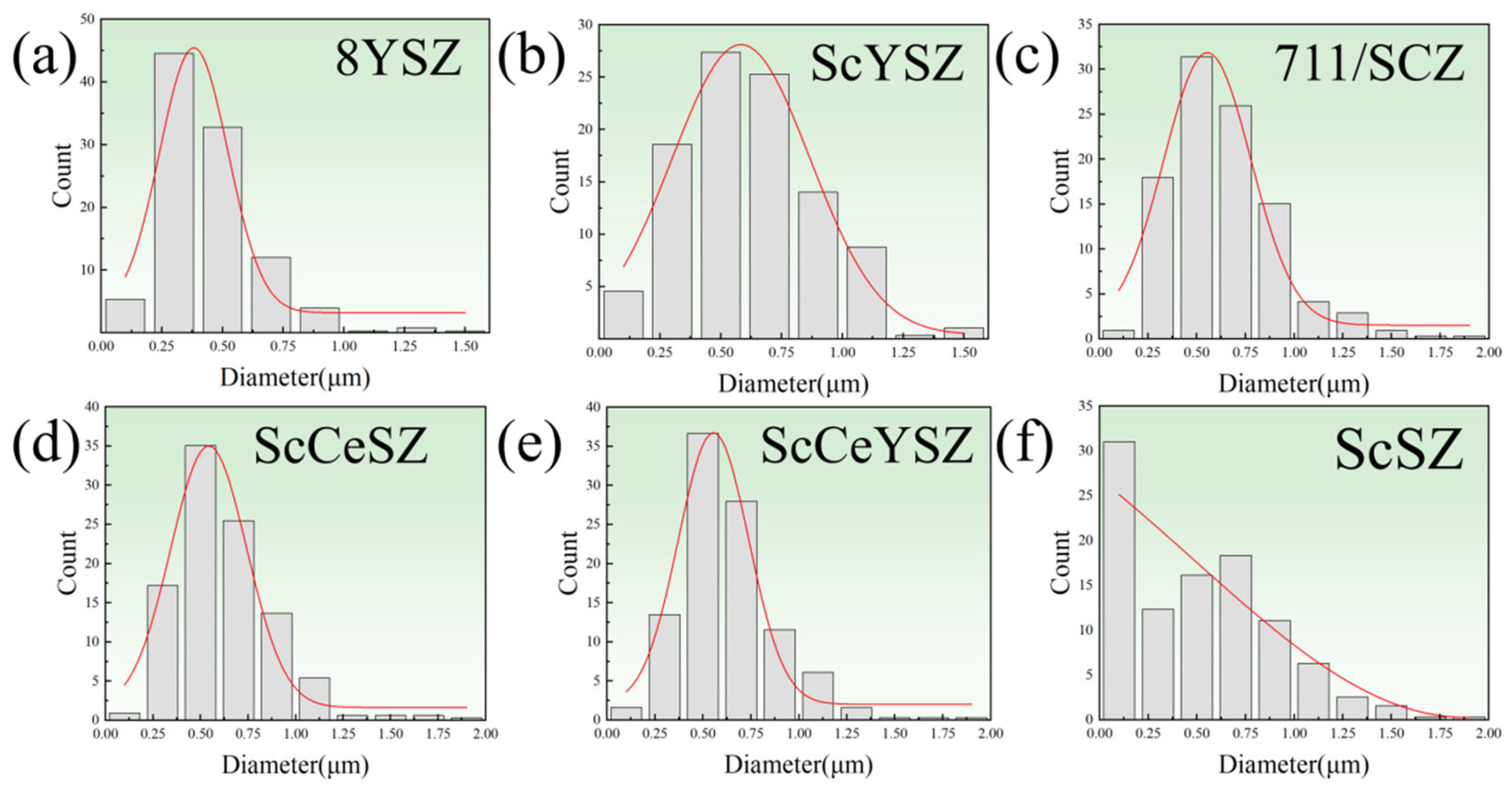
The crystalline phases of the sintered ceramics were analyzed with an X-ray diffractometer (XRD, D/max-2500/PC, Rigaku, Tokyo, Japan) at a scan speed of 5° per minute, while their microstructural features were examined using a scanning electron microscope (SEM, Oxford X-MaxN20, ZEISS, Oberkochen, Germany). Before testing, the ceramic specimens underwent ultrasonic cleaning. From the SEM micrographs, the mean grain size of the sintered specimens was quantitatively evaluated using the linear intercept technique [21], and the obtained data were approximated by a Gaussian distribution (Equation (1)). For each composition, at least 300 grains were counted.
In this context, μ denotes the central position, σ governs the distribution width, and A corresponds to the peak amplitude.
To gain deeper insight into the phase configuration of the ceramic specimens and to examine the localized elemental distribution by EDS, high-resolution transmission electron microscopy (HRTEM) and selected area electron diffraction (SAED) were carried out on ScCeYSZ ceramics. Furthermore, the microstructure was investigated using a transmission electron microscope (Talos F200X, Thermo Fisher Scientific, Waltham, MA, USA).
2.3. Bulk Density
The volumetric mass density of the ceramic samples was evaluated using the Archimedes technique. Initially, a cleaned ceramic sample was placed on an analytical balance to measure its dry weight in air, designated as m1. Subsequently, the specimen was immersed in high-purity water to measure its wet mass, recorded as m2. The bulk density of the ceramic material was calculated using the following equation:
2.4. Thermal Physical Properties
The specific heat capacity of the ceramic bulk was calculated using the Neumann-Kopp rule [22], with the calculation formula referring to Equation (3):
In Equation (3), Cpi (where i = 1, 2, 3, ...) denotes the molar heat capacity of each constituent in the solid solution, and ni (where i = 1, 2, 3, ...) denotes the associated mole fraction, while M designates the molecular mass of the solid solution.
The thermal diffusivity (α) was determined using a laser flash apparatus (LFA427; Netzsch, Selb, Germany) under an argon environment across temperatures spanning from ambient conditions up to 1000 °C. Samples with a thickness of 1.5 mm were tested three times at each target temperature. Before measuring thermal diffusivity, a thin film of graphite was applied to both faces of the ceramic samples. The thermal conductivity of the ceramics was then determined using the following equation [20]:
Here, λ, ρ, α and Cp denote, respectively, the sample’s thermal conductivity, density, thermal diffusivity and specific heat capacity.
Accounting for the effect of porosity (φ), the thermal conductivity (λ) of the fully dense specimen is adjusted as [23]:
where φ denotes the porosity fraction, defined as φ = 1 − ρ/ρt, ρt represents the theoretical density of the sintered ceramic, and ρ is the experimentally measured density.
The theoretical density of the material is calculated by the formula presented in Equation (6):
In this expression, W signifies the combined volume of all particles contained in the unit cell, while V denotes the volume of the unit cell itself.
The coefficient of linear thermal expansion for ceramic specimens measuring 20 mm × 3 mm × 4 mm was evaluated with a push-rod dilatometer (Netzsch DIL 402 C, Selb, Germany) in an argon environment. The experiments were performed from room temperature up to 1400 °C at a heating rate of 5 °C/min.
2.5. X-Ray Photoelectron Spectroscopy (XPS)
The oxidation states of the oxygen ions were examined by X-ray photoelectron spectroscopy (XPS, K-Alpha, Thermo Fisher, Waltham, MA, USA). Deconvolution of the O 1s spectra was conducted using the XPSPEAK v4.1 program. All binding energies were referenced to the C 1s peak at 284.6 eV for calibration.
2.6. Infrared Emissivity of the Materials
The infrared emissivity of the ceramic samples at elevated temperatures was evaluated with a Fourier transform infrared (FTIR) spectrometer (Nicolet IS50, Thermo Fisher Scientific, USA), while the specimens were heated using a blackbody furnace (Perkin Elmer Lambda, Waltham, MA, USA) during the measurements. The normal emissive power of the samples at 1000 °C was measured using an active blackbody radiation source, and the normal emissivity of the samples was derived by comparing it with that of a blackbody under the same temperature and environmental conditions. Each specimen was measured three times, and the mean value was taken. The specimens were ceramic disks with a diameter of 12.7 mm and a thickness of 1.5 mm, and their infrared emissivity within the wavelength range of 2.5–20 μm was evaluated.
The room-temperature reflection and absorption spectra of the ceramic samples over 200–2500 nm were recorded with a UV–Vis–NIR spectrophotometer (Perkin Elmer Lambda 750(s), Shelton, CT, USA).
2.7. Mechanical Properties Testing
The elastic modulus of 8YSZ and SCZ ceramic materials was determined using an elastic strain property tester (BUZZ-O-SONIC). Specifically, the elastic modulus of the ceramic samples was derived by analyzing the frequency of shock waves transmitted to the signal amplifier, with the average value calculated from five replicate tests.
The fracture resistance of the fabricated ceramic samples was evaluated using a Vickers hardness apparatus. During testing, a load of 10 kgf was employed, and the reported result corresponds to the mean value derived from five successive measurements. The calculation formula for fracture toughness is presented in Equation (7):
Within this equation, E signifies the elastic modulus, HV indicates the hardness, a corresponds to half the indentation diagonal, and l refers to the mean length of crack propagation.
3. Results and Discussion
3.1. Crystal Structure and Phase Composition
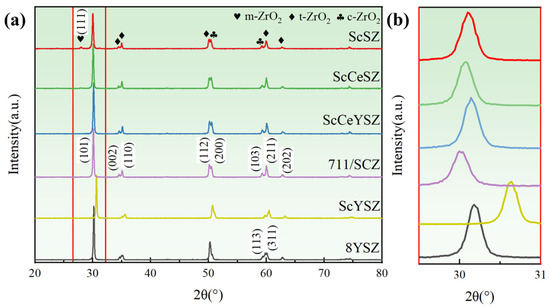
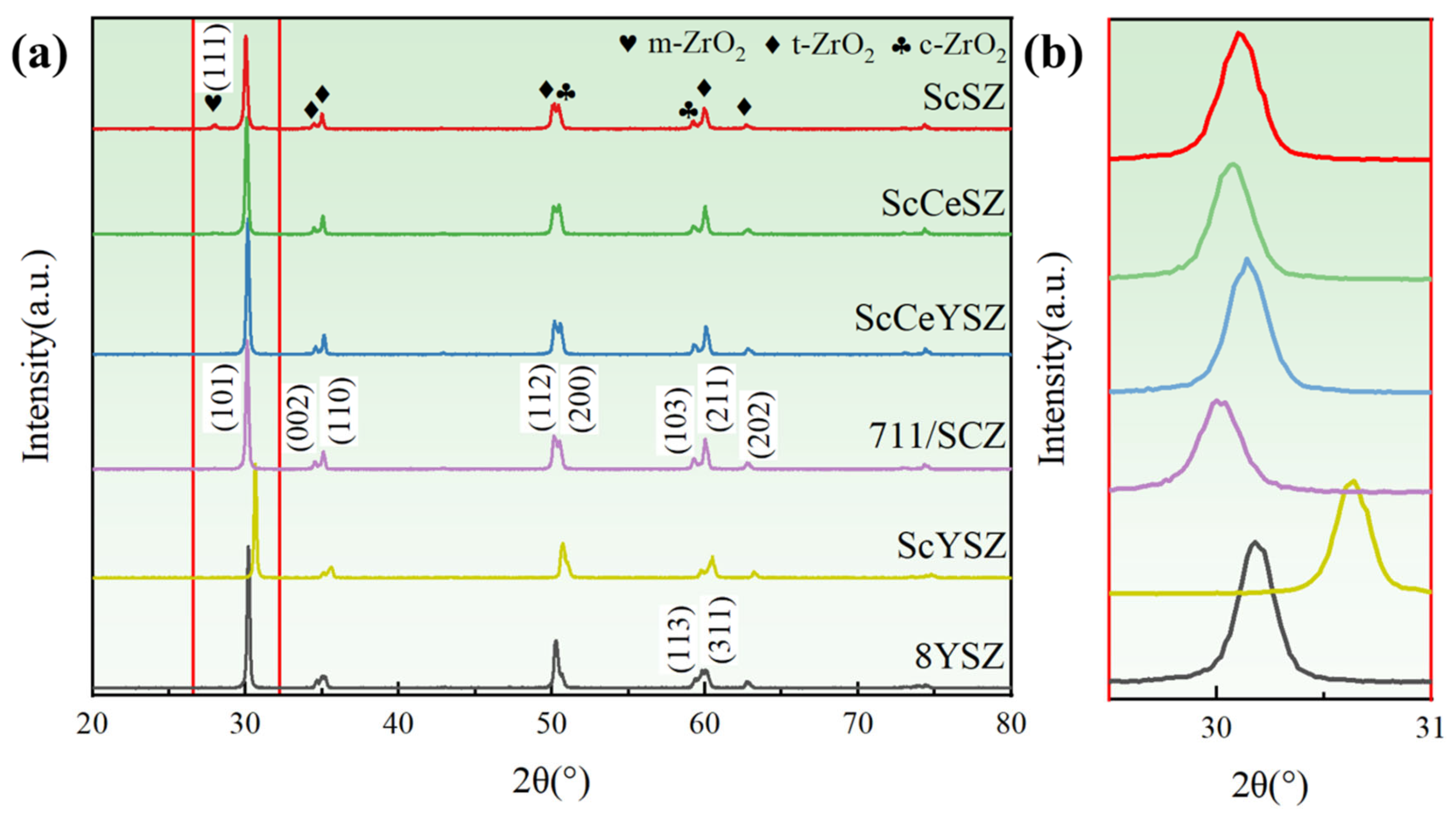
Figure 1a presents the XRD diffraction patterns of the as-prepared 8YSZ and SCZ-series ceramics. The findings show that the synthesized ScSZ phase assemblage is made up of a monoclinic phase (displaying a distinct diffraction peak for the monoclinic (111) plane at 28.5°) together with a fluorite-type structure that includes a mixture of tetragonal and cubic phases. For 8YSZ, two characteristic peaks corresponding to the cubic (113) and (311) planes emerge around 60°, with no monoclinic phase detected.
Figure 1.
(a) XRD patterns of 8YSZ and SCZ series ceramics. (b) Diffraction peaks in the 29–31° range.
The phase compositions of ScYSZ, 711/SCZ, ScCeSZ, and ScCeYSZ are composed of the tetragonal and cubic phases of zirconia. Characteristic peaks of tetragonal ZrO2 were observed at the (101), (002), (110), (112), (103), (211), and (202) crystal planes. This indicates that Sc2O3, CeO2, and Y2O3 have been fully incorporated into the ZrO2 lattice via solid solution, where Sc, Ce, and Y ions have substituted for Zr ions, thereby stabilizing the ZrO2 phase.
Figure 1b presents the diffraction peaks within the 29–31° range. Apart from ScYSZ, the diffraction peaks for the remaining compositions are displaced toward smaller 2θ values. This phenomenon arises because in ScYSZ, Sc3+ (ionic radius: 0.073 nm) replaces Y3+ (ionic radius: 0.089 nm). The smaller radius of Sc3+ leads to a reduction in interplanar spacing with negligible lattice distortion. ScSZ, which contains a monoclinic phase, does not conform to this trend. For the other compositions, the doped Ce ions (Ce4+: 0.097 nm; Ce3+: 0.087 nm) have larger ionic radii than the substituted Sc3+ and the host Zr4+ (0.072 nm), thereby inducing the shift of diffraction peaks to lower angles. Additionally, as the number of doped components increases, both the interplanar spacing and unit cell volume increase.
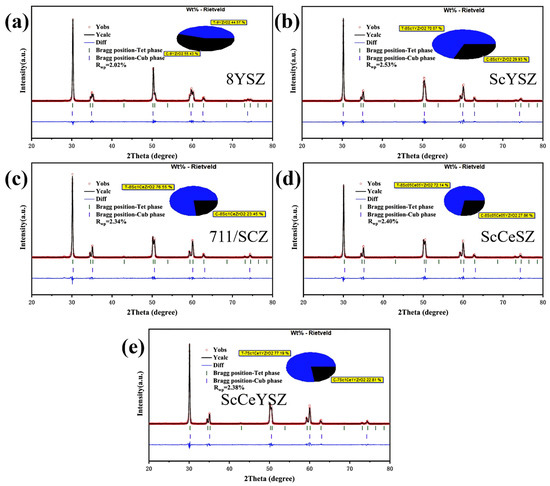
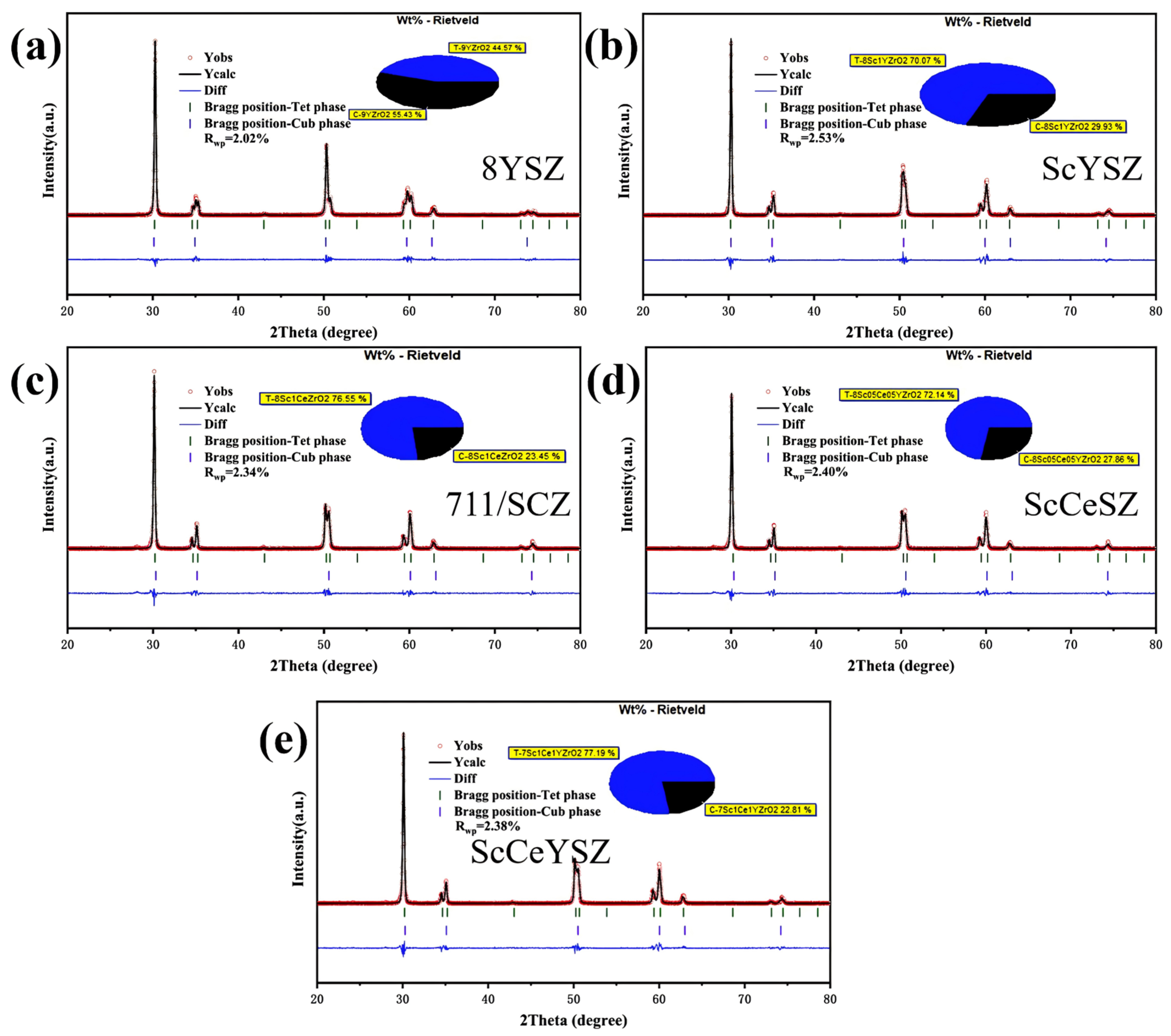
In addition, the lattice constants were obtained by performing Rietveld refinement of the XRD patterns for the samples, with the corresponding outcomes displayed in Figure 2. Table 2 summarizes the unit cell parameters of the 8YSZ and SCZ ceramic materials (excluding the ScSZ phase) determined from the XRD Rietveld refinement.
Figure 2.
XRD refinement results of (a) 8YSZ; (b) ScYSZ; (c) 711/SCZ; (d) ScCeSZ; and (e) ScCeYSZ ceramics.
Table 2.
Structural Parameters and Density of SCZ Ceramic Materials.
Figure 2 indicates that the weighted profile R-factor (Rwp) values associated with the unit cell parameters are quite low (all under 3%), reflecting a strong agreement with the reference parameters. This indicates that the XRD Rietveld refinement results possess high accuracy. Additionally, as can be seen from Figure 2, the tetragonal phase content of 711/SCZ, ScCeSZ, and ScCeYSZ doped with CeO2 is higher than that of 8YSZ and ScYSZ without CeO2 doping. Among these, ScCeYSZ has the highest tetragonal phase content, reaching 77.19%.
3.2. Micriscopic Morphology
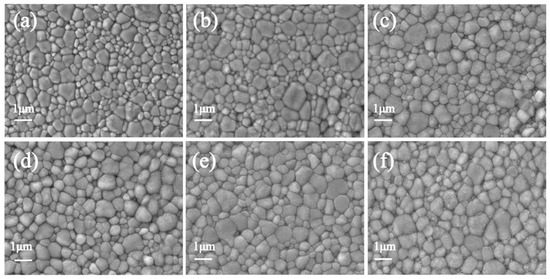
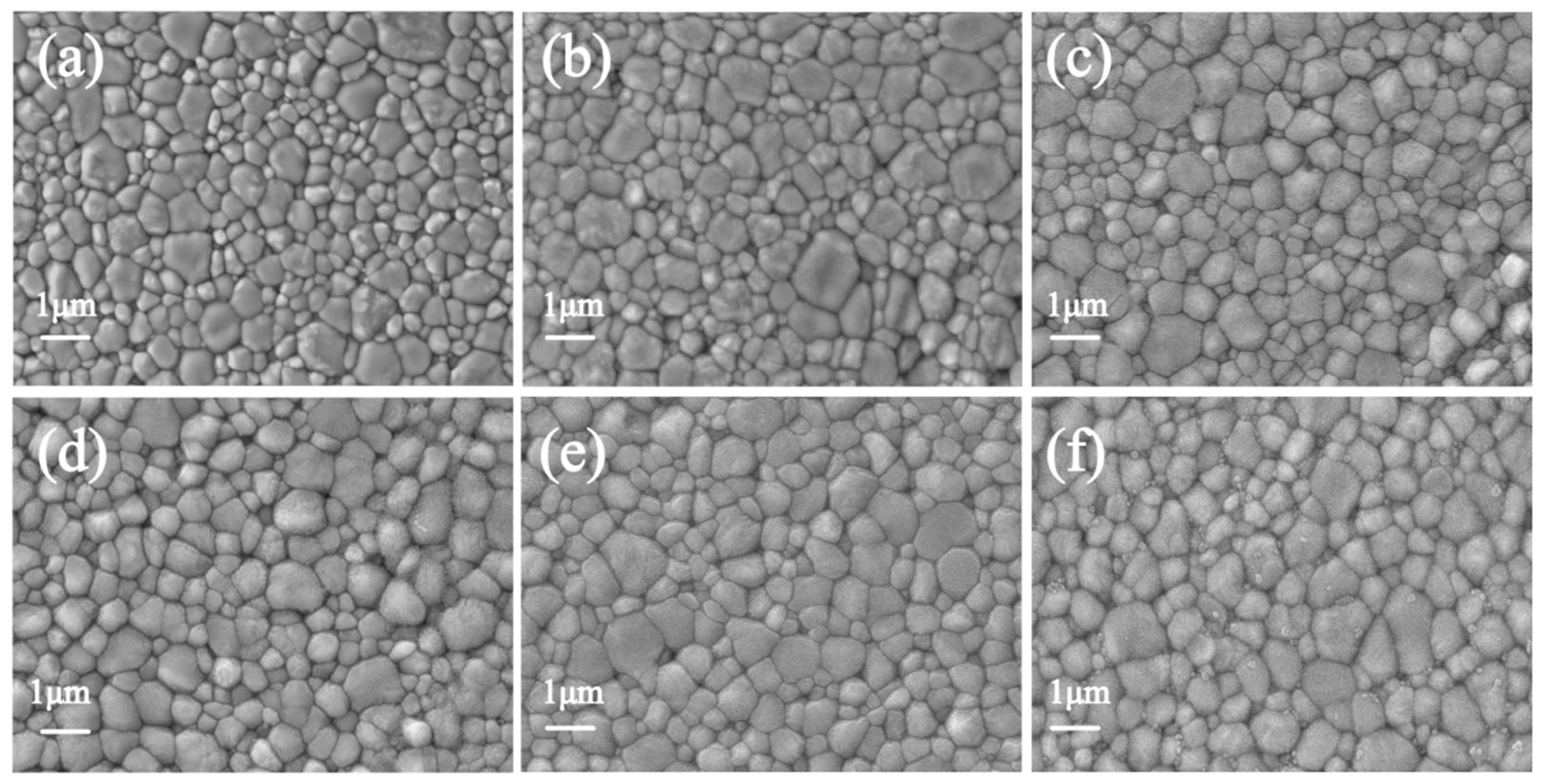
In addition, scanning electron microscopy (SEM) was utilized to comprehensively examine the microstructural features of SCZ ceramic specimens prepared with different doping levels (Figure 3a–f). Statistical analysis of the grain sizes for each composition was subsequently performed, and the resulting data were subjected to Gaussian distribution fitting (Figure 4a–f).
Figure 3.
SEM images of (a) 8YSZ; (b) ScYSZ; (c) 711/SCZ; (d) ScCeSZ; (e) ScCeYSZ; (f) ScSZ.
Figure 4.
Gaussian-fitted grain size distributions of (a) 8YSZ; (b) ScYSZ; (c) 711/SCZ; (d) ScCeSZ; (e) ScCeYSZ; (f) ScSZ.
As shown in Figure 3f, a distinct secondary phase is observed in the ScSZ ceramic, which is consistent with the XRD results, confirming the presence of the monoclinic phase in ScSZ. Consequently, ScSZ was excluded from subsequent relevant characterizations.
With the ScSZ ceramic excluded, the remaining results indicate that, under the condition of a constant total stabilizer content, the average grain sizes of ScYSZ, 711SCZ, ScCeSZ and ScCeYSZ fall within the range of 0.61–0.62 μm, all of which are larger than the 0.42 μm observed for the 8YSZ ceramic. This indicates that the doped Sc2O3 exhibits a sintering-promoting effect, while the inhibitory effect of a small amount of doped CeO2 on the sintering promotion by Sc2O3 is not significant.
All ceramic compositions exhibit a dense structure (relative density > 96%), with regular polygonal grain morphology, uniform grain distribution, distinct grain boundaries, and no detectable impurity phases.
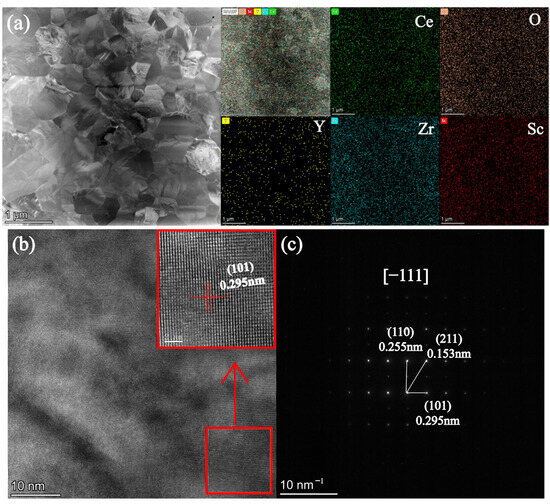
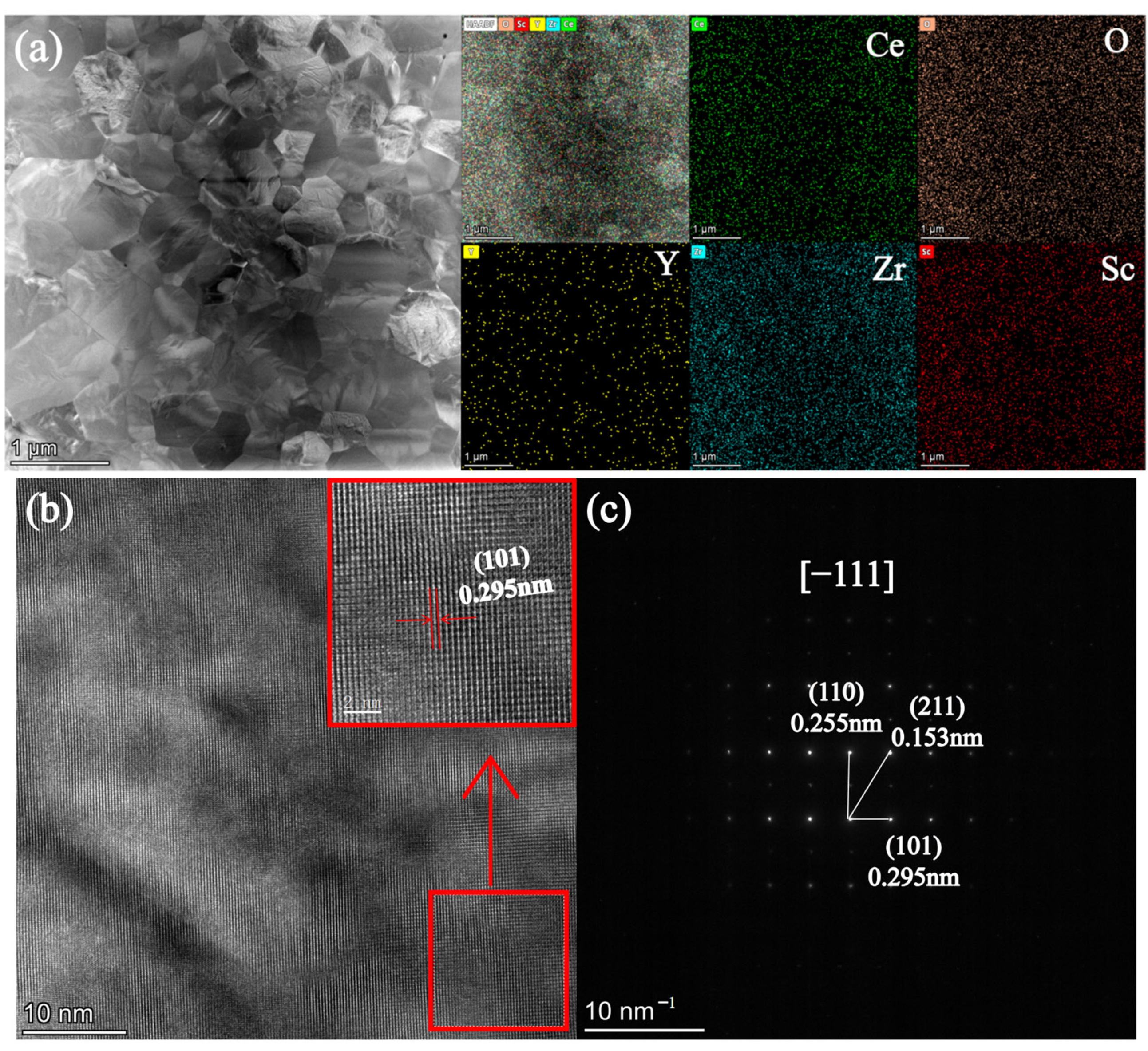
Typical ScCeYSZ ceramic specimens were chosen for in-depth microstructural analysis, including localized EDS compositional mapping combined with high-resolution transmission electron microscopy (HRTEM) observations and selected area electron diffraction (SAED) examination. The related findings are shown in Figure 5a–c.
Figure 5.
For the ScCeYSZ ceramics, (a) the elemental distribution was examined by electron microscopy, (b) the grain boundary region was observed using high-resolution transmission electron microscopy, and (c) the selected-area electron diffraction patterns of the fluorite phase were analyzed along the [−111] zone axis.
As shown in Figure 5a, the TEM-EDS mapping of ScCeYSZ ceramics demonstrates uniform distribution of all elements with no secondary phases detected. Figure 5b displays the lattice fringes observed between crystal phases via HRTEM. In Figure 5b, the observed d-spacing of 0.296 nm is assigned to the (101) lattice plane of the fluorite-type phase, in agreement with the standard diffraction pattern of ZrO2.
Furthermore, the SAED pattern acquired along the [−111] zone axis of the fluorite phase (Figure 5c) yields interplanar spacings of 0.295 nm and 0.153 nm for the (101) and (211) planes, respectively, both of which match the values calculated from XRD data. This comprehensive analysis conclusively confirms the tetragonal phase structure in ScCeYSZ ceramics.
3.3. Thermal Conductivity
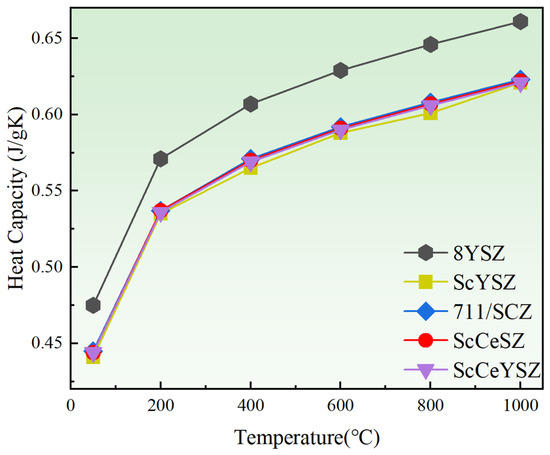
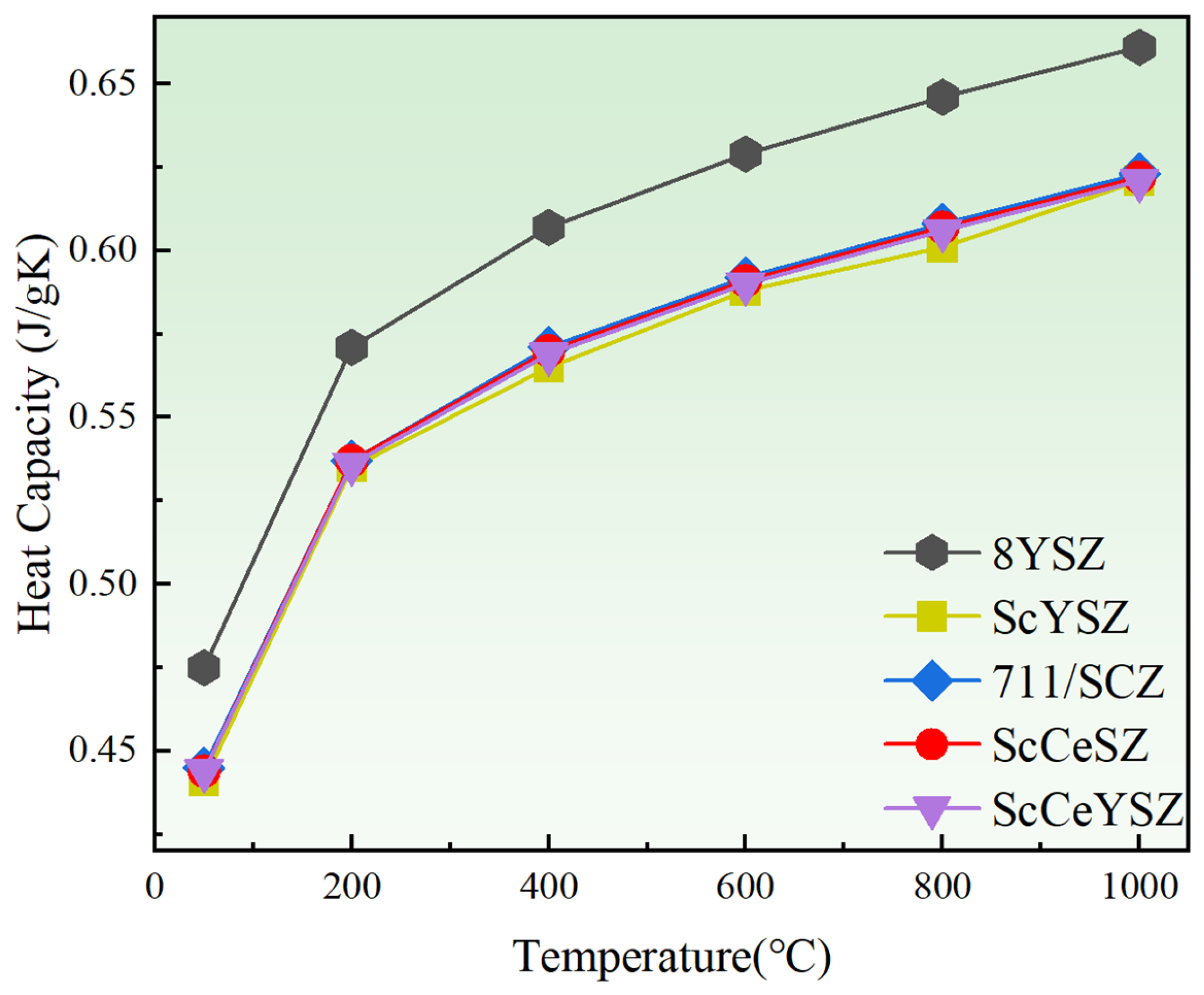
Based on the Neumann–Koop rule, the theoretical heat capacities of the as-prepared ceramic materials at different temperatures were calculated. Given that the Neumann–Koop rule yields oxide heat capacities with high accuracy (deviation from experimental values within 5%), the calculated values were adopted for the heat capacities of 8YSZ and SCZ ceramics. The calculation results are presented in Figure 6.
Figure 6.
Specific heat capacity of 8YSZ and SCZ ceramics at various temperatures.
The calculation results indicate that the specific heat capacity of the ceramic materials increases with the incorporation of Sc2O3 and CeO2, and the theoretical values are consistent with the Debye law. The specific heat capacity of SCZ ceramics ranges from 0.44 to 0.66 J·g−1·K−1, which is slightly higher than that of 8YSZ (0.43–0.61 J·g−1·K−1).
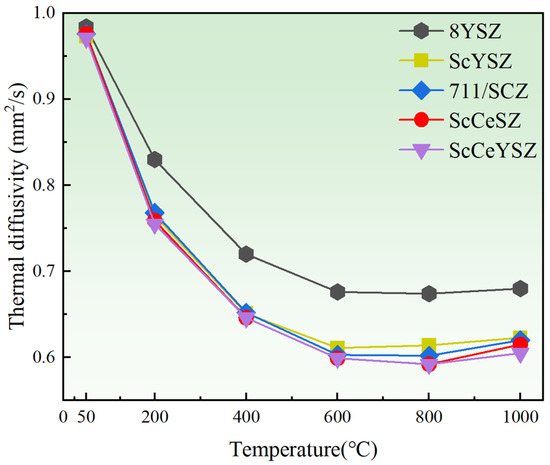
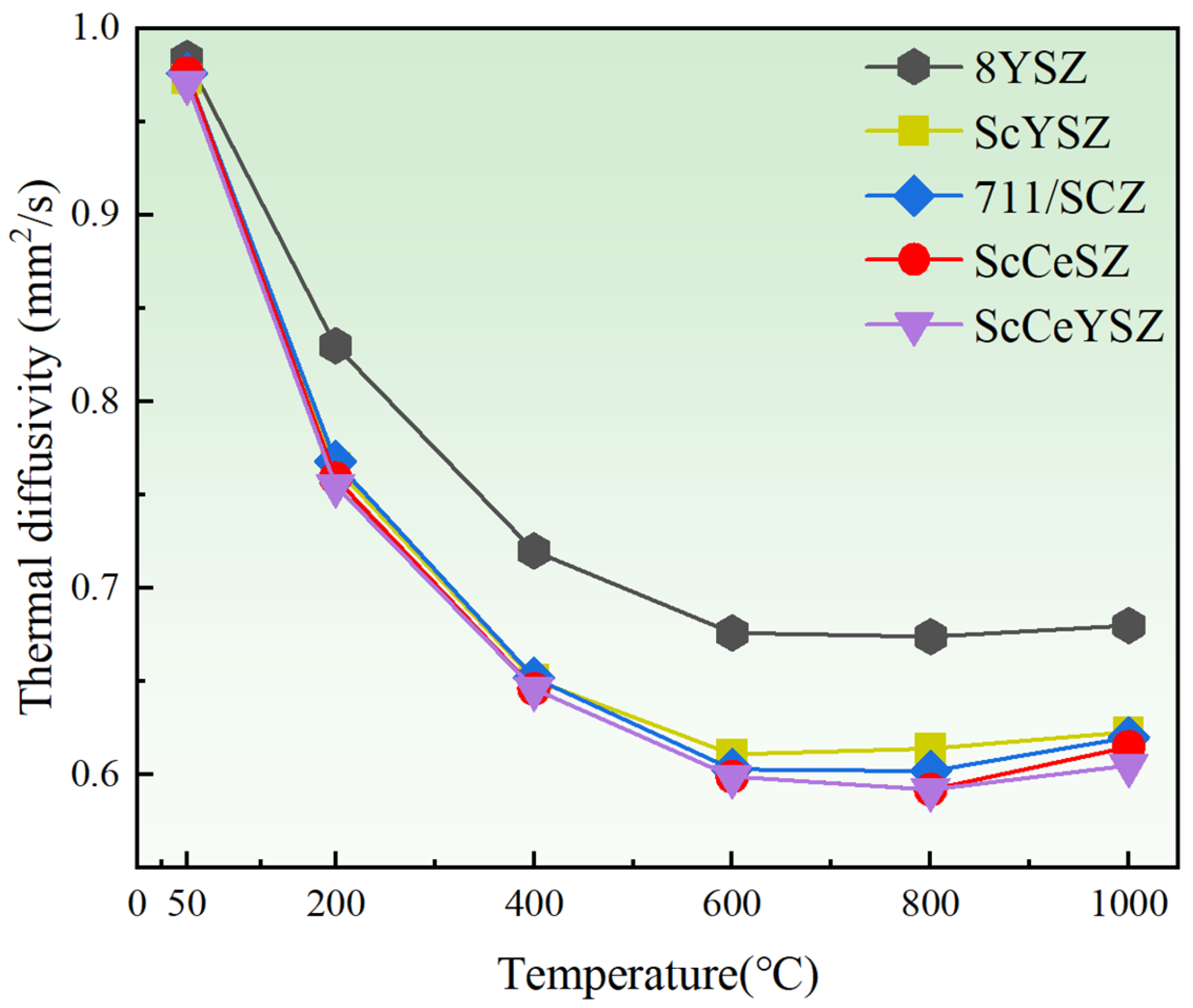
Figure 7 depicts the temperature-dependent thermal diffusivity curves of the SCZ series ceramic materials. When the temperature is below 600 °C, the thermal diffusivity of all ceramic compositions declines as the temperature rises; once the temperature exceeds 600 °C, it begins to increase. This behavior arises because heat transport is mainly governed by phonon conduction at temperatures below 600 °C, whereas the enhancement above 600 °C is attributed to the growing influence of radiative heat transfer at high temperatures [24]. In the sub–600 °C range, the thermal diffusivity of SCZ ceramics remains consistently lower than that of 8YSZ.
Figure 7.
Thermal diffusivity of 8YSZ and SCZ ceramics at various temperatures.
Above 600 °C, the thermal diffusivity values of CeO2-doped 711/SCZ, ScCeSZ, and ScCeYSZ are all lower than that of ScYSZ. This suggests that CeO2 may exert a stronger influence on radiative heat transfer than Sc2O3. Notably, ScCeYSZ exhibits the lowest thermal diffusivity, decreasing from 0.958 mm2·s−1 at 50 °C to 0.603 mm2·s−1 at 1000 °C.
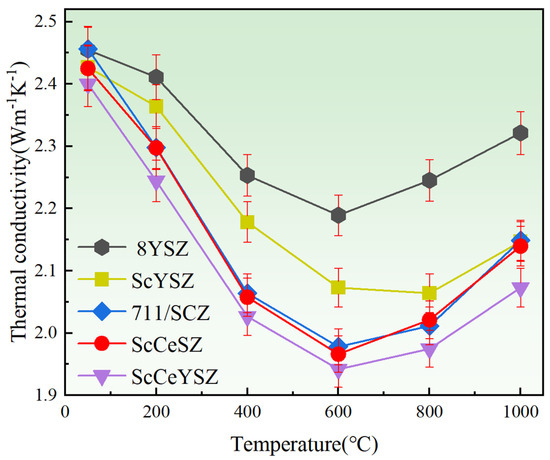
The thermal conductivity of SCZ-series ceramic materials was calculated via Formula 4 and corrected using Formula 5, with the results presented in Figure 8. Considering a 0.5% error in bulk density measurement, a 5% error in heat capacity calculation based on the Neumann-Kopp rule, and a 1.5% error in thermal diffusivity measurement, the overall error of thermal conductivity is approximately 7%.
Figure 8.
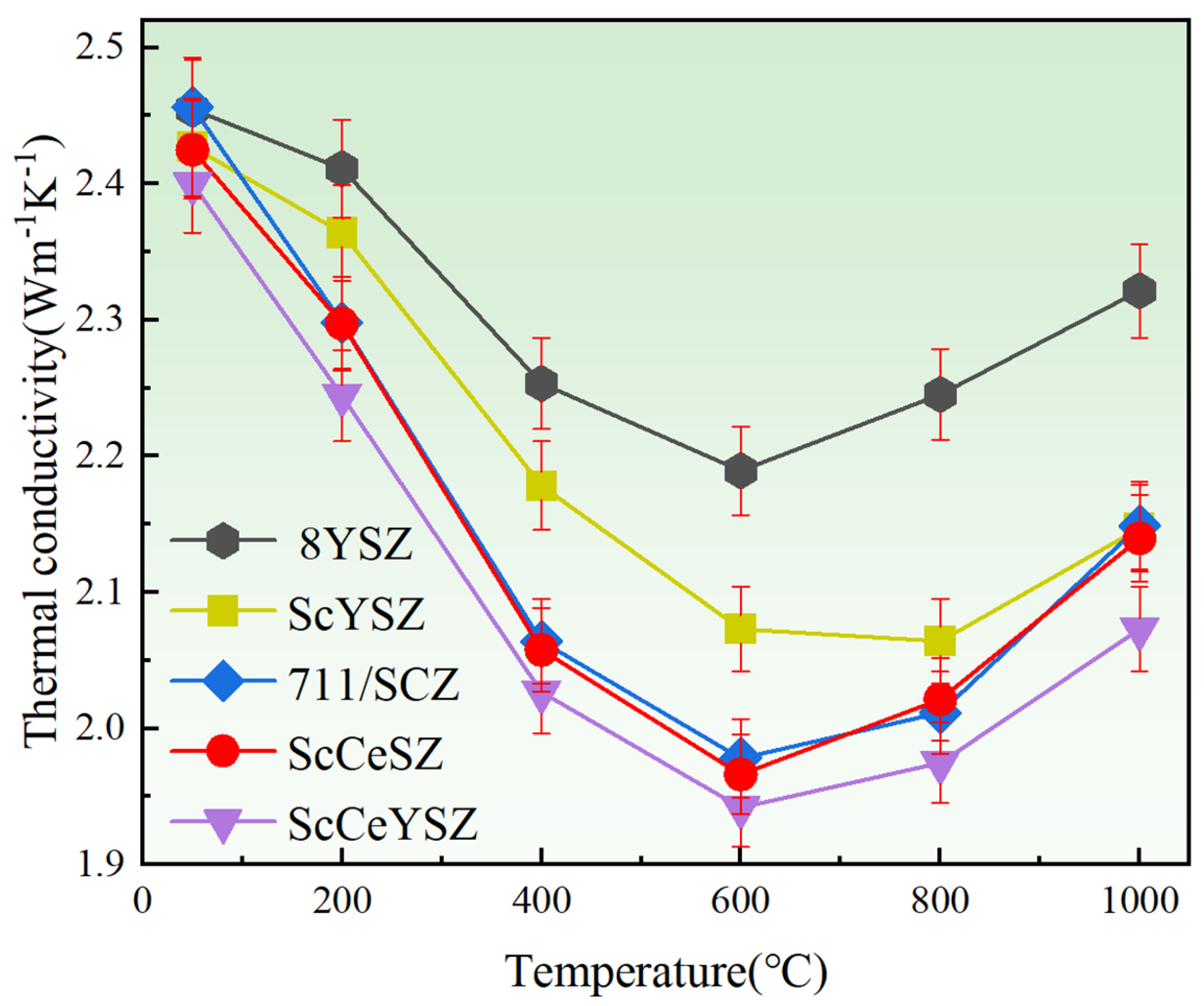
The relationship of thermal conductivity of 8YSZ and SCZ ceramics.
Within the temperature interval from room temperature to 600 °C, the thermal conductivity of every composition declines as the temperature increases, displaying the characteristic behavior of heat transport governed by phonons. With rising temperature, phonon-phonon interactions become more pronounced, which shortens the phonon mean free path and consequently causes a progressive decrease in thermal conductivity.
Compared with 8YSZ, SCZ-series ceramics possess lower thermal conductivity, which is primarily attributed to enhanced point defect scattering. The mass and ionic radius mismatches between Sc3+, Ce3+/4+, and Zr4+ induce local lattice distortion and strengthen phonon scattering. Additionally, Ce-related defects further increase the oxygen vacancy concentration, thereby shortening the phonon mean free path. Notably, the ScCeYSZ sample exhibits the lowest thermal conductivity (e.g., 1.942 W·m−1·K−1 at 600 °C), which is consistent with its higher oxygen vacancy content. These results indicate that defect structure engineering plays a crucial role in suppressing lattice heat transfer.
When the temperature exceeds 600 °C, the thermal conductivity of all compositions shows an upward trend. This suggests that besides lattice heat transfer, radiative heat transfer also begins to exert a significant influence on the total thermal conductivity at elevated temperatures.
3.3.1. Lattice (Phonon) Thermal Conductivity
Within the temperature interval spanning ambient conditions up to 600 °C, the ceramics exhibit a reduction in thermal conductivity as the temperature rises, in agreement with the typical behavior of heat transport dominated by phonons. Within the framework of Debye’s model, the lattice thermal conductivity is governed collectively by the heat capacity, the velocity of phonons, and their mean free path. The ionic sizes and masses of Sc3+, Ce3+/Ce4+, and Y3+ deviate markedly from those of Zr4+, resulting in the generation of numerous point defects. Meanwhile, the introduction of Ce may induce alterations in local defect states, and the associated defects are likely to participate in defect engineering, thereby further enhancing defect scattering. The combined influence of these two parameters markedly reduces the phonon mean free path, thereby leading to a pronounced decrease in lattice thermal conductivity. The lattice thermal conductivity in crystalline solids can be represented as [25,26]:
In this context, C stands for the heat capacity, ω refers to the phonon angular frequency, T denotes the temperature, v represents the phonon propagation speed, and l signifies the phonon mean free path. For temperatures higher than the Debye temperature, the heat capacity is given by C = X·ω2 (with X being a constant), v describes the phonon speed, and ωmax corresponds to the Debye angular frequency.
The principal determinants of the phonon mean free path (l(ω,T)) are chiefly phonon-phonon scattering (li(ω,T)), point-defect scattering (lp(ω,T)), and grain-boundary scattering (lb) [27]. The relationship between these factors can be expressed by the following formula [28,29]:
Since the grain boundary thickness greatly exceeds the phonon mean free path, the influence of grain boundary scattering on thermal conductivity can be considered insignificant [30]. In contrast, phonon-phonon scattering constitutes an intrinsic scattering mode of the material, and phonon propagation is strongly temperature-dependent [31]. Consequently, with increasing temperature, the enhanced intrinsic phonon scattering reduces li(ω,T), thereby causing a decrease in lattice thermal conductivity. This trend is consistent with the temperature-dependent variations of thermal diffusivity and thermal conductivity for SCZ ceramics within the range of RT to 600 °C, which validates the phonon-dominated heat transfer mechanism.
The defect scattering lp(ω,T) can be further expressed as [28,29]:
Here, Cp represents the defect concentration. Dp can be expressed as [32,33,34,35]:
Here, m denotes the atomic number, V denotes the unit cell volume, and Γ is the phonon scattering coefficient.
Based on the Debye phonon theory, when the temperature of a defect-containing crystal exceeds the Debye temperature, the relationship between the thermal conductivity (κ) of the lattice-defect compound and the defect scattering coefficient (Γ) is expressed by the following equation [36]:
Thus, the phonon scattering coefficient (Γ) can be expressed as [37,38]:
Here, f denotes the defect concentration, Mi and δ represent the mass and atomic radius of the substituting atom, and denote the average atomic mass and average atomic radius, respectively, and ε is the stress field factor (quantifying the contribution of ionic radius mismatch to phonon scattering).
In this study, XRD and TEM characterizations revealed that SCZ ceramics exhibit a tetragonal phase structure, with doped cations achieving complete solid solution. Thus, the doped zirconia can be treated as an AB2-type compound, where A denotes metal cations and B represents anions and vacancies. Upon replacing Y with Sc and introducing Ce as a dopant, both the mean atomic mass and ionic radius at the A-site are modified, resulting in a higher Γ. At the same time, the population of oxygen vacancy defects increases, which further amplifies Γ and consequently diminishes the phonon mean free path—this manifests as a decrease in the lattice thermal conductivity.
Experimental results demonstrate that the thermal conductivities of 711/SCZ and ScCeSZ doped with 0.01 mol CeO2 are higher than those of ScCeYSZ doped with 0.005 mol CeO2, which aligns with experimental observations. The concentration of oxygen vacancy defects was determined via XPS analysis.
3.3.2. XPS Analysis
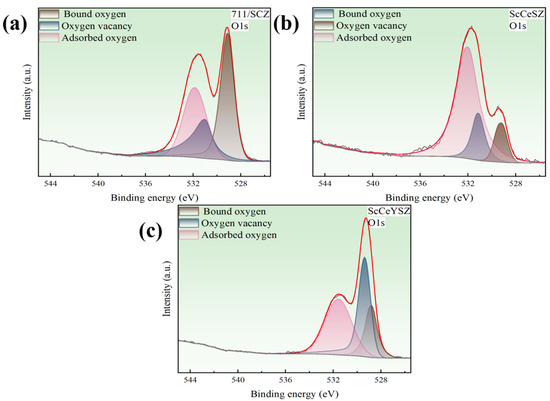
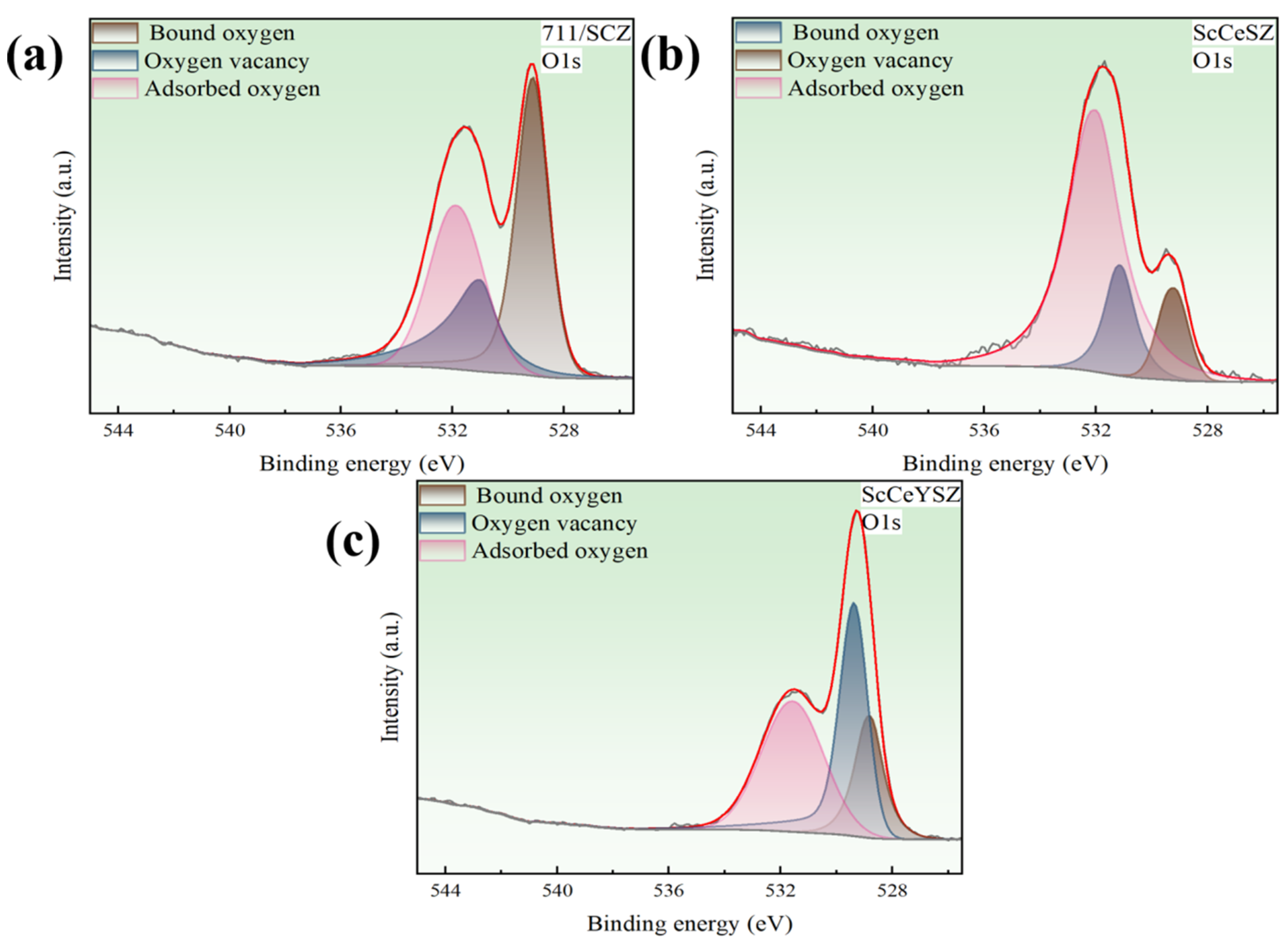
To investigate the influence of CeO2 doping on defect states, O 1s XPS measurements were performed on the 711/SCZ, ScCeSZ, and ScCeYSZ samples (ScYSZ was excluded from XPS testing as it exhibits a fixed valence state and constant oxygen vacancy concentration). The acquired spectra were fitted using mixed Gauss–Lorentz curves. The generation of oxygen defects is represented by the Kröger-Vink notation [17] as follows:
Among them, Oo represents lattice oxygen; V″o represents oxygen vacancy defects.
Figure 9 presents the O 1s XPS spectra of 711/SCZ, ScCeSZ and ScCeYSZ samples. Consistent with the results presented in Reference [39], the O 1s signal observed at 529.3–530.5 eV in binding energy is attributed to lattice oxygen (Ol), whereas the feature appearing at 530.5–531.7 eV is ascribed to oxygen vacancies (Od). Additionally, the peak spanning 530.8–532.3 eV is attributed to adsorbed oxygen (i.e., oxidized clusters, Oa). Importantly, the amount of oxygen vacancies in the materials is determined from the integrated area of the Od feature.
Figure 9.
(a–c) O 1s spectra of 711/SCZ; ScCeSZ and ScCeYSZ ceramics.
The results demonstrate distinct variations in the peak areas associated with oxygen vacancies across different samples. Notably, the ScCeYSZ sample exhibits the highest oxygen vacancy fraction, reaching 38.33%. This suggests that the introduction of Ce modulates the local defect states and elevates the oxygen vacancy concentration. As an important type of point defect, oxygen vacancies can intensify phonon scattering and decrease the phonon mean free path, thus lowering the lattice thermal conductivity. At the same time, the corresponding rise in defect states can modify the material’s electronic structure, thereby further affecting its infrared radiation characteristics at elevated temperatures.
It should be noted that in oxide ceramic systems, oxygen vacancies can exist in multiple charge states contingent on the local charge environment and redox conditions, including electron-untrapped bare oxygen vacancies, F+ centers with one trapped electron, and F centers with two trapped electrons. The reversible valence transition of Ce3+/Ce4+ can regulate the charge state distribution of oxygen vacancies via local charge compensation. Owing to the low Ce doping level in this study and the limited characterization precision of conventional XPS, fine differentiation of the charge states of oxygen vacancies was not performed herein; all relevant discussions are centered on the collective effects of oxygen vacancy-like defects. Subsequent studies will consider integrating characterization techniques such as EPR and PAS to further reveal the correlation between Ce valence equilibrium and oxygen vacancy charge state distribution, and to refine the defect chemistry theory of this system.
3.3.3. Radiative (Photon) Thermal Conductivity
When the temperature exceeds 600 °C, the thermal conductivity instead increases significantly with increasing temperature, leading to a deviation from the 1/T relationship. This phenomenon can be ascribed to the enhanced contribution of photon thermal conduction under high-temperature conditions [40,41]. According to the Stefan–Boltzmann law [42], the photon (radiative) thermal conductivity of materials at elevated temperatures is correlated with their optical properties. Consequently, as temperature increases, the contribution of photons to thermal conductivity will become dominant. The photon thermal conductivity Kp is given by Equation (17) [43]:
In this context, τ represents the Stefan–Boltzmann constant (about 5.67 × 10⁻⁸ W/m2·K), α denotes the material’s emissivity, n stands for the refractive index, and lr corresponds to the photon mean free path. And lr can be expressed as [44]:
Here, α and σ denote the absorption coefficient and scattering coefficient of the material, respectively. By jointly applying Equations (17) and (18), it follows that the photon thermal conductivity Kp scales with the third power of temperature and varies inversely with both the absorption and scattering coefficients. As the temperature increases, the contribution of photon-mediated heat conduction to the overall thermal conduction becomes increasingly significant. Enhanced infrared absorption/emission can shorten the photon transport path, thereby facilitating the suppression of radiative heat transfer at elevated temperatures.
In accordance with Kirchhoff’s law [45], a material’s capacity to radiate heat is identical to its capacity to take up that radiation; in other words, its emissivity matches its absorptivity. According to Wien’s displacement law and the blackbody radiation law [12], at temperatures below 1200 °C, 90% of the blackbody radiation is within the wavelength range of 3–5 μm. Thus, the thermal radiation absorption capacity of 8YSZ, ScYSZ, 711/SCZ, ScCeSZ, and ScCeYSZ ceramics can be directly evaluated by assessing their infrared emissivity at elevated temperatures. This further explains and validates the phenomenon that the thermal conductivity of SCZ-series ceramics remains lower than that of 8YSZ ceramics above 600 °C.
3.4. Infrared Emittance
3.4.1. Infrared Emissivity
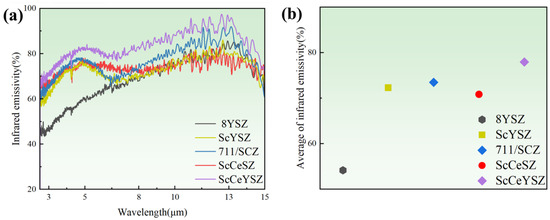
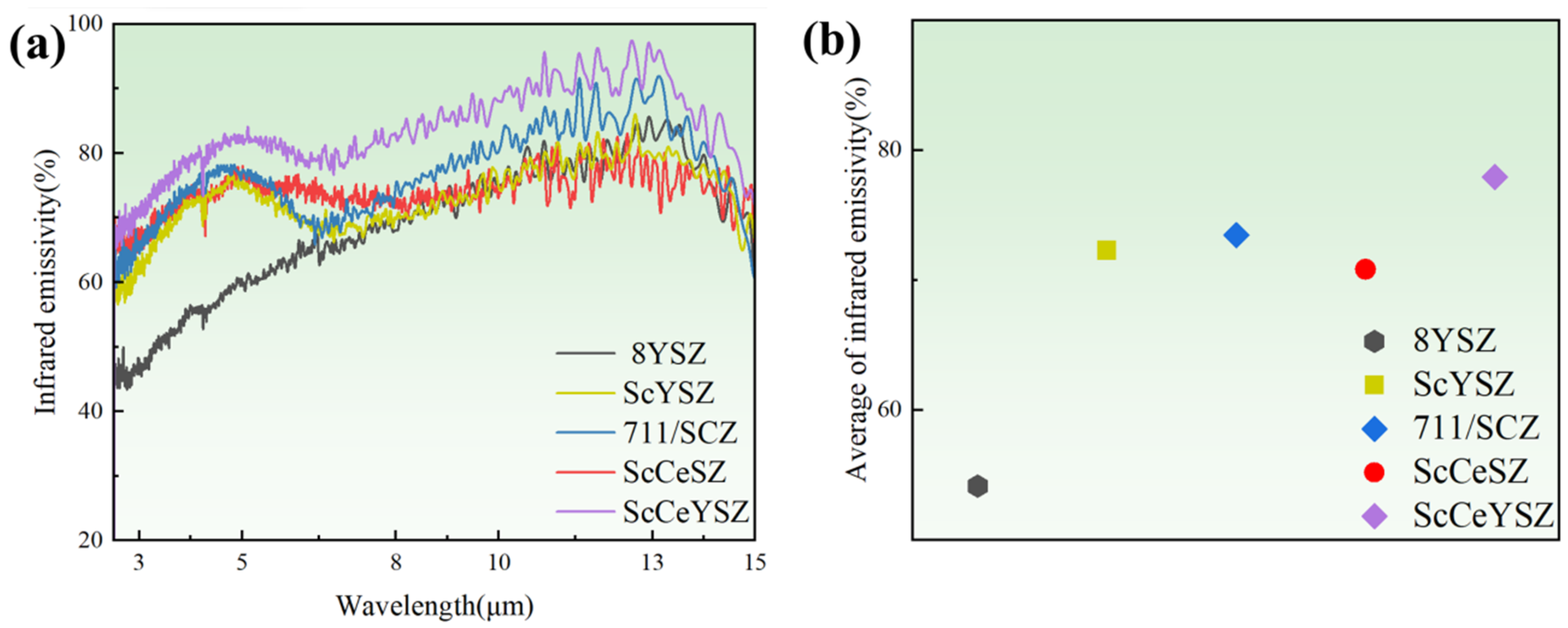
To further investigate the behavior of radiative heat conduction at elevated temperatures, high-temperature infrared emissivity measurements were carried out on the SCZ series ceramics. The normal spectral emissivity of 8YSZ and SCZ ceramics within the wavelength range of 2.5–15 μm was characterized at an elevated temperature of 1000 °C. Thereafter, the mean infrared emissivity within the 3–5 μm range was determined and graphed, and the corresponding results are displayed in Figure 10.
Figure 10.
(a,b) The infrared emissivity of 8YSZ and SCZ ceramic materials at 1000 °C, along with their corresponding average infrared emissivity within the 3–5 μm wavelength range at this temperature.
The results indicate that the infrared emissivity of the material is significantly enhanced following CeO2 doping. Among the samples, ScCeYSZ exhibits the highest average emissivity (0.779) in the 3–5 μm band, which is higher than that of 8YSZ (0.547) and represents a 6.4% improvement over ScYSZ (0.732). This pattern aligns with the fact that its thermal conductivity at high temperatures is the lowest. Generally, at elevated temperatures, the heat transfer of materials encompasses not only phonon thermal conduction but also radiative heat transfer. The infrared absorption and emission behaviors of materials directly influence the photon heat transfer process. Thus, variations in high-temperature infrared emissivity exert a significant impact on the total thermal conductivity. The significantly higher emissivity of the SCZ series ceramics compared to 8YSZ is mainly attributed to the combined effects of two aspects: Firstly, the co-doping of multi-sized ions such as Sc3+, Ce3+/Ce4+, and Y3+ causes intense lattice distortion and symmetry reduction, enhancing multi-phonon absorption and lattice absorption. Secondly, the incorporation of Ce and the formation of oxygen vacancies generate impurity states within the band gap, narrowing its width and facilitating the excitation of free carriers [39], thus improving infrared absorption and emission performance.
The mechanism underlying the influence of lattice distortion on the infrared emissivity of materials can be elaborated as follows: When Y3+, Sc3+, and Ce ions (with distinct ionic radii) are co-doped into the ZrO2 lattice, lattice distortion is induced more effectively. During this process, oxygen vacancies and substitutional defects further react to form defect clusters, and the reaction mechanism is illustrated in Equation (19) [46]:
Defect clusters reduce the concentration of mobile defects, thereby suppressing ionic migration and mass transport. This induces significant lattice distortion [14], reduces lattice symmetry, and enhances the anharmonicity of lattice vibrations–collectively synergizing to boost infrared multiphonon absorption and lattice absorption [44,47]. In accordance with Kirchhoff’s law, the increased absorptivity directly translates to elevated emissivity. High emissivity shortens the photon’s mean free path, inhibits photon thermal conduction, and further lowers the effective thermal conductivity at elevated temperatures.
3.4.2. Band Gap Width
The incorporation of doped CeO2, Sc2O3, and the resulting oxygen vacancies creates defect-related electronic states inside the band gap, thereby enabling free charge carriers to move between the valence band and the conduction band. This phenomenon falls under the impurity absorption mechanism [17]. A narrower band gap width (Eg) corresponds to a higher electron transition probability, a greater concentration of free carriers in the conduction band, and thus a higher infrared emissivity of the material. Consequently, the band gaps of the SCZ ceramic samples prior to and following doping were determined from their UV–Vis–NIR reflectance spectra, and the carrier behavior in these samples was examined.
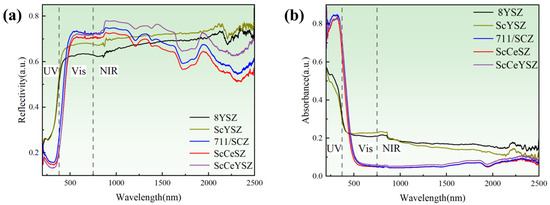
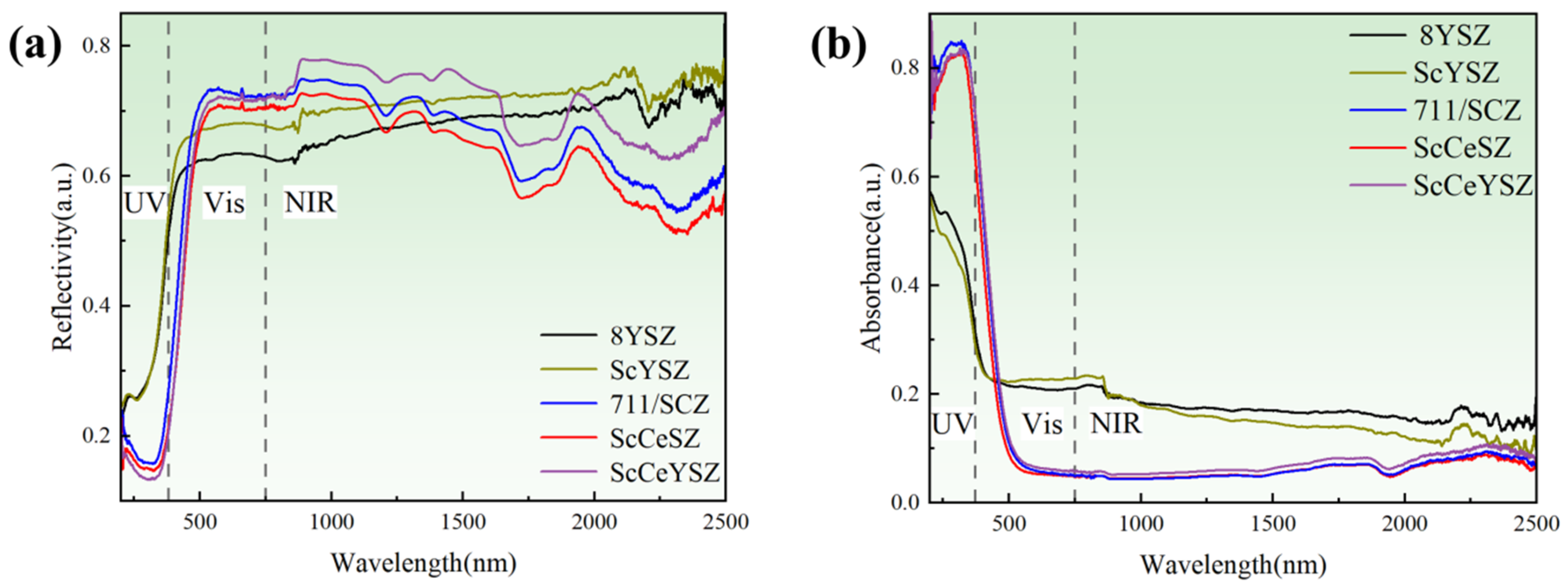
Figure 11a presents the room-temperature diffuse reflectance spectra of 8YSZ and SCZ ceramic materials over the UV–Vis–NIR spectral range (200–2500 nm), while the corresponding absorption spectra derived from these data are shown in Figure 11b.
Figure 11.
(a) UV–Vis–NIR reflectance curves and (b) UV–Vis–NIR absorption curves for 8YSZ and SCZ ceramic samples.
In accordance with the standard oxide spectral analysis method proposed by Brik et al. [48], a detailed analysis and separation of the UV–Vis–NIR reflectance and absorbance spectra were carried out: the distinct, step-like abrupt increase in absorbance observed in the 200–400 nm ultraviolet range is associated with the intrinsic fundamental absorption edge of the ZrO2 host lattice, arising from the inherent interband transition between the O 2p valence band and the Zr 4d conduction band, and this feature can be utilized to determine the intrinsic optical bandgap via Tauc fitting. The smooth and continuous absorption band in the 400–2500 nm visible-near-infrared region does not belong to the intrinsic absorption edge; instead, it is attributed to sub-bandgap defect absorption induced by oxygen vacancies and Ce3+/Ce4+ 4f impurity levels within the bandgap.
The bandgap width (Eg) can be calculated via the Tauc equation, as specified below [49,50]:
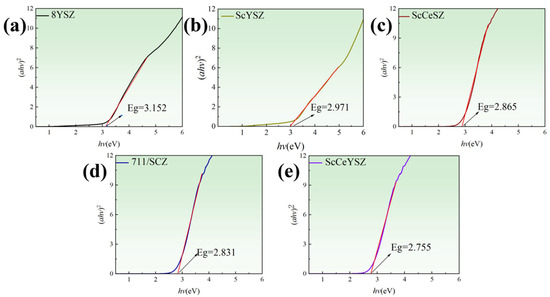
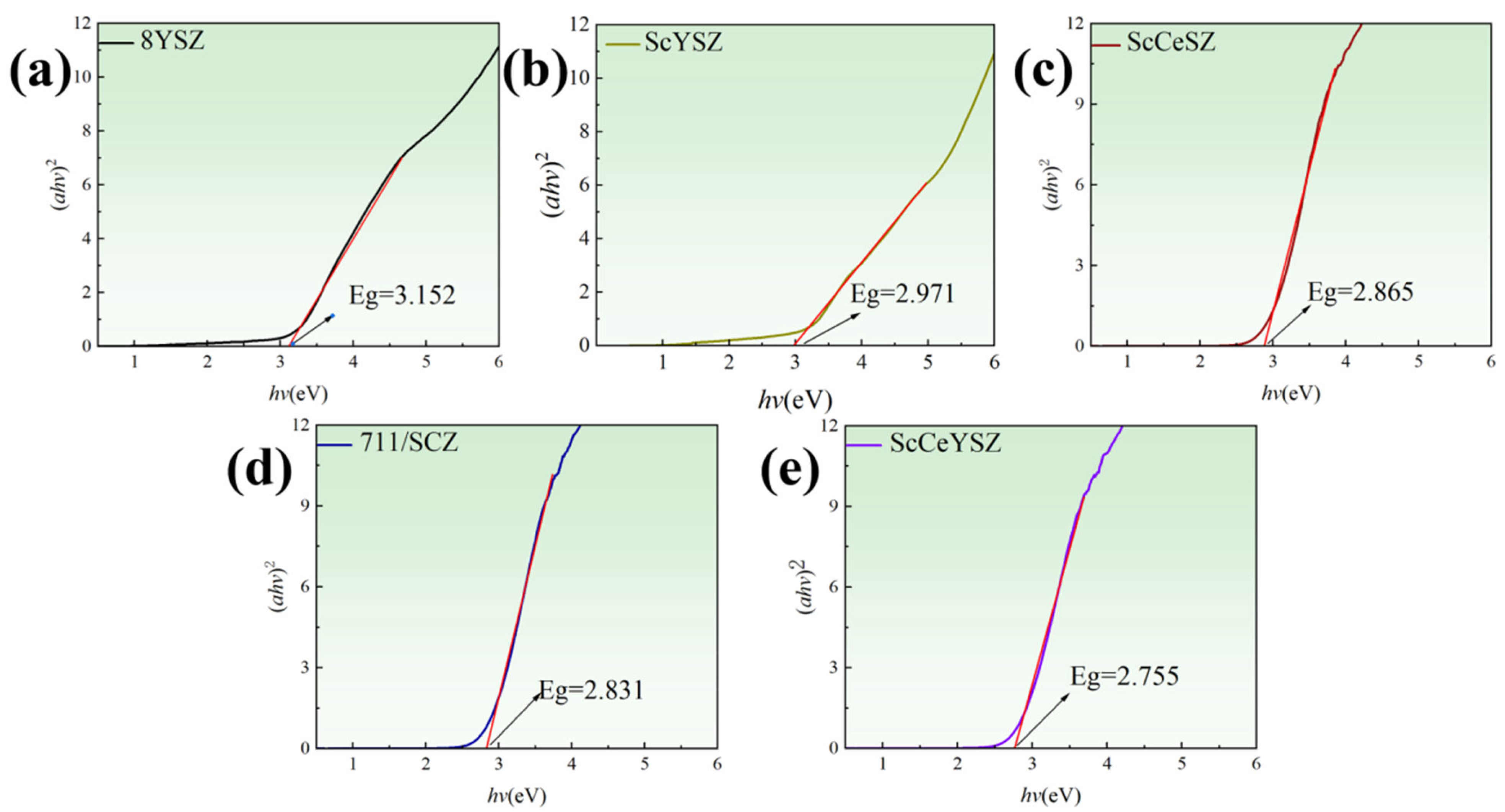
In this formula, α denotes the absorbance, h represents Planck’s constant (4.136 × 10⁻¹⁵ eV·s), v is the photon frequency, and k is a material-related constant. Using the ultraviolet–visible (UV–Vis) absorption spectrum together with Equation (20), the graph of (αhv)2 as a function of hv is shown in Figure 12. The band gap energy (Eg) is obtained from the point where the extrapolated straight-line portion of the hv − (αhv)2 plot meets the horizontal axis.
Figure 12.
(a–e) hν − (αhν)2 curves of 8YSZ and SCZ ceramic materials.
As shown in Figure 12, the band gaps of SCZ ceramics are all narrower than that of 8YSZ, with ScCeYSZ exhibiting the smallest band gap of 2.755 eV, representing a 7.8% reduction compared to ScYSZ (2.971 eV).
As indicated by the results in Figure 12, the bandgap width of the material decreases following CeO2 doping. Among the samples, ScCeYSZ exhibits the narrowest band gap (2.755 eV), representing a 7.8% reduction compared to ScYSZ (2.971 eV). This phenomenon can be attributed to two factors: first, the incorporation of Sc2O3 effectively narrows the material’s band gap [16]; second, the co-doping of Sc2O3 and CeO2 generates a synergistic effect that further reduces the band gap. Consequently, the band gap widths of all SCZ series ceramics are lower than that of 8YSZ. Based on the results presented in Figure 11, all samples show a rapid decay in reflectance within the ultraviolet region, which confirms the stable intrinsic absorption behavior of the tetragonal ZrO2 matrix. Upon incorporating CeO2, the reflectance within the visible–near-infrared (Vis–NIR) region is markedly reduced, whereas the absorbance is enhanced. Among all specimens, ScCeYSZ displays the most pronounced defect-level absorption strength, owing to its highest density of oxygen vacancies and the lattice distortion caused by the coexistence of multiple rare-earth cations, which in turn is consistent with its minimum bandgap width. This bandgap defect absorption directly determines the high-temperature infrared emission performance of the material in the 3–5 μm range: a higher density of defect levels leads to stronger infrared absorption and emission capabilities, which is consistent with the infrared emissivity test results at 1000 °C. In contrast, the redshift of the ultraviolet intrinsic absorption edge only reflects the change in the intrinsic bandgap of the matrix regulated by lattice distortion, and the two physical mechanisms are independent of each other.
Thus, Sc2O3–CeO2 co-doping not only modulates lattice thermal conduction behavior but also regulates the high-temperature radiative heat conduction process, achieving synergistic optimization of thermal conductivity and infrared emissivity.
3.5. Mechanical Properties
Superior mechanical properties play a critical role in extending the service life of thermal barrier coatings (TBCs). A modest decrease in elastic modulus not only helps to reduce the thermal conductivity of TBCs and thereby improve their thermal insulation capability but also enhances the material’s ability to accommodate strain and alleviates thermal stresses arising from mismatched coefficients of thermal expansion (CTEs). Additionally, excellent fracture toughness increases the resistance to crack propagation, thereby significantly reducing the risk of brittle failure in TBCs.
3.5.1. Modulus of Elasticity
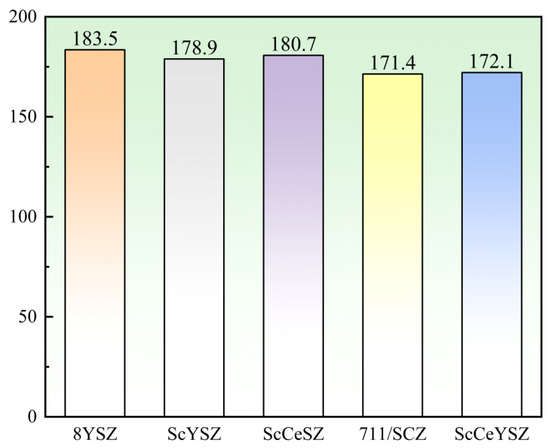
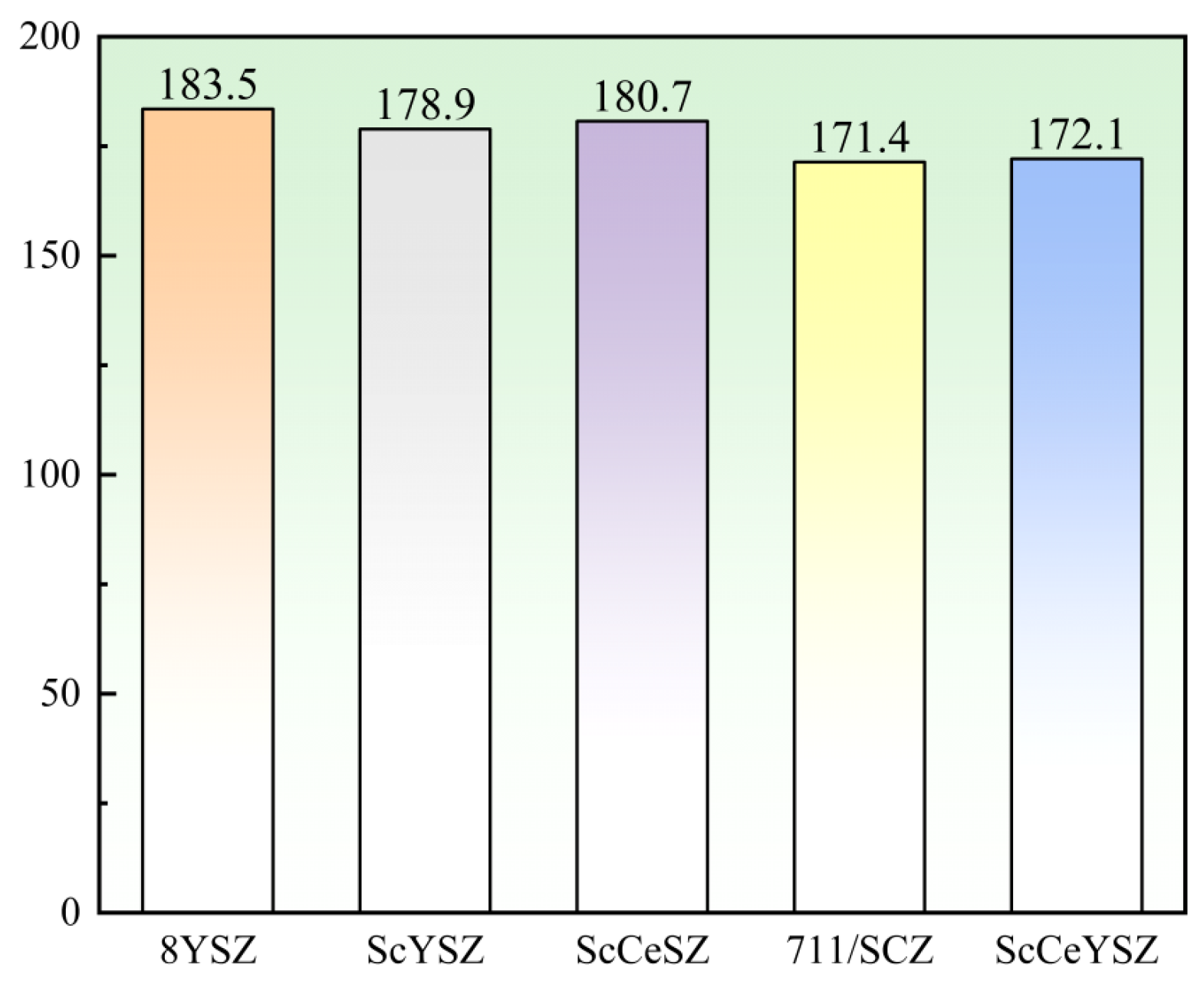
Figure 13 presents the elastic modulus of the 8YSZ and SCZ ceramic series.
Figure 13.
Elastic modulus of 8YSZ and SCZ ceramic materials.
As can be seen from Figure 13, the elastic modulus of 8YSZ ceramic is approximately 183.5 GPa, while those of SCZ ceramics are consistently lower than that of 8YSZ. Among them, 711/SCZ exhibits the minimum elastic modulus of around 171.4 GPa, which is extremely close to that of ScCeYSZ (172.1 GPa). On one hand, the co-doping of multiple rare earth elements introduces rare earth ions of various sizes, leading to further enhanced lattice disorder and increased lattice distortion (the mechanism by which multi-ion co-doping intensifies lattice distortion is also discussed in Section 3.4.1), thereby contributing to the reduction in elastic modulus. On the other hand, the incorporation of CeO2 elevates the concentration of oxygen vacancies. Serving as imperfections within the lattice, these vacancies promote atomic displacement and structural distortion under applied stress, thereby leading to a reduction in the elastic modulus. This observation agrees with the results shown in Figure 13, where the elastic moduli of Sc–Ce–Y co-doped 711/SCZ and ScCeYSZ are lower than those of Sc-Y co-doped ScYSZ and Sc–Ce co-doped ScCeSZ.
3.5.2. Fracture Toughness
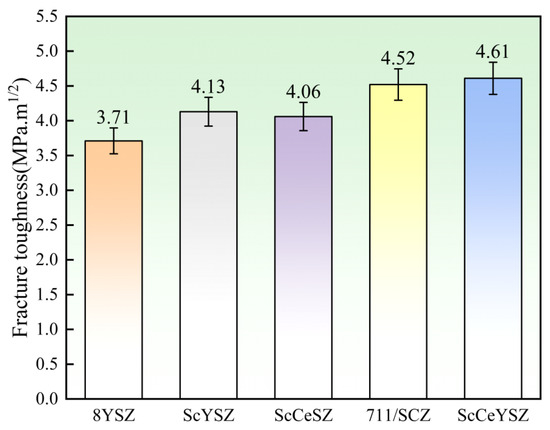
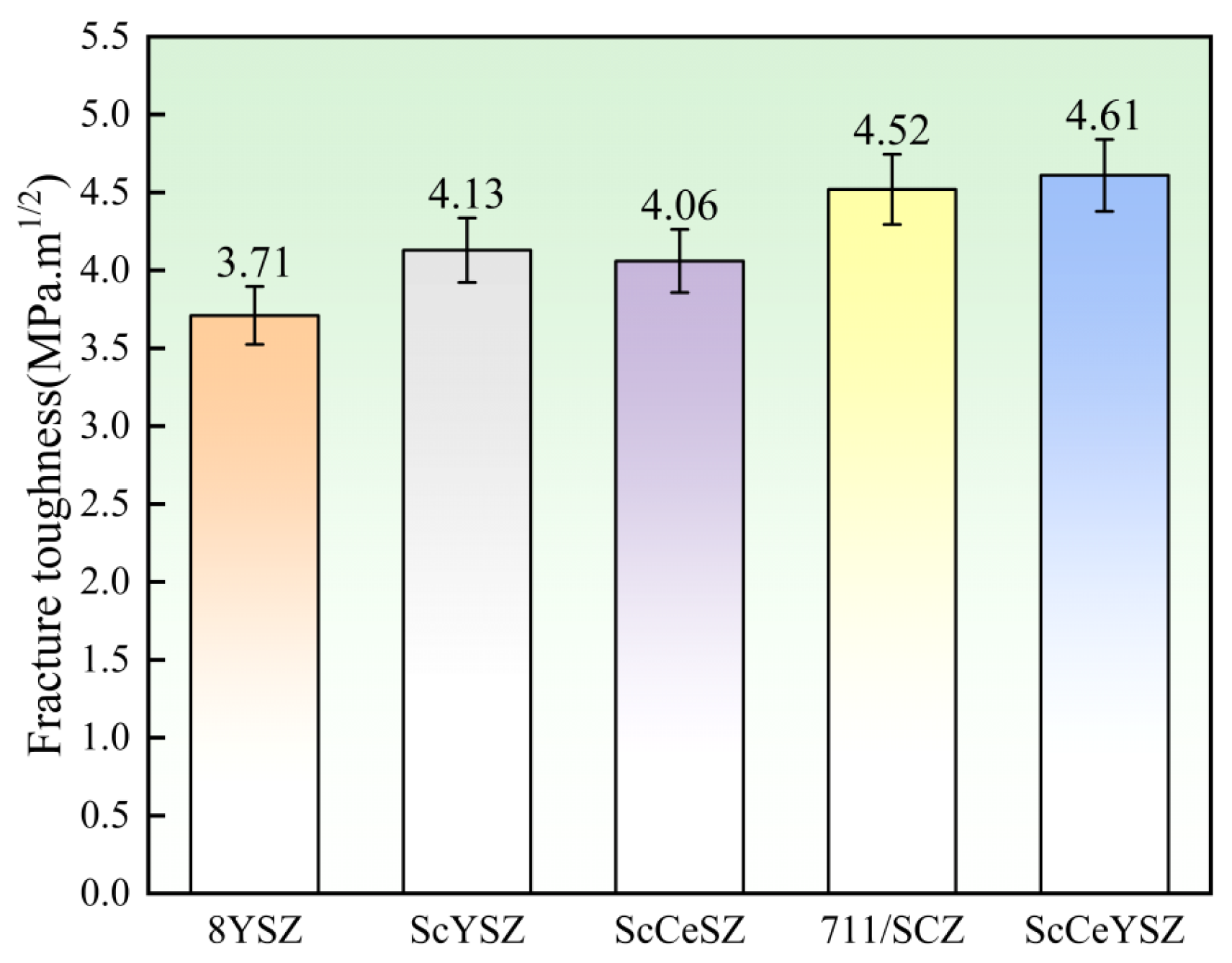
The fracture toughness of the 8YSZ and SCZ ceramic series is presented in Figure 14.
Figure 14.
Fracture Toughness of 8YSZ and SCZ Ceramic Materials.
As shown in Figure 14, the fracture toughness of 8YSZ is approximately 3.71 MPa·m1/2, while all ceramics in the SCZ series exhibit higher fracture toughness than 8YSZ. Among them, ScCeYSZ demonstrates the highest fracture toughness, at around 4.61 MPa·m1/2. The improved fracture toughness of the SCZ-series ceramics is attributed to the combined effects of grain boundary strengthening regulated by co-doping and oxygen vacancy modulation. On one hand, co-doping enhances grain boundary bonding, thereby inhibiting intergranular brittle fracture [51]; on the other hand, the increased oxygen vacancies promote lattice plasticity and dissipate fracture energy, which contributes to the enhanced fracture toughness of ScCeSZ, 711/SCZ, and ScCeYSZ.
This optimized combination of elastic modulus and fracture toughness can enhance the damage resistance and thermomechanical stability of thermal barrier coatings, thereby significantly prolonging their service life in harsh service environments.
4. Conclusions
Sc2O3–CeO2–Y2O3 co-stabilized ZrO2 ceramics were fabricated via solid-state sintering, and their structural characteristics, thermal transport behavior, and high-temperature infrared emissivity performance were systematically investigated. The results indicate that all samples except ScSZ maintain a stable tetragonal phase structure with high densification. The introduction of CeO2 modulates the defect states of the material and increases the oxygen vacancy concentration, thereby enhancing phonon scattering and reducing lattice thermal conductivity. Concurrently, the increase in defect states narrows the band gap and improves infrared emissivity. Among the samples, ScCeYSZ exhibits the optimal comprehensive performance: at 1000 °C, its thermal conductivity is 2.073 W·m−1·K−1, and the average infrared emissivity in the 3–5 μm band reaches 0.779. These findings demonstrate that Sc2O3–CeO2 co-doping can simultaneously regulate lattice thermal transport and high-temperature radiative heat transport behaviors.
This study establishes the correlation between defect structure, energy band characteristics, and thermal/radiative transport, which can provide a theoretical basis for the design of next-generation ultra-high-temperature thermal barrier coating materials.
Author Contributions
Conceptualization, C.X.; Methodology, C.X.; Formal analysis, C.X., M.X., B.H., Y.Z., C.P., L.D., Z.W., R.M. and X.S.; Data curation, C.X.; Writing—original draft, C.X.; Writing—review & editing, M.X.; Supervision, M.X., B.H. and Y.Z.; Funding acquisition, M.X. All authors have read and agreed to the published version of the manuscript.
Funding
Program for Young Talents of Science and Technology in Universities of Inner Mongolia Autonomous Region [grant number NJYT23008]; Research Program of Science and Technology at Universities of Inner Mongolia Autonomous Region [grant number NJZZ23055]; Inner Mongolia Natural Science Foundation Project [grant number 2024MS05021]; Basic Research Funds for Universities Directly under Inner Mongolia [grant number 2023QNJS023]. The authors acknowledge the National Natural Science Foundation of China [grant number 52372062].
Data Availability Statement
The raw data supporting the conclusions of this article will be made available by the authors on request.
Conflicts of Interest
The authors declare no conflict of interest.
References
- Su, Q.; Zhang, Y.Q.; Li, G.; Geng, Y.X.; Zheng, H.Z.; Chen, Z.; Peng, P. Doped effect of Gd and Y elements on corrosion resistance of ZrO2 in CMAS melt: First-principles and experimental study. J. Eur. Ceram. Soc. 2021, 41, 7893–7901. [Google Scholar]
- Yan, K.; Xiang, Y.; Yu, H.Y.; Li, Z.R.; Wu, Y.J.; Sun, J. Effect of irregular microcracks on the hot corrosion behavior and thermal shock resistance of YSZ thermal barrier coatings. Surf. Coat. Technol. 2022, 431, 128038. [Google Scholar] [CrossRef] [Scilit]
- Zhao, M.; Pan, W.; Wan, C.L.; Qu, Z.X.; Li, Z.; Yang, J. Defect engineering in development of low thermal conductivity materials: A review. J. Eur. Ceram. Soc. 2017, 37, 1–13. [Google Scholar] [CrossRef] [Scilit]
- Clarke, D.R.; Oechsner, M.; Padture, N.P. Thermal-barrier coatings for more efficient gas-turbine engines. MRS Bull. 2012, 37, 891–898. [Google Scholar]
- Li, G.R.; Xie, H.; Yang, G.J.; Liu, G.; Li, C.X.; Li, C.J. A comprehensive sintering mechanism for TBCs-Part I: An overall evolution with two-stage kinetics. J. Am. Ceram. Soc. 2017, 100, 2176–2189. [Google Scholar]
- Xiang, Y.; Tan, N.M.; Ma, W.Z.; Yin, J.H.; Zhou, T.; Zhou, P.H.; Zhang, L. Optimizing the gradient pore distribution of YSZ coatings to achieve excellent thermal shock resistance. J. Am. Ceram. Soc. 2025, 108, e20609. [Google Scholar] [CrossRef] [Scilit]
- Soltani, R.; Coyle, T.W.; Mostaghimi, J. Microstructure and Creep Behavior of Plasma-Sprayed Yttria Stabilized Zirconia Thermal Barrier Coatings. J. Therm. Spray Technol. 2008, 17, 244–253. [Google Scholar] [CrossRef] [Scilit]
- Vaßen, R.; Jarligo, M.O.; Steinke, T.; Mack, D.E.; Stöver, D. Overview on advanced thermal barrier coatings. Surf. Coat. Technol. 2010, 205, 938–942. [Google Scholar] [CrossRef] [Scilit]
- Yin, J.H.; Zhang, L.; Ma, W.Z.; Wang, C.; Zhang, Q.; Zhang, X.F.; Deng, C.M.; Zhang, M.; Weng, X.L.; Deng, L.J. Research on reducing infrared emissivity of 8YSZ coating by regulating microstructure. Infrared Phys. Technol. 2023, 130, 104587. [Google Scholar] [CrossRef] [Scilit]
- Kulyk, V.; Duriagina, Z.; Vasyliv, B.; Kovbasiuk, T.; Lyutyy, P.; Vira, V.; Vavrukh, V. Effect of Sintering Temperature on Crack Growth Resistance Characteristics of Yttria-Stabilized Zirconia. Acta Phys. Pol. A 2022, 141, 323–327. [Google Scholar] [CrossRef] [Scilit]
- Zhou, Y.; Lu, X.; Xiang, H.; Feng, Z. Preparation, mechanical, and thermal properties of a promising thermal barrier material: Y4Al2O9. J. Adv. Ceram. 2015, 4, 94–102. [Google Scholar] [CrossRef] [Scilit]
- Altman, I.S. On principle inadequacy of the Plank distribution to the spectrum of the small particle thermal radiation. Phys. Lett. A 1999, 256, 122–124. [Google Scholar] [CrossRef] [Scilit]
- Jones, R.L.; Mess, D. Improved tetragonal phase stability at 1400 °C with scandia, yttria-stabilized zirconia. Surf. Coat. Technol. 1996, 86, 94–101. [Google Scholar]
- Zu, J.H.; Gao, Y.; Liu, D.; Luo, W.F.; Feng, Z.; Bao, Y.; Shang, Q.Y.; Bai, Y.; Fan, W.; Wang, Y.; et al. Preparation and high-temperature performance of Sc2O3–Y2O3 co-stabilized ZrO2 thermal barrier coatings. Ceram. Int. 2024, 50, 20460–20472. [Google Scholar]
- Liu, H.F.; Li, S.L.; Li, Q.L.; Li, Y.M. Investigation on the phase stability, sintering and thermal conductivity of Sc2O3–Y2O3–ZrO2 for thermal barrier coating application. Mater. Des. 2010, 31, 2972–2977. [Google Scholar]
- Xia, C.X.; Xie, M.; Zhang, Y.H.; Xiao, J.W.; Yuan, W.J.; Mu, R.D.; Wang, Z.G.; Song, X.W. High-temperature thermal conductivity and infrared emissivity of Sc2O3–Y2O3 co-stabilized ZrO2 ceramics for thermal protective coatings. Ceram. Int. 2025, 51, 64967–64978. [Google Scholar]
- Guo, J.C.; Yin, J.L.; Gao, D.X.; Ren, K.; Wang, W.Y.; Wang, Y.G. Infrared emissivity behavior of doped CeO2 at high temperature. Ceram. Int. 2024, 50, 42913–42921. [Google Scholar] [CrossRef] [Scilit]
- Zhou, Q.; Zhu, S.; Ma, Z.; Liu, Y.; Liu, L.; Gao, L. Experimental and first-principles study on the effect of oxygen vacancy on infrared emissivity of CeO2. Ceram. Int. 2022, 48, 11313–11319. [Google Scholar] [CrossRef] [Scilit]
- Hao, X.; Wei, G.; Zhang, H.; Tan, S.; Ji, G. Defect chemistry-regulated design of doping CeO2 with the enhanced high-temperature low infrared emissivity property. Mater. Today Nano 2025, 30, 100614. [Google Scholar]
- Wei, X.D.; Hou, G.L.; An, Y.L.; Yang, P.; Zhao, X.Q.; Zhou, H.D.; Chen, J.M. Effect of doping CeO2 and Sc2O3 on structure, thermal properties and sintering resistance of YSZ. Ceram. Int. 2021, 47, 6875–6883. [Google Scholar]
- Zhang, Y.H.; Xie, M.; Wang, Z.G.; Mu, R.D.; Song, X.W.; Yu, Y.B.; Bao, J.X.; Zhou, F.; Pan, W. Marked reduction in the thermal conductivity of (La0.2Gd0.2Y0.2Yb0.2Er0.2)2Zr2O7 high-entropy ceramics by substituting Zr4+ with Ti4+. Ceram. Int. 2022, 48, 9602–9609. [Google Scholar]
- Leitner, J.; Chuchvalec, P.; Sedmidubský, D.; Strejc, A.; Abrman, P. Estimation of heat capacities of solid mixed oxides. Thermochim. Acta 2002, 395, 27–46. [Google Scholar] [CrossRef] [Scilit]
- Wu, J.; Wei, X.Z.; Padture, N.P.; Klemens, P.G.; Gell, M.; García, E.; Miranzo, P.; Osendi, M.I. Low-thermal-conductivity rare-earth zirconates for potential thermal-barrier-coating applications. J. Am. Ceram. Soc. 2002, 85, 3031–3035. [Google Scholar]
- Nicholls, J.R.; Lawson, K.J.; Johnstone, A.; Rickerby, D.S. Methods to reduce the thermal conductivity of EB-PVD TBCs. Surf. Coat. Technol. 2002, 151, 383–391. [Google Scholar] [CrossRef] [Scilit]
- Zhang, H.S.; Sun, K.; Xu, Q.; Wang, F.C.; Liu, L. Thermal conductivity of (Sm1–xLax)2Zr2O7 (x = 0, 0.25, 0.5, 0.75 and 1) oxides for advanced thermal barrier coatings. J. Rare Earths 2009, 27, 222–226. [Google Scholar]
- Tritt, T.M. Thermal Conductivity: Theory, Properties, and Applications; Springer Science & Business Media: Berlin/Heidelberg, Germany, 2005. [Google Scholar]
- Soyez, G.; Eastman, J.A.; Thompson, L.J.; Bai, G.-R.; Baldo, P.M.; McCormick, A.W.; DiMelfi, R.J.; Elmustafa, A.A.; Tambwe, M.F.; Stone, D.S. Grain-size-dependent thermal conductivity of nanocrystalline yttria-stabilized zirconia films grown by metal-organic chemical vapor deposition. Appl. Phys. Lett. 2000, 77, 1155–1157. [Google Scholar]
- Yang, F.; Zhao, X.F.; Xiao, P. The effects of temperature and composition on the thermal conductivities of [(ZrO2)1−x(CeO2)x]0.92(Y2O3)0.08 (0≤x≤1) solid solutions. Acta Mater. 2012, 60, 914–922. [Google Scholar]
- Mévrel, R.; Laizet, J.C.; Azzopardi, A.; Leclercq, B.; Poulain, M.; Lavigne, O.; Demange, D. Thermal diffusivity and conductivity of Zr1−xYxO2−x/2 (x = 0, 0.084 and 0.179) single crystals. J. Eur. Ceram. Soc. 2004, 24, 3081–3089. [Google Scholar]
- Fan, W.; Bai, Y.; Wang, Z.Z.; Che, J.W.; Wang, Y.; Tao, W.Z.; Wang, R.J.; Liang, G.Y. Effect of point defects on the thermal conductivity of Sc2O3-Y2O3 co-stabilized tetragonal ZrO2 ceramic materials. J. Eur. Ceram. Soc. 2019, 39, 2389–2396. [Google Scholar]
- Fan, W.; Wang, Z.Z.; Bai, Y.; Che, J.W.; Wang, R.J.; Ma, F.; Tao, W.Z.; Liang, G.Y. Improved properties of scandia and yttria co-doped zirconia as a potential thermal barrier material for high temperature applications. J. Eur. Ceram. Soc. 2018, 38, 4502–4511. [Google Scholar] [CrossRef] [Scilit]
- Roufosse, M.; Klemens, P.G. Thermal conductivity of complex dielectric crystals. Phys. Rev. B 1973, 7, 5379. [Google Scholar] [CrossRef] [Scilit]
- Bisson, J.F.; Fournier, D.; Poulain, M.; Lavigne, O.; Mévrel, R. Thermal conductivity of yttria–zirconia single crystals, determined with spatially resolved infrared thermography. J. Am. Ceram. Soc. 2000, 83, 1993–1998. [Google Scholar] [CrossRef] [Scilit]
- Klemens, P.G. The scattering of low-frequency lattice waves by static imperfections. Proc. Phys. Soc. Sect. A 1955, 68, 1113–1128. [Google Scholar] [CrossRef] [Scilit]
- Clarke, D.R. Materials selection guidelines for low thermal conductivity thermal barrier coatings. Surf. Coat. Technol. 2003, 163, 67–74. [Google Scholar] [CrossRef] [Scilit]
- Qu, Z.X.; Sparks, T.D.; Pan, W.; Clarke, D.R. Thermal conductivity of the gadolinium calcium silicate apatites: Effect of different point defect types. Acta Mater. 2011, 59, 3841–3850. [Google Scholar] [CrossRef] [Scilit]
- Yang, J.; Meisner, G.P.; Chen, L. Strain field fluctuation effects on lattice thermal conductivity of ZrNiSn-based thermoelectric compounds. Appl. Phys. Lett. 2004, 85, 1140–1142. [Google Scholar]
- Wan, C.L.; Qu, Z.X.; Du, A.B.; Pan, W. Influence of B site substituent Ti on the structure and thermophysical properties of A2B2O7-type pyrochlore Gd2Zr2O7. Acta Mater. 2009, 57, 4782–4789. [Google Scholar]
- Guo, T.; Tan, S.; Xu, G.; Ma, J.; Liu, X.; Ji, G.; Liu, G.; He, Y.; Zhang, S. Temperature-dependent infrared emissivity property of Ce-doped ZnO nanoparticles. Ceram. Int. 2020, 46, 1569–1576. [Google Scholar]
- Li, Z.; Shi, D.; Yang, J.; Luo, W.; Wan, C.; Pan, W. Contribution of optical phonons to lattice thermal conductivity in complex structural thermal insulation materials. J. Eur. Ceram. Soc. 2021, 41, 7981–7987. [Google Scholar] [CrossRef] [Scilit]
- Liu, N.N.; Dou, R.F.; Wen, Z.; Liu, X.L. Numerical and Experimental Studies on the In-Situ Measurement of Thermal Conductivity of the Thermal Barrier Coating. J. Therm. Spray Technol. 2025, 34, 460–476. [Google Scholar] [CrossRef] [Scilit]
- Qiao, Z.; Mao, J. Multifunctional poly (melamine-urea-formaldehyde)/graphene microcapsules with low infrared emissivity and high thermal conductivity. Mater. Sci. Eng. B 2017, 226, 86–93. [Google Scholar]
- Yang, J.; Wan, C.L.; Zhao, M.; Shahid, M.; Pan, W. Effective blocking of radiative thermal conductivity in La2Zr2O7/LaPO4 composites for high temperature thermal insulation applications. J. Eur. Ceram. Soc. 2016, 36, 3809–3814. [Google Scholar]
- Xu, J.Y.; Xie, M.; Zhang, Y.H.; Song, X.W.; Wang, Z.G.; Mu, R.D. Effects of small polarons on the high-temperature thermal radiation shielding properties of La2(Zr0.7Ce0.3)2O7/LaMnO3 composite ceramics. Ceram. Int. 2025, 51, 26025–26033. [Google Scholar]
- Modest, M.F.; Mazumder, S. Radiative Heat Transfer; Academic Press: Cambridge, MA, USA, 2021. [Google Scholar]
- Zhu, D.M.; Miller, R.A. Development of advanced low conductivity thermal barrier coatings. Int. J. Appl. Ceram. Technol. 2005, 1, 86–94. [Google Scholar]
- He, X.D.; Li, Y.B.; Wang, L.D.; Sun, Y.; Zhang, S. High emissivity coatings for high temperature application: Progress and prospect. Thin Solid Films 2009, 517, 5120–5129. [Google Scholar] [CrossRef] [Scilit]
- Brik, M.; Srivastava, A.; Popov, A. A few common misconceptions in the interpretation of experimental spectroscopic data. Opt. Mater. 2022, 127, 112276. [Google Scholar] [CrossRef] [Scilit]
- Hashim, A.; Ahmed, G.; Ibrahim, H.; Hadi, A. Ameliorating the features of TiN/SiO2 promising nanoceramic doped optical polymer for multifunctional optoelectronics applications. Silicon 2025, 17, 585–598. [Google Scholar]
- Abbas, M.H.; Ibrahim, H.; Hashim, A.; Hadi, A. Ameliorating and tailoring the features of silica-silicon carbide nanoceramic doped polyethylene oxide for promising optoelectronics applications. Silicon 2025, 17, 697–707. [Google Scholar] [CrossRef] [Scilit]
- Yuan, P.-L. Effect of co-doping of CeO2 and Sc2O3 on mechanical properties and CMAS corrosion resistance of YSZ ceramics. In IOP Conference Series: Earth and Environmental Science; IOP Publishing: Bristol, UK, 2024; p. 012010. [Google Scholar]

Disclaimer/Publisher’s Note: The statements, opinions and data contained in all publications are solely those of the individual author(s) and contributor(s) and not of MDPI and/or the editor(s). MDPI and/or the editor(s) disclaim responsibility for any injury to people or property resulting from any ideas, methods, instructions or products referred to in the content. |
© 2026 by the authors. Licensee MDPI, Basel, Switzerland. This article is an open access article distributed under the terms and conditions of the Creative Commons Attribution (CC BY) license.