You are currently on the new version of our website. Access the old version .

Non-Coding RNA, Volume 5, Issue 1

March 2019 - 30 articles

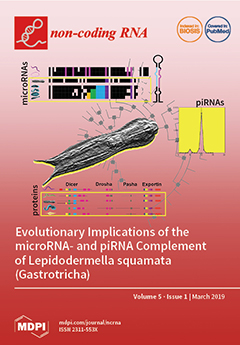
Cover Story: Gastrotrichs—’hairy bellies’—are microscopic free-living animals that were historically placed close to nematodes, but recent phylogenomic analyses have suggested a close relationship to flatworms. To resolve this long-standing question, in a ‘multi-omics’ approach, we used small-RNA sequencing and available transcriptome and genomic data to unravel the miRNA- and piRNA complements along with the RNAi protein machinery of Lepidodermella squamata. We identified 52 miRNA genes with overall high similarities to flatworm miRNA complements. In addition, we found four large piRNA clusters that also resemble flatworm piRNAs but not those earlier described for nematodes. Congruently, transcriptomic annotation revealed that the Lepidodermella protein machinery is highly similar to flatworms, too. View this paper.
  • Issues are regarded as officially published after their release is announced to the table of contents alert mailing list .
  • You may sign up for email alerts to receive table of contents of newly released issues.
  • PDF is the official format for papers published in both, html and pdf forms. To view the papers in pdf format, click on the "PDF Full-text" link, and use the free Adobe Reader to open them.

Articles (30)

  • Feature Paper
  • Review
  • Open Access
27 Citations
6,008 Views
25 Pages

Management of chronic diabetic complications remains a major medical challenge worldwide. One of the characteristic features of all chronic diabetic complications is augmented production of extracellular matrix (ECM) proteins. Such ECM proteins are d...

  • Feature Paper
  • Review
  • Open Access
10 Citations
5,808 Views
22 Pages

Crosstalk Between Mammalian Antiviral Pathways

  • Samir F. Watson,
  • Lisanne I. Knol,
  • Jeroen Witteveldt and
  • Sara Macias

As part of their innate immune response against viral infections, mammals activate the expression of type I interferons to prevent viral replication and dissemination. An antiviral RNAi-based response can be also activated in mammals, suggesting that...

  • Review
  • Open Access
93 Citations
7,408 Views
22 Pages

The identification of exosomes, their link to multivesicular bodies and their potential role as a messenger vehicle between cancer and healthy cells opens up a new approach to the study of intercellular signaling. Furthermore, the fact that their mai...

  • Feature Paper
  • Review
  • Open Access
18 Citations
6,143 Views
12 Pages

Breast Cancer and miR-SNPs: The Importance of miR Germ-Line Genetics

  • Poonam Malhotra,
  • Graham H. Read and
  • Joanne B. Weidhaas

Recent studies in cancer diagnostics have identified microRNAs (miRNAs) as promising cancer biomarkers. Single nucleotide polymorphisms (SNPs) in miRNA binding sites, seed regions, and coding sequences can help predict breast cancer risk, aggressiven...

  • Review
  • Open Access
32 Citations
5,439 Views
14 Pages

Long Non-Coding RNA in Vascular Disease and Aging

  • Diewertje I. Bink,
  • Noelia Lozano-Vidal and
  • Reinier A. Boon

Cardiovascular diseases are the most prominent cause of death in Western society, especially in the elderly. With the increasing life expectancy, the number of patients with cardiovascular diseases will rise in the near future, leading to an increase...

  • Brief Report
  • Open Access
26 Citations
5,111 Views
16 Pages

MicroRNA-451 Inhibits Migration of Glioblastoma while Making It More Susceptible to Conventional Therapy

  • Daisuke Ogawa,
  • Khairul Ansari,
  • Michal O. Nowicki,
  • Elżbieta Salińska,
  • Agnieszka Bronisz and
  • Jakub Godlewski

Malignant glioblastoma (GBM, glioma) is the most common and aggressive primary adult brain tumor. The prognosis of GBM patients remains poor, despite surgery, radiation and chemotherapy. The major obstacles for successful remedy are invasiveness and...

  • Feature Paper
  • Review
  • Open Access
25 Citations
6,471 Views
13 Pages

MicroRNAs (miRNAs) are small noncoding RNAs that fine-tune the responses of the cell by modulating the cell transcriptome and gene expression. MicroRNA 155 (miR-155) is a conserved multifunctional miRNA involved in multiple roles including the modula...

  • Review
  • Open Access
67 Citations
5,246 Views
12 Pages

The MicroRNA miR-155 Is Essential in Fibrosis

  • Mousa G. Eissa and
  • Carol M. Artlett

The function of microRNAs (miRNAs) during fibrosis and the downstream regulation of gene expression by these miRNAs have become of great biological interest. miR-155 is consistently upregulated in fibrotic disorders, and its ablation downregulates co...

  • Article
  • Open Access
14 Citations
5,285 Views
9 Pages

Integrative System Biology Analyses Identify Seven MicroRNAs to Predict Heart Failure

  • Henri Charrier,
  • Marie Cuvelliez,
  • Emilie Dubois-Deruy,
  • Paul Mulder,
  • Vincent Richard,
  • Christophe Bauters and
  • Florence Pinet

Heart failure (HF) has several etiologies including myocardial infarction (MI) and left ventricular remodeling (LVR), but its progression remains difficult to predict in clinical practice. Systems biology analyses of LVR after MI provide molecular in...

  • Article
  • Open Access
14 Citations
3,812 Views
16 Pages

Adolescence is hallmarked by two parallel processes of sexual maturation and adult patterning of the brain. Therefore, adolescence represents a vulnerable postnatal period for neurodevelopment where exogenous factors can negatively impact adult brain...

of 3

Get Alerted

Add your email address to receive forthcoming issues of this journal.

XFacebookLinkedIn
Non-Coding RNA - ISSN 2311-553X