
- Article

22 Pages
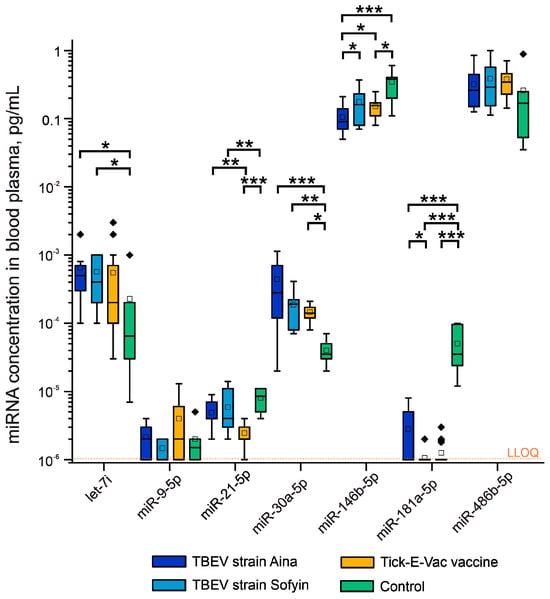
Background/Objectives: Tick-borne encephalitis virus (TBEV) is a vector-borne flavivirus that targets the CNS and causes severe encephalitis with long-term neurological sequelae. As the geographic range of its vectors expands and climate conditions shift, the incidence of tick-borne encephalitis continues to rise, yet no specific antiviral therapy has been developed to date. Understanding the molecular mechanisms of tissue-specific immune responses during TBEV infection is essential for identifying novel therapeutic targets and biomarkers. Methods: In this study, quantitative reverse transcription PCR with stem-loop primers was used to examine changes in the levels of seven immunoregulatory miRNAs (let-7i, miR-9-5p, miR-21a-5p, miR-30a-5p, miR-146b-5p, miR-181a-5p, miR-486-5p) in blood plasma, peripheral organs (spleen, liver), and four central nervous system structures (olfactory bulb, cerebral hemispheres, cerebellum, spinal cord) of BALB/c mice. Three experimental groups were compared: (1) infection with the Aina strain (Siberian subtype), (2) infection with the Sofyin strain (Far Eastern subtype), and (3) vaccination with the vaccine “Tick-E-Vak”. Results: It was shown that both infection and vaccination induce pronounced tissue-specific changes in the miRNA profile. MiR-181a-5p is a negative regulator of TLR4/NF-κB signaling. Its downregulation was the most reproducible change observed across all compartments and in all three groups, suggesting a possible universal mechanism for derepression of the proinflammatory cascade. Two miRNAs (miR-30a-5p and miR-146b-5p) were altered in all examined tissues and may be considered candidate markers of antigenic stimulation. Conclusions: The direction of their changes in plasma and tissues was frequently opposite, suggesting redistribution of miRNAs between the tissue and circulating pools, which is important for the interpretation of plasma biomarkers. Infection-specific changes were identified for let-7i and miR-9-5p in the CNS. The most pronounced changes were observed in the structures most affected by neuroinvasion (olfactory bulb, spinal cord), making them candidate markers associated with TBEV infection and CNS involvement. Infection with the Aina strain induced more pronounced miRNA changes in peripheral organs and the CNS than the Sofyin strain, despite the higher epidemiological lethality of the latter. This suggests that the pathogenicity of individual strains in the mouse model may not always correspond to the subtype-based lethality classification in humans and is determined by strain-specific features of tropism and infection kinetics.
Non-Coding RNA
20 October 2026