You are currently viewing a new version of our website. To view the old version click .

Biomolecules, Volume 11, Issue 4

April 2021 - 128 articles

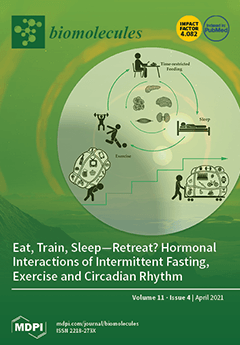
Cover Story: The circadian rhythm in humans is driven by a complex primary transcriptional–translational autoregulatory feedback loop located in suprachiasmatic nucleus in the brain. Evidence suggests that alterations in this system through modern lifestyle, characterized by physical inactivity, overconsumption of food and changes in normal sleep/wake cycle, may have an influence on our metabolic and hormonal health. Time-restricted feeding and exercise have been shown to play a crucial role in resetting the disruptions in circadian processes, making both appropriate nutrition and exercise timing powerful tools to support circadian rhythm and potentially contribute to the prevention of metabolic diseases. However, the potential cause of diseases arising from sleep deprivation may not solely be solved by only treating symptoms rather than eliminating the source of alterations in diurnal rhythmicity. View this paper
  • Issues are regarded as officially published after their release is announced to the table of contents alert mailing list .
  • You may sign up for email alerts to receive table of contents of newly released issues.
  • PDF is the official format for papers published in both, html and pdf forms. To view the papers in pdf format, click on the "PDF Full-text" link, and use the free Adobe Reader to open them.

Articles (128)

  • Article
  • Open Access
14 Citations
3,697 Views
14 Pages

A Homozygous Dab1−/− Is a Potential Novel Cause of Autosomal Recessive Congenital Anomalies of the Mice Kidney and Urinary Tract

  • Anita Racetin,
  • Natalija Filipović,
  • Mirela Lozić,
  • Masaki Ogata,
  • Larissa Gudelj Ensor,
  • Nela Kelam,
  • Petra Kovačević,
  • Koichiro Watanabe,
  • Yu Katsuyama and
  • Mirna Saraga-Babić
  • + 2 authors

20 April 2021

This study aimed to explore morphology changes in the kidneys of Dab1−/− (yotari) mice, as well as expression patterns of reelin, NOTCH2, LC3B, and cleaved caspase3 (CASP3) proteins, as potential determinants of normal kidney formation and function....

  • Article
  • Open Access
17 Citations
4,267 Views
15 Pages

Relationship between Oxidative Stress and Imatinib Resistance in Model Chronic Myeloid Leukemia Cells

  • Sylwester Głowacki,
  • Ewelina Synowiec,
  • Marzena Szwed,
  • Monika Toma,
  • Tomasz Skorski and
  • Tomasz Śliwiński

20 April 2021

Chronic myeloid leukemia (CML) develops due to the presence of the BCR-ABL1 protein, a target of tyrosine kinase inhibitors (TKIs), such as imatinib (IM), used in a CML therapy. CML eradication is a challenge due to developing resistance to TKIs. BCR...

  • Feature Paper
  • Review
  • Open Access
49 Citations
10,604 Views
41 Pages

Gene Therapy for Lysosomal Storage Disorders: Ongoing Studies and Clinical Development

  • Giulia Massaro,
  • Amy F. Geard,
  • Wenfei Liu,
  • Oliver Coombe-Tennant,
  • Simon N. Waddington,
  • Julien Baruteau,
  • Paul Gissen and
  • Ahad A. Rahim

20 April 2021

Rare monogenic disorders such as lysosomal diseases have been at the forefront in the development of novel treatments where therapeutic options are either limited or unavailable. The increasing number of successful pre-clinical and clinical studies i...

  • Review
  • Open Access
180 Citations
34,331 Views
17 Pages

20 April 2021

Parkinson’s disease (PD) usually presents in older adults and typically has both motor and non-motor dysfunctions. PD is a progressive neurodegenerative disorder resulting from dopaminergic neuronal cell loss in the mid-brain substantia nigra pars co...

  • Feature Paper
  • Review
  • Open Access
18 Citations
7,940 Views
32 Pages

Alternative Targets to Fight Alzheimer’s Disease: Focus on Astrocytes

  • Marta Valenza,
  • Roberta Facchinetti,
  • Giorgia Menegoni,
  • Luca Steardo and
  • Caterina Scuderi

19 April 2021

The available treatments for patients affected by Alzheimer’s disease (AD) are not curative. Numerous clinical trials have failed during the past decades. Therefore, scientists need to explore new avenues to tackle this disease. In the present review...

  • Article
  • Open Access
8 Citations
4,034 Views
17 Pages

Central Alteration in Peripheral Neuropathy of Trembler-J Mice: Hippocampal pmp22 Expression and Behavioral Profile in Anxiety Tests

  • Juan Pablo Damián,
  • Lucia Vázquez Alberdi,
  • Lucía Canclini,
  • Gonzalo Rosso,
  • Silvia Olivera Bravo,
  • Mariana Martínez,
  • Natalia Uriarte,
  • Paul Ruiz,
  • Miguel Calero and
  • María Vittoria Di Tomaso
  • + 1 author

19 April 2021

Charcot–Marie–Tooth (CMT) type 1 disease is the most common human hereditary demyelinating neuropathy. Mutations in pmp22 cause about 70% of all CMT1. Trembler-J (TrJ/+) mice are an animal model of CMT1E, having the same spontaneous pmp22 mutation th...

  • Article
  • Open Access
2 Citations
3,012 Views
10 Pages

19 April 2021

Protein tyrosine kinases and protein phosphatases play a critical role in cellular regulation. The length of a cellular response depends on the interplay between activating protein kinases and deactivating protein phosphatases. Protein tyrosine phosp...

  • Review
  • Open Access
164 Citations
15,625 Views
27 Pages

Podophyllotoxin: History, Recent Advances and Future Prospects

  • Zinnia Shah,
  • Umar Farooq Gohar,
  • Iffat Jamshed,
  • Aamir Mushtaq,
  • Hamid Mukhtar,
  • Muhammad Zia-UI-Haq,
  • Sebastian Ionut Toma,
  • Rosana Manea,
  • Marius Moga and
  • Bianca Popovici

19 April 2021

Podophyllotoxin, along with its various derivatives and congeners are widely recognized as broad-spectrum pharmacologically active compounds. Etoposide, for instance, is the frontline chemotherapeutic drug used against various cancers due to its supe...

  • Article
  • Open Access
9 Citations
3,957 Views
12 Pages

Dual Role for Astroglial Copper-Assisted Polyamine Metabolism during Intense Network Activity

  • Zsolt Szabó,
  • Márton Péter,
  • László Héja and
  • Julianna Kardos

19 April 2021

Astrocytes serve essential roles in human brain function and diseases. Growing evidence indicates that astrocytes are central players of the feedback modulation of excitatory Glu signalling during epileptiform activity via Glu-GABA exchange. The unde...

of 13

Get Alerted

Add your email address to receive forthcoming issues of this journal.

XFacebookLinkedIn
Biomolecules - ISSN 2218-273X