

Skip to Content
You are currently on the new version of our website. Access the old version .

Universe, Volume 10, Issue 5

2024 May - 41 articles

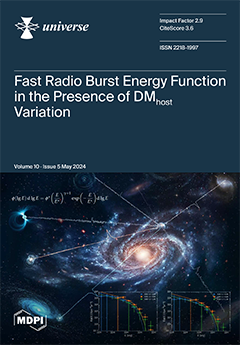
Cover Story: Fast radio bursts (FRBs) have been discovered in large numbers, yet their physical mechanism remains a mystery. The evolution of the FRB energy distribution function (EDF) with redshift can provide insights into their origins. However, estimating this relies on the relationship between redshift and dispersion measure (DM), which has significant uncertainties due to contributions from their host galaxies. In this article, we used a lognormal distribution model for the host DM contribution and estimated the EDF of non-repeating FRBs selected from the CHIME/FRB Catalog 1. We found that while the volumetric rate of FRBs is consistent with the redshift evolution of stellar-mass density, the lognormal distribution model increases measurement errors, making the inference that FRBs track the stellar-mass density less certain. View this paper
  • Issues are regarded as officially published after their release is announced to the table of contents alert mailing list .
  • You may sign up for email alerts to receive table of contents of newly released issues.
  • PDF is the official format for papers published in both, html and pdf forms. To view the papers in pdf format, click on the "PDF Full-text" link, and use the free Adobe Reader to open them.

Articles (41)

  • Article
  • Open Access
2 Citations
1,629 Views
25 Pages

Every numerical general relativistic investigation starts from the solution of the initial value equations at a given time. Astrophysically relevant initial values for different systems lead to distinct sets of equations that obey specific assumption...

  • Review
  • Open Access
3 Citations
2,028 Views
18 Pages

Detectors and Shieldings: Past and Future at LUNA

  • Chemseddine Ananna,
  • Lucia Barbieri,
  • Axel Boeltzig,
  • Matteo Campostrini,
  • Fausto Casaburo,
  • Alessandro Compagnucci,
  • Laszlo Csedreki,
  • Riccardo Maria Gesue,
  • Jordan Marsh and
  • Jakub Skowronski
  • + 4 authors

Nuclear reactions are responsible for the chemical evolution of stars, galaxies and the Universe. Unfortunately, at temperatures of interest for nuclear astrophysics, the cross-sections of the thermonuclear reactions are in the pico- femto-barn range...

  • Article
  • Open Access
10 Citations
1,582 Views
9 Pages

Uncovering the First AGN Jets with AXIS

  • Thomas Connor,
  • Eduardo Bañados,
  • Nico Cappelluti and
  • Adi Foord

Jets powered by AGN in the early Universe (z6) have the potential to not only define the evolutionary trajectories of the first-forming massive galaxies but to enable the accelerated growth of their associated SMBHs. Under typical assumptions,...

  • Article
  • Open Access
7 Citations
1,921 Views
20 Pages

The equation of state of asymmetric nuclear matter as well as the neutron and proton effective masses and their partial-wave and spin–isospin decomposition are analyzed within the Brueckner–Hartree–Fock approach. Theoretical uncerta...

  • Communication
  • Open Access
4 Citations
1,891 Views
7 Pages

Detecting Wandering Intermediate-Mass Black Holes with AXIS in the Milky Way and Local Massive Galaxies

  • Fabio Pacucci,
  • Bryan Seepaul,
  • Yueying Ni,
  • Nico Cappelluti and
  • Adi Foord

This white paper explores the detectability of intermediate-mass black holes (IMBHs) wandering in the Milky Way (MW) and massive local galaxies, with a particular emphasis on the role of AXIS. IMBHs, ranging within 1036M, are commonly f...

  • Communication
  • Open Access
1,637 Views
10 Pages

Gravitational Waves of Holographic QCD Phase Transition with Hyperscaling Violation

  • Zhourun Zhu,
  • Manman Sun,
  • Rui Zhou,
  • Jinzhong Han and
  • Defu Hou

In this paper, we study the gravitational waves of holographic QCD phase transition with hyperscaling violation. We consider an Einstein–Maxwell Dilaton background and discuss the confinement–deconfinement phase transition between thermal...

  • Article
  • Open Access
5 Citations
1,809 Views
25 Pages

The Rotation of Classical Bulges in Barred Galaxies in the Presence of Gas

  • Rubens E. G. Machado,
  • Kenzo R. Sakamoto,
  • Andressa Wille and
  • Gustavo F. Gonçalves

Barred galaxies often develop a box/peanut pseudobulge, but they can also host a nearly spherical classical bulge, which is known to gain rotation due to the bar. We aim to explore how the presence of gas impacts the rotation of classical bulges. We...

  • Article
  • Open Access
1 Citations
1,760 Views
15 Pages

Estimating the Mass of Galactic Components Using Machine Learning Algorithms

  • Jessica N. López-Sánchez,
  • Erick Munive-Villa,
  • Ana A. Avilez-López and
  • Oscar M. Martínez-Bravo

The estimation of galactic component masses can be carried out through various approaches that involve a host of assumptions about baryon dynamics or the dark matter model. In contrast, this work introduces an alternative method for predicting the ma...

  • Article
  • Open Access
3 Citations
1,664 Views
15 Pages

Space-based gravitational wave detection is extremely sensitive to disturbances. The Keplerian configuration cannot accurately reflect the variations in spacecraft configuration. Planetary gravitational disturbances are one of the main sources. Numer...

  • Article
  • Open Access
3 Citations
1,810 Views
12 Pages

Hourglass Magnetic Field of a Protostellar System

  • Shantanu Basu,
  • Xiyuan Li and
  • Gianfranco Bino

An hourglass-shaped magnetic field pattern arises naturally from the gravitational collapse of a star-forming gas cloud. Most studies have focused on the prestellar collapse phase, when the structure has a smooth and monotonic radial profile. However...

  • Article
  • Open Access
3 Citations
1,388 Views
14 Pages

Palatini-like theories of gravity have a remarkable connection to models incorporating linear generalized uncertainty principles. Considering this, we delve into the thermodynamics of systems comprising both Bose and Fermi gases. Our analysis encompa...

  • Article
  • Open Access
1,764 Views
17 Pages

‘X-Currents’ and Extreme Brightening in Dayside Aurora

  • Gerard Fasel,
  • Abrielle Wang,
  • Audrey Daucher,
  • Lou-Chuang Lee,
  • Julia Pepperdine,
  • Owen Bradley,
  • John Mann,
  • Minji Kim,
  • Benjamin Swonger and
  • Dag Lorentzen
  • + 1 author

Solar-terrestrial interaction is a dynamic process that manifests itself in the ionosphere. Interplanetary (IP) shocks or solar wind dynamic pressure pulses can generate enhanced brightening in dayside aurora. Foreshock transients are capable of indu...

  • Article
  • Open Access
4 Citations
1,846 Views
17 Pages

Modeling the brightness of satellites in large Low-Earth Orbit (LEO) constellations can not only assist the astronomical community in assessing the impact of reflected light from satellites, optimizing observing schedules and guiding data processing,...

  • Article
  • Open Access
5 Citations
3,183 Views
15 Pages

With the development of large-scale sky surveys, an increasing number of stellar photometric images have been obtained. However, most stars lack spectroscopic data, which hinders stellar classification. Vision Transformer (ViT) has shown superior per...

  • Editorial
  • Open Access
1,338 Views
4 Pages

This Special Issue is a collection of reviews highlighting the recent progress in the very vast and closely related fields of γ-ray astrophysics and astro-particle physics in recent years, looking toward a very promising future [...]

  • Article
  • Open Access
8 Citations
2,015 Views
18 Pages

Previously, a class of regular and asymptotically flat gravitating scalar solitons (scalarons) has been constructed in the Einstein–Klein–Gordon (EKG) theory by adopting a phantom field with Higgs-like potential where the kinetic term has...

  • Article
  • Open Access
17 Citations
1,584 Views
23 Pages

We consider F-term hybrid inflation (FHI) and SUSY breaking in the context of a BL extension of the MSSM that largely respects a global U(1)R symmetry. The hidden sector Kaehler manifold enjoys an enhanced SU(1,1)/U(1) symmetry, with the scala...

  • Review
  • Open Access
9 Citations
4,818 Views
28 Pages

Artificial Intelligence in Astronomical Optical Telescopes: Present Status and Future Perspectives

  • Kang Huang,
  • Tianzhu Hu,
  • Jingyi Cai,
  • Xiushan Pan,
  • Yonghui Hou,
  • Lingzhe Xu,
  • Huaiqing Wang,
  • Yong Zhang and
  • Xiangqun Cui

With new artificial intelligence (AI) technologies and application scenarios constantly emerging, AI technology has become widely used in astronomy and has promoted notable progress in related fields. A large number of papers have reviewed the applic...

  • Article
  • Open Access
24 Citations
2,264 Views
16 Pages

Cosmological Inference from within the Peculiar Local Universe

  • Roya Mohayaee,
  • Mohamed Rameez and
  • Subir Sarkar

The existence of ‘peculiar’ velocities due to the formation of cosmic structure marks a point of discord between the real universe and the usually assumed Friedmann–Lemaítre–Robertson–Walker metric, which accomoda...

  • Article
  • Open Access
4 Citations
1,481 Views
18 Pages

By extending the dipole Pomeron (DP) model, successful in describing elastic nucleon–nucleon scattering, to proton single diffractive dissociation (SD), we predict a dip-bump structure in the squared four-momentum transfer (t) distribution of p...

  • Article
  • Open Access
13 Citations
1,769 Views
14 Pages

Fast Radio Burst Energy Function in the Presence of DMhost Variation

  • Ji-Guo Zhang,
  • Yichao Li,
  • Jia-Ming Zou,
  • Ze-Wei Zhao,
  • Jing-Fei Zhang and
  • Xin Zhang

Fast radio bursts (FRBs) have been found in great numbers, but the physical mechanism of these sources is still a mystery. The redshift evolutions of the FRB energy distribution function and the volumetric rate shed light on the origin of FRBs. Howev...

  • Communication
  • Open Access
4 Citations
1,828 Views
7 Pages

To the first post-Newtonian order, the orbital angular momentum of the fast-revolving inner binary of the triple system PSR J0337+1715, made of a millisecond pulsar and a white dwarf, induces an annular gravitomagnetic field which displaces the line...

  • Article
  • Open Access
6 Citations
1,732 Views
19 Pages

At the moment, there are two neutron star X-ray binaries with massive red supergiants as donors. Recently, De et al. (2023) proposed that the system SWIFT J0850.8-4219 contains a neutron star at the propeller stage. We study this possibility by apply...

  • Article
  • Open Access
4 Citations
2,152 Views
14 Pages

Impact of Newly Measured Nuclear Reaction Rates on 26Al Ejected Yields from Massive Stars

  • Umberto Battino,
  • Lorenzo Roberti,
  • Thomas V. Lawson,
  • Alison M. Laird and
  • Lewis Todd

Over the last three years, the rates of all the main nuclear reactions involving the destruction and production of 26Al in stars (26Al(n, p)26Mg, 26Al(n, α)23Na, 26Al(p, γ)27Si and 25Mg(p, γ)26Al) have been re-evaluated thanks to ne...

  • Article
  • Open Access
4 Citations
2,495 Views
38 Pages

30 April 2024

The theory of heavy ion double charge exchange (DCE) reactions proceeding by effective rank-2 isotensor interactions is presented. Virtual pion–nucleon charge exchange interactions are investigated as the source for induced isotensor interactio...

  • Article
  • Open Access
2 Citations
1,660 Views
13 Pages

An Investigation of the Loop Oscillations after a Solar Flare

  • Jun Xu,
  • Zongjun Ning,
  • Dong Li,
  • Fanpeng Shi,
  • Yuxiang Song and
  • Yuzhi Yang

29 April 2024

We study the loop oscillations after a solar flare on 19 January 2023, in the active region N11E40 3196, which is well observed by the SDO/AIA. After tracing the loop position and fitting, we find that the loop oscillations have a period between 3 an...

  • Article
  • Open Access
1 Citations
1,870 Views
10 Pages

Variation in XCO Factor in N55 Region

  • Qiang Li,
  • Mingyue Li,
  • Li Zhang and
  • Songpeng Pei

29 April 2024

The XCO factor is defined as XCO=N(H2)/W12CO. It is useful for estimating cloud mass. However, there is only limited research on how the XCO factor varies within a single cloud. Employing 12CO(J=1-0) and 13CO(J=1-0) spectral data, we computed an XCO...

  • Review
  • Open Access
3 Citations
1,373 Views
21 Pages

28 April 2024

We review the role of the spectral condition as a characteristic of Minkowski, de Sitter, and anti-de Sitter quantum field theories. We also discuss the role of plane waves which are compatible with the relevant analyticity domains linked to the spec...

  • Article
  • Open Access
8 Citations
1,576 Views
28 Pages

28 April 2024

We compare a relativistic and a nonrelativistic version of Ostrogradsky’s method for higher-time derivative theories extended to scalar field theories and consider as an alternative a multi-field variant. We apply the schemes to space–tim...

  • Article
  • Open Access
2 Citations
2,303 Views
11 Pages

26 April 2024

In this paper, we use the key parameters data set of the Neutral Gas and Ion Mass Spectrometer from the Mars Atmosphere and Volatile Evolution (MAVEN) mission. The particle density profiles of electrons, CO2+/N2+, CO+, O2+, O+, NO+, O2 and O from 90...

  • Review
  • Open Access
7 Citations
2,677 Views
13 Pages

Shanghai Tianma Radio Telescope and Its Role in Pulsar Astronomy

  • Zhen Yan,
  • Zhiqiang Shen,
  • Yajun Wu,
  • Rongbing Zhao,
  • Jie Liu,
  • Zhipeng Huang,
  • Rui Wang,
  • Xiaowei Wang,
  • Qinghui Liu and
  • Bo Xia
  • + 4 authors

26 April 2024

After two phases of on-site construction and testing (2010–2013 and 2013–2017), the Shanghai Tianma Radio Telescope (TMRT) can work well, with efficiencies better than 50% from 1.3 to 50.0 GHz, mainly benefiting from its low-noise cryogen...

  • Article
  • Open Access
2 Citations
1,582 Views
15 Pages

Changes in and Recovery of the Turbulence Properties in the Magnetosheath for Different Solar Wind Streams

  • Liudmila Rakhmanova,
  • Alexander Khokhlachev,
  • Maria Riazantseva,
  • Yuri Yermolaev and
  • Georgy Zastenker

26 April 2024

Solar wind is known to have different properties depending on its origin at the Sun. In addition to the differences in plasma and magnetic field parameters, these streams differ due to the properties of turbulent fluctuations involved in the flow. Th...

  • Article
  • Open Access
1 Citations
1,677 Views
10 Pages

Cosmological Test of an Ultraviolet Origin of Dark Energy

  • Hans Christiansen,
  • Bence Takács and
  • Steen H. Hansen

25 April 2024

The accelerated expansion of the Universe is impressively well described by a cosmological constant. However, the observed value of the cosmological constant is much smaller than expected based on quantum field theories. Recent efforts to achieve con...

  • Article
  • Open Access
8 Citations
1,413 Views
15 Pages

Non-Commutative Classical and Quantum Fractionary Cosmology: FRW Case

  • J. Socorro,
  • J. Juan Rosales and
  • Leonel Toledo-Sesma

25 April 2024

In this work, we will explore the effects of non-commutativity in fractional classical and quantum schemes using the flat Friedmann–Robertson–Walker (FRW) cosmological model coupled to a scalar field in the K-essence formalism. In previou...

  • Article
  • Open Access
2 Citations
2,213 Views
20 Pages

Combining Empirical and Physics-Based Models for Solar Wind Prediction

  • Rob Johnson,
  • Soukaina Filali Boubrahimi,
  • Omar Bahri and
  • Shah Muhammad Hamdi

24 April 2024

Solar wind modeling is classified into two main types: empirical models and physics-based models, each designed to forecast solar wind properties in various regions of the heliosphere. Empirical models, which are cost-effective, have demonstrated sig...

  • Article
  • Open Access
1 Citations
1,921 Views
14 Pages

24 April 2024

The question of the global topology of the Universe (cosmic topology) is still open. In the ΛCDM concordance model, it is assumed that the space of the Universe possesses the trivial topology of R3, and thus that the Universe has an infinite volume....

  • Article
  • Open Access
12 Citations
1,966 Views
37 Pages

CP Conservation in the Strong Interactions

  • Wen-Yuan Ai,
  • Björn Garbrecht and
  • Carlos Tamarit

23 April 2024

We discuss matters related to the point that topological quantization in the strong interaction is a consequence of an infinite spacetime volume. Because of the ensuing order of limits, i.e., infinite volume prior to summing over topological sectors,...

Get Alerted

Add your email address to receive forthcoming issues of this journal.

XFacebookLinkedIn
Universe - ISSN 2218-1997