

Universe 2026, 12(7), 217; https://doi.org/10.3390/universe12070217 - 22 Jul 2026
Abstract
When high-energy particles of cosmic origin penetrate the atmosphere, they collide with atmospheric atoms and molecules, triggering cascades of secondary particles that can propagate down to the surface. These energetic particles constitute a radiation background in the atmosphere with direct implications for aviation
[...] Read more.
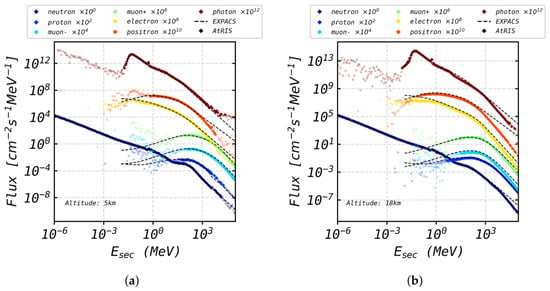
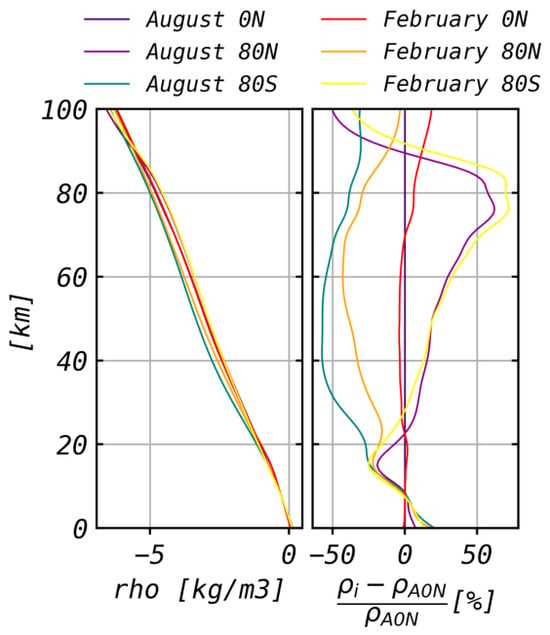
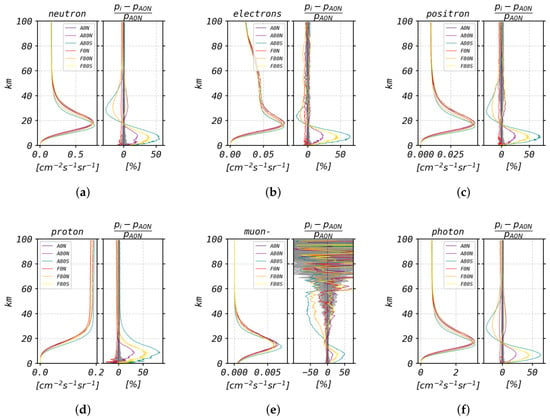
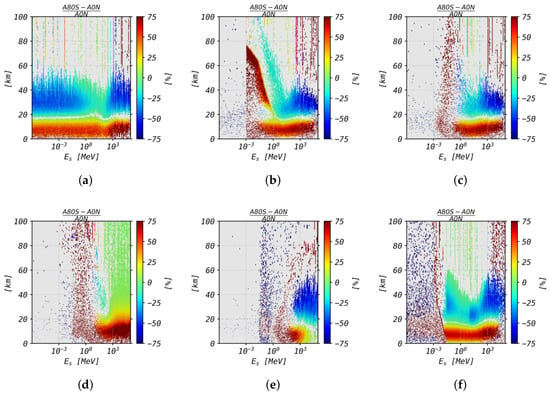
When high-energy particles of cosmic origin penetrate the atmosphere, they collide with atmospheric atoms and molecules, triggering cascades of secondary particles that can propagate down to the surface. These energetic particles constitute a radiation background in the atmosphere with direct implications for aviation exposure safety and influence atmospheric chemistry through the ionization of ambient air. For these reasons, the development of secondary particle showers has been extensively studied, and considerable effort has been devoted to Monte Carlo-based models capable of computing secondary particle fluxes in the atmosphere. However, the atmospheric models in which particle transport is simulated are generally standard atmospheric models, which can differ substantially from actual atmospheric conditions. In this work, the Atmospheric Radiation Interaction Simulator (AtRIS) is used in conjunction with the NRLMSIS-2.1 atmospheric model to investigate the effects of varying density, pressure, and temperature profiles on secondary particle fluxes at different atmospheric levels. For a given incident radiation spectrum, the AtRIS simulations reveal substantial differences between atmospheric profiles when a uniform vertical cutoff rigidity is prescribed across all latitudes, effectively isolating atmospheric effects from geomagnetic shielding. Below ∼20 km, secondary particle fluxes are consistently higher in the polar atmosphere than at the equator. At ∼7 km, the difference between the equatorial and southern polar winter profiles reaches ∼40% for protons, photons, electrons, and positrons, and ∼30% for neutrons and muons.
Full article
(This article belongs to the Section Planetary Sciences)
►
Show Figures
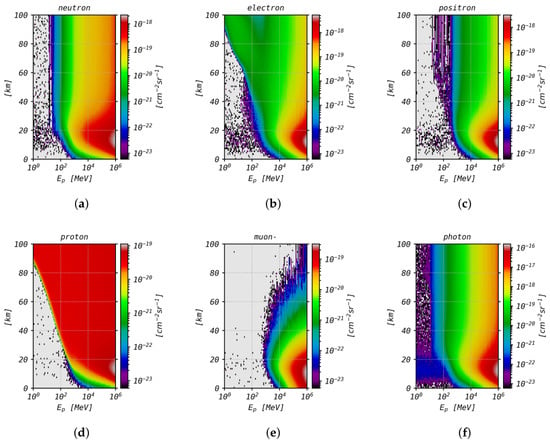
Figure 1