

You are currently viewing a new version of our website. To view the old version click .

Cosmetics, Volume 10, Issue 2

April 2023 - 30 articles

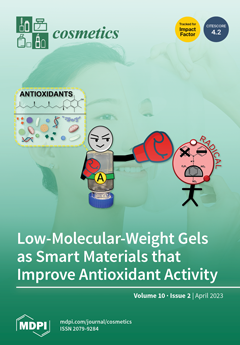
Cover Story: Low-molecular-weight gelators are small molecules that can self-assemble inside a solvent, leading to the formation of supramolecular gels. These gels can be used in the cosmetic industry for encapsulation and improved penetration of active compounds. Antioxidants can be incorporated into formulations for many reasons, for example, for their slow release over time or the preservation of the formulation activity and applicability. In the present study, a low-molecular-weight gel made with Boc-L-DOPA(Bn)2-OH was studied as a suitable material to host antioxidants (1) α-tocopherol and (2) postbiotics, and improve their activity. It was demonstrated that the antioxidant activity was not only maintained but even significantly enhanced by inserting the antioxidants in the supramolecular gels. View this paper
  • Issues are regarded as officially published after their release is announced to the table of contents alert mailing list .
  • You may sign up for email alerts to receive table of contents of newly released issues.
  • PDF is the official format for papers published in both, html and pdf forms. To view the papers in pdf format, click on the "PDF Full-text" link, and use the free Adobe Reader to open them.

Articles (30)

  • Article
  • Open Access
11 Citations
6,229 Views
11 Pages

Compositions of Abrasive Cosmetics from Polish Manufacturers

  • Martyna Guzik,
  • Olga Czerwińska-Ledwig and
  • Anna Piotrowska

Microplastics have been widely used in cosmetics and, among other things, very often as an abrasive component in peelings. This type of additive is not the main cause of environmental microplastic contamination, but it can pose a significant threat t...

  • Review
  • Open Access
42 Citations
26,578 Views
21 Pages

In Vitro Models for Anti-Aging Efficacy Assessment: A Critical Update in Dermocosmetic Research

  • Ana M. Cruz,
  • Margarida C. Gonçalves,
  • Matilde S. Marques,
  • Francisco Veiga,
  • Ana Cláudia Paiva-Santos and
  • Patrícia C. Pires

The skin is the human body’s largest organ and serves as a crucial boundary between the body and the external environment. As a natural process, skin aging cannot be avoided, and it causes changes in the skin’s strength, structure, elasti...

  • Review
  • Open Access
46 Citations
73,897 Views
14 Pages

Therapeutic Values of Exosomes in Cosmetics, Skin Care, Tissue Regeneration, and Dermatological Diseases

  • Abhimanyu Thakur,
  • Disheet Shah,
  • Deepika Rai,
  • Diana Carolina Parra,
  • Spoorthy Pathikonda,
  • Svetlana Kurilova and
  • Alma Cili

Exosomes are small extracellular nanovesicles that are released by cells, and their potential has been explored for use in cosmetics, skin care, tissue regeneration, and dermatological diseases. The therapeutic value of exosomes lies in their ability...

  • Article
  • Open Access
4 Citations
4,830 Views
11 Pages

Chemical and Rheological Characterization of a Facial Mask Containing an Olive Pomace Fraction

  • Raquel Rodrigues,
  • Joana C. Lobo,
  • Diana M. Ferreira,
  • Ewa Senderowicz,
  • M. Antónia Nunes,
  • M. Helena Amaral,
  • Rita C. Alves and
  • M. Beatriz P. P. Oliveira

Cosmetic interest in agro-industrial byproducts is growing. In fact, many studies have shown that these residues present bioactive compounds with several skincare applications. One example is olive byproducts, such as olive pomace, which has a compos...

  • Article
  • Open Access
1 Citations
4,062 Views
16 Pages

The invention and use of chelating purification products directed at atmospheric particulate matter 2.5 (PM2.5) are beneficial in preventing cytotoxicity and bodily harm. However, natural plant active compounds that minimize the adverse effect of PM2...

  • Review
  • Open Access
14 Citations
38,220 Views
23 Pages

Regulatory Requirements for Exporting Cosmetic Products to Extra-EU Countries

  • Silvia Morel,
  • Simona Sapino,
  • Elena Peira,
  • Daniela Chirio and
  • Marina Gallarate

In this study, an overview of the regulations in force in some extra-EU states belonging to different geoeconomic areas is provided, starting from the current EU legislation on cosmetic products. We focused on their legislative frameworks and the loc...

  • Review
  • Open Access
4 Citations
11,420 Views
13 Pages

Hyaluronic Acid in Facial Rehabilitation—A Narrative Review

  • Uwe Wollina,
  • Hristina Kocic and
  • Alberto Goldman

Background: Hyaluronic acid fillers (HAF) are a versatile tool in esthetic medicine. They also have a potential for medical indications including facial rehabilitation. Materials and methods: We performed a literature search on PUBMED and Google Scho...

  • Article
  • Open Access
2 Citations
3,622 Views
21 Pages

Oenanthe javanica (OJ) is a perennial herb that grows wildly or is cultivated in Asia, and it is used as food or in traditional medicine. The antioxidant and anti-inflammatory effects of OJ-derived materials have been extensively explored previously,...

  • Communication
  • Open Access
10,897 Views
8 Pages

Comparing Traditional and “In-Motion” Intense Pulsed Light Techniques for Hair Removal: A Split Study

  • Luigi Bennardo,
  • Steven Paul Nisticò,
  • Grazia Primavera,
  • Martina Tolone,
  • Federica Tamburi,
  • Stefano Bennardo and
  • Giovanni Cannarozzo

Background and Objectives: Hair removal is a common aesthetic concern for patients referred to dermatologists and aesthetic physicians. Lasers and lights are one of the mainstays in the management of this condition. Among these devices, intense pulse...

  • Article
  • Open Access
10 Citations
4,198 Views
19 Pages

Chemical Characterization and Bioactive Properties of Wine Lees and Diatomaceous Earth towards the Valorization of Underexploited Residues as Potential Cosmeceuticals

  • Cristina N. Duarte,
  • Oludemi Taofiq,
  • Maria Inês Dias,
  • Sandrina A. Heleno,
  • Celestino Santos-Buelga,
  • Lillian Barros and
  • Joana S. Amaral

Annually, wine production is responsible for generating large quantities of residues, which are frequently disposed of and not valorized. So far, different studies have been conducted on grape pomace, yet less attention has been paid to other residue...

of 3

Get Alerted

Add your email address to receive forthcoming issues of this journal.

XFacebookLinkedIn
Cosmetics - ISSN 2079-9284