


Nanomaterials in Cosmetics: An Outlook for European Regulatory Requirements and a Step Forward in Sustainability

 ,
,  ,
,  , ,
, ,  ,
, 

Abstract
1. Introduction
2. Regulatory Framework of Cosmetics (An Overview)
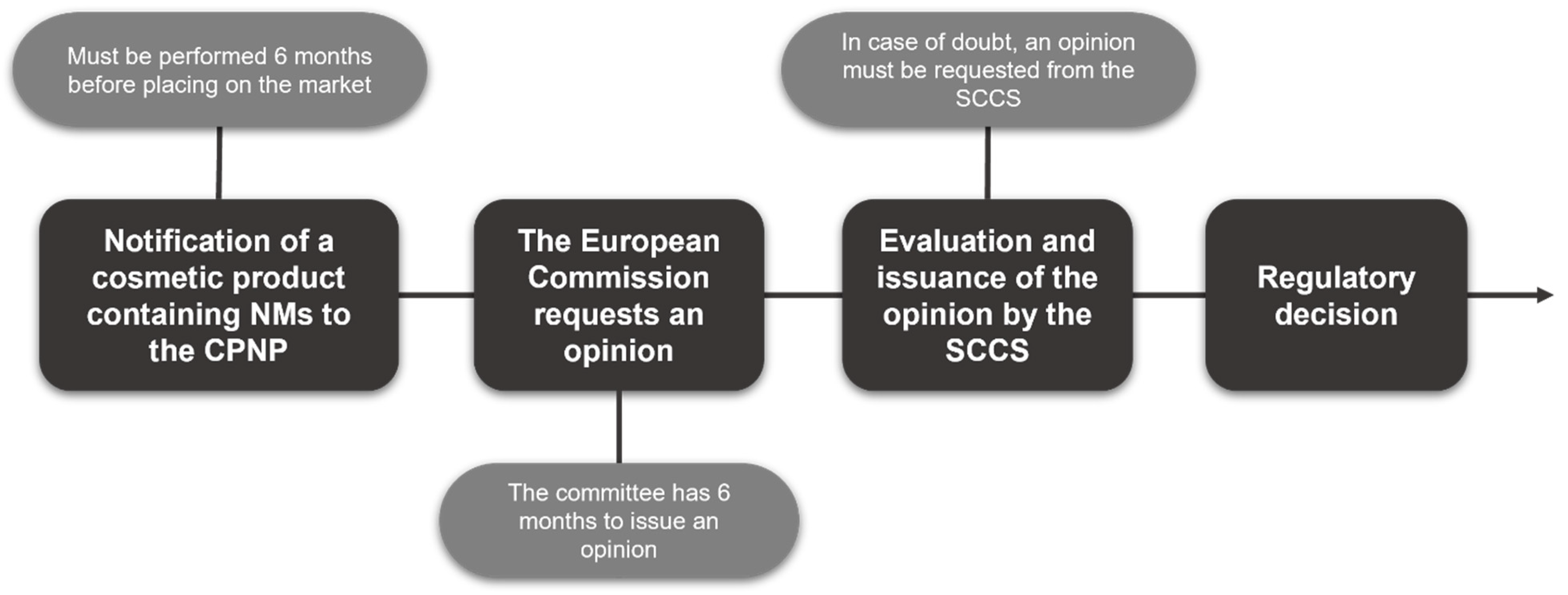
3. Nanomaterials (NMs) in Cosmetics
3.1. Notification of a Cosmetic Product Containing NMs in the CPNP
3.1.1. Identification of the Product and the NM
3.1.2. Specifications
- Particle size and size distribution, including presence of agglomeration or aggregation: Mean, median, and standard deviation in particle size, size distribution, and weighted sum function must be supplied. Presence of aggregates or agglomerates must be indicated, along with particle number and mass distribution, which is required to be shown graphically, coupled with distribution diagrams [13,27,28].
- Morphology: In this field, information regarding the physical/crystalline form of the material (amorphous, crystalline, tube, or stick), propensity to aggregation, state of preparation (solution, powder, dispersion, or suspension), and NM aspect ratio (for elongated fiber/tube type materials) must be provided. The data must be properly supported by images obtained by some of the aforementioned techniques [20,27,29].
- Surface characteristics: Information considering morphology/topography, surface charge (zeta potential), reactive sites, and coatings that may change reactivity characteristics or that are responsible for adding a new function and any biochemical/chemical surface changes must be provided. Information on zeta potential (measured in water or buffer) provides an indication of the strength of surface charge [14,15].
- Solubility: Information regarding the solubility of NM in relevant solvents, such as water and n-octanol, and the partition between the octanol/water partition coefficients must be filled. This information should include dissolution rates, not only for soluble NMs but also for partially insoluble ones, as well as information on the hygroscopicity of the powders [16,30].
- Surface area: Providing information on the specific surface area (SSA) using the Brunauer–Emmett and Teller method (BET method) and volume-specific surface area (VSSA) is mandatory for dry powders only [21]. The BET method measures the particle SSA by dividing the absolute surface area by the sample mass analyzed giving the so-called mass-specific surface area, reported in m²/g. The VSSA is calculated from the SSA using the density of the NM in question and is expressed in m²/cm³ [15,31].
- Catalytic activity: Indication concerning the chemical reactivity of the surface of the NM and information on the possible potential of photocatalytic activity must be disclosed. It should also be indicated if the core material is doped, meaning if the NM contains intentionally introduced materials for the purpose of modulating certain chemical, biochemical, or catalytic reactivity [27,32].
3.1.3. Quantity
3.1.4. Toxicological Profile of the NM
3.1.5. Safety Data
3.1.6. Exposure Conditions
4. Labeling Information
5. NMs in EU Market
5.1. Titanium Dioxide (TiO2)
5.2. Methylene Bis-Benzotriazolyl Tetramethylbutylphenol (MBBT)
5.3. Tris-Biphenyl Triazine (TBPT)
5.4. Nano Carbon Black (CI 77266)
5.5. Silica Dimethyl Silylate, Silane, Dichlorodimethyl, Silica Reaction Products, and Silica Nanoparticles
6. Sustainability in Cosmetic Industry
7. Regulatory Harmonization
8. Concluding Remarks
Author Contributions
Funding
Institutional Review Board Statement
Informed Consent Statement
Data Availability Statement
Conflicts of Interest
Abbreviations
References
- Kaul, S.; Gulati, N.; Verma, D.; Mukherjee, S.; Nagaich, U. Role of Nanotechnology in Cosmeceuticals: A Review of Recent Advances. J. Pharm. 2018, 2018, 3420204. [Google Scholar] [CrossRef] [Scilit] [PubMed]
- Fytianos, G.; Rahdar, A.; Kyzas, G.Z. Nanomaterials in Cosmetics: Recent Updates. Nanomaterials 2020, 10, 979. [Google Scholar] [CrossRef] [Scilit] [PubMed]
- Nath, R.; Chakraborty, R.; Roy, R.; Mukherjee, D.; Nag, S.; Bhattacharya, A. Nanotechnology Based Cosmeceuticals. Int. J. Sci. Res. Sci. Technol. 2021, 8, 94–106. [Google Scholar] [CrossRef] [Scilit]
- Karamanidou, T.; Bourganis, V.; Gatzogianni, G.; Tsouknidas, A. A Review of the EU’s Regulatory Framework for the Production of Nano-Enhanced Cosmetics. Metals 2021, 11, 455. [Google Scholar] [CrossRef] [Scilit]
- Regulation (EC). No. 1223/2009 of the European Parliament and of the Council, of 30 November 2009, on Cosmetic Products. 2009. Available online: http://data.europa.eu/eli/reg/2009/1223/oj (accessed on 2 November 2022).
- Bowman, D.M.; van Calster, G.; Friedrichs, S. Nanomaterials and regulation of cosmetics. Nat. Nanotechnol. 2010, 5, 92. [Google Scholar] [CrossRef] [Scilit] [PubMed]
- SCCS. Notes of Guidance for the Testing of Cosmetic Ingredients and their Safety Evaluation, 9th Revision, SCCS/1564/15, Revision of 25 April 2016. Available online: https://ec.europa.eu/health/scientific_committees/consumer_safety/docs/sccs_o_190.pdf (accessed on 7 November 2022).
- Ferreira, M.S.; de Oliveira, A.P.; Oliveira, R.; de Oliveira, R.P.; Lobo, J.M.S.; Almeida, I. Regulamentação dos produtos cosméticos: Uma perspetiva da evolução em Portugal e na União Europeia. Acta Farm. Port. 2021, 10, 15. Available online: https://actafarmaceuticaportuguesa.com/index.php/afp/article/view/243 (accessed on 14 December 2022).
- Eixarch, H.; Wyness, L.; Sibanda, M. The Regulation of Personalized Cosmetics in the EU. Cosmetics 2019, 6, 29. [Google Scholar] [CrossRef] [Scilit]
- Ferreira, M.; Matos, A.; Couras, A.; Marto, J.; Ribeiro, H. Overview of Cosmetic Regulatory Frameworks around the World. Cosmetics 2022, 9, 72. [Google Scholar] [CrossRef] [Scilit]
- Pauwels, M.; Rogiers, V. EU legislations affecting safety data availability of cosmetic ingredients. Regul. Toxicol. Pharmacol. 2007, 49, 308–315. [Google Scholar] [CrossRef] [Scilit]
- Bernauer, U.; Bodin, L.; Chaudhry, Q.; Coenraads, P.J.; Dusinska, M.; Gaffet, E.; Panteri, E.; Rogiers, V.; Rousselle, C.; Stepnik, M.; et al. The SCCS scientific advice on the safety of nanomaterials in cosmetics. Regul. Toxicol. Pharmacol. 2021, 126, 105046. [Google Scholar] [CrossRef] [Scilit]
- Pastrana, H.; Avila, A.; Tsai, C.S.J. Nanomaterials in Cosmetic Products: The Challenges with regard to Current Legal Frameworks and Consumer Exposure. NanoEthics 2018, 12, 123–137. [Google Scholar] [CrossRef] [Scilit]
- Bhattacharjee, S. DLS and zeta potential—What they are and what they are not? J. Control. Release 2016, 235, 337–351. [Google Scholar] [CrossRef] [Scilit] [PubMed]
- Lin, P.-C.; Lin, S.; Wang, P.C.; Sridhar, R. Techniques for physicochemical characterization of nanomaterials. Biotechnol. Adv. 2014, 32, 711–726. [Google Scholar] [CrossRef] [Scilit]
- Hartmann, S.F.; Eckert, R.W.; Knoth, D.; Keck, C.M. Characterization of Nanoparticles for Cosmetic Applications. In Nanocosmetics: From Ideas to Products; Cornier, J., Keck, C.M., Van de Voorde, M., Eds.; Springer International Publishing: Cham, Switzerland, 2019; pp. 181–198. [Google Scholar] [CrossRef] [Scilit]
- Santos, A.C.; Morais, F.; Simões, A.; Pereira, I.; Sequeira, J.A.D.; Pereira-Silva, M.; Sequeira, J.A.D.; Pereira-Silva, M.; Veiga, F.; Ribeiro, A. Nanotechnology for the development of new cosmetic formulations. Expert Opin. Drug Deliv. 2019, 16, 313–330. [Google Scholar] [CrossRef] [Scilit] [PubMed]
- Dubey, S.K.; Dey, A.; Singhvi, G.; Pandey, M.M.; Singh, V.; Kesharwani, P. Emerging trends of nanotechnology in advanced cosmetics. Colloids Surf. B Biointerfaces 2022, 214, 112440. [Google Scholar] [CrossRef] [Scilit] [PubMed]
- Huguet-Casquero, A.; Gainza, E.; Pedraz, J.L. Towards Green Nanoscience: From extraction to nanoformulation. Biotechnol. Adv. 2021, 46, 107657. [Google Scholar] [CrossRef] [Scilit]
- Gupta, V.; Mohapatra, S.; Mishra, H.; Farooq, U.; Kumar, K.; Ansari, M.J.; Aldawsari, M.F.; Alalaiwe, A.S.; Mirza, M.A.; Iqbal, Z. Nanotechnology in Cosmetics and Cosmeceuticals—A Review of Latest Advancements. Gels 2022, 8, 173. [Google Scholar] [CrossRef] [Scilit]
- Directorate-General for Internal Market, Industry, Entrepreneurship and SMEs. Guide to Using CPNP (Cosmetic Products Notification Portal); European Commission: Brussels, Belgium, 2017; Available online: https://ec.europa.eu/docsroom/documents/29563/attachments/1/translations/en/renditions/native (accessed on 24 November 2022).
- Directorate-General for Internal Market, Industry, Entrepreneurship and SMEs. Cosmetic Product Notification Portal; European Commission: Brussels, Belgium, 2009; Available online: https://single-market-economy.ec.europa.eu/sectors/cosmetics/cosmetic-product-notification-portal_en (accessed on 13 December 2022).
- Dhawan, S.; Sharma, P.; Nanda, S. Chapter 8—Cosmetic nanoformulations and their intended use. In Nanocosmetics; Nanda, A., Nanda, S., Nguyen, T.A., Rajendran, S., Slimani, Y., Eds.; Elsevier: Amsterdam, The Netherlands, 2020; pp. 141–169. [Google Scholar] [CrossRef] [Scilit]
- Vinardell, M.P. The use of non-animal alternatives in the safety evaluations of cosmetics ingredients by the Scientific Committee on Consumer Safety (SCCS). Regul. Toxicol. Pharmacol. 2015, 71, 198–204. [Google Scholar] [CrossRef] [Scilit]
- Santana Cabello, R.; Gañán Rojo, P.; Zuluaga, R. Lessons from the European Regulation 1223 of 2009, on Cosmetics: Expectations Versus Reality. NanoEthics 2019, 13, 21–35. [Google Scholar] [CrossRef] [Scilit]
- European Commission, Directorate-General for Health and Food Safety. Guidance on the Safety Assessment of Nanomaterials in Cosmetics: Publications Office; European Commission: Luxembourg, 2020. [Google Scholar] [CrossRef]
- Meinke, M.C.; Lademann, J.; Knorr, F.; Patzelt, A.; Lohan, S.B. 7. Nanocosmetics. In Nanoscience and Nanotechnology; Van de Marcel, V., Ed.; De Gruyter: Berlin, Germany; Boston, MA, USA, 2018; pp. 101–116. [Google Scholar] [CrossRef] [Scilit]
- Pan, G.-H.; Barras, A.; Boussekey, L.; Qu, X.; Addad, A.; Boukherroub, R. Preparation and Characterization of Decyl-Terminated Silicon Nanoparticles Encapsulated in Lipid Nanocapsules. Langmuir 2013, 29, 12688–12696. [Google Scholar] [CrossRef] [Scilit]
- Popović, Z.V.; Dohčević-Mitrović, Z.; Šćepanović, M.; Grujić-Brojčin, M.; Aškrabić, S. Raman scattering on nanomaterials and nanostructures. Annalen der Physik 2011, 523, 62–74. [Google Scholar] [CrossRef] [Scilit]
- ISO. ISO/TR 13014, 2012 Nanotechnologies—Guidance on Physico-Chemical Characterization of Engineered Nanoscale Materials for Toxicologic Assessment. 2012. Available online: https://www.iso.org/standard/52334.html (accessed on 27 November 2022).
- Baer, D.R. Application of surface analysis methods to nanomaterials: Summary of ISO/TC 201 technical report: ISO 14187, 2011—Surface chemical analysis—Characterization of nanomaterials. Surf. Interface Anal. 2012, 44, 1305–1308. [Google Scholar] [CrossRef] [Scilit]
- Petersen, R. Nanocrystals for Use in Topical Cosmetic Formulations and Method of Production Thereof. U.S. Patent WO2008058755A1, 25 February 2010. [Google Scholar]
- Regulation (EC) n.° 1907/2006 of 18 December 2006 Concerning the Registration, Evaluation, Authorisation and Restriction of Chemicals (REACH). 2006. Available online: http://data.europa.eu/eli/reg/2006/1907/2014-04-10 (accessed on 5 December 2022).
- (ECHA) ECA. Understanding. Available online: https://echa.europa.eu/regulations/reach/understanding-reach (accessed on 13 December 2022).
- Scientific Committee on Consumer Safety. The SCCS guidance on the safety assessment of nanomaterials in cosmetics. Regul. Toxicol. Pharmacol. 2020, 112, 104611. [Google Scholar] [CrossRef] [Scilit] [PubMed]
- European Commission, Directorate-General for Trade. Reports from the Commission to the European Parliament and the Council: First Annual Report on the Screening of Foreign Direct Investments into the Union and Report on the Implementation of Regulation (EU) 2021/821 Setting up a Union Regime for the Control of Exports, Brokering, Technical Assistance, Transit and Transfer of Dual-Use Items: Publications Office of the European Union; European Commission: Brussels, Belgium, 2021. [Google Scholar]
- Dréno, B.; Alexis, A.; Chuberre, B.; Marinovich, M. Safety of titanium dioxide nanoparticles in cosmetics. J. Eur. Acad. Dermatol. Venereol. 2019, 33 (Suppl. 2), 34–46. [Google Scholar] [CrossRef] [Scilit] [PubMed]
- Schneider, S.L.; Lim, H.W. A review of inorganic UV filters zinc oxide and titanium dioxide. Photodermatol. Photoimmunol. Photomed. 2019, 35, 442–446. [Google Scholar] [CrossRef] [Scilit] [PubMed]
- Velimirovic, M.; Wagner, S.; Monikh, F.A.; Uusimaki, T.; Kaegi, R.; Hofmann, T.; von der Kammer, F. Accurate quantification of TiO2 nanoparticles in commercial sunscreens using standard materials and orthogonal particle sizing methods for verification. Talanta 2020, 215, 120921. [Google Scholar] [CrossRef] [Scilit]
- Lu, P.J.; Fang, S.W.; Cheng, W.L.; Huang, S.C.; Huang, M.C.; Cheng, H.F. Characterization of titanium dioxide and zinc oxide nanoparticles in sunscreen powder by comparing different measurement methods. J. Food Drug Anal. 2018, 26, 1192–1200. [Google Scholar] [CrossRef] [Scilit]
- Scientific Committee on Consumer Safety. Opinion on Titanium Dioxide (Nano Form), 22 July 2013, Revision of 22 April 2014. 2014. Available online: https://health.ec.europa.eu/publications/revision-opinion-titanium-dioxide-nano-form_en (accessed on 7 January 2023).
- Oh, H.J.; Han, T.T.; Mainelis, G. Potential consumer exposure to respirable particles and TiO2 due to the use of eyebrow powders. J. Expo. Sci. Environ. Epidemiol. 2021, 31, 1032–1046. [Google Scholar] [CrossRef] [Scilit]
- European Commission, Directorate-General for Health and Food Safety. Opinion on 2,2′-Methylene-bis-(6-(2H-benzotriazol-2-yl)-4-(1,1,3,3-tetramethylbutyl)phenol) (nano form): Submission III: COLIPA S79; European Commission: Luxembourg, 2018. [Google Scholar]
- Taskforce TEMPTS. A European multicentre photopatch test study. Br. J. Dermatol. 2012, 166, 1002–1009. [Google Scholar] [CrossRef] [Scilit]
- Aerts, O.; Clinck, B.; Schramme, M.; Lambert, J. Contact allergy caused by Tinosorb (R) M: Let us not forget about xanthan gum. Contact Dermat. 2015, 72, 121–123. [Google Scholar] [CrossRef] [Scilit]
- Lim, S.-K.; Kim M-k Suh, H.-S.; Kim, M.-H.; Baek, S.-H.; Lee, B.-M. Risk assessment of methylene bis-benzotriazolyl tetramethylbutylphenol in sunscreen cosmetics. Toxicol. Lett. 2017, 280, S105. [Google Scholar] [CrossRef] [Scilit]
- Couteau, C.; Paparis, E.; Chauvet, C.; Coiffard, L. Tris-biphenyl triazine, a new ultraviolet filter studied in terms of photoprotective efficacy. Int. J. Pharm. 2015, 487, 120–123. [Google Scholar] [CrossRef] [Scilit]
- Hüglin, D. Advanced UV Absorbers for the Protection of Human Skin. Chimia 2016, 70, 496–501. [Google Scholar] [CrossRef] [Scilit]
- European Commission, Directorate-General for Health and Food Safety. Opinion on 1,3,5-Triazine, 2,4,6-tris1,1′-biphenyl-4-yl; European Commission: Luxembourg, 2013; Available online: https://data.europa.eu/doi/10.2772/10016 (accessed on 8 January 2023).
- Sabine, V.I.C.; Fabienne, B.; Brigitte, N.; Eric, P. Make-up composition producing a change in colour on application. U.S. Patent US9433804B2, 6 September 2016. [Google Scholar]
- Scientific Committee on Consumer Safety. Opinion of the Scientific Committee on Consumer safety (SCCS)—Second revision of the opinion on carbon black, nano-form, in cosmetic products. Regul. Toxicol. Pharmacol. 2016, 79, 103–104. [Google Scholar] [CrossRef] [Scilit]
- Park, Y.-H.; Kim, J.N.; Jeong, S.H.; Choi, J.E.; Lee, S.-H.; Choi, B.H.; Lee, J.P.; Sohn, K.H.; Park, K.L.; Kim, M.-K.; et al. Assessment of dermal toxicity of nanosilica using cultured keratinocytes, a human skin equivalent model and an in vivo model. Toxicology 2010, 267, 178–181. [Google Scholar] [CrossRef] [Scilit]
- Mebert, A.M.; Baglole, C.J.; Desimone, M.F.; Maysinger, D. Nanoengineered silica: Properties, applications and toxicity. Food Chem. Toxicol. 2017, 109, 753–770. [Google Scholar] [CrossRef] [Scilit]
- Scientific Committee on Consumer Safety. Opinion of the Scientific Committee on Consumer Safety (SCCS)—Revision of the opinion on the safety of the use of Silica, Hydrated Silica, and Silica Surface Modified with Alkyl Silylates (nano form) in cosmetic products. Regul. Toxicol. Pharmacol. 2016, 74, 79–80. [Google Scholar] [CrossRef] [Scilit]
- Bozza, A.; Campi, C.; Garelli, S.; Ugazio, E.; Battaglia, L. Current regulatory and market frameworks in green cosmetics: The role of certification. Sustain. Chem. Pharm. 2022, 30, 100851. [Google Scholar] [CrossRef] [Scilit]
- Dini, I.; Laneri, S. The New Challenge of Green Cosmetics: Natural Food Ingredients for Cosmetic Formulations. Molecules 2021, 26, 3921. [Google Scholar] [CrossRef] [Scilit]
- Bom, S.; Jorge, J.; Ribeiro, H.M.; Marto, J. A step forward on sustainability in the cosmetics industry: A review. J. Clean. Prod. 2019, 225, 270–290. [Google Scholar] [CrossRef] [Scilit]
- Almeida, T.; Silvestre, A.J.D.; Vilela, C.; Freire, C.S.R. Bacterial Nanocellulose toward Green Cosmetics: Recent Progresses and Challenges. Int. J. Mol. Sci. 2021, 22, 2836. [Google Scholar] [CrossRef] [Scilit] [PubMed]

| (1) Range of cosmetic products indicated for the use of NM | (7) Improper applications that may increase exposure |
| (2) Percentage of ingredient, by weight, of the final cosmetic product | (8) Absorbed fraction or amount likely to enter the body |
| (3) Amount of product to be applied in each use | (9) Application on dermal areas exposed to sunlight |
| (4) Application frequency | (10) On the basis of the intended use of the product, dermal exposure, oral exposure, or inhalation exposure must be estimated |
| (5) Skin contact area and duration of exposure | (11) Specific area of exposure |
| (6) Different target groups, such as people with compromised or damaged skin or children, where relevant | (12) Any other relevant information |
Disclaimer/Publisher’s Note: The statements, opinions and data contained in all publications are solely those of the individual author(s) and contributor(s) and not of MDPI and/or the editor(s). MDPI and/or the editor(s) disclaim responsibility for any injury to people or property resulting from any ideas, methods, instructions or products referred to in the content. |
© 2023 by the authors. Licensee MDPI, Basel, Switzerland. This article is an open access article distributed under the terms and conditions of the Creative Commons Attribution (CC BY) license (https://creativecommons.org/licenses/by/4.0/).
Share and Cite
Ferreira, L.; Pires, P.C.; Fonseca, M.; Costa, G.; Giram, P.S.; Mazzola, P.G.; Bell, V.; Mascarenhas-Melo, F.; Veiga, F.; Paiva-Santos, A.C. Nanomaterials in Cosmetics: An Outlook for European Regulatory Requirements and a Step Forward in Sustainability. Cosmetics 2023, 10, 53. https://doi.org/10.3390/cosmetics10020053
Ferreira L, Pires PC, Fonseca M, Costa G, Giram PS, Mazzola PG, Bell V, Mascarenhas-Melo F, Veiga F, Paiva-Santos AC. Nanomaterials in Cosmetics: An Outlook for European Regulatory Requirements and a Step Forward in Sustainability. Cosmetics. 2023; 10(2):53. https://doi.org/10.3390/cosmetics10020053
Chicago/Turabian StyleFerreira, Laura, Patrícia C. Pires, Mariana Fonseca, Gustavo Costa, Prabhanjan Shridhar Giram, Priscila Gava Mazzola, Victoria Bell, Filipa Mascarenhas-Melo, Francisco Veiga, and Ana Cláudia Paiva-Santos. 2023. "Nanomaterials in Cosmetics: An Outlook for European Regulatory Requirements and a Step Forward in Sustainability" Cosmetics 10, no. 2: 53. https://doi.org/10.3390/cosmetics10020053
APA StyleFerreira, L., Pires, P. C., Fonseca, M., Costa, G., Giram, P. S., Mazzola, P. G., Bell, V., Mascarenhas-Melo, F., Veiga, F., & Paiva-Santos, A. C. (2023). Nanomaterials in Cosmetics: An Outlook for European Regulatory Requirements and a Step Forward in Sustainability. Cosmetics, 10(2), 53. https://doi.org/10.3390/cosmetics10020053

