



Antioxidants, Volume 15, Issue 1 (January 2026) – 149 articles
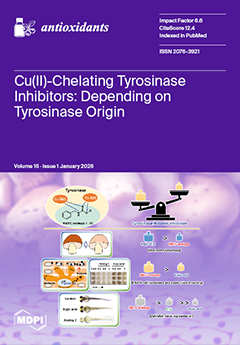
Cover Story (view full-size image):
N-Benzylthiocarbamate (NBTC) analogs, synthesized as potential Cu2+-chelating tyrosinase (TYR) inhibitors, demonstrated strong Cu2+-chelating activity. In B16F10 cells, all analogs outperformed kojic acid (KA) in inhibiting melanin production; however, none inhibited mushroom TYR (mTYR) activity more effectively than KA. Their melanin-inhibitory effects were attributed to inhibition of cellular TYR (cTYR). The differing TYR inhibitory activities of the analogs toward mTYR and B16F10 TYR are likely due to structural differences between because mTYR and mammalian TYR. Analogs 1 was highly effective in reducing browning in potato juice, while Analog 3 showed strong depigmenting activity in zebrafish larvae. Overall, the differential TYR inhibitory activity of NBTC analogs appears to result from their high sensitivity to interactions with TYRs of different origins. View this paper
- Issues are regarded as officially published after their release is announced to the table of contents alert mailing list.
- You may sign up for e-mail alerts to receive table of contents of newly released issues.
- PDF is the official format for papers published in both, html and pdf forms. To view the papers in pdf format, click on the "PDF Full-text" link, and use the free Adobe Reader to open them.
Previous Issue
Next Issue
