

You are currently on the new version of our website. Access the old version .

Metals, Volume 11, Issue 5

2021 May - 173 articles

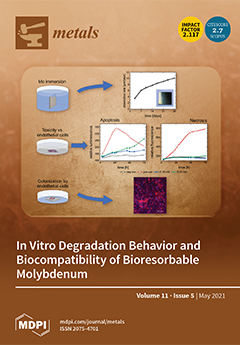
Cover Story: The degradation behavior and biocompatibility of molybdenum (Mo) were investigated. After immersion in simulated body fluid for 28 days at 37 °C, the degradation product layers were examined with optical microscopy and REM/EDX analysis. The degradation product layer was non-passivating, uniform, slowly soluble, and it released molybdate ions (MoO42−). A dissolution rate of 10 µm/year was derived from ion concentration measurements. Apoptosis and necrosis assays with human endothelial and smooth muscle cell lines showed that Mo is tolerated at concentrations relevant for implant applications. Mo is also colonizable by those cell lines. Consequently, Mo is a promising biomaterial for resorbable implants due to its favorable mechanical properties, uniform degradation, and good biocompatibility. View this paper.
  • Issues are regarded as officially published after their release is announced to the table of contents alert mailing list .
  • You may sign up for email alerts to receive table of contents of newly released issues.
  • PDF is the official format for papers published in both, html and pdf forms. To view the papers in pdf format, click on the "PDF Full-text" link, and use the free Adobe Reader to open them.

Articles (173)

  • Article
  • Open Access
16 Citations
3,238 Views
21 Pages

A Comprehensive Study of Dynamic Recrystallization Behavior of Mg Alloy with 3 wt.% Bi Addition

  • Hui Yu,
  • Hao Liu,
  • Binan Jiang,
  • Wei Yu,
  • Shaoming Kang,
  • Weili Cheng,
  • Sunghyuk Park,
  • Dong Chen,
  • Fuxing Yin and
  • Jianghai Li
  • + 3 authors

20 May 2021

The effect of the addition of bismuth on the dynamic recrystallization (DRX) behavior of the matrix has been investigated by comparing coarse grain pure Mg with the addition of 3 wt.% Bi, using a uniaxial compression test in the temperature range of...

  • Article
  • Open Access
9 Citations
2,864 Views
13 Pages

20 May 2021

The reaction behaviour of partially reduced iron (PRI) was studied to understand the effect of PRI utilisation in the blast furnace process. For quantitative analysis, the reaction behaviour of PRI under typical operating conditions of a blast furnac...

  • Article
  • Open Access
6 Citations
3,964 Views
12 Pages

MEROS Dust Quality of Different Plants and Its Potential Further Uses

  • Claudia Hledik,
  • Martin Goetz,
  • Franz Ottner and
  • Maria Fürhacker

20 May 2021

Sintering is a process of agglomeration of fine particles into porous sinters for blast furnaces. During the sintering process, high volumes of sinter plant gas containing high loads of dust, SO2 and NOX and toxic pollutants, such as heavy metals (e....

  • Article
  • Open Access
5 Citations
3,375 Views
9 Pages

Study on Ultra-High Temperature Contact Solution Treatment of Al–Zn–Mg–Cu Alloys

  • Wenming Jin,
  • Jianhao Yu,
  • Zhiqiang Zhang,
  • Hongjie Jia and
  • Mingwen Ren

20 May 2021

Contact solution treatment (CST) of Al–Zn–Mg–Cu alloys can shorten solution time to within 40 s in comparison with 1800 s with traditional solution treatment using a heating furnace. Heating temperature is the key factor in solution treatment. Consid...

  • Article
  • Open Access
13 Citations
3,763 Views
25 Pages

20 May 2021

Ultrasonic nanocrystal surface modification (UNSM) technology was applied to the surfaces of specimens additively manufactured by powder bed fusion (PBF). The changes in roughness and hardness due to the UNSM were set as objective functions, and the...

  • Article
  • Open Access
7 Citations
4,755 Views
13 Pages

Effect of Gas Bubbling Filtration Treatment Conditions on Melt Quality of AlSiMgCu Alloy

  • Ho-Sung Jang,
  • Ho-Jung Kang,
  • Gyu-Heun Lee,
  • Pil-Hwan Yoon,
  • Jin-Young Park,
  • Yoon-Suk Choi and
  • Sunmi Shin

20 May 2021

In this study, the optimal conditions of gas bubbling filtration (GBF) treatment for securing highly-clean molten Al-Si-Mg-Cu alloy were identified. The effects of GBF treatment time and stabilization time on the degree of molten metal cleanliness we...

  • Article
  • Open Access
11 Citations
3,009 Views
10 Pages

20 May 2021

W/Cu joining is key for the fabrication of plasma-facing compounds of fusion reactors. In this work, W and Cu are joined through three steps: (1) hydrothermal treatment and reduction annealing (i.e., nano-treatment), (2) Cu plating and annealing in a...

  • Article
  • Open Access
9 Citations
3,904 Views
18 Pages

20 May 2021

Iron-based amorphous metallic alloys (AMAs) of several compositions were exposed to neutron irradiation with fluences of up to 1019 n/cm2. These materials exhibit excellent magnetic properties which predetermine them for use in electronic devices ope...

  • Article
  • Open Access
7 Citations
4,119 Views
16 Pages

20 May 2021

The solidification cooling curve itself as well as its first derivative, and related temperatures, reported to the calculated equilibrium temperatures in stable and metastable solidification systems, are used to predict the solidification characteris...

  • Article
  • Open Access
17 Citations
4,141 Views
15 Pages

Creep Behavior of Diffusion-Welded Alloy 617

  • Injin Sah,
  • Jong-Bae Hwang and
  • Eung-Seon Kim

19 May 2021

Plate-type heat exchangers are anticipated to be used in the next-generation nuclear industry, and solid-state diffusion welding is a critical technology for building plate-type heat exchangers with high integrity. In this study, we manufactured a di...

of 18

Get Alerted

Add your email address to receive forthcoming issues of this journal.

XFacebookLinkedIn
Metals - ISSN 2075-4701