You are currently viewing a new version of our website. To view the old version click .

Cells, Volume 12, Issue 16

August-2 2023 - 103 articles

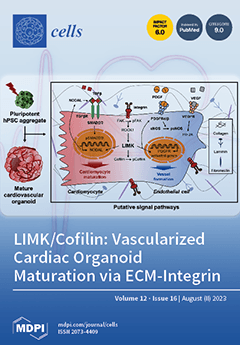
Cover Story: This study aims to create mature vascularized cardiac organoids (hPSC-COs) for effective drug testing. Investigating the impact of CA stemness impact hPSC-CO development reveals the mechanisms driving maturation and vascularization. Using Wnt signaling, high-stemness (H-COs) and low-stemness (L-COs) hPSC-COs were induced. H-COs displayed advanced cardiomyocyte maturation, diverse vessel networks, and upregulated genes related to maturation and vessel formation. Activating ROCK-LIMK-pCofilin via ECM–integrin interactions promoted cardiomyocyte maturation and vessel formation. The LIMK/Cofilin pathway triggered TGFβ/NODAL and PDGF pathways, enhancing H-CO maturation and vascularization. The study underscores CA stemness and self-organization's importance in hPSC-CO development, aiding drug discovery and cardiac disease modeling. View this paper
  • Issues are regarded as officially published after their release is announced to the table of contents alert mailing list .
  • You may sign up for email alerts to receive table of contents of newly released issues.
  • PDF is the official format for papers published in both, html and pdf forms. To view the papers in pdf format, click on the "PDF Full-text" link, and use the free Adobe Reader to open them.

Articles (103)

  • Communication
  • Open Access
20 Citations
4,456 Views
13 Pages

Ethanol Induces Neuroinflammation in a Chronic Plus Binge Mouse Model of Alcohol Use Disorder via TLR4 and MyD88-Dependent Signaling

  • Kalee N. Holloway,
  • James C. Douglas,
  • Tonya M. Rafferty,
  • Cynthia J. M. Kane and
  • Paul D. Drew

21 August 2023

Ethanol induces neuroinflammation, which is believed to contribute to the pathogenesis of alcohol use disorder (AUD). Toll-like receptors (TLRs) are a group of pattern recognition receptors (PRRs) expressed on both immune cells, including microglia a...

  • Article
  • Open Access
5 Citations
3,680 Views
16 Pages

Effects of Scaffolds on Urine- and Urothelial Carcinoma Tissue-Derived Organoids from Bladder Cancer Patients

  • Simon Walz,
  • Paul Pollehne,
  • Philipp Vollmer,
  • Wilhelm K. Aicher,
  • Arnulf Stenzl,
  • Niklas Harland and
  • Bastian Amend

20 August 2023

Organoids are three-dimensional constructs generated by placing cells in scaffolds to facilitate the growth of cultures with cell–cell and cell–matrix interactions close to the in vivo situation. Organoids may contain different types of c...

  • Article
  • Open Access
9 Citations
2,799 Views
21 Pages

Emerging Role of Kinin B1 Receptor in Persistent Neuroinflammation and Neuropsychiatric Symptoms in Mice Following Recovery from SARS-CoV-2 Infection

  • Srinivas Sriramula,
  • Drew Theobald,
  • Rohan Umesh Parekh,
  • Shaw M. Akula,
  • Dorcas P. O’Rourke and
  • Jeffrey B. Eells

19 August 2023

Evidence suggests that patients with long COVID can experience neuropsychiatric, neurologic, and cognitive symptoms. However, these clinical data are mostly associational studies complicated by confounding variables, thus the mechanisms responsible f...

  • Article
  • Open Access
8 Citations
3,208 Views
20 Pages

Simulated Microgravity Exposure Induces Antioxidant Barrier Deregulation and Mitochondria Enlargement in TCam-2 Cell Spheroids

  • Marika Berardini,
  • Luisa Gesualdi,
  • Caterina Morabito,
  • Francesca Ferranti,
  • Anna Reale,
  • Michele Zampieri,
  • Katsiaryna Karpach,
  • Antonella Tinari,
  • Lucia Bertuccini and
  • Simone Guarnieri
  • + 3 authors

19 August 2023

One of the hallmarks of microgravity-induced effects in several cellular models is represented by the alteration of oxidative balance with the consequent accumulation of reactive oxygen species (ROS). It is well known that male germ cells are sensiti...

  • Review
  • Open Access
12 Citations
3,594 Views
30 Pages

Tripartite Motif-Containing Protein 32 (TRIM32): What Does It Do for Skeletal Muscle?

  • Seung Yeon Jeong,
  • Jun Hee Choi,
  • Jooho Kim,
  • Jin Seok Woo and
  • Eun Hui Lee

19 August 2023

Tripartite motif-containing protein 32 (TRIM32) is a member of the tripartite motif family and is highly conserved from flies to humans. Via its E3 ubiquitin ligase activity, TRIM32 mediates and regulates many physiological and pathophysiological pro...

  • Article
  • Open Access
12 Citations
3,265 Views
31 Pages

Effect of Expansion Media on Functional Characteristics of Bone Marrow-Derived Mesenchymal Stromal Cells

  • Viktoria Jakl,
  • Tanja Popp,
  • Julian Haupt,
  • Matthias Port,
  • Reinhild Roesler,
  • Sebastian Wiese,
  • Benedikt Friemert,
  • Markus T. Rojewski and
  • Hubert Schrezenmeier

19 August 2023

The therapeutic efficacy of mesenchymal stromal cells (MSCs) has been shown to rely on their immunomodulatory and regenerative properties. In order to obtain sufficient numbers of cells for clinical applications, MSCs have to be expanded ex vivo. Exp...

  • Review
  • Open Access
18 Citations
5,020 Views
32 Pages

Porcine Macrophage Markers and Populations: An Update

  • Belén Álvarez,
  • Concepción Revilla,
  • Teresa Poderoso,
  • Angel Ezquerra and
  • Javier Domínguez

19 August 2023

Besides its importance as a livestock species, pig is increasingly being used as an animal model for biomedical research. Macrophages play critical roles in immunity to pathogens, tissue development, homeostasis and tissue repair. These cells are als...

  • Article
  • Open Access
9 Citations
2,465 Views
17 Pages

Circulated TGF-β1 and VEGF-A as Biomarkers for Fabry Disease-Associated Cardiomyopathy

  • Margarita M. Ivanova,
  • Julia Dao,
  • Omar Abu Slayeh,
  • Andrew Friedman and
  • Ozlem Goker-Alpan

19 August 2023

Fabry disease (FD) is a lysosomal disorder caused by α-galactosidase A deficiency, resulting in the accumulation of globotriaosylceramide (Gb-3) and its metabolite globotriaosylsphingosine (Lyso-Gb-3). Cardiovascular complications and hypertrop...

  • Article
  • Open Access
9 Citations
3,455 Views
23 Pages

The Adiponectin Receptor Agonist, ALY688: A Promising Therapeutic for Fibrosis in the Dystrophic Muscle

  • Nicolas Dubuisson,
  • Romain Versele,
  • Maria A. Davis-López de Carrizosa,
  • Camille M. Selvais,
  • Laurence Noel,
  • Chloé Planchon,
  • Peter Y. K. Van den Bergh,
  • Sonia M. Brichard and
  • Michel Abou-Samra

19 August 2023

Duchenne muscular dystrophy (DMD) is one of the most devastating myopathies, where severe inflammation exacerbates disease progression. Previously, we demonstrated that adiponectin (ApN), a hormone with powerful pleiotropic effects, can efficiently i...

  • Article
  • Open Access
1 Citations
1,764 Views
13 Pages

Increased Actin Binding Is a Shared Molecular Consequence of Numerous SCA5 Mutations in β-III-Spectrin

  • Alexandra E. Atang,
  • Amanda R. Keller,
  • Sarah A. Denha and
  • Adam W. Avery

19 August 2023

Spinocerebellar ataxia type 5 (SCA5) is a neurodegenerative disease caused by mutations in the SPTBN2 gene encoding the cytoskeletal protein β-III-spectrin. Previously, we demonstrated that a L253P missense mutation, localizing to the β-III...

of 11

Get Alerted

Add your email address to receive forthcoming issues of this journal.

XFacebookLinkedIn
Cells - ISSN 2073-4409