




Cancers, Volume 17, Issue 24 (December-2 2025) – 150 articles
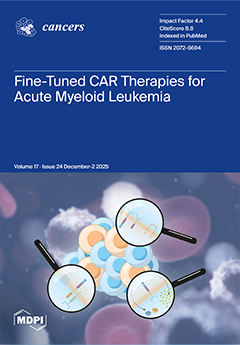
Cover Story (view full-size image):
Chimeric antigen receptor (CAR)-based therapies are rapidly evolving, particularly in challenging diseases such as acute myeloid leukemia (AML). This review summarizes recent advances in CAR engineering aimed at improving specificity, safety, and efficacy, including modular receptor architectures, logic-gated activation strategies, functional armoring approaches, gene-editing technologies, and emerging CAR platforms based on alternative immune cell types beyond conventional T-cell therapies. We highlight how these fine-tuned designs may reshape cellular immunotherapy strategies against AML and guide future development toward more controlled, adaptable, and personalized immune cell therapies. View this paper
- Issues are regarded as officially published after their release is announced to the table of contents alert mailing list.
- You may sign up for e-mail alerts to receive table of contents of newly released issues.
- PDF is the official format for papers published in both, html and pdf forms. To view the papers in pdf format, click on the "PDF Full-text" link, and use the free Adobe Reader to open them.
Previous Issue
Next Issue
