You are currently viewing a new version of our website. To view the old version click .

Toxins, Volume 9, Issue 3

March 2017 - 37 articles

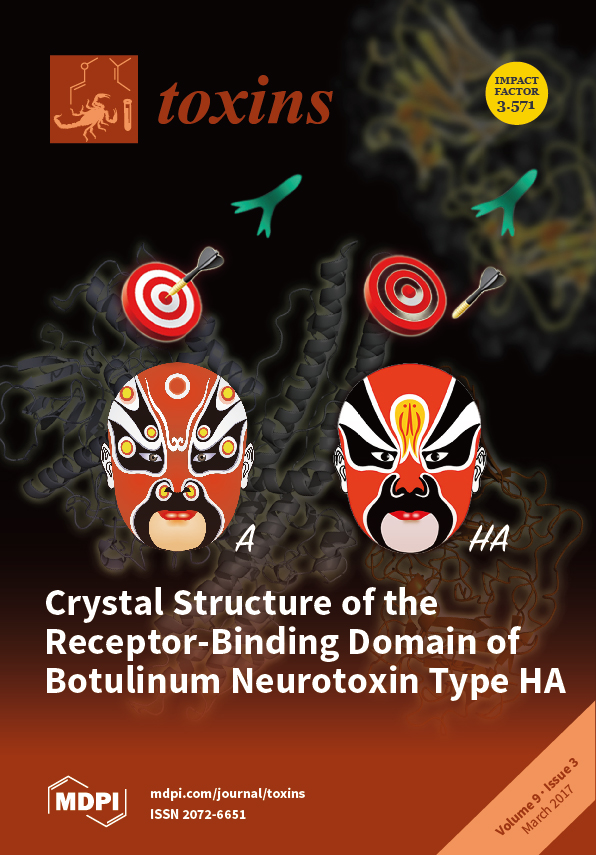
Cover Story: BoNTs are diverse protein toxins. BoNT/HA is a newly identified mosaic toxin, while new toxin variants are being identified with increasing frequency. We present here the first crystal structure of the receptor-binding domain of BoNT/HA. Our structural analyses reveal that, even though BoNT/HA and the classical type A toxin (BoNT/A) have highly similar structures in this domain, BoNT/HA drastically dampens binding of a potent BoNT/A-neutralizing antibody targeting this domain via subtle genetic changes. View this paper
  • Issues are regarded as officially published after their release is announced to the table of contents alert mailing list .
  • You may sign up for email alerts to receive table of contents of newly released issues.
  • PDF is the official format for papers published in both, html and pdf forms. To view the papers in pdf format, click on the "PDF Full-text" link, and use the free Adobe Reader to open them.

Articles (37)

  • Article
  • Open Access
31 Citations
6,528 Views
12 Pages

17 March 2017

Citrinin (CTN) is a hepato-nephrotoxic mycotoxin produced by fungi genera of Aspergillus, Monauscus, and Penicillium. CTN contaminates grains, fruits, juices and vegetables, and causes various toxic effects to humans and animals. It has small molecul...

  • Article
  • Open Access
19 Citations
5,828 Views
10 Pages

Consumption of Bt Maize Pollen Containing Cry1Ie Does Not Negatively Affect Propylea japonica (Thunberg) (Coleoptera: Coccinellidae)

  • Yonghui Li,
  • Yanmin Liu,
  • Xinming Yin,
  • Jörg Romeis,
  • Xinyuan Song,
  • Xiuping Chen,
  • Lili Geng,
  • Yufa Peng and
  • Yunhe Li

16 March 2017

Propylea japonica (Thunberg) (Coleoptera: Coccinellidae) are prevalent predators and pollen feeders in East Asian maize fields. They are therefore indirectly (via prey) and directly (via pollen) exposed to Cry proteins within Bt-transgenic maize fiel...

  • Article
  • Open Access
7 Citations
5,989 Views
14 Pages

Functional Contributions of Positive Charges in the Pore-Lining Helix 3 of the Bordetella pertussis CyaA-Hemolysin to Hemolytic Activity and Ion-Channel Opening

  • Chattip Kurehong,
  • Chalermpol Kanchanawarin,
  • Busaba Powthongchin,
  • Panchika Prangkio,
  • Gerd Katzenmeier and
  • Chanan Angsuthanasombat

16 March 2017

The Bordetella pertussis CyaA-hemolysin (CyaA-Hly) domain was previously demonstrated to be an important determinant for hemolysis against target erythrocytes and ion-channel formation in planar lipid bilayers (PLBs). Here, net-charge variations in t...

  • Article
  • Open Access
77 Citations
10,687 Views
13 Pages

Simultaneous Determination of Multi-Mycotoxins in Cereal Grains Collected from South Korea by LC/MS/MS

  • Dong-Ho Kim,
  • Sung-Yong Hong,
  • Jea Woo Kang,
  • Sung Min Cho,
  • Kyu Ri Lee,
  • Tae Kyung An,
  • Chan Lee and
  • Soo Hyun Chung

16 March 2017

An improved analytical method compared with conventional ones was developed for simultaneous determination of 13 mycotoxins (deoxynivalenol, nivalenol, 3-acetylnivalenol, aflatoxin B1, aflatoxin B2, aflatoxin G1, aflatoxin G2, fumonisin B1, fumonisin...

  • Review
  • Open Access
35 Citations
13,646 Views
58 Pages

16 March 2017

An understanding of the molecular mechanisms by which microbial, plant or animal-secreted toxins exert their action provides the most important element for assessment of human health risks and opens new insights into therapies addressing a plethora o...

  • Article
  • Open Access
27 Citations
43,749 Views
15 Pages

15 March 2017

Cnidarian envenomations are the leading cause of severe and lethal human sting injuries from marine life. The total amount of venom discharged into sting-site tissues, sometimes referred to as “venom load”, has been previously shown to correlate with...

  • Article
  • Open Access
25 Citations
7,096 Views
14 Pages

Ameliorative Effects of Neutral Electrolyzed Water on Growth Performance, Biochemical Constituents, and Histopathological Changes in Turkey Poults during Aflatoxicosis

  • Denise Gómez-Espinosa,
  • Francisco Javier Cervantes-Aguilar,
  • Juan Carlos Del Río-García,
  • Tania Villarreal-Barajas,
  • Alma Vázquez-Durán and
  • Abraham Méndez-Albores

14 March 2017

Different in vitro and in silico approaches from our research group have demonstrated that neutral electrolyzed water (NEW) can be used to detoxify aflatoxins. The objective of this investigation was to evaluate the ability of NEW to detoxify B-aflat...

  • Article
  • Open Access
22 Citations
7,298 Views
17 Pages

Characteristics and Lethality of a Novel Recombinant  Dermonecrotic Venom Phospholipase D from  Hemiscorpius lepturus

  • Elham Torabi,
  • Mahdi Behdani,
  • Mohammad Hosseininejad Chafi,
  • Reza Moazzami,
  • Jean‐Marc Sabatier,
  • Vahid Khalaj,
  • Delavar Shahbazzadeh and
  • Kamran Pooshang Bagheri

13 March 2017

Hemoscorpius lepturus is the most medically important scorpion in Iran. The clinical signs of H. lepturus envenomation are remarkably similar to those reported for brown spiders, including dermonecrosis, hematuria, renal failure and even death. The l...

  • Article
  • Open Access
83 Citations
39,363 Views
22 Pages

How the Cobra Got Its Flesh-Eating Venom: Cytotoxicity as a Defensive Innovation and Its Co-Evolution with Hooding, Aposematic Marking, and Spitting

  • Nadya Panagides,
  • Timothy N.W. Jackson,
  • Maria P. Ikonomopoulou,
  • Kevin Arbuckle,
  • Rudolf Pretzler,
  • Daryl C. Yang,
  • Syed A. Ali,
  • Ivan Koludarov,
  • James Dobson and
  • Brittany Sanker
  • + 16 authors

13 March 2017

The cytotoxicity of the venom of 25 species of Old World elapid snake was tested and compared with the morphological and behavioural adaptations of hooding and spitting. We determined that, contrary to previous assumptions, the venoms of spitting spe...

  • Article
  • Open Access
55 Citations
10,139 Views
20 Pages

Nitrate Increased Cucumber Tolerance to Fusarium Wilt by Regulating Fungal Toxin Production and Distribution

  • Jinyan Zhou,
  • Min Wang,
  • Yuming Sun,
  • Zechen Gu,
  • Ruirui Wang,
  • Asanjan Saydin,
  • Qirong Shen and
  • Shiwei Guo

11 March 2017

Cucumber Fusarium wilt, induced by Fusarium oxysporum f. sp. cucumerinum (FOC), causes severe losses in cucumber yield and quality. Nitrogen (N), as the most important mineral nutrient for plants, plays a critical role in plant–pathogen interactions....

of 4

Get Alerted

Add your email address to receive forthcoming issues of this journal.

XFacebookLinkedIn
Toxins - ISSN 2072-6651