


You are currently viewing a new version of our website. To view the old version click .

Toxins, Volume 9, Issue 2

February 2017 - 30 articles

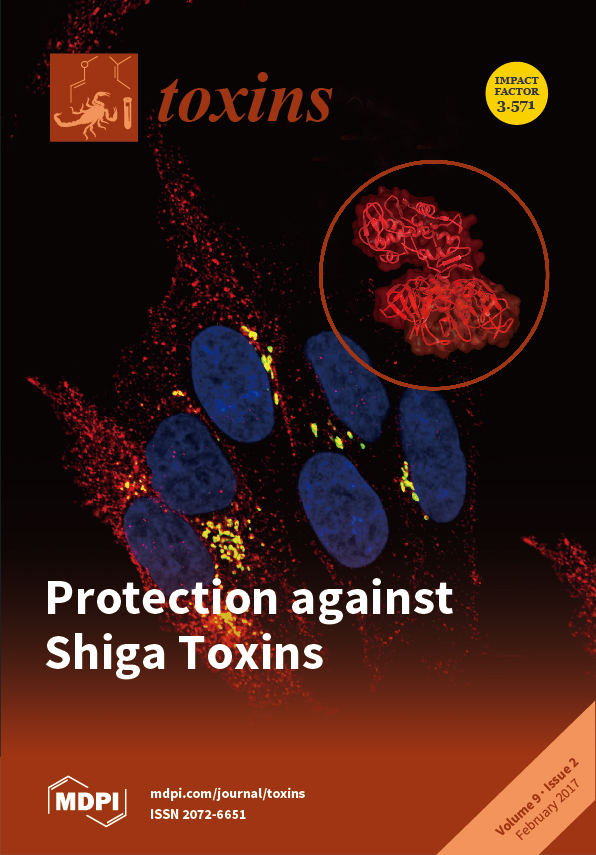
Cover Story: Shiga toxins comprise a family of related bacterial protein toxins which bind to their receptor on the cell surface and then become endocytosed and transported retrogradely to the endoplasmic reticulum, where the enzymatically active moiety of the toxin is released to the cytosol and inhibits proteins synthesis. The top right corner: the structure of Shiga toxin as determined by X-ray crystallography. Fluorescent confocal image of HEp-2 cells treated with Shiga toxin B (receptor binding moiety) for 30 min 37oC. Red: Shiga toxin B; green: Golgi protein giantin; blue: nucleus (DAPI). View this paper.
  • Issues are regarded as officially published after their release is announced to the table of contents alert mailing list .
  • You may sign up for email alerts to receive table of contents of newly released issues.
  • PDF is the official format for papers published in both, html and pdf forms. To view the papers in pdf format, click on the "PDF Full-text" link, and use the free Adobe Reader to open them.

Articles (30)

  • Article
  • Open Access
14 Citations
6,682 Views
12 Pages

Determination of Mycotoxin Production of Fusarium Species in Genetically Modified Maize Varieties by Quantitative Flow Immunocytometry

  • Hajnalka Bánáti,
  • Béla Darvas,
  • Szilvia Fehér-Tóth,
  • Árpád Czéh and
  • András Székács

22 February 2017

Levels of mycotoxins produced by Fusarium species in genetically modified (GM) and near-isogenic maize, were determined using multi-analyte, microbead-based flow immunocytometry with fluorescence detection, for the parallel quantitative determination...

  • Article
  • Open Access
37 Citations
7,712 Views
8 Pages

21 February 2017

Paralytic shellfish poisoning results from consumption of seafood naturally contaminated by saxitoxin and its congeners, the paralytic shellfish toxins (PSTs). The levels of such toxins are regulated internationally, and maximum permitted concentrati...

  • Review
  • Open Access
68 Citations
11,460 Views
21 Pages

Fungal Ribotoxins: A Review of Potential Biotechnological Applications

  • Miriam Olombrada,
  • Rodrigo Lázaro-Gorines,
  • Juan C. López-Rodríguez,
  • Álvaro Martínez-del-Pozo,
  • Mercedes Oñaderra,
  • Moisés Maestro-López,
  • Javier Lacadena,
  • José G. Gavilanes and
  • Lucía García-Ortega

21 February 2017

Fungi establish a complex network of biological interactions with other organisms in nature. In many cases, these involve the production of toxins for survival or colonization purposes. Among these toxins, ribotoxins stand out as promising candidates...

  • Article
  • Open Access
26 Citations
5,814 Views
11 Pages

Static Hot Air and Infrared Rays Roasting are Efficient Methods for Aflatoxin Decontamination on Hazelnuts

  • Ilenia Siciliano,
  • Barbara Dal Bello,
  • Giuseppe Zeppa,
  • Davide Spadaro and
  • Maria Lodovica Gullino

21 February 2017

Aflatoxins are a group of secondary metabolites produced by members of Aspergillus Section Flavi that are dangerous to humans and animals. Nuts can be potentially contaminated with aflatoxins, often over the legal threshold. Food processes, including...

  • Article
  • Open Access
53 Citations
6,651 Views
13 Pages

Toxin Release of Cyanobacterium Microcystis aeruginosa after Exposure to Typical Tetracycline Antibiotic Contaminants

  • Jing Ye,
  • Yuping Du,
  • Lumei Wang,
  • Jingru Qian,
  • Jiejing Chen,
  • Qingwen Wu and
  • Xiaojun Hu

21 February 2017

The global usage of veterinary antibiotics is significant. Antibiotics can be released into aquatic environments and elicit toxic effects on non-target organisms. In this study, the growth characteristics and toxin release of the cyanobacterium Micro...

  • Article
  • Open Access
30 Citations
7,090 Views
18 Pages

Comparative Transcriptome Analysis of Penicillium citrinum Cultured with Different Carbon Sources Identifies Genes Involved in Citrinin Biosynthesis

  • Taotao Li,
  • Guoxiang Jiang,
  • Hongxia Qu,
  • Yong Wang,
  • Yehui Xiong,
  • Qijie Jian,
  • Yu Wu,
  • Xuewu Duan,
  • Xiangrong Zhu and
  • Wenzhong Hu
  • + 3 authors

21 February 2017

Citrinin is a toxic secondary metabolite of Penicillium citrinum and its contamination in many food items has been widely reported. However, research on the citrinin biosynthesis pathway and its regulation mechanism in P. citrinum is rarely reported....

  • Article
  • Open Access
25 Citations
8,261 Views
12 Pages

Bee Venom Phospholipase A2 Ameliorates House Dust Mite Extract Induced Atopic Dermatitis Like Skin Lesions in Mice

  • Kyung-Hwa Jung,
  • Hyunjung Baek,
  • Manho Kang,
  • Namsik Kim,
  • Seung Young Lee and
  • Hyunsu Bae

18 February 2017

Atopic dermatitis (AD) is a biphasic inflammatory skin disease that is provoked by epidermal barrier defects, immune dysregulation, and increased skin infections. Previously, we have demonstrated that bvPLA2 evoked immune tolerance by inducing regula...

  • Article
  • Open Access
19 Citations
7,982 Views
17 Pages

Human scFvs That Counteract Bioactivities of Staphylococcus aureus TSST-1

  • Thunchanok Rukkawattanakul,
  • Nitat Sookrung,
  • Watee Seesuay,
  • Nattawat Onlamoon,
  • Pornphan Diraphat,
  • Wanpen Chaicumpa and
  • Nitaya Indrawattana

17 February 2017

Some Staphylococcus aureus isolates produced toxic shock syndrome toxin-1 (TSST-1) which is a pyrogenic toxin superantigen (PTSAg). The toxin activates a large fraction of peripheral blood T lymphocytes causing the cells to proliferate and release ma...

  • Article
  • Open Access
4 Citations
9,358 Views
10 Pages

The Cardiovascular and Neurotoxic Effects of the Venoms of Six Bony and Cartilaginous Fish Species

  • Han Han,
  • Kate Baumann,
  • Nicholas R. Casewell,
  • Syed A. Ali,
  • James Dobson,
  • Ivan Koludarov,
  • Jordan Debono,
  • Scott C. Cutmore,
  • Niwanthi W. Rajapakse and
  • Timothy N. W. Jackson
  • + 4 authors

16 February 2017

Fish venoms are often poorly studied, in part due to the difficulty in obtaining, extracting, and storing them. In this study, we characterize the cardiovascular and neurotoxic effects of the venoms from the following six species of fish: the cartila...

  • Comment
  • Open Access
11 Citations
5,033 Views
5 Pages

14 February 2017

Recently a species in the genus Talaromyces, a uniseriate species of Aspergillus section Nigri and an isolate each of two widespread species, Penicillium rubens and P. commune, were reported to produce ochratoxin A. This claim was based on insufficie...

of 3

Get Alerted

Add your email address to receive forthcoming issues of this journal.

XFacebookLinkedIn
Toxins - ISSN 2072-6651