

You are currently viewing a new version of our website. To view the old version click .

Toxins, Volume 9, Issue 4

April 2017 - 38 articles

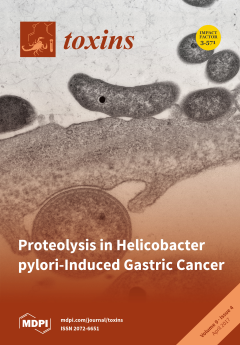
Cover Story: TEM image of Helicobacter pylori attaching to the gastric epithelial cell line AGS. H. pylori is a class-I carcinogen which can lead to chronic inflammation, ulceration, MALT lymphoma and gastric cancer. In this special issue, different complex pathogen-host interactions were summarized shedding light on different H. pylori virulence factors that interfere with epithelial cells and cells from the immune system. View this paper
  • Issues are regarded as officially published after their release is announced to the table of contents alert mailing list .
  • You may sign up for email alerts to receive table of contents of newly released issues.
  • PDF is the official format for papers published in both, html and pdf forms. To view the papers in pdf format, click on the "PDF Full-text" link, and use the free Adobe Reader to open them.

Articles (38)

  • Article
  • Open Access
8 Citations
5,627 Views
11 Pages

21 April 2017

The morphology and secondary metabolism of Aspergillus spp. are associated with initial spore density (ISD). Fatty acids (FA) are involved in the biosynthesis of aflatoxins (AF) through Aspergillus quorum sensing (QS). Here, we studied how ochratoxin...

  • Article
  • Open Access
37 Citations
6,363 Views
14 Pages

A Rapid Magnetic Solid Phase Extraction Method Followed by Liquid Chromatography-Tandem Mass Spectrometry Analysis for the Determination of Mycotoxins in Cereals

  • Giorgia La Barbera,
  • Anna Laura Capriotti,
  • Chiara Cavaliere,
  • Patrizia Foglia,
  • Carmela Maria Montone,
  • Riccardo Zenezini Chiozzi and
  • Aldo Laganà

21 April 2017

Mycotoxins can contaminate various food commodities, including cereals. Moreover, mycotoxins of different classes can co-contaminate food, increasing human health risk. Several analytical methods have been published in the literature dealing with myc...

  • Feature Paper
  • Review
  • Open Access
24 Citations
12,086 Views
20 Pages

Treatments for Latrodectism—A Systematic Review on Their Clinical Effectiveness

  • Nicole M. Ryan,
  • Nicholas A. Buckley and
  • Andis Graudins

21 April 2017

Latrodectism or envenomation by widow-spiders is common and clinically significant worldwide. Alpha-latrotoxin is the mammalian-specific toxin in the venom that results in toxic effects observed in humans. Symptoms may be incapacitating and include s...

  • Article
  • Open Access
41 Citations
9,208 Views
10 Pages

A Simple and Specific Noncompetitive ELISA Method for HT-2 Toxin Detection

  • Henri O. Arola,
  • Antti Tullila,
  • Alexis V. Nathanail and
  • Tarja K. Nevanen

20 April 2017

We developed an HT-2 toxin-specific simple ELISA format with a positive read-out. The assay is based on an anti-immune complex (IC) scFv antibody fragment, which is genetically fused with alkaline phosphatase (AP). The anti-IC antibody specifically r...

  • Article
  • Open Access
12 Citations
5,325 Views
10 Pages

Diabetogenic Effects of Ochratoxin A in Female Rats

  • Firdevs Mor,
  • Omur Sengul,
  • Senay Topsakal,
  • Mehmet Akif Kilic and
  • Ozlem Ozmen

19 April 2017

In this study, the diabetogenic effects of long term Ochratoxin A (OTA) administration in rats were investigated, and its role in the etiology of diabetes mellitus (DM) was examined utilizing 42 female Wistar rats for these purposes. The rats were di...

  • Feature Paper
  • Review
  • Open Access
55 Citations
15,232 Views
17 Pages

Antivenom for Neuromuscular Paralysis Resulting From Snake Envenoming

  • Anjana Silva,
  • Wayne C. Hodgson and
  • Geoffrey K. Isbister

19 April 2017

Antivenom therapy is currently the standard practice for treating neuromuscular dysfunction in snake envenoming. We reviewed the clinical and experimental evidence-base for the efficacy and effectiveness of antivenom in snakebite neurotoxicity. The m...

  • Comment
  • Open Access
7 Citations
4,122 Views
2 Pages

Comment on Indoxyl Sulfate—Review of Toxicity and Therapeutic Strategies. Toxins 2016, 8, 358

  • Fellype C. Barreto,
  • Daniela V. Barreto,
  • Andrea E. M. Stinghen and
  • Ziad A. Massy

17 April 2017

Recently, the clinical and experimental evidences that support the toxic effects of indoxyl sulfate, a protein-bound uremic toxin in chronic kidney disease (CKD) patients, has been discussed. In this panorama, the authors described several in vitro a...

  • Article
  • Open Access
21 Citations
6,639 Views
11 Pages

Modification of the Mycotoxin Deoxynivalenol Using Microorganisms Isolated from Environmental Samples

  • Nina M. Wilson,
  • Nicole McMaster,
  • Dash Gantulga,
  • Cara Soyars,
  • Susan P. McCormick,
  • Ken Knott,
  • Ryan S. Senger and
  • David G. Schmale

15 April 2017

The trichothecene mycotoxin deoxynivalenol (DON) is a common contaminant of wheat, barley, and maize. New strategies are needed to reduce or eliminate DON in feed and food products. Microorganisms from plant and soil samples collected in Blacksburg,...

  • Review
  • Open Access
55 Citations
13,717 Views
23 Pages

14 April 2017

Protein translation is the most common target of toxin-antitoxin system (TA) toxins. Sequence-specific endoribonucleases digest RNA in a sequence-specific manner, thereby blocking translation. While past studies mainly focused on the digestion of mRN...

  • Article
  • Open Access
20 Citations
6,022 Views
15 Pages

An On-Site, Ultra-Sensitive, Quantitative Sensing Method for the Determination of Total Aflatoxin in Peanut and Rice Based on Quantum Dot Nanobeads Strip

  • Suiyan Ouyang,
  • Zhaowei Zhang,
  • Ting He,
  • Peiwu Li,
  • Qi Zhang,
  • Xiaomei Chen,
  • Du Wang,
  • Hui Li,
  • Xiaoqian Tang and
  • Wen Zhang

13 April 2017

An on-site, ultra-sensitive, and quantitative sensing method was developed based on quantum dot nanobeads (QDNBs) and a test strip for the determination of total aflatoxins (AFTs) in rice and peanuts. The monoclonal antibody against AFT (mAbAFT) was...

of 4

Get Alerted

Add your email address to receive forthcoming issues of this journal.

XFacebookLinkedIn
Toxins - ISSN 2072-6651