You are currently viewing a new version of our website. To view the old version click .

Toxins, Volume 14, Issue 11

November 2022 - 91 articles

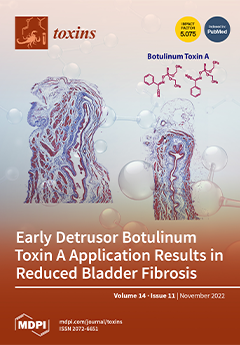
Cover Story: Approximately 80% of individuals who suffer spinal cord injury (SCI) will develop hypertrophic and neurogenic bladders resulting in complications including urinary incontinence, urinary tract infection and renal failure. In this study, the authors examined the effect of early bladder chemodenervation with botulinum toxin A on bladder histopathology and collagen deposition. They found that the bladders of SCI rats injected with botulinum toxin A had a significant reduction in detrusor hypertrophy and less fibrous collagen deposition compared to bladders from SCI animals injected with saline. These findings suggest that acute detrusor chemodenervation using botulinum toxin A after SCI can preserve bladder tissue integrity by reducing the development of detrusor fibrosis and hypertrophy associated with SCI. View this paper
  • Issues are regarded as officially published after their release is announced to the table of contents alert mailing list .
  • You may sign up for email alerts to receive table of contents of newly released issues.
  • PDF is the official format for papers published in both, html and pdf forms. To view the papers in pdf format, click on the "PDF Full-text" link, and use the free Adobe Reader to open them.

Articles (91)

  • Article
  • Open Access
5 Citations
3,427 Views
16 Pages

Measurement of Microcystin Activity in Human Plasma Using Immunocapture and Protein Phosphatase Inhibition Assay

  • Brady R. Cunningham,
  • Rebekah E. Wharton,
  • Christine Lee,
  • Mike A. Mojica,
  • Logan C. Krajewski,
  • Shirley C. Gordon,
  • Adam M. Schaefer,
  • Rudolph C. Johnson and
  • Elizabeth I. Hamelin

21 November 2022

Microcystins are toxic chemicals generated by certain freshwater cyanobacteria. These chemicals can accumulate to dangerous levels during harmful algal blooms. When exposed to microcystins, humans are at risk of hepatic injury, including liver failur...

  • Article
  • Open Access
15 Citations
3,090 Views
14 Pages

The Influence of Micronutrient Trace Metals on Microcystis aeruginosa Growth and Toxin Production

  • Jordan A. Facey,
  • Jake P. Violi,
  • Josh J. King,
  • Chowdhury Sarowar,
  • Simon C. Apte and
  • Simon M. Mitrovic

21 November 2022

Microcystis aeruginosa is a widespread cyanobacteria capable of producing hepatotoxic microcystins. Understanding the environmental factors that influence its growth and toxin production is essential to managing the negative effects on freshwater sys...

  • Article
  • Open Access
3 Citations
2,831 Views
14 Pages

21 November 2022

Peptide toxins generally have extreme pharmacological activities and provide a rich source for the discovery of drug leads. However, determining the optimal activity of a new peptide can be a long and expensive process. In this study, peptide toxins...

  • Article
  • Open Access
9 Citations
3,129 Views
20 Pages

Time- and Dose-Dependent Effects of Dietary Deoxynivalenol (DON) in Rainbow Trout (Oncorhynchus mykiss) at Organism and Tissue Level

  • Paraskevi Koletsi,
  • Geert F. Wiegertjes,
  • Elisabeth A. M. Graat,
  • Philip Lyons and
  • Johan Schrama

20 November 2022

This study with juvenile rainbow trout evaluated the effects of dietary exposure to deoxynivalenol (DON) at industrially relevant doses (up to 1.6 mg/kg) on growth performance, the liver, and the gastrointestinal tract. Fifteen groups of 30 fish each...

  • Article
  • Open Access
5 Citations
2,581 Views
14 Pages

Post Hoc Subgroup Analysis of the BCause Study Assessing the Effect of AbobotulinumtoxinA on Post-Stroke Shoulder Pain in Adults

  • Marcelo Riberto,
  • João Amaury Frances,
  • Regina Chueire,
  • Ana Cristina Ferreira Garcia Amorim,
  • Denise Xerez,
  • Tae Mo Chung,
  • Lucia Helena Costa Mercuri,
  • Sérgio Lianza,
  • Eduardo Carvalho de Melo Rocha and
  • Pascal Maisonobe
  • + 2 authors

20 November 2022

Botulinum toxin type A is approved for the focal treatment of spasticity; however, the effectiveness of abobotulinumtoxinA (aboBoNT-A) in patients with shoulder pain who have set reduced pain as a treatment goal is understudied. In addition, some pat...

  • Article
  • Open Access
9 Citations
2,778 Views
15 Pages

Integrated Transcriptome Analysis Reveals mRNA–miRNA Pathway Crosstalk in Roman Laying Hens’ Immune Organs Induced by AFB1

  • Zhongxian Xu,
  • Qian Liu,
  • Xueqin Liu,
  • Maosen Yang,
  • Yuan Su,
  • Tao Wang,
  • Diyan Li and
  • Feng Li

19 November 2022

Aflatoxin B1 (AFB1) is a widely distributed contaminant in moldy corn, rice, soybean, and oil crops. Many studies have revealed its adverse effects, such as carcinogenicity, immunotoxicity, and hepatotoxicity, on the health of humans and animals. To...

  • Article
  • Open Access
19 Citations
4,094 Views
25 Pages

Lactic Acid Bacteria as Potential Agents for Biocontrol of Aflatoxigenic and Ochratoxigenic Fungi

  • Eva María Mateo,
  • Andrea Tarazona,
  • Misericordia Jiménez and
  • Fernando Mateo

19 November 2022

Aflatoxins (AF) and ochratoxin A (OTA) are fungal metabolites that have carcinogenic, teratogenic, embryotoxic, genotoxic, neurotoxic, and immunosuppressive effects in humans and animals. The increased consumption of plant-based foods and environment...

  • Feature Paper
  • Article
  • Open Access
5 Citations
4,158 Views
26 Pages

Extracellular Vesicles from Bothrops jararaca Venom Are Diverse in Structure and Protein Composition and Interact with Mammalian Cells

  • Larissa Gonçalves-Machado,
  • Brunno Renato Farias Verçoza,
  • Fábio César Sousa Nogueira,
  • Rafael Donadélli Melani,
  • Gilberto Barbosa Domont,
  • Silas Pessini Rodrigues,
  • Juliany Cola Fernandes Rodrigues and
  • Russolina Benedeta Zingali

19 November 2022

Snake venoms are complex cocktails of non-toxic and toxic molecules that work synergistically for the envenoming outcome. Alongside the immediate consequences, chronic manifestations and long-term sequelae can occur. Recently, extracellular vesicles...

  • Case Report
  • Open Access
6 Citations
3,719 Views
9 Pages

Bilateral Simultaneous Optic Neuritis Following Envenomations by Indian Cobra and Common Krait

  • Subramanian Senthilkumaran,
  • Stephen W. Miller,
  • Harry F. Williams,
  • Ponniah Thirumalaikolundusubramanian,
  • Ketan Patel and
  • Sakthivel Vaiyapuri

19 November 2022

In India, most snakebite envenomation (SBE) incidents are caused by the “Big Four” snakes which include Russell’s viper, common krait, Indian cobra, and saw-scaled viper. Their common envenomation effects include neurotoxicity, myotoxicity, and coagu...

  • Article
  • Open Access
10 Citations
5,734 Views
19 Pages

Confirmation Using Triple Quadrupole and High-Resolution Mass Spectrometry of a Fatal Canine Neurotoxicosis following Exposure to Anatoxins at an Inland Reservoir

  • Andrew D. Turner,
  • Florence R. I. Turner,
  • Martha White,
  • David Hartnell,
  • Claire G. Crompton,
  • Nicola Bates,
  • Jan Egginton,
  • Liz Branscombe,
  • Adam M. Lewis and
  • Benjamin H. Maskrey

18 November 2022

Cyanobacterial blooms are often associated with the presence of harmful natural compounds which can cause adverse health effects in both humans and animals. One family of these compounds, known as anatoxins, have been linked to the rapid deaths of ca...

of 10

Get Alerted

Add your email address to receive forthcoming issues of this journal.

XFacebookLinkedIn
Toxins - ISSN 2072-6651