


You are currently viewing a new version of our website. To view the old version click .

Current Oncology, Volume 32, Issue 1

January 2025 - 55 articles

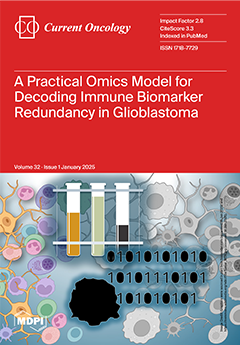
Cover Story: Glioblastoma (GBM) is a highly aggressive form of brain cancer with a median survival of 15–20 months. Recurrence is nearly universal, despite standard-of-care therapies. The heterogeneity within and between tumors complicates the understanding of resistance mechanisms, including immune escape. Molecular profiling of diverse tumor cell populations is crucial for improving treatment outcomes. Immune signatures, composed of CD markers and cytokines, may serve as molecular biomarkers in GBM patients. However, understanding how the immune system interacts with GBM is limited. In this review, we explore immune subsets in the brain, current data on immune signatures in GBM, and potential therapeutic implications, emphasizing the need for multi-omics analysis to identify non-invasive biomarkers for better treatment strategies. View this paper
  • Issues are regarded as officially published after their release is announced to the table of contents alert mailing list .
  • You may sign up for email alerts to receive table of contents of newly released issues.
  • PDF is the official format for papers published in both, html and pdf forms. To view the papers in pdf format, click on the "PDF Full-text" link, and use the free Adobe Reader to open them.

Articles (55)

  • Article
  • Open Access
2,530 Views
20 Pages

The PREPARE Study: Acceptability and Feasibility of a Telehealth Trimodal Prehabilitation Program for Women with Endometrial Neoplasia

  • Elise P. Legault,
  • Paula A. B. Ribeiro,
  • Danielle Moreau-Amaru,
  • Emmanuelle Robert,
  • Sara Forte,
  • Alain S. Comtois,
  • Vanessa Samouëlian and
  • François Tournoux

Patients with endometrial neoplasia (EN) often have multiple comorbidities and a higher surgical risk. Prehabilitation programs (PPs) combine various interventions to improve preoperative conditions and reduce impairment due to surgical stress. We co...

  • Article
  • Open Access
1,670 Views
15 Pages

MicroRNA-129-3p Suppresses Tumor Progression and Chemoradioresistance in Head and Neck Squamous Cell Carcinoma

  • Tae Mi Yoon,
  • Sun-Ae Kim,
  • Eun Kyung Jung,
  • Young-Kook Kim,
  • Kyung-Hwa Lee and
  • Sang Chul Lim

(1) Background: MicroRNA-129 (miR-129) participates in tumor progression and chemoresistance in various cancer types. In this study, the role of miR-129-3p, the main mature form of miR-129, in tumor progression and chemoradiotherapy resistance in hea...

  • Systematic Review
  • Open Access
2 Citations
4,680 Views
30 Pages

Systematic Review and Network Meta-Analysis on Treating Hormone Receptor-Positive Metastatic Breast Cancer After CDK4/6 Inhibitors

  • Neha Pathak,
  • Abhenil Mittal,
  • Sudhir Kumar,
  • Chitrakshi Nagpal,
  • Eitan Amir,
  • Partha Haldar,
  • Bharath B. Gangadharaiah,
  • Akash Kumar,
  • Ashutosh Mishra and
  • Atul Batra

Introduction: The optimal treatment of estrogen receptor-positive (ER +) metastatic breast cancer (MBC) after progression on cyclin-dependent 4/6 kinase inhibitors (CDK4/6i) is unknown. Methods: We conducted a systematic review and network meta-analy...

  • Communication
  • Open Access
2 Citations
3,633 Views
8 Pages

Real-World Experience with CDK4/6 Inhibitors in the First-Line Palliative Setting for HR+/HER2− Advanced Breast Cancer

  • Ram Patel,
  • John Mathews,
  • Caroline Hamm,
  • Swati Kulkarni,
  • Rasna Gupta,
  • Tarquin Opperman,
  • John Dean Chiong and
  • Abdullah Nasser

Introduction: CDK4/6 inhibitors in combination with aromatase inhibitors (AIs) are the standard first-line treatment for hormone receptor-positive (HR+), HER2-negative (HER2−) metastatic breast cancer. Landmark trials have demonstrated a compar...

  • Article
  • Open Access
1 Citations
2,030 Views
14 Pages

TP53 Mutation Predicts Worse Survival and Earlier Local Progression in Patients with Hepatocellular Carcinoma Treated with Transarterial Embolization

  • Ken Zhao,
  • Anita Karimi,
  • Luke Kelly,
  • Elena Petre,
  • Brett Marinelli,
  • Erica S. Alexander,
  • Vlasios S. Sotirchos,
  • Joseph P. Erinjeri,
  • Anne Covey and
  • Constantinos T. Sofocleous
  • + 6 authors

The aim of this study was to evaluate associations between TP53 status and outcomes after transarterial embolization (TAE) for the treatment of patients with hepatocellular carcinoma (HCC). This single-institution study included patients from 1/2014...

  • Case Report
  • Open Access
2,007 Views
6 Pages

Extensive Morphea Following Adjuvant Radiotherapy for Breast Carcinoma—Case Report

  • Alexandru Panaitescu,
  • Hannah Nguyen,
  • Laurence Masson-Côté and
  • Carolina Lucena Fernandes

Radiation-induced morphea (RIM) is a rare complication following radiotherapy (RT) for breast cancer treatment. Its distribution is usually confined to the breast having received radiotherapy. A generalized form of RIM also exists, defined as lesions...

  • Article
  • Open Access
1 Citations
2,395 Views
12 Pages

Advancing Radiobiology: Investigating the Effects of Photon, Proton, and Carbon-Ion Irradiation on PANC-1 Cells in 2D and 3D Tumor Models

  • Alexandra Charalampopoulou,
  • Amelia Barcellini,
  • Giuseppe Magro,
  • Anna Bellini,
  • Sara Sevan Borgna,
  • Giorgia Fulgini,
  • Giovanni Battista Ivaldi,
  • Alessio Mereghetti,
  • Ester Orlandi and
  • Marco Giuseppe Pullia
  • + 4 authors

Introduction: Pancreatic cancer (PC) is one of the most aggressive and lethal malignancies, calling for enhanced research. Pancreatic ductal adenocarcinoma (PDAC) represents 70–80% of all cases and is known for its resistance to conventional th...

  • Review
  • Open Access
3,296 Views
19 Pages

A Canadian Perspective on Systemic Therapy for Recurrent or Metastatic Nasopharyngeal Carcinoma

  • Anna Spreafico,
  • Eric Winquist,
  • Cheryl Ho,
  • Brian O’Sullivan,
  • Nathaniel Bouganim,
  • Neil Chua,
  • Sarah Doucette,
  • Lillian L. Siu and
  • Desiree Hao

Although the majority of patients with nasopharyngeal carcinoma (NPC) present with early-stage or locoregional disease that can be treated with definitive radiotherapy, approximately 20% of patients experience disease recurrence, and 15% present with...

  • Review
  • Open Access
4 Citations
3,653 Views
29 Pages

Towards Personalized Radiotherapy in Pelvic Cancer: Patient-Related Risk Factors for Late Radiation Toxicity

  • Anna C. Nuijens,
  • Arlene L. Oei,
  • Nicolaas A. P. Franken,
  • Coen R. N. Rasch and
  • Lukas J. A. Stalpers

Normal tissue reactions vary significantly among patients receiving the same radiation treatment regimen, reflecting the multifactorial etiology of late radiation toxicity. Predicting late radiation toxicity is crucial, as it aids in the initial deci...

  • Systematic Review
  • Open Access
1 Citations
3,264 Views
11 Pages

Background: Immune checkpoint inhibitors (ICIs), either alone or in combination with platinum-based chemotherapy, are effective in the first-line treatment of metastatic, non-oncogene-addicted, non-small cell lung cancer (NSCLC). However, when NSCLC...

of 6

Get Alerted

Add your email address to receive forthcoming issues of this journal.

XFacebookLinkedIn
Curr. Oncol. - ISSN 1718-7729