



Cellular Stress Responses, Lysosomal Damage and Non-Canonical Autophagy
This special issue belongs to the section "Autophagy".
Special Issue Information
Dear Colleagues,
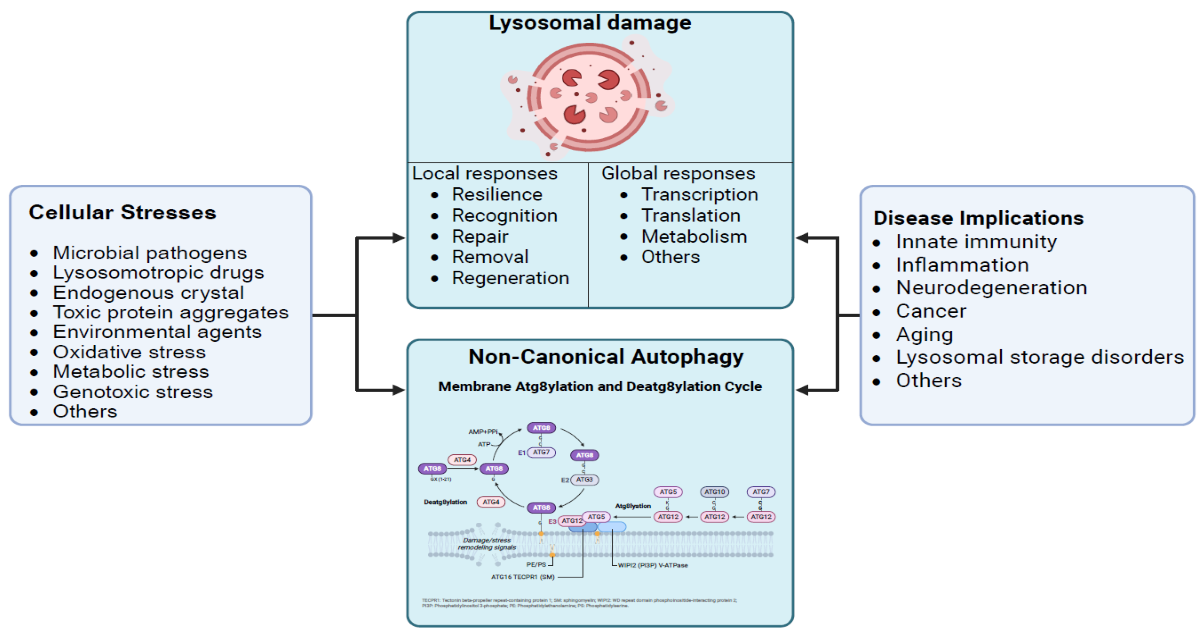
Cells are continuously challenged by diverse intrinsic and extrinsic stressors, including environmental, metabolic, infectious and genetic insults, that threaten cellular homeostasis and survival. Therefore, understanding how cells mount coordinated stress responses to sense damage, preserve organelle integrity, initiate global cellular remodeling and ultimately restore homeostasis is of fundamental importance. Among intracellular organelles, lysosomes have emerged as central regulators of cellular stress responses, integrating nutrient sensing, metabolism, protein translation, autophagy, immune signaling and cell fate decisions.
Recent advances have revealed that lysosomal damage triggers highly coordinated signaling networks that orchestrate both local and global stress responses. At the organelle level, cells preserve lysosomal integrity through damage resilience, recognition, membrane repair, the removal of damaged lysosomes and lysosome regeneration to restore the functional lysosomal pool. Beyond preserving lysosomal quality, lysosomal stress initiates global adaptive programs that rewire cellular physiology through transcriptional, translational and metabolic reprogramming. These responses involve extensive organelle crosstalk, membrane trafficking, RNA granules and stress signaling pathways, enabling cells to adapt and maintain homeostasis. Importantly, non-canonical autophagy, particularly ATG8 lipidation on damaged lysosomes through the conjugation of ATG8 to single membranes (CASM), represents a form of ATG8ylation that has emerged as a central regulator of these stress responses while also playing essential roles in diverse cellular stress conditions beyond lysosomal damage. Together, these pathways coordinate cellular adaptation, maintain homeostasis and determine cell fate under both physiological and pathological conditions.
Defects in these pathways contribute to the pathogenesis of numerous human diseases, including neurodegenerative disorders, lysosomal storage diseases, cancer, infectious diseases, chronic inflammation and aging. A deeper understanding of these mechanisms will not only advance fundamental cell biology but also facilitate the development of novel therapeutic strategies targeting lysosomal stress responses and non-canonical autophagy, underscoring the rapidly growing importance of this research field.
This Special Issue aims to present and disseminate the most recent advances related to cellular stress responses, lysosomal damage and non-canonical autophagy. We welcome original research articles, reviews and perspectives that provide mechanistic insights into lysosome-centered stress responses and non-canonical autophagy, as well as their roles in physiology and disease. We particularly encourage interdisciplinary studies spanning cell biology, molecular biology, immunology, metabolism, neuroscience, microbiology and translational research.
Topics of interest include, but are not limited to, the following:
- Cellular stress responses associated with lysosomal damage and non-canonical autophagy
- Lysosomal damage sensing, signaling, membrane repair, lysophagy and lysosome regeneration
- Canonical and non-canonical autophagy in lysosomal homeostasis and stress adaptation
- Global cellular remodeling following lysosomal damage, including transcriptional, translational, metabolic and epigenetic reprogramming
- Lysosome–organelle communication, membrane trafficking and organelle quality control upon cellular stress response
- Roles of lysosomal damage and non-canonical autophagy in immunity, metabolism, cell fate, aging, neurodegeneration, cancer, lysosomal storage disorders and other human diseases.
- Emerging technologies, advanced imaging, multi-omics and systems biology approaches
- Therapeutic strategies targeting lysosomal stress responses and non-canonical autophagy
Dr. Jingyue Jia
Dr. Alf Håkon Lystad
Guest Editors
Manuscript Submission Information
Manuscripts should be submitted online at www.mdpi.com by registering and logging in to this website. Once you are registered, click here to go to the submission form. Manuscripts can be submitted until the deadline. All submissions that pass pre-check are peer-reviewed. Accepted papers will be published continuously in the journal (as soon as accepted) and will be listed together on the special issue website. Research articles, review articles as well as communications are invited. For planned papers, a title and short abstract (about 250 words) can be sent to the Editorial Office for assessment.
Submitted manuscripts should not have been published previously, nor be under consideration for publication elsewhere (except conference proceedings papers). All manuscripts are thoroughly refereed through a single-anonymized peer-review process. A guide for authors and other relevant information for submission of manuscripts is available on the Instructions for Authors page. Cells is an international peer-reviewed open access semimonthly journal published by MDPI.
Please visit the Instructions for Authors page before submitting a manuscript. The Article Processing Charge (APC) for publication in this open access journal is 2700 CHF (Swiss Francs). Submitted papers should be well formatted and use good English. Authors may use MDPI's English editing service prior to publication or during author revisions.
Keywords
- lysosomal damage
- cellular stress responses
- non-canonical autophagy
- lysosomal homeostasis
Benefits of Publishing in a Special Issue
- Ease of navigation: Grouping papers by topic helps scholars navigate broad scope journals more efficiently.
- Greater discoverability: Special Issues support the reach and impact of scientific research. Articles in Special Issues are more discoverable and cited more frequently.
- Expansion of research network: Special Issues facilitate connections among authors, fostering scientific collaborations.
- External promotion: Articles in Special Issues are often promoted through the journal's social media, increasing their visibility.
- Reprint: MDPI Books provides the opportunity to republish successful Special Issues in book format, both online and in print.
Published Papers


Cells - ISSN 2073-4409