Skip to Content

Applied System Innovation

Applied System Innovation (ASI) is an international, peer-reviewed, open access journal on integrated engineering and technology, published monthly online.
Quartile Ranking JCR - Q2 (Engineering, Electrical and Electronic | Computer Science, Information Systems | Telecommunications)

Get Alerted

Add your email address to receive forthcoming issues of this journal.

All Articles (925)

In this research, surface Au concentration measurements are considered as a spatially correlated geochemical field associated with deep occurrences of disturbing masses using real geological exploration data from the Novo-Khairuzovsky gold deposit in East Kazakhstan. The approach is based on the relationship between potential-field continuation problems and reconstruction of subsurface geological anomalies from surface observations. The considered approaches include Tikhonov and Lavrentiev regularization, SVD, and TSVD. Special attention is given to regularization parameter selection using the L-curve method, Morozov discrepancy principle, and GCV. Comparative computational analysis is performed to evaluate the accuracy, stability, and efficiency of these methods in solving first-kind Fredholm integral equations. Results are assessed using error metrics and spatial visualization of reconstructed fields within a Geographic Information System (ArcGIS), enabling consistent geospatial interpretation. Results show that Lavrentiev regularization with L-curve criterion provides the most stable and reliable reconstruction across all depths, achieving high correlations (R=0.8876 at 100 m and R=0.8049 at 200 m) with low reconstruction errors. Tikhonov regularization performs acceptably at 100 m but becomes less stable at greater depths. Among spectral methods, TSVD improves stability compared with classical SVD, while standard SVD shows weak correlations and larger reconstruction errors due to high noise sensitivity.

29 May 2026
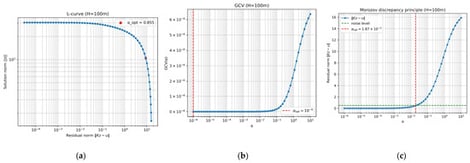
Choosing the optimal regularizing parameter (100 m): (a) L-curve method; (b) GCV method; (c) Morozov discrepancy principle.

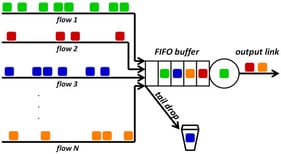
FIFO buffers are widely employed in networking devices to store packets prior to transmission. Their impact on aggregate traffic has been extensively studied and is well documented in the literature. In contrast, significantly less attention has been allocated to the impact of FIFO buffers on individual flows contributing to the aggregate traffic. In this paper, the throughput of each flow traversing a FIFO buffer supplied with complex traffic composed of numerous flows, potentially exhibiting heterogeneous statistical properties, is investigated. A full queuing model of a FIFO buffer fed by many flows with different characteristics is considered first. This model is very precise with respect to each flow, but cannot be solved in practice. Then, a simplification of the full model based on a limiting theorem is proposed. For the simplified model, exact formulae for throughput and loss ratio of each participating flow are derived. In numerical examples, the throughput of flows of diverse types in scenarios with various buffer sizes, buffer loads, and transmission time distributions is calculated. It is also examined, how these factors influence per-flow throughput. Finally, it is demonstrated that in typical scenarios, the results of the simplified model differ by only a few percent from those obtained through simulations of the full, precise model.

29 May 2026

Full model under study.

Towards Intelligent Fiscal Auditing: Integrating Network Analytics and Predictive Systems for Proactive Risk Detection

  • Andrés F. Cifuentes-Perdomo,
  • Carlos A. Rodado-Grijalba and
  • Hernán Felipe García
  • + 5 authors

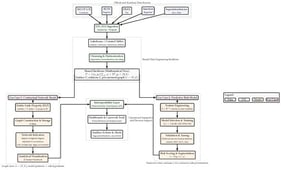
Public procurement systems are prone to risks such as collusion, contractual concentration, and irregular subcontracting, which undermine transparency and accountability. Traditional fiscal oversight approaches remain largely retrospective, limiting their ability to anticipate irregularities and prevent potential losses. Addressing the gap between theoretical machine learning models and real-world institutional deployment, this study introduces an applied system innovation that integrates two complementary approaches at a national scale: a Contractual Network Model (Mallas Contractuales) and a Predictive Risk Model for Contractors. The first component uses graph-based analytics, employing an Entity–Link–Property schema to represent relationships among entities, contractors, and contracts, thereby enabling the detection of structural patterns associated with collusive or anomalous behavior. The second component implements supervised machine learning models, trained on more than 16 million contracts and 2.6 million contractors from sources such as SECOP, RUES, DIAN, and national sanction registries. Models, including Random Forests and Gradient Boosted Trees, were optimized via cross-validated hyperparameter search and evaluated on a separate hold-out set using ROC AUC and Gini metrics, achieving strong discriminatory performance under the available retrospective validation setting while maintaining operational interpretability. Both approaches were deployed in a modular architecture that integrated Databricks, i2 Analyst’s Notebook, and Power BI dashboards, providing interactive visualizations and risk scores at multiple levels. Together, these systems demonstrate how the convergence of graph analytics and predictive modeling enables proactive fiscal auditing, strengthens institutional capacity, and offers a replicable framework for public sector accountability.

28 May 2026

System architecture for intelligent fiscal auditing. A shared data engineering backbone ingests heterogeneous sources into curated tables, enabling two complementary pathways: (left) the Contractual Network Model builds a procurement graph 
  
    G
    =
    (
    V
    ,
    E
    )
  
 under an ELP schema to surface structural risk; (right) the Predictive Risk Model estimates contract-level risk probabilities 
  
    
      r
      i
    
    =
    P
  
(
  
    
      y
      i
    
    =
    1
  
∣
  
    x
    i
  
) using supervised ML. Outputs interoperate through jobs/APIs into dashboards and casework tools to support auditor triage and case review.

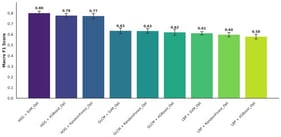
Automated thermal inspection supports scalable photovoltaic asset management by reducing the subjectivity and limited temporal coverage of manual surveys. This study benchmarks a lightweight machine vision framework for low-resolution infrared inspection of photovoltaic modules using native 24×40 pixel thermal images. Morphological and textural descriptors, namely HOG, LBP, and GLCM, were evaluated with optimized SVM, Random Forest, and XGBoost classifiers under a unified experimental protocol. The HOG + SVMOpt configuration achieved the best performance, with a Macro F1-score of 0.80±0.02 and an average accuracy of 0.80±0.02. The same pipeline maintained an end-to-end CPU latency of 12.45±0.85 ms per image, including preprocessing, descriptor extraction, and prediction. The results indicate that gradient-based structural descriptors provide the most favorable balance between predictive performance and computational cost among the evaluated configurations. The proposed pipeline is therefore presented as an interpretable reference for first-stage thermal screening in low-cost photovoltaic inspection workflows.

25 May 2026

Benchmark ranking of descriptor and classifier combinations in terms of Macro F1 score under repeated cross-validation.

News & Conferences

Volumes

Latest Issues

Open for Submission

Editor's Choice

Reprints of Collections

Effectiveness and Sustainable Application on Educational Technology
Reprint

Effectiveness and Sustainable Application on Educational Technology

Editors: Jian-Hong Ye, Yung-Wei Hao, Yu-Feng Wu, Savvas A. Chatzichristofis
Fuzzy Decision Making and Soft Computing Applications
Reprint

Fuzzy Decision Making and Soft Computing Applications

Editors: Giuseppe De Pietro, Marco Pota
XFacebookLinkedIn
Appl. Syst. Innov. - ISSN 2571-5577