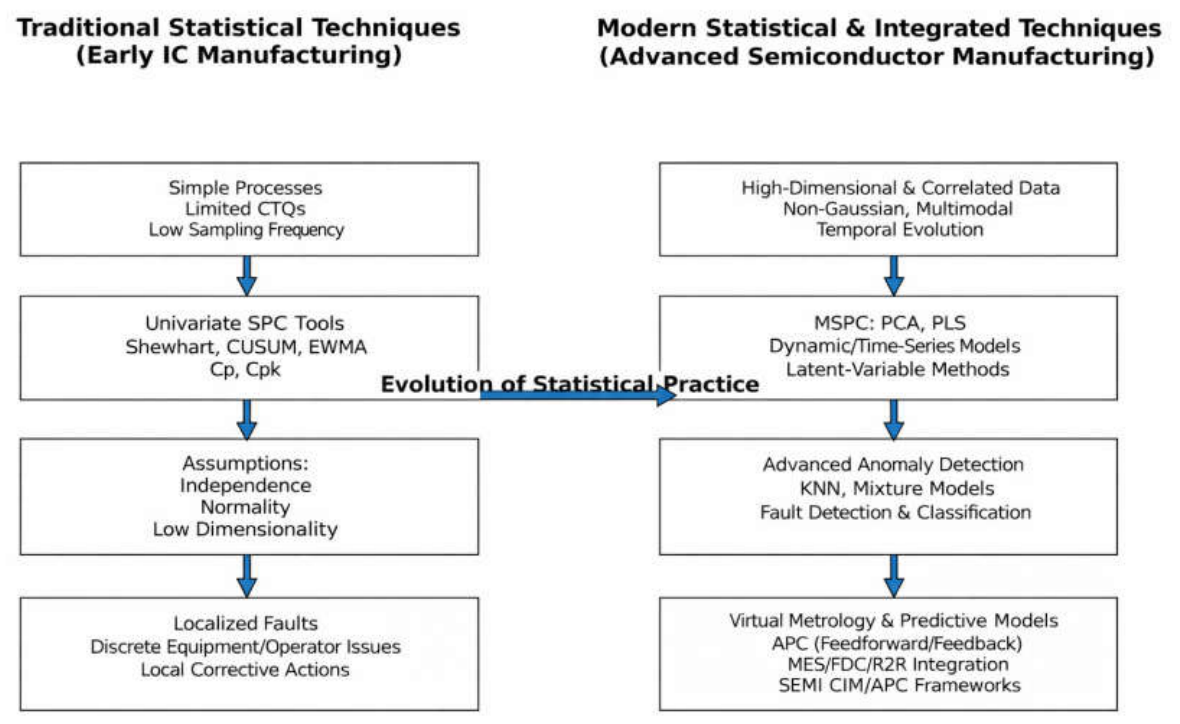

An Overview of the Application of Modern Statistical Techniques in Semiconductor Manufacturing


Abstract
1. Introduction
- a.
- Prediction accuracy (R2): 0.85–0.98 for CD, thickness, or etch rate.
- b.
- RMSE reduction: 20–50% compared with baseline empirical models.
- c.
- Metrology cycle time reduction: 30–70%, by replacing or reducing physical measurements.
- d.
- Yield improvement: 2–5% through faster corrective action and tighter control loops.
2. Characteristics of Semiconductor Manufacturing Materials
2.1. High-Dimensionality and Relevance
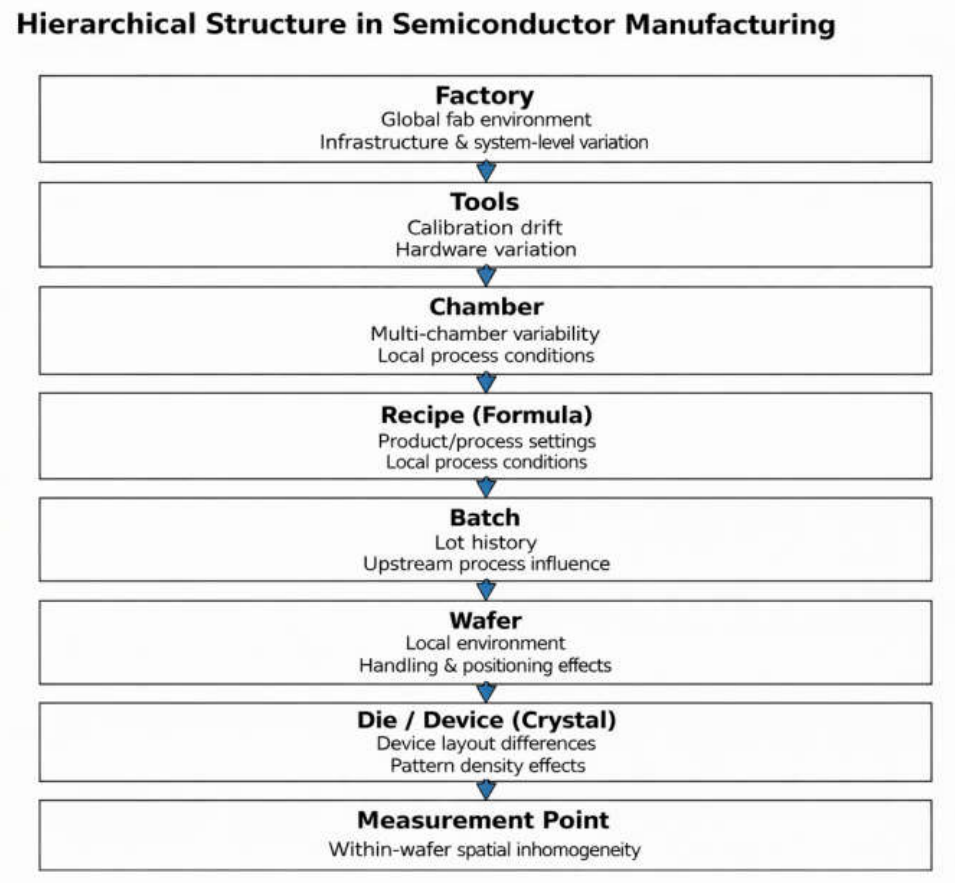
2.2. Hierarchical Structure
2.3. Sparsity and Delay Measurement
2.4. Abnormal and Non-Stationary Behavior
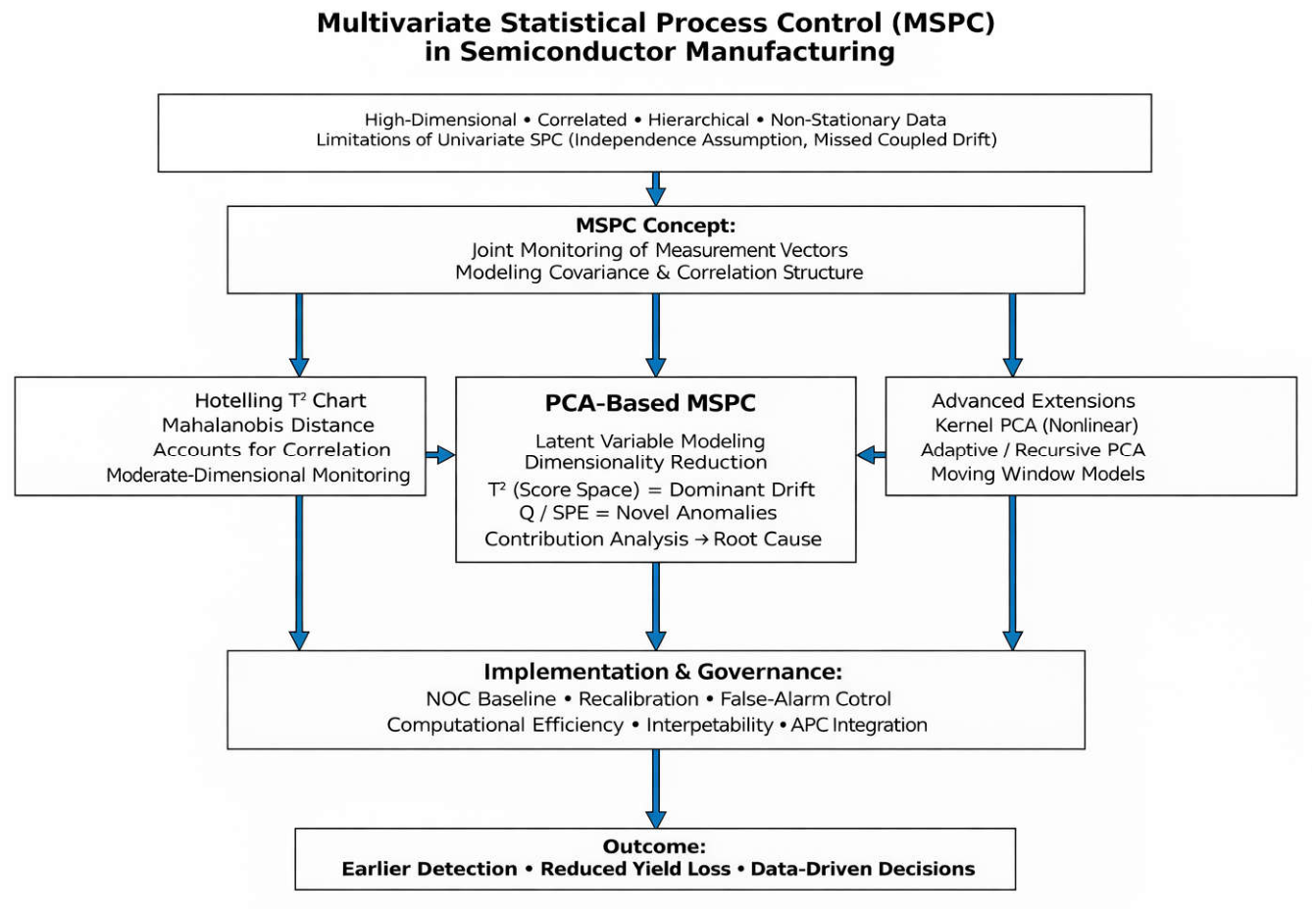
3. Multivariate Statistical Process Control
3.1. Motivation for Adopting a Multi-Faceted Approach
3.2. Hotelling T2 Control Chart
3.3. MSPC Based on Principal Component Analysis
3.4. Expansion and Practical Considerations
4. Time-Series Modeling and Drift Detection
4.1. Drift Characteristics of Semiconductor Manufacturing Processes
4.2. Exponentially Weighted Moving Average and Cumulative Sum Chart
4.3. Autoregressive Model and State-Space Model
4.4. Change Point Detection
- 1.
- For small sustained driftCUSUM > EWMA > Kalman > ARIMA > Change-point
- 2.
- For noisy measurements with evolving baselineKalman > ARIMA > EWMA > CUSUM > Change-point
- 3.
- For abrupt post-maintenance or recipe changesChange-point > CUSUM > EWMA > Kalman > ARIMA
- 4.
- For forecasting and residual-based monitoringKalman ≈ ARIMA > EWMA > CUSUM > Change-point
- 5.
- For simplicity and shop-floor deploymentEWMA ≈ CUSUM > Change-point > ARIMA > Kalman
5. Bayesian Statistical Methods
5.1. Theoretical Basis of Bayesian Methods
5.2. Bayesian Control Chart
5.3. Hierarchical Bayesian Model
5.4. Bayesian Decision Making
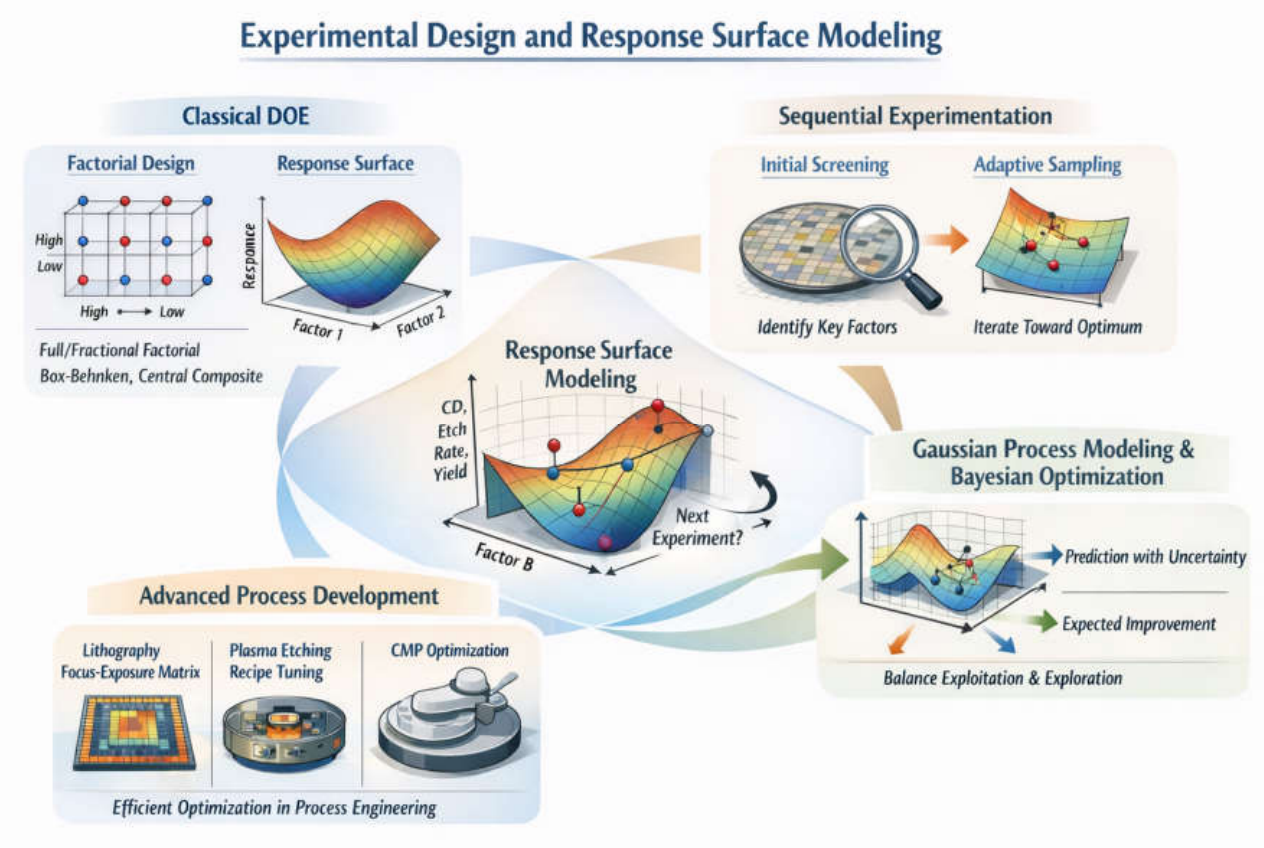
6. Experimental Design and Response Surface Modeling
6.1. Evolution of DOE in Semiconductor Manufacturing
6.2. Sequential and Adaptive Experimental Design
6.3. Gaussian Process Modeling
6.4. Applications in Advanced Process Development
7. Fault Detection and Classification
7.1. From Quality Control to Equipment Health Monitoring
7.2. Statistical Basis of FDC
7.3. Time–Frequency Models and Sequence Models
7.4. Integration with Statistical Quality Control
8. In-Process Control and Statistical Modeling
8.1. Control Principles of Inter-Run Operation
8.2. Model-Based Controllers
8.3. Role of SPC in R2R Systems
9. Statistics and Machine Learning: Complementary Roles
9.1. Limitations of Pure Data-Driven Models
9.2. Statistical Information-Driven Machine Learning
9.3. Model Governance and Lifecycle Management
10. Integration with Manufacturing Systems
10.1. Integration with MES and APC Architectures
10.2. Automated Decision Support and Smart Manufacturing
11. Emerging Trends and Challenges
11.1. Real-Time and Streaming Analysis
11.2. Uncertainty Quantification and Risk-Based Decision Making
11.3. Physics-Based Learning and Digital Twins
11.4. Challenges of Complexity and Model Lifecycle Management
11.5. Other Emerging Directions
12. Conclusions
Author Contributions
Funding
Institutional Review Board Statement
Data Availability Statement
Acknowledgments
Conflicts of Interest
References
- Shewhart, W.A. Economic Control of Quality of Manufactured Product; Barakaldo Books: Barakaldo, Spain, 2022. [Google Scholar]
- Page, E.S. Continuous inspection schemes. Biometrika 1954, 41, 100–115. [Google Scholar] [CrossRef]
- Roberts, S.W. Control chart tests based on geometric moving averages. Technometrics 2000, 42, 97–101. [Google Scholar] [CrossRef]
- Kane, V.E. Process capability indices. J. Qual. Technol. 1986, 18, 41–52. [Google Scholar] [CrossRef]
- Montgomery, D.C. Introduction to Statistical Quality Control, 6th ed.; John Wiley & Sons: Hoboken, NJ, USA, 2009. [Google Scholar]
- May, G.S.; Spanos, C.J. Fundamentals of Semiconductor Manufacturing and Process Control; John Wiley & Sons: Hoboken, NJ, USA, 2006. [Google Scholar]
- Spanos, C.J. Statistical process control in semiconductor manufacturing. Proc. IEEE 2002, 80, 819–830. [Google Scholar] [CrossRef]
- International Technology Roadmap for Semiconductors (ITRS). Factory Integration (ITRS 2.0). 2015. Available online: https://www.semiconductors.org/resources/2015-international-technology-roadmap-for-semiconductors-itrs/ (accessed on 13 February 2026).
- He, Q.P.; Wang, J. Fault detection using the k-nearest neighbor rule for semiconductor manufacturing processes. IEEE Trans. Semicond. Manuf. 2007, 20, 345–354. [Google Scholar] [CrossRef]
- Yu, J. Fault detection using principal components-based Gaussian mixture model for semiconductor manufacturing processes. IEEE Trans. Semicond. Manuf. 2011, 24, 432–444. [Google Scholar] [CrossRef]
- Qin, S.J. Statistical process monitoring: Basics and beyond. J. Chemom. 2003, 17, 480–502. [Google Scholar] [CrossRef]
- Kourti, T.; MacGregor, J.F. Process analysis, monitoring and diagnosis, using multivariate projection methods. Chemom. Intell. Lab. Syst. 1995, 28, 3–21. [Google Scholar] [CrossRef]
- Jackson, J.E.; Mudholkar, G.S. Control procedures for residuals associated with principal component analysis. Technometrics 1979, 21, 341–349. [Google Scholar] [CrossRef]
- Wold, S.; Ruhe, A.; Wold, H.; Dunn, W.J. The collinearity problem in linear regression: The partial least squares (PLS) approach to generalized inverses. SIAM J. Sci. Stat. Comput. 1984, 5, 735–743. [Google Scholar] [CrossRef]
- Ku, W.; Storer, R.H.; Georgakis, C. Disturbance detection and isolation by dynamic principal component analysis. Chemom. Intell. Lab. Syst. 1995, 30, 179–196. [Google Scholar] [CrossRef]
- Nomikos, P.; MacGregor, J.F. Multivariate SPC charts for monitoring batch processes. Technometrics 1995, 37, 41–59. [Google Scholar] [CrossRef]
- Goodlin, B.E.; Boning, D.S.; Sawin, H.H.; Wise, B.M. Simultaneous fault detection and classification for semiconductor manufacturing tools. J. Electrochem. Soc. 2002, 150, 778–784. [Google Scholar] [CrossRef]
- Chien, C.F.; Chen, Y.J.; Hsu, C.Y.; Wang, H.K. Overlay error compensation using advanced process control with dynamically adjusted proportional-integral R2R controller. IEEE Trans. Autom. Sci. Eng. 2013, 11, 473–484. [Google Scholar] [CrossRef]
- Butler, S.W. Process control in semiconductor manufacturing. J. Vac. Sci. Technol. B 1995, 13, 1917–1927. [Google Scholar] [CrossRef]
- SEMI E93; Provisional Specification for CIM Framework Advanced Process Control Component. SEMI: Milpitas, CA, USA, 2000.
- SEMI E81; Provisional Specification for CIM Framework Domain Architecture. SEMI: Milpitas, CA, USA, 2000.
- Hsu, C.Y.; Liu, W.C. Multiple time-series convolutional neural network for fault detection and diagnosis and empirical study in semiconductor manufacturing. J. Intell. Manuf. 2021, 32, 823–836. [Google Scholar] [CrossRef]
- Bao, L.; Wang, K.; Jin, R. A hierarchical model for characterizing spatial wafer variations. Int. J. Prod. Res. 2014, 52, 1827–1842. [Google Scholar] [CrossRef]
- Ezzat, A.A.; Liu, S.; Hochbaum, D.S.; Ding, Y. A graph-theoretic approach for spatial filtering and its impact on mixed-type spatial pattern recognition in wafer bin maps. IEEE Trans. Semicond. Manuf. 2021, 34, 194–206. [Google Scholar] [CrossRef]
- Pinheiro, J.C.; Bates, D.M. Mixed-Effects Models in S and S-PLUS; Springer: New York, NY, USA, 2000. [Google Scholar]
- Cheng, F.T.; Chen, Y.T.; Su, Y.C.; Zeng, D.L. Evaluating the reliance level of a virtual metrology system. IEEE Trans. Semicond. Manuf. 2008, 21, 92–103. [Google Scholar] [CrossRef]
- Bunday, B.D.; Allgair, J.A.; Caldwell, M.; Solecky, E.P.; Archie, C.N.; Rice, B.J.; Emami, I. Value-added metrology. IEEE Trans. Semicond. Manuf. 2007, 20, 266–277. [Google Scholar] [CrossRef]
- Wu, W.M.; Cheng, F.T.; Kong, F.W. Dynamic-moving-window scheme for virtual-metrology model refreshing. IEEE Trans. Semicond. Manuf. 2012, 25, 238–246. [Google Scholar] [CrossRef]
- Kao, C.A.; Cheng, F.T.; Wu, W.M.; Kong, F.W.; Huang, H.H. Run-to-run control utilizing virtual metrology with reliance index. IEEE Trans. Semicond. Manuf. 2013, 26, 69–81. [Google Scholar]
- Kang, P.; Kim, D.; Lee, H.J.; Doh, S.; Cho, S. Virtual metrology for run-to-run control in semiconductor manufacturing. Expert Syst. Appl. 2011, 38, 2508–2522. [Google Scholar]
- Lambert, D. Zero-inflated Poisson regression, with an application to defects in manufacturing. Technometrics 1992, 34, 1–14. [Google Scholar] [CrossRef]
- Hilbe, J.M. Negative Binomial Regression, 2nd ed.; Cambridge University Press: Cambridge, UK, 2011. [Google Scholar]
- Shim, J.; Cho, S.; Kum, E.; Jeong, S. Adaptive fault detection framework for recipe transition in semiconductor manufacturing. Comput. Ind. Eng. 2021, 161, 107632. [Google Scholar] [CrossRef]
- Alshammri, F.; Pan, J. Moving dynamic principal component analysis for non-stationary multivariate time series. Comput. Stat. 2021, 36, 2247–2287. [Google Scholar] [CrossRef]
- MacGregor, J.F.; Kourti, T. Statistical process control of multivariate processes. Control Eng. Pract. 1995, 3, 403–414. [Google Scholar]
- Hotelling, H. Multivariate quality control, illustrated by the air testing of sample bombsights. In Techniques of Statistical Analysis; Eisenhart, C., Hastay, M.W., Wallis, W.A., Eds.; McGraw-Hill: New York, NY, USA, 1947; pp. 111–184. [Google Scholar]
- Mahalanobis, P.C. On the generalized distance in statistics. Sankhya A 2018, 80, S1–S7. [Google Scholar]
- Tracy, N.D.; Young, J.C.; Mason, R.L. Multivariate control charts for individual observations. J. Qual. Technol. 1992, 24, 88–95. [Google Scholar] [CrossRef]
- Mason, R.L.; Tracy, N.D.; Young, J.C. Decomposition of T2 for multivariate control chart interpretation. J. Qual. Technol. 1995, 27, 99–108. [Google Scholar]
- Cherry, G.A.; Qin, S.J. Multiblock principal component analysis based on a combined index for semiconductor fault detection and diagnosis. IEEE Trans. Semicond. Manuf. 2006, 19, 159–172. [Google Scholar] [CrossRef]
- Li, W.; Yue, H.H.; Valle-Cervantes, S.; Qin, S.J. Recursive PCA for adaptive process monitoring. J. Process Control 2000, 10, 471–486. [Google Scholar] [CrossRef]
- Schölkopf, B.; Smola, A.; Müller, K.-R. Nonlinear component analysis as a kernel eigenvalue problem. Neural Comput. 1998, 10, 1299–1319. [Google Scholar] [CrossRef]
- Cheng, C.-Y.; Hsu, C.-C.; Chen, M.-C. Adaptive kernel principal component analysis (KPCA) for monitoring small disturbances of nonlinear processes. Ind. Eng. Chem. Res. 2010, 49, 2254–2262. [Google Scholar] [CrossRef]
- Sachs, E.; Hu, A.; Ingolfsson, A. Run-by-run process control: Combining SPC and feedback control. IEEE Trans. Semicond. Manuf. 1995, 8, 26–43. [Google Scholar] [CrossRef]
- Spanos, C.J.; Guo, H.F.; Miller, A.; Levine-Parrill, J. Real-time statistical process control using tool data. IEEE Trans. Semicond. Manuf. 1992, 5, 308–318. [Google Scholar] [CrossRef]
- Guo, R.S.; Chen, A.; Chen, J.J. Run-to-run control schemes for CMP process subject to deterministic drifts. In Proceedings of the 2000 Semiconductor Manufacturing Technology Workshop (Cat. No. 00EX406), Hsinchu, Taiwan, 14–15 June 2000; IEEE: New York, NY, USA, 2000; pp. 251–258. [Google Scholar]
- Chen, J.H.; Kuo, T.W.; Lee, A.C. Run-by-run process control of metal sputter deposition: Combining time series and extended Kalman filter. IEEE Trans. Semicond. Manuf. 2007, 20, 278–285. [Google Scholar] [CrossRef]
- Hamilton, J.D. Time Series Analysis; Princeton University Press: Princeton, NJ, USA, 1994. [Google Scholar]
- Shumway, R.H.; Stoffer, D.S. Time Series Analysis and Its Applications: With R Examples, 4th ed.; Springer: Cham, Switzerland, 2017. [Google Scholar]
- Hawkins, D.M.; Olwell, D.H. Cumulative Sum Charts and Charting for Quality Improvement; Springer Science & Business Media: New York, NY, USA, 2012. [Google Scholar]
- Box, G.E.P.; Jenkins, G.M.; Reinsel, G.C.; Ljung, G.M. Time Series Analysis: Forecasting and Control, 5th ed.; John Wiley & Sons: Hoboken, NJ, USA, 2015. [Google Scholar]
- Kalman, R.E. A new approach to linear filtering and prediction problems. J. Basic Eng. 1960, 82, 35–45. [Google Scholar] [CrossRef]
- Durbin, J.; Koopman, S.J. Time Series Analysis by State Space Methods, 2nd ed.; Oxford University Press: Oxford, UK, 2012. [Google Scholar]
- Jazwinski, A.H. Stochastic Processes and Filtering Theory; Courier Corporation: Mineola, NY, USA, 2007. [Google Scholar]
- Basseville, M.; Nikiforov, I.V. Detection of Abrupt Changes: Theory and Application; Prentice Hall: Englewood Cliffs, NJ, USA, 1993. [Google Scholar]
- Pettitt, A.N. A non-parametric approach to the change-point problem. J. R. Stat. Soc. Ser. C 1979, 28, 126–135. [Google Scholar] [CrossRef]
- Adams, R.P.; MacKay, D.J.C. Bayesian online changepoint detection. arXiv 2007, arXiv:0710.3742. [Google Scholar] [CrossRef]
- Killick, R.; Fearnhead, P.; Eckley, I.A. Optimal detection of changepoints with a linear computational cost. J. Am. Stat. Assoc. 2012, 107, 1590–1598. [Google Scholar] [CrossRef]
- Brodsky, E.; Darkhovsky, B.S. Nonparametric Methods in Change Point Problems; Springer Science & Business Media: New York, NY, USA, 2013; Volume 243. [Google Scholar]
- Fearnhead, P.; Liu, Z. On-line inference for multiple changepoint problems. J. R. Stat. Soc. Ser. B 2007, 69, 589–605. [Google Scholar] [CrossRef]
- Gelman, A.; Carlin, J.B.; Stern, H.S.; Rubin, D.B. Bayesian Data Analysis; Chapman & Hall/CRC: Boca Raton, FL, USA, 2013. [Google Scholar]
- Berger, J.O. Statistical Decision Theory and Bayesian Analysis; Springer Science & Business Media: New York, NY, USA, 2013. [Google Scholar]
- Girshick, M.A.; Rubin, H. A Bayes approach to a quality control model. Ann. Math. Stat. 1952, 23, 114–125. [Google Scholar] [CrossRef]
- Lindley, D.V.; Smith, A.F.M. Bayes estimates for the linear model. J. R. Stat. Soc. Ser. B 1972, 34, 1–18. [Google Scholar] [CrossRef]
- Gelman, A. Prior distributions for variance parameters in hierarchical models (comment on article by Browne and Draper). Bayesian Anal. 2006, 1, 515–534. [Google Scholar] [CrossRef]
- Naderkhani, F.; Makis, V. Economic design of multivariate Bayesian control chart with two sampling intervals. Int. J. Prod. Econ. 2016, 174, 29–42. [Google Scholar] [CrossRef]
- Lin, J.; Wang, K. A Bayesian framework for online parameter estimation and process adjustment using categorical observations. IIE Trans. 2012, 44, 291–300. [Google Scholar] [CrossRef]
- Chen, A.; Blue, J. Recipe-independent indicator for tool health diagnosis and predictive maintenance. IEEE Trans. Semicond. Manuf. 2009, 22, 522–535. [Google Scholar] [CrossRef]
- Chien, C.F.; Van Nguyen, T.H.; Li, Y.C.; Chen, Y.J. Bayesian decision analysis for optimizing in-line metrology and defect inspection strategy for sustainable semiconductor manufacturing and an empirical study. Comput. Ind. Eng. 2023, 182, 109421. [Google Scholar] [CrossRef]
- Kanarik, K.J.; Osowiecki, W.T.; Lu, Y.; Talukder, D.; Roschewsky, N.; Park, S.N.; Gottscho, R.A. Human–machine collaboration for improving semiconductor process development. Nature 2023, 616, 707–711. [Google Scholar] [CrossRef]
- Blei, D.M.; Kucukelbir, A.; McAuliffe, J.D. Variational inference: A review for statisticians. J. Am. Stat. Assoc. 2017, 112, 859–877. [Google Scholar] [CrossRef]
- Box, G.E.P.; Hunter, J.S.; Hunter, W.G. Statistics for Experimenters: Design, Innovation, and Discovery, 2nd ed.; John Wiley & Sons: Hoboken, NJ, USA, 2005. [Google Scholar]
- Myers, R.H.; Montgomery, D.C.; Anderson-Cook, C.M. Response Surface Methodology: Process and Product Optimization Using Designed Experiments, 4th ed.; John Wiley & Sons: Hoboken, NJ, USA, 2016. [Google Scholar]
- Box, G.E.P.; Draper, N.R. Empirical Model-Building and Response Surfaces; John Wiley & Sons: New York, NY, USA, 1987. [Google Scholar]
- Boning, D.S.; Mozumder, P.K. DOE/Opt: A system for design of experiments, response surface modeling, and optimization using process and device simulation. IEEE Trans. Semicond. Manuf. 2002, 7, 233–244. [Google Scholar] [CrossRef]
- Gaston, G.J.; Walton, A.J. The integration of simulation and response surface methodology for the optimization of IC processes. IEEE Trans. Semicond. Manuf. 2002, 7, 22–33. [Google Scholar] [CrossRef]
- Shumate, D.A.; Montgomery, D.C. Development of a TiW plasma etch process using a mixture experiment and response surface optimization. IEEE Trans. Semicond. Manuf. 1996, 9, 335–343. [Google Scholar] [CrossRef]
- Boning, D.S.; McIlrath, M.B.; Penfield, P.; Sachs, E.M. A general semiconductor process modeling framework. IEEE Trans. Semicond. Manuf. 2002, 5, 266–280. [Google Scholar] [CrossRef]
- Montgomery, D.C. Design and Analysis of Experiments, 10th ed.; John Wiley & Sos: Hoboken, NJ, USA, 2019. [Google Scholar]
- Chaloner, K.; Verdinelli, I. Bayesian experimental design: A review. Stat. Sci. 1995, 10, 273–304. [Google Scholar] [CrossRef]
- Atkinson, A.C. Optimum experimental design. In International Encyclopedia of Statistical Science; Lovric, M., Ed.; Springer: Berlin/Heidelberg, Germany, 2011. [Google Scholar]
- Jones, D.R.; Schonlau, M.; Welch, W.J. Efficient global optimization of expensive black-box functions. J. Glob. Optim. 1998, 13, 455–492. [Google Scholar] [CrossRef]
- Rasmussen, C.E. Gaussian processes in machine learning. In Proceedings of the Summer School on Machine Learning, Berlin, Germany, 2–14 February 2003; Springer: Berlin/Heidelberg, Germany, 2003; pp. 63–71. [Google Scholar]
- Mockus, J. Bayesian Approach to Global Optimization: Theory and Applications; Springer Science & Business Media: New York, NY, USA, 2012. [Google Scholar]
- Mack, C. Fundamental Principles of Optical Lithography: The Science of Microfabrication; John Wiley & Sons: Hoboken, NJ, USA, 2008. [Google Scholar]
- Quiñonero-Candela, J.; Rasmussen, C.E. A unifying view of sparse approximate Gaussian process regression. J. Mach. Learn. Res. 2005, 6, 1939–1959. [Google Scholar]
- Moyne, J.; Samantaray, J.; Armacost, M. Big data capabilities applied to semiconductor manufacturing: Advanced process control. IEEE Trans. Semicond. Manuf. 2016, 29, 283–291. [Google Scholar] [CrossRef]
- Cohen, L. Time-Frequency Analysis; Prentice Hall: Englewood Cliffs, NJ, USA, 1995. [Google Scholar]
- Mallat, S. A Wavelet Tour of Signal Processing; Academic Press: San Diego, CA, USA, 1999. [Google Scholar]
- Jeong, Y.S.; Kim, B.; Ko, Y.D. Exponentially weighted moving average-based procedure with adaptive thresholding for monitoring nonlinear profiles: Monitoring of plasma etch process in semiconductor manufacturing. Expert Syst. Appl. 2013, 40, 5688–5693. [Google Scholar] [CrossRef]
- Rabiner, L.R. A tutorial on hidden Markov models and selected applications in speech recognition. Proc. IEEE 2002, 77, 257–286. [Google Scholar] [CrossRef] [PubMed]
- Hong, S.J.; Lim, W.Y.; Cheong, T.; May, G.S. Fault detection and classification in plama etch equipment for semiconductor manufacturing e-diagnostics. IEEE Trans. Semicond. Manuf. 2011, 25, 83–93. [Google Scholar] [CrossRef]
- Susto, G.A.; Schirru, A.; Pampuri, S.; McLoone, S.; Beghi, A. Machine learning for predictive maintenance: A multiple classifier approach. IEEE Trans. Ind. Inform. 2014, 11, 812–820. [Google Scholar] [CrossRef]
- Park, S.J.; Lee, M.S.; Shin, S.Y.; Cho, K.H.; Lim, J.T.; Cho, B.S.; Park, C.H. Run-to-run overlay control of steppers in semiconductor manufacturing systems based on history data analysis and neural network modeling. IEEE Trans. Semicond. Manuf. 2005, 18, 605–613. [Google Scholar] [CrossRef]
- Musacchio, J.; Rangan, S.; Spanos, C.; Poolla, K. On the utility of run to run control in semiconductor manufacturing. In Proceedings of the 1997 IEEE International Symposium on Semiconductor Manufacturing, San Francisco, CA, USA, 6–8 October 1997; IEEE: New York, NY, USA, 1997; p. D9-12. [Google Scholar]
- Wu, M.J.; Jang, J.S.R.; Chen, J.L. Wafer map failure pattern recognition and similarity ranking for large-scale data sets. IEEE Trans. Semicond. Manuf. 2014, 28, 1–12. [Google Scholar] [CrossRef]
- Yang, Y.; Sun, M. Semiconductor defect pattern classification by self-proliferation-and-attention neural network. IEEE Trans. Semicond. Manuf. 2021, 35, 16–23. [Google Scholar] [CrossRef]
- Cheng, K.C.C.; Chen, L.L.Y.; Li, J.W.; Li, K.S.M.; Tsai, N.C.Y.; Wang, S.J.; Huang, A.Y.A.; Chou, L.; Lee, C.S.; Chen, J.-E.; et al. Machine learning-based detection method for wafer test induced defects. IEEE Trans. Semicond. Manuf. 2021, 34, 161–167. [Google Scholar] [CrossRef]
- Gama, J.; Žliobaitė, I.; Bifet, A.; Pechenizkiy, M.; Bouchachia, A. A survey on concept drift adaptation. ACM Comput. Surv. 2014, 46, 1–37. [Google Scholar] [CrossRef]
- Bayram, F.; Ahmed, B.S.; Kassler, A. From concept drift to model degradation: An overview on performance-aware drift detectors. Knowl.-Based Syst. 2022, 245, 108632. [Google Scholar] [CrossRef]
- Ross, G.J.; Adams, N.M.; Tasoulis, D.K.; Hand, D.J. Exponentially weighted moving average charts for detecting concept drift. Pattern Recognit. Lett. 2012, 33, 191–198. [Google Scholar] [CrossRef]
- Ribeiro, M.T.; Singh, S.; Guestrin, C. “Why should I trust you?” Explaining the predictions of any classifier. In Proceedings of the 22nd ACM SIGKDD International Conference on Knowledge Discovery and Data Mining, San Francisco, CA, USA, 13–17 August 2016; ACM: San Diego, CA, USA, 2016; pp. 1135–1144. [Google Scholar]
- Lundberg, S.M.; Lee, S.-I. A unified approach to interpreting model predictions. In Advances in Neural Information Processing Systems 30 (NeurIPS 2017); Curran Associates, Inc.: Red Hook, NY, USA, 2017. [Google Scholar]
- Gama, J.; Sebastião, R.; Rodrigues, P.P. On evaluating stream learning algorithms. Mach. Learn. 2013, 90, 317–346. [Google Scholar] [CrossRef]
- Wang, S.; Botros, Y.; Martin, J.W. Enabling robustness and flexibility of equipment data collection through SEMI EDA standards. In Proceedings of the 2004 IEEE/SEMI Advanced Semiconductor Manufacturing Conference and Workshop, Boston, MA, USA, 4–6 May 2004; IEEE: New York, NY, USA, 2004; pp. 165–169. [Google Scholar]
- IEEE. International Roadmap for Devices and Systems (IRDS): Factory Integration; IEEE: Piscataway, NJ, USA, 2022; Available online: https://irds.ieee.org/images/files/pdf/2023/2023IRDS_FAC.pdf (accessed on 13 February 2026).
- Khan, A.A.; Moyne, J.R.; Tilbury, D.M. An approach for factory-wide control utilizing virtual metrology. IEEE Trans. Semicond. Manuf. 2007, 20, 364–375. [Google Scholar] [CrossRef]
- Qin, S.J.; Cherry, G.; Good, R.; Wang, J.; Harrison, C.A. Semiconductor manufacturing process control and monitoring: A fab-wide framework. J. Process Control 2006, 16, 179–191. [Google Scholar]
- Cheng, F.T.; Chang, J.Y.C.; Kao, C.A.; Chen, Y.L.; Peng, J.L. Configuring AVM as a MES component. In Proceedings of the 2010 IEEE/SEMI Advanced Semiconductor Manufacturing Conference (ASMC), San Francisco, CA, USA, 11–13 July 2010; IEEE: New York, NY, USA, 2010; pp. 226–231. [Google Scholar]
- International Society of Automation (ISA). Enterprise-Control System Integration—Part 1: Models and Terminology; International Society of Automation: Research Triangle Park, NC, USA, 2010. [Google Scholar]
- Zou, C.; Wang, Z.; Zi, X.; Jiang, W. An efficient online monitoring method for high-dimensional data streams. Technometrics 2015, 57, 374–387. [Google Scholar] [CrossRef]
- Ko, J.M.; Hong, S.R.; Choi, J.Y.; Kim, C.O. Wafer-to-wafer process fault detection using data stream mining techniques. Int. J. Precis. Eng. Manuf. 2013, 14, 103–113. [Google Scholar] [CrossRef]
- Colosimo, B.M.; Jones-Farmer, L.A.; Megahed, F.M.; Paynabar, K.; Ranjan, C.; Woodall, W.H. Statistical process monitoring from industry 2.0 to industry 4.0: Insights into research and practice. Technometrics 2024, 66, 507–530. [Google Scholar] [CrossRef]
- Kritzinger, W.; Karner, M.; Traar, G.; Henjes, J.; Sihn, W. Digital twin in manufacturing: A categorical literature review and classification. IFAC-PapersOnLine 2018, 51, 1016–1022. [Google Scholar] [CrossRef]
- ISO 23247-1:2021; Automation Systems and Integration—Digital Twin Framework for Manufacturing—Part 1: Overview and General Principles. International Organization for Standardization: Geneva, Switzerland, 2021.
- Shao, G. Manufacturing digital twin standards. In Proceedings of the ACM/IEEE 27th International Conference on Model Driven Engineering Languages and Systems, Linz, Austria, 22–27 September 2024; ACM: San Diego, CA, USA, 2024; pp. 370–377. [Google Scholar]
- Pan, L.; Li, G.; Zhu, T.; Liu, D.; Wang, Y.; Lu, Y. Physics-informed machine learning in design and manufacturing: Status and challenges. J. Comput. Inf. Sci. Eng. 2025, 25, 120804. [Google Scholar] [CrossRef]
- Leng, J.; Zuo, K.; Xu, C.; Zhou, X.; Zheng, S.; Kang, J.; Gao, R.X. Physics-informed machine learning in intelligent manufacturing: A review. J. Intell. Manuf. 2025, 1–43. [Google Scholar] [CrossRef]
- Sculley, D.; Holt, G.; Golovin, D.; Davydov, E.; Phillips, T.; Ebner, D.; Chaudhary, V.; Young, M.; Crespo, J.F.; Dennison, D. Hidden technical debt in machine learning systems. In Advances in Neural Information Processing Systems 28 (NeurIPS 2015); Curran Associates, Inc.: Red Hook, NY, USA, 2015; pp. 2503–2511. [Google Scholar]



| Method/Category | Core Idea (What It Models) | Drift/Anomaly Types Best Detected | Strengths of Fab Use | Key Limitations/Cautions | Typical Semiconductor Use Cases | Representative Literature |
|---|---|---|---|---|---|---|
| Why time-series methods are needed (context) | Fab data are sequential: tool age, PM resets, and environments vary. Yield loss often comes from accumulated small deviations across runs (R2R context). | Slow drift, low-frequency oscillations, post-PM shifts, time-varying regimes. | Captures autocorrelation and dynamics, enabling earlier detection of subtle degradation compared with static SPC. | Ignoring the time structure allows noise to mask drift, delaying detection and giving a false sense of stability. | R2R/APC loops; long-term monitoring of CD, overlay, thickness, etch rate; alignment with maintenance cycles. | [6,44,45,46,47] |
| Drift characteristics in advanced tools (process reality) | Drift arises from physical causes such as chamber contamination, CMP pad/slurry wear, sensor calibration drift, and lithography optics degradation. | Gradual trends and oscillations rather than abrupt failures. | Supports mechanism-aware monitoring design, focusing on small but persistent changes and temporal structure. | High variability can obscure drift; independence assumptions often fail; one must separate noise from degradation. | Plasma etch/deposition monitoring, CMP stability, lithography CD/overlay, sensor drift tracking. | [6,44,45,46,47,48,49] |
| EWMA control chart | Uses exponentially weighted averages; recent data have more influence, smoothing noise while tracking slow change. | Small, sustained mean shifts and gradual drift. | Simple, widely used, and effective for detecting subtle long-term trends while reducing noise. | Sensitive to parameter choice; autocorrelation and regime changes may distort control limits. | CD/overlay monitoring, film-thickness, etch-rate trends, and smoothed metrology signals. | [2,3,5,6,50] |
| CUSUM chart | Accumulates deviations from a target over time; persistent, small biases add up until the detection threshold is reached. | Small systematic shifts and persistent bias. | Highly sensitive to small changes; matches the gradual degradation behavior. | Requires careful threshold tuning; may produce false alarms under correlated noise or regime shifts. | Overlay bias detection, etch rate drift, and electrical parameter shifts. | [2,5,6,50] |
| AR/ARIMA modeling (Box–Jenkins) | Models a variable using past values and prediction errors; anomalies are detected via residuals from forecasts. | Autocorrelated sequences and predictable temporal patterns; anomalies appear as residual outliers. | Explicitly models time dependence; supports prediction and residual-based monitoring. | Mainly linear; may not capture nonlinear interactions; requires updating across regime changes. | Residual monitoring for CD/overlay/thickness; run-to-run trends; tool condition tracking. | [48,49,51] |
| State-space models + Kalman filtering | Models a hidden system state evolving, with noisy observations; recursively updates estimates. | Gradual drift, evolving baselines, noisy measurements. | Integrates naturally with R2R/APC; separates process and measurement noise; enables adaptive control. | Requires correct model structure and noise assumptions; complex for multivariate systems. | Lithography dose/focus control, CMP compensation, etch correction, and chamber state estimation. | [44,45,47,52,53,54] |
| Change point detection (offline/online) | Detects times when statistical properties change, segmenting data into distinct regimes. | Abrupt shifts such as post-maintenance changes, recipe updates, or new degradation phases. | Improves diagnosis and modeling by linking changes to events and enabling regime-specific analysis. | Trade-off between detection delay and false alarms; gradual drift and multiple changes complicate detection. | Maintenance impact analysis, degradation-onset detection, and regime segmentation for modeling. | [6,44,45,55,56,57,58,59,60] |
| Integrated takeaway (combined framework) | Combines EWMA/CUSUM (fast detection), ARIMA/state-space (prediction and control), and change point methods (regime management). | Both gradual drift and discrete changes across evolving baselines. | Provides comprehensive monitoring, earlier intervention, and improved diagnosis for advanced fabs. | Requires handling autocorrelation, regime shifts, and model updates; increased system complexity. | Full monitoring of CD, overlay, thickness, etch, and CMP; integration with R2R/APC systems. | [2,3,4,5,6,44,45,46,47,48,49,50,51,52,53,54,55,56,57,58,59,60] |
| Method | Best at Detecting | Detection Delay | False Alarm Risk | Small-Shift Sensitivity | Prediction Ability | Regime-Shift Handling | Complexity | Typical Quantitative Strengths |
|---|---|---|---|---|---|---|---|---|
| EWMA | gradual drift | low | medium | high | low | low | low | strong for 0.5σ–1σ shifts; simple online use |
| CUSUM | persistent small bias | very low | medium-high if poorly tuned | very high | low | low | low | Often best for the smallest sustained shifts |
| AR/ARIMA | autocorrelated patterns | medium | low-medium | medium | high | low-medium | medium | good forecast RMSE and residual monitoring |
| State-space/Kalman | noisy evolving drift | low | low | high | very high | medium | high | strong state estimation, adaptive filtering |
| Change-point detection | abrupt shifts/regime changes | very low for abrupt changes; high for slow drift | depends on the threshold | low for tiny gradual drift | low | very high | medium-high | best onset localization for discrete changes |
| Aspect | MSPC | Time-Series Models and Drift Detection | Bayesian Approaches | FDC (Fault Detection and Classification) |
|---|---|---|---|---|
| Core idea | Jointly model correlated multivariate variables using covariance structure and latent variables. | Model temporal dependence, autocorrelation, and drift evolution over time | Treat parameters as probabilistic; update beliefs using prior + data (posterior) | Monitor equipment health using high-frequency sensor data and multivariate/dynamic models |
| Primary data characteristics addressed | High dimensionality, correlation, multicollinearity, moderate non-stationarity | Sequential data, temporal dynamics, drift, regime changes | Sparse data, uncertainty, hierarchical structure, evolving baselines | High-frequency sensor streams, dynamic signals, and equipment-level variability |
| Typical methods | Hotelling T2, PCA/PLS, kernel/adaptive PCA | EWMA, CUSUM, ARIMA, state-space (Kalman), change-point detection | Bayesian inference, Bayesian control charts, hierarchical models, decision theory | PCA-based monitoring, multivariate charts, kNN/GMM classifiers, time–frequency and sequence models |
| Detection capability | Detects correlated and coordinated multivariate shifts | Detects gradual drift, autocorrelation, and structural changes | Detects shifts under uncertainty; robust with small samples | Detects early equipment anomalies before wafer-level defects |
| Sensitivity to subtle changes | High for correlated small shifts; improved vs. univariate SPC | Very high for slow drift (EWMA/CUSUM); strong for temporal patterns | High when priors are informative; supports probabilistic thresholds | High, especially for transient and phase-specific anomalies |
| Strengths | Reduces false alarms under correlation; enables contribution-based diagnosis; handles high-dimensional data | Captures process evolution; supports early detection and predictive monitoring; integrates with APC | Handles sparse data; quantifies uncertainty; supports hierarchical modeling and risk-based decisions | Enables proactive monitoring, upstream detection, and integrates sensor physics with statistical learning |
| Limitations | Covariance estimation is unstable in very high dimensions; assumes baseline stability; often linear. | May require stationarity or model updating; limited for nonlinear multivariate coupling unless extended | Computationally intensive; sensitive to prior choice; latency concerns in real-time use | Requires frequent model maintenance; sensitive to tool changes; high computational and data demands |
| Interpretability | Moderate–high (via contribution analysis and latent variables) | Moderate (depends on model; control charts intuitive, ARIMA less so) | High (probabilistic interpretation, uncertainty quantification) | Moderate (diagnostics possible but complex for ML/time-frequency models) |
| Adaptability to process change | Moderate (adaptive PCA, moving window methods) | High (state-space, change-point detection enables adaptation) | Very high (sequential updating and hierarchical pooling) | High but requires recalibration after maintenance or recipe change |
| Typical fab applications | CD/overlay monitoring, plasma/CMP sensor analysis, tool health indicators | Drift monitoring (CD, overlay, etch rate), R2R/APC integration, maintenance impact analysis | Early ramp processes, sparse metrology environments, tool matching, risk-based decisions | Real-time tool monitoring, anomaly detection, fault classification, predictive maintenance |
| Role in the control framework | Core monitoring layer for multivariate quality control | Dynamic monitoring and prediction layer | Decision-making and uncertainty quantification layer | Upstream monitoring and diagnostic layer integrated with SPC/APC |
| Key advantage (summary) | Captures correlation and reduces dimensionality for robust multivariate monitoring | Captures time evolution and enables early drift detection | Integrates prior knowledge with data for robust inference under uncertainty | Moves monitoring upstream to the equipment level for early fault prevention |
| Key references | [5,6,13,35,40,41] | [2,3,6,44,45,46,47,48,49,50,51,52,53,54,55,56,57,58,59,60] | [6,61,62] | [6,17,68,87,92] |
| Trend/Challenge Area | What Is Changing (Technical Driver) | Statistical/Analytics Implication | Representative Methods/Approaches | Practical Implementation Challenges | Impact on Fab Operations | Representative Literature |
|---|---|---|---|---|---|---|
| Overall direction | Shrinking process windows, greater tool complexity, and massive data volumes demand faster, more reliable decision-making. | Shift from offline SPC to continuous, model-integrated, uncertainty-aware monitoring and control. | Streaming MSPC, risk-based decisioning, physics-informed ML, digital twins. | Scaling, interpretability, governance, and maintaining complex model systems. | Faster response and improved robustness, but a higher maintenance burden. | [87,106,113,114,115,116,117,118,119] |
| Real-time and streaming analysis | High-frequency sensors generate continuous wafer-level data streams. | Need online, low-latency, high-dimensional algorithms handling autocorrelation. | Streaming monitoring, online anomaly/change detection, and data stream mining. | Compute limits, noise robustness, and balancing speed vs. accuracy. | Earlier detection and intervention support real-time equipment monitoring. | [87,106,111,112,113] |
| Speed–stability tradeoff | Faster detection increases false alarms; conservative settings delay detection. | Monitoring becomes a tuning problem under nonstationary conditions. | Adaptive thresholds, incremental updates, robust statistics. | Requires operational policies, escalation rules, and alignment with workflows. | Affects tool utilization, downtime, and engineer trust. | [87,106,113] |
| Uncertainty quantification (UQ) | High wafer value requires decisions beyond simple alarms. | Systems provide probabilities or prediction intervals instead of binary outputs. | Bayesian inference, probabilistic thresholds, predictive distributions. | Communicating uncertainty, selecting thresholds, and ensuring calibration. | Better prioritization; avoids overreaction to noise; supports informed decisions. | [61,62] |
| Risk-based decision making | Operational decisions involve economic trade-offs (yield vs. downtime vs. cycle time). | Integrates statistical inference with cost/loss functions. | Bayesian decision frameworks, cost-aware policies. | Defining loss functions, aligning with organizational goals, and avoiding bias. | More consistent and economically aligned interventions. | [61,62] |
| Physics-based learning (hybrid models) | Pure data-driven models struggle under distribution shift or limited fault data. | Combine physics constraints with data-driven models for robustness. | Physics-informed ML, constraint-based learning. | Requires accurate physics knowledge and integration with real data. | Improved generalization, stability, and interpretability. | [117,118] |
| Digital twin architectures | Need synchronized digital representations of tools and processes. | Twins integrate monitoring, prediction, and control in a unified system. | Digital models, digital shadows, full digital twins. | Continuous calibration, data integration, and governance challenges. | Enables predictive maintenance, virtual metrology, and coordinated control. | [106,114] |
| Standards and interoperability | Cross-vendor systems require common architectures and interfaces. | Standardization supports integration, validation, and trust. | ISO 23247 digital twin framework, interoperable platforms. | Integrating legacy systems, ensuring traceability and reliability. | Faster deployment and improved system consistency. | [115,116] |
| Complexity and interpretability | Advanced models increase system complexity and reduce transparency. | Interpretability becomes essential for trust and usability. | Explainable AI, diagnostic tools, physics-based constraints. | Explaining decisions under changing conditions; avoiding black-box outputs. | Influences adoption, troubleshooting efficiency, and decision quality. | [87,106,113,117,118] |
| Model lifecycle and technical debt | Rapid process evolution makes models outdated; complexity accumulates hidden costs. | Requires structured model governance and lifecycle management. | Monitoring, retraining, validation, version control, and MLOps practices. | Managing dependencies, drift, ownership, and long-term maintenance. | Determines long-term effectiveness and prevents performance degradation. | [87,106,113,119] |
Disclaimer/Publisher’s Note: The statements, opinions and data contained in all publications are solely those of the individual author(s) and contributor(s) and not of MDPI and/or the editor(s). MDPI and/or the editor(s) disclaim responsibility for any injury to people or property resulting from any ideas, methods, instructions or products referred to in the content. |
© 2026 by the authors. Published by MDPI on behalf of the International Institute of Knowledge Innovation and Invention. Licensee MDPI, Basel, Switzerland. This article is an open access article distributed under the terms and conditions of the Creative Commons Attribution (CC BY) license.
Share and Cite
Chen, H.-Y.; Chen, C. An Overview of the Application of Modern Statistical Techniques in Semiconductor Manufacturing. Appl. Syst. Innov. 2026, 9, 83. https://doi.org/10.3390/asi9040083
Chen H-Y, Chen C. An Overview of the Application of Modern Statistical Techniques in Semiconductor Manufacturing. Applied System Innovation. 2026; 9(4):83. https://doi.org/10.3390/asi9040083
Chicago/Turabian StyleChen, Hsuan-Yu, and Chiachung Chen. 2026. "An Overview of the Application of Modern Statistical Techniques in Semiconductor Manufacturing" Applied System Innovation 9, no. 4: 83. https://doi.org/10.3390/asi9040083
APA StyleChen, H.-Y., & Chen, C. (2026). An Overview of the Application of Modern Statistical Techniques in Semiconductor Manufacturing. Applied System Innovation, 9(4), 83. https://doi.org/10.3390/asi9040083