- Systematic Review

28 Pages
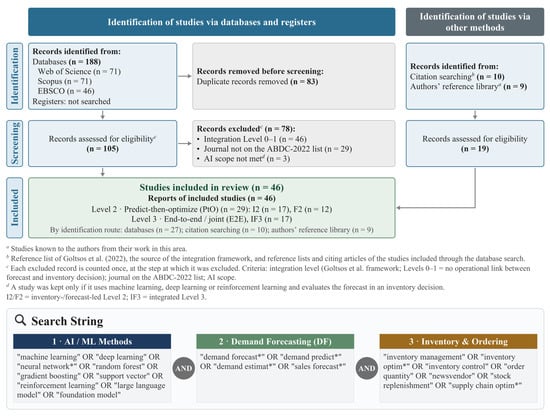
Demand forecasting and inventory management have evolved as parallel bodies of literature, despite their operational interdependence, and the resulting disconnect between prediction and decision has been diagnosed as a standing gap in operational research. Following the Preferred Reporting Items for Systematic Reviews and Meta-Analyses (PRISMA 2020) protocol, this review systematically codes 46 studies published between 2010 and 2023 in journals listed by the Australian Business Deans Council, operationalizing an established prediction–inventory integration hierarchy to evaluate how modern artificial intelligence architectures couple prediction with decision-making. We find that predict-then-optimize (PtO) and end-to-end or joint learning (E2E) architectures co-evolve rather than succeed one another. Crucially, integration level is orthogonal to model class: seven of the seventeen E2E studies use no neural network, so decision-focused coupling does not inherently require the opacity of deep learning. Instead, architecture performance is highly contingent on a domain’s data regime and cost structure rather than algorithmic sophistication alone. We provide a contingency framework equipping academic researchers, analytics practitioners, and supply chain managers with actionable architecture-selection guidance, identifying hybrid PtO–E2E designs, which remain absent within this corpus, as the unresolved structural frontier of the predictive AI era.
Systems
3 November 2026