1. Introduction
Globalization, information technology, and current societal trends have increased the speed at which companies must update and reinvent themselves in order to maintain their competitive advantages [
1]. Given the substantial progress achieved over the past decade in data-driven and automation technologies, artificial intelligence (AI) is being introduced as a disruptive element of the broader digital transformation of organizations [
2].
Artificial intelligence (AI) refers to systems or algorithms that possess cognitive and learning abilities and can execute tasks that would otherwise require human intelligence, such as pattern recognition, prediction, and complex decision-making [
3]. Instead of relying on hand-coded decision rules, many AI applications rely substantially on sophisticated computing capabilities and process vast amounts of data to learn and improve over time [
4]. This ability allows AI to improve decision-making and optimize internal procedures through continuous and repeated learning [
2,
4].
As AI is projected to become increasingly valuable and has already demonstrated success in its initial applications, its integration into human resources (HR) departments has become an emerging trend [
3,
5]. In January 2024, a survey of 2366 HR respondents representing organizations of all sizes in the US showed that over 60% of them had positive attitudes toward the possibility of successfully using AI in their companies [
6]. The ability of an employer to build online credibility, visibility, and attractiveness is very important for attracting talented people [
7]. In this regard, a variety of technologies, such as machine learning, chatbots, robotics, deep learning, conversational AI tools, the Internet of Things, natural language processing (NLP), and augmented or virtual reality, are changing the way HR managers conduct their activities [
8].
Recruitment and selection are among the most prominent HR areas in which AI is used. According to surveys, talent acquisition is the most widespread application of AI in HR within companies (64%), followed by learning and development (43%) and performance management (25%) [
6]. AI in recruitment can alleviate several challenges inherent in traditional approaches, including laborious manual procedures, a certain degree of subjectivity in decision-making, and the high cost of screening [
9]. Vendor estimates cited in Kammerer’s legal analysis of AI-based interviews suggest that the adoption of artificial intelligence in recruitment may reduce the time needed to fill vacancies by up to 75 percent [
4].
To maximize the benefits of AI while mitigating associated risks, companies are also considering applying AI at various stages of recruitment and selection (R&S). Nevertheless, the use of AI in these stages is multifaceted, as it involves various stakeholders, such as HR professionals, managers, candidates, and technology providers, whose perceptions may not always coincide [
10,
11]. When implemented in Human Resource Management (HRM), AI integrates the traditional people-oriented approach with an increased emphasis on data and analytics [
12]. AI tools can imitate intelligent behaviors, such as visual perception and speech recognition, while chatbots provide examples of AI-powered conversational interfaces [
4,
8]. This innovation blurs the boundary between human and algorithmic decision-making. This blurring may be challenging in interviews or surveys because it raises issues of authenticity, interpretation, and control [
4,
11].
Although research on artificial intelligence in HRM and recruitment has expanded substantially, existing explanations of AI adoption in recruitment and selection remain theoretically fragmented. Prior studies have already examined organizational and contextual determinants of AI adoption in employee recruitment [
3], technology-adoption factors in talent acquisition [
13], and ethical issues associated with AI-supported recruitment and selection [
10]. In parallel, research on AI acceptance has emphasized cognitive evaluations such as perceived usefulness [
14], while studies on responsible and explainable AI have highlighted the importance of trust, transparency, privacy, and fairness [
10,
15,
16]. However, these streams have largely developed through distinct theoretical perspectives and levels of analysis.
Three specific gaps can therefore be identified. First, recruitment-focused studies have primarily examined organizational and contextual adoption conditions [
3] or adoption and use through TOE- and TTF-related factors [
13], whereas integrated TAM–TOE explanations have been developed in other organizational contexts [
17]. This leaves limited recruitment-specific theorization connecting individual-level acceptance mechanisms with organizational conditions surrounding HR professionals’ behavioral intention. Second, although ethical and human-related concerns are well documented in recruitment and selection [
10], mechanisms involving trust in AI, data privacy concerns, job replacement anxiety, and resistance to change have not been jointly articulated with established technology-adoption mechanisms in the representative recruitment-focused models considered here [
3,
10,
13]. Third, based on the representative adoption models reviewed in this study, reciprocal interdependencies among technological characteristics, human perceptions, ethical concerns, and organizational conditions remain less explicitly theorized within a broader socio-technical perspective.
To further position these gaps within the existing literature, the present study systematically contrasts its theoretical scope with representative AI adoption and recruitment-related models. As summarized in
Table 1, prior studies have examined AI adoption in HRM [
5], organizational and contextual determinants of AI adoption in employee recruitment [
3], AI-enabled talent acquisition [
13], and integrated TAM–TOE explanations of AI adoption in other organizational contexts [
17]. While these studies provide important foundations, they differ in their analytical level and in the extent to which cognitive, ethical–psychological, and organizational mechanisms are considered jointly. This comparison helps clarify the theoretical positioning of the present framework.
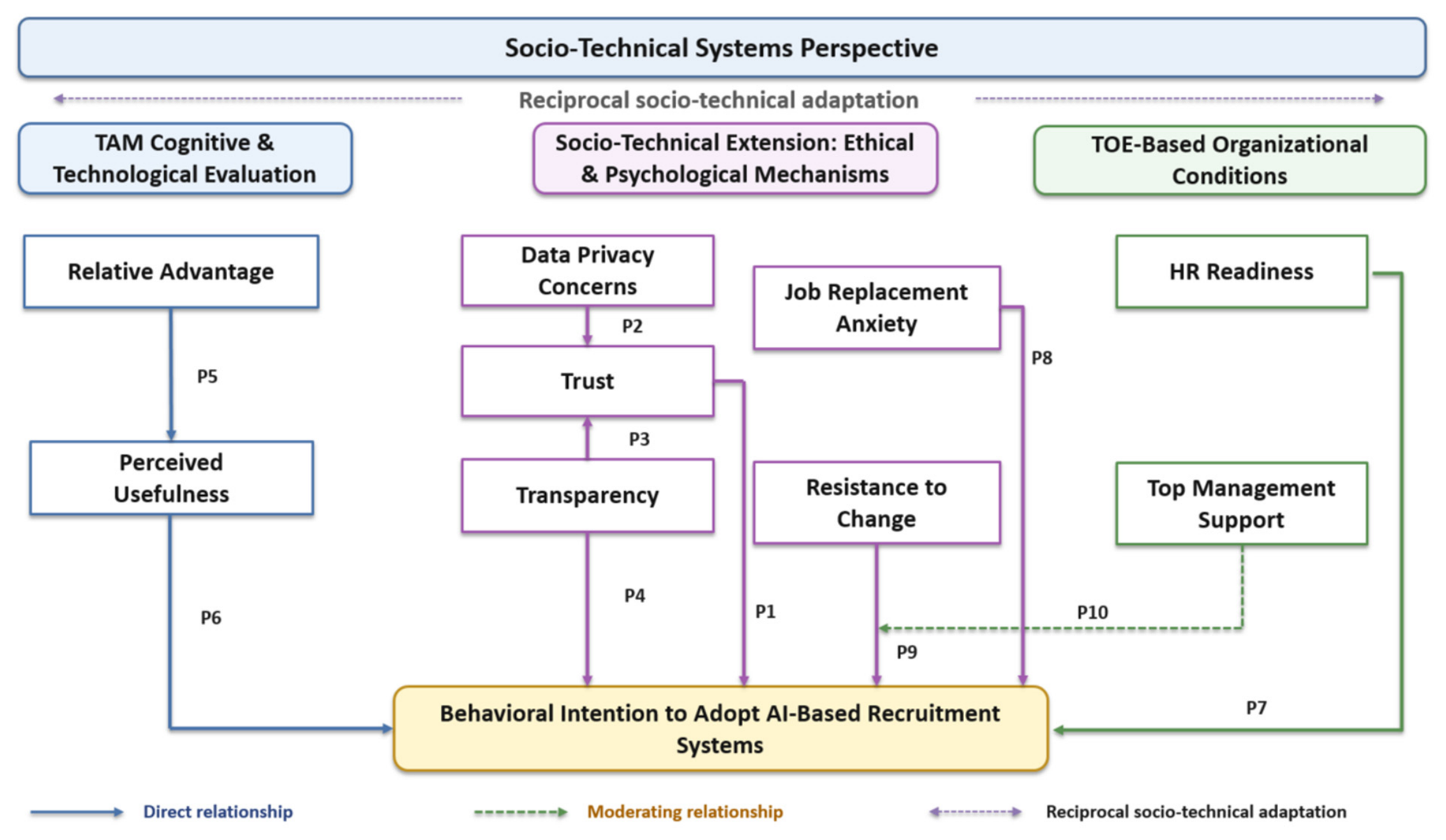
The present study addresses these gaps by developing an integrative socio-technical TAM–TOE framework for AI adoption in recruitment and selection. The contribution does not lie in claiming that the individual constructs included in the framework are themselves novel. Rather, it lies in their theoretical articulation within a recruitment-specific framework that connects technological–cognitive, ethical–psychological, and organizational mechanisms and specifies how these mechanisms may jointly shape HR professionals’ behavioral intention to adopt AI-based recruitment systems. This paper is a conceptual article. It develops an integrative framework for explaining behavioral intention to adopt AI-based recruitment systems by combining individual- and organizational-level perspectives. First, within the cognitive and technological evaluation component, Relative Advantage is theorized to positively influence the TAM-based construct of Perceived Usefulness, which in turn is proposed to positively influence Behavioral Intention. Second, the socio-technical extension incorporates ethical and psychological mechanisms by theorizing that Data Privacy Concerns negatively influence Trust, while Transparency is proposed to positively influence Trust and Behavioral Intention, and Trust is theorized to positively influence Behavioral Intention. Job Replacement Anxiety and Resistance to Change are theorized as distinct psychological mechanisms that may negatively influence HR professionals’ Behavioral Intention to adopt AI-based recruitment systems. Third, within the TOE-based organizational conditions, HR Readiness is theorized to positively influence Behavioral Intention, whereas Top Management Support is conceptualized specifically as a moderating organizational condition that may attenuate the negative relationship between Resistance to Change and Behavioral Intention. In doing so, the framework integrates technological–cognitive evaluations, ethical and psychological mechanisms, and organizational conditions without collapsing their distinct theoretical roles.
From a socio-technical systems perspective, AI adoption in recruitment cannot be understood as the simple introduction of a new technological tool. Rather, it involves interdependencies between technological capabilities, HR professionals’ perceptions and reactions, ethical concerns, and organizational conditions. The framework therefore places the TAM cognitive and technological evaluation component, the ethical and psychological socio-technical extension, and the TOE-based organizational conditions within a broader socio-technical systems perspective. Reciprocal socio-technical adaptation represents the broader interaction between technological and social–organizational subsystems rather than an additional direct causal proposition. Accordingly, the study conceptualizes AI adoption in recruitment as an interdependent socio-technical process in which technological characteristics, human perceptions, ethical considerations, and organizational conditions interact and require ongoing alignment.
The aim of this conceptual study is to develop an integrative socio-technical framework explaining HR professionals’ Behavioral Intention to adopt AI-based recruitment systems. More specifically, the study pursues four objectives: (1) to integrate individual-level technology-acceptance mechanisms, particularly Relative Advantage and Perceived Usefulness, with organizational conditions relevant to AI adoption in recruitment; (2) to incorporate, and theoretically differentiate, ethical and psychological mechanisms, including trust, transparency, data privacy concerns, job replacement anxiety, and resistance to change, that may support or constrain HR professionals’ adoption intention; (3) to distinguish the direct organizational role of HR readiness from the moderating role of top management support, and to situate these mechanisms within a broader process of reciprocal socio-technical adaptation between technological and social–organizational subsystems; and (4) to provide a theoretically grounded framework that can guide future empirical research and the responsible organizational implementation of AI-based recruitment systems.
2. Methodological Approach
This study adopts a conceptual review approach based on a theory-driven synthesis of prior research on artificial intelligence (AI) in Human Resource Management (HRM), AI-based recruitment and selection, technology acceptance, HR readiness, and responsible AI governance. The objective of this paper is not to conduct an empirical test or a systematic literature review, but to develop an integrative socio-technical framework explaining HR professionals’ behavioral intention to adopt AI-based recruitment systems.
The focal level of analysis of the proposed framework is the individual HR professional, because behavioral intention is conceptualized as an individual-level outcome. However, the framework incorporates organizational-level conditions that may shape this individual intention. Specifically, relative advantage, perceived usefulness, trust, transparency, data privacy concerns, job replacement anxiety, and resistance to change are conceptualized primarily at the level of HR professionals’ perceptions and reactions, whereas HR readiness and top management support represent organizational-level conditions surrounding AI implementation. The framework should therefore be understood as a cross-level conceptual integration in which organizational conditions provide the context within which individual adoption intentions are formed, rather than as a fully specified multilevel statistical model.
The literature was reviewed with the aim of identifying theoretical foundations, key constructs, and conceptual gaps relevant to AI adoption in recruitment and selection. Particular attention was given to studies addressing the Technology Acceptance Model (TAM), the Technology–Organization–Environment (TOE) framework, AI in HRM, recruitment technologies, trust in AI, transparency, data privacy concerns, perceived usefulness, relative advantage, HR readiness, top management support, job replacement anxiety, and resistance to change. Both foundational works and recent peer-reviewed studies were considered in order to connect established adoption theories with emerging debates on responsible and human-centered AI.
To enhance the transparency of the review process, the literature search was conducted using the academic databases and search platforms Google Scholar, ScienceDirect, Scopus, and Web of Science. No fixed lower publication-date limit was imposed, as foundational theoretical contributions were retained when necessary to establish the conceptual origins of the frameworks and constructs included in the study. The review considered publications available up to August 2026, with particular emphasis on recent peer-reviewed studies relevant to AI adoption, recruitment and selection, and the focal constructs of the proposed framework. Search terms were combined iteratively and included “artificial intelligence”, “AI adoption”, “human resource management”, “recruitment”, “selection”, “talent acquisition”, “Technology Acceptance Model”, “TAM”, “Technology–Organization–Environment”, “TOE”, “trust in AI”, “transparency”, “explainability”, “data privacy”, “perceived usefulness”, “relative advantage”, “HR readiness”, “top management support”, “job replacement anxiety”, and “resistance to change”.
The selection of constructs followed a theory-driven logic. TAM was used to capture individual-level cognitive beliefs, particularly perceived usefulness, while relative advantage was incorporated as a complementary technological evaluation of AI-based recruitment compared with existing recruitment practices. TOE was used to account for organizational-level adoption conditions, with HR readiness conceptualized as a direct organizational antecedent of behavioral intention and top management support as a moderating organizational condition. In addition, ethical and psychological variables such as trust, transparency, data privacy concerns, job replacement anxiety, and resistance to change were integrated because AI-based recruitment systems raise specific issues related to opacity, fairness, privacy, control, and human agency.
Studies were prioritized when they contributed directly to at least one of three purposes: establishing the theoretical foundations of the framework, defining or differentiating the focal constructs, or supporting theoretically relevant relationships in the context of AI adoption, HRM, recruitment, and selection. Peer-reviewed journal articles were prioritized, while seminal books and foundational theoretical contributions were retained when required for conceptual grounding. Sources with only peripheral relevance to AI adoption, HRM, recruitment, or the focal constructs were not retained in the core conceptual synthesis. A total of 116 sources were retained as directly relevant to the final conceptual synthesis and framework development.
The initial literature pool was progressively narrowed through an iterative relevance-based selection process rather than through a formal systematic-review protocol. Retrieved studies were assessed according to their direct relevance to the theoretical foundations, focal constructs, and proposed relationships of the framework. Backward citation searching was used selectively by examining the reference lists of theoretically central studies to identify relevant foundational and related sources, while forward citation searching was used to identify subsequent research citing these key contributions. Sources were retained when they contributed to conceptual grounding, construct definition or differentiation, or evidence relevant to the proposed relationships, whereas sources with only peripheral relevance were excluded from the core synthesis. Studies presenting conflicting or non-supportive evidence were not excluded solely on that basis. Instead, such evidence was compared across theoretical perspectives, contexts, and levels of analysis. Where the available evidence did not provide sufficiently consistent support for a specific relationship, the more conservative theoretical specification was retained and alternative relationships were reserved for future empirical investigation.
The synthesis was organized around three analytical dimensions. The first dimension concerns technological and cognitive mechanisms, including relative advantage and perceived usefulness. The second dimension concerns ethical and psychological mechanisms, including trust, transparency, data privacy concerns, job replacement anxiety, and resistance to change. The third dimension concerns organizational conditions, including HR readiness as a direct antecedent of behavioral intention and top management support as a moderating condition. This structure supports the development of a socio-technical framework that links individual perceptions and reactions, technological evaluations, ethical and psychological mechanisms, and organizational conditions.
Conceptual overlap and inconsistent evidence across research streams were addressed by comparing the theoretical definitions, levels of analysis, and proposed mechanisms of closely related constructs before their inclusion in the framework. Particular attention was given to distinctions between relative advantage and perceived usefulness, job replacement anxiety and resistance to change, HR readiness and top management support, and transparency and trust. Constructs were retained as distinct only when they represented theoretically differentiated mechanisms.
For future empirical operationalization, these constructs should be measured using separate multi-item scales that preserve their theoretical boundaries. Relative advantage should capture comparative evaluations of AI-based recruitment relative to existing recruitment practices, whereas perceived usefulness should capture HR professionals’ beliefs about the extent to which AI enhances their individual work performance. Job replacement anxiety should measure affective concerns about AI reducing, transforming, or replacing human work, whereas resistance to change should capture broader cognitive, emotional, and behavioral reactions to organizational transformation. HR readiness should assess organizational capabilities, resources, processes, training, and implementation preparedness, whereas top management support should assess managerial commitment, resource provision, strategic involvement, and organizational legitimacy. Transparency should measure perceived visibility and disclosure regarding AI functioning and decision processes, while trust should measure willingness to rely on AI-based recruitment systems; explainability should be treated as a specific manifestation of transparency rather than as a separate focal construct in the present model. Future empirical studies should assess these constructs through distinct measurement models and explicitly evaluate their discriminant validity before testing the proposed structural relationships.
The cross-level nature of the framework also has implications for future empirical operationalization. Conceptually, HR readiness and top management support represent organizational-level conditions. In an individual-level empirical design, these constructs may be operationalized as HR professionals’ perceptions of organizational readiness and managerial support, in which case they should be interpreted as perceived organizational conditions surrounding individual adoption intention. Alternatively, if HR readiness and top management support are modeled as genuine organization-level variables based on data collected from multiple respondents within the same organizations, appropriate aggregation procedures and multilevel analytical techniques would be required. These two approaches represent distinct empirical specifications and should be selected according to the level of inference intended in future research.
Based on this synthesis, the study proposes a conceptual framework and a set of theoretical propositions that can guide future empirical research. The framework is intended to provide a foundation for quantitative, qualitative, and mixed-methods studies examining AI adoption in recruitment and selection across different organizational, cultural, and regulatory contexts.
3. Literature Review
3.1. Artificial Intelligence in Contemporary Human Resource Management
In recent years, the role of AI in HRM has increased rapidly and has begun to reshape several core HR processes. Much of its growing integration into operational HR activities is driven by the massive amounts of workforce and organizational data now available [
19]. This integration is intended to support more sustainable business structures and increase strategic decision-making capabilities [
20].
Within the performance management domain, AI systems can transform performance management by providing data-based, ongoing, and customized performance evaluation processes [
21]. AI-based performance dashboards, real-time feedback platforms, and similar tools can complement or replace traditional annual performance reviews and reduce the workload of human resource teams [
22], allowing them to focus on more strategic tasks and enhance overall performance and productivity [
23].
AI can also enable the use of personalized learning modules and sentiment analysis platforms to enhance employee development and engagement by personalizing developmental paths and identifying organizational climate trends in real time [
24].
Consequently, the growing use of AI in HR processes represents a shift from an administrative to a strategic form of Human Resource Management, with an emphasis on data-based and individualized decision-making. Of these functions, recruitment and selection are among the most profoundly affected [
8]. AI-based selection systems can reduce the time and effort required to manually screen résumés and job applications and identify qualified candidates according to specified guidelines, but they also introduce additional issues of transparency, ethics, and fairness [
19].
Finally, the development of AI in HRM illustrates a dual pursuit: (i) efficiency and (ii) responsibility. Companies are still learning how to balance technology with the human values that make successful people management possible.
3.2. Recruitment and Selection in the Era of Artificial Intelligence
Strategic and operational recruitment aims to identify, attract, and retain skilled employees required to meet organizational human capital needs [
25]. It involves systematically defining job specifications, advertising vacancies, engaging potential candidates, and promoting the organization as an attractive employer [
26].
Before the advent of digital technologies, recruitment was largely manual, paper-based, and localized. Internal recruitment was typically the first method used by organizations to maintain and motivate staff by posting vacancies and promoting or transferring employees [
27]. When internal recruitment was insufficient, companies resorted to external recruitment methods, most prominently by advertising positions in local or national newspapers and placing classified advertisements to attract potential applicants [
28]. At that time, manual HR and recruitment processes were often difficult and time-consuming [
29].
After generating an adequate number of applicants, organizations move to the selection stage. Selection refers to the process through which organizations narrow the applicant pool to candidates who are most likely to succeed in a position, thereby reducing poor hiring decisions and turnover and supporting organizational goals [
30,
31].
The use of digital technologies to assist in recruitment has become increasingly common among organizations [
32]. Research has already focused on the use of tools such as social media recruiting [
32], e-recruitment platforms [
33], or blockchain-based HR applications [
34].
More recently, research has also examined candidates’ perceptions of AI-enabled recruitment [
35]. Prior studies suggest that AI may have a positive impact on applicant experience, diversity programs, employer branding, and selection efficacy [
13].
Although the use of AI tools is increasing, researchers and policy analysts have raised concerns regarding transparency, privacy, and equity in hiring algorithms [
36]. To address this gap, the present conceptual paper integrates organizational and psychological constructs to examine factors that may influence behavioral intention to adopt AI in the hiring process.
The preceding literature shows that AI adoption in HRM and recruitment has been examined from different theoretical and analytical perspectives. To clarify the positioning and theoretical contribution of the present study,
Table 1 compares representative prior studies according to their context and level of analysis, theoretical model, key constructs, main proposed or tested relationships, principal findings, theoretical gaps, and differentiation from the present framework.
The comparison presented in
Table 1 indicates that the novelty of the present study does not reside in introducing entirely new adoption constructs. Rather, it lies in their theoretical articulation across levels and domains that have frequently been examined separately in prior AI-adoption and recruitment research. Specifically, the framework connects the individual cognitive mechanism of perceived usefulness with the technological evaluation of relative advantage and incorporates ethical and psychological mechanisms involving trust, transparency, data privacy concerns, job replacement anxiety, and resistance to change. It also embeds these mechanisms within organizational conditions, with HR readiness conceptualized as a direct antecedent of behavioral intention and top management support as a moderating condition. The socio-technical perspective further extends this integration by conceptualizing AI adoption as an alignment process between technological arrangements and social–organizational conditions rather than as a purely individual or organizational acceptance decision.
4. Theoretical Background
4.1. Technology Acceptance Model (TAM)
The Technology Acceptance Model (TAM), developed by Davis [
37] as an extension of the Theory of Reasoned Action (TRA) [
38,
39], is one of the most widely used models for explaining technology adoption at the individual level. It is built around two fundamental beliefs: (i) perceived usefulness (PU), the degree to which the use of a technology is viewed as enhancing task performance; and (ii) perceived ease of use (PEOU), the degree to which the use of the technology is perceived as relatively effortless [
37].
In the present study, behavioral intention refers to the extent to which HR professionals express a conscious willingness or plan to use AI-based recruitment systems in their professional activities. Consistent with the technology-acceptance literature, behavioral intention is treated as a proximal indicator of future technology use rather than as actual adoption behavior itself [
38,
40]. The framework therefore seeks to explain HR professionals’ intention to engage with and use AI-supported recruitment systems, while recognizing that actual implementation may also depend on organizational, technological, and contextual conditions.
More recently, TAM has been applied in the context of AI. Ibrahim et al. [
14] show that perceived usefulness is a major factor in attitudes toward AI systems, while perceived ease of use also plays a role in evaluative judgments. Prior research similarly emphasizes that perceptions of usefulness and ease of use play a central role in the willingness of users to engage with tools enabled by AI [
14,
41].
At the same time, TAM has been criticized for its parsimony, in that it focuses on individual cognitive beliefs and pays limited attention to social influence, trust, and organizational context in complex AI environments. Consequently, different models based on technology acceptance, such as extensions of TAM, and related models such as UTAUT, have introduced domain-specific variables including subjective norms, ethics, trust, perceived risk, and mindfulness in AI-related contexts [
18,
42,
43].
Overall, TAM provides a strong foundation for analyzing individual acceptance of AI. In the present study, it is complemented by selected dimensions of the Technology–Organization–Environment (TOE) framework to capture organizational conditions relevant to AI adoption in recruitment. Environmental conditions are acknowledged as potentially important contextual factors but are not modeled as direct antecedents in the present framework.
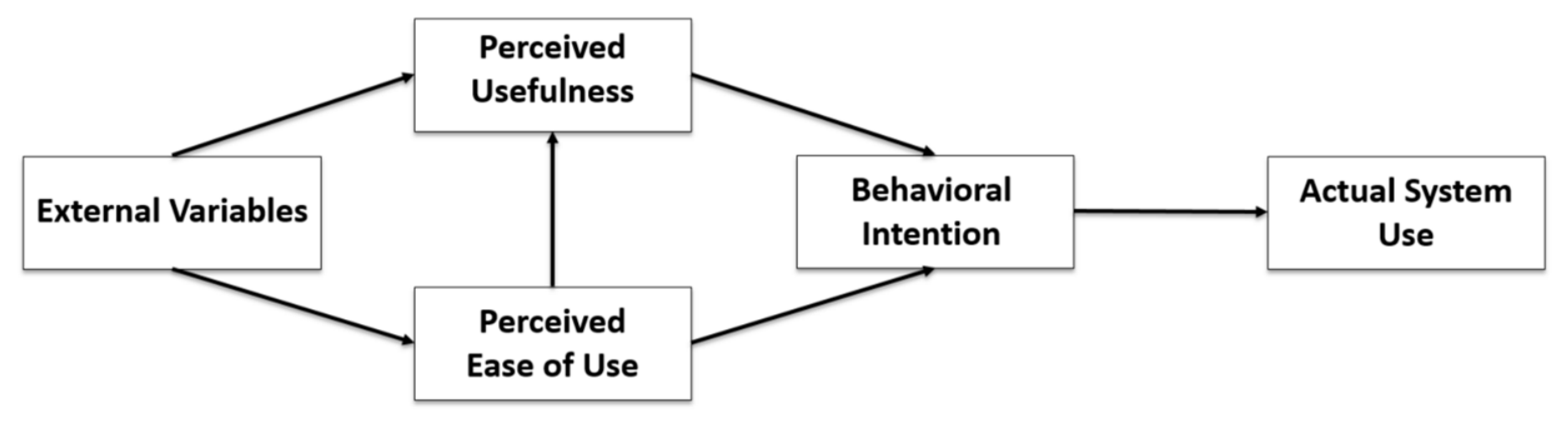
Although perceived ease of use (PEOU) is a core construct of the original TAM [
37], it is not retained as a separate construct in the present framework. This exclusion is intentional and reflects the analytical scope of the study. The framework focuses on HR professionals’ behavioral intention in relation to the perceived value, trustworthiness, ethical implications, and organizational conditions surrounding AI-based recruitment systems rather than on the ease of interacting with and using a single standardized AI recruitment application. Because ease of use may vary substantially across AI tools, vendors, and implementation configurations, PEOU is treated here as a context-dependent characteristic rather than as a core explanatory mechanism of the broader adoption process. Perceived usefulness is therefore retained as the principal TAM construct because it captures HR professionals’ evaluation of whether AI can enhance recruitment-related performance and decision-making. The exclusion of PEOU should not be interpreted as implying that ease of use is irrelevant; rather, it represents a boundary of the present conceptual model. Future empirical studies examining specific AI recruitment applications may reintroduce PEOU as an additional explanatory construct. The original structure of the Technology Acceptance Model is illustrated in
Figure 1.
4.2. Technology–Organization–Environment Framework (TOE)
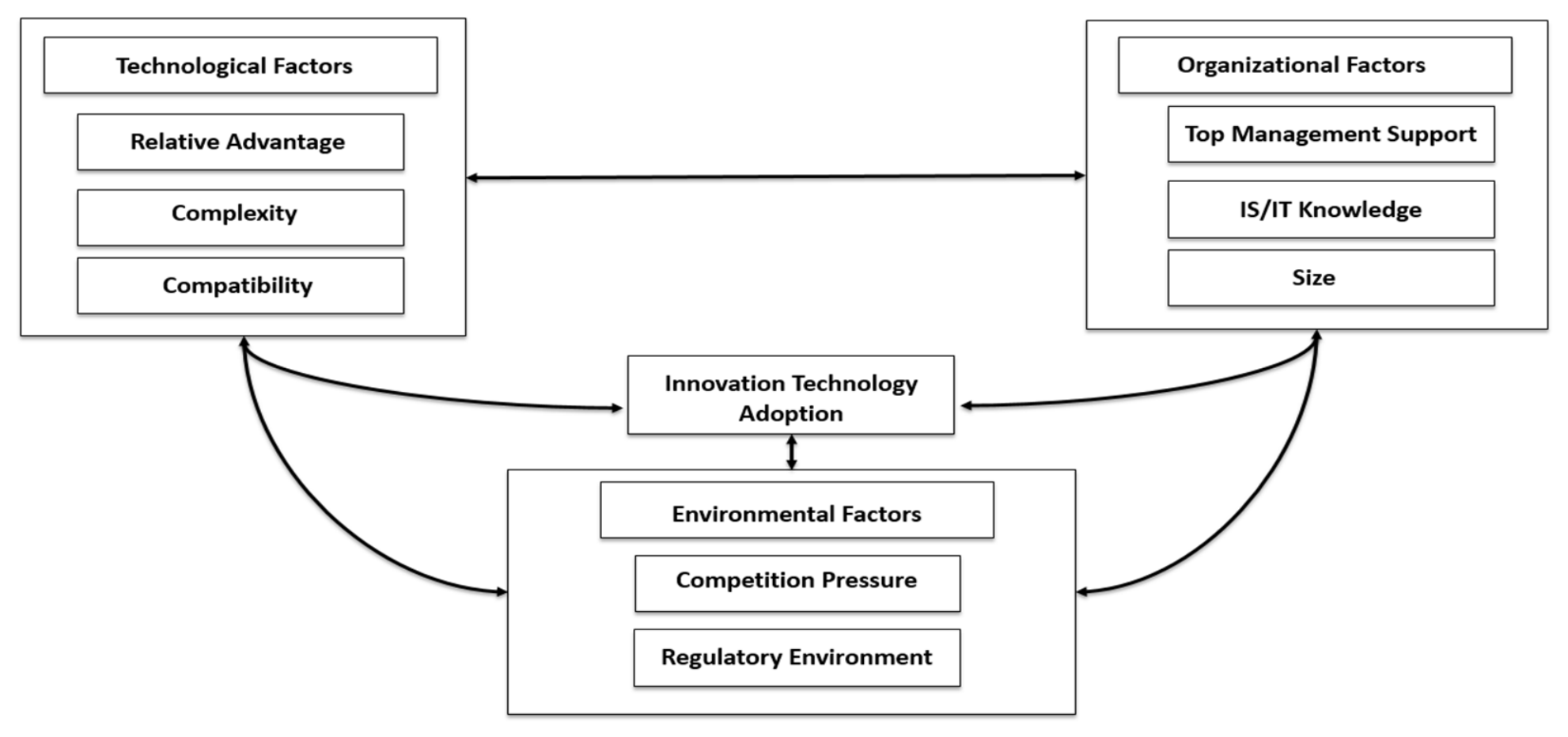
The Technology–Organization–Environment (TOE) framework, developed by Tornatzky and Fleischer [
44], describes organizational adoption of technological innovation through three interrelated contexts: technological, organizational, and environmental [
44,
45]. TOE has been widely employed as a model of technology adoption at the firm level, especially because it focuses on organizational and contextual determinants [
46].
At an organizational level, TOE emphasizes the role of factors such as resource availability, organizational size, organizational structures and managerial practices in determining the ability of a firm to adopt innovation [
44,
45]. In this study, HR readiness refers to the general financial, human and technological capacity of the firm to implement AI effectively, including supportive structures and adaptive processes. Empirical and conceptual research suggests that HR readiness, supportive leadership, employee capabilities, and engagement are important conditions for the effective integration of AI and other emerging technologies within organizations and HRM [
8,
47,
48].
Top management support (TMS) is an important organizational enabler within the TOE tradition, as it provides strategic direction, resources, and organizational support for technology adoption, as demonstrated by research on cloud computing and e-maintenance [
49,
50]. In the context of AI adoption, TMS has been found to enhance perceived usefulness and perceived ease of use in TAM-based models [
41]. In the present framework, however, TMS is not modeled as a direct antecedent of behavioral intention. Instead, it is conceptualized as a moderating organizational condition that may attenuate the negative relationship between resistance to change and behavioral intention.
Because TOE primarily addresses technology adoption at the organizational level, prior research has combined it with individual-level acceptance models such as TAM [
51].
The choice to integrate TAM and selected dimensions of TOE is theoretically motivated by the cross-level nature of AI adoption in recruitment. TAM provides a parsimonious explanation of individual users’ cognitive evaluations of technology, particularly the role of perceived usefulness in shaping behavioral intention [
37]. UTAUT offers a broader individual-level acceptance framework by incorporating performance expectancy, effort expectancy, social influence, and facilitating conditions [
40]. However, the present study does not primarily seek to explain technology use through social influence or demographic moderators; rather, it focuses on how HR professionals’ cognitive and psychological evaluations interact with organizational conditions surrounding AI implementation. For this purpose, TAM provides a more focused individual-level foundation that can be extended with AI-specific ethical and psychological mechanisms such as trust, transparency, data privacy concerns, job replacement anxiety, and resistance to change.
Diffusion of Innovation theory (DOI) provides an important perspective on how innovation characteristics, such as relative advantage, compatibility, complexity, trialability, and observability, influence the diffusion and adoption of innovations [
52]. However, DOI is primarily concerned with the diffusion process and perceived characteristics of innovations, whereas the present study seeks to explain the formation of HR professionals’ behavioral intention within an organizational implementation context. Relative advantage is therefore retained as a particularly relevant innovation characteristic, while TAM is used to capture individual cognitive evaluation and TOE is used to incorporate organizational adoption conditions.
The integration of TAM and TOE is also consistent with prior research showing that individual technology-acceptance beliefs and organizational adoption conditions can provide complementary explanations of technology and AI adoption [
17,
51]. Whereas TAM explains how users evaluate the expected utility of a technology, TOE broadens the analysis by considering the organizational conditions under which adoption occurs. This complementarity is particularly relevant to AI-based recruitment, where HR professionals’ willingness to adopt AI may depend on their perceptions of the technology and on organizational conditions such as HR readiness, while top management support may shape how resistance to change translates into behavioral intention.
Importantly, the present framework does not operationalize the full TOE structure. Although TOE encompasses technological, organizational, and environmental contexts [
44,
45], the current conceptual model selectively draws on organizational dimensions of TOE that are most directly relevant to HR professionals’ behavioral intention, while technological evaluation is represented separately through relative advantage and perceived usefulness. External environmental factors, such as AI regulation, labor law, competitive pressure, professional norms, vendor support, and national AI governance, are recognized as potentially important boundary conditions but are not modeled as direct antecedents in the present framework [
3]. This boundary is intentional and reflects the study’s analytical focus on internal socio-technical mechanisms underlying HR professionals’ adoption intention. Future empirical extensions may incorporate the environmental dimension to examine how external institutional and regulatory conditions shape or moderate these relationships. The main components of the Technology–Organization–Environment framework are illustrated in
Figure 2.
5. Development of the Conceptual Framework
5.1. Socio-Technical Systems Perspective on AI Adoption in Recruitment
From a socio-technical systems perspective, the adoption of artificial intelligence in recruitment should not be understood as the simple implementation of a technological tool, but as a broader organizational transformation that reshapes HR tasks, professional roles, decision-making mechanisms, and work practices. AI-based recruitment systems automate and support activities such as résumé screening, candidate ranking, profile matching, and preliminary decision support. However, their organizational value depends not only on algorithmic performance, but also on their integration into HR routines, the capacity of HR professionals to interpret algorithmic outputs, and the preservation of human oversight in recruitment decisions.
This perspective is consistent with the socio-technical tradition, which emphasizes that organizational performance depends on the alignment between the technical system and the social system [
53]. In the context of AI-based recruitment, the technical system includes algorithms, data, digital infrastructures, and automated functionalities, while the social system includes HR professionals, managerial practices, organizational culture, ethical expectations, and decision-making routines. Similarly, Leavitt’s diamond model highlights that technological change affects tasks, people, structures, and technology simultaneously, requiring an overall alignment between these organizational dimensions [
54].
Accordingly, the constructs included in the proposed framework should not be considered as isolated determinants of adoption. Rather, they form an interdependent system through which technological characteristics, ethical concerns, psychological perceptions, and organizational conditions jointly shape HR professionals’ behavioral intention to adopt AI-based recruitment systems. Transparency is theorized to contribute to trust by reducing uncertainty and enabling users to better understand how AI systems process information and support recruitment decisions. In contrast, data privacy concerns may weaken trust by increasing fears related to the misuse, loss of control, or inappropriate processing of candidates’ personal information. Relative advantage is theorized to contribute to perceived usefulness by allowing HR professionals to evaluate the practical benefits of AI compared with traditional recruitment practices.
At the same time, adoption also depends on how HR professionals interpret, appropriate, and integrate AI systems into their daily work. In line with the view that technology is shaped through use and organizational practices, AI systems may be accepted, adapted, limited, or resisted depending on how recruiters perceive their transparency, reliability, fairness, and compatibility with professional judgment [
55,
56,
57,
58]. Resistance to change may therefore reduce behavioral intention by reinforcing uncertainty, skepticism, and perceived loss of control. In this framework, top management support is conceptualized as a moderating organizational condition that may attenuate the negative relationship between resistance to change and behavioral intention by providing strategic direction, resources, transparent communication, and legitimacy for AI-related transformation.
Importantly, the socio-technical perspective adopted in this study does not imply that all relationships among the constructs are strictly linear or unidirectional. The directional propositions represent specific theoretically expected mechanisms leading to behavioral intention, whereas the broader socio-technical system is understood as involving reciprocal adaptation between the technical and social–organizational subsystems [
53,
56]. On the technical side, the characteristics and functioning of AI-based recruitment systems may shape HR professionals’ perceptions of usefulness, transparency, trust, and control. On the social and organizational side, HR professionals’ interpretations, HR readiness, managerial support, resistance, and governance practices may influence how AI systems are selected, configured, implemented, monitored, and subsequently used [
55,
57,
58]. Accordingly, AI adoption is conceptualized as an iterative alignment process in which technological arrangements and organizational practices may evolve together rather than as a one-time linear acceptance decision [
56,
57].
The conceptual framework therefore distinguishes between the directional propositions explaining behavioral intention and a higher-order socio-technical interaction between the technical and social–organizational subsystems. This reciprocal interaction is not formulated as an additional causal proposition; rather, it represents the system-level principle of mutual adaptation underlying the framework [
53,
56,
57]. In this sense, the socio-technical perspective complements the TAM–TOE logic by emphasizing that AI adoption emerges not only from individual determinants of acceptance or organizational conditions considered separately, but also from their ongoing alignment within the organizational context.
The theoretical contribution of the socio-technical perspective therefore lies in changing the explanatory logic of the integrated TAM–TOE framework. TAM explains how individual users cognitively evaluate technology, while selected TOE dimensions capture organizational conditions associated with adoption. The socio-technical perspective adds a relational and dynamic principle: these individual evaluations and organizational conditions are not assumed to operate independently, but are embedded in an ongoing process of mutual adjustment between the AI system and the organizational context in which it is implemented [
53,
56,
57]. Thus, the framework moves beyond an additive combination of adoption determinants by theorizing alignment between technological characteristics, human interpretations, organizational practices, and governance arrangements as a system-level condition surrounding the formation of adoption intention.
It is important to distinguish the scope of the present framework from the broader concept of responsible AI. The model is designed primarily to explain HR professionals’ behavioral intention to adopt AI-based recruitment systems; it does not treat responsible use, legal compliance, or ethical outcomes as equivalent to adoption itself. Adoption refers here to the willingness of HR professionals to accept and engage with AI-based recruitment systems. Responsible use concerns how such systems are subsequently governed and used, including issues of transparency, explainability, fairness, accountability, privacy protection, human oversight, auditability, and the possibility of challenging or reviewing algorithmic decisions. Ethical and legal consequences, in turn, concern the effects that AI-supported recruitment may have on candidates and organizations, including discrimination, privacy violations, procedural fairness, accountability, and compliance with applicable employment and data-protection requirements. These dimensions are therefore recognized as important contextual and governance considerations surrounding adoption rather than as additional dependent variables in the present framework.
The framework is deliberately centered on HR professionals as the focal users and decision-makers involved in organizational AI adoption. Candidates constitute an important stakeholder group because they may experience the consequences of AI-supported screening and selection, particularly in relation to fairness, privacy, transparency, contestability, and procedural justice. However, candidate perceptions and behavioral responses are not modeled as antecedents or outcomes in the present framework. Their perspective represents a distinct level of analysis that warrants dedicated investigation and is therefore treated as a boundary of the present study and an important direction for future research.
The linked paths represented in the framework may imply theoretically plausible indirect mechanisms, particularly those involving relative advantage through perceived usefulness and transparency or data privacy concerns through trust. However, these indirect effects are not formalized as mediation propositions in the present conceptual model. Their mediating role should therefore be examined empirically in future research rather than interpreted as established relationships.
Overall, this socio-technical perspective positions AI adoption in recruitment as the outcome of an alignment process between technological capabilities, ethical governance, human perceptions, and organizational support. It therefore strengthens the logic of the proposed TAM–TOE framework by situating the formation of behavioral intention within the broader alignment between the AI system, HR professionals, and the organizational context in which the technology is introduced.
5.2. Trust
Trust in technology has long been studied across psychology, information systems, software engineering, and computer science. More recently, attention has shifted toward the dynamics of trust in relation to artificial intelligence (AI) [
15]. Trust has consistently been shown to be a significant factor in technology adoption over time [
59]. It has been shown to influence user acceptance in domains such as e-commerce [
60] and big data analytics [
61], and its cross-domain significance lies in reducing perceived uncertainty and supporting reliance on technology.
The concept of trust can be especially salient in the context of AI-based systems because of their complexity, opacity, and autonomy [
15,
62]. Users may be required to rely on outputs that they cannot easily verify; therefore, trust may represent an important antecedent of adoption rather than merely a by-product of long-term usage. The lack of transparency in AI is another factor that generates information asymmetry between algorithms and human users, which strengthens the need for trust as an alternative to direct authority or control [
15]. Similar to the trust-in-automation literature, trust in AI in the present study refers to users’ willingness to rely on the results or decisions produced by an AI system [
15,
63]. Recent research indicates that transparency and explainability features may strengthen trusting beliefs in AI and, in certain contexts, may also enhance users’ intention to accept AI-based systems [
16].
Despite the strong evidence of the relationship between trust and technology acceptance in previous research, the literature on the role of trust in AI adoption remains relatively young [
15]. In this context, trust represents an important psychological mechanism in AI adoption and is theorized to positively influence HR professionals’ behavioral intention to use AI-based recruitment systems.
Accordingly, trust is expected to play a central role in shaping HR professionals’ willingness to adopt AI-based recruitment systems. When HR professionals perceive AI systems as reliable, understandable, and aligned with recruitment goals, they may be more willing to adopt them.
In AI-supported recruitment and selection specifically, trust is particularly important because HR professionals may rely on algorithmic outputs in consequential decisions involving candidate screening, ranking, and selection. Recruitment-focused literature has highlighted concerns regarding algorithmic fairness, opacity, bias, and the appropriate role of human judgment in AI-supported hiring processes [
10,
36]. These recruitment-specific concerns reinforce the relevance of trust when HR professionals evaluate whether and to what extent they are willing to rely on AI-based recruitment systems.
Proposition 1. Trust in AI positively influences HR professionals’ behavioral intention to adopt AI-based recruitment systems.
5.3. Data Privacy Concerns
Privacy, as a legal, sociological, and economic phenomenon, has been studied for over a hundred years across various fields [
64,
65]. Information privacy is described as the right of individuals, groups, or institutions to decide when, how, and to what extent their personal information is disclosed to others [
66]. Data privacy concerns, in turn, refer to concerns about the loss of privacy and the misuse or unauthorized transmission of personal information [
67].
In addition to legal and normative aspects, personal information has become an economically and strategically valuable resource for organizations [
64]. At the same time, privacy issues have become more complex as the capabilities of information technologies to store, analyze, and use personal information have increased [
68]. Previous studies have also noted that individual differences help explain variations in privacy-related perceptions and behaviors. For example, disposition to value privacy [
69], privacy-related sensitivity and risk perceptions [
70], and prior Internet experience [
71] have all been examined as factors influencing individuals’ reactions to the collection and use of their personal information.
Studies addressing privacy issues have gradually moved from general contexts to more specific ones [
72]. Within the current model, privacy concerns are theorized as a determinant of trust. This argument is consistent with previous research findings showing that elevated privacy concerns are associated with diminished trust and decreased readiness to conduct transactions through technology [
70,
73]. Building on these findings, the current research extends the negative relationship between privacy concerns and trust to an AI-based recruitment environment: recruiters’ perceptions of the risks of data misuse or loss of control over candidates’ personal information may undermine their willingness to trust algorithm-based recruitment systems.
Taken together, these insights suggest that user privacy concerns undermine trust in AI-based recruitment systems. Uncertainty about data misuse, as well as the loss of control, may reduce trust in algorithmic decision-making processes [
16,
74]. This ethical tension underscores the importance of transparency as a means to restore trust and ensure accountability in the use of AI applications.
In AI-based recruitment, concerns about the collection, storage, processing, and potential misuse of candidates’ personal data may reduce HR professionals’ confidence in AI systems [
10]. Therefore, data privacy concerns are expected to weaken trust in AI-based recruitment tools.
Accordingly, data privacy concerns are not conceptualized in the present framework as a direct determinant of behavioral intention. Instead, Proposition 2 specifies a negative relationship between data privacy concerns and trust, while Proposition 1 separately specifies a positive relationship between trust and behavioral intention. Although these linked propositions may suggest a plausible indirect pathway, the present conceptual model does not formulate or test a formal mediation effect. Concerns regarding the collection, processing, storage, or potential misuse of candidates’ personal information may undermine HR professionals’ confidence in AI-based recruitment systems [
10,
73]. This interpretation is consistent with prior research showing that privacy-related uncertainty and perceived loss of control can weaken trust in technology-mediated environments [
70,
74].
Proposition 2. Data privacy concerns negatively influence trust in AI-based recruitment systems.
5.4. Transparency
Transparency is defined as the extent to which a trustee provides information about organizational behaviors and intentions, focusing on the visibility of and access to information [
75]. It is usually defined in terms of the amount and type of information that is revealed or disclosed to stakeholders [
76]. In the context of artificial intelligence (AI), however, a technical and interaction-oriented dimension of transparency emerges. According to Chen et al. [
77], it refers to the capability of an information system to enable users to comprehend the intent, performance, plans, and reasoning of an intelligent agent.
In the present framework, transparency is distinguished from explainability and trust. Transparency refers broadly to the visibility and disclosure of information concerning how an AI system operates, what information it uses, and how it contributes to recruitment decisions. Explainability is treated more specifically as the capacity to provide understandable reasons or interpretations for particular algorithmic outputs or decisions [
16]. Trust, by contrast, represents the psychological state of willingness to rely on the AI system [
15]. Explainability may therefore function as one mechanism through which transparency is experienced by users, while trust represents a distinct psychological response that may develop from such perceptions. For parsimony, explainability is not modeled as an independent construct in the present framework but is considered a specific manifestation of broader transparency.
The effects of transparency characteristics on trust in technology have been examined experimentally. Wanner et al. [
78] found that, although the initial acceptance of an intelligent system is primarily based on system performance, transparency also has a significant indirect effect by improving trust and perceived system performance, which in turn favor adoption intentions. Likewise, as evidenced by Märtins et al. [
79], transparency can be interpreted as a precursor of trusting beliefs, and trusting beliefs are determinants of the intention to use technology. Transparency can therefore be considered a tool for minimizing perceived uncertainty and information asymmetry between the system and its users, which are two critical antecedents of trust formation according to Trust Theory in human–computer interaction [
80]. This is especially true for AI systems that are complex, non-deterministic, and opaque, as these characteristics can undermine user trust and acceptance [
15,
81].
These results highlight that transparency can be seen not only as a technical property but also as a socio-cognitive mechanism through which users build trust in AI-based technologies by reducing perceived uncertainty and information asymmetry.
In addition to its proposed relationship with trust, transparency may also directly influence users’ behavioral intention to adopt AI systems. Users may perceive greater fairness, control, and legitimacy when algorithmic criteria and decision-making processes are transparently presented and, as a result, may be more willing to use and rely on AI [
16,
81]. This twofold role, involving both trust formation and behavioral intention, positions transparency as an important mechanism in the adoption of AI-based recruitment systems.
Having examined the ethical and psychological mechanisms involving trust, data privacy concerns, and transparency [
15,
16,
70], the following sections shift the focus to technological–cognitive and organizational mechanisms relevant to behavioral intention in recruitment-related contexts.
In recruitment and selection, transparency is especially relevant because AI-supported screening and ranking can influence consequential employment decisions. Recruitment-focused literature has emphasized concerns related to the visibility of algorithmic processes, fairness, bias, and accountability in AI-supported hiring [
10,
36]. Greater transparency regarding the information used by AI systems, the role of algorithmic recommendations, and the preservation of human oversight may therefore be particularly important in the recruitment context.
Proposition 3. Transparency positively influences trust in AI-based recruitment systems.
Proposition 4. Transparency positively influences HR professionals’ behavioral intention to adopt AI-based recruitment systems.
5.5. Relative Advantage
Within studies using the Technology–Organization–Environment (TOE) framework, innovation attributes such as relative advantage are often incorporated to characterize the perceived benefits of a new technology [
44,
52]. Relative advantage refers to the degree to which an innovation is perceived as superior to existing practices in terms of performance, efficiency, or other valued outcomes [
52]. Empirical research has consistently highlighted its importance in explaining technology adoption. In their meta-analysis of 75 studies, Tornatzky and Klein [
82] found relative advantage to be one of the innovation characteristics most consistently associated with adoption decisions. TOE-based research has subsequently examined relative advantage in contexts such as cloud computing and big data analytics, while also showing that its influence may vary according to contextual conditions [
49,
83,
84].
Consistent with diffusion of innovation and TOE perspectives, relative advantage is therefore considered an important predictor of technology adoption [
52,
82]. Building on this empirical foundation, the current research applies this notion to the recruitment context, where organizations may evaluate AI partly in terms of its expected benefits for efficiency, decision quality, and HR performance [
3,
9,
13]. Recruitment-specific research similarly indicates that organizations evaluate AI-based talent acquisition partly in terms of its perceived advantages over existing recruitment practices, including improvements in efficiency, screening capacity, and decision support [
3,
13]. This evidence strengthens the relevance of relative advantage in the recruitment context while supporting its positioning as an antecedent of perceived usefulness rather than as a direct equivalent of user acceptance. HR professionals who perceive AI as offering greater efficiency, strategic value, and decision quality are therefore more likely to evaluate it as useful. In this sense, relative advantage is expected to contribute to perceived usefulness by shaping HR professionals’ evaluation of the practical value of AI-based recruitment systems [
37,
83].
Relative advantage and perceived usefulness are therefore conceptually related but distinct. Relative advantage represents a comparative evaluation of the innovation, that is, whether AI-based recruitment is perceived as offering benefits over existing recruitment practices [
52,
82], whereas perceived usefulness represents an individual user’s belief that using the technology will enhance his or her work performance [
37]. In the present framework, relative advantage is consequently treated as an antecedent of perceived usefulness rather than as an interchangeable measure of the same underlying construct.
Overall, perceived usefulness represents the individual cognitive evaluation through which HR professionals assess the practical value of AI-based recruitment systems. In the present framework, relative advantage is theorized to strengthen perceived usefulness, which in turn is proposed to positively influence behavioral intention [
37]. This sequence reflects the distinction between the comparative evaluation of AI relative to existing recruitment practices and the individual belief that using AI can enhance work performance, without specifying a formal mediation effect.
Proposition 5. Relative advantage positively influences the perceived usefulness of AI-based recruitment systems.
5.6. Perceived Usefulness
The Technology Acceptance Model (TAM), proposed by Davis [
37], identifies perceived usefulness (PU) as a key determinant of technology acceptance. It reflects the extent to which people perceive that use of a given system promotes their job performance. Extensive empirical research supports PU as one of the most powerful predictors of behavioral intention across different technology contexts [
17,
85].
In the context of recruitment, PU captures users’ belief that AI-based systems support better decision-making and facilitate the hiring process [
3,
13]. This interpretation is consistent with recruitment-focused studies showing that expected performance improvements and benefits are important considerations in the evaluation of AI-enabled recruitment and talent acquisition systems [
3,
13]. In this context, usefulness is not limited to generic system efficiency but concerns whether AI meaningfully supports recruitment tasks such as candidate screening, information processing, and hiring-related decision support. Consistent with TAM, perceived usefulness is expected to play a direct role in shaping users’ behavioral intention to use technology [
37,
85]. In the present framework, relative advantage and perceived usefulness are linked through two separate propositions. Relative advantage is proposed to strengthen perceived usefulness (P5), while perceived usefulness is separately proposed to positively influence behavioral intention (P6) [
83,
85]. These linked propositions may suggest a theoretically plausible indirect pathway, but the present conceptual study does not formulate or empirically test a formal mediation effect. Although there are contextual variations across industries, perceived usefulness remains one of the most robust constructs for explaining technology acceptance [
14,
85].
However, the role of perceived usefulness in AI adoption is embedded within broader psychological and organizational conditions, including trust and HR readiness [
17,
18]. This is particularly relevant in HR contexts, where adoption involves not only individual cognitive evaluations but also psychological, ethical, and organizational mechanisms. Integrating TAM with selected organizational dimensions of the Technology–Organization–Environment (TOE) framework therefore provides a broader perspective by linking individual cognitive evaluations with organizational conditions relevant to AI adoption [
17,
51].
Perceived usefulness therefore provides a cognitive connection between evaluations of AI’s technological benefits and HR professionals’ behavioral intention to adopt AI-based recruitment systems.
Proposition 6. Perceived usefulness positively influences HR professionals’ behavioral intention to adopt AI-based recruitment systems.
5.7. HR Readiness
Organizational readiness has long been identified as a fundamental antecedent of successful organizational change, including technology-driven organizational change [
86]. In this study, HR readiness is conceptualized as an organizational-level condition reflecting the extent to which the HR function possesses the capabilities, resources, processes, and implementation preparedness required to implement and integrate AI-based recruitment systems. It includes relevant employee capabilities and AI-related skills, training and communication mechanisms, change-management processes, technological and procedural preparedness, and organizational arrangements that enable HR professionals to engage effectively with AI-supported recruitment [
48,
87]. Conceptual work on HRM and technology indicates that HR readiness, aided by initiatives such as skill development and employee engagement, is key to the effective use of emerging digital technologies within organizations [
48].
These contemporary insights are in line with classical research in HRM, which stresses the importance of supportive HR practices such as continuous learning, career development, and participatory communication in building employee engagement, commitment, and adaptability [
88,
89]. Such practices can support organizational adaptability during transformation processes and strengthen employees’ commitment to organizational change [
90,
91]. Nevertheless, the success of HR readiness initiatives may be constrained by organizational inertia, resource limitations, or cultural resistance, particularly in less agile or strongly hierarchical organizations.
Taken together, this body of work leads us to conceptualize HR readiness as a pivotal enabler of AI adoption in recruitment, thereby bridging the gap between individual willingness and organizational capacity for technological transformation. By aligning people, processes, and continuous upskilling, HR readiness may strengthen HR professionals’ behavioral intention to engage with AI systems. Consistent with TOE evidence, organizational readiness, including capabilities, infrastructure, and change practices, has been associated with technology adoption and assimilation across various information systems contexts [
46,
92]. In accordance with this logic, HR readiness in this study is modeled as an important determinant of behavioral intention to adopt AI in recruitment.
Accordingly, HR readiness is conceptually distinct from individual willingness to adopt AI. The former represents the organizational capacity and preparedness of the HR function to support implementation, whereas individual willingness is reflected in HR professionals’ behavioral intention, which constitutes the focal outcome of the framework.
Proposition 7. HR readiness positively influences HR professionals’ behavioral intention to adopt AI-based recruitment systems.
5.8. Job Replacement Anxiety
With the rapid development of artificial intelligence (AI), there have been concerns about whether AI will replace human labor. This has led to job replacement anxiety, a type of AI-related anxiety involving the fear that intelligent systems will eventually take over or reduce the number of job opportunities available to humans [
93,
94]. Job replacement anxiety can therefore act as an emotional barrier that weakens individuals’ attitudes toward AI and their willingness to use AI-based systems at work [
93].
Prior studies have identified anxiety as a reaction to technological innovation in various settings, such as assistive robotics among older adults [
59], mobile computing and mobile learning environments [
95], and AI-supported digital education [
96]. Unlike more general computer anxiety, AI-related anxiety is often a result of the perception that intelligent systems can be autonomous, make independent decisions, and thus challenge human control and expertise [
93,
97]. In the recruitment sphere, there are concerns that automation of critical HR operations, such as sourcing, screening, and preliminary interviews, may increasingly reduce the role of human judgment in these activities [
7,
8], which in turn may create job replacement fears among HR professionals.
Empirical work suggests that AI-related anxiety, including concerns about job displacement, can be associated with less favorable attitudes and behavioral intentions toward AI use [
93,
98]. However, the influence of job replacement anxiety may vary across contexts and may operate through different psychological mechanisms [
99]. Taken together, these results suggest that job replacement anxiety can act as a psychological inhibitor of technology acceptance, although the magnitude of job replacement anxiety and the routes of influence differ across settings.
In a recruitment context, such anxiety may be further compounded by ethical concerns about opacity and fairness in algorithmic screening, which may reinforce skepticism toward AI-based hiring systems [
10,
36]. Addressing job replacement anxiety through transparent communication about the role of AI, participatory change management, and reskilling initiatives may help reframe AI as a complement rather than a direct substitute for human capability [
48,
100]. In line with this reasoning, the present study theorizes job replacement anxiety as a psychological mechanism that may negatively influence HR professionals’ behavioral intention to adopt AI-based recruitment systems.
Job replacement anxiety should nevertheless be distinguished from resistance to change. In the present framework, job replacement anxiety refers to an AI-specific affective response centered on the perceived threat that intelligent systems may reduce, transform, or replace human work [
93,
94]. Resistance to change is broader and refers to cognitive, emotional, and behavioral reactions to organizational transformation, which may arise from multiple sources, including uncertainty, perceived loss of control, organizational routines, and concerns about the change process itself [
101,
102,
103]. Job replacement anxiety may therefore coexist with resistance to change, but the two constructs are not treated as conceptually equivalent.
Because the current literature reviewed in this study does not provide sufficiently consistent evidence to establish a specific mediating pathway from job replacement anxiety through resistance to change in AI-based recruitment, the framework retains both constructs as theoretically distinct antecedents of behavioral intention. The possibility that resistance to change mediates the relationship between job replacement anxiety and behavioral intention is therefore considered an important empirical question for future research rather than a formal proposition of the present conceptual model.
Proposition 8. Job replacement anxiety negatively influences HR professionals’ behavioral intention to adopt AI-based recruitment systems.
5.9. Resistance to Change
Resistance to change has long been cited as an important barrier to organizational transformation, including technology-driven change efforts. Early management perspectives often viewed resistance as an obstacle to be overcome rather than as a potentially meaningful response to change [
104,
105]. Subsequent research has, however, redefined resistance as a complex psychological, emotional, and behavioral response to change [
101,
103]. Resistance is therefore not simply a matter of unwillingness to adapt, but may reflect perceived threats, uncertainty, and a sense of losing control [
102,
106].
Scholars have identified several antecedents of resistance, such as fear of the unknown, self-interest, and lack of awareness [
107,
108,
109], which are often accompanied by anxiety and defensive behaviors [
102,
110]. Yet resistance is not necessarily a purely negative phenomenon; it may also represent ambivalence and a search for meaning during organizational transitions [
103].
In the context of AI adoption, emotional and cognitive reactions, including AI-related technostress and perceptions of fairness, can shape employees’ responses to AI and their willingness to adopt it [
98,
111]. Recent research further conceptualizes resistance to AI as a multidimensional workplace phenomenon influenced by technological, organizational, and human factors, highlighting the importance of appropriate organizational responses to facilitate AI integration [
43].
Within recruitment, resistance toward AI-based tools may arise alongside concerns about job displacement, perceived algorithmic unfairness, and uncertainty surrounding AI-supported hiring and selection decisions [
93,
112]. These concerns highlight the importance of transparent oversight, open communication, and leadership engagement in transforming resistance into more constructive forms of participation and collaboration [
43,
112].
Taken together, resistance to change can be conceptualized as a psychological and behavioral response to organizational transformation that may directly reduce HR professionals’ behavioral intention to adopt AI-based recruitment systems.
In contrast to job replacement anxiety, which is centered specifically on perceived employment displacement by AI, resistance to change represents a broader response to organizational transformation and may emerge even when employees do not fear direct job replacement. Resistance may reflect uncertainty, perceived loss of control, procedural concerns, organizational inertia, or skepticism toward the change process [
102,
103,
106,
108]. This distinction supports the treatment of job replacement anxiety and resistance to change as related but conceptually separate constructs within the proposed framework.
Proposition 9. Resistance to change negatively influences HR professionals’ behavioral intention to adopt AI-based recruitment systems.
5.10. Top Management Support
Within the organizational dimension of the Technology–Organization–Environment (TOE) framework, top management support (TMS) is widely recognized as an important determinant of successful technology adoption [
49,
50,
113]. Change initiatives, including those related to Artificial Intelligence (AI), may face employee resistance arising from uncertainty, perceived loss of control, and broader concerns surrounding organizational transformation [
43,
102]. In such contexts, visible managerial commitment can reassure employees about the strategic intent and legitimacy of technological transformation [
113,
114].
Top management support goes beyond symbolic support. It is manifested in transparent communication, appropriate resource allocation, and active involvement of leaders in the change process [
113,
115]. Such leadership behaviors can promote openness to technological change and help alleviate defensive reactions during digital transformation. Recent research further suggests that supportive managerial involvement can shape employees’ responses to AI initiatives and foster more favorable conditions for adoption [
43,
113]. By providing strategic support and legitimizing AI adoption, top management may help create an organizational context in which resistance is less likely to translate into reduced adoption intention.
The strength of this influence may vary depending on organizational culture, leadership conditions, and employees’ experience with organizational change [
115,
116]. Within a TOE perspective, TMS operates alongside HR readiness as an important organizational condition supporting AI adoption capacity. While HR readiness provides an operational foundation for implementation in terms of capabilities, resources, processes, and change preparedness, top management support provides strategic direction, resource commitment, and organizational legitimacy for sustaining technology-related transformation [
47,
113,
115].
Accordingly, in the present framework, top management support is conceptualized as a moderating organizational condition. This specification is not based solely on theoretical parsimony and does not imply that direct effects of top management support on AI adoption are theoretically implausible. Recruitment-specific evidence has shown that top management support can directly contribute to AI adoption in talent acquisition [
13], while broader technology-adoption research also recognizes it as an important organizational enabler [
49,
113]. The present framework retains the moderating specification to capture a more specific cross-level boundary-condition mechanism. Resistance to change represents an employee-level reaction to uncertainty, perceived loss of control, and organizational transformation [
101,
102], whereas top management support operates at the organizational level through strategic legitimacy, resource provision, communication, and visible managerial commitment [
113,
115]. Recent research on workplace AI resistance further emphasizes that employee resistance manifests at the individual level but may be alleviated through organization-level mechanisms, including AI accessibility, human-AI augmentation, and the legitimation of AI technology [
43]. This cross-level logic suggests that managerial support may alter the extent to which resistant reactions translate into reduced willingness to adopt AI.
Empirical research outside the recruitment context also provides evidence that top management support can moderate relationships involving technology adoption and organizational outcomes [
113]. In AI-based recruitment, where implementation may affect established professional roles, judgment, and work practices, strong managerial support may therefore reduce the extent to which resistance to change translates into lower behavioral intention by providing organizational legitimacy, resources, communication, and implementation support. Proposition 10 consequently represents a theoretically derived boundary-condition proposition rather than a claim that this specific moderating relationship has already been empirically established in AI-based recruitment. Direct relationships between top management support and adoption, readiness, training, or governance remain theoretically plausible alternatives that warrant empirical comparison in future research.
Proposition 10. Top management support weakens the negative relationship between resistance to change and HR professionals’ behavioral intention to adopt AI-based recruitment systems.
To consolidate the conceptual architecture of the framework,
Table 2 summarizes the focal constructs, their concise definitions, their principal theoretical origins, and the propositions with which they are associated. This synthesis clarifies the role of each construct and helps distinguish conceptually related mechanisms before presenting the integrated framework in
Figure 3.
The proposed framework organizes the constructs according to their theoretical role within the integrated model. Perceived usefulness represents the individual cognitive mechanism derived from TAM [
37], while relative advantage reflects the technological evaluation of AI as an innovation [
52,
82]. HR readiness and top management support represent organizational conditions informed by the TOE perspective [
44,
47]. Trust, transparency, data privacy concerns, job replacement anxiety, and resistance to change capture the ethical, psychological, and human dimensions required to extend technology-adoption explanations toward a socio-technical understanding of AI-enabled recruitment [
15,
16,
70,
93,
102].
For conceptual consistency, all relationships in
Figure 3 are labeled as Propositions (P1–P10), rather than hypotheses, because the present study develops a theoretical framework that has not yet been empirically tested. The figure further distinguishes technological–cognitive, ethical–psychological, and organizational mechanisms while representing their integration within a broader socio-technical system. The directional propositions indicate the specific relationships theorized in the framework, whereas the reciprocal interaction between the technical and social–organizational subsystems represents the higher-order principle of socio-technical alignment [
53,
56,
57].
In terms of level of analysis, Behavioral Intention and the cognitive, ethical, and psychological mechanisms are conceptualized primarily at the individual HR-professional level, whereas HR Readiness and Top Management Support represent organizational-level conditions. The framework specifies directional theoretical relationships and one moderating relationship (P10). No formal mediating relationships are specified in the present conceptual model; potential indirect mechanisms are reserved for future empirical investigation.
The proposed research model is presented in
Figure 3.
6. Discussion and Implications
6.1. Theoretical Implications
The rapid advancement of artificial intelligence (AI) is reshaping Human Resource Management (HRM) and encouraging organizations to reconsider how people, data, technology, and organizational practices interact [
8,
19]. This conceptual study addresses this transformation by proposing an integrative framework based on the Technology Acceptance Model (TAM), selected dimensions of the Technology–Organization–Environment (TOE) framework, and a socio-technical systems perspective [
37,
44,
53,
56]. The framework brings together cognitive, psychological, ethical, technological, and organizational mechanisms that may shape HR professionals’ behavioral intention to adopt AI-based recruitment systems.
The proposed framework differs from a conventional extension of TAM in several respects. TAM primarily explains technology acceptance through individual cognitive evaluations, particularly perceived usefulness and perceived ease of use [
37]. Although extended TAM models may incorporate additional variables such as trust, perceived risk, or social influence [
18,
85], their explanatory logic generally remains centered on individual technology acceptance. In contrast, the present framework combines individual cognitive mechanisms with organizational conditions derived from TOE, including HR readiness and top management support, while also incorporating psychological and ethical mechanisms that are particularly salient in AI-enabled recruitment. This integration therefore broadens the analysis from individual technology acceptance toward a socio-technical understanding of AI adoption.
The framework also differs from conventional TOE applications. TOE explains organizational technology adoption through technological, organizational, and environmental conditions [
44,
45], but does not directly explain how individual HR professionals cognitively and psychologically interpret AI-based recruitment systems [
51]. By combining TAM with selected TOE dimensions, the proposed framework links organizational conditions with individual perceptions and behavioral intention. This articulation is particularly relevant to recruitment because an organizational decision to introduce AI does not necessarily imply that HR professionals will trust, accept, or willingly use such systems.
This reasoning is consistent with prior research showing that technological and organizational factors jointly influence AI adoption [
17] and that contextual conditions are important in explaining the adoption of AI in employee recruitment [
3]. However, the present framework extends these perspectives by incorporating mechanisms related to trust, transparency, data privacy concerns, job replacement anxiety, resistance to change, HR readiness, and top management support. The contribution therefore does not lie in claiming that these constructs are individually new, but in theoretically articulating them within a recruitment-specific framework that connects technological–cognitive, ethical–psychological, and organizational mechanisms.
Compared with Chatterjee et al. [
17], who demonstrate the usefulness of integrating TAM and TOE for explaining organizational AI adoption outside the recruitment context, the present framework places greater emphasis on recruitment-specific ethical and psychological mechanisms. In particular, trust, transparency, privacy concerns, job replacement anxiety, and resistance to change are treated as theoretically relevant mechanisms surrounding HR professionals’ adoption intention. Similarly, Pan et al. [
3] highlight the importance of contextual factors in organizational AI adoption in employee recruitment; the present framework complements this organizational perspective by explicitly incorporating the individual cognitive and psychological evaluations through which HR professionals may interpret AI-based recruitment systems.
The relationships involving trust further illustrate this integrative logic. Transparency is proposed to strengthen trust by reducing uncertainty surrounding AI-supported decisions, whereas data privacy concerns may weaken trust by increasing concerns regarding the collection, processing, and potential misuse of personal information [
16,
70,
73,
78]. Trust is consequently positioned as an important psychological mechanism connecting ethical perceptions of AI systems with HR professionals’ willingness to rely on them. This interpretation is consistent with research emphasizing the importance of trust in technology acceptance and organizational AI adoption [
15,
49,
62].
Recent organizational evidence further suggests that attitudes toward and trust in AI may evolve as employees gain experience with AI systems and as organizational conditions change [
62]. This observation is consistent with the socio-technical logic of the present framework, which treats trust not as a fixed individual disposition but as a perception that may develop through ongoing interaction with technological characteristics, organizational practices, and governance arrangements.
A similar distinction applies to relative advantage and perceived usefulness. Relative advantage reflects the perceived benefits of AI compared with existing recruitment practices, whereas perceived usefulness captures the extent to which HR professionals believe that using AI can improve their job performance [
37,
52,
82]. The proposed framework therefore conceptualizes relative advantage as contributing to perceived usefulness [
83], while perceived usefulness is expected to be more directly associated with behavioral intention [
37,
85]. This distinction helps connect the technological characteristics of innovation with individual cognitive evaluations of its practical value.
The framework also highlights that favorable evaluations of AI may not be sufficient to generate adoption intention. Job replacement anxiety and resistance to change represent distinct psychological barriers. Job replacement anxiety reflects AI-specific concerns regarding displacement or transformation of human work [
93,
94], whereas resistance to change represents a broader cognitive, emotional, and behavioral response to organizational transformation [
101,
102,
103]. Although these constructs may coexist, they are treated as conceptually distinct in the present framework. Their inclusion highlights that AI adoption in recruitment involves not only evaluations of technological usefulness but also perceptions of threat, uncertainty, professional identity, and control.
At the organizational level, HR readiness and top management support play complementary roles. HR readiness reflects the availability of capabilities, skills, change-management practices, and organizational mechanisms needed to support AI implementation [
47,
48,
87]. Top management support, by contrast, reflects strategic commitment, resource allocation, legitimacy, and managerial involvement in technological transformation [
113,
115]. In the proposed framework, top management support is theorized as a moderating organizational condition that may weaken the negative relationship between resistance to change and behavioral intention. This proposition emphasizes the potential role of leadership in shaping how employees interpret and respond to AI-related transformation.
The proposed framework therefore does not reject the core assumptions of TAM or TOE. Rather, it extends their explanatory scope by linking individual cognitive evaluations with AI-specific ethical and psychological mechanisms and organizational conditions relevant to recruitment.
The socio-technical perspective adds a further layer to this theoretical integration. Rather than treating technological, psychological, ethical, and organizational variables as independent sets of predictors, AI adoption is understood as an alignment process in which technological arrangements and social–organizational practices may shape one another over time [
53,
56,
57]. Characteristics of AI-based recruitment systems may influence perceptions of usefulness, transparency, trust, and control, while organizational actors, managerial support, readiness, resistance, and governance practices may influence how these systems are selected, configured, implemented, monitored, and used. This interpretation extends the TAM–TOE logic beyond additive prediction by emphasizing reciprocal adaptation between the technical and social–organizational subsystems.
Taken together, the framework extends beyond an explanation based primarily on favorable cognitive evaluations of AI. Perceived usefulness may strengthen behavioral intention, but this relationship is situated within a broader socio-technical context that also includes trust, ethical and psychological mechanisms, HR readiness, and the moderating role of top management support. AI adoption in recruitment should therefore be understood not simply as an individual technology-acceptance decision, but as an organizational process involving the alignment of technological value, human perceptions, professional practices, and organizational conditions.
6.2. Practical and Managerial Implications
For HR leaders and organizational decision-makers, the framework suggests that preparing for AI adoption requires more than acquiring technically capable recruitment systems. Organizations should simultaneously address technological performance, employee perceptions, organizational preparedness, and responsible governance. Because the relationships proposed in this study have not yet been empirically validated, the following implications should be understood as theoretically derived recommendations to guide implementation and future evaluation.
Building appropriate trust should be a central organizational priority. Transparency regarding the purpose, functioning, limitations, and role of AI in recruitment may help HR professionals better understand how algorithmic outputs are generated and how they should be interpreted [
16,
78]. At the same time, organizations should establish clear procedures governing the collection, processing, storage, and use of candidates’ personal information, because data privacy concerns may undermine trust in AI-based recruitment systems [
10,
70].
Organizations should also preserve meaningful human oversight. AI-based recruitment systems should be positioned as decision-support mechanisms rather than unquestioned substitutes for professional judgment. Human involvement is particularly important when algorithmic recommendations affect candidate screening, ranking, or selection decisions, where concerns regarding fairness, accountability, and transparency may arise [
4,
10,
36]. HR professionals should therefore remain able to interpret, question, and, when justified, override automated recommendations.
HR readiness requires sustained investment in capabilities rather than one-time technical training. Organizations may need to develop AI-related knowledge, data literacy, critical interpretation skills, and understanding of the ethical implications of algorithmic recruitment. Continuous learning, employee involvement, and participatory communication can support readiness for technological change and strengthen organizational adaptability [
48,
87,
88,
89]. Training should therefore address not only how to operate AI tools, but also how to evaluate their outputs, limitations, and appropriate role in professional decision-making.
Job replacement anxiety and resistance to change should also be addressed explicitly during implementation. Transparent communication regarding why AI is being introduced, which activities it is expected to support, and which responsibilities remain under human control may reduce uncertainty surrounding technological transformation. Participation in implementation processes and opportunities for reskilling may help employees perceive AI as a tool that complements professional capabilities rather than as an immediate substitute for human expertise [
43,
48,
93].
Top management has an important role in providing legitimacy and continuity to AI initiatives. Visible managerial commitment, appropriate allocation of resources, communication of strategic objectives, and support for employee learning may create an organizational context in which resistance to change is less likely to translate into reduced behavioral intention [
47,
113,
115]. Leadership should also ensure coordination among HR, information technology, legal, compliance, and managerial functions, particularly when recruitment systems process sensitive personal information or contribute to consequential employment decisions.
A gradual implementation strategy may further support responsible adoption. Pilot projects can enable organizations to examine whether AI systems provide the expected recruitment benefits while identifying difficulties related to user acceptance, transparency, privacy, fairness, and integration into existing HR practices. Feedback from HR professionals can subsequently inform adjustments to system configuration, training, governance mechanisms, and work processes before broader organizational deployment.
To translate these implications into a more actionable implementation process,
Table 3 proposes a concise four-stage roadmap for the responsible introduction of AI-based recruitment systems. The roadmap links the main mechanisms of the conceptual framework to organizational actions, responsible functions, and illustrative assessment indicators. It should be interpreted as a theoretically derived managerial tool rather than as an empirically validated implementation standard.
The roadmap emphasizes that responsible implementation requires more than technical deployment. HR readiness, user trust, transparency, privacy and fairness safeguards, appropriate human oversight, and coordination across HR, IT, legal/compliance, and top management should be considered throughout the implementation process.
To complement the stage-based roadmap with construct-level evaluation criteria, the following
Table 4 translates each focal construct of the framework into an illustrative assessment focus and a corresponding managerial assessment question.
These illustrative indicators and assessment questions are not presented as validated measurement scales. Rather, they translate the conceptual constructs into practical assessment areas that organizations may use during readiness assessment, pilot testing, implementation, and monitoring. Future empirical studies should operationalize the constructs using validated multi-item scales and assess their reliability, convergent validity, and discriminant validity before testing the proposed structural relationships.
From a longer-term perspective, responsible AI adoption should not be evaluated solely by whether employees initially accept the technology. Organizations should also consider whether trust can be maintained, whether HR professionals develop the capabilities required to use AI appropriately, whether human oversight remains meaningful, and whether organizational practices adapt as AI systems evolve. HR readiness and top management support may contribute to this process by providing the strategic direction, resources, communication, and organizational legitimacy needed to support responsible use beyond the initial implementation stage.
Ultimately, the framework suggests that successful AI-enabled recruitment transformation requires alignment between technological capabilities, human perceptions, organizational preparedness, and governance practices. Organizations that focus exclusively on technical performance may overlook psychological and organizational barriers, whereas organizations that combine technological implementation with transparency, capability development, employee involvement, managerial support, and appropriate oversight may create more favorable conditions for responsible and sustainable AI adoption.
7. Conclusions
This conceptual study develops an integrative socio-technical TAM–TOE framework to explain HR professionals’ behavioral intention to adopt AI-based recruitment systems. The framework brings together cognitive and technological mechanisms, ethical and psychological factors, and organizational conditions that have often been examined separately in prior research. Its contribution does not lie in proposing that the individual constructs are themselves novel, but in theoretically articulating them within a recruitment-specific framework that connects individual perceptions, organizational conditions, and socio-technical interactions.
The framework positions relative advantage as an antecedent of perceived usefulness; transparency and data privacy concerns as antecedents of trust, with transparency also proposed to be directly related to behavioral intention; and trust, perceived usefulness, HR readiness, job replacement anxiety, and resistance to change as proposed direct antecedents of behavioral intention. Top management support is conceptualized as a moderating organizational condition that may attenuate the negative relationship between resistance to change and behavioral intention.
More broadly, the socio-technical perspective extends the TAM–TOE integration by conceptualizing AI adoption as an evolving process of alignment between technological characteristics, human interpretations, organizational practices, and governance arrangements. AI adoption in recruitment is therefore understood not as a one-time acceptance decision, but as an organizational process in which technical and social–organizational conditions may adapt reciprocally over time. Because these relationships are theoretically proposed rather than empirically validated, the framework provides a foundation for subsequent empirical testing and refinement.
8. Limitations
As a conceptual paper, this study does not empirically test the proposed framework. The direction, strength, and generalizability of the proposed relationships therefore remain to be established empirically across different industries, cultures, and organizational contexts.
The framework also reflects several deliberate analytical choices that constitute limitations of the present study. First, although Perceived Ease of Use (PEOU) is a core construct of the original TAM, it is not retained as a separate construct because the present framework focuses on broader cognitive, ethical, psychological, and organizational mechanisms rather than on the usability of a specific AI recruitment application. This choice may limit the explanatory scope of the framework in contexts where ease of use plays an important role in HR professionals’ acceptance of particular AI systems. Future empirical studies examining specific AI recruitment applications may therefore consider reintroducing PEOU where system-specific usability is theoretically relevant.
Second, the framework selectively draws on organizational dimensions of TOE without formally operationalizing its environmental dimension. Consequently, external factors such as AI regulation, employment law, competitive pressure, professional norms, vendor support, and national AI governance are treated as contextual boundary conditions rather than being modeled as antecedents. This limits the framework’s ability to explain variation arising from external institutional and regulatory environments. Future empirical extensions may therefore examine whether such environmental factors exert direct or moderating influences on AI adoption in recruitment.
The framework also focuses on HR professionals’ behavioral intention rather than actual adoption behavior, and candidate perceptions and behavioral responses are not modeled directly, although candidates remain an important stakeholder group affected by AI-supported recruitment decisions. Finally, several linked relationships may suggest theoretically plausible indirect mechanisms, particularly those involving perceived usefulness and trust, but these are not formalized as mediation propositions in the present conceptual model.
9. Future Research
Future research should operationalize the constructs and empirically test the proposed theoretical propositions across different industries, cultures, and organizational contexts. Quantitative analyses, including structural equation modeling (SEM), could be used to test the proposed relationships among the focal constructs, including the moderating role of top management support in the relationship between resistance to change and behavioral intention. Future studies may also test theoretically plausible indirect mechanisms, including the potential indirect relationship between relative advantage and behavioral intention through perceived usefulness, as well as the potential indirect relationships of transparency and data privacy concerns with behavioral intention through trust.
In parallel, qualitative research could explore how HR professionals interpret, appropriate, adapt, or resist AI-based recruitment systems in practice. Longitudinal designs would provide deeper insights into how perceptions of fairness, transparency, trust, usefulness, and resistance evolve as organizations gain experience with AI-supported recruitment and as technological and organizational arrangements adapt over time.
Comparative research across countries and sectors could also help uncover the influence of contextual factors, such as leadership style, national culture, regulatory frameworks, professional norms, and institutional conditions, on AI adoption dynamics. The literature reviewed in the present study is drawn primarily from studies conducted outside Morocco, while the proposed framework has not yet been empirically examined in the Moroccan context. Morocco therefore represents a relevant setting for future empirical examination of the framework, particularly among HR professionals and recruiters. Such research would provide an opportunity to assess whether the theorized relationships remain applicable in a different national and organizational context and whether regulatory, cultural, institutional, and organizational conditions influence the proposed mechanisms.
Future research should also devote greater attention to the candidate perspective by examining perceptions of fairness, transparency, privacy, explainability, contestability, and human oversight in AI-supported recruitment. Finally, expanding the conceptual model to incorporate ethical governance mechanisms, human-centered design principles, algorithmic accountability, and responsible AI use could help bridge the gap between technological efficiency and social responsibility in AI-driven HRM. Such extensions would provide a richer foundation for future empirical and policy-oriented research.