1. Introduction
Tourism destinations rarely operate as unified organisations. They function instead as governance environments in which public authorities, tourism businesses, and local communities interact while observing the same developments from different roles within the destination system. Policymakers design regulatory frameworks and coordination mechanisms; tourism professionals encounter those policies through operational practice; residents experience the visible consequences of tourism activity in everyday life. These different vantage points shape how tourism development is interpreted across the destination.
Research on sustainable tourism has long recognised that stakeholder perceptions influence whether tourism initiatives receive support or face resistance. Residents often evaluate tourism through perceived economic benefits and social costs, while tourism professionals focus more strongly on operational viability and employment conditions. Governance actors tend to prioritise institutional coordination and policy effectiveness. Social exchange theory has frequently been used to interpret these differences [
1,
2,
3].
Despite the substantial body of work in this area, one issue remains underexplored. Most studies focus on stakeholder perceptions within individual groups, such as residents, employees, or policymakers, without looking at how these evaluations differ when the groups are considered together. In practice, however, destinations function as multi-actor governance systems where these groups are in constant interaction. Examining perceptions in isolation can miss what these differences actually reveal about how governance works on the ground.
A systems approach helps clarify these dynamics. Tourism destinations evolve through ongoing interactions among interdependent actors, whose decisions shape one another over time [
4]. Stakeholder perceptions can be read as feedback signals, indicating how governance processes are understood across different parts of the system. When evaluations converge, they tend to reinforce trust in governance institutions. When they diverge, they point to coordination mechanisms that remain only partially visible within the governance structure. Yet empirical tourism research rarely interprets such differences in this way. Comparisons between stakeholder groups are typically descriptive. They help identify where views differ but are seldom linked to the underlying conditions that give rise to these differences.
The analysis examines patterns in stakeholder perceptions across tourism destinations through a diagnostic lens. Governance actors, tourism and hospitality professionals, and local community members evaluate sustainability-related practices from different roles within the governance structure, producing evaluation patterns that reveal how governance processes are interpreted across different stakeholder positions. Survey data from 466 respondents across Greek tourism destinations provide the empirical basis for the analysis. Differences between stakeholder groups are examined using one-way ANOVA across four perception domains: sustainability-oriented human resource practices, organisational support conditions, experiential perceptions of tourism development and perceived sustainability outcomes.
The analysis therefore focuses on identifying where stakeholder evaluations converge and where they diverge within the destination system. These patterns reveal how governance practices are experienced across different stakeholder groups and where coordination may require closer attention. The study addresses the following research questions:
RQ1: Where do perception patterns diverge across stakeholder positions in relation to sustainability-related human resource practices?
RQ2: Where do perception patterns diverge across stakeholder positions regarding organisational support conditions?
RQ3: How do experiential evaluations of tourism development vary across stakeholder positions within the system?
RQ4: Where do perception patterns converge across stakeholder positions in evaluations of overall sustainability outcomes?
The study makes three contributions:
Conceptual: It introduces a diagnostic application of system dynamics reasoning at the problem-structuring stage of the modelling cycle, showing how patterns consistent with feedback asymmetries can be inferred from empirical observation without formal simulation.
Methodological: It extends comparative stakeholder analysis in tourism governance by interpreting perception differences not as attitudinal variation but as observable signals of coordination conditions within the governance structure.
Empirical: It shows that divergence at the implementation level can coexist with alignment at the outcome level within the same governance structure. This pattern has direct implications for how destinations monitor coordination over time.
2. Theoretical Background
2.1. Stakeholder Perspectives in Sustainable Tourism
Understanding sustainable tourism governance requires recognising who is involved and how differently they experience the same processes. Destinations bring together governance bodies, destination management organisations, tourism enterprises, and residents, each shaping development paths from distinct roles, with different information and different stakes in tourism outcomes [
5]. Stakeholder theory has long recognised this. It emphasises that sustainable tourism depends not only on sound policy design but also on whether diverse actors, with different levels of power, varying proximity to outcomes, and different expectations of fairness, can maintain sufficient common ground to cooperate [
6,
7]. Governance actors, tourism and hospitality professionals, and local communities represent three structurally distinct roles within the destination system, differing in institutional responsibilities and in how directly they experience tourism activity in everyday practice [
8].
These positional differences influence how sustainability initiatives are interpreted. Governance actors engage with policy coordination and regulatory processes, tourism professionals encounter sustainability through operational practice and service delivery, and community members primarily evaluate visible impacts and lived outcomes. As a result, stakeholders develop distinct evaluations shaped by their access to information and everyday experience, which in turn influences trust in institutions and support for tourism development [
9,
10,
11]. Destinations therefore function as systems in which interaction occurs across unequal positions of authority and visibility. Governance bodies, organisations, and residents participate in shared processes but interpret them differently depending on their roles. These differences in perception shape trust in governance and influence how cooperation is sustained across the destination [
12,
13].
Although recent research highlights participatory planning and stakeholder networks as mechanisms for strengthening trust and policy effectiveness [
14,
15], perceptual divergence remains common. Differences in evaluation weaken feedback alignment and may reduce acceptance of destination strategies [
16,
17,
18].
2.2. Perceptions, Social Exchange, and Support for Tourism Development
Social Exchange Theory offers a useful lens for understanding why stakeholder evaluations diverge [
1,
2]. The basic logic is familiar: people assess whether what they receive is proportional to what they contribute or risk. Applied to tourism, this perspective suggests that stakeholders evaluate development processes partly through perceived fairness. They consider whether benefits reach them, whether costs are distributed equitably, and whether they have genuine opportunities to participate. When these conditions are met, trust tends to build and cooperation follows. When exchanges are perceived as imbalanced, support erodes and coordination becomes more difficult [
3,
19]. Such evaluations are shaped not only by objective outcomes but also by access to information, participation opportunities, and institutional processes [
20,
21]. Different stakeholder groups have very different levels of that access, which is why their evaluations tend to diverge systematically rather than randomly. This matters because persistent misalignment in perceptions has been linked to weaker inter-organisational collaboration and poorer long-term sustainability outcomes [
22,
23,
24]. Comparative perception analysis therefore goes beyond simple description and helps identify where trust in governance is uneven and where intervention may be most needed [
25].
2.3. Human and Organisational Dimensions of Destination Sustainability
Sustainability in tourism governance is not only a matter of environmental policy. It also depends on whether the human and organisational infrastructure of a destination, including workforce practices, training systems, and inter-organisational coordination, can sustain coherent action over time. These internal capacities shape service quality, innovation capacity, and resilience in ways that external policy cannot substitute for [
26,
27]. And they are themselves shaped by how participatory the governance process is: when frontline workers and community actors have genuine input into how sustainability-oriented HR practices are designed and implemented, those practices tend to be interpreted more favourably and take hold more durably [
18,
28,
29].
Tourism research consistently highlights the importance of inclusive recruitment, training and collaboration for destination sustainability [
18,
30,
31]. However, most studies examine individual stakeholder groups, leaving limited comparative evidence on how different actors evaluate such practices. This, in turn, makes it harder to understand how coordination develops and how trust in governance evolves within destination systems. Stakeholders interpret human-centred initiatives through different experiential frames: residents focus on visible outcomes, governance actors on institutional capacity and professionals on operational conditions [
1,
2,
32]. These differences correspond to perception asymmetries that relate to variation in responsiveness and alignment across the system. Human-centred practices are not equally visible to all actors, producing uneven evaluations even when practices exist [
3,
20,
33]. Such variation is associated with differences in trust and perceived fairness, indicating imbalances in how governance processes are experienced across stakeholder groups [
34,
35].
2.4. System Dynamics Perspective on Stakeholder Perceptions
System dynamics approaches tourism destinations as evolving systems rather than stable organisational structures. Outcomes emerge through feedback processes, time delays, and interactions among social, economic, and organisational actors, conditions in which no single participant fully controls the direction of change [
4]. Within this framework, stakeholder perceptions gain analytical importance because they reflect how different parts of the system interpret ongoing developments.
When governance actors, tourism professionals, and local communities evaluate organisational practices in similar ways, these shared perceptions tend to support cooperation and strengthen trust in governance institutions. Yet disagreement between stakeholder groups may indicate something more fundamental than differing opinions. Divergent evaluations may indicate that information about governance processes circulates unevenly across the system, limiting collective understanding and slowing coordination. Perception asymmetries therefore provide useful insight into how the destination system operates, highlighting areas where governance processes may be under strain.
When destinations are viewed as interconnected governance systems, comparative stakeholder analysis becomes more than a descriptive exercise. Differences in perception do not merely reflect stable group characteristics. At the same time, they may indicate how governance arrangements operate across different stakeholder positions and suggest where coordination may weaken. Observing where evaluations converge or diverge can therefore reveal areas where communication, participation mechanisms, or transparency practices require greater attention.
Bringing together system dynamics, stakeholder theory, and social exchange theory helps clarify these patterns from complementary angles. Stakeholder theory explains why actors occupying different roles within the destination structure develop distinct viewpoints. Social exchange theory focuses on how these perceptions emerge through assessments of reciprocity and fairness. System dynamics, in turn, helps interpret what such patterns imply for how the governance system functions, particularly in relation to feedback processes and coordination mechanisms. These perspectives offer a framework for identifying perception gaps and understanding their implications for governance interventions.
Recent tourism studies using systems approaches highlight the value of integrated analytical frameworks for addressing destination management challenges. Peña-Casillas et al. [
36], for example, examined organisational management systems in social tourism enterprises and showed how coordinated institutional arrangements can strengthen competitive integration and organisational performance. Su et al. [
37] examined destination competitiveness through a systems thinking approach, highlighting how structured coordination supports the differentiation of tourism products and the positioning of destinations in competitive markets. In a different line of work, Kirilenko and Stepchenkova [
38] used advanced topic modelling techniques to explore perception differences among tourist groups, illustrating how large-scale behavioural data can inform destination management strategies.
These studies point to a broader shift in tourism research toward analytical frameworks that view destinations as interconnected governance systems. Such approaches help identify entry points for intervention and show how coordination mechanisms influence destination performance. This view also shapes the diagnostic approach used in the analysis.
Diagnostic System Dynamics: A Pre-Modelling Approach
The use of system dynamics in this study requires some clarification. The analysis does not involve simulation modelling and no stock–flow model or scenario analysis is developed. Instead, system dynamics offers a conceptual lens for interpreting empirical findings. The focus lies on understanding what differences in stakeholder evaluations reveal about the functioning of the governance system. For instance, when community members report substantially lower evaluations of HR practices than tourism professionals, the difference raises questions about how governance processes are perceived and communicated across stakeholder groups.
The system dynamics literature describes an initial problem-structuring stage in the modelling process in which system boundaries are defined, key variables are identified, and feedback relationships are mapped before formal simulation takes place [
39,
40,
41]. The present analysis operates at this stage. Rather than treating ANOVA results simply as statistical group differences, the findings are interpreted as indications of how governance processes are experienced by different destination actors. Convergence in stakeholder evaluations suggests stronger alignment in how governance practices are perceived, whereas divergence often reflects uneven visibility of policies, information asymmetries, or coordination difficulties. The diagnostic approach does not replace simulation modelling; it highlights where deeper system modelling may offer additional insight.
By examining differences in stakeholder evaluations, the analysis draws attention to feedback mechanisms that may deserve closer examination in future modelling efforts. At the same time, the approach makes system dynamics reasoning more accessible to practitioners by translating abstract concepts into observable governance conditions that can guide practical interventions. Another advantage lies in its comparative potential. Because perception patterns can be examined across different stakeholder groups, destinations can be assessed side by side before substantial resources are committed to complex modelling exercises. The diagnostic approach therefore provides an intermediate analytical step between empirical observation and full simulation modelling.
This diagnostic orientation emphasises interpretation rather than long-term prediction. This is consistent with applied systems thinking in tourism management [
4,
6], where system dynamics principles are used to inform governance decisions even when full simulation models are unavailable. Interpreting statistical findings through a systems lens therefore helps connect empirical analysis with governance practice. From a system dynamics standpoint, the analysis remains at the problem-structuring stage, where key relationships are identified and coordination patterns become visible before formal modelling takes place. It should be emphasised that the causal loop structure presented later in the manuscript (
Section 6) is not derived from the empirical data through formal estimation, nor does it support causal quantification; it functions as a structural representation that supports the interpretation of the statistical findings reported in subsequent sections, consistent with the problem-structuring stage described above.
2.5. Research Framework and Positioning
Building on the preceding theoretical discussion, the study adopts a comparative stakeholder approach to examine how key destination actors evaluate sustainable tourism practices. Particular attention is given to human and organisational dimensions of sustainability, which influence how coordination processes and institutional trust develop within destination governance. Instead of modelling predictive causal relationships, the analysis focuses on identifying patterns of agreement and disagreement across stakeholder groups and considering what these differences reveal about governance dynamics.
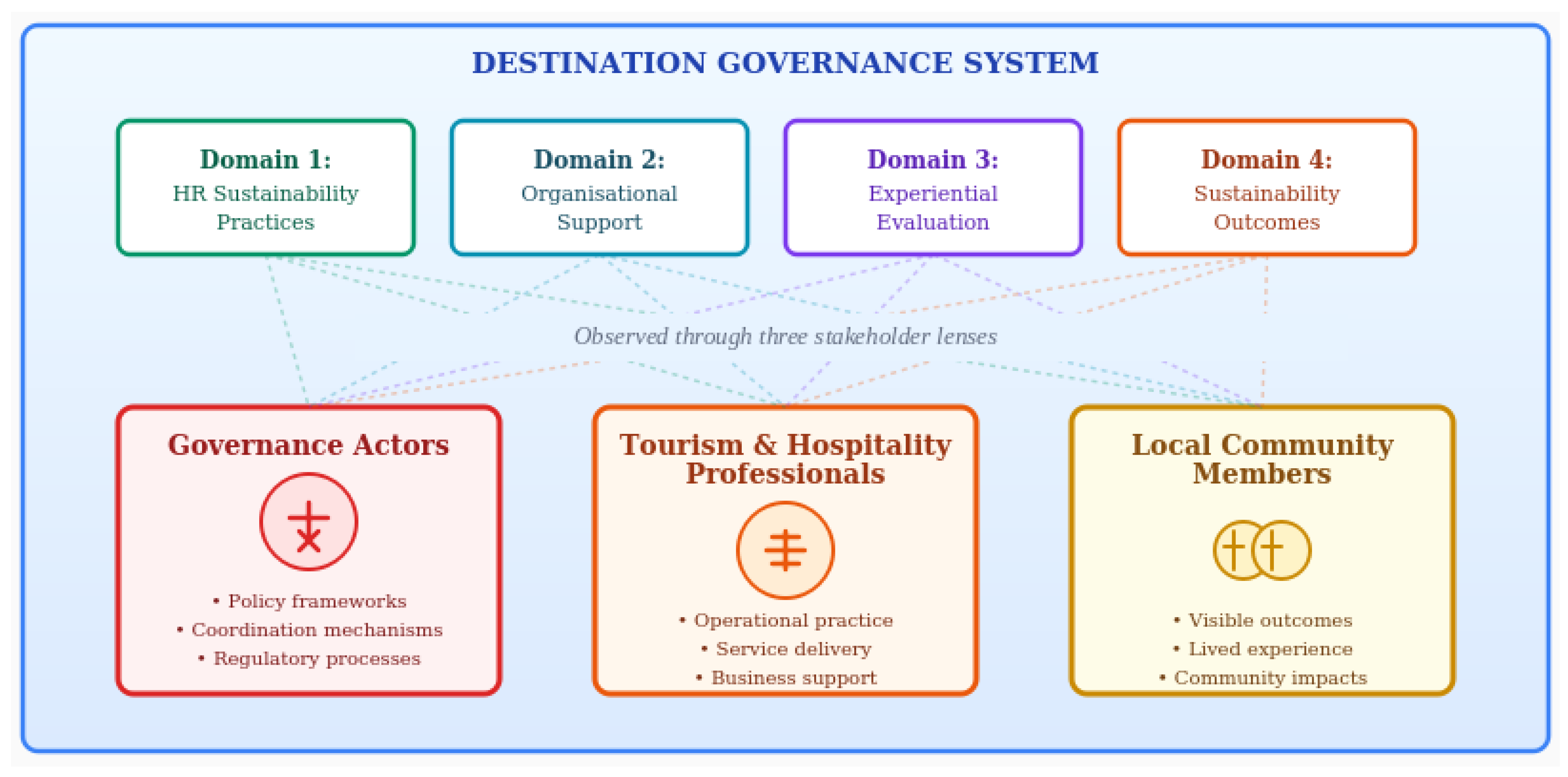
The framework draws on stakeholder theory and social exchange logic interpreted through system dynamics. Actors occupying different roles within the destination system, including governance authorities, tourism professionals, and local communities, interact with tourism development in distinct ways and therefore evaluate sustainability initiatives differently. Examining these differences helps reveal where tensions related to trust in governance and coordination may arise within the governance structure.
Figure 1 illustrates the empirical observation layer of the destination system, positioning stakeholder groups across four perception domains through which governance dynamics become observable.
The three theoretical perspectives each perform a distinct explanatory function within the framework, directly linked to the four research questions. Stakeholder theory explains why actors occupying structurally distinct positions within destination governance, namely governance authorities, tourism professionals, and community members, are expected to develop different evaluative orientations toward sustainability initiatives. This rationale underpins the comparative design of RQ1–RQ4, all of which examine where and how perception patterns diverge or converge across these groups. Social Exchange Theory explains the mechanisms through which such evaluations are formed. Stakeholders assess governance practices in terms of perceived reciprocity, fairness, and benefit distribution, with the result that groups with different levels of access to organisational processes are likely to evaluate those processes differently. This logic is most directly relevant to the divergence observed in RQ1 (HR practices) and RQ2 (organisational support), where differential proximity to internal governance activities is expected to produce differential assessments. System dynamics provides the diagnostic vocabulary for interpreting what these empirical patterns imply for governance functioning. Rather than treating divergence simply as attitudinal variation, the SD framework interprets it as consistent with feedback asymmetry, a condition under which different parts of the governance system receive or process information unequally. Convergence, in contrast, is interpreted as consistent with shared endpoint alignment. This interpretive logic applies across all four RQs and distinguishes between implementation level divergence (RQ1–RQ2), partial misalignment in experiential evaluations (RQ3), and outcome level alignment (RQ4). Together, the three perspectives allow the study to move from describing group differences to interpreting what those differences reveal about how destination governance operates.
2.6. Stakeholders as Consumers: A Business Management Perspective
Traditional stakeholder theory in tourism primarily emphasises participation in governance and collaborative decision making. Yet stakeholders also evaluate how governance arrangements perform in practice, forming judgments about the value, fairness and effectiveness of policies and organisational practices. In this sense, stakeholders also act as evaluators of governance outcomes, assessing policies, institutional practices, and support mechanisms much like consumers evaluate services or products in market settings. Considering stakeholders in this way helps clarify how governance activities are interpreted across the destination environment.
Governance actors, tourism professionals and local communities therefore function as distinct evaluative groups within destination governance. Each group interacts with different aspects of institutional activity. Governance authorities engage mainly with policy frameworks and coordination mechanisms, tourism professionals encounter workforce development initiatives and business support structures in daily practice, and community members primarily observe transparency, information flows and the visible outcomes of tourism development.
These groups tend to evaluate governance quality using evaluative criteria such as perceived value, fairness, and responsiveness [
42,
43]. Differences in evaluation therefore reflect more than simple preference. They indicate how governance processes are experienced from different roles within the destination context. In this sense, variation in stakeholder perceptions can highlight where governance practices are interpreted consistently across groups and where important differences in interpretation emerge.
This approach also complements social exchange theory, which explains how stakeholder attitudes develop through perceptions of reciprocity and fairness. This evaluative perspective further reflects each group’s differing level of exposure to policies, services, and institutional practices. Differences in evaluation therefore often reflect unequal access to information and experience rather than simple disagreement about tourism development. Although tourism research has increasingly considered stakeholders as evaluators of destination governance, empirical applications of this idea remain limited. Comparative analysis of stakeholder perceptions offers one way to address this gap. By examining how different groups evaluate the same governance practices, such analysis helps illuminate how legitimacy develops and how coordination unfolds within destination governance systems, as summarized in
Table 1.
3. Diagnostic Framework
A comparative stakeholder approach is used to examine how governance actors, tourism professionals, and local communities evaluate sustainable tourism practices. Drawing on stakeholder theory and social exchange logic, the framework assumes that these groups occupy different roles within the governance structure and interact with tourism development in distinct ways. Their evaluations therefore tend to vary depending on their level of involvement in governance processes and their proximity to tourism activity. When interpreted through system dynamics, these differences provide insight into how the destination governance structure operates and adapts over time.
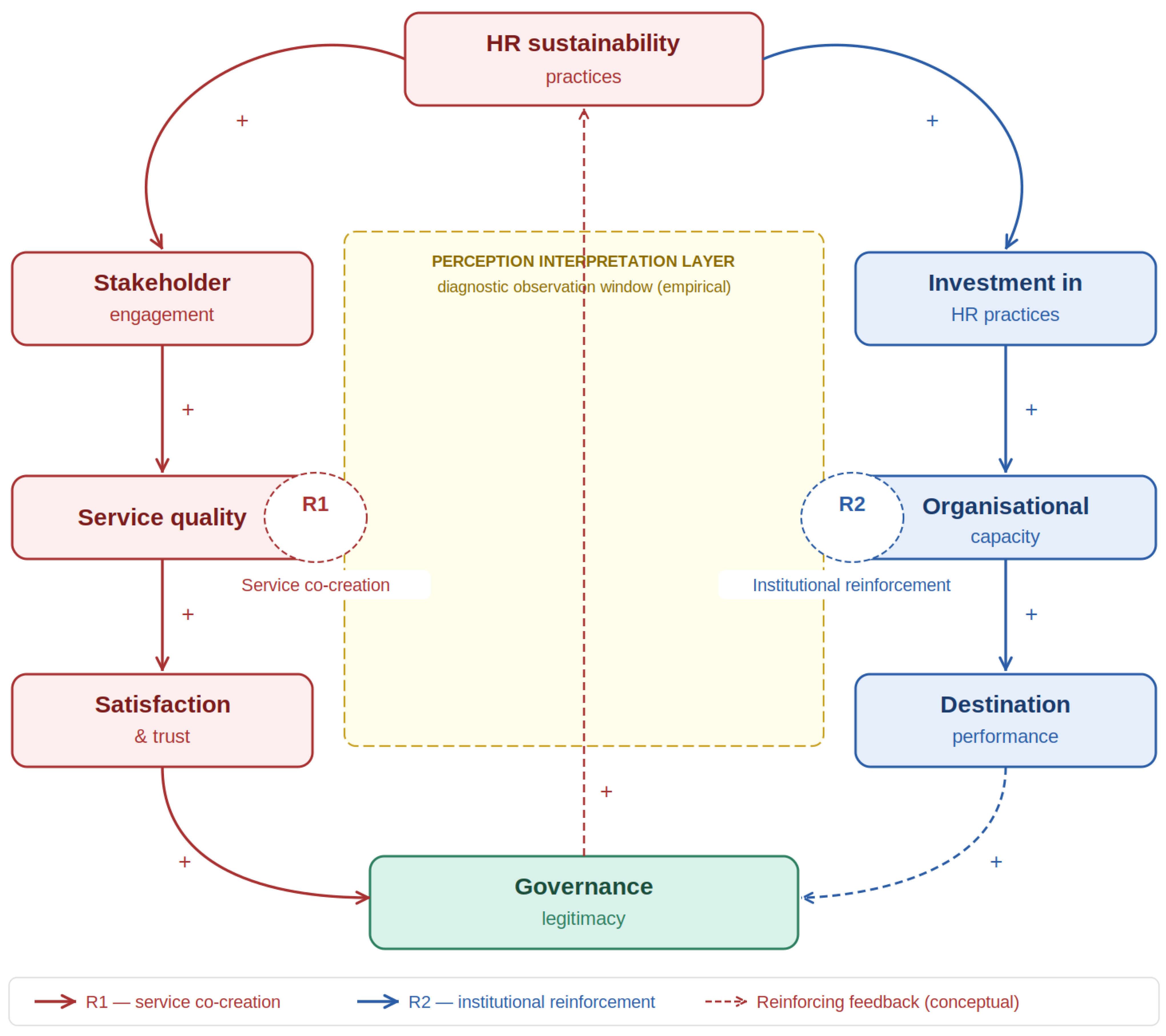
Figure 2 presents the causal loop model used to illustrate the main relationships within the destination governance structure. Two reinforcing feedback loops are central to this structure. The first loop (R1) links HR sustainability practices with stakeholder engagement, service quality, satisfaction, and institutional trust. As these conditions strengthen, perceptions of governance legitimacy tend to increase, encouraging further investment in workforce development.
The second loop (R2) connects governance legitimacy with destination performance and organisational capacity. Improvements in these areas support continued investment in sustainability practices and help reinforce the conditions that sustain the first loop. Within this governance structure, stakeholder perceptions play a key role in shaping coordination and collective learning across the destination system. When stakeholder groups evaluate HR practices or organisational support conditions differently, these differences can weaken the entry points of the reinforcing loops, reducing the alignment that supports coordination over time.
The framework links stakeholder group membership to comparative evaluations of sustainability-related practices and outcomes across four domains: HR sustainability practices, organisational support conditions, experiential perceptions of tourism development and perceived sustainability outcomes. Convergent evaluations indicate stronger coordination within governance processes, whereas divergence signals points where alignment between stakeholder perceptions weakens. The following section presents the methodological design used to examine these patterns empirically.
5. Results
5.1. Preliminary Measurement Results and Descriptive Overview
The factor structure used here derives from exploratory factor analysis (PCA, Varimax rotation) conducted on the full dataset. Sample adequacy was confirmed prior to extraction: the Kaiser–Meyer–Olkin measure indicated very good sampling adequacy (KMO = 0.836), and Bartlett’s test of sphericity was statistically significant (χ
2 = 1265.21, df = 378,
p < 0.001). Of 38 initial items, 28 were retained based on primary loadings ≥ 0.51 and cross-loadings < 0.41, yielding the four-factor structure described above. Harman’s single-factor test indicated that the first unrotated factor accounted for 45.07% of total variance, below the 50% threshold, providing preliminary evidence against serious common method bias [
51].
Construct validity was further assessed via confirmatory factor analysis [
52], yielding mixed model fit indices: χ
2(344) = 1687.74,
p < 0.001; Comparative Fit Index (CFI) = 0.942; Tucker–Lewis Index (TLI) = 0.936; Root Mean Square Error of Approximation (RMSEA) = 0.104, 90% CI [0.100, 0.109]; Standardised Root Mean Residual (SRMR) = 0.048. Although RMSEA exceeded the recommended threshold of 0.08, this inflation is well-documented under Diagonally Weighted Least Squares (DWLS) estimation with ordinal data [
53,
54]; accordingly, greater interpretive weight is placed on CFI (0.942), TLI (0.936), and SRMR (0.048), all of which indicated acceptable to good fit. All standardised loadings were statistically significant (
p < 0.001). Measurement reliability was assessed using three complementary indices: Cronbach’s α, composite reliability (CR), and McDonald’s omega (ω). Corrected item-total correlations ranged from 0.616 to 0.819 (F1), 0.622 to 0.750 (F2), 0.527 to 0.695 (F3), and 0.375 to 0.484 (F4). Full reliability indices are presented in
Table 2. EFA-based composite mean scores are used here to enable diagnostic comparison across stakeholder groups rather than further measurement development, consistent with applied multi-stakeholder tourism research [
2,
22].
Table 3 presents descriptive statistics for the four perception dimensions across the three stakeholder groups: governance actors, tourism and hospitality professionals, and local community members. Across groups, respondents reported moderate to high evaluations of sustainability-related practices, organisational support conditions and perceived outcomes of sustainable tourism development. Inspection of group means shows noticeable variation, indicating differences in how sustainability-related human and organisational practices are perceived across stakeholder groups. This pattern is consistent with the assumption that stakeholder proximity to tourism activity is associated with differences in evaluation.
5.2. Differences in Perceptions of Sustainability-Related Human Resource Practices
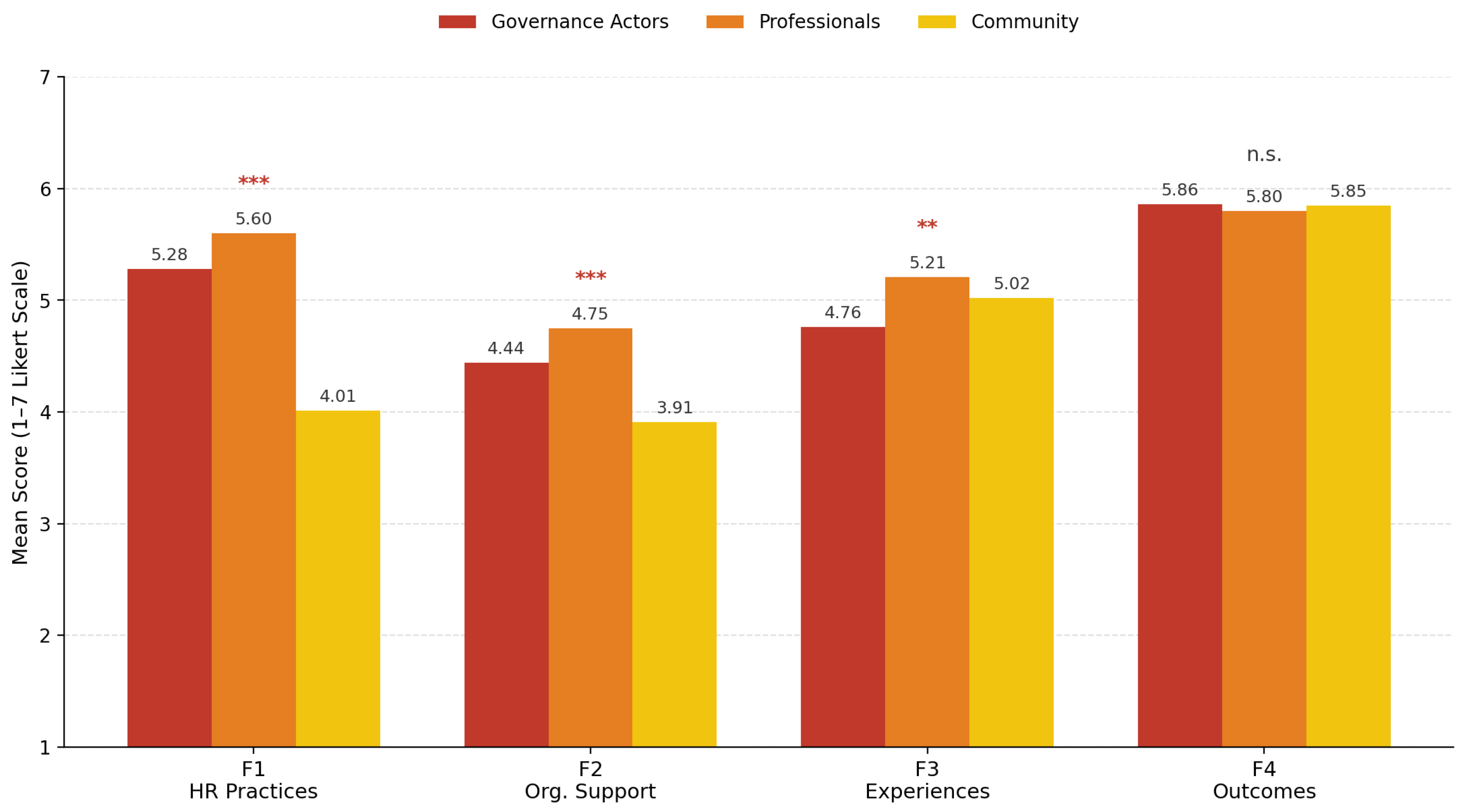
One-way ANOVA results indicate statistically significant differences across stakeholder groups in evaluations of sustainability-related human resource practices. Post hoc comparisons show that tourism and hospitality professionals report the highest evaluations (M = 5.60), followed by governance actors (M = 5.28), while local community members report comparatively lower scores (M = 4.01). This pattern is consistent with the expectation that direct operational exposure to HR practices increases awareness: tourism professionals encounter workforce management through daily practice, governance actors engage with it through policy coordination, while community members observe tourism development primarily through visible outcomes rather than internal processes. The observed divergence is consistent with stakeholder theory, according to which actors positioned differently within the tourism system form distinct evaluations of fairness and benefit. In system dynamics terms, this pattern is consistent with differences in how governance practices are interpreted across stakeholder groups, highlighting uneven informational visibility rather than disagreement about overall objectives.
One-way ANOVA revealed statistically significant differences across stakeholder groups in evaluations of HR-related sustainability practices, F(2, 463) = 114.60,
p < 0.001. The degrees of freedom denominator (df
2 = 463) equals N − k = 466 − 3, where N is the total sample size and k is the number of groups; this notation is consistent across
Table 4,
Table 5,
Table 6 and
Table 7. Levene’s test indicated homogeneity of variances (
p = 0.732), and Tukey post hoc comparisons were therefore applied. The results show that tourism and hospitality professionals (M = 5.60) reported the highest evaluations, followed by governance actors (M = 5.28), while local community members (M = 4.01) reported the lowest scores. All pairwise group differences were statistically significant.
5.3. Differences in Organisational Support Conditions
Differences in perception patterns were observed in evaluations of organisational support conditions. Tourism and hospitality professionals expressed more favourable assessments, followed by governance actors, while local community members reported comparatively lower evaluations. Interpreted systemically, this pattern suggests uneven visibility of coordination and institutional support mechanisms across observation points in the governance structure. The findings indicate an information visibility gap in sustainability governance, where organisational processes may exist but generate different feedback signals regarding effectiveness and transparency.
A one-way ANOVA indicated significant differences across stakeholder groups in perceptions of organisational support conditions, F(2, 463) = 21.29, p < 0.001. Levene’s test showed a violation of the homogeneity of variances assumption (p = 0.012); therefore, Games–Howell post hoc tests were applied. The results indicate that local community members reported significantly lower evaluations than both governance actors and tourism and hospitality professionals, while no significant difference was observed between governance actors and tourism and hospitality professionals.
5.4. Differences in Experiential Perceptions of Tourism Development
Comparisons across groups revealed significant differences in experiential perceptions of tourism development. Tourism and hospitality professionals reported the most positive evaluations (M = 5.21), followed by local community members (M = 5.02), while governance actors expressed comparatively lower assessments (M = 4.76). This pattern is consistent with social exchange theory: professionals who experience destination development directly through operational roles report stronger positive evaluations, while governance actors, whose engagement is primarily institutional and regulatory, express more measured assessments.
A one-way ANOVA revealed statistically significant differences across stakeholder groups in experiential perceptions of tourism development, F(2, 463) = 5.08, p = 0.007. Levene’s test confirmed homogeneity of variances (p = 0.259), and Tukey post hoc comparisons identified a significant difference between governance actors and tourism and hospitality professionals (p < 0.01).
5.5. Perceived Outcomes of Sustainable Tourism Development
In contrast to the previous dimensions, ANOVA results indicate no statistically significant differences across stakeholder groups in perceived overall outcomes of sustainable tourism development. This suggests a shared evaluation across stakeholders regarding the general direction of sustainability efforts, despite differences in how specific practices and organisational conditions are experienced. The convergence in outcome perceptions indicates alignment at the overall evaluative level, even where assessments of implementation remain uneven.
ANOVA results indicated no statistically significant differences across stakeholder groups in perceived overall sustainable tourism outcomes, F(2, 463) = 0.15, p = 0.861.
The convergence observed in F4 is noteworthy given its relatively modest internal consistency (α = 0.609; see
Section 4.3). Despite the clear differences identified in HR practices (F1) and organisational support (F2), all stakeholder groups reported very similar evaluations of overall sustainability outcomes (governance M = 5.86; professionals M = 5.80; community M = 5.85). This pattern suggests that stakeholders share a broadly common orientation toward the overall direction of tourism development, even though their assessments of how sustainability initiatives are implemented differ.
Within the governance structure, this convergence can be interpreted as a stabilising condition. Differences appear mainly at the procedural level, while views on the overall direction remain broadly shared. In this sense, outcome alignment coexists with implementation divergence. This pattern also refines the interpretation of social exchange processes. Perceived procedural imbalance does not necessarily translate into rejection of outcomes. In system terms, convergence in F4 moderates the effects of asymmetries observed in F1 and F2, maintaining a minimum level of coordination within the governance system. Nevertheless, the F4 convergence should be interpreted with caution. Three alternative explanations cannot be excluded with the available data. First, a social desirability effect is plausible: sustainability as a general orientation carries positive normative valence, and all respondent groups may have endorsed it regardless of their actual operational assessments. Second, the high mean scores across all three groups (all above 5.80 on a 7-point scale) are consistent with a ceiling effect that would limit the construct’s ability to discriminate between groups even if genuine differences exist. Third, F4 is measured with only three items covering broad outcome perceptions; its lower internal consistency (α = 0.609) may reflect insufficient item coverage rather than genuine construct-level convergence. Future research with a more extensive sustainability outcomes measurement scale would allow these competing explanations to be separated empirically.
5.6. Summary of Findings
In summary, stakeholder groups differ markedly in their evaluations of HR-related practices and organisational support conditions, yet they converge in their assessments of overall sustainability outcomes. Tourism and hospitality professionals reported the highest evaluations of HR and organisational dimensions, followed by governance actors, while local community members reported the lowest—likely reflecting their more limited proximity to workplace-level practices. These findings indicate that perception differences in sustainable tourism governance appear primarily at the operational and procedural level, whereas evaluations of broader sustainability outcomes remain largely aligned across stakeholder groups.
Figure 3 presents the mean stakeholder evaluations across the four sustainability dimensions.
6. Discussion and Implications
The analysis highlights clear differences in how key tourism stakeholders interpret sustainable tourism practices. Governance actors, tourism professionals and local communities do not evaluate organisational and human-centred sustainability initiatives in the same way. These differences emerge most clearly at the operational level of tourism governance, where stakeholder groups encounter policies and practices from distinct roles within the governance structure.
At the same time, the results reveal a notable pattern: stakeholder evaluations diverge in relation to specific organisational practices yet remain broadly aligned in assessments of overall sustainability outcomes, suggesting that disagreement concerns implementation rather than strategic direction.
6.1. Theoretical Implications
The results confirm that perception gaps are concentrated at the implementation level rather than in strategic orientations. Stakeholders with direct operational involvement report more favourable assessments, suggesting that legitimacy may emerge not only from institutional arrangements but also from how governance practices are experienced in everyday settings.
Viewed through a system dynamics lens, divergence in F1 and F2 is consistent with uneven information visibility within the governance structure, while convergence in F4 (F = 0.15, p = 0.861), despite its lower internal consistency, is consistent with a shared strategic orientation. The coexistence of implementation level divergence and outcome level alignment has direct implications for how coordination is monitored within destination governance. It should be noted, however, that the feedback asymmetries inferred here remain interpretive constructs drawn from empirical perception patterns rather than directly demonstrated causal processes. The statistical findings establish group differences in stakeholder evaluations; their interpretation as signals of feedback dynamics within the governance structure remains an analytical inference, consistent with the diagnostic pre-modelling orientation of the study.
By shifting the focus from aggregate relationships to comparative stakeholder evaluation, the present analysis highlights how coordination patterns vary across different parts of the governance structure, illustrating how similar governance practices may be interpreted differently depending on institutional position.
Methodological Contribution to Systems Practice
The use of an interpretive SD lens also suggests that causal loop reasoning can productively inform empirical analysis without requiring full simulation [
39].
6.2. Business Management and Organisational Performance Implications
From a business management standpoint, differences in stakeholder evaluations can be interpreted as segmentation patterns that reveal how various groups assess governance outcomes. Examining these perception differences therefore offers insight into how organisational practices are experienced across the destination context [
55].
The relationships represented in
Figure 2 provide a structural basis for interpreting how these dynamics may unfold. Improvements in sustainable HR practices may be associated with higher levels of engagement, service quality, satisfaction, and trust, conditions that strengthen perceptions of governance legitimacy. In turn, stronger legitimacy can support destination performance and organisational capacity, encouraging continued investment in workforce development and organisational practices. These reinforcing relationships provide a conceptual explanation for how human-centred management practices, perceived fairness, and coordination processes may evolve jointly over time within destination governance structures.
Community members, governance actors, and tourism professionals evaluate governance practices from different vantage points: community members focus on visible outcomes, governance actors on institutional effectiveness, and tourism professionals on the operational relevance of policies for everyday practice.
Strategic Stakeholder–Consumer Segmentation
HR Management Implications
The strong differences observed in stakeholder evaluations of HR practices (F = 114.60, p < 0.001) indicate that workforce-related sustainability initiatives are interpreted unevenly across stakeholder groups. Local community members report the lowest evaluations (M = 4.01), a pattern that likely reflects their limited visibility of internal workforce policies and organisational initiatives. Residents typically encounter tourism development through its visible outcomes rather than through the internal employment practices that shape workforce conditions.
Governance actors report more moderate evaluations (M = 5.28), consistent with their involvement at the policy and coordination level. Tourism professionals, by contrast, show the highest evaluations (M = 5.60), which aligns with their direct experience of HR practices in everyday operational settings.
This pattern is consistent with a communication gap within destination governance. Workforce initiatives that are familiar to operational actors remain only partially visible to the broader community. As a result, the potential of sustainable HR management to strengthen stakeholder legitimacy may not be fully realised. In this context, workforce-related sustainability initiatives should be understood not only as internal organisational measures but also as governance practices whose visibility and communication shape how different stakeholder groups evaluate tourism development.
Organisational Performance Metrics
The results suggest that alignment in stakeholder evaluations can be considered an additional dimension of organisational performance. Destination performance is often assessed through indicators such as visitor arrivals or economic impact. The findings indicate that differences in stakeholder evaluations may also reflect perceptions of governance legitimacy and the destination’s capacity to coordinate diverse actors.
Monitoring these patterns over time can help identify shifts in coordination and institutional trust among key stakeholder groups.
Destination Competitiveness
Differences in stakeholder evaluations are also linked to destination competitiveness through their relationship with governance legitimacy and cooperation among tourism actors. Competitiveness in this context extends beyond market indicators and includes governance quality, social cohesion, and stakeholder trust.
Patterns in stakeholder evaluations therefore offer insight into how governance conditions are experienced across different groups. Monitoring these patterns can help identify emerging tensions or alignment within destination governance, both of which have implications for the long-term stability and responsiveness of the destination.
System Dynamics Diagnostic Framework
The results presented earlier identified differences in stakeholder evaluations across the four perception domains. These statistical comparisons were then interpreted through the causal loop framework to understand what such differences imply for coordination within destination governance.
Table 8 integrates the ANOVA results with their system dynamics interpretation, linking each perception domain to its causal loop linkage and system diagnosis.
The analytical value of the framework lies in linking observed perception patterns with the feedback relationships represented in the causal structure. The ANOVA results indicate where stakeholder evaluations diverge, while the causal loop interpretation helps clarify how these differences relate to reinforcing and balancing dynamics within the governance structure. For instance, higher evaluations among tourism professionals compared with community members are consistent with greater visibility of HR practices within operational settings. Lower evaluations among community members suggest weaker coordination linked to the second reinforcing relationship in the model. Interpreting the results in this way connects empirical comparison with systems-oriented reasoning. Stakeholder perception patterns are therefore not treated simply as group attitudes but as indicators of how governance processes are experienced across the destination.
6.3. Managerial and Policy Implications
The findings point to several practical considerations for destination governance. Many HR initiatives that are familiar to tourism professionals seem to remain largely unseen by local communities. This pattern does not imply that communities are disengaged from tourism development. Rather, workforce initiatives such as training programmes, inclusive recruitment, and fair employment conditions usually operate within organisational and operational channels and therefore remain less visible outside the tourism sector.
If these initiatives become more visible at the community level, their role in shaping stakeholder perceptions may become easier to observe. This indicates that the issue is not simply a matter of communication in a narrow sense. Instead, it reflects how governance activities are experienced differently across stakeholder groups depending on their level of exposure to organisational practices.
Alignment does not occur automatically. Tracking how stakeholder evaluations evolve over time can provide early signals about coordination conditions within destination governance. Examined longitudinally, such patterns offer indications of shifts in cooperation and legitimacy rather than isolated opinions at a single point in time.
Transparency appears to play an important role in this process. Many coordination activities remain only partially visible to wider stakeholder groups, which may weaken confidence even when collaboration is present. Greater visibility of inter-organisational cooperation outcomes, training initiatives, or investment efforts tends to produce more consistent stakeholder interpretations. These patterns highlight how internal HR initiatives extend beyond organisational boundaries, shaping how governance is perceived across the broader destination context.
6.4. Limitations and Directions for Future Research
The study has several limitations that should be considered when interpreting the findings. The cross-sectional design does not allow for causal inference, and longitudinal or mixed-method approaches would provide a better understanding of how stakeholder perceptions evolve over time. The non-probability sampling design, combining purposive and snowball techniques, is appropriate for accessing specialised multi-stakeholder populations that are not captured in formal registries. However, it limits statistical generalisation to broader populations. Findings should therefore be interpreted as analytically generalisable, meaning that they may be transferable as theoretical insights to comparable multi-actor governance contexts, rather than as statistically representative of any defined population. In relation to this, the cross-sectional data capture stakeholder evaluations at a single point in time, which constrains the ability to assess how perception patterns respond to changes in governance arrangements or to establish temporal precedence among the variables examined.
The analysis focuses on three stakeholder groups, namely governance actors, tourism professionals, and local community members. Although these groups represent central actors in destination governance, they do not capture the full diversity of participants involved in tourism systems. Future studies could expand the analysis by including additional actors such as NGOs, small tourism enterprises, or policy intermediaries in order to examine how a wider range of perspectives influences coordination dynamics.
The present analysis identifies differences in stakeholder evaluations but does not explore the motivational mechanisms underlying these perceptions. Qualitative methods, including interviews or focus groups, could provide deeper insight into how factors such as trust, power relations, and perceived fairness shape stakeholder attitudes toward governance processes. Additional analytical tools, such as power–interest mapping or validated measures of stakeholder trust, may also help clarify influence patterns and cooperation conditions in destination governance. The internal consistency of F4 (α = 0.609), discussed in
Section 4.3, is relatively lower than that of the other constructs and should therefore be interpreted with some caution. This likely reflects the limited number of items and the broader conceptual scope of the sustainability outcomes dimension. Future research could strengthen this construct by expanding the measurement scale and examining its reliability across different destination contexts.
Although the data are drawn from Greek tourism destinations, the pattern observed in the analysis, namely strategic alignment combined with operational divergence, may also appear in other multi-actor governance settings. Testing the framework in different destinations and governance arrangements would help assess its broader applicability.
Future research may extend this diagnostic approach through simulation methods such as stock–flow or agent-based modelling, examining how stakeholder perceptions evolve over time and how policy interventions influence coordination dynamics. Such approaches could also examine the threshold at which perception divergence begins to destabilise governance processes or explore alternative governance scenarios. In this study, the analysis remains at the problem-structuring stage of system dynamics methodology. The framework therefore identifies coordination patterns and areas of alignment or divergence before formal simulation modelling is undertaken, helping clarify where more detailed system modelling could provide additional analytical insight.
6.5. Synthesis and Broader Implications
Sustainable tourism development depends not only on the design of policies but also on how those policies are understood and experienced by different stakeholder groups. Shared strategic goals do not automatically translate into effective collaboration. Perceptions of fairness, transparency, and institutional trust play a central role in shaping whether coordination develops in practice. Differences in interpretation among governance authorities, tourism professionals, and local communities therefore represent an important condition of destination governance rather than merely a communication challenge. Examining how these groups evaluate governance practices provides insight into how legitimacy and cooperation develop within destination contexts.
Patterns in stakeholder evaluations reveal how governance arrangements are experienced by different actors and provide indications of how coordination evolves over time. Understanding these patterns contributes to a more adaptive and inclusive view of governance in complex multi-stakeholder environments. The diagnostic framework proposed in this study may also prove relevant beyond tourism. Similar dynamics appear in other governance settings where policy implementation depends on how diverse actor groups interpret policies, including urban planning, education policy, and public health administration.
7. Conclusions
Stakeholders within the same destination do not necessarily interpret sustainability initiatives in the same way. These differences appear closely related to the roles from which governance processes are observed within the governance structure. Community members, governance actors, and tourism professionals interact with different aspects of the governance system, and their evaluations reflect these different vantage points. As a result, perception differences provide indirect insight into how coordination operates within the destination.
In this sense, patterns in stakeholder perceptions can serve as early diagnostic signals of governance conditions. Interpreting these patterns through a system dynamics lens helps reveal where feedback relationships may be weakening and where perceptions of legitimacy are uneven across the system. Importantly, such insights can be obtained even without the use of formal simulation modelling.
These observations open several avenues for future research. Longitudinal analyses could examine how perception alignment evolves as governance arrangements change, while simulation-based approaches may explore how different governance strategies influence stakeholder feedback over time. From a practical standpoint, attention to how stakeholder groups interpret governance practices may provide early indications of emerging governance challenges that traditional performance indicators fail to capture.