Skip to Content
  • 3.1
    Impact Factor
  • 5.7
    CiteScore
  • 16 days
    Submission to First Decision
  • 3 days
    Acceptance to Publication

Metals

Metals is an international, peer-reviewed, open access journal published monthly online by MDPI. The Spanish Materials Society (SOCIEMAT) is affiliated with Metals and their members receive discounts on the article processing charges.

Get Alerted

Add your email address to receive forthcoming issues of this journal.

All Articles (15,619)

  • Article
  • Open Access

To address the task allocation problem of a gantry-type dual-arm welding robotic system subject to heavy and diverse welding workloads as well as limited operating span, a Dynamic Small-World Genetic Algorithm (DSWGA) for multi-objective optimization is proposed to obtain optimal welding task allocation. To meet the operational requirements of workload balancing and high-efficiency welding for ship multi-subassembly components, a multi-objective optimization model is established to minimize the system makespan and the load imbalance rate, and the small-world genetic algorithm is adopted to solve this model. To tackle the drawback of fixed parameters in the small-world network, a dynamic network parameter adjustment mechanism is developed. By dynamically tuning the connectivity among individuals in the population, the scope of information exchange is adjusted throughout the optimization process to enhance the global search capability of the algorithm. To overcome the limitation of fixed crossover and mutation probabilities in conventional genetic operations, adaptive crossover and mutation strategies are designed based on the structural differences between parents and the structural similarity between offspring and non-dominated solutions, which improves the search efficiency and solution-set quality. Test results for each improvement strategy demonstrate that the three strategies show potential complementary effects, and their combination yields better overall performance in terms of the mean values of HV, GD, and Spread, with a statistically significant advantage in HV. Task allocation experiments are conducted in three typical welding scenarios with different task scales and constraint characteristics. The results indicate that DSWGA achieves competitive overall performance in convergence, solution set quality, and distribution uniformity compared with NSGA-II, SPEA2, and MOPSO. In the more complex test scenario, the makespan of the selected compromise solution obtained by DSWGA is reduced by approximately 1.03%, 3.72%, and 2.68% compared with NSGA-II, SPEA2, and MOPSO, respectively, while the robot load balancing rate reaches 99.7%.

Metals

21 October 2026
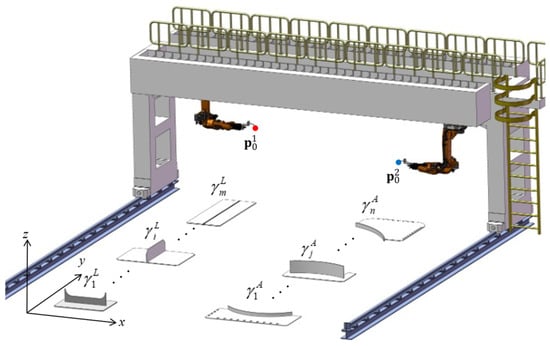
Welding task model.
  • Article
  • Open Access

The strong coupling between the dynamically evolving thermal roll profile and strip shape across a multi-stand hot finishing mill poses a major challenge to shape control. To address this issue, this paper proposes a multi-stand collaborative zone cooling method based on a thermo-mechanical coupling inverse problem. A dynamic heat-transfer coefficient model incorporating multi-source disturbances (spray angle, water flow density, and roll surface temperature) is established, and an online inversion based on the Gauss–Newton method using measured post-service roll temperatures improves the temperature prediction accuracy to over 95%. A cascade-inheritance mechanism is revealed, whereby the thermal crown formed at an upstream stand alters the incoming strip profile and thereby affects the roll gap of downstream stands; the associated decrease in rolling-force regulation efficiency from F1 to F7 is explained by the increasing strip plastic stiffness. A differentiated strategy is accordingly developed: upstream stands (F1–F3) actively regulate lateral metal flow through the thermal crown, whereas downstream stands (F4–F7) rely on zone cooling to compensate for plastic stiffness effects. A mapping from the loaded roll gap profile to the zone cooling flow is established, and a Mamdani fuzzy adaptive algorithm provides real-time compensation within the 150 ms control calculation cycle (distinct from the up-to-10 s physical response time of the actuators). Industrial validation on the downstream stands (F5–F7) of a 1580 mm hot strip finishing mill reduced the upper/lower work roll temperature difference from 7 to 12 °C to within 5 °C, decreased the average C40 crown by 8.7%, raised the excellent edge rate (C15–C40 ≤ 20 µm) from 59.4% to 83.4%, and expanded the adjustable range of the thermal crown by more than 2.5 times. In addition, numerical analyses extend the collaborative regulation strategy to the full mill (F1–F7) and demonstrate its applicability; these full-mill results are model-based predictions rather than directly validated industrial responses.

Metals

21 October 2026

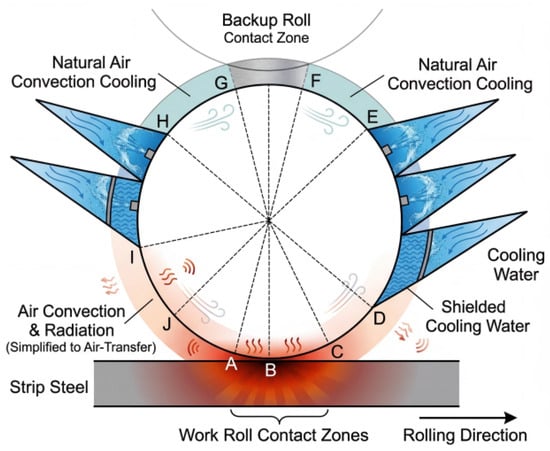
Boundary conditions of the work roll. Ten circumferential zones (A–J).
  • Article
  • Open Access

This study investigates a two-stage duplex process for producing low-carbon ferrochrome based on sequential mixing of molten ore–lime and metallic melts, with emphasis on its adaptation to the raw materials and operating conditions of the Aktobe Ferroalloy Plant. Unlike the conventional process, in which the chromite ore–lime charge directly interacts with ferrosilicochromium, the proposed approach distributes FeSiCr between two successive stages of melt interaction to improve chromium reduction and metal–slag separation. Kempirsai chromite ore, lime, and ferrosilicochromium (FeSiCr 48) were used as raw materials. Thermodynamic analysis using HSC Chemistry 6.0 confirmed the feasibility of the main reduction reactions at 1600–1800 °C. Pilot-industrial trials produced ferrochrome containing 71.42–73.15% Cr and 1.28–1.31% Si, while the final slag contained 1.54–1.58% Cr2O3 and 0.11–0.14% FeO. X-ray diffraction analysis identified merwinite, gehlenite, and spinel-type solid solutions containing chromium. Dicalcium silicate was not detected, consistent with the observed stone-like structure of the cooled slag. Chromium recovery reached approximately 70%, compared with approximately 65% for the conventional process. The results demonstrate the potential of sequential FeSiCr distribution to improve chromium utilization and reduce chromium losses to slag under the specific conditions of ferrochrome production at the Aktobe Ferroalloy Plant.

Metals

21 October 2026

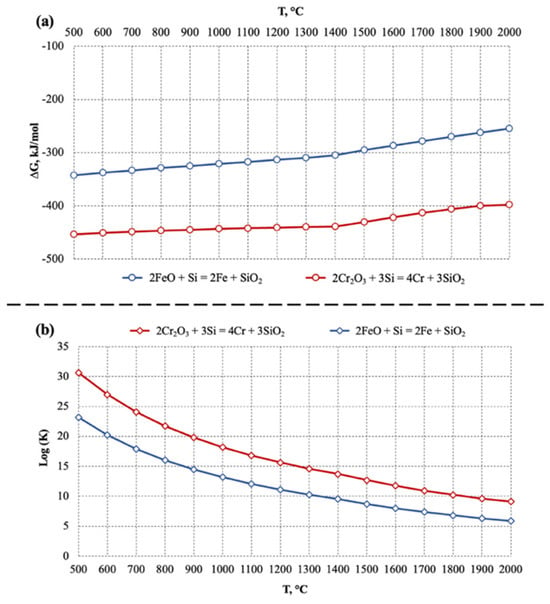
Thermodynamic Characteristics of the Silicothermic Reduction Reactions of Iron and Chromium Oxides: (a) Dependence of Standard Gibbs Free Energy (ΔG°) on Temperature; (b) Dependence of the Logarithm of the Equilibrium Constant (log K) on Temperature.
  • Article
  • Open Access

The strength–ductility trade-off limits the wider application of high-strength titanium alloys in aerospace. Here, a new Ti-3.7Al-3V-3Fe-1.7Mo-0.5Cr alloy is designed based on d-electron alloy design theory and molybdenum equivalence, and the dual-phase microstructure is tailored by varying the cooling rate after solution treatment, which governs both the phase fraction and the spatial connectivity of the primary α (αp) and β phases. In the furnace-cooled (FC) condition, the αp phase exhibits the highest fraction (76%) and a continuous network with isolated β islands, whereas higher cooling rates (AC and WQ) yield lower fractions (50% and 38%) and a continuous β matrix, confirming that decreasing cooling rate promotes αp connectivity and β isolation. Consequently, the FC sample achieves a tensile strength of 1250 MPa and a total elongation of 18.4%, significantly higher than those of the AC (14.0%) and WQ (10.0%) samples. This interconnected architecture enhances dislocation storage and work hardening, while enabling effective load transfer and strain compatibility between phases, thereby suppressing strain localization and interface debonding. In situ SEM observations further confirm that high-density αp/β interfaces, crack deflection, and deformation twinning also play a key role in enhancing damage tolerance. These findings identify phase connectivity as a key microstructural parameter for overcoming the strength–ductility trade-off in α/β titanium alloys.

Metals

21 October 2026

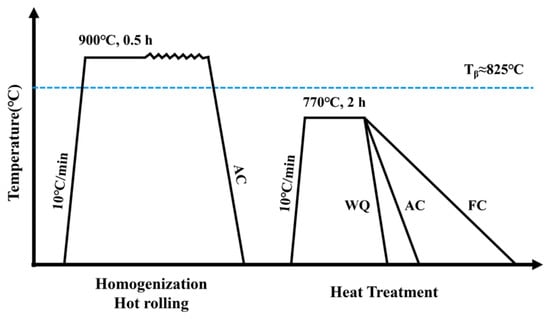
Thermomechanical processing and heat treatment schedule.

Highly Accessed Articles

News & Conferences

Latest Issues

Open for Submission

Journal Sections

XFacebookLinkedIn
Metals - ISSN 2075-4701