



Heat and Mass Transfer in Sustainable Construction and Building Materials
This special issue belongs to the section "Construction and Building Materials".
Special Issue Information
Dear Colleagues,
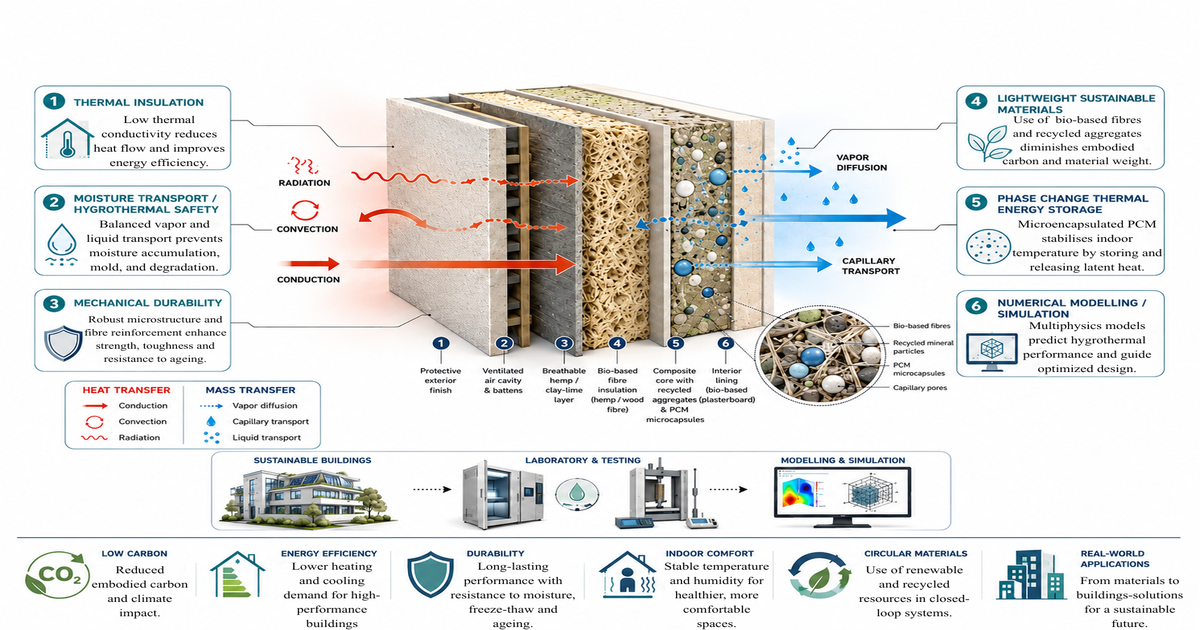
Heat and mass transfer processes play a fundamental role in the design, characterisation, optimisation, and long-term performance of materials used in engineering, energy, environmental, and building applications. The thermal and transport behaviour of materials directly affects their energy efficiency, durability, safety, mechanical reliability, environmental resistance, and service-life performance. As global research moves toward low-carbon technologies, resilient infrastructure, energy-efficient buildings, advanced thermal systems, and sustainable material solutions, there is an increasing need to understand how heat, moisture, gases, vapours, and fluids interact with material structures across different length and time scales.
Recent developments in materials science have created new opportunities for designing multifunctional materials with improved thermal regulation, reduced energy demand, enhanced mechanical stability, and greater resistance to environmental degradation. Sustainable building materials, porous insulation systems, phase change materials, aerogels, bio-based composites, geopolymer binders, advanced ceramics, metallic foams, polymeric composites, nanostructured materials, and energy storage materials are increasingly being engineered to control heat and mass transport more effectively. However, the practical implementation of these materials still requires deeper understanding of their thermal conductivity, diffusivity, permeability, sorption behaviour, vapour transport, moisture buffering capacity, convective and radiative heat exchange, phase transition behaviour, and degradation mechanisms under realistic operating conditions.
This Special Issue aims to present and disseminate the most recent advances related to heat and mass transfer in materials science. We particularly welcome studies that connect material composition, microstructure, and transport properties with practical performance in sustainable construction, energy systems, thermal management, environmental control, and advanced engineering applications. Contributions may include experimental studies, numerical modelling, theoretical analysis, multi-physics simulations, material characterisation, durability assessment, life cycle-oriented evaluation, and performance optimisation. Research that combines heat and mass transfer analysis with mechanical performance, long-term durability, sustainability, circularity, and real-world application potential is especially encouraged.
The scope of this Special Issue covers both fundamental and applied aspects of heat and mass transfer in materials. Particular attention will be given to materials and systems that contribute to energy efficiency, low-carbon development, climate resilience, thermal safety, and sustainable engineering. Studies dealing with building envelope materials, insulation materials, porous media, heat storage materials, moisture-sensitive materials, high-temperature materials, thermally functional composites, and advanced modelling approaches are highly suitable for this collection. Review articles, original research papers, short communications, and case studies are all welcome.
Topics of interest for publication include, but are not limited to, the following:
(1) Heat and mass transfer in construction and building materials;
(2) Thermal conductivity, thermal resistance, and U-value reduction;
(3) Moisture transport, vapour diffusion, sorption, and drying behaviour;
(4) Hygrothermal performance of building envelopes;
(5) Sustainable, recycled, bio-based, and low-carbon building materials;
(6) Lightweight, porous, aerogel-based, and high-performance insulation materials;
(7) Phase change materials and thermal energy storage in buildings;
(8) Mechanical performance and durability of thermally efficient materials;
(9) Freeze–thaw resistance, wetting–drying cycles, fire exposure, and thermal ageing;
(10) Experimental testing, hot-box methods, heat-flow measurements, co-heating tests, and thermal imaging;
(11) CFD, finite element modelling, hygrothermal simulation, and multi-physics analysis;
(12) Life cycle assessment, embodied carbon, and environmental performance of building materials;
(13) Field applications, retrofitting solutions, and real-world performance validation.
Prof. Dr. Pinar Mert Cuce
Prof. Dr. Erdem Cuce
Guest Editors
Manuscript Submission Information
Manuscripts should be submitted online at www.mdpi.com by registering and logging in to this website. Once you are registered, click here to go to the submission form. Manuscripts can be submitted until the deadline. All submissions that pass pre-check are peer-reviewed. Accepted papers will be published continuously in the journal (as soon as accepted) and will be listed together on the special issue website. Research articles, review articles as well as short communications are invited. For planned papers, a title and short abstract (about 250 words) can be sent to the Editorial Office for assessment.
Submitted manuscripts should not have been published previously, nor be under consideration for publication elsewhere (except conference proceedings papers). All manuscripts are thoroughly refereed through a single-anonymized peer-review process. A guide for authors and other relevant information for submission of manuscripts is available on the Instructions for Authors page. Materials is an international peer-reviewed open access semimonthly journal published by MDPI.
Please visit the Instructions for Authors page before submitting a manuscript. The Article Processing Charge (APC) for publication in this open access journal is 2600 CHF (Swiss Francs). Submitted papers should be well formatted and use good English. Authors may use MDPI's English editing service prior to publication or during author revisions.
Keywords
- heat and mass transfer
- sustainable construction materials
- building materials
- thermal insulation
- moisture transport
- hygrothermal performance
- lightweight materials
- durability
- phase change materials
- numerical modelling
Benefits of Publishing in a Special Issue
- Ease of navigation: Grouping papers by topic helps scholars navigate broad scope journals more efficiently.
- Greater discoverability: Special Issues support the reach and impact of scientific research. Articles in Special Issues are more discoverable and cited more frequently.
- Expansion of research network: Special Issues facilitate connections among authors, fostering scientific collaborations.
- External promotion: Articles in Special Issues are often promoted through the journal's social media, increasing their visibility.
- Reprint: MDPI Books provides the opportunity to republish successful Special Issues in book format, both online and in print.
Published Papers


Materials - ISSN 1996-1944